1
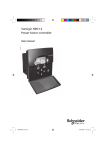
Varlogic R12, RC12
power factor controller / régulateur varmétrique / Blindleistungsregler / regulador de energia reactiva
5 6
3 4
1 2
user manual / notice d'utilisation / Gebrauchsanleitung / guia de utilización
11 12
9 10
7 8
+
–
Mg
recti
e
phas
gic R12
varlo
Contents
GB
Inhaltsverzeichnis
D
description ..................................................................... 1
cos f and step display (display mode) ......................... 6
alarms and warnings ..................................................... 7
display of currents, harmonic distortion and step state
(measurement mode) (1) ................................................ 8
5 - connection of controller ............................................... 10
6 - commissioning settings (commissioning mode) .......... 12
7 - programming of controller (programming mode) ........ 16
8 - activating / de-activating alarms (alarm mode) ........... 22
9 - troubleshooting ............................................................ 24
10 - maintenance (maintenance mode) (1) ........................... 32
11 - technical specifications ............................................... 34
allgemeine Beschreibung .............................................. 1
Cos f - und Schaltstufenanzeige .................................. 6
Alarm- und Fehlermeldungen ....................................... 7
Anzeige für Schein- und Blindstrom, Spannungsüberlastung
durch Oberschwingungen und Kondensatorüberwachung (1) 9
5 - Regleranschlußbedingungen ...................................... 10
6 - Serviceprogrammeinstellungen .................................. 14
7 - Reglerprogrammierung ............................................... 18
8 - Aktivieren und quittieren von Fehlermeldungen .......... 23
9- Fehlermeldungen und Ursachen .................................. 28
10 - Überwachungsprogramm (1) ....................................... 33
11 - Technische Daten ....................................................... 36
Sommaire
Indice
1234-
1234-
5 6
3 4
1 2
11 12
9 10
7 8
+
–
Mg
recti
e
phas
gic R12
varlo
12345 6
3 4
1 2
11 12
9 10
7 8
+
–
Mg
e
phas
recti
gic R12
varlo
ent.
esc.
–
+
F
description ..................................................................... 1
affichage cos f et gradins (mode affichage) ................. 6
alarmes et avertissements ............................................ 7
affichage courants, distorsion harmonique et état des
gradins (mode mesure) (1) ............................................... 8
5 - raccordement du régulateur ........................................ 10
6 - réglages de mise en service (mode installation) ......... 13
7 - paramétrage du régulateur (mode paramétrage) ........ 17
8 - activation / désactivation des alarmes (mode alarmes) 22
9 - défauts et remèdes ...................................................... 26
10 - maintenance (mode maintenance) (1) ............................ 32
11 - caractéristiques techniques ........................................ 35
E
1234-
description ..................................................................... 1
visualización cos f y escalones (menú usuario) ......... 6
alarmas y avisos .......................................................... 7
visualización de corrientes, distorsiones armónicas y estado
de escalones (menú mediciones) (I) ................................. 9
5 - conexión del regulador ............................................... 10
6 - ajustes de puesta en marcha (menú puesta en marcha) 15
7 - programación del regulador (menú programación) .... 19
8 - activación / desactivación de alarmas ...................... 23
(menú alarmas)
9 - defectos y soluciones ................................................ 30
10 - mantenimiento (menú mantenimiento) (I) ...................... 33
11 - características técnicas ............................................. 37
(1) type RC12 only / type RC12 seulement
nur für Regler RC12 / modelo RC12 únicamente.
■ Merlin Gerin ■ Square D ■ Telemecanique
1 - description / description / allgemeine Beschreibung / descripción
front view door opened
vue face avant porte ouverte
Frontseitenansicht bei geöffneter Tür
vista parte frontal
puerta abierta
front view / vue face avant
Frontseitenansicht / vista parte frontal
B
C
A
D
1
+
–
7
2
3
8
4
5
6
1
9
2
3
12
10 11
+
–
7
Mg
9
8
4
5
6
12
10 11
Mg
e
phas
2
gic R1
e
phas
recti
2
gic R1
varlo
recti
varlo
esc.
–
ent.
+
G
N
F
ABCDEFGHIJK* LMNOPQ-
GB
display
L.E.D.: connection about to occur
L.E.D.: disconnection about to occur
alarm signalling L.E.D.
door
opening of door
keys
alarm codes
current / voltage connection inputs
step outputs (1 to 6)
step outputs (7 to 12)
alarm output
specification label
mounting bracket for panel mounting installation
DIN rail mounting installation area
fixing spring for DIN rail mounting installation
screw driver guide
(*) the last output (12th), if free, is programmed
as a fan output. Refer to alarm A9 in chapter 9.
E
rear view / vue face arrière
Rückseitenansicht / vista parte posterior
J
L
H
view from below / vue de dessous
Ansicht von unten / vista inferior
O
M
I
P
N
legend
Q
K
esc.
esc.
user interface
DISPLAY mode
ALARM mode
ent.
MEASUREMENT mode
ent.
load current
reactive current
total harmonic distortion
step status
alarm 1
alarm 2
...
alarm 8
alarm 9
...
alarm 12
COMMISSIONING mode
2s
ent.
target cos f
C/K auto
C/K manuel
response currents
ent.
inductive value
capacitive value
CT ratio
manual override
interface language
PROGRAMMING mode
ent.
2
GB
esc.
number of steps
step program
connection type
delay
phase polarity detection
input voltage
capacitor loss set up
ent.
CT ratio
step voltage
step power
step configuration
(DOL setup)
MAINTENANCE mode
ent.
settings
Irms/In alarm threshold
THD(U) alarm threshold
fan switching threshold
temperature alarm threshold
reset settings
measurements
voltage
current
reactive power
active power
apparent power
phase
Irms/In overload
harmonic spectrum
temperature
bank test
How to use the four interface keys ?
The interface is made of 6 main modes each
of them including display or setting fields.
The display mode is the main interface mode.
Keys
and
allow you to move
within one same interface level. Keys ent.
and esc. allow you to go from one
interface level to another one. On an editor
level (defined by a horizontal dash)
and
keys allow you to increment or
decrement a field value, while the ent. key
allows you to enter the selected value.
How to change the interface language ?
The interface language can be selected
between the five following options:
english,
french,
spanish,
german,
finnish.
To change the interface language follow the
user interface menu in the relevant
language, enter the commissioning mode
and get to the last field by pressing several
times on
. Press ent. and look for the
correct language using keys
and
.
Press ent. to enter then esc. to get out of
the commissioning mode.
grey characters: only concern RC12 type
2 - cos f and connected step display (display mode) / affichage cos f et gradins
(mode affichage) / Cos f - und Schaltstufenanzeige / visualización cos f
y escalones conectados (menú usuario)
X
Y
1 2 3 4 5 6
0.98
GB
The display mode includes 3 pieces of
information:
c cos f display "X"
Netz induktiv
inductive network
T
7 8 9 10 11 12
1 2 3 4 5 6
ALARM 12
7 8 9 10 11 12
Z
F
capacitive network
c connected step and contact
configuration (type RC12) display "Y"
disconnected step
connected step
fixed step
step not used in regulation
free output
fan output (temperature alarm)
c when necessary display of alarm and
warning codes (flashing with cos f) "Z".
Netz kapazitiv
c zugeschaltete Kondensatorstufen und
Ausgangsbelegung (nur bei RC12) "Y"
nicht eingeschaltete Stufe
eingeschaltete Stufe
definierte Feststufe
nicht im Regelkreis einbezogene
Ausgänge oder freie nicht belegte
Ausgänge
Lüfterausgang (Temperatur Alarm)
c nach belieben kann die Anzeige so
programmiert werden, daß entweder der
Alarm- und Fehlermeldecode oder der
Cos f-Wert angezeigt wird "Z".
Le mode affichage comprend 3 types
d’information :
c l’affichage du cos f , "X"
El menú usuario contiene 3 tipos de
información:
c visualización del cos f , "X"
réseau inductif
réseau capacitif
c l’affichage du nombre de gradins
enclenchés et de la configuration des contacts
(type RC12), "Y"
gradin déclenché
gradin enclenché
gradin fixe
gradin exclu de la régulation
contact non utilisé
contact ventilateur (alarme temp.)
c le cas échéant, l’affichage des codes
d’alarmes et avertissements
(en alternance avec le cos f), "Z".
6
D
Drei Informationen können im Display
angezeigt werden:
c Cos f "X"
E
red inductiva
red capacitiva
c visualización del número de escalones
conectados y configuración de salidas
(modelo RC12) "Y"
escalón desconectado
escalón conectado
escalón fijo
escalón excluido de la regulación,
contacto no utilizado
contacto ventilador (alarma temp.)
c si es necesario, la visualización de
códigos de alarmas y avisos
(alternando con el cos f) "Z".
3 - alarms and warnings / alarmes et avertissements
Alarm- und Fehlermeldungen / alarmas y avisos
+
GB
1 2 3 4 5 6
7 8 9 10 11 12
MERLIN GERIN
la maîtrise de l'énergie électrique
GROUPE SCHNEIDER
L.E.D.
1 2 3 4 5 6
F
ALARM 12
7 8 9 10 11 12
alarm code
code alarme
Alarmkontakt
código de la alarma
Controllers R12 and RC12 type respectively
include 8 and 12 alarms and 3 warnings the
description of which is given in chapter 9.
c when an alarm condition is detected the
appropriate alarm code flashes on display,
a red L.E.D. is switched on and the alarm
relay closes. Once the fault has cleared the
red L.E.D. is switched off, the alarm relay
opens but display of alarm code is kept till
manual reset (using
key).
c when a warning condition is detected a
warning code is displayed and disappears
when the fault has cleared.
c Alarms A1 to A8 are initially active.
Alarms A9 to A12 are initially de-activated
(see page 22).
Les régulateurs type R12 et RC12 incluent
respectivement 8 et 12 alarmes
et 3 avertissements dont la description est
donnée chapitre 9.
c lorsqu’une condition d’alarme est
détectée, le code d’alarme approprié
clignote à l’écran, la D.E.L. rouge s’allume
et le contact d’alarme se ferme. Lorsque le
défaut disparaît la D.E.L. rouge s’éteint, le
contact d’alarme s’ouvre mais l’affichage du
code d’alarme est maintenu jusqu’à
affranchissement manuel (par pression sur
la touche
).
c lorsqu’une condition d’avertissement est
détectée, seul le code d’avertissement est
affiché jusqu’à la disparition du défaut.
c les alarmes A1 à A8 sont initialement
actives. Les alarmes A9 à A12 sont
initialement désactivées (voir page 22).
D
E
In den Reglern R12 und RC12 sind 8 bzw.
12 Alarmmeldungen und 3 Fehlermeldungen
integriert (nähere Angaben dazu im
Kapitel 9):
c Wird eine Alarmfunktion ausgelöst, so
wird sie auf dem Display und durch eine rote
L.E.D. angezeigt, der Alarmkontakt wird
geschlossen. Wird die Störung behoben, so
öffnet sich der Alarmkontakt und die rote
L.E.D. erlischt, die Alarmfunktion im Display
muß aber manuell zurückgesetzt werden
(durch Tastendruck
).
c Wird eine Fehlfunktion festgestellt, so
wird sie im Display signalisiert, erlischt aber
sofort, sobald die Störung behoben ist.
c A1 bis A8 sind aktive Alarmmeldungen.
A9 bis A12 sind Alarmmeldungen mit autom.
Rücksetzung (nähere Informationen s.S. 23).
Los reguladores R12 y RC12 incluyen
respectivamente 8 y 12 alarmas y 3 avisos
cuya descripción se da en el capítulo 10.
c Cuando se detecta una situación de
alarma, el código de la alarma parpadea
sobre la pantalla, el L.E.D. rojo se enciende
y el contacto de la alarma se cierra. Cuando
el defecto desaparece se apaga el L.E.D.
rojo abriéndose el contacto de alarma, pero
la visualización de alarma se mantiene
hasta la realización de un reset manual
(mediante presión sobre la tecla
)
c Cuando se detecta una situación de
aviso, sólo se visualiza el código del aviso
mientras permanece el defecto.
c En el modelo RC12 las alarmas A9 y
A12 están inicialmente desactivadas
(ver página 23).
7
4 - display of currents, harmonic distorsion and step state (measurement mode)
affichage courants, distorsion harmonique et état des gradins (mode mesure)
English
RC12 type only
GB
Type RC12 uniquement
F
1 2 3 4 5 6
MEASUREMENTS
7 8 9 10 11 12
1 2 3 4 5 6
Status
7 8 9 10 11 12
Français
1 2 3 4 5 6
MESURES
7 8 9 10 11 12
1 2 3 4 5 6
etat
7 8 9 10 11 12
8
The measurement mode may be entered
from the display mode by pressing
.
It is defined on the display by symbol " ".
This mode does not include any editor field.
c load and reactive currents are displayed in
Amps if the CT ratio has been entered
during commissioning. If not values are
given in % of 5A.
c The total voltage harmonic distortion is
displayed in %.
c Display of step status makes it easy to
identify steps which have lost a significant
amount of their nominal power:
step in normal condition,
step with reduced output power.
Le mode mesure est accessible à partir du
mode affichage par pression sur la touche
. Il est caractérisé sur l’écran par le
symbole " ".
Ce mode ne contient pas de champ éditeur.
c les valeurs de courant apparent et
courant réactif sont donnés en Ampères si le
ratio du TC a été paramétré lors de la mise
en service. Dans le cas contraire les valeurs
sont affichées en % de 5 A.
c le taux de distorsion harmonique en
tension ou THD (U) est donné en %.
c l’affichage de l’état des gradins permet
d’identifier les gradins qui ont une perte de
puissance significative :
gradin en état de fonctionnement
normal,
gradin ayant perdu de la puissance.
5 - connection of controller / raccordement du régulateur
Regleranschlußbedingungen / conexión del regulador
GB
The current transformer must be installed
upstream of capacitor bank and loads.
Standard programming of the controller
makes it insensitive to phase rotation and
CT polarities.
Two different connections may be used:
c LL connection type
Voltage is measured between two phases.
Current is measured from the phase that is
not used for voltage connection. Refer to
drawings on page 11.
c LN connection type
Voltage is measured between one phase
and neutral. Current is measured from the
same phase. Refer to drawings on page 11.
Warning: connection type used must be
in conformity with programming of
controller.
On a network with a voltage below 110 V or
above 415 V use a transformer to connect
controller voltage inputs. In such case
transformer specifications must include a
limited phase variation.
Warning: on generator applications
(type RC12 only) automatic detection of
phase rotation polarity must be
de-activated (to be done in programming
mode - see chapter 7). In this particular
case phase rotation and CT polarities
must be correct.
10
F
Le transformateur de courant doit être
impérativement installé en amont de la
batterie de condensateurs et des récepteurs.
Le paramétrage normal du régulateur le rend
insensible au sens de rotation des phases et
au sens de raccordement du transformateur
de courant.
Le régulateur peut être raccordé de deux
manières :
c raccordement type PP
La mesure de tension est réalisée entre deux
phases. La mesure du courant est réalisée sur
une phase différente des deux phases
précédemment utilisées. Voir shéma
électrique page 11.
c raccordement type PN
La mesure de tension est réalisée entre une
phase et le neutre. La mesure du courant est
réalisée à partir de la même phase.
Voir shéma électrique page 11.
Attention : le type de raccordement utilisé
doit être cohérent avec le paramétrage du
régulateur.
Sur un réseau de tension inférieure à 110 V ou
supérieure à 415 V utiliser un transformateur
pour alimenter les entrées tension de mesure
du régulateur. Ce transformateur utilisé ne doit
induire qu’un déphasage minimum.
Attention en utilisation 4 quadrants
(type RC12 seulement) la détection
automatique du sens de rotation des
phases doit être désactivée (à effectuer
dans le mode paramétrage - voir chap. 7).
Dans ce cas particulier il faut donc
respecter le sens de connexion du TC et le
sens de rotation des phases .
D
Der Wandler muß so ins Kundennetz
eingebaut werden, daß die Stromrichtung
durch den Wandler entgegengesetzt zur
Kompensationsanlage ist.
Keine Funktionsbeeinträchtigungen
entstehen dem Regler durch
Phasenvertauschung oder falschem
Wandleranschluß.
Zwei Anschlußmöglichkeiten sind
möglich:
c Außenleiter-Außenleiter-Anschluß
Die Spannung wird zwischen zwei
Außenleitern gemessen. Die Strommessung
erfolgt in dem Außenleiter,
der nicht zur Spannungsmessung genutzt
wird. Gemäß Anschlußschema auf Seite 11.
c Außenleiter-Nulleiter-Anschluß
Die Spannung wird zwischen dem Außenund Nulleiter gemessen. Die Strommessung
erfolgt im gleichen Pfad. Gemäß
Anschlußschema auf Seite 11.
Achtung: Reglerprogrammierung- und
anschluß müssen konform sein.
Für den Reglerbetrieb in Netzen mit
abweichenden Spannungsniveaus
gegenüber den Standardbemessungsspannungen unterhalb von 110 V oder
oberhalb von 415 V werden
Anpassungstransformatoren benötigt.
Achtung : Spezifikation der
Anpassungstransformatoren für den
richtigen Netzbetrieb auslegen.
Vorsicht: Bei Generatorbetrieb (RC12) muß
die automatische Phasenrotationskennung
deaktiviert werden (im Programm
Reglerprogrammierung s. Kapitel 7)
Hierbei sind Korrekturen der Phasenlage
und der Wandlerpolarität vorzunehmen.
TR
TR
QF
QF
P1 S1
S2
P2
Atención: en utilización 4 cuadrantes (solo
RC12) la detección automática del sentido
de rotación de las fases debe ser desactivada
(realizar en el menú programación - ver
capítulo 7). En este caso en concreto se
debe respetar el sentido de conexión del TI
y la rotación de fases.
(1) control voltage / tension auxiliaire
Bemessungssteuerspannung / tensión auxiliar
…/5 A class 1
50/60 Hz
L1
L2
L3
N
50/60 Hz
L1
L2
L3
N
QF
QF
(1)
(1)
M
3a
M
3a
M
3a
FU1
A1
S2 S1
0V
C 12 11 10 9 8 7
C1
C12
C
1
2
3
4
5
6
B
A
connection drawing (LL) - ex. 380/415 V network
schéma de racc. (PP) - ex. réseau 380/415 V
Regleranschluß an (LL) - ca. 380/415 V
esquema de conexión (FF) - ejemplo: red 380/415 V
KM12
A2
c
U1 U2
A1
KM1
KM12
A2
o
FU12
A1
A1
KM1
C1
FU1
FU12
A2
c
M
3a
L1
L2
L3
N
L1
L2
L3
Importante: el tipo de conexión utilizada
debe ser coherente con la programación
del regulador
En una red de tensión distinta de 220/240 V
ó 380/415 V, utilizar un transformador para
alimentar las entradas de tensión del regulador.
El transformador utilizado debe inducir un desfase
mínimo.
P1 S1
S2
P2
…/5 A class 1
A2
C12
o
S2 S1
U1 U2
0V
C 12 11 10 9 8 7
C
1
2
3
4
5
6
6 5 4 3 2 1 C
El transformador de intensidad debe de estar
obligatoriamente instalado aguas arriba de la
batería de condensadores y de la carga.
El regulador funciona correctamente sin tener
en cuenta el sentido de rotación de fases ni
el sentido de conexión del transformador de
intensidad.
El regulador se puede conectar de dos
maneras:
c conexión tipo FF
La medida de tensión se realiza entre dos fases.
La medida de intensidad debe tomarse de en
una fase distinta de las dos fases utilizadas
anteriormente. Ver esquema eléctrico página 11.
c conexión tipo FN
La medida de tensión se realiza entre una
fase y el neutro. La medida de intensidad
debe tomarse en la misma fase. Ver esquema
eléctrico página 11.
6 5 4 3 2 1 C
E
B
A
connection drawing (LN) - ex. 380/415 V network
schéma de racc. (PN) - ex. réseau 380/415 V
Regleranschluß an (LN) - ca. 380/415 V
esquema de conexión (FN) - ejemplo: red 380/415 V
11
6 - commissioning settings (commissioning mode)
Commissioning settings are done in the
commissioning mode which may be entered
from the measurement mode by pressing
for 2s. The commissioning mode is
defined on the display by symbol " ".
Display shows "C/K SEARCH" and the
cumulative number of first step connections.
When a value is found display shows "OK"
and the C/K value.
If for reasons of important load variations the
controller cannot find a proper C/K value
"C/K SEARCH ERROR" appears on display
and C/K manual setting must be used.
Automatic search of C/K can be stopped by
pressing esc. , display then shows
"C/K SEARCH STOP".
c target cos f setting
digital setting from 0.80 inductive to 0.90
capacitive.
c setting of C/K or response currents
The C/K value defines the reactive current
threshold from which the controller connects
one step. It equals value of current in the
first step divided by ratio of primary and
secondary currents of the current
transformer. Hence it does not take account
of values of other steps.
The C/K value can be automatically
searched ("C/K AUTO" field) or manually set
("C/K MAN." field on type R12 and
"RESP VALUES" field on type R12).
Manual setting of C/K on type R12 is digital
(0...1.99).
Examples of C/K calculation
a) 400 V network, 500/5A CT,
10 kvar first step
current in first step:
10000/400/e = 14.4 A
CT ratio: K = 500/5 = 100
C/K = 14.4/100 = 0.14
b) 600 V network, 1500/5A CT,
50 kvar first step
current in first step:
50000/600/e = 48.1A
CT ratio: K = 1500/5 = 300
C/K = 48.1/300 = 0.16
Automatic search of C/K takes between
2 and 8 minutes: the controller connects
then disconnects the first step several times
and measures the network reactive power
variation.
Manual setting of response currents on type
RC12 may allow you to define two different
connection and disconnection thresholds
(setting of inductive and capacitive values).
This makes it possible to adapt the
regulation curve to specific applications.
Examples: no overcompensation, minimum
cos f guaranteed.
1 2 3 4 5 6
COMMISSIONING
7 8 9 10 11 12
12
GB
Warning: the sum of the two response
current values must be at least 2 times
the true C/K value to avoid regulation
unstability which would lead to contactor
hunting.
Standard settings:
inductive value = capacitive value = C/K.
Warning: both values must be entered.
c CT ratio setting (type RC12)
digital setting from 100/5 to 3000/5.
c manual override
This makes possible manual step
connection and disconnection. After five
minutes the controller comes back to
automatic regulation. Connection and
disconnection order depends on the
regulation program selected. Connection
delay depends on the programmed delay
between successive connections of same
step.
c interface language
The interface language can be selected
between the following options: english,
french, german, spanish or finnish.
7 - programming of controller (programming mode)
1 2 3 4 5 6
PROGRAMMING
7 8 9 10 11 12
This paragraph is dedicated to capacitor
bank manufacturers.
The programming mode may be entered
from the commissioning mode by pressing
and
simultaneously for 2 s.
It is defined on the display by symbol " ".
c number of steps 12
This the number of physical steps of the
capacitor bank.
c regulation program
n
There are two main types of regulation
sequences:
v the linear sequence
v the circular sequence
Each of the four possible regulation
programs of this controller use one of these
two sequences as their main principle.
(see page 20).
c connection type LL
This is the connection type used for voltage
inputs. The two options are LL or LN. Refer
to drawings on page 11.
c delay 50 s
This is the safety delay between successive
connections of same step.
Warning: if a short delay is used
capacitors and contactors may be
damaged. Never use a shorter delay than
recommended by the capacitor
manufacturer.
The response time before connection or
disconnection is automatically set at one
fifth of the above delay with a minimum
value of 10 s.
c phase rotation polarity ON
(type RC12)
In its normal configuration (ON) the
controller is insensitive to phase rotation
polarity.
For generator applications this must be
changed to OFF.
c input voltage 400 V
This is the voltage used as a reference for
undervoltage and overvoltage alarms.
c capacitance loss set up
(type RC12)
This programming submenu includes all
settings required to set up the capacitor loss
survey function :
v current transformer ratio
%
v step voltage 400 V
This is the voltage at which capacitor
power outputs are defined. It may be
greater than the network voltage.
v step power 1…12
0
Power outputs of all steps must be defined
in kvar at the above step voltage.
The interface makes it compulsory to view
all step values. Use keys
and
to
change values. Enter and view the next step
by pressing ent. .
GB
To exit the cap loss set up submenu
press esc. . Display shows
1 2 3 4 5 6
- NO + RESET
7 8 9 10 11 12
Pressing
will reset the memory
including results of connections /
disconnections used to detect steps with
reduced power. This is required if step
values have been modified. Pressing
will avoid such reset.
c step configuration (DOL setup) AUTO
(type RC12)
Each step of the capacitor bank may be
programmed in one of the three following
options:
v fixed step (1),
v step not used in regulation (0),
v normal step (AUTO).
All steps must be viewed. Use keys
and
to change an option. Enter and / or
view the next step by pressing ent. .
Warning: step configurations must suit
the sequence of the program selected.
When programming fixed steps we
recommend (if possible) that last steps
are selected in priority in order to avoid a
change in regulation program.
initial settings
16
step combination possible programs
gradinage
programmes possibles
Schaltkombination Regelprogrammarten
escalonamiento programas posibles
1.1.1.1.1.1
CA/n/S
1.1.2.2.2.2
n
1.1.2.3.3.3
n
1.2.2.2.2.2
Cb/n
1.2.3.3.3.3
n
1.2.3.4.4.4
n
1.2.4.4.4.4
n
GB
linear sequence / séquence linéaire
Standard Regelung (linear) / secuencia lineal
6
5
5
4
3
2
2
1
1
circular sequence / séquence circulaire
Kreisregelung / secuencia circular
5
2
1
1
2
3
4
5
6
20
➞ B type circular program
(Cb)
Step combination: 1.2.2.2.2.2.
Circular sequence from the second step the
first step being used as an adjustment step.
Warning: this program will correctly operate
only if the total number of steps in the bank
is correctly set.
➞ Stack program
(S)
Step combination: 1.1.1.1.1.1.
Linear sequence.
For harmonic filtering applications
6
3
➞ A type circular program
(CA)
Step combination: 1.1.1.1.1.1.
Circular sequence.
Warning: this program will correctly operate
only if the total number of steps in the bank
is correctly set.
4
3
4
c possible regulation programs
➞ normal program
(n)
Suits all step combinations
Common combinations:
1.2.4.4.4.4 or 1.1.2.2.2.2.
Linear sequence from the third step, the first
two steps being used as adjustment steps
(the contoller always first connects or
disconnects the first step then the second).
F
c programmes de régulation possibles
➞ programme normal
(n)
Convient pour tout type de gradinage.
Gradinages courants :
1.2.4.4.4.4 ou 1.1.2.2.2.2
Séquence linéaire à partir du troisième
gradin, les deux premiers gradins étant
utilisés comme gradins d’ajustement
(le régulateur commence toujours par
enclencher ou déclencher le premier gradin
puis le second).
➞ programme circulaire A
(CA)
Gradinage : 1.1.1.1.1.1
Séquence circulaire.
Attention, ce programme ne fonctionne de
manière optimale que si le nombre de
gradins de la batterie a été correctement
paramétré.
➞ programme circulaire B
(Cb)
Gradinage : 1.2.2.2.2.2
Séquence circulaire à partir du second
gradin, le premier étant utilisé comme gradin
d’ajustement.
Attention, ce programme ne fonctionne
correctement que si le nombre de gradins de
la batterie a été correctement paramétré.
➞ programme linéaire
(S)
Gradinage : 1.1.1.1.1.1
Séquence linéaire.
Application filtrage d’harmoniques
8 - activating - de-activating alarms (alarm mode)
activation - désactivation des alarmes (mode alarmes)
1 2 3 4 5 6
Alarm 1
ON
7 8 9 10 11 12
1 2 3 4 5 6
Alarm 1
ON
7 8 9 10 11 12
22
GB
The alarm mode may be entered from the
programming mode by pressing
.
It is defined on display by symbol " ".
This mode defines each alarm state:
ON: alarm activated
OFF: alarm de-activated
c : alarm condition obtained
Initially only alarms A1 to A8 are activated.
De-activating one alarm may be desirable
when frequent alarm conditions occur and
their origin is known and not considered as
being serious.
Warning: the capacitor overload alarm
(type RC12) has been designed to protect
capacitor banks which do not include
detuned reactors. It must be de-activated
when the controller is installed in a
detuned bank.
F
Le mode alarme est accessible à partir du
mode paramétrage en appuyant sur la
touche
. Il est caractérisé sur l’écran par le
symbole " ".
Ce mode permet de définir l’état de chaque
alarme :
ON : l’alarme est activée
OFF : l’alarme est désactivée
c : conditions de déclenchement
obtenues.
Seules les alarmes A1 à A8 sont initialement
activées.
La désactivation d’une alarme peut être
souhaitée dans les cas de déclenchements
fréquents dont l’origine est connue et sans
caractère de gravité.
Attention : l’alarme de surcharge en
courant (type RC12) a été conçu pour
protéger des batteries de condensateurs
sans self anti-harmoniques ; elle doit donc
être désactivée dans le cas de batteries
avec self anti-harmoniques.
9 - troubleshooting
GB
code
faults
possible origin
necessary actions
automation
A1
low power factor
the controller has connected all steps.
target cos f is not reached.
c wrong voltage connection set LL/LN;
c check voltage connection setting LL/LN;
alarm
c wrong connection;
c refer to drawings on page 11;
c contactors or fuses do not operate;
c capacitors are not effective;
c check contactors and fuses;
c measure current on each capacitor
terminals;
c bank is undersized;
c consider bank extension;
c target cos f occasionaly not reached;
c alarm can be de-activated see page 22;
A2
hunting
unstable regulation making
contactors hunt.
c C/K setting too low;
c set correct value of C/K or use
automatic search function;
c load variations too fast;
c modify the bank to adapt it to your site;
A3
abnormal cos f
lower than 0,5 inductive or 0,8 capacitive.
c wrong voltage connection set LL/LN;
c check voltage connection setting LL/LN
and controller connections;
c wrong connection;
c refer to drawings page 11;
c check location of CT;
c small load;
c alarm can be de-activated see page 22
A4
undervoltage
lower than 80% of input voltage for Is.
A5
overcapacitive
controller has disconnected all steps.
display shows capacitive cos f.
A6
frequency not detected during start up
50 or 60 Hz ± 2 Hz.
A7
A8
overcurrent
greater than 6A for 180 s on CT
secondary side.
c wrong voltage connection set LL/LN;
c check voltage connection setting LL/LN;
c wrong connection;
c refer to drawings on page 11;
c capacitive network (presence of fixed
capacitors at small load).
c reduce reactive power at small load;
c alarm can be de-activated see page 22.
24
alarm
alarm
regulation does not start.
alarm
c installation overloaded;
c CT undersized.
overvoltage
voltage greater than input voltage setting
10% above for 30 minutes (RC12 type)
20% above for 1 minute.
overtemperature
temperature inside the bank greater than 50°C
threshold 2.
alarm
alarm
fast disconnection of all steps until voltage
becomes normal again
automatic reconnection.
c replace CT.
c consider oversizing capacitors.
alarm
disconnection of all steps (RC12 type)
automatic reconnection after 10 minutes.
activation of fan output contact (if available).
overtemperature
temperature inside the bank greater than 35°C
(RC12 type) threshold 1.
A9
(RC12 type)
alarm
c cooling defective;
c ambiant temperature too high.
c check cooling of bank and ambiant
temperature.
alarm
disconnection of all steps till temperature
comes back to an acceptable level.
Automatic reconnection.
code
faults
possible origin
necessary actions
automation
A10
THD(U) high
greater than threshold for 2 min.
7%
c high level of harmonic pollution;
c resonance.
c think about installing detuned banks or
filters.
alarm
A11
capacitor overload
Irms/In greater than threshold for 2 min.
1,5
c resonance.
c make an harmonic survey.
alarm
disconnection of all steps
automatic reconnection after 10 minutes.
c look for the weak step in the
measurement mode;
c measure the capacity of the weak step;
c replace defective capacitors.
alarm
(RC12 type)
(RC12 type)
capacitor output low
one step has lost a significant amount
(RC12 type) of capacity
A12
I . Low
low load current
lower than 0.24 A (0.05 A RC12 type)
for 2s on CT secondary side.
c small load;
c defective CT circuit.
c check CT circuit using an ammeter.
I . High
high load current
greater than 5.5A for 30s on CT
secondary side.
c CT undersized.
c replace CT.
warning
U . Low
input voltage not detected during start up.
c wrong connection;
c check connection and network voltage.
warning
c input voltage out of specifications.
cos f display is not stable.
C/K
Search
Error
warning
c wrong voltage connection set LL/LN;
c check voltage connection setting LL/LN;
c wrong connection.
c refer to drawings on page 11;
c check that CT has been correctly
selected (secondary: 5A).
display is blank and does not react to any key.
c wrong connection;
c input voltage out of specifications;
c protection fuses defective.
c check connection of controller, voltage
input and state of protection fuses.
controller does not disconnect any step
at small load.
c C/K setting is too high;
c enter correct C/K or use automatic
search function.
c wrong target cos f setting (capacitive).
c set correct target cos f.
display shows that some steps are
connected but connections are not
effective.
c control circuit defective;
c check control circuit of contactors.
c contactors or fuses defective.
c check contactors and fuses.
automatic search of C/K does
not succeed.
c network is not stable;
c wait for network stabilisation or
set C/K manually.
c wrong connection;
c check connection.
c contactors or fuses defective.
c check contactors and fuses.
preprogrammed and recommanded threshold
25
10 - maintenance (maintenance mode) / maintenance (mode maintenance)
Überwachungsprogramm / mantenimiento (menú mantenimiento)
English
Type RC12 only
1 2 3 4 5 6
MAINTENANCE
7 8 9 10 11 12
1 2 3 4 5 6
Fan 35°C
7 8 9 10 11 12
1 2 3 4 5 6
Bank test
7 8 9 10 11 12
Français
1 2 3 4 5 6
MAINTENANCE
7 8 9 10 11 12
1 2 3 4 5 6
ventil. 35°C
7 8 9 10 11 12
1 2 3 4 5 6
test batterie
7 8 9 10 11 12
32
GB
Warning: this mode is an expert level.
There is no need to enter this mode
during commissioning. In particular
alarm threshold initial settings are results
of experience.
The maintenance mode may be entered from
the alarm mode by pressing keys esc. and
ent. simultaneously for 2 s. It is defined on the
display by symbol " " . This mode gives
access to:
c programming of thresholds used:
v in capacitor overload alarm,
v in THD(U) alarm,
v to close the fan contact,
v in temperature alarm.
c reinitialization of settings of
commissioning, programming, alarm and
maintenance modes (return to initial settings).
c display of measurements that may be
used for maintenance or troubleshooting
purposes:
v voltage,
v load current (secondary of CT),
v reactive power (secondary of CT),
v active power (secondary of CT),
v apparent power (secondary of CT),
v phase,
v Irms/In overload,
v voltage harmonic spectrum,
v temperature.
c a capacitor bank test (successive
connections and disconnections of
contactors).
Type RC12 uniquement
F
Attention : ce mode est un niveau expert
du menu. Il n’est pas nécessaire d’y
accéder lors de la mise en service de la
batterie de compensation. En particulier
les préréglages initiaux des seuils
d’alarmes ont été déterminés par
expérience.
Le mode maintenance est accessible à partir
du mode alarme en appuyant sur les
touches esc. et ent. simultanément
pendant 2 s . Il est caractérisé sur l’écran
par le symbole " ". Il permet :
c le paramétrage des seuils :
v de déclenchement de l'alarme surcharge,
v de déclenchement de l'alarme harmonique,
v d’activation du contact ventilateur,
v de déclenchement de l'alarme température.
c la réinitialisation des réglages des modes
installation, paramétrage, alarmes et
maintenance (retour aux préréglages initiaux),
c l’affichage de mesures utiles à la
maintenance ou au diagnostic de défaut
de l’équipement de compensation :
v tension,
v courant (secondaire TC),
v puissance réactive (secondaire TC),
v puissance active (secondaire TC),
v puissance apparente (secondaire TC),
v déphasage,
v surcharge Irms/In,
v spectre des tensions harmoniques,
v température.
c la réalisation d’une procédure de test de
fonctionnement de la batterie
(enclenchements puis déclenchements
successifs des contacteurs).
11 - technical specifications
GB
c connection type;
v line/line or line/neutral
(see drawings)
c power factor setting;
c response current setting;
c connection features;
v insensitive to CT direction
v insensitive to phase
rotation polarity
v
v
v
v
c regulation programs;
digital (0.80 ind ... 0.90 cap)
automatic search of C/K
manual setting of C/K
inductive and capacitive values
c supply voltage;
v standard:
220/240 V (198...264V)
v type RC12V120:
110/120 V (99...132 V)
c step combinations;
v normal, circular (2 versions),
linear
1.1.1.1
1.2.2.2
1.1.2.2
1.2.3.3
1.1.2.3
1.2.3.4
1.2.4.4
c input voltage;
v 110-415 V (99…456 V)
c programming of step
configuration;
v on type RC12
(auto, fixed, not used)
c momentary no voltage
function;
v disconnection of all steps after
voltage loss greater than 15 ms,
automatic reconnection
c safety delay between
successive connections
of same step;
v digital setting
c frequency;
c voltage circuit consumption;
c current input;
v 50/60 Hz (±2 Hz)
v 7 VA
v for CT ... /5A class 1,
min. type R12
0,18 A
min. type RC12 0.036 A
c processing;
c accuracy class;
v
v
v
v
v
c display;
c user interface;
c current circuit consumption;
v 0.7 VA
c overloads;
v current 10 In 5 s
v voltage 2 Un 5 s
c temperature;
c generator application;
v type RC12 only
c protection class;
c no of step output contacts;
c output contact specifications;
(step and alarm contacts)
v 12
v volt free contacts
2 A, 400 V ac
2 A, 250 V ac
2 A ,120 V ac
0.3 A, 110 V dc
0.6 A, 60 V dc
2 A, 24 V dc
c enclosure;
c alarms and warnings;
34
v see chapter 9
c colour;
c dimensions;
c panel cut out;
c DIN rail mounting;
c weight;
c standards;
digital (microcontroler)
type R12
2.5%
type RC12 1.5%
16 characters
4 keys on front face
4 access levels
5 languages (english, french,
german, spanish, finnish)
v working condition 0...50°C
v in storage -20...+60°C
v DIN rail mounting IP 20
panel mounting IP 40
v UL94 V0 class
v RAL 7021
v 144 x 144 mm (DIN 43700),
...depth 90 mm
v 138 x 138 mm -0, +1 mm
v according to EN 50022
v 1 kg
v EN 50082-2, EN 50081-2
IEC 664, VDE 0110, IEC 1010-1
EN 61010-1
Schneider Electric SA
As characteristics and dimensions of our products are constantly changing, please contact our offices for
confirmation.
Les caractéristiques et encombrements des produits pouvant évoluer doivent être confirmés par nos services.
Abweichungen zwischen dem gelieferten Gerät und der technischen Dokumentation sind möglich.
Las características y dimensiones de los productos susceptibles de evolucionar deben ser confirmadas por
nuestros servicios.
Réalisation : AMEG SA
12/1996