1
EN
Foreword
The installation, use and maintenance Manual (hereinafter Manual) provides the user with information
necessary for correct and safe use of the machine (hereinafter “machine”, “refrigerated/freezer base” or
“appliance”).
The following must not be considered a long and exacting list of warnings, but rather a set of instructions suitable
for improving machine performance in every respect and, above all, preventing injury to persons and animals
and damage to property due to improper operating procedures.
All persons involved in machine transport, installation, commissioning, use and maintenance, repair and disassembly must
consult and carefully read this manual before carrying out the various operations, in order to avoid wrong and improper
actions that could compromise the machine’s integrity or endanger persons. Make sure to periodically inform the appliance
user regarding the safety regulations. It is also important to instruct and update personnel authorised to operate on the
machine, regarding its use and maintenance.
The manual must be available to operators and carefully kept in the place where the machine is used, so that it is always
at hand for consultation in case of doubts or whenever required.
If, after reading this manual, there are still doubts regarding machine use, do not hesitate to contact the Manufacturer or
the authorised after-sales service centre, to receive prompt and precise assistance for better operation and maximum
efficiency of the machine.
During all stages of machine use, always respect the current regulations on safety, work hygiene and environmental
protection. It is the user’s responsibility to make sure the machine is started and operated only in optimum conditions of
safety for persons, animals and property.
The manufacturer declines any liability for operations carried out on the appliance without respecting the
instructions given in this manual.
No part of this manual may be reproduced.
29
Safety device
a device (other than a guard) that eliminates or reduces the
risk; it can be used alone or in combination with a guard.
A.1 GENERAL INFORMATION
A.1.1 INTRODUCTION
Given below is some information regarding the machine’s
intended use, its testing, and a description of the symbols used
(that identify the type of warning), the definitions of terms used
in the manual and useful information for the appliance user.
Customer
the person who purchased the machine and/or who manages
and uses it (e.g. company, entrepreneur, firm).
Electrocution
an accidental discharge of electric current on a human body.
A.1.2 INTENDED USE AND RESTRICTIONS
Our appliances are designed and optimised in order to obtain
high performance and efficiency. This appliance is designed for
the refrigeration and preservation of foods. Any other use is
deemed improper.
The appliance must not be used by people (including children)
with limited physical, sensory or mental abilities or without
experience and knowledge of it, unless instructed in its use by
those responsible for their safety.
ATTENTION: The appliance is not suitable for installation
outdoors and/or in places exposed to atmospheric agents (rain,
direct sunlight, etc.).
The manufacturer declines any liability for improper use of
the product.
A.1.5 TYPOGRAPHICAL CONVENTIONS
For best use of the manual, and therefore the machine, it is
advisable to have good knowledge of the terms and
typographical conventions used in the documentation.
The following symbols are used in the manual to indicate and
identify the various types of hazards:
ATTENTION!
DANGER FOR THE HEALTH AND SAFETY OF
OPERATORS.
ATTENTION!
DANGER OF ELECTROCUTION DANGEROUS VOLTAGE.
A.1.3 TESTING AND INSPECTION
Our appliances are designed and optimised, with laboratory
testing, in order to obtain high performance and efficiency. The
product is shipped ready for use.
The certificates guaranteeing that the tests (visual inspection electrical test - functional test) have been passed are included
in specific enclosures.
ATTENTION!
RISK OF DAMAGE TO THE MACHINE.
Words further explaining the type of hazard are placed next to
the symbols in the text. The warnings are intended to guarantee
the safety of personnel and prevent damage to the machine or
the product being worked.
The drawings and diagrams given in the manual are not in
scale. They supplement the written information with an outline,
but are not intended to be a detailed representation of the
machine supplied.
The numerical values given on the machine installation
diagrams refer to measurements expressed in mm.
A.1.4 DEFINITIONS
Listed below are the definitions of the main terms used in the
manual. Carefully read them before using the manual.
Operator
machine installation, adjustment, use, maintenance, cleaning,
repair and transport personnel.
Manufacturer
Electrolux Professional SPA or any other service centre
authorised by Electrolux Professional SPA.
A.1.6 MACHINE AND MANUFACTURER’S IDENTIFICATION
DATA
A reproduction of the marking or dataplate on the machine is
given below:
Operator for normal machine use
an operator who has been informed and trained regarding the
tasks and hazards involved in normal machine use.
F.Mod. COMP36R
PNC 9VTX 727188 00
W Tot. 0.57 kW
Technical assistance or specialised technician
an operator instructed/trained by the Manufacturer and who,
based on his professional and specific training, experience
and knowledge of the accident-prevention regulations, is able
to appraise the operations to be carried out on the machine
and recognise and prevent any risks. His professionalism
covers the mechanical, electrotechnical and electronics fields.
Comm.Model COMP36R
Ser.Nr. 02807001
Volt 230V 1N ~ 50Hz
Potenza Sbrinamento / Defrost Power
0.15 kW
Cyclopentane
2010
Total Current 3.2 A
Classe / Class 5
Resistenza Evaporazione / Evaporation Heater El. 0 kW
Refrigerante / Refrigerant R404a 0,13 Kg
Illuminazione / Lighting
Cap. 0
0W
NF nominal Charge
Rated Pressure
Mpa
IP23
Electrolux Professional SPA - Viale Treviso, 15 - 33170 Pordenone (Italy)
Danger
source of possible injury or harm to health.
The dataplate gives the product identification and technical
data.
Hazardous situation
any situation where an operator is exposed to one or more
hazards.
Risk
a combination of probabilities and risks of injury or harm to
health in a hazardous situation.
Guards
safety measures consisting of the use of specific technical
means (guards and safety devices) for protecting operators
against dangers.
Guard
an element of a machine used in a specific way to provide
protection by means of a physical barrier.
30
The Manufacturer declines any liability for damage caused by
arbitrary modifications and conversions carried out by the user
or the Customer.
The employer, workplace manager or service technician are
responsible for identifying and choosing adequate and suitable
personal protection equipment to be worn by operators, in
compliance with regulations in force in the country of use.
Electrolux Professional SPA declines any liability for any
inaccuracies contained in the manual, if due to printing or
translation errors.
Any supplements to the installation, use and maintenance
manual the Customer receives from the Manufacturer will form
an integral part of the manual and therefore must be kept
together with it.
The meaning of the various information given on it is listed
below:
F.Mod. ……………………………factory description of product
Comm.Model …………………… trade description
PNC ………………………………production number code
Ser.No. ……………………………serial number
230V 1N ………………………… power supply voltage
50 Hz …………………………… power supply frequency
0.57 kW ………………………… max. power input
Cyclopentane……………….....…expanding gas used in insulation
Total Current……………….…… current absorbed
Defrost Power …….………….... defrost power
Evaporation Heater El.………… heating element power
Lighting…………….………......... internal light power
Class……………………………. climatic class
Refrigerant………………..…….. type of refrigerant gas
Cap………………………………. nominal capacity
IP23 ………………………………dust and water protection
rating
CE …………………………………CE marking
Electrolux Professional SPA
Viale Treviso, 15
33170 Pordenone
(Italy)………………………………Manufacturer
A.1.10 PERSONAL PROTECTION EQUIPMENT
Give below is a summary table of the Personal Protection
Equipment (PPE) to be used during the various stages of the
machine’s service life.
Protective
Safety
garments footwear
Gloves
Glasses
Ear
protectors
Mask
Safety
helmet
Stage
Transport
Handling
Unpacking
Assembly
When installing the appliance, make sure the electrical
connection is carried out in compliance with that specified on
the dataplate.
Normal use
X
Adjustments
Routine
cleaning
Extraordinary
cleaning
ATTENTION!
Do not remove, tamper with or make the machine
“CE” marking illegible.
Maintenance
Dismantling
Scrapping
ATTENTION!
Refer to the data given on the machine “CE”
marking for relations with the Manufacturer (e.g.
when ordering spare parts, etc.).
Key:
X
X
X
X
X
X
X
X
X
X
X
X
X (*)
X (*)
X
PPE REQUIRED
PPE AVAILABLE OR TO BE USED IF NECESSARY
ATTENTION!
When scrapping the machine, the “CE” marking
must be destroyed.
PPE NOT REQUIRED
A.1.7 APPLIANCE IDENTIFICATION
This manual applies to various refrigerated/freezer base
models. For further details regarding your model, refer to the
section A.2.2 DIMENSIONS, PERFORMANCE AND
CONSUMPTION.
(*) During Normal use, gloves protect hands from the cold tray
when being removed from the appliance.
A.1.8 COPYRIGHT
This manual is intended solely for consultation by the operator
and can only be given to third parties with the permission of
Electrolux Professional SPA.
Failure to use the personal protection equipment by operators,
specialised technicians or users can involve exposure to
chemical risk and possible damage to health.
NOTE: The gloves to be worn during Cleaning are the type
suitable for contact with the cooling fins (metal plates).
A.1.11 KEEPING THE MANUAL
The manual must be carefully kept for the entire life of the
machine, until scrapping.
The manual must stay with the machine in case of transfer,
sale, hire, granting of use or leasing.
A.1.9 RESPONSIBILITY
The Manufacturer declines any liability for damage and
malfunctioning caused by:
• non-compliance with the instructions contained in this
manual;
• repairs not carried out in a workmanlike fashion, and
replacements with parts different from those specified in the
spare parts catalogue (the fitting and use of non-original spare
parts and accessories can negatively affect machine
operation and invalidates the warranty);
• operations by non-specialised technicians;
• unauthorised modifications or operations;
• inadequate maintenance;
• improper machine use;
• unforeseeable extraordinary events;
• use of the machine by uninformed and untrained personnel;
• non-application of the current provisions in the country of
use, concerning safety, hygiene and health in the workplace.
A.1.12 RECIPIENTS OF THE MANUAL
This manual is intended for:
• the carrier and handling personnel;
• installation and commissioning personnel;
• the employer of machine users and the workplace manager;
• operators for normal machine use;
• specialised technicians - after-sales service (see service
manual).
31
“N900” refrigerated/freezer base
Operating mode
Ventilated
Power supply
230V single-phase 50Hz
Absorbed current
4.5 A
Absorbed power
760 W
Refrigerant type
R404A
Qty refrigerant
180 g
No. and type of defrosts in 24 h 3xmax 25 minutes - electric
Max. absorbed power in defrost
380 W
Working temperature (from/to)
-22°C/+8°C
Protection rating
IPX3
Equivalent sound pressure
level Leq (¹)
dB(A)
<70
A.2 TECHNICAL DATA
The areas in contact with the product are in steel or coated with
non-toxic plastic material. An HFC refrigerant fluid complying
with the current regulations is used in the refrigerating units. The
type of refrigerant gas used is given on the dataplate.
A.2.2 DIMENSIONS, PERFORMANCE AND CONSUMPTION
2 drawer refrigerated/freezer base 36"
Operating mode
Ventilated
Power supply
230V single-phase 50Hz
Absorbed current
3.2 A
Absorbed power
670 W
Refrigerant type
R404A
Qty refrigerant
130 g
No. and type of defrosts in 24 h 3xmax 25 minutes - electric
Max. absorbed power in defrost
270 W
Working temperature (from/to)
-22°C/+8°C
Protection rating
IPX3
Equivalent sound pressure
level Leq (¹)
dB(A)
<70
(¹) The value could increase depending on the work station
where measured.
A.2.3 MECHANICAL SAFETY CHARACTERISTICS,
HAZARDS
The appliance does not have sharp edges or protruding parts.
The guards for the movable and live parts are fixed to the cabinet
with screws to prevent accidental access.
A.2.4 CLIMATIC CLASS
The climatic class given on the dataplate refers to the following
values:
(¹) The value could increase depending on the work station
where measured.
2 drawer refrigerated/freezer base 48"
Operating mode
Ventilated
Power supply
230V single-phase 50Hz
Absorbed current
4.5 A
Absorbed power
760 W
Refrigerant type
R404A
Qty refrigerant
180 g
No. and type of defrosts in 24 h 3xmax 25 minutes - electric
Max. absorbed power in defrost
380 W
Working temperature (from/to)
-22°C/+8°C
Protection rating
IPX3
Equivalent sound pressure
level Leq (¹)
dB(A)
<70
• for refrigerated and freezer models
CLIMATIC CLASS: 5
43°C (EN 60335-2-89)
40°C room with 40% relative humidity (EN ISO 23953).
B.1 TRANSPORT, HANDLING AND
STORAGE
B.1.1 INTRODUCTION
Transport (i.e. transfer of the machine from one place to another)
and handling (i.e. transfer inside workplaces) must occur with
the use of special and adequate means.
(¹) The value could increase depending on the work station
where measured.
ATTENTION!
Due to their size, the machines cannot be stacked
on top of each other during transport, handling and
storage; this eliminates any risks of loads tipping
over due to stacking.
4 drawer refrigerated/freezer base 72"
Operating mode
Ventilated
Power supply
230V single-phase 50Hz
Absorbed current
7.1 A
Absorbed power
1260 W
Refrigerant type
R404A
Qty refrigerant
180 g+130 g
No. and types of defrosts in 24 h 3xmax 25 minutes - electric
Max. absorbed power in defrost
530 W
Working temperature (from/to)
-22°C/+8°C
Protection rating
IPX3
Equivalent sound pressure
level Leq (¹)
dB(A)
<70
The machine must only be transported, handled and stored by
qualified personnel, who must:
- have specific technical training and experience in the use of
lifting systems;
- have knowledge of the safety regulations and applicable laws
in the relevant sector;
- have knowledge of the general safety rules;
- ensure the use of personal protection equipment suitable for
the type of operation carried out;
- be able to recognise and avoid any possible hazard.
(¹) The value could increase depending on the work station
where measured.
B.1.2 TRANSPORT: INSTRUCTIONS FOR THE CARRIER
ATTENTION!
Do not stand under suspended loads during loading/
unloading operations.
Unauthorised personnel must not enter the work
area.
4 drawer refrigerated/freezer base 84"
Operating mode
Ventilated
Power supply
230V single-phase 50Hz
Absorbed current
7.8 A
Absorbed power
1290 W
Refrigerant type
R404A
Qty refrigerant
2x180 g
No. and types of defrosts in 24 h 3xmax 25 minutes - electric
Max. absorbed power in defrost
615 W
Working temperature (from/to)
-22°C/+8°C
Protection rating
IPX3
Equivalent sound pressure
level Leq (¹)
dB(A)
<70
ATTENTION!
The machine’s weight alone is not sufficient to
keep it steady. The transported load can shift:
- when braking;
- when accelerating;
- in corners;
- on particularly rough roads.
B.1.3 HANDLING
Arrange a suitable area with flat floor for machine unloading and
storage operations.
(¹) The value could increase depending on the work station
where measured.
32
B.1.4 PROCEDURES FOR HANDLING OPERATIONS
For correct and safe lifting operations:
• use the type of equipment most suitable for characteristics
and capacity (e.g. electric pallet truck or lift truck);
• cover sharp edges;
B.2 INSTALLATION AND ASSEMBLY
To ensure correct operation of the appliance and maintain safe
conditions during use, carefully follow the instructions given
below in this section.
Before lifting:
• send all operators to a safe position and prevent persons
from entering the handling area;
• make sure the load is stable;
• make sure no material can fall during lifting. Manoeuvre
vertically in order to avoid impacts;
• handle the machine, keeping it at minimum height from the
ground.
ATTENTION!
The operations described below must be carried
out in compliance with the current safety
regulations, regarding the equipment used and
the operating procedures.
ATTENTION!
Before moving the appliance make sure the load
bearing capacity of the lifting equipment to be
used is suitable for its weight.
ATTENTION!
For machine lifting, do not use movable or weak
parts such as: casings, electrical raceways,
pneumatic parts, etc.
B.2.1 THE CUSTOMER’S RESPONSIBILITIES
The Customer must:
- arrange a point of connection to the power supply with earth
and of suitable capacity for the input specified on the data plate;
for information regarding the electrical connection, refer to par.
B.2.5 “Electrical connection”;
- check the flatness of the surface on which the machine is
placed.
B.1.5 TRANSLATION
The operator must:
• have a general view of the path to be followed;
• stop the manoeuvre in case of hazardous situations.
ATTENTION!
Do not push or pull the appliance to move it, as it
may tip over.
B.2.2 MACHINE SPACE LIMITS
A suitable space must be left around the machine (for operations,
maintenance, etc.). This space must be increased in case of use
and/or transfer of other equipment and/or means or if exit routes
are necessary inside the workplace. Make sure to position the
appliance at least 50 mm from any other machines present in
the room (in fact, close proximity can create problems of
condensation forming on the walls of the appliances), also
taking into consideration the space needed for drawer opening.
B.1.6 PLACING THE LOAD
Before placing the load, make sure the way is free and that the
floor is flat and can take the load. Use a fork-lift truck to move the
appliance; inserting the forks under the pallet, lift the appliance
making sure the load is balanced.
B.1.7 STORAGE
The machine and/or its parts must be stored and protected
against damp, in a non-aggressive place free of vibrations and
with room temperature between -10°C and +50°C.
The place where the machine is stored must have a flat support
surface in order to avoid any twisting of the machine or damage
to the support feet.
B.2.3 POSITIONING
ATTENTION!
Appliance installation must only be carried out
by the manufacturer’s service personnel or by a
skilled person.
ATTENTION!
Machine positioning, installation and disassembly
must be carried out by a specialised technician.
Install the appliance, taking all the safety precautions required
for this type of operation, also respecting the relevant fireprevention instructions.
Install the appliance in a ventilated place, away from heat
sources such as radiators or air conditioning systems, to allow
correct cooling of the refrigerating unit components. To avoid
compromising correct appliance operation, never cover the
front panel slits, even temporarily. If the appliance is installed
in a place where there are corrosive substances (chlorine, etc.),
it is advisable to go over all the stainless steel surfaces with a
rag moistened with paraffin oil in order to create a protective film.
Adjust the height and levelling with the adjustment feet, also
checking correct drawer closing.
ATTENTION!
Do not make modifications to the parts supplied
with the machine. Any missing or faulty parts must
be replaced with original parts.
The machine must be taken to the place of installation and the
packing base removed only when being installed.
Arranging the machine:
• position the machine in the required place;
• adjust the height and levelling with the adjustment feet, also
checking correct drawer closing.
ATTENTION!
The appliance must be levelled; otherwise its
operation could be affected.
ATTENTION!
Appliances with wheels can be moved for
distances shorter than the length of the power
supply connection cable;
for longer
distances, the appliance must be electrically
disconnected.
33
If the power cable is damaged, it must be replaced by the
after-sales service or in any case by qualified personnel, in
order prevent any risk.
• Wear protective gloves and unpack the machine, carrying
out the following operations:
- cut the straps and remove the protective film, taking care
not to scratch the surface if scissors or blades are used;
- remove the cardboard top, the polystyrene corners and
the vertical protection pieces.
For appliances with stainless steel cabinet, remove the
protective film very slowly without tearing it, to avoid leaving
glue stuck to the surface. Should this happen, remove the traces
of glue with a non-corrosive solvent, rinsing it off and drying
thoroughly; it is advisable to go over all the stainless steel
surfaces with a rag soaked in paraffin oil in order to create a
protective film.
The manufacturer declines any liability for damage or injury
resulting from breach of the above rules or non-compliance
with the electrical safety regulations in force in the country
where the appliance is used.
ATTENTION:
An H07RN-F power cable (designation 60245 IEC
66) is used for the permanent connection to the
power supply; when replacing it, use a type having
at least these characteristics.
B.2.4 DISPOSAL OF PACKING
The packing must be disposed of in compliance with the current
regulations in the country where the appliance is used.
All the packing materials are environmentally friendly. They can
be safely kept, recycled or burnt in an appropriate waste
incineration plant. Recyclable plastic parts are marked as
follows:
polyethylene:
PE
ATTENTION:
When replacing the cable, the earth wire must be
kept longer than the live and neutral wires.
C.1 OPERATION
C.1.1 ACCESSING THE CONTROL PANEL
To access the control panel, proceed as follows:
outer wrapping, instruction booklet
bag
polypropylene:
straps
polystyrene foam:
corner protectors
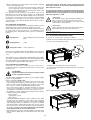
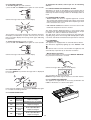
• undo the 2 screws located on the front panel: using a screwdriver,
turn the screw until hearing a click:
PP
PS
The parts in wood and cardboard can be disposed of, respecting
the current regulations in the country where the machine is
used.
The appliance uses a single-phase 230V/50Hz power supply.
The factory-set inside temperature is +0°C; the room temperature
where the appliance is installed must not exceed 43°C, in order
to maintain the required inside temperatures.
B.2.5 ELECTRICAL CONNECTION
Connection to the power supply must be carried out in
compliance with the regulations and provisions in force in the
country of use.
• carefully open the upper part of the front panel
as shown in the drawing (pay attention because it is fitted in
the lower part):
ATTENTION!
Work on the electrical systems must only be carried
out by a qualified electrician.
The information regarding the appliance power supply voltage
is given on the dataplate.
Before connecting, make sure:
- the connection point has an efficient earth contact and the
mains voltage and frequency match that given on the data
plate. In case of doubts regarding the efficiency of the earth
wire, have the system checked by qualified personnel;
- the system power supply is arranged and able to take the
actual current absorption and that it is correctly executed
according to the regulations in force in the country of use;
- the appliance must be permanently connected to the power
supply, respecting the polarities:
- brown: phase
- yellow/green: earth
- blue: neutral;
- a differential thermal-magnetic switch suitable for the input
specified on the dataplate, with contact gap enabling
complete disconnection in category III overvoltage conditions
and complying with the regulations in force, is installed
between the power cable and the electric line. For the correct
size of the switch, refer to the absorbed current specified on
the appliance dataplate. The chosen device must be lockable
in the open position in case of maintenance.
• After making the connection, with the appliance running check
that the power supply does not fluctuate by ±10% the rated
voltage.
• lift the panel upwards, removing it from its position:
34
C.1.4.1 LEDs
• the control panel can now be accessed:
LED
MODE
FUNCTION
On
Compressor working
Flashing
Anti-short cycle delay activated
On
Fan working
On
Defrost activated
On
Fast freezing function activated
On
Alarm signal
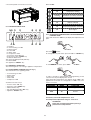
C.1.2 DESCRIPTION OF KEYS
1
2
4
6
7
9
11
C.1.5 SETTING THE TEMPERATURE FOR REFRIGERATED/
FREEZER BASE
Press and release the “SET” key to display the temperature set
point
SET
5
1
2
3
4
5
6
7
8
9
10
11
12
-
3
8
10
SET
12
Display
“Fast freezing” on LED
Defrost LED
Fans LED
Alarm LED
Compressor LED
Increase value “UP” key
Decrease value “DOWN” key
Manual Defrost key
Set point display/modify SET key
NOT USED
Appliance “ON/OFF” key
The LED
flashes.
To change the set point value, press the “UP” or “DOWN” key
or
To store the new set value, press “SET”
C.1.3 GENERAL OPERATION
The thermoregulator can manage appliance temperatures.
SET
C.1.4 ELECTRONIC CONTROLLER (see fig. 1)
The instrument has 5 signalling LEDs:
•
•
•
•
•
“Fast freezing” on LED
Defrost LED
Fans LED
Alarm LED
Compressor LED
or wait 15 seconds to automatically exit programming. In this
case the last set point displayed is stored.
After setting the temperatures, the display shows “rEF” if the
appliance is set to work as a refrigerator, or “FrE” if it is set to
work as a freezer:
and there are also 5 keys:
•
•
•
•
•
Increase value “UP” key
Decrease value “DOWN” key
Manual Defrost key
Set point display/modify “SET” key
Appliance “ON/OFF” key
MESSAGE
MODE
FUNCTION
Ref
On
Refrigerator
FrE
On
Freezer
NB: The message appears for 5 seconds at minute intervals.
The factory-set inside temperature is +0°C.
The temperature adjustment range is -22°C/+8°C.
ATTENTION:
Check the set temperature before placing a
product in the compartment.
35
C.1.6 KEYPAD LOCKOUT
To lock the keypad, proceed as follows:
• press the “UP” and “DOWN” keys together for a few seconds
To deactivate the alarms, refer to par. C.1.10 “Resetting
alarms”.
C.1.9 DEACTIVATING THE ACOUSTIC ALARM
Signalling of an alarm on the display occurs together with an
acoustic alarm, which can be deactivated by pressing any key.
Obviously, the alarm message remains on the display until it is
reset.
C.1.10 RESETTING ALARMS
• alarm “P1/P2”: this alarm is signalled approx.10 seconds
after a probe fault and automatically resets approx. 10 seconds
after the function has been restored. Before replacing it, check
if the connections are correct.
until the message “POF” flashes on the display
• “HA” and “LA” alarms: these alarms are reset as soon as the
thermostat temperature returns to normal.
The alarm remains displayed until it is reset. All the alarm
messages flash, alternating with the probe temperature, except
for alarms “P1” and “P2” which flash continuously.
The “EE” alarm can be reset by pressing any key during the
signalling stage. Then the message “rSt” is displayed for about
3 seconds, after which normal thermostat operation is restored.
The keypad is now locked and the only operation allowed is
the display of temperature set point. Press any key for more
than 3 seconds to display the message “POF” again, indicating
keypad status.
C.1.11 DEFROST
- Automatic defrost
The appliance is equipped with an automatic defrost device.
This function is signalled by lighting up of the “Defrost” LED
To release the keypad, proceed as follows:
• press the “UP” and “DOWN” keys together for a few seconds
.
The defrost water is run into a bowl under the appliance and
automatically evaporated by an electrical resistance.
- Manual defrost activation
To start a manual defrost cycle, keep the “MANUAL DEFROST”
key pressed for more than 2 seconds
until the message “POn” flashes on the display
until the message “dEF” appears on the display
C.1.7 SWITCHING OFF
Press the “ON/OFF” key and the message “OFF” is displayed
for 5 seconds
The procedure will end automatically.
NOTE: During the initial stage of the process, the LED flashes.
1
C.1.12 LOADING THE PRODUCT
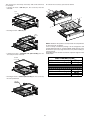
The appliance is supplied with an accessory positioned in the
middle of the drawer, as shown in the figure:
2
ACCESSORIO
In this status the appliance is off. Press the “ON/OFF” key again
to re-enable the heating elements.
C.1.8 ALARM SIGNALLING
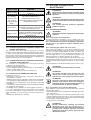
MESSAGE
P1
P2
HA
LA
CAUSE
Thermostat
probe fault
Evaporator
probe fault
Maximum
temperature
alarm
Minimum
temperature
alarm
OUTPUTS
Alarm output ON; Compressor
output according to
parameters "Con" and "COF"
Alarm output ON; Other
outputs unchanged
Alarm output ON; Other
outputs unchanged
Alarm output ON; Other
outputs unchanged
36
This accessory is not always necessary and can be removed,
for example:
- if having to insert a GN 2/1 pan, the accessory must be
removed:
To remove the accessory, proceed as follows:
GN 2/1
- if having to insert a GN 1/1 pan:
GN 1/1
NOTE: Distribute the products evenly inside the compartment
to allow good air circulation.
Cover or wrap food before placing it in the refrigerator and
avoid putting hot foods or steaming liquids inside. Do not leave
the drawers open any longer than necessary when loading or
removing food.
Regarding the max. load for each shelf, respect that given in the
table below:
- if having to insert a standard size (FULL SIZE) pan, the
accessory must be removed:
MAX. DRAWER LOAD
36" model drawers (small)
25 kg
48" model drawers (large)
40 kg
FULL SIZE
72" model drawers
small
large
84" model drawers (large)
"N900" model drawers
- if having to insert a smaller (HALF SIZE) pan, the accessory
must be positioned:
HALF SIZE
ACCESSORIO
37
25 kg
40 kg
40 kg
40 kg
Workers must be informed of the prohibition by means of clearly
visible signs. To guarantee machine efficiency and correct
operation, periodical maintenance must be carried out
according to the instructions given in this manual. In particular,
make sure to periodically check correct operation of all the
safety devices and the insulation of electrical cables, which
must be replaced if damaged.
C.2 GENERAL SAFETY RULES
C.2.1 INTRODUCTION
The machines are provided with electric and/or mechanical
safety devices for protecting workers and the machine itself.
Therefore the user must not remove or tamper with such
devices.
The Manufacturer declines any liability for damage due to
tampering or their non-use.
ATTENTION!
Machine maintenance operations must only be
carried out by specialised Technicians provided
with all the appropriate personal protection
equipment (safety shoes, gloves, glasses,
overalls, etc.), tools, utensils and ancillary
means.
C.2.2 PROTECTION DEVICES INSTALLED ON THE MACHINE
C.2.2.1 Guards
The guards on the machine are:
- fixed guards (e.g. casings, covers, side panels, etc.), fixed to
the machine and/or frame with screws or quick-release
connectors that can only be removed or opened with tools;
- interlocked movable guards (front panels) for access inside
the machine;
- machine electrical equipment access doors, made from
hinged panels openable with tools. The door must not be
opened when the machine is connected to the power supply.
ATTENTION!
Never operate the machine, removing, modifying
or tampering with the guards, protection or safety
devices.
ATTENTION!
Before carrying out any operation on the machine,
always consult the manual, which gives the correct
procedures and contains important information
on safety.
ATTENTION!
Several illustrations in the manual show the
machine, or parts of it, without guards or with
guards removed. This is purely for explanatory
purposes. Do not use the machine without the
guards or with the protection devices deactivated.
C.2.6 REASONABLY FORESEEABLE IMPROPER USE
Improper use is any use different from that specified in this
manual. During machine operation, other types of work or
activities deemed improper and that in general can involve
risks for the safety of operators and damage to the appliance
are not allowed.
Reasonably foreseeable improper use includes:
• lack of machine maintenance, cleaning and periodical checks;
• structural changes or modifications to the operating logic;
• tampering with the guards or safety devices;
• failure to use personal protection equipment by operators,
specialised technicians and maintenance personnel;
• failure to use suitable accessories (e.g. use of unsuitable
equipment or ladders);
• keeping combustible or flammable materials, or in any case
materials not compatible with or pertinent to the work, near
the machine;
• wrong machine installation;
• placing in the machine any objects or things not compatible
with refrigeration, freezing or preservation, or that can damage
the machine, cause injury or pollute the environment;
• climbing on the machine;
• non-compliance with the requirements for correct machine
use;
• other actions that give rise to risks not eliminable by the
Manufacturer.
C.2.3 SAFETY SIGNS TO BE PLACED ON THE MACHINE
OR NEAR ITS AREA
PROHIBITION MEANING
Do not remove the safety
devices.
Do not use water
to extinguish fires (shown on
electrical parts).
DANGER
MEANING
DANGER OF BURNS.
DANGER OF ELECTROCUTION
(shown on electrical parts with
indication of voltage).
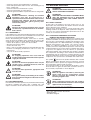
ATTENTION!
The previously described actions are prohibited!
ATTENTION!
Do not remove, tamper with or make illegible the
safety, danger and instruction signs and labels on
the machine.
C.2.7 RESIDUAL RISKS
The machine has several risks that were not completely
eliminated from a design standpoint or with the installation of
adequate protection devices.
Nevertheless, through this manual the Manufacturer has taken
steps to inform operators of such risks, carefully indicating the
personal protection equipment to be used by them.
Sufficient spaces are provided for during the machine
installation stages in order to limit these risks.
To preserve these conditions, the areas around the machine
must always be:
• kept free of obstacles (e.g. ladders, tools, containers, boxes,
etc.);
• clean and dry;
• well lit.
For the Customer’s complete information, the residual risks
remaining on the machine are indicated below: such actions
are to be considered incorrect and therefore strictly forbidden.
C.2.4 END OF USE
When the appliance is no longer to be used, make it unusable
by removing the power supply wiring.
C.2.5 INSTRUCTIONS FOR USE AND MAINTENANCE
Risks mainly of a mechanical, thermal and electrical nature
are present in the machine.
Where possible the risks have been neutralised:
• directly, by means of adequate design solutions,
• or indirectly by using guards, protection and safety devices.
Any anomalous situations are signalled on the control panel
display.
During maintenance several risks remain, as these could not
be eliminated, and must be neutralised by adopting specific
measures and precautions.
Do not carry out any control, cleaning, repair or maintenance
operations on moving parts.
38
D.1 MACHINE CLEANING AND
MAINTENANCE
DESCRIPTION OF HAZARDOUS
SITUATION
The operator can slip due to water or dirt
Slipping or falling
on the floor.
Burns/abrasions
The operator deliberately or
(e.g. heating
unintentionally touches some
elements, cold
components inside the machine without
tray, cooling
using protective gloves.
circuit plates and
pipes)
Contact with live parts during
Electrocution
maintenance operations carried out with
the electrical panel powered.
When handling the machine or the
packing containing it, using unsuitable
Tipping of loads
lifting systems or accessories or with the
load unbalanced.
Chemical
Inhalation of refrigerant gas. Therefore
(refrigerant gas)
always refer to the appliance labels.
RESIDUAL RISK
ATTENTION!
Disconnect the appliance from the power supply
before carrying out any cleaning or maintenance
operation.
ATTENTION!
Do not touch the appliance with wet hands or feet
or when barefoot. Do not remove the safety guards.
ATTENTION!
Use suitable personal protective equipment
(protective gloves).
D.1.1 ROUTINE MAINTENANCE
ATTENTION!
Disconnect the power supply before cleaning the
appliance.
D.1.1.1 Precautions for maintenance
Routine maintenance operations can be carried out by nonspecialised personnel, carefully following the instructions given
below. The manufacturer declines any liability for operations
carried out on the appliance without following these
instructions.
C.3 NORMAL MACHINE USE
D.1.1.2 Cleaning the cabinet and accessories
Before using the appliance, clean all the inside parts and
accessories with lukewarm water and neutral soap or products
that are over 90% biodegradable (in order to reduce the
emission of pollutants into the environment), then rinse and
dry thoroughly. Do not use solvent-based detergents (e.g.
trichloro-ethylene) or abrasive powders for cleaning.
It is advisable to go over the stainless steel surfaces with a rag
moistened with paraffin oil in order to create a protective film.
Check the power cable regularly and replace it in case of signs
of wear.
Have the appliance checked periodically (at least once a year).
C.3.1 CHARACTERISTICS OF PERSONNEL TRAINED FOR
NORMAL MACHINE USE
The Customer must make sure the personnel for normal
machine use are adequately trained and skilled in their duties,
as well as ensuring their own safety and that of other persons.
The Customer must make sure his personnel have understood
the instructions received and in particular those regarding work
hygiene and safety in use of the machine.
C.3.2 CHARACTERISTICS OF PERSONNEL ENABLED TO
OPERATE ON THE MACHINE
The Customer is responsible for ensuring that persons
assigned to the various duties:
• read and understand the manual;
• receive adequate training and instruction for their duties in
order to perform them safely;
• receive specific training for correct machine use.
ATTENTION!
Do not clean the machine with jets of water.
ATTENTION!
Pay special attention when cleaning the front
control panel: make sure water sprays do not
enter the slits in the condenser protection panel.
C.3.3 OPERATOR FOR NORMAL MACHINE USE
He must have at least:
• knowledge of the technology and specific experience in
operating the machine;
• adequate general basic education and technical knowledge
for reading and understanding the contents of the manual;
• including correct interpretation of the drawings, signs and
pictograms;
• sufficient technical knowledge for safely performing his duties
as specified in the manual;
• knowledge of the regulations on work hygiene and safety.
In case of a significant fault (e.g. short circuits, wires coming
out of the terminal block, motor breakdowns, worn electrical
cable sheathing, etc.) the operator for normal machine use
must:
• immediately deactivate the machine.
ATTENTION!
Do not use steel wool or similar material to clean
stainless steel surfaces. Do not use detergents
containing chlorine, solvent-based detergents (e.g.
trichloro-ethylene) or abrasive powders.
D.1.1.3 Precautions in case of long idle periods
If the appliance is not going to be used for some time, take the
following precautions:
• remove all food from the compartments and clean the inside
and accessories;
• go over all the stainless-steel surfaces vigorously with a cloth
moistened with paraffin oil in order to create a protective film;
• leave the door ajar so that air can circulate inside, preventing
the formation of unpleasant odours;
• air the premises periodically.
ATTENTION!
Machine maintenance, checking and overhaul
operations must only be carried out by a
specialised Technician or the After-Sales Service,
provided with adequate personal protection
equipment (safety shoes, gloves, glasses), tools
and ancillary means.
39
• the Ser. No. (appliance serial number).
Note: The code and serial number are essential for
identifying the type of appliance and date of manufacture:
ATTENTION!
Work on the electrical equipment must only be
carried out by a specialised electrician or the
After-Sales Service.
appliance identification
code
ATTENTION!
Put the machine in safe conditions before starting
any maintenance operation.
After carrying out maintenance make sure the machine is able
to work safely and, in particular, that the protection and safety
devices are efficient.
PNC 727188 00
Ser. No. 0 30 07 005
ATTENTION!
Respect the requirements for the various routine
and extraordinary maintenance operations.
Non-compliance with the instructions can create
risks for personnel.
manufactured
in 2010
5th piece
produced
in the
week
production
plant
week
30
D.1.2 EXTRAORDINARY MAINTENANCE
D.1.3 MAINTENANCE INTERVALS
The inspection and maintenance intervals depend on the
actual machine operation conditions and ambient conditions
(presence of dust, damp, etc.), therefore precise time intervals
cannot be given. In any case, to minimise interruptions of the
service, careful and periodical machine maintenance is
advisable.
It is advisable to stipulate a preventive and scheduled
maintenance contract with the after-sales service.
ATTENTION!
WEAR PROTECTIVE GLOVES AND A MASK WHEN
CARRYING OUT ANY EXTRAORDINARY
MAINTENANCE OPERATIONS.
Extraordinary maintenance must be carried out by
specialised personnel, who can ask the manufacturer to
supply a servicing manual.
D.1.2.1 Periodical condenser cleaning
To ensure optimum appliance operation, the condenser filter of
the refrigeration unit, located behind the control panel, must be
cleaned at least once every 6 months.
If the appliance is installed in a dusty or poorly ventilated place,
the condenser filter must be cleaned more frequently, at least
once every 3 months.
Note: It is advisable to use a brush or vacuum cleaner to remove
the dirt accumulated on the filter.
D.1.3.1 Maintenance frequency
In order to guarantee constant machine efficiency, it is advisable
to carry out the checks with the frequency given in the following
table:
MAINTENANCE, INSPECTIONS, CHECKS AND
FREQUENCY
CLEANING
Routine cleaning
Daily
General cleaning of machine and surrounding
area
Mechanical protection devices
Monthly
Check condition, and for any deformation,
loosening or removed parts.
Control
Check mechanical part, for any breakage or
Yearly
deformation, tightening of screws. Check
readability and condition of words, stickers and
symbols and restore if necessary.
Machine structure
Yearly
Tightening of main bolts (screws, fixing systems,
etc.) of machine.
Safety signs
Yearly
Check readability and condition of safety signs.
Electrical control panel
Check electrical components installed inside the
Yearly
Electrical Control Panel . Check wiring between
the Electrical Panel and machine parts.
Electrical connection cable.
Yearly
Check the connection cable (replace it if
necessary).
Extraordinary machine maintenance
Every 10
Check all components, electrical equipment,
years (*)
corrosion, pipes, ……
ATTENTION!
Do not clean the appliance with jets of water.
D.1.2.2 Replacing the power cable
To replace the power cable, proceed as follows:
• switch the appliance off with the key
;
• disconnect the power supply;
• remove the front control panel;
• remove the electrical system box cover;
• replace the power cable;
• refit the control panel and box cover;
• reconnect the power supply;
• switch the appliance on again with the key
.
D.1.2.3 Quick troubleshooting guide
In some cases, faults can be eliminated easily and quickly; The
following is a list of possible problems with their solutions:
A. The appliance does not switch on:
- check the correct power supply at the point of connection to
the permanent system;
- make sure the socket is powered.
B. The inside temperature is too high:
- check the thermostat setting;
- make sure there is no heat source near the appliance;
- make sure the drawers close properly.
C. The appliance is too noisy:
- make sure the appliance is properly levelled. An
unbalanced position can set off vibrations;
- make sure the appliance is not touching other appliances
or parts which could reverberate.
(*) the machine is designed and built for a duration of about 10
years. After this period of time (from machine commissioning)
the machine must undergo a general inspection and overhaul.
Some examples of checks to be carried out are given below.
- check for any oxidised electrical components or parts; if
necessary, replace them and restore the initial conditions;
If the fault persists after carrying out the above checks, contact
the After-Sales Service, remembering to give the following
details:
• the type of fault;
• the appliance PNC (production code);
40
- check the structure and welded joints in particular;
- check and replace bolts and/or screws, also checking for any
loose components;
- check the electrical and electronic system;
- check the functionality of safety devices;
- check the general condition of protection devices and guards.
D.2 MACHINE DISPOSAL
ATTENTION!
DISMANTLING OPERATIONS MUST BE CARRIED
OUT BY QUALIFIED PERSONNEL.
ATTENTION!
WORK ON THE ELECTRICAL EQUIPMENT MUST
ONLY BE CARRIED OUT BY A QUALIFIED
ELECTRICIAN, WITH THE POWER SUPPLY
DISCONNECTED.
ATTENTION!
Machine maintenance, checking and overhaul
operations must only be carried out by a
specialised Technician or the After-Sales Service,
provided with adequate personal protection
equipment (safety shoes, gloves, glasses), tools
and ancillary means.
D.2.1 WASTE STORAGE
At the end of the product’s life-cycle, make sure it is not
dispersed in the environment. The drawers must be removed
before disposing of the appliance.
Special waste materials can be stored temporarily while
awaiting treatment for disposal and/or permanent storage. In
any case, the current environmental protection laws in the
country of use must be observed.
ATTENTION!
Work on the electrical equipment must only be
carried out by a qualified electrician or the AfterSales Service.
D.1.4 DISASSEMBLY
If the appliance has to be disassembled and then reassembled,
make sure the various parts are assembled in the correct order
(if necessary mark them during disassembly).
Before disassembling the machine, make sure to carefully
check its physical condition, and in particular any parts of the
structure that can give or break. Before starting disassembly:
- remove all the pieces, if present, in the machine;
- disconnect the power supply;
- enclose the work area;
- place a sign on the Main Electrical Panel indicating that the
machine is undergoing maintenance and not to carry out
manoeuvres;
- carry out the disassembly operations.
D.2.2 PROCEDURE REGARDING APPLIANCE
DISMANTLING MACRO OPERATIONS
Before disposing of the machine, make sure to carefully check
its physical condition, and in particular any parts of the structure
that can give or break during scrapping. The machine’s parts
must be disposed of in a differentiated way, according to their
different characteristics (e.g. metals, oils, greases, plastic,
rubber, etc.). Different regulations are in force in the various
countries, therefore comply with the provisions of the laws and
competent bodies in the country where scrapping takes place.
In general, the appliance must be taken to a specialised
collection/scrapping centre. Dismantle the machine, grouping
the components according to their chemical characteristics,
remembering that the compressor contains lubricant oil and
refrigerant fluid which can be recycled, and that the appliance
components are special waste assimilable with urban waste.
ATTENTION!
All scrapping operations must occur with the
machine stopped and cold and the electrical power
supply disconnected.
The symbol
placed on the product indicates that it should
not be considered as domestic waste, but must be correctly
disposed of in order to prevent any negative consequences for
the environment and the health of people.
For further information on the recycling of this product, contact
the local dealer or agent, the after-sales assistance service or
the local body responsible for waste disposal.
ATTENTION!
Work on the electrical equipment must only be
carried out by a qualified electrician, with the
power supply disconnected.
ATTENTION!
To carry out these operations, appropriate PPE
must be used.
ATTENTION!
Make the appliance unusable by removing the
power cable and any compartment closing
devices, to prevent the possibility of someone
becoming trapped inside.
ATTENTION!
During disassembly and handling of the various
parts, the minimum height from the floor must be
maintained.
ATTENTION!
When scrapping the machine, the “CE” marking,
this manual and other documents concerning the
appliance must be destroyed.
D.1.5 DECOMMISSIONING
If the machine cannot be repaired, carry out the decommissioning
operations, signalling the failure with a suitable sign, and
request assistance of the manufacturer’s after-sales service.
D.3 ENCLOSED DOCUMENTS
• Set of test and inspection documents
• Wiring diagram
• Installation diagram
41