1
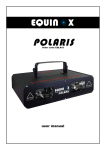
Equinox Polaris Laser
Safety
What types of effect are safe to scan directly at audiences?
Fast moving laser effects with evenly distributed scan patterns, such as circular tunnels are
generally safer than effects such as finger beams, or effects with pronounced bright spots in them.
Diffraction grating type effects are typically safer to point towards an audience, as long as the
bright central spots are kept above head height. The important thing is to not guess if an effect is
safe or not, and if in doubt keep it above head height. Being aware of the laser’s hazard distance
is useful to know.
Hazard Distances
All display lasers have a characteristic known as the hazard distance for direct viewing (NOHD).
This is distance at which the hazard of viewing the laser directly no longer presents a hazard. i.e.
at any point between the laser projector and the calculated hazard distance, it may be hazardous
to view the laser directly. But viewing the laser directly from beyond the hazard distance is
considered to be safe.
The worst case effect to look at directly is a static single beam, because all the light energy is
concentrated into one point. The hazard distances for several different powers of typical Class 3B
laser are shown in the table below, to give an idea of the distances involved.
Laser Output Power
10mW
Hazard Distance 12m
30mW 20m
50mW 100mW 250mW 450mW
25m
36m
56m
76m
Table 1 Static Beam Hazard Distances.
Note - The values have been calculated assuming the characteristics of a typical laser lightshow device,
which has a beam spread of 2mradians. Actual devices may differ in practice, so this table should only be
used as a guide. Details of how to calculate laser hazard distances are detailed in the British Safety Standard, and many laser safety text books. It is also one of the topics usually covered in laser safety courses.
It can been seen that static laser beams can remain hazardous for considerable distances, which
is why projecting such effects into peoples faces in not recommended.
Remember, projecting these beams overhead is fine, as long as they, or any reflections, are not
hitting anybody.
When an effect such as a tunnel is projected, the continual scanning reduces the time the eye is
directly exposed to the laser energy. These types of effect are less harmful to aim at the audience
directly. The table below shows the hazard distances of a stationary circular tunnel, with a spread
of 50 degrees, and a scan rate of 20Hz, to give an idea of how it is reduced.
Laser Output Power
Hazard Distance
10mW
30mW
50mW
100mW
250mW
450mW
5m
9m
11m
16m
26m
35m
Table 2 Scanned Tunnel Hazard Distances.