1
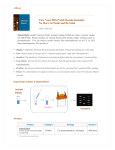
Instant-Bands Protein Sample Loading Buffer for SDS-PAGE User’s Manual View Protein Bands in an SDS Gel Instantly EZBiolab www.ezbiolab.com 2 Instant-Bands User’s Manual Table of Contents Introduction 3 Storage and Stability 4 Products 4 Experimental Protocol 5 Record the Results 6 Sensitivity 7 Molecular Weight Marker 9 Applications 9 Frequently Asked Questions and Trouble Shooting EZBiolab Setting High Standards for Scientific Excellence 10 Visit us at www.ezbiolab.com Contact us at [email protected] 3 Instant-Bands User’s Manual Introduction Instant-Bands sample treatment buffer (sample loading buffer) pre-stains a protein sample for SDS-PAGE. Protein samples are stained fluorescently during sample treatment prior to electrophoresis. Protein bands in an SDS-gel and on a membrane after transfer can be visualized and analyzed by an UV or LED transilluminator or by a digital gel image system. Instant-Bands are more sensitive than silver staining. Instant-Bands have been formulated to enhance the sensitivity, stability and to eliminate background. Instant-Bands stain all proteins. It doesn’t change protein migration rates and electrophoresis patterns. During electrophoresis, free dye molecules migrate at the same rate as the tracking dye bromophenol blue and migrate to the bottom of the gel at the end of a run, leaving a clean background. Instant-Bands ideally suit to an SDS-PAGE experiments for tracking protein expression and purification and Western blot. Features • • • • No more gel stain/de-stain No special instruments or reagents required No extra experimental steps No need to retrieve gels from gel cassettes • • • • Bands retain on membranes after transfer Compatible with Western blot Stain the selected lanes, not the entire gel Apply to any gels, hand-made or precast Experiment Scheme of Instant-Band protein sample Mix Heat Run Instant-Bands loading buffer does not change SDS-PAGE experimental protocol EZBiolab Setting High Standards for Scientific Excellence Visit us at www.ezbiolab.com Contact us at [email protected] 4 Instant-Bands User’s Manual Storage and Stability Immediately store the package at -20 oC upon receiving. Instant-Band Sample Treatment Buffer is stable for 12 month at -20 ºC, 12-15 weeks at 4 ºC and 2-3 weeks at room temperature. Like regular sample treatment buffer, oxidation of reducing reagent such as DTT is the major problem for long term storage of Instant-Band at room temperature. Some protein bands could become less sharp and less bright if Instant-Band is stored at RT for more than 3 weeks. Add freshly made DTT will restore band sharpness and brightness. The final concentration of DTT in Instant-Band should not be over 20 mM Always avoid direct light. Products Instant-Bands is a 3x sample treatment buffer. It comes in various forms and sizes. In the term of physical state, Instant-Bands offer two different forms: the ready-to-use solution form and the dry powder form. The powder form needs to be re-suspended in water before use. Otherwise the two forms are identical. Powder form is designed for shipping at room temperature to reduce the sipping cost. Functionally, there are the reduced Instant-Band and the non-reduced Instant-Band, which are for reducing gel (the most common gel) and non reducing gel, respectively. Table below summarizes the package sizes of Instant-Bands. Each size has the solution and the powder forms as well as reducing and the non-reducing Instant-Bands. Products Instant-Bands 3 x Protein Sample Treatment Buffer for SDS-PAGE Fluorescent Protein Marker Pretreated M.W. marker for SDS-PAGE EZBiolab Setting High Standards for Scientific Excellence Catalog # Package Size PFS001 2 vials (1,000 ul/vial) PFS001R 1 vials (1,000 ul/vial) PFS001T 1 vial (100 ul/vial) MKP004 1 vial (250 ul) Visit us at www.ezbiolab.com Contact us at [email protected] 5 Instant-Bands User’s Manual Instant-Bands Protocol This protocol applies to both reduced and non-reduced gels If you ordered the powder form of Instant-Bands, please re-suspend it in high purity water according the volume on the label 1. Mix Instant-Band Sample Treatment Buffer with a protein sample in 1:2 ratio (volume). For example, mix 3 µl Instant-Bands with 6 µl protein sample. 2. Heat the sample at 90-100 ºC for 10 minutes. For whole cell or tissue samples, increase the heating time to 15 minutes. Make sure your heating block is >90oC to let the sample be sufficiently heated. 3. The sample is ready for gel electrophoresis. If the molecular weight marker is needed, load 3 µl ready-to-use pretreated fluorescent molecular weight makers to a sample well. 4. After electrophoresis, place the gel on a transilluminator to view protein bands and take pictures. The transilluminator can be an UV, a LED blue or a digital gel image system. The gel does not need to be removed from the gel cassette if light source is in visible wavelength range. 5. (Optional) The gel can still be stained by Coomassie Blue if desired: Stain the gel according to the standard Coomassie Blue protocol Cautions: 1. Do not apply Instant-Bands to pre-stained or pre-treated protein molecular weight markers. They are not compatible with Instant-Bands. Use ready-to-use pre-stained fluorescent protein molecular weight markers from EZBiolab (catalog # MKP004) or from other vendors. Alternatively, you can apply InstantBands to untreated protein molecular weight markers. 2. If you run mops gel such as the precast gel from Life Technology, it is necessary to remove residual liquid from sample wells before loading Instant-Bands treated protein samples. The buffer used to make this type of gel has high density that prevents Instant-Bands treated samples to sink to the bottom of the wells. EZBiolab Setting High Standards for Scientific Excellence Visit us at www.ezbiolab.com Contact us at [email protected] 6 Instant-Bands User’s Manual Record the Results Gels stained by Instant-Bands can be visualized, pictured and analyzed on an UV transilluminator, a LED blue transilluminator or a digital gel image system. Because light in visible wavelength range can pass through a glass or plastic gel cassette, it is not necessary to remove the gel from its cassette on a LED blue transilluminator or a fluorescent gel image system. Instant Bands: 0 minute Coomassie Blue: 4 hours LED In cassette UV 1, 3, 5 and 7 were treated by Instant-Band loading buffer 2, 4, 6 and 8 were treated by the regular loading buffer A gel can been processed as a positive, a negative or a color image by a gel image system Western Blot Instant-Bands stained protein samples become brighter on a membrane after transfer. As a result, membrane stain by Ponceau S dye is no longer needed. Perform Western Blot experiments according to the standard protocol. The brightness of protein bands retains after blotted by antibodies. This helps to identify the target proteins. Alternatively, Instant-Bands treated samples can be run as a control lane next to the same sample treated by the regular treatment buffer to verify transfer efficiency and positions of the target proteins. EZBiolab Setting High Standards for Scientific Excellence Visit us at www.ezbiolab.com Contact us at [email protected] 7 Instant-Bands User’s Manual Sensitivity of Instant-Bands Instant-Band is a super sensitive method to stain protein in SDS-gel. It can detect as low as 0.1 ng protein, which is about 10 times more sensitive than silver staining. Instant-band is a fluorescence based dye. Its sensitivity depends on the light sources, instrument setting, quality of the camera and if a gel is inside a plastic cassette or not. Sensitivity for the gel casted in glass cassette is virtually identical to the naked gel. Below is the sensitivity under each condition and its comparison with silver staining and Coomassie blue. Detection Sensitivity Instant-Band Silver Coomassie Instrument Gel status Gel image system camera Naked gel or in glass cassette Gel in plastic cassette Naked gel or in glass cassette Gel in plastic cassette 0.1-0.3 ng 0.2-0.5 ng 5 ng 5-10 ng Naked gel 5-10 ng LED Transilluminator visual UV Transilluminator visual 1-2 ng 25-50 ng Linearity and Dynamic Range of Instant-Bands The amount of a protein and its band intensity shows a linear relation extended for from 1 to ~100. The exactly range of linearity depends on the sensitivity. For example, the two figures shown below were based on a same gel. The difference is that one was exposed for 10 seconds when its picture was taken and band density was scanned while the other was exposed for 60 seconds. The lowest amount of protein could be detected by 60-second exposure is 0.1 ng. Its linearity range is from 0.1 ng to ~ 7 ng. The low limit of 10-second exposure is 0.4 ng. Its linearity is from 0.4 to 25 ng. 10 seconds 0.1 0.2 0.4 0.8 1.6 3.2 6.3 12.5 25 50 ng EZBiolab Setting High Standards for Scientific Excellence 60 seconds 0.1 0.2 0.4 0.8 1.6 3.2 6.3 12.5 25 50 ng Visit us at www.ezbiolab.com Contact us at [email protected] 8 Instant-Bands User’s Manual Conditions and Factors affect the Sensitivity pH Low pH reduces stain efficiency. If pH of a sample solution is below 5, we suggest you to adjust pH to above 7 for the best results. High pH (>7) does not affect Instant-Band. Other Factors Proteins are effectively stained by Instant-Bands under normal conditions. Table Buffers Detergents below summarizes the effect of common reagents found in protein solution (Control is 5+) 0.1 % 0.5% 1% Triton - 100 5+ 5+ 5+ Chaps 5+ 5+ 5+ Glycoside 5+ 5+ 5+ Tween 5+ 5+ 5+ 25 mM 50 mM 100 mM Pi Buffer, pH7.4 5+ 5+ 5+ Tris Buffer, pH 7.4 5+ 5+ 3+ PIPES Buffer, pH 6.5 5+ 4+ 2+ HEPES Buffer, pH 7.5 5+ 5+ 4+ 10 mM 5+ 1% 5+ 2M 5+ 5% 5+ 20 mM 5+ 3% 5+ 4M 5+ 10% 4+ 30 mM 5+ 5% 5+ 6M 4+ 20% 3+ Others DTT DMSO Urea Glycerol EZBiolab Setting High Standards for Scientific Excellence 50 mM 4+ 8M 3+ Visit us at www.ezbiolab.com Contact us at [email protected] 9 Instant-Bands User’s Manual Molecular Weight Markers Instant-Band is specially formulated to enhance its stain efficiency. Most of ready-to-use protein molecular weight markers are not compatible with Instant-Band. EZBiolab provides pre-stained fluorescent protein M.W. markers. Alternatively, markers can be generated by staining untreated proteins with Instant-Bands. Application The product is best used for SDS-PAGE electrophoresis to check protein expression, determine the purity of a protein sample, track target protein during purification and western blot as well as to exam immune-precipitation results The product is not recommended for experiments to cut protein bands from a gel for sequencing, mass spectrometry analysis or antibody production. Related Products Fluorescent Protein M.W. Marker EZ-Viewer LED Transilluminator EZ-PAGE, the next generation of precast gel EZBiolab Setting High Standards for Scientific Excellence Visit us at www.ezbiolab.com Contact us at [email protected] 10 Instant-Bands User’s Manual Frequently Asked Questions and Trouble Shooting 1. Why can’t ready-to-use protein M.W. markers I purchased from other vendors be stained by InstantBand effectively? Instant-Band is specially formulated to enhance its staining efficiency. Most of the ready-to-use protein molecular weight markers are not compatible with Instant-Bands. EZBiolab provides pre-stained fluorescent protein M.W. marker. Alternatively, markers can be generated by staining untreated proteins with Instant-Bands. 2. How about the stability of Instant-Band? Instant-Band dye itself is stable. However, same as the regular sample treatment buffer, oxidation of reducing reagent such as DTT could reduce the sharpness and brightness of some protein bands. The recommended storage time of instant-Band loading buffer at room temperature is 2-3 weeks. Adding freshly made DTT to Instant-Bands loading buffer will restore the sharpness and brightness. The final concentration of DTT in Instant-Band should not be over 20 mM DTT. Other reducing reagents such as TCEP (2 mM) also work well. 3. Do post-translational modifications affect Instant-Bands? No 4. Some protein bands get less sharp over time, why? Oxidation of protein reduces band sharpness. Add freshly made DTT to Instant-Bands. DTT concentration should not be over 20 mM. 5. Can I do Western Blot experiments using Instant-Bands stained samples? Yes. Instant-Bands do not affect Western Blot results. Alternatively, you can use Instant-bands stained sample as a control lane to check expression level of the target protein and verify the transfer efficiency. 6. Why do I see precipitation in Instant-Bands that has been stored at 4 degree? The precipitation is SDS. It will disappear when temperature is raised to room temperature. 7. When I ran bis-tris gel, Instant-Bands treated samples do not sink to the bottom of sample wells, why? The gel buffer for bis-tris gel that is mostly used by the precast gel from Life Technology (NuPAGE gel) has very high density. This buffer sometimes still remains in the sample wells before use. It prevents protein sample to sink because of its high density. So, you need to remove the residual gel buffer from sample wells before pouring running buffer and then load your protein samples. 8. When I ran whole cell or tissue culture samples, the intensity sometimes was less strong, why? For whole cell and tissue samples, you need to increase heating time to 15 minutes to completely denature all the proteins. 9. Why did I see strange shaped bands like those shown on the right lane? The samples did not sink to the bottom of the well. Please see question 7. EZBiolab Setting High Standards for Scientific Excellence Visit us at www.ezbiolab.com Contact us at [email protected]