1
Processed Data
Storage Format
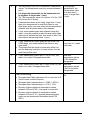
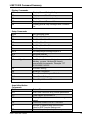
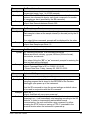
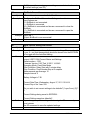
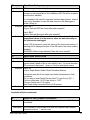
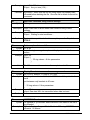
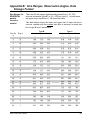
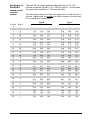
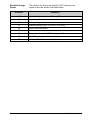
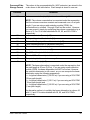
The values in the processed data file (.ASC extension) are stored in the
order shown in the table below. Each sample is stored in one row.
Elements
1:32
Parameter
Volume concentration (in µl/l) for size class 1 through 32.
33
NOTE: The volume concentration is computed under the assumption
that the volume conversion constant was measured over a 5 cm path
length. If you are using a path reduction module (PRM), the
concentrations in columns 1 through 32 will not be correct. However,
you can correct it simply by multiplying the volume concentration by a
factor of 2, 5 or 10 for data obtained with 50, 80, and 90% PRM’s
respectively.
Laser transmission Sensor [mW]
34
Battery voltage in calibrated units [V]
35
External Auxiliary input 1 in calibrated units [mW]
36
Laser Reference sensor in calibrated units [mW]
37
Pressure in calibrated units [m]
38
Temperature in calibrated units [C]
39
(Day*100 + Hour) at which data taken
40
(Minutes*100 + Seconds) at which data taken
41
Computed optical transmission over path
42
Beam-attenuation (c) [m-1].
NOTE: The beam attenuation is computed under the assumption that
the path length is 50 mm (0.05 m). If you are using a path reduction
module (PRM), the beam attenuation will NOT be correct. However,
the optical transmission is still correct, so you can compute the beam
attenuation using the following expressions:
c = -ln(optical transmission)*(1/0.025 m) if you are using a 50% PRM
(25 mm path length).
c = -ln(optical transmission)*(1/0.01 m) if you are using an 80% PRM
(10 mm path length) and
c = -ln(optical transmission)*(1/0.005 m) if you are using a 90% PRM
(5 mm path length).
An alternative option is to multiply the beam attenuation in column 42
with 2, 5 and 10 for data obtained with 50, 80, and 90% PRM’s
respectively.
LISST-100X User’s Guide
107