1
4
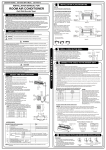
CONNECT THE CABLE TO THE INDOOR UNIT
4
Electrical work
I
N
D
O
O
R
U
N
I
T
Electric safety regulations for the initial Installation
1. If there is serious safety problem about the power supply, the technicians should refuse to install
the air conditioner and explain to the client until the problem is solved.
2. Power voltage should be in the range of 90%~110%of rated voltage.
3. The surge protector and main power switch with a 1.5 times capacity of Max. Current of the
unit should be installed in power circuit. Ensure the air conditioner is grounded well.
4. The appliance shall be installed in accordance with national wiring regulations. Do not operate your air
conditioner in a wet room such as a bathroom or laundry room.
5. An all-pole disconnection device which has at least 3mm clearances in all poles, and have a leakage
current that may exceed 10mA, the residual current device(RCD) having a rated residual operating
current not exceeding 30mA, and disconnection must be incorporated in the fixed wiring in accordance
with the wiring rules.
6. For the unit adopts auxiliary electric heater, keep at least 1 meter away from the nearest combustible
materials.
7. According to the attached Electrical Connection Diagram located on the panel of the indoor & outdoor
unit to connect the wire. All wiring must comply with local and national electrical codes and be installed
by qualified and skilled electricians.
8. An individual branch circuit and single receptacle used only for this air conditioner must be available.
See the following table for suggested wire sizes and fuse specifications:
Appliance Amps
Terminal block of outdoor unit
L1 L2
Cover
S
L1 L2
L1 L2
S
L1 L2
Screw
10
18
13
16
18
14
25
12
30
10
40
8
To indoor unit
NOTE:
AWG Wire Size
The wire size of power supply cord and
interconnected wire and the current of
the fuse or switch are determined by the
maximum current indicated on the
nameplate which located on the side panel
of the unit. Please refer to the nameplate
before selecting the wire size, fuse or switch.
The controller of the air conditioner designed
with a fuse protection function under
abnormal conditions, the specifications of
the fuse have printed on the circuit board,
such as: T3.15A/250VAC, T5A/250VAC, etc.
NOTE: The air conditioner can be connected only to a supply with system impedance no more than
0.0538 ohm. In case necessary, please consult your supply authority for system impedance information.
Terminal block of indoor unit
Panel
L1 L2 S
5
.
.
.
To power supply
(2)
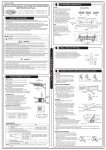
AIR PURGING AND TEST OPERATION
1. Air purging
Air and moisture in the refrigerant system have undesirable effects. Therefore, the indoor unit
and tubing between the indoor and outdoor unit must be leak tested and evacuated to remove
any noncondensables and moisture from the system.
Check that each tube(both liquid and gas side tubes) between the indoor and outdoor units have
been properly connected and all wiring for the test run has been completed.
Pipe length and refrigerant amount:
Less than 7.5m
Use vacuum pump
More than 7.5m
Use vacuum pump
.
.
.
.
.
Additional amount of refrigerant to be charged
Liquid side:φ6.35mm
Liquid side:φ9.52mm:
R22: (Pipe length-7.5)x30g/m
R22: (Pipe length-7.5)x60g/m
R410A: (Pipe length-7.5)x15g/m R410A: (Pipe length-7.5)x30g/m
For the R407C refrigerant model, make sure the refrigerant added into air conditioner is liquid
form in any cases.
When relocate the unit to another place, using vacuum pump to perform evacuation.
Open the valve stem until it hits against
the stopper. Do not try to open it further.
Securely tighten the valve stem cap with
a spanner or the like.
Valve stem cap tightening torque. See
Tightening torque table.
Or
Electrical box
cover
Refrigerant
Outdoor
unit
A
Gas side
Liquid side
Flare nut
Indoor
unit
D
B
Packed valve
Stopper
Cap
C
Half union
Valve body
Valve stem
To outdoor unit
To outdoor unit
2. When using the Vacuum Pump
OUTDOOR INSALLATION PRECAUTION
Install the outdoor unit on a rigid base to prevent increasing noise level and vibration.
Determine the air outlet direction where the discharged air is not blocked.
In the case that the installation place is exposed to strong wind such as a seaside, make
sure the fan operating properly by putting the unit lengthwise along the wall or using a dust
or shield plates.
Specially in windy area, install the unit to prevent the admission of wind. If need suspending
installation, the installation bracket should accord with technique requirement in the
installation bracket diagram. The installation wall should be solid brick, concrete or the same
intensity construction, or actions to reinforce, damping supporting should be taken.
The connection between bracket and wall, bracket and the air conditioner should be firm,
stable and reliable.
Be sure there is no obstacle which block radiating air.
Incorrect
Correct
Barrier
Strong
wind
Strong
wind
2
To indoor unit
CAUTION
1 2(N) S G
1
To power supply
(1)
Connective pipe length Air purging method
Connect the cable to the indoor unit
NOTE: Before performing any electrical work, turn off the main power to the system.
,
DRAIN JOINT INSTALLATION
1. Completely tighten the flare nuts, A, B, C, D, connect
the manifold valve charge hose to a charge port of the
Manifold valve
packed valve on the gas pipe side.
Compound meter Pressure gauge
2. Connect the charge hose connection to the vacuum
pump.
-76cmHg
3. Fully open the handle Lo of the manifold valve.
4. Operate the vacuum pump to evacuate. After starting
Handle Hi
Handle Lo
evacuation, slightly loose the flare nut of the packed
Charge hose
valve on the gas pipe side and check that the air is
Charge hose
entering. (Operation noise of the vacuum pump changes
Vacuum pump
and a compound meter indicates 0 instead of minus)
5. After the evacuation is complete, fully close the handle
Lo of the manifold valve and stop the operation of the
vacuum pump.
Make evacuation for 15 minutes and more and check
Packed valve
that the compound meter indicates -76cmHg(-1.0x10⁵Pa).
6. Turn the stem of the packed valve B about 45O counterclockwise for 6~7 seconds after the gas coming out, then
tighten the flare nut again. Make sure the pressure display
in the pressure indicator is a little higher than the atmosphere
pressure.
7. Remove the charge hose from the Low pressure charge hose.
8. Fully open the packed valve stems B and A.
9. Securely tighten the cap of the packed valve.
NOTE: The drain joint is slightly different according to the
different outdoor unit.
For the drain joint with the seal(Fig.A), first fit the seal onto
the drain joint, then insert the drain joint into the base pan
。
hole of outdoor unit, rotate 90 to securely assemble them.
To install drain joint as shown in Fig.B, insert the drain
joint into the base pan hole of outdoor unit until it remains
fixed with a clicking sound. Connecting the drain joint with
an extension drain hose (Locally purchased), in case of the
water draining off the outdoor unit during the heating mode.
3
3. Safety and leakage check
Base pan hole
of outdoor unit
(A)
(B)
1. Soap water method:
Apply a soap water or a liquid neutral detergent on the indoor
unit connections and outdoor unit connections by a soft brush
to check for leakage of the connecting points of the piping. If
bubbles come out, it indicates that the pipes have leakage.
2. Leak detector
Use the leak detector to check for leakage.
CAUTION
Indoor unit
check point
D
C
B
A
Cover
Outdoor unit
check point
A: Lo packed valve B: Hi packed valve
C and D are ends of indoor unit connection.
REFRIGERANT PIPE CONNECTION
4. Test running
Flaring
90O
1. Cut a pipe with a pipe cutter.
2. Remove flare nuts attached to indoor and
outdoor unit, then put them on pipe/tube
having completed burr removal and flare
the pipe.
3. Firmly hold copper pipe in a die in the
dimension shown in the table below.
Bar
A(mm)
Outer diam.
(mm)
Max.
Min.
..
.
Drain joint
Seal
6.35
1.3
0.7
9.52
1.6
1.0
12.7
16
19
1.8
2.2
2.4
1.0
2.0
2.0
Tightening connection
Align pipes to be connected.
Sufficiently tighten the flare nut with fingers,
and then tighten it with a spanner and torque
wrench as shown.
Excessive torque can break nut depending
on installation conditions.
Oblique Roughness
Copper pipe
Indoor unit tubing
Outer
diam.
φ6.35mm
φ9.52mm
φ12.7mm
φ16mm
φ19mm
Burr
Handle
"A"
U
N
I
T
1. Remove the electrical control board cover from the outdoor unit by loosening the screw.
2. Connect the connective cables to the terminals as identified with their respective matched numbers
on the terminal block of indoor and outdoor units.
3. Secure the cable onto the control board with the cord clamp.
4. To prevent the ingress of water, form a loop of the connective cable as illustrated in the installation
diagram of indoor and outdoor units.
5. Insulate unused cords (conductors) with PVC-tape. Process them so they do not touch any electrical
or metal parts.
Suggest Minimum Wire Size(AWG:American Wire Gage):
1. The inside and outside connecting cable can be connected without removing the front grille.
2. The indoor power cord type is H05VV-F or H05V2V2-F, the outdoor power cord and
interconnected cord type is H07RN-F.
3. Lift the indoor unit panel up, remove the electrical box cover by loosening the screw.
4. Ensure the wires colour of outdoor unit and the terminal Nos. are the same to the indoor s respectively.
5. Wrap those cables not connected with terminals with insulation tapes, so that they will not touch
any electrical components. Secure the cable onto the control board with the cord clamp.
O
U
T
D
O
O
R
CONNECT THE CABLE TO THE OUTDOOR UNIT
Bar
Clamp handle
Flare nut
Pipings
Tightening
torque(N.cm)
Perform test operation after completing gas leak check at the flare nut connections and electrical
safety check.
Check that all tubing and wiring have been properly connected.
Check that the gas and liquid side service valves are fully open.
1. Connect the power, press the ON/OFF button on the remote controller to turn the unit on.
2. Use the MODE button to select COOL, HEAT, AUTO and FAN to check if all the functions works
well.
3. When the ambient temperature is too low(lower than 17OC/62OF), the unit cannot be controlled by the
remote controller to run at cooling mode, manual operation can be taken. Manual operation is
used only when the remote controller is disable or maintenance necessary.
Hold the panel sides and lift the panel up to an angle until it remains fixed with a clicking sound.
Press the Manual control button to select the AUTO or COOL, the unit will operate under Forced
AUTO or COOL mode(see User Manual for details).
4. The test operation should last about 30 minutes.
Additional tightening
torque(N.cm)
1500
(153kgf.cm)
2500
(255kgf.cm)
1600
(163kgf.cm)
3500
(357kgf.cm)
4500
(459kgf.cm)
6500
(663kgf.cm)
3600
(367kgf.cm)
4700
(479kgf.cm)
6700
(683kgf.cm)
2600
(265kgf.cm)
Manual control
Button
AUTO/COOL