1
If the finger/earlobe clip ‘loses contact’
with the pulse, the reading may
momentarily drop to zero.
Contact lost
Communication
re-established
The light sensitive detector (LSD) in the clip can be sensitive to high levels of ambient infrared
light e.g. bright sun or room lights. If the light interferes with the detector the Sensor may ‘lose
contact’. Stop logging, and reduce the light level e.g. by covering the sensor clip before starting
to log again.
Note: If you alter the light level while logging the sensor will need to adjust to the new conditions.
Avoid applying pressure to the sensor clip e.g. by resting the finger clip on a work surface.
It is possible to alter heart rate by changing breathing. Encourage the test subject to breath
normally.
This Sensor is not intended for medical diagnosis. Do not be alarmed if results do not
correspond to quote numbers, these represent typical averages. It is quite normal for the
heart to occasionally miss a beat.
Example of the depth of dicrotic notch
that may affect Heart rate data.
It is possible for the dicrotic notch
to be recorded as a separate pulse,
and so give higher readings than
expected. The effects are usually
more noticeable if the clip is
attached to the finger; try using with
the clip attached to the ear lobe.
Dicrotic notch
This sensor is not waterproof. Clean the clip by wiping with a cloth that has been rinsed in
disinfectant.
Background
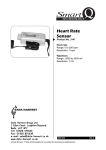
The Heart rate sensor is used to measure the pulse that is found throughout the human body.
This pulse will result in a change in the volume of arterial blood with each pulse beat. This
change in blood volume can be detected in the fingertip or ear lobe using a technique called
Photoplethysmography. The device that detects the signal is called a plethysmograph (or
‘pleth’ for short).
3