1
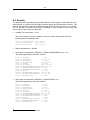
Accessing XML Data from an
Object-Relational Mediator Database
A semester thesis paper
by Christof Roduner
Advisor and Supervisor
Prof. Tore Risch
December 4, 2002
Thesis Register Number 235
ISSN 1100-1836
Uppsala Database Laboratory
Uppsala University
P.O. Box 513
S-751 20 Uppsala
Sweden
2
Contents
Contents........................................................................................................................... 2
1 Introduction .................................................................................................................. 3
1.1 The roots of XML and databases............................................................................. 3
1.2 XML as a database ................................................................................................. 4
1.3 The need for XML enabled databases..................................................................... 4
2 Storing XML documents in databases........................................................................ 6
2.1 Table-Based Mapping ............................................................................................. 6
2.2 Object-Relational mapping ...................................................................................... 6
2.3 Drawbacks .............................................................................................................. 7
2.4 Document preserving storage.................................................................................. 8
3 Representing XML documents in AMOS II.................................................................. 9
3.1 The Document Object Model................................................................................... 9
3.2 Database Schema................................................................................................. 12
4 Implementation of the Extensions ............................................................................ 16
4.1 General Architecture ............................................................................................. 16
4.2 Importing XML documents: The Builder................................................................. 16
4.2.1 Simple API for XML ........................................................................................ 16
4.2.2 Java Implementation ...................................................................................... 17
4.2.3 Parsing Issues................................................................................................ 17
4.3 Querying documents: The Evaluator...................................................................... 19
4.3.1 The Jaxen Framework.................................................................................... 19
4.3.2 The Simple DOM Implementation................................................................... 19
4.3.3 Putting it together: Jaxen and the Simple DOM Implementation...................... 20
4.4 Exporting nodes: The Flattener ............................................................................. 20
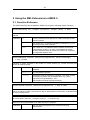
5 Using the XML Extensions in AMOS II...................................................................... 22
5.1 Function Reference ............................................................................................... 22
5.2 Usage examples ................................................................................................... 23
5.2.1 Storing and retrieving a document.................................................................. 24
5.2.2 Exploring the DOM tree.................................................................................. 24
5.2.3 Querying the document with XPath................................................................. 25
6 Performance Measurements...................................................................................... 27
6.1 Evolution of the system ......................................................................................... 27
6.2 Results.................................................................................................................. 29
7 Conclusion and Future Work..................................................................................... 30
References..................................................................................................................... 31
3
1 Introduction
The following paper is the finishing report on a term project exploring an approach to store
arbitrary XML documents in the object-oriented database management system AMOS II
[RJK00].
AMOS II has a functional data model and is based on the relationally complete objectoriented query language AmosQL, which is similar to the OO parts of SQL-99. An AMOS II
database system can integrate data of different type (e.g. relational databases) into its own
OO database using a wrapper. This results in a common data model and query language
for heterogeneous data.
Apart from serving as a standalone database server for applications, many independent
AMOS II systems can also interoperate over a communication network such as the internet.
In this design, an application can access data stored in an AMOS II database through other
AMOS II databases called mediators. A mediator offers a high-level abstraction of the
underlying data sources by combining them in the way required by the application. This
greatly simplifies the use of heterogeneous data sources at an application level. In addition
to this, each mediator system can also manage data of its own.
The AMOS II database system is implemented in C and available for the Windows platform.
An AMOS II system’s database resides in main-memory and is saved to disk only when
requested explicitly. AMOS II is extensible through the use of foreign functions. Foreign
functions are implemented by the user in some external programming language (Java, C
and LISP are currently supported) and can then be used as new data types or operators in
the AMOS II system.
The goal of the project presented in this paper was to use Java to write extensions to the
AMOS II system in order to integrate XML documents into the database. These XML
Extensions consist of three modules that can be called from the AMOS II environment:
§
Builder module (wrapper) to parse XML documents using SAX technology and
store them as objects in the AMOS II database
§
Evaluator module to query an XML document stored in the database with an XPath
expression.
§
Flattener module to traverse an object graph representing a document or parts of it
in order to rebuild the original text representation of the XML data.
1.1 The roots of XML and databases
As this paper is dealing with the issue of bringing traditional database technology and XML
together, it is worth taking a look at the relationship between these two technologies. In this
section, we will first discuss their origin and benefits offered. Later, we will look more
closely at what these two technologies have in common and what makes them different.
Databases have proven an extremely valuable technology for handling large amounts of
data and have therefore become an essential tool in software development. They provide
features like multi-user access, consistency, integrity, security and distribution that are
important building blocks of today’s software solutions.
With the rapid growth of the Internet during the 1990ies there was an increasing need for a
data format to publish and exchange information between different platforms (operating
systems, programming languages, vendors etc.). This led to the standardization of the
4
Extensible Markup Language (XML) by the World Wide Web Consortium (W3C) in 1998.
XML is a metalanguage (i.e. a language to describe other languages with) that meets these
challenges by providing means to easily define schemas for documents and to create
document instances. Together with its surrounding Web technologies (e.g. HTTP) and
other widely accepted standards (e.g. Unicode), XML allows for the encapsulation of
information in documents in order to share it across the Web. In this way, information can
be exchanged between systems that wouldn’t be able to communicate otherwise. Since its
introduction by the W3C, XML has gained attention throughout the industry and is now
widely used in various ways in software projects.
1.2 XML as a database
A question that arises frequently in discussions about XML is, if XML is actually a database.
In the narrow definition of the term, an XML document is a database, namely a collection
of logically related data and a description of this data. However, in a broader definition, a
database also consists of the many features a Database Management System (DBMS)
provides. Of these, XML and its related technologies only offer some:
DBMS function
storage
schemas
data retrieval
API
views
concurrency control
transactions
enforcing integrity constraints
backup and recovery
security and authorization
Corresponding XML technology
XML documents
DTDs, XML Schema
XPath, XML Query, XQL,
SAX, DOM, JDOM, dom4j etc.
XSLT
not supported
not supported
not supported
not supported
not supported
1.3 The need for XML enabled databases
As we saw in the previous subsection, XML and its related technologies lack some
important features that are commonly used in software development. There are many
application scenarios in which it would be advantageous to rely on these features that are
typically provided by a DBMS. Some of these scenarios include:
§
Simple Object Access Protocol (SOAP) and Electronic Business using XML
(ebXML): An application might need to keep track of transmitted messages in order
to guarantee non-repudiation. Such a system needs querying facilities over XML
documents that are usually found in DBMS.
§
Content Management Systems (CMS): Solutions to publish content on the Web
usually use XML to store data in a device-independent way. Depending on the
requested output-format, these XML documents are then transformed to HTML,
WML or PDF using XSLT technology. Efficient solutions require more sophisticated
ways for storing XML content than just flat files.
§
Message-Oriented Middleware (MOM): A middleware for exchanging messages
asynchronously typically uses XML as its message format. Once published, these
XML message have to be queued until they can be delivered to the subscriber.
Because the messages need to be queried and processed concurrently, storing
5
them in flat XML files is not an option for anything other than very light load.
Products like XmlBlaster1 therefore use XML databases.
To satisfy these needs, most commercial database vendors offer extensions to their
database systems that support the storage of XML documents. Thus, the advantages of
both XML and database technology can be combined.
1
XmlBlaster (http://www.xmlblaster.org) uses the Apache Xindice
(http://xml.apache.org/xindice) native XML database.
6
2 Storing XML documents in databases
As the aim of this project is to store XML documents in the existing AMOS II database, we
shall briefly look at some simple methods commonly used to achieve this in relational
database environments. Both of the following ideas are outlined in [Bour99a].
2.1 Table-Based Mapping
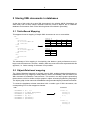
This approach uses a mapping of simple XML documents to one or more tables:
<A>
<B>
<C>ccc</C>
<D f=”111”>ddd</D>
<E >eee</E>
</B>
<B>
<C>fff</C>
<D f=”222”>ggg</D>
<E>hhh</E>
</B>
<F>
<G>iii</G>
</F>
</A>
Table
docId
635
635
…
B
C
ccc
fff
…
Table
docId
635
…
F
G
iii
…
D
ddd
ggg
…
f
111
222
E
eee
hhh
…
The advantage of this mapping is its simplicity that leads to good performance even in
large-scale environments. However, arbitrary XML structures cannot be expressed with this
approach, i.e. further nesting of elements is not possible.
2.2 Object-Relational mapping
The Object-Relational approach is typically used in XML-enabled relational databases or
middleware tools (e.g. mapping of Entity Beans in EJB to an RDBMS). With this method, an
XML document is treated as a tree structure. This results in an object graph representing
the document, which is similar to object graphs in object-oriented programming languages.
The object graph is then stored in the database using standard object persistence methods.
To create the database schema associated with a certain type of XML documents, the
corresponding DTD is first mapped to classes:
DTD
<!ELEMENT
<!ATTLIST
<!ELEMENT
<!ELEMENT
<!ELEMENT
<!ELEMENT
Classes
A
A
B
C
D
E
(B | C)>
F CDATA #REQUIRED>
(#PCDATA)>
(D, E)>
(#PCDATA)>
(#PCDATA)>
class A {
String b;
String f;
C c;
}
class C {
String d;
String e;
}
7
Attributes and elements that contain only PCDATA are mapped to scalar properties in the
classes. Elements that contain other elements are mapped to classes and properties of the
according type.
As a second step, the resulting classes are then mapped to tables in the database schema:
Classes
Tables
class A {
String b;
String f;
C c;
}
Table A (
Column b
# Nullable
Column f
# Not nullable
Column c_fk # Nullable
)
class C {
String d;
String e;
}
Table C (
Column c_pk # Not nullable
Column d
# Not nullable
Column e
# Not nullable
)
With this mapping, a foreign key is used to express the object reference.
There are of course many more mappings of XML data to a relational database. They are
mostly based on a graph modelling the underlying XML document. Some of these
approaches are presented in [FK99a] and [FK99b].
2.3 Drawbacks
There are several drawbacks to the two approaches presented above:
§
The mappings may lead to a large number of tables in the database. Although the
mappings try to avoid introducing new tables whenever possible, the number of
tables is proportional to the number of elements defined in the DTD. (A mapping
with a constant number of tables is presented in [FK99a]. However, performance
evaluation has shown that this slows down querying.)
§
The relational approach is not very intuitive in the context of XML data. This makes
it somewhat inelegant to formulate queries.
There are two characteristics that all of these approaches have in common:
§
The database schema is dependent on the DTD of the documents stored. This
might be problematic in scenarios where documents of many different types (i.e.
DTDs) are to be stored in the same database. There is a potential for conflicts
occurring between elements with the same name but different syntax and
semantics in different DTDs.
§
Fidelity to the original document is not preserved. This is because the above
methods only model a document’s elements and attributes. Other items of an XML
document like comments and processing instructions are omitted.
Both characteristics are the result of the mappings being data-centric rather than
document-centric. Data-centric documents are usually more structured and more finegrained with the order of the elements being unimportant. They are mainly intended for
processing through software. Document-centric documents, however, are usually intended
for human consumption. Their structure is less regular and the order of their elements
8
matters. Processing instructions are often essential, e.g. to inform a processor to apply a
certain stylesheet to a document. Examples of data-centric documents include air travel
information, stock quotes and orders. Typical document-centric documents include user
manuals, news articles and web pages.
A more natural mapping can be accomplished by using an underlying object-oriented
database system. AMOS II has already been used for this as depicted in [KLR01].
However, that object-oriented database representation did not fully preserve the
corresponding XML document either. By contrast, the representation used in this work is an
object-oriented database representation with a one-to-one mapping to the original XML
document.
2.4 Document preserving storage
Because document-centric applications require documents to be stored with the original
structure preserved (i.e. including items other than elements and attributes), the mappings
presented so far cannot be used. Thus, other mappings have to be applied. The XML
community has developed several data models to store an XML document. Some of these
models are more complete than others and are therefore more or less suitable for storing a
document without losing too many of its features. What document-preserving approaches
have in common is that they provide a logical model for an XML document rather than for
the data in the document. As the internal models of such systems are based on XML, they
are usually referred to as native XML databases.
The term “native XML database” (NXD) has never been defined formally. One possible
definition that was developed by the members of the XML:DB initiative2 reads as follows:
A native XML database…
•
Defines a (logical) model for an XML document – as opposed to the
data in that document – and stores and retrieves documents according
to that model. At a minimum, the model must include elements,
attributes, PCDATA, and document order. Examples of such models
are the XPath data model, the XML Infoset, and the models implied by
the DOM and the events in SAX 1.0.
•
Has an XML document as its fundamental unit of (logical) storage, just
as a relational database has a row in a table as its fundamental unit of
(logical) storage.
•
Is not required to have any particular underlying physical storage
model. For example, it can be built on a relational, hierarchical, or
object-oriented database, or use a proprietary storage format such as
indexed, compressed files.
With this definition in mind, the software in this project was developed as a small step
exploring the possibilities of extending AMOS II to provide some of the capabilities
found in native XML databases.
2
The aim of the XML:DB initiative (http://www.xmldb.org) is to develop standards and
specifications for XML databases. This includes the promotion of a standardized programming
interface for XML databases (XML:DB API) and an update language for XML documents
(XUpdate). Several products such as the Tamino XML Database and Apache Xindice provide
support for the XML:DB API.
9
3 Representing XML documents in AMOS II
Being a truly object-oriented system, AMOS II is almost ideally suited for mapping an XML
data model to a persistent structure in the database. In this project, it was decided to go for
the probably most straightforward approach of representing XML structures, namely using
a DOM-like database schema in the underlying AMOS II system. The decision in favour of
DOM was made for several reasons: First, the DOM data model is widely used and thus
well documented. The implementation presented in this paper allows users that are familiar
with the concepts of DOM to navigate intuitively through an XML document using simple
AMOS II commands. Second, DOM is supported by an abundance of tools readily
available. In this project, such a tool is used for performing XPath evaluation, thus providing
path-oriented queries over XML documents stored in AMOS II. Third, the implementation of
a more or less straightforward DOM data model in AMOS II serves as a reference point for
future work and improvement.
3.1 The Document Object Model
The Document Object Model (DOM) [W3C00b] is an application programming interface
(API) for valid HTML and well-formed XML documents. It defines the logical structure of
documents and the way a document is accessed and manipulated. DOM allows an
application to create documents, navigate their structure and add, modify and delete
elements, attributes and content. It is important to note that DOM is not an implementation
carrying out these tasks. DOM is just a specification that is originally defined in Object
Management Group (OMG) IDL. Additionally, language bindings for Java and ECMAScript
are provided by the W3C.
The DOM models the document that it represents with a tree-like object graph. Consider
the following well-formed XML document:
<?xml version=”1.0”?>
<!DOCTYPE periodictable SYSTEM 'periodic.dtd'>
<periodictable>
<atom>
<name>Helium</name>
<symbol>He</symbol>
<meltingpoint units=”Kelvin”>0.95</meltingpoint>
</atom>
<atom>
<name>Aluminium</name>
<symbol>Al</symbol>
<meltingpoint units=”Kelvin”>933.5</meltingpoint>
</atom>
</periodictable>
<!-- Warning: This periodic table is incomplete. -->
10
DOM exposes this document as the following tree structure:
: Document
nodeName = “#document“
nodeValue = null
: DocumentType
: Element
: Comment
nodeName = “periodictable“
nodeValue = null
nodeName = “periodictable“
nodeValue = null
nodeName = “#comment“
nodeValue = “Warning…“
: Element
: Element
nodeName = “atom“
nodeValue = null
nodeName = “atom“
nodeValue = null
: Element
: Element
: Element
: Element
: Element
: Element
nodeName =
“name“
nodeValue = null
nodeName =
“symbol“
nodeValue = null
nodeName =
“meltingpoint“
nodeValue = null
nodeName =
“name“
nodeValue = null
: Text
: Text
: Text
: Text
: Text
: Text
nodeName =
“#text“
nodeValue =
“Helium”
nodeName =
“#text“
nodeValue =
“He”
nodeName =
“#text“
nodeValue =
“0.95”
nodeName =
“#text“
nodeValue =
“Aluminium”
nodeName =
“#text“
nodeValue =
“Al”
nodeName =
“#text“
nodeValue =
“933.5”
nodeName =
nodeName =
“symbol“
“meltingpoint“
nodeValue = null nodeValue = null
The object graph in DOM is composed of so-called nodes as shown above. Each node is of
a certain node type (Document, Element, Text etc.) with twelve possible node types
(interfaces) in total. Depending on its type, a node can have children that are stored in an
ordered list. All the specific node types like Document, Element, Text etc. are descendants
of the general node type Node. This interface defines some common properties and
methods, notably the properties nodeName and nodeValue as shown in the diagram
above.
The following table summarizes the twelve node types and their possible child nodes as
found in the DOM specification:
Node Type
Document
Allowed Children
Element, ProcessingInstruction,
Comment, DocumentType
DocumentFragment
Element, ProcessingInstruction,
Comment, Text, CDATASection,
EntityReference
none
DocumentType
EntityReference
Element, ProcessingInstruction,
Comment, Text, CDATASection,
EntityReference
Description
Represents the whole XML document and is the root
node of the document tree. Each document contains zero
or one node for the document type, one node for the root
element and zero or more comments or processing
instructions.
Provides an abstraction of a subtree in the XML
document. Used to extract or insert portions of a
document.
Represents the <!DOCTYPE …> declaration and
provides an interface to the list of entities (e.g. €)
defined for the document.
Represents a reference to an entity other than a
reference to a predefined entity or a character. (An XML
processor needs not provide EntityReference objects and
11
Element
Attr
Element, Text, Comment,
ProcessingInstruction,
CDATASection, EntityReference
Text, EntityReference
ProcessingInstruction
none
Comment
Text
none
none
CDATASection
none
Entity
Element, ProcessingInstruction,
Comment, Text, CDATASection,
EntityReference
none
Notation
can just expand entities instead.)
Represents an element (e.g. <person>…</person>) in an
XML document.
Represents an attribute in an Element node (e.g. <person
name=”Henric”>…</person>).
Represents a processing instruction (e.g. <?xmlstylesheet href="mystyle.css" type="text/css"?>). Note
that the XML declaration (<?xml version=”1.0”?>) is not a
processing instruction as processing instructions must not
begin with the sequence <?xml. [W3C00a]
Represents a comment (e.g. <!-- ignore -->)
Represents the textual content (“character data”) in an
Element node (e.g. “Henric” in <name>Henric</name>).
Special characters (e.g. & and <) that are represented in
the original document by a predefined entity reference or
character reference are replaced by the actual characters
they stand for.
Represents a section of text containing character
sequences (like < or &) that would otherwise be regarded
as markup (e.g. <![CDATA[ if (a > 10 && b) invoke(); ]]>)
Represents a (parsed or unparsed) entity declared in the
document’s DTD (e.g. <!ENTITY euro "€">).
Represents a notation declared in the document’s DTD
(e.g. <!NOTATION PNG SYSTEM
"http://www.w3.org/TR/REC-png">)
Please note that the four node types DocumentFragement, Attr, Entity and Notation are not
considered part of the document tree. They are not in any other node’s children list and
thus not present in the example above. Because these nodes are not children of the nodes
they are attached to, they are accessible through special properties of Element and
Document nodes.
Please also note that the XML declaration (<?xml version=”1.0”?>) is not a processing
instruction and thus not present in the document tree above.
Besides the original DOM specification presented by the W3C, there are a number of
alternative models [Sos01] that slightly differ from the W3C model. Products like JDOM3
and dom4j4 try to speed up and simplify DOM functionality in Java through the definition of
a somewhat modified object model than the one originally proposed by the W3C.
3
4
http://www.jdom.org
http://www.dom4j.org
12
3.2 Database Schema
Due to the object-oriented nature of the AMOS II system, it was possible to map the DOM
Level 2 data model to a database schema in a rather straightforward way (see diagram
below). However, the three node types EntityReference, Entity and Notation have been
omitted in the database schema. Entity references are not represented in the database for
efficiency reasons. It would be highly inefficient to create a database object for every single
occurrence of an entity reference. Thus, entity references are always expanded and
merged with the surrounding Text nodes. This design decision implies that the value of
creating Entity nodes in the database would be very limited: If there are no references to
entities, then the entities themselves contain no valuable information. Finally, Notation
nodes are omitted because they’re very uncommon and hardly ever used in applications.
The general (simplified) overview of the database schema is shown in the following
diagram.
13
Database Schema
Node
ownerDocument (?)
childNodes (*)
parentNode (?)
Document
doctype (1)
nodeName: charstring
nodeValue: charstring
namespaceURI: charstring
prefix: charstring
localName: charstring
lastChild (?)
firstChild (?)
previousSibling (?)
nextSibling (?)
DocumentType
ProcessingInstruction
name: charstring
publicId: charstring
systemId: charstring
internalSubset: charstring
target: charstring
data: charstring
nodeName: charstring
nodeValue: charstring
nodeName: charstring
Symbols used
Type
CharacterData
stored function: literal type
data: Charstring
derived function: literal type
nodeValue: charstring
inheritance (is a)
stored function referencing
objects of user-defined type
derived function / procedure
referencing objects of userdefined type
Cardinalities: (1) exactly one, (?) zero or one,
(*) zero or more
Text
Comment
CDATASection
Attr
attrib (*)
Element
value: charstring
name: charstring
nodeName: charstring
nodeValue: charstring
ownerElement (1)
tagName: charstring
nodeName: charstring
14
One important goal during the design of the database schema was to implement as much
as possible directly in the AmosQL. Thus, all of the crucial properties of the DOM Level 2
data model specified by [W3C00b] have been implemented in the database using either
stored functions, derived functions or procedures in AMOS II. The following tables
summarize these properties. If the semantics of a property matches the semantics defined
in [W3C00b], then the name of the property is identical wherever possible. Please refer to
the implementation in AmosQL for full details.
Node
Function / Procedure Return type
nodeName
Charstring
Description
value depending on node type (see respective
table)
value depending on node type (see respective
table)
see types Element and Attr, null for other types
see types Element and Attr, null for other types
see types Element and Attr, null for other types
the child nodes of this node
the parent node of this node
the first child node of this node
the last child node of this node
the node immediately preceding this node
the node immediately following this node
the document containing this node
see type Element, null for other types
nodeValue
Charstring
namespaceURI
prefix
localName
childNodes
parentNode
firstChild
lastChild
previousSibling
nextSibling
ownerDocument
attrib5
Charstring
Charstring
Charstring
bag of Node
Node
Node
Node
Node
Node
Document
bag of Attr
Document
Function / Procedure
nodeName
nodeValue
doctype
Return type
Charstring
Charstring
DocumentType
Description
fixed value “#document”
null
The document type declaration associated with
this document.
DocumentType
Function / Procedure
nodeName
nodeValue
name
Return type
Charstring
Charstring
Charstring
publicId
systemId
internalSubset
Charstring
Charstring
Charstring
Description
same value as function name
null
the name of the DTD; i.e. the name immediately
following the DOCTYPE keyword
the public identifier of the internal subset
the system identifier of the internal subset
the internal subset of the DTD as a string
ProcessingInstruction
Function / Procedure Return type
nodeName
Charstring
nodeValue
Charstring
target
Charstring
data
Charstring
5
Description
same value as function target
same value as function value
the target of the processing instruction
the content of the processing instruction (string
starting with first non-whitespace character
immediately after the target)
The DOM specification calls this property “attributes”. As there is a predefined function by that
name in AMOS II, the identifier has been modified to “attrib”.
15
Text
Function / Procedure Return type
nodeName
Charstring
nodeValue
Charstring
data
Charstring
Description
fixed value “#text”
same value as data
the string contained in this node
CDATASection
Function / Procedure
nodeName
nodeValue
data
Return type
Charstring
Charstring
Charstring
Description
fixed value “#cdata-section”
same value as data
the string contained in this node
Comment
Function / Procedure Return type
nodeName
Charstring
nodeValue
Charstring
data
Charstring
Description
fixed value “#comment”
same value as data
the string contained in this node
Element
Function / Procedure
nodeName
nodeValue
namespaceURI
prefix
localName
tagName
Return type
Charstring
Charstring
Charstring
Charstring
Charstring
Charstring
attrib
bag of Attr
Attrib
Function / Procedure
nodeName
nodeValue
namespaceURI
prefix
localName
name
Return type
Charstring
Charstring
Charstring
Charstring
Charstring
Charstring
value
ownerElement
Charstring
Element
Description
same value as tagName
same value as data
the namespace URI of this element
the namespace prefix of this element
the local name of this element
the qualified name of this element (i.e.
localName or a concatenation of prefix, a colon
and localName)
the attributes of this element
Description
same value as name
same value as value
the namespace URI of this attribute
the namespace prefix of this attribute
the local name of this attribute
the qualified name of this attribute (i.e.
localName or a concatenation of prefix, a colon
and localName)
the value assigned to this element
the element owning this attribute
In DOM, the base type Node defines some properties like namespaceURI that are not
actually used by its descendants (e.g. ProcessingInstruction). These properties are not
repeated in the descendants’s tables above although they’re inherited, of course.
16
4 Implementation of the Extensions
4.1 General Architecture
AMOS II
objects to create
objects read
(tree traversal)
result:
text
W3C DOM
result:
objects
objects
read
implements
XML Extensions
Builder
Flattener
uses
SAX Parser (Xerces)
Evaluator
uses
uses
reads
XML Files
Simple DOM Impl.
uses
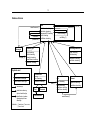
XPath Engine (Jaxen)
The XML Extensions implemented in this project are divided into the four modules Builder,
Evaluator, Flattener and Simple DOM Implementation. The Builder module is used to
import XML files into the database (wrapper). The Flattener traverses a subtree indicated
by a root node (e.g. an entire document) and emits the subtree in its flat string
representation. The Evaluator takes a document and an XPath expression and returns the
matching nodes. Finally, the Simple DOM Implementation is used as a glue layer between
the database and third party tools (currently Jaxen). These four modules will be discussed
in detail in the following sections.
4.2 Importing XML documents: The Builder
4.2.1 Simple API for XML
The XML Wrapper uses the Simple API for XML (SAX6) for importing XML documents into
the database. SAX is an event-driven way of reading XML documents. This means that the
user of a SAX parser has to implement some interfaces that define a set of parsing events.
Before starting the parse, the implementation is passed to the parser for callback. As the
parser then reads the file, it emits a stream of so called parse events by invoking the
respective methods of the registered implementation. The parser is sometimes referred to
as the producer, while the implementation provided by the user is referred to as the
consumer.
Unlike other XML technologies, SAX acts like a serial I/O stream. Data is seen as it
streams in, but there is no way to go back to an earlier position or forward to a later
position. The granularity with which events are processed by the application can be defined
by implementing only a certain subset of the interfaces.
6
http://www.saxproject.org
17
The following listing shows an XML file and the corresponding event stream:
XML file
SAX Event Stream
<?xml version=”1.0”?>
<record type=”cd”>
<artist>
The White Stripes
</artist>
</record>
startDocument
startElement: record
attributes: type “cd”
startElement: artist
characters: “The White Stripes”
endElement: artist
endElement: record
endDocument
The advantage of the SAX technology is that it is fast and, unlike a DOM tree, requires very
little memory. However, many operations on XML documents cannot be carried out if only
an event stream is present. XPath for example needs access to a tree modelling the
document in order to evaluate expressions.
4.2.2 Java Implementation
The DOM representation of an XML file in the database is created by the Builder class of
the XML Extensions. It is an implementation of the SAX parsing event interfaces
ContentHandler, LexicalHandler, DeclHandler, DTDHandler and ErrorHandler.
To build the tree structure of the DOM representation by processing the event stream, the
Builder class has to keep track of the current position in the tree. Whenever a startElement,
processingInstruction or comment event occurs, a new node of the respective type is
attached as a child node to the Element node last created. To deal with this, the Builder
class uses an internal stack: Every time a startElement event is reported, the newly created
Element node is pushed onto the stack. Thus, events that are triggered later create child
nodes of the topmost Element on the stack. Whenever an endElement event occurs, the
topmost Element is popped from the stack.
SAX also requires special handling of character events to create a Text node in the DOM
representation. SAX may read characters in chunks and report a continuous string through
multiple events. A single Text node may thus be the result of several calls to the SAX event
character. The Builder class handles this by appending strings reported by the character
event to an internal buffer. This buffer is written out to the database as a Text node only
upon notification of a startElement, endElement, processingInstruction or comment event.
Only then it is sure that there cannot be any more character events that refer to the same
Text node.
4.2.3 Parsing Issues
The wrapper developed in this project uses the Xerces-J7 SAX parser by the Apache XML
Project8. As most parsers, it supports two different modes of operation called validating and
non-validating mode. The wrapper provides a switch for the user to decide which mode to
use. The main difference between the two modes is that with validation, the parser is
required to read the document’s DTD. If it cannot fetch the DTD, an error occurs. In nonvalidating mode, however, the parser can read the DTD. Whether it actually reads the DTD
(i.e. whether the external DTD file can be fetched) influences the parsing behaviour. For the
wrapper, the following aspects that are linked to the parsing mode are important:
7
8
http://xml.apache.org/xerces2-j
http://xml.apache.org
18
Checking against model
Checking against the model means that the parser makes sure that a document complies
with its DTD, i.e. that it is valid and not just well-formed [W3C00a]. Elements for example
are checked if they occur in an allowed context. If an XML document is invalid, the errors
are reported, but the document is still parsed. Xerces performs model checking only if the
user explicitly requires validating mode. If the DTD cannot be read in validating mode, the
document is still parsed, but a warning is reported.
Ignorable Whitespaces
Ignorable whitespaces are used in XML documents solely for the convenience of a human
reader. In the following XML document, the ignorable whitespaces are marked with a
dotted line:
<?xml version=”1.0”?>
<!DOCTYPE catalog [
<!ELEMENT catalog (record*)>
<!ELEMENT record (#PCDATA)>
]>
<catalog>
<record>The White Stripes</record>
<record>Flaming Lips
</record>
</catalog>
In this fragment, the definition of the catalog element specifies that it only consists of record
elements and must not contain character data. Thus, the dotted whitespaces before the
<record> tag cannot be character data. They’re only provided to make the document more
readable and are thus ignorable to applications. However, the trailing whitespaces after the
string “Flaming Lips” up to the </record> tag are not ignorable because the record element
is defined as containing character data. Because ignorable whitespaces are meaningless
for most applications, the wrapper just discards them. Storing them in the database would
be an unnecessary waste of space. However, if the parser cannot fetch a document’s DTD,
then it cannot decide if a whitespace sequence is ignorable or not. In this case, the wrapper
stores all whitespaces in the database. To avoid this situation, it is recommended to
carefully check the error and warning messages issued by the parser.
Attribute Defaulting
DTDs allow users to specify default values for attributes. When a parser then encounters
an unspecified attribute in an XML file, it defaults it to the value as defined in the DTD.
Attribute defaulting is only possible if the parser has access to the DTD, of course. In a
DOM representation, the node type Attr usually has a property called specified. This
property indicates whether the attribute was specified in the original document or defaulted
by a parser. Unfortunately, this information is not provided by SAX parsers. For this reason,
there is no such property stored in the database.
Entity Expansion
Whenever Xerces has access to the DTD, it expands all general entity references
recursively. But when the DTD cannot be read, the references cannot be resolved. For an
unresolvable reference outside an attribute value, the parser reports this to the application
with the skippedEntity event. However, for an unresolvable reference in an attribute value,
SAX provides no way to report this to the application. This means that the application will
simply not see the unresolvable entity reference. As this limitation causes some loss of
information anyway, the wrapper does not store unresolvable entities in the database at all.
This decision can also be justified by the high overhead that storing of single entity
references would generate.
19
For the various reasons outlined in this section, it is generally recommended to use the
wrapper in validating mode.
4.3 Querying documents: The Evaluator
The XML Path Language (XPath) [W3C99a] is a language for addressing parts of an XML
document. Like DOM, the underlying data model of XPath defines an XML document as a
tree of nodes. However, the two models differ in many ways. The XPath language is
commonly used by both XSLT and XPointer.
In the project presented in this paper, the XPath language is used to retrieve portions of an
XML document stored in the database. Together with a reference to a document or any
part of it, an XPath expression can be passed to the evaluation function. This function then
returns all the nodes that match the XPath expression.
4.3.1 The Jaxen Framework
To evaluate XPath expressions, the XML Extensions make use of the Jaxen9 framework.
This package provides a universal XPath engine capable of evaluating expressions across
different underlying object models. The models currently supported by Jaxen are DOM,
JDOM, dom4j and JavaBeans. Jaxen can be flexibly extended to support additional object
models by implementing a predefined interface. The project has its roots in an XPath
engine for both JDOM and dom4j. It was decided to factor out the common functionality
and to provide a general framework for XPath evaluation.
4.3.2 The Simple DOM Implementation
Jaxen requires the underlying documents to be accessible through the DOM API. For this
reason, the XML extensions contain a simple DOM implementation. This module exhibits
the documents stored in the AMOS II database through the standard DOM API as defined
by the W3C. However, the W3C specification of DOM is rather large and requires the
implementation of more than 100 methods. Due to the limited time available for this project,
only the methods required by Jaxen have been implemented. Writing access to the
document, for example, is not possible. All the methods not directly needed by Jaxen are
implemented with placeholders that simply issue an error message on invocation. Still, this
simple implementation of DOM provides all the necessary operations to carry out basic
read-only tasks with the documents stored in AMOS II.
The simple DOM implementation consists of twelve classes in total. The following code
sample illustrates how a W3C DOM object that represents an XML document stored in
AMOS II can be created in Java when called as a foreign function from AMOS II:
public void someAmosForeignFunction(
CallContext cxt, Tuple tpl)
throws AmosException {
Oid oid = tpl.getOidElem(0);
org.w3c.Document doc = new SimpleDocumentImpl(oid);
...
}
9
http://www.jaxen.org
20
The simple DOM implementation uses lazy initialization if possible. That is, data is only
fetched from the AMOS II database when needed. When a property of the DOM object in
Java is accessed, its value is transparently loaded from the database.
Unlike DOM implementations generally used, the solution developed in this project does
not suffer from excessive memory consumption in the Java application. DOM tools like
Jaxen usually operate on the complete DOM tree of a document in the Java memory.
Depending on the size of the document processed, memory consumption can be relatively
high. By contrast, the DOM implementation used in this project builds the DOM tree step by
step: The DOM tree grows only as data is fetched from the database, because it is actually
needed by the application.
4.3.3 Putting it together: Jaxen and the Simple DOM Implementation
With these two building blocks, it is rather easy to apply XPath querying to the XML
documents stored in the AMOS II database. The following code section selects all nodes in
a document doc matching a given XPath expression and emits them to the AMOS II query
executor.
// create object representing XPath expression
org.jaxen.XPath xpath =
new org.jaxen.dom.DOMXPath(“/sample/xpath/expression”);
// query document (doc is of class SimpleDocumentImpl)
Iterator result = xpath.selectNodes(doc).iterator();
while (result.hasNext()) {
// fetch node matching XPath expression
SimpleNodeImpl node = (SimpleNodeImpl)result.next();
// return oid of node to AMOS II
tpl.setElem(2, node.getId());
cxt.emit(tpl);
}
4.4 Exporting nodes: The Flattener
To export an XML document or a fragment of it to a string representation, the Flattener
module is used. This string representation produced by it can be written to a file in order to
recreate the original XML file outside the database. The module is implemented by the
Flattener class.
To build the string representation, the module uses a simple pre-order traversal algorithm.
Like the Evaluator, it operates on the Simple DOM Implementation. The module can be
passed a single node indicating the root node of a subtree. An entire XML file can be
reconstructed by calling the Flattener module with the root node of the document as a
parameter. Flattening of subtrees is also useful to print the result of an XPath evaluation.
Please note that the resulting string representation of the XML document might not be
physically equivalent10 to the original XML file. This is, again, due to a limitation of the SAX
10
However, the XML documents might still be logically equivalent in a given application context.
Further information regarding an operator to test for document equivalence can be found in
[W3C01].
21
parsing technology. As discussed earlier, SAX cannot supply the Specified property of an
attribute. Therefore, there is no reliable way to reconstruct the original document by the
sole means provided by SAX.
The same difficulty applies to the representation of an empty element. When parsed with
SAX, the two sequences <element></element> and <element/> generate exactly the same
event stream. Hence, in the output of the Flattener module, you will always find two tags
denoting an empty element, no matter what the original sequence was.
A similar but more serious problem occurs with formatting the output of the Flattener
module. XML files are usually indented to make them more readable for humans. The idea
of indenting is to add ignorable whitespaces to the document. However, as discussed
above, indenting cannot be applied to a document without prior knowledge of its grammar
(DTD). If whitespaces are mechanically added to a document without considering its DTD,
the semantics of the document might change, as not all created whitespaces are ignorable.
In the context of long term storage (typically in a database), problems with external DTDs
arise: In order to recreate a string representation equivalent to the original XML file, the
whole DTD has to be accessible. Because external subsets might not be accessible in the
future, it might be advantageous to store them in the database.
Because the software developed in this project does not store external DTD subsets in the
database, it is not possible to reconstruct a pretty printed string representation equivalent to
the original document. The Flattener module thus provides the option of building the string
representation with pretty printing either switched on or off. With pretty printing switched off,
the resulting string is more difficult to read for humans. But at the same time, it is
guaranteed not to differ from the original document because of output formatting.
22
5 Using the XML Extensions in AMOS II
5.1 Function Reference
The XML Extensions are accessible in AMOS II through the following foreign functions:
store(Charstring uri, Integer validation, Integer cdata) -> Node
Imports an XML document into the AMOS II database. A reference to the stored document is
returned.
Parameters
uri
A string containing a local filename or a URL to the XML file that
is to be imported.
validation
The number 0 or 1 to indicate if validation is switched on (1) or off
(0) during parsing of the document.
cdata
The number 0 or 1 to indicate if CDATA sections are stored as
CDATASection nodes (1). A value of 0 indicates that CDATA
sections should be stored as normal Text nodes and, if possible,
be merged with adjacent text.
evaluateNS(Node subtree, Charstring expression, Vector bindings)
-> bag of Node
Evaluates an XPath expression in the context of a certain subtree (e.g. a whole document) and
returns all matching nodes.
Parameters
subtree
The root node of the context in which the expression is to be
evaluated.
expression
Any valid XPath expression.
bindings
Namespace bindings used during evaluation. The vector consists
of interleaving prefixes and namespace URIs. E.g.: {“html”,
“http://www.w3.org/1999/xhtml”, “env”,
“http://schemas.xmlsoap.org/soap/envelope”}
evaluate(Node subtree, Charstring expression) -> bag of Node
Evaluates an XPath expression in the context of a certain subtree (e.g. a whole document) and
returns all matching nodes. This function is just an abbreviation for the function evaluateNS with
an empty bindings vector.
flatten(Node subtree, Integer pretty) -> Charstring
Returns the string representation of an XML document or fragment.
Parameters
subtree
The root node of the subtree to be converted to its string
representation.
23
pretty
The number 0 or 1 to indicate if the output should be formatted to
be more readable by humans. Please note: Pretty printing might
change the XML data in a way that does not retain equivalence to
the original XML file.
pretty(Node subtree) -> Charstring
Returns the string representation of an XML document or fragment. This function is just an
abbreviation for the function flatten with pretty printing switched on.
verbose(Integer mode) -> Boolean
The functions of the XML Extensions collect data on the internal steps carried out. If verbose
mode is switched on, this data is displayed at the end of each function call. Please note that the
times displayed in the brackets are accumulated and not per-call times.
Parameters
mode
The number 0 or 1 indicating if extra information is shown at the
end of each function call.
5.2 Usage examples
The following examples use an XML document called example.xml 11 with the following
content modelling an imaginary online shop for records:
<?xml version="1.0"?>
<!DOCTYPE catalog SYSTEM 'example.dtd'>
<?xml-stylesheet href="webpage.xsl" type="text/xsl"?>
<!-- data from an imaginary record shop -->
<catalog xmlns:html="http://www.w3.org/1999/xhtml">
<entry type="cd">
<artist>Kent</artist>
<title>Vapen & Ammunition</title>
<style>Pop/Rock</style>
<price>17</price>
<comment user="Lena">Best album <html:I>ever</html:I>! Check it out!</comment>
<comment user="Magnus">After all the hype: Rather disappointing.</comment>
</entry>
<entry type="cd">
<artist>Suede</artist>
<title>Coming Up</title>
<style>Pop/Rock</style>
<price>19</price>
<comment user="Sofia">Still <html:B>great</html:B> - even without Bernard.</comment>
</entry>
<entry type="lp">
<artist>Tricky</artist>
<title>Blockback</title>
<style>Triphop</style>
<price>25</price>
</entry>
<entry type="cd">
<artist>White Stripes</artist>
11
The file can be found in the samples directory of the source distribution.
24
<title>White Blood Cells</title>
<style>Independent</style>
<price>19</price>
<comment user="Lena">Hotel Yorba rocks!</comment>
</entry>
</catalog>
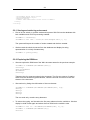
5.2.1 Storing and retrieving a document
§
First of all, we switch on verbose mode and import an XML file into the database with
both validation and CDATA processing enabled:
JavaAMOS 1> verbose(1);
JavaAMOS 2> set :doc = store("c:\xml\example.xml", 1, 1);
The system will report the number of nodes created and the time needed.
§
We then read the whole document from the database and display its string
representation in a nicely formatted way:
JavaAMOS 3> pretty(:doc);
5.2.2 Exploring the DOM tree
§
We now explore the DOM tree of the XML document stored in the previous example:
JavaAMOS 4> nodeName(childNodes(:doc));
"catalog"
"xml-stylesheet"
"#comment"
"catalog"
These are the four topmost nodes in the document. The first occurrence of catalog
stems from the document type declaration, while the second occurrence is the root
element of the document.
§
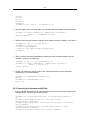
We continue by listing the child nodes of the root element:
JavaAMOS 5> nodeName(childNodes(childNode(:doc, 3)));
"entry"
"entry"
"entry"
"entry"
The root node only contains entry elements.
§
To reduce the typing, we first select the first entry element into the variable :e. We then
display its child nodes again and select the first child into the variable :artist.
JavaAMOS 6> set :e = childNode(childNode(:doc, 3), 0);
JavaAMOS 7> nodeName(childNodes(:e));
"artist"
25
"title"
"style"
"price"
"comment"
"comment"
JavaAMOS 8> set :artist = childNode(:e, 0);
§
Now we display the name and value of the child nodes found under the element artist:
JavaAMOS 9> select nodeName(c), nodeValue(c) from Node c
where c = childNodes(:artist);
<"#text","Kent">
§
We then fetch the last element under the entry element into the variable :c and print it.
JavaAMOS 10> set :c = lastChild(:e);
JavaAMOS 11> pretty(:c);
"<comment user='Magnus'>
After all the hype: Rather disappointing.
</comment>
"
§
Then we select the node immediately preceding the last comment element into the
variable :c and print its attributes:
JavaAMOS 12> set :c = previousSibling(:c);
JavaAMOS 13> select nodeName(a), nodeValue(a) from Attr a
where a = attrib(:c);
<"user","Lena">
§
Finally, we retrieve the parent node of the comment element and the document
containing the comment element.
JavaAMOS 14> nodeName(parentNode(:c));
"entry"
JavaAMOS 15> ownerDocument(:c);
#[OID 713]
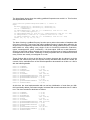
5.2.3 Querying the document with XPath
§
In this example, we extract all the comment elements from the document stored in the
example above and print the resulting nodes:
JavaAMOS 16> flatten(evaluate(:doc, "/catalog/entry/comment"),
0);
"<comment user='Magnus'>After all the hype: Rather
disappointing.</comment>"
"<comment user='Lena'>Best album <html:I>ever</html:I>! Check it
out!</comment>"
"<comment user='Sofia'>Still <html:B>great</html:B> - even
without Bernard.</comment>
"<comment user='Lena'>Hotel Yorba rocks!</comment>"
26
§
We then select only the comment by Magnus:
JavaAMOS 17> pretty(evaluate(:doc,
"/catalog/entry/comment[@user='Magnus']/text()"));
"After all the hype: Rather disappointing."
§
Next, we select the titles of all records selling for the same price as the album by
Suede. This time, we use the unabbreviated XPath syntax:
JavaAMOS 18> pretty(evaluate(:doc,
"/child::catalog/child::entry[price=/child::catalog/child::entry
[artist='Suede']/child::price/text()]/child::title/text()"));
"Coming Up"
"White Blood Cells"
§
Now we are interested to know the records with more than one user commenting on:
JavaAMOS 20> pretty(evaluate(:doc,
"/catalog/entry[count(comment) > 1]/title/text()"));
"Vapen & Ammunition"
§
In this example, we evaluate an XPath expression that is not in the context of an entire
document, but of an individual Text node. We first fetch the last Text node of Lena’s
comment into the variable :t. Then we select all the Element nodes on the same level
as the node stored in t:.
JavaAMOS 21> set :t = evaluate(:doc,
"/catalog/entry[artist='Kent']/comment[@user='Lena']/text()[posi
tion()=last()]");
JavaAMOS 22> pretty(evaluate(:t, "../*"));
"<html:I>
ever
</html:I>"
§
Finally, we select all the elements in the http://www.w3.org/1999/xhtml namespace:
JavaAMOS 23> pretty(evaluateNS(:doc, "//pref:*", {"pref",
"http://www.w3.org/1999/xhtml"}));
"<html:I>
ever
</html:I>"
"<html:B>
great
</html:B>"
27
6 Performance Measurements
6.1 Evolution of the system
The first implementation of the system used a slightly different approach of representing the
parent-child-relationship in XML documents. The idea was then, to store all the child nodes
in an indexed vector property of the parent node. The following AmosQL listing illustrates
the initial implementation:
create function childNodes(Node) -> vector of Node as stored;
create function nextSibling(Node n) -> Node s as
select s from integer i, integer j, Node p where
childNodes(p)[i] = n and
j = i + 1 and
childNodes(p)[j] = s;
To measure the performance of the system, the XML document periodic.xml 12 was
imported into the database. This 114 KB document containing the periodic table of the
elements consists of roughly 1900 element nodes, 1900 text nodes and 900 attributes. In
the context of this document, the XPath expression /PERIODIC_TABLE/ATOM/NAME was
then evaluated. Total runtime for evaluation was 135.154 s with the following details13:
Calls
Calls
Calls
Calls
Calls
Calls
Calls
to
to
to
to
to
to
to
getBasicProperties:
getExtendedNextSibling:
getExtendedPrevSibling:
getExtendedParentNode:
attrib:
getExtendedChildNodes:
ownerDocument:
1899 (5874 ms)
1898 (127877 ms)
0 (0 ms)
0 (0 ms)
0 (0 ms)
114 (1144 ms)
0 (0 ms)
XPath evaluation with Jaxen obviously requires numerous database calls to fetch the next
sibling of a node. To improve performance, it was decided to give up vector storage and
use a linked list with a stored nextSibling property instead. The database schema was
modified to reflect this change and performance was measured again. Total runtime
decreased to 9.804 s with the following details:
Calls
Calls
Calls
Calls
Calls
Calls
Calls
to
to
to
to
to
to
to
getBasicProperties:
getExtendedNextSibling:
getExtendedPrevSibling:
getExtendedParentNode:
attrib:
getExtendedChildNodes:
ownerDocument:
1899 (6869 ms)
1898 (1253 ms)
0 (0 ms)
0 (0 ms)
0 (0 ms)
114 (1332 ms)
0 (0 ms)
Changing the datastructure from a vector to a linked list also sped up the document’s
loading time. Originally, a parent node’s child nodes vector was built by appending nodes
with the following statement:
set childNodes(parent) = concat(childNodes(parent), {child});
With the new datastructure, nextSibling references are added instead. Performance
evaluation showed that loading speed had nearly doubled by changing from a vector to the
linked list, too.
12
See samples directory in the source distribution.
The first number in a row indicates the number of calls to a function, while the number in the
bracket sums up the time that was needed for these calls.
13
28
The times listed above show that calling getBasicProperties now took 6.9 s. This function
was implemented as follows:
create function getBasicProperties(Node n) -> vector as
begin
declare charstring c1, charstring c2, charstring c3,
charstring c4, charstring c5, charstring c6;
set c1 = nodeName(n);
if some(nodeValue(n)) then set c2 = nodeValue(n) else set c2 = NIL;
set c3 = lower(name(typeof(n)));
if some(namespaceURI(n)) then set c4 = namespaceURI(n) else set c4 = NIL;
if some(prefix(n)) then set c5 = prefix(n) else set c5 = NIL;
if some(localName(n)) then set c6 = localName(n) else set c6 = NIL;
result {c1, c2, c3, c4, c5, c6};
end;
The idea of having a getBasicProperty function was to reduce the number of database calls
from Java. However, it turned out that calling getBasicProperty is slower than calling the six
single functions separately. Measurements showed that calling getBasicProperty 110 times
takes 3885 ms, while calling every single of the six functions (nodeName, nodeValue,
typeof, namespaceURI, prefix, localName) 110 times takes 1292 ms in total. Moreover,
analysis of the XPath engine showed, that it would be sufficient just to fetch localName and
namespaceURI in most cases. Clustering of these properties was not considered because
many of them are usually not assigned to a node.
These findings led to giving up the idea of a property that gets the six values in a single
database call. Instead, they are now fetched in many individual calls whenever needed. As
a result of this, evaluation time of the XPath expression decreased from 9.804 s to 3.565 s
with the following details:
Calls
Calls
Calls
Calls
Calls
Calls
Calls
Calls
Calls
Calls
Calls
Calls
to
to
to
to
to
to
to
to
to
to
to
to
nodeName:
nodeValue:
nodeType:
namespaceURI:
prefix:
localName:
getExtendedNextSibling:
getExtendedPrevSibling:
getExtendedParentNode:
attrib:
getExtendedChildNodes:
ownerDocument:
0 (0 ms)
0 (0 ms)
0 (0 ms)
1897 (482 ms)
0 (0 ms)
1897 (410 ms)
1898 (1192 ms)
0 (0 ms)
0 (0 ms)
0 (0 ms)
114 (1331 ms)
0 (0 ms)
At this time, the Java implementation did not use lazy initialization of node lists yet. With
this functionality added, performance again increased with a total evaluation time of 1.883 s
now. The times needed in detail are as follows:
Calls
Calls
Calls
Calls
Calls
Calls
Calls
Calls
Calls
Calls
Calls
Calls
Calls
to
to
to
to
to
to
to
to
to
to
to
to
to
nodeName:
nodeValue:
getNodeType:
namespaceURI:
prefix:
localName:
getExtendedNextSibling:
getExtendedPrevSibling:
getExtendedParentNode:
attrib:
getExtendedFirstChild:
getExtendedChildNodes:
ownerDocument:
0 (0 ms)
0 (0 ms)
0 (0 ms)
1897 (431 ms)
0 (0 ms)
1897 (220 ms)
1898 (1132 ms)
0 (0 ms)
0 (0 ms)
0 (0 ms)
114 (40 ms)
0 (0 ms)
0 (0 ms)
29
6.2 Results
The following data summarizes the runtime behaviour of the system. It was collected on an
Intel Pentium III machine with 500 MHz processor speed and 256 MB main memory. The
software environment consisted of Windows 2000 (SP2) and the Java VM 1.4.0_01. Again,
the 114 KB XML document periodic.xml consisting of 1897 Element nodes, 1888 Text
nodes and 936 Attr nodes was imported.
§
Loading of the document14: 2.9 s.
This time consists of 742 ms needed by Xe rces to parse the document and the
following times for database calls:
Calls to create_Element: 1897 (1142 ms)
Calls to create_Attr:
936 (350 ms)
Calls to create_Text:
1887 (712 ms)
§
Space requirements: 1.68 MB
§
Query time for expression /PERIODIC_TABLE/ATOM[SYMBOL=’Cu’]: 1.9 s
The following database calls were needed:
Calls
Calls
Calls
Calls
Calls
Calls
Calls
Calls
Calls
Calls
Calls
Calls
Calls
§
nodeName:
nodeValue:
getNodeType:
namespaceURI:
prefix:
localName:
getExtendedNextSibling:
getExtendedPrevSibling:
getExtendedParentNode:
attrib:
getExtendedFirstChild:
getExtendedChildNodes:
ownerDocument:
0 (0 ms)
112 (40 ms)
0 (0 ms)
1897 (451 ms)
0 (0 ms)
1897 (251 ms)
1898 (931 ms)
0 (0 ms)
0 (0 ms)
0 (0 ms)
226 (70 ms)
112 (20 ms)
0 (0 ms)
Query time for expression /PERIODIC_TABLE/ATOM: 0.12 s
The following database calls were needed:
Calls
Calls
Calls
Calls
Calls
Calls
Calls
Calls
Calls
Calls
Calls
Calls
Calls
14
to
to
to
to
to
to
to
to
to
to
to
to
to
to
to
to
to
to
to
to
to
to
to
to
to
to
nodeName:
nodeValue:
getNodeType:
namespaceURI:
prefix:
localName:
getExtendedNextSibling:
getExtendedPrevSibling:
getExtendedParentNode:
attrib:
getExtendedFirstChild:
getExtendedChildNodes:
ownerDocument:
Average of 10 individual measurements.
0 (0 ms)
0 (0 ms)
0 (0 ms)
113 (0 ms)
0 (0 ms)
113 (20 ms)
114 (40 ms)
0 (0 ms)
0 (0 ms)
0 (0 ms)
2 (0 ms)
0 (0 ms)
0 (0 ms)
30
7 Conclusion and Future Work
In this project, a fully functioning set of XML extensions to the AMOS II database have
been developed. With AMOS II, XML documents of any (possibly unknown) schema can be
integrated in a distributed environment that consists of many heterogeneous data sources.
Imported documents or parts of them can be queried by using an XPath evaluation module.
This module provides support for the full XPath language as specified by the W3C. The
results of these XPath queries can be exported back to a string representation that could
be written to an XML file. These features are available in AMOS II through foreign functions
and can thus be easily integrated in any AmosQL expression.
In addition to this, a simple implementation of the W3C DOM API has been developed. It is
now possible for Java programmers to access XML data stored in AMOS II through the
most widely used XML API. Any existing Java library operating on XML data can be
combined easily with AMOS II, as long as it supports the W3C DOM API. Because the XML
data is stored in a DOM-like database schema, no reparsing of documents is needed. An
advantage of the simple DOM implementation is, that it does not need to keep the whole
document tree in memory. A Java application starts by using just a single DOM object (e.g.
the root node of the document) that is linked to an AMOS II database object. This initial tree
consisting of a single node only grows, when the application really needs to access more
data in the document. Then, the requested nodes are read from the database and added to
the in-memory DOM tree in Java. This process of growing is transparent to the
programmer, as it happens in the background.
A problem with the current implementation is the space consumption of XML files in the
AMOS II database. One reason for this is the DOM-like database schema, in which even
simple primitive types like strings and numbers (e.g. 12 in <price>12</price>) are stored as
complex objects (nodes) with an own database identifier (OID).
The direction of future work could be towards addressing the following issues:
§
Reduce the space requirements in AMOS II. As space requirement is linked to
performance, extensive analysis would be needed to assess the tradeoffs. The current
system supports the storage of the complete XML document (document-centric) and
provides features like namespace evaluation in XPath. A more lightweight solution
omitting for example support for comments, processing instructions, namespaces etc.
might reduce space requirements, because a simple schema could be used.
§
The evaluation of XPath expressions could be sped up by an own implementation of
the W3C XPath specifications. XPath evaluation is currently done by Jaxen, which is
not optimized for the AMOS II environment, of course.
§
At the moment, the simple DOM implementation only allows read-access to the XML
data stored in AMOS II. It could be easily extended to provide write-access as well.
§
Support for more standard technologies like XQuery, XUpdate and especially the XML
DB API could be added.
31
References
[ABS00]
Abiteboul, S. / Buneman, P. / Suciu, D. (2000): Data on the Web. From
Relations to Semistructured Data and XML.
[Bour99a]
Bourret, R. (2001): Mapping DTDs to Databases.
(Available at: http://www.xml.com/pub/a/2001/05/09/dtdtodbs.html)
[Bour99b]
Bourret, R. (2001): XML and Databases.
(Available at: http://www.rpbourret.com/xml/XMLAndDatabases.htm)
[Bro02]
Brownell, D. (2002): SAX 2. Processing XML Efficiently with Java.
[EN00]
Elmasri, R. / Navathe, S.B. (2000): Fundamentals of Database Systems.
[ER00]
Elin, D. / Risch, T. (2000): Amos II Java Interfaces.
[FK99a]
Florescu, D. / Kossmann, D. (1999): Storing and Querying XML Data using an
RDMBS.
[FK99b]
Florescu, D. / Kossmann, D. (1999): A Performance Evaluation of Alternative
Mapping Schemes for Storing XML Data in a Relational Database.
[Flo00]
Flodin, S. / Josifovski, V. / Katchaounov, T. / Risch, T. / Sköld, M. / Werner, M.
(2000): Amos II User’s Manual.
(Available at: http://user.it.uu.se/~udbl/amos/doc/amos_users_guide.html)
[Har02]
Harold, E. R. (2002): Processing XML with Java.
(Available at: http://cafeconleche.org/books/xmljava)
[KLR01]
Katchaounov, T. / Lin, H. / Risch, T. (2001): Adaptive Data Mediation over XML
Data.
(Available at: http://user.it.uu.se/~torer/publ/jass01.pdf)
[Ris01]
Risch, T. (2001): AMOS II Active Mediators for Information Integration
(Whitepaper).
(Available at: http://user.it.uu.se/~udbl/amos/amoswhite.html)
[RJK00]
Risch, T. / Josifovski, V. / Katchaounov, T. (2000): AMOS II Concepts.
(Available at: http://user.it.uu.se/~udbl/amos/doc/amos_concepts.html)
[Sos01]
Sosnoski, D. (2001): XML in Java: Document Models, Part 1: Performance.
(Available at: http://www-106.ibm.com/developerworks/xml/library/xinjava/index.html)
[ST02]
Salminen, A. / Tompa F. W. (2002): Requirements for XML Document
Database Systems. In: E.V. Munson (Ed.), Proceedings of the ACM
Symposium on Document Engineering (DocEng '01), pp. 85-94, New York:
ACM Press.
(Available at: http://db.uwaterloo.ca/~fwtompa/.papers/xmldb-desiderata.pdf)
32
[W3C00a] Bray, T. / Maler, E. / Paoli, J. / Sperberg-McQueen, C. M. (2000): Extensible
Markup Language (XML) 1.0 (Second Edition).
(Available at: http://www.w3.org/TR/2000/REC-xml-20001006)
[W3C00b] Byrne, S. / Champion, M. / Le Hégaret, P. /Le Hors, A. / Nicol, G. / Robie, J. /
Wood, L. (2000) : Document Object Model (DOM) Level 2 Core Specification
(Version 1.0).
(Available at : http://www.w3.org/TR/2000/REC-DOM-Level-2-Core-20001113)
[W3C01]
Boyer, J. (2001): Canonical XML Version 1.0.
(Available at: http://www.w3.org/TR/xml-c14n)
[W3C99a] Clark, J. / DeRose, S. (1999): XML Path Language (XPath) Version 1.0.
(Available at: http://www.w3.org/TR/xpath)
[W3C99b] Bray, T. / Hollander, D. / Layman, A. (1999): Namespaces in XML.