1
Two Old Women Study Guide-Pre-reading/Introduction
Name:
Language Arts Period:
Date:
SURVIVAL!
On the surface, Two Old Women by Velma Wallis is the story of two old women fighting to survive in
the Alaskan wilderness, so thinking about survival will help you get ready to read the book.
All living creatures have the desire to survive. That desire can cause creatures, including humans, to
do some extreme things in order to stay alive. Here‟s a list of things a person might have to do (and that many
have done) in order to survive in the Alaskan wilderness. Put a checkmark in the blank next to the things
you‟d be willing to do.
_____Eating raw meat
_____Taking food away from another person to eat it yourself
_____Drinking animal blood
_____Eating food that has dropped on the ground
_____Taking items of use (like knives or matches) out of the pockets of a dead human body
_____Killing/eating a domestic animal (like a dog)
_____Drinking water from a stream
_____Eating animal guts
_____Warming your hands inside a recently dead (still warm) animal carcass
_____Eating insects or worms
_____Finding an animal that is already dead and eating it
On pages xi to xiii (at the very beginning of the book), the author of Two Old Women, Velma Wallis, writes
about why she chose to write down this traditional story. How would writing down traditional stories be connected to the survival of a culture? Why isn‟t just telling the stories enough?
Watch Living from the Land and Sea. What survival principles does the film seem to communicate?
Two Old Women Study Guide-Chapter 1
Focus: Questions
Name:
Language Arts Period:
Date:
After reading Chapter 1, “Hunger and told take their toll,” please respond to the following questions:
Class Discussion Question: Why didn‟t Sa‟ and Ch‟idzigyaak question what was happening to them?
Today’s Task: Complete the activities in the boxes below.
Choose ONE of the question sets to answer. Your answer should use complete sentences and complete
thoughts.
A. Discuss something in your life that you choose never or rarely to question. Why is this thing so certain to
you?
B. What does your culture instruct you never to question? Do you obey this expectation? Why or why not?
??????????????????????????????????????????????????????????????????????????????????
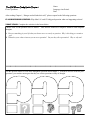
Use the question wheel to create three thoughtful questions about chapter 1. In order to receive credit for your
questions, your teacher must agree that they are serious questions worthy of thought.
Two Old Women Study Guide-Chapter 2
Focus: Connections
Name:
Language Arts Period:
Date:
Class Activity:
You‟ve been introduced to most of the characters that will play a role in this book. To keep track of who‟s
who, write a short description of each character listed below:
Sa‟Ch‟idzigyaakOzhii NeliiShruh ZhuuThe chiefCreating Connections
Read the following message: “Meet me @ Joe‟s instead of my house „cuz Il b l8.” What connections do you
need to be able to make to understand this message and do what it asks? Be prepared to share your answer
with the class.
Understanding something new often requires that you relate it to something you already know. This is called
creating connections. There are several ways to create connections to text that you read, even if it seems like
the text has absolutely nothing to do with you. Check out the names of different types of connections below.
Discuss with a neighbor how you think each connection might work. After you‟re done guessing, you‟ll be
given information about each connection so that you can see how close your guesses were.
CONNECTION
Text-People
INFORMATION ABOUT THE CONNECTION
Text-History
Text-Text
Text-Self
Text-World
Class Activity:
Please read pages 17 and 18 in Two Old Women. Then, watch Indian Pete. What sort of connection do you
see between the two sources?
Today’s Task: Finish reading Chapter 2, and complete the Connection Tic-Tac-Toe.
(over)
EXAMPLE Connection: (From Chapter 1)
Name:
Language Arts Period:
Text to Text:
Text to World:
Text to History:
Date:
Text to World:
Text to Self:
Text to Text:
Text to People: When the two old women get abandoned, it’s like when a sports team has to cut a
player. The player is left out of the group like the
women were left by The People.
Text to History:
Text to History:
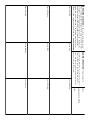
Connection Tic-Tac-Toe: Choose three connections across,
down, or diagonal (like winning rows in a game of Tic-Tac-Toe)
to complete. Do not complete more than one row. Include the
events from Chapter 2 that make up the connection and your
explanation of the connection. The example connection (from
Chapter 1) shows what yours should look like.
Text to People:
Two Old Women Study Guide-Chapter 3
Focus: Tracking Down Important Information
Name:
Language Arts Period:
Date:
CLASS ACTIVITY:
Chapter 3 has the subtitle, “Recalling old skills.” Brainstorm two questions about the subtitle.
Today’s Task:
While survival is a part of Chapters 1 and 2, Chapter 3 is where details about what Sa‟ and Ch‟idzigyaak do to
survive become a bigger part of the story. Pick out important survival information to create a survival manual.
First, use two-column notes to track down important survival information and examples from chapters 1, 2,
and 3:
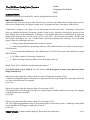
BIG IDEA
Supporting details—you may list only two, so make them important.
Have appropriate
1.
Equipment
2.
Dress properly
1.
2.
Keep your body
1.
moving
2.
Pay attention
1.
2.
Be determined to live
1.
2.
Now, please use your notes to create an Alaskan survival manual.
Basics: you need five pages and a cover. Use three pieces of white typing paper folded in half to create six
pages—the first page is your cover. Use only one side of each page.
Information: you need one survival idea with supporting details on each page. Your cover will include your
full and correct language arts heading.
Illustrations: you need a full page and full color illustration on your cover. Remember not to cover up your
heading! You also need one small color illustration to illustrate each page. Your illustrations should make
your information more clear to the reader—the way illustrations function in a textbook.
Two Old Women Study Guide-Chapter 4
Focus: Inferring
Name:
Language Arts Period:
Date:
Class Activity:
Brainstorm questions you could ask Sa‟ and Ch‟idzigyaak about survival.
What is inferring?
Think about this: how do you know when someone has a crush on you without them actually asking you out?
What sorts of things do they do that gives them away? Be prepared to share your answer with the class.
“Understand,” “interpret,” and “figure out” are all synonyms for the word, “infer.” Inferring is what you do
when you interpret the actions of someone who has a crush on you. Inferring is basically the process of your
brain making sense of the information. Inferring is what happens when you use information to figure out
things about characters that an author doesn’t tell you right away. Check out the items below. Decide if the
item includes inferring or not. Put „I‟ in the blanks next to the items that show inferring. Leave the blank
empty if there is no inferring in the item.
_____1. Young people gathered around elders to listen to stories.
_____2. After being punished for questioning authority, Shruh Zhuu decided it was better to keep his questions to himself.
_____3. It‟s clear that the Athabascans value children since Two Old Women states that children fed second
only to hunters.
_____4. Sa‟ killed a squirrel by throwing a hatchet at it.
_____5. Ozhii Nelii hung her head and did not look her mother in the eye.
Watch Yup’ik Soulja. What can you infer about the dancers?
Now, please listen to p.p. 45-50 of Two Old Women, and be prepared to make some inferences about
things from the story.
What can you infer about this sentence about Sa‟ and Ch‟idzigyaak from pages 45-46?
“Finally, they huddled together and stared as if hypnotized into the large orange blaze they ignited from the
live coals carried from the first campsite.”
I infer that…
What can you infer about this sentence about Sa‟ from pages 47-48?
“Shrugging off the cold, the pain in her sides, her empty stomach, and the numbness in her legs, she struggled
to get up and this time succeeded.”
I infer that…
What can you infer about this sentence about Sa‟ from pages 49-50?
“Sa‟ felt a slight disappointment when Ch‟idzigyaak agreed to resume their journey, wondering if deep within
her she had hoped Ch‟idzigyaak would refuse to move.”
I infer that…
Today’s Task: Continue reading Chapter 4, please make more inferences.
(over)
1. What can you infer about these words about Sa‟ on page 52?
“Sa stopped and suddenly felt weak. It was with great effort that she stood on her shaking legs…”
I infer that…
2. What can you infer about this sentence about Ch‟idzigyaak from page 56?
“Ch‟idzigyaak‟s mind when immediately to her daughter and grandson.”
I infer that…
3. What can you infer about this sentence about Ch‟idzigyaak‟s family from page 58?
“And they burned her body in case anyone thought of filling their bellies with her flesh.”
I infer that…
4. What can you infer about this sentence about Sa‟ from page 59?
“She smiled at her memories.”
I infer that…
5. What can you infer about these sentences spoken by Sa‟ on page 61?
“There were times when I brought more food than the men. This did not seem to please them.”
I infer that…
6. What can you infer about this sentence about Sa‟ from page 64?
“I talked to myself all the time.”
I infer that…
7. What can you infer about this sentence about Ch‟idzigyaak from page 71?
“Knowing that the birds were about to take flight, Ch‟idzigyaak stopped for a few minutes to give them time to
calm down.”
I infer that…
8. Now, choose a sentence to make an inference about from pages 71-73. Copy the sentence, and write
the page number where it came from, then write down what you infer about it.
Two Old Women Study Guide-Chapter 5
Focus: Visualization
Name:
Language Arts Period:
Date:
The subtitle of Chapter 5 is “Saving a cache of fish.” What can you infer from the subtitle about what sort of
luck Sa‟ and Ch‟idzigyaak have in this chapter? Be prepared to share your answer with the class.
CLASS ACTIVITY: Visualization
Imagine your favorite food. What does it look like? You just visualized. Visualization is the process of
imagining things, and the ability to visualize has a lot to do with whether or not you understand and enjoy what
you are reading. You use visualization skills in other areas too. Listen to Song of the Snow Geese Flying Over
the Mouth of the Yukon. What does the song lead you to visualize?
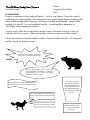
Today’s Task: Quick! Draw! Read the phrases from Chapter 5, and draw a quick sketch of what you
visualize from them in the boxes provided.
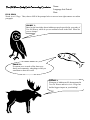
1. “…feisty little squirrels…”
2. “…one of the women would snatch it with her net and
end its life with a blow to the head.”
3. “…masses of flying pests.”
Now, please read Chapter 5. When you’re done reading, choose to draw or give a written description of
what you visualized while reading the different parts of the chapter. Contain your answers in the boxes.
What would it be like to survive a winter with very little
food, and then have a summer with food all around you?
Why would you worry about a friend who went into the
woods, but didn‟t come back out for a long time?
Two Old Women Study Guide-Chapter 6
Focus: Research
Name:
Language Arts Period:
Date:
Class Activity:
Practice visualization before reading Chapter 6. Look at your fingers. Notice the signs of
health that your fingers display. Now imagine the tips of your healthy fingers turning grayishwhite and then purple-black! Imagine your fingers swelling and throbbing! Imagine them
needing to be cut off! You just visualized frostbite—something that is happening to
The People at the beginning of Chapter 6.
To get a sense of how the weather affects people living a subsistence lifestyle, watch An
Unpredictable Environment. What emotions do you see as people react to the weather?
Check out statistics on frostbite and the weather of interior Alaska where Sa‟, Ch‟idzigyaak,
and The People are trying to survive:
Interior Alaska‟s winter temperatures
average five to ten degrees below zero.
At forty degrees below zero, a person can
develop frostbite in ten minutes. At fifty-five
degrees below zero, a person can develop
frostbite in only two minutes.
Interior Alaska‟s environmental conditions are
considered to be some of the harshest on Earth.
The lowest temperature recorded inside
interior Alaska was eighty degrees below
zero.
At eighty degrees below zero, skin
freezes in less than thirty seconds!
Fort Yukon‟s average
snowfall is around ten
feet. Precipitation is low
because the mountains of
the Alaska Range block
water-producing weather
systems.
Interior Alaska sees four
to six hours of daylight in
the winter.
In Chapter 6 of Two Old Women, we encounter The People that abandoned Sa' and Ch'idzigyaak. The People are not in good shape. They are sad,
hungry, cold, and frostbitten.
YOUR JOB: Find the answers to these questions: What is frostbite? How do you prevent it? If you do get it, how do you treat it? Is it gross? Is it
dangerous? When you‟re all done checking out frostbite, you get to decide whether or not The People deserved it for leaving Sa‟ and Ch‟idzigyaak
behind. In other words, research the facts and images, then make a judgment call. You‟ll also need to decide how you‟re going to use your newfound information.
HOW TO RESEARCH: Most websites have a search bar. Start there. Type in “frostbite.” Be sure to spell the word correctly. Then, be sure to
read the information the site presents. Read carefully—“frostbite” is the name of a G.I. Joe character and a movie, among other things, so be sure
that the information you‟re researching is about frostbite the medical condition. If the information sounds like a textbook, you‟re probably in good
shape. If it sounds like it‟s trying to entertain you or sell you something, be suspicious.
Remember that a computer is just like a phone. It will produce results based on what you put into it. If you dial the wrong number on a phone, you
won‟t get the person you wanted to talk to. The computer is the same way. If you do not enter a web address correctly, it won‟t figure out what you
meant to type. If you get a website that doesn‟t look like what you wanted, check the web address in the browser bar before you wave your hand
around in the air and whine about how the computer, Internet, or website is broken.
http://health.discovery.com
http://www.cdc.gov
http://www.emedicinehealth.com
A family resource for health.
The website for Discovery Health Channel—educational programming about diseases and conditions.
The website for the Center for Disease Control and Prevention.
An online resource about diseases and conditions.
WHERE TO LOOK: Use the following sites to look for information about frostbite:
http://www.kidshealth.org
(over)
Now, perform a Google Image Search by clicking the “Images” link in the top left corner of www.google.com and then typing in “frostbite.” You;ll
use the images you see to complete the adjective section of your webquest answer sheet. You only need to look at the first page, but you can go further if you wish.
Done researching? COMPLETE THE WEBQUEST ANSWER SHEET!
Instructions:
Name:
Language Arts Period:
How do you treat frostbite?
Date:
How do you prevent frostbite?
Which body parts are most often affected by
frostbite?
After you read about frostbite, begin by writing your answers in the spaces provided.
Please write in complete sentences and provide at least one specific detail per
answer.
What is frostbite?
Who is most at risk for frostbite?
6.
7.
8.
9.
10.
How is frostbite dangerous?
1.
2.
3.
4.
5.
Instructions: Complete this part after you do your image search.
Make a list of ten
adjectives
describing the
images of
frostbite.
Make the call: Did The People deserve frostbite as a punishment for leaving Sa‟ and Ch‟idzigyaak behind? Be sure to explain your opinion
with specific details.
Think! How could you apply the information you have discovered about frostbite to your own life? Provide a specific example.
Two Old Women Study Guide-Chapter 7
Focus: Eureka! Synthesis!
Name:
Language Arts Period:
Date:
Class Activity:
Visualize a dot-to-dot activity. What do you see before you start connecting the dots? What do you see once
you‟ve made all the connections? Synthesis is what happens when little things work together to produce
something new. And sometimes, a synthesis is a surprising discovery.
Eureka! Synthesis!
What possible synthesis would come from these things: a block, battery, fan, transmission, and combustion
chamber?
What possible synthesis would come from these things: tomato sauce, pepperoni, flour, yeast, and cheese?
What possible synthesis would come from these things: milk and bacteria?
What pieces can be synthesized to make a hamburger?
What pieces can be synthesized to make a coat?
What pieces can be synthesized to make a car?
Today’s Tasks:
Choose one of the following boxes to complete:
The recycling symbol is a triangle of
arrows following each other. Create a
symbol to represent synthesis.
Make a list of items, then state what
synthesis could come from the items.
Find five words that are synonyms for
“synthesis,” and write them in a list.
Please answer the following questions in complete sentences:
Listen to Dorothy Savage Joseph discuss spring and her favorite foods from Season of Subsistence. What
ingredients does she say are synthesized into ice cream?
In Chapter 6, Daagoo experiences synthesis. Recall the pieces of information Daagoo collected throughout
the chapter. What did Daagoo figure out after he‟d considered all the pieces of available information?
Now, think about synthesis that Sa‟ and Ch‟idzigyaak might experience. By Chapter 7, what pieces of
information do Sa‟ and Ch‟idzigzaak have?
What synthesis could result from those pieces of information?
Now, please read Chapter 7 to see what synthesis is experienced by Sa’ and Ch’idzigyaak.
Two Old Women Study Guide-Chapter 8
Name:
Language Arts Period:
Date:
Focus: Review A.C.T.I.V.E. Strategies
Class Discussion Question:
What synthesis did Sa‟ and Ch‟idzigyaak experience in Chapter 7?
Today’s Task:
Please read Chapter 8, and choose one A.C.T.I.V.E. Reading Strategy to use to respond to the text. Except
for the inference chart, you should complete your chosen assignment on a separate piece of paper. The
assignments for each strategy are outlined below:
A. Ask questions: write seven open-ended questions about the chapter, and answer three of them.
C. Create four of the five kinds of connections: text-people, text-history, text-text, text-self, text-world.
T. Track down the important information in the chapter by identifying the most important thing that each of
the following characters learned or did in the chapter: the chief, The People as a group, Sa‟ Shruh Zhuu,
and Ch‟idzigyaak.
I. Make an inference using the chart.
Does the story indicate that
The People were wrong to
leave Sa‟ and Ch;idzigyaak
behind, or does it teach that
both sides needed to learn a
lesson?
What does the text say
about it?
What do you think about
it?
So, were The People wrong
to leave Sa‟ and Ch‟idzigyaak?
V. Draw or provide a detailed written description of yourself as a member of The People. Would you
choose to be a hunter, a child, the chief, an elder, or a guide? Remember to include in your drawing or description the details that would identify you as a hunter, child, chief, elder or guide so that people would immediately recognize your role in the group.
E. Eureka! You‟ve come to the end of the story! Now, create synthesis. This story is made of many things,
including betrayal, persistence, survival, courage, and forgiveness. What is the point? What are all these
things working together to communicate to you? Write your answer using complete thoughts.
Two Old Women Study Guide-Post-reading/Conclusion
Name:
Language Arts Period:
Date:
Final Exam:
Watch Arctic Village. Then, choose ONE of the prompts below to answer in an eight-sentence accordion
paragraph.
Prompt 1:
Based on the knowledge about Athabascan people provided in your study of
Two Old Women, where do you see tradition at work in the film? Where do
you see change?
Prompt 2:
If someone were to make a film about your
family and community, what things would you
want them to show the world?
Prompt 3:
What part of Athabascan life demonstrated in
Two Old Women and/or in Arctic Village has
had the biggest impact on your thinking?
EXPERIENCING CULTURE THROUGH LITERATURE
List plot details that show each value being honored or
ignored in Two Old Women.
Explain how the plot shows the value being honored
or ignored.
One of the greatest things about literature is the way that it allows us to experience things that we may not otherwise have access to. For
example, you weren‟t the first man to set foot on the moon, yet, you can experience stepping onto the dusty surface of a world never touched by
humanity by reading about that adventure. In Two Old Women, you are privileged to experience some aspects of traditional Athabascan culture by
reading the story of Ch‟idzigyaak and Sa‟. In order to help you pick out the aspects of culture that are presented in the novel, please explore five of
them using the chart below.
Choose five Athabascan traditional values from the
list on the back of this page.
Self-sufficiency and hard work
Care/provision for family
Family relationships and unity
Love for children
Village cooperation and responsibility to village
Practice of Alaska Native Traditions
Honesty and fairness
Respect for knowledge and wisdom from life
Respect for elders and others
Honoring ancestors
Experiences
Respect for the land and nature
Spirituality
Humor
Sharing and caring
“Alaska Native Values for the Curriculum.” Denakkanaaga Elder‟s Conference 1985.
<http://www.ankn.uaf.edu/values/athabaskan.html> 10 April 2005.
Two Old women alternative/enrichment teaching approaches:
Approaches for pre-reading, reading, and post-reading of Two Old Women by Velma Wallis with an emphasis on
using literature as a way to answer essential questions and with a prohibition on overteaching.
Essential Questions:
What is conflict?
How can conflict be resolved?
What do we learn from conflict?
Pre-reading: Get students in the frame of mind to experience the shocking conflict that opens Two Old Women by
having them spelunk into what conflict is and/or how it affects us as people and our entertainment. Each of the
following options has been designed toward the first essential question, “What is conflict?” but shades of the other two
essential questions will probably arise.
OPTIONS:
Have students watch a few short cartoons (Looney Tunes are usually good ones for conflict). Have students identify
who is in conflict and what they are in conflict over. After a few rounds of that, break students into groups to create
definitions for “conflict.” Wrap up with a class share of conflict definitions.
Have students watch Old Minto Camp. What conflicts is the camp trying to prevent? This is a good option for gifted
students.
Have students explain how they know that movie characters are in conflict. What lighting/music cues are given? What
facial expressions and tones of voice are used by characters in conflict? This is an good option for ELL students.
Provide a definition of conflict; then ask students to predict conflicts that might occur in a book called Two Old Women.
Ask students to brainstorm conflicts that occur between the young and old. What do students think about those conflicts—are they inevitable between generations? If so, why? How do the conflicts harm our society or how do those
conflicts add to our society? This is a good option for gifted students.
Ask students which conflicts arise most often in their communities or cultures. Are those conflicts unique?
Reading: For each chapter, a two-pronged discussion question can both focus reading and serve as a review of chapter
material. Students should explain (in-class response writing, through email, as blog entries, in-class discussion, etc.)
what Sa‟ and Ch‟izigyaak learn from the conflict in each chapter and what we, as readers learn. This discussion question
is born from the third essential question: what do we learn from conflict? This is also a culturally responsive question
for the Athabascan worldview in Two Old Women since the wisdom of elders is a vital cultural value for the Athabascan
people (and for many, many other cultures as well). A strand for gifted students might be an attempt at reconciling the
fact that the Gwichin people in Two Old Women have abandoned their elders with the knowledge that respect for elders
is an Athabascan cultural value. This discussion strand will evolve and deepen through the novel and is appropriate to
revisit at several points.
If further enrichment for chapter discussions is desired, consider the following options to explore other facets of conflict:
OPTIONS:
Have students compare the different conflicts and conflict resolutions (big and small, central or not) in chapters to
events in a given sport or activity. For example, when Sa‟ kills the squirrel in chapter 2, Let Us Die Trying, is that like a
free throw or a three-pointer? Practicing music scales or composing a new score? Tracing an image or completing an oil
painting? The connecting nature of this activity lends itself especially well to the advanced/gifted learner.
Keep a running bulletin board or white board collection of student response to the words revenge, justice, forgiveness,
and betrayal. One good way to manage this participation is to provide something distinctive, like a colored paper die cut
shape for each student to use when he/she is ready to contribute to the board. Keep a running discussion strand
concerning the new entries each day. The tactile-visual nature of this activity is especially suited to less proficient or
reluctant readers.
Two Old women alternative/enrichment teaching approaches: (cont.)
Have students watch Gwich’in Tribe Protects Caribou. How are the Gwich‟in people working to resolve the conflict
over the Arctic National Wildlife Refuge?
Tried and true option: use conflict quotes to spur chapter discussions. A suggestion to really focus on conflict might be
to discuss what opinion/idea the quote presents, then match the quote‟s opinion/idea to a chapter. Or, ask students which
of the quotes below best reflects their families‟, community‟s, or culture‟s approach to conflict. Here are some good
conflict quotes, but a simple Internet search or extra credit assignment would produce many more:
“When one burns one‟s bridges, what a very nice fire it makes.”
-Dylan Thomas
“These are the times that try men's souls.”
-Thomas Paine
All men have an instinct for conflict: at least, all healthy men.”
-Hilaire Belloc
“Conditions for creativity are to be puzzled; to concentrate; to accept conflict and tension; to be born everyday; to feel a
sense of self.”
-Erich Fromm
“The conflict of forces and the struggle of opposing wills are of the essence of our universe and alone hold it together.”
-Havelock Ellis
Post-reading: Once students have read the ending of Two Old Women, discussions revolving around the second
essential question: how is conflict resolved? can begin.
Options:
Have students identify the central conflict they see in the book. Have them prove whether the conflict has been resolved
or not. Debate forum is a great way to keep the discussion lively and flowing.
Have students identify the means by which our modern era/lifestyles resolve conflict. How do our modern approaches to
conflict resolution compare to how conflict is resolved in Two Old Women? Which forms of conflict resolution cross
cultures and times? Do any?
Have students explore the basics of Restorative Justice—the concept that wrongdoings are committed against individuals
and communities rather than governments. In Restorative Justice, the person/persons who has committed wrongdoing
takes responsibility for his/her/their actions and the person/persons who have been wronged take an active role in the
justice process (for example, the wronged party may directly receive reparations or formal apologies from the offender).
Restorative Justice also includes a fellowship component—after the consequences and healing process have been completed, all parties celebrate (with food) the restoration that has taken place. Ultimately, students will discuss/present
their views on how Restorative Justice is a part of the conflict resolution in Two Old Women. This is an especiallculturally responsive activity since Restorative Justice is a foundational idea in many of the world‟s cultures and ethnicities,
including America‟s First Nation cultures.
Have students outline the Sa‟ and Ch‟idzigyaak Model of Conflict Resolution. What would the two old women recommend for conflict resolution? An extension here for advanced/eager/gifted students would be to apply that model to a
modern conflict—Muslims vs. Jews, Haves vs. Have-Nots, even rival sports teams!
Have students watch Our Very Own. What does the film state that Alaska Natives have learned in conflicts over spoken
languages?