1
Clinical Practice Procedures:
Resuscitation/Defibrillation
Version October 2015
Disclaimer and copyright
©2015 Queensland Government
All rights reserved. Without limiting the reservation of copyright, no person shall reproduce,
store in a retrieval system or transmit in any form, or by any means, part or the whole of the
Queensland Ambulance Service (‘QAS’) Clinical practice manual (‘CPM’) without the prior
written permission of the Commissioner.
The QAS accepts no responsibility for any modification, redistribution or use of the CPM
or any part thereof. The CPM is expressly intended for use by QAS paramedics when
performing duties and delivering ambulance services for, and on behalf of, the QAS.
Under no circumstances will the QAS, its employees or agents, be liable for any loss, injury,
claim, liability or damages of any kind resulting from the unauthorised use of, or reliance
upon the CPM or its contents.
While effort has been made to contact all copyright owners this has not always been possible.
The QAS would welcome notification from any copyright holder who has been omitted or
incorrectly acknowledged.
All feedback and suggestions are welcome, please forward to:
[email protected]
This work is licensed under the Creative Commons
Attribution-NonCommercial-NoDerivatives 4.0
International License. To view a copy of this license,
visit http://creativecommons.org/licenses/by-nc-nd/4.0/.
Defibrillation
October, 2015
Defibrillation is the definitive treatment for the life-threatening cardiac dysrhythmias – ( VF and pulseless VT ) – and is undertaken in parallel with advanced cardiac life support
procedures.[1]
UNCONTROLLED WHEN PRINTED
A direct current countershock when applied through the chest produces simultaneous
depolarisation of a mass of myocardial cells
and may enable resumption of organised
electrical activity.[2]
UNCONTROLLED WHEN PRINTED
Depending on the type of defibrillator, shocks may be performed using:
corpuls3
LIFEPAK®12
• manual mode
UNCONTROLLED WHEN PRINTED
• semi-automatic mode
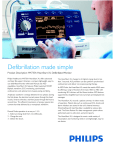
Four types of defibrillator are utilised by the QAS:
• corpuls 3
• LIFEPAK®12
UNCONTROLLED WHEN PRINTED
• Propaq®MD (QAS Flight paramedics working with CareFlight Physicians)
• HeartStart FRx (QAS First Responders)
Figure 3.98
Propaq®MD
HeartStart FRx
QUEENSLAND AMBULANCE SERVICE
652
Procedure – Defibrillation
Indications
• VF
• Pulseless VT
•
Prepare the patient and skin for electrode placement (refer to additional information)
- Ensure non-conductive environment
- Ensure non-explosive environment
UNCONTROLLED WHEN PRINTED
Contraindications
- Ensure no-contact environment
• Non shockable rhythms:
- Expose chest: shave, clean, dry area to ensure good skin contact between defibrillation pads and the skin
- asystole
- pulseless electrical activity
- perfusing rhythms
- Remove monitoring electrodes if they are obstructing defibrillation pads.
•
Position defibrillation electrodes in the anterior-lateral position (all patient ages).
Anterior-posterior electrode placement my be considered if defibrillation electrodes are at risk of overlapping (paediatric patients).
UNCONTROLLED WHEN PRINTED
• Patients presenting with signs of life
Complications
• Patient injury including burns:
- Arcing between electrodes may occur if pads are incorrectly placed.[1]
* In females defibrillation pad placement over the breast may increase impedance and decrease defibrillation efficiency. The positive defibrillation pad should be placed lateral to, or underneath the breast tissue in large breasted women.
UNCONTROLLED WHEN PRINTED
- Foreign bodies (including cardiac
leads) between the pads and patient
- Pads with insufficient lubrication[1] • Explosion:
- Discharge of the shock could initiate an explosion if there is a combustible gas or fluid in the vicinity.[2] NOTE: Authority to defibrillate in an aircraft must be obtained from the pilot prior to commencing defibrillation.
UNCONTROLLED WHEN PRINTED
• Transmitted shock to the operator or bystanders[3]
Anterior-lateral defibrillation pad placement
653
Procedure – Defibrillation
corpuls3: For comprehensive instruction refer to the corpuls3 operating instructions.
Manual external defibrillation mode
• To start in manual mode, press the Manual key. To change to manual mode when the defibrillator is in AED mode, press the Manual key.
UNCONTROLLED WHEN PRINTED
Automatic external defibrillation (AED) mode
• To start the AED mode, press the AED key. To change to AED mode
when the defibrillator is in manual mode, press the AED key.
• Select the required energy level with the flashing jog dial or via the soft keys, confirm the joule setting by pressing the jog dial.
• Attach corPatcheasy defibrillation electrodes to the patient.
• Press the Analyse key to initiate analysis. Do not touch or move patient.
• Press the Charge key to charge the defibrillator.
UNCONTROLLED WHEN PRINTED
AED key
• After analysis Analyse key
of the ECG the defibrillator will advise either DELIVER SHOCK or SHOCK NOT RECOMMENDED.
Manual key
Charge key
• Once charged, hold the
to the patient.
key to deliver the shock • Confirm that defibrillation has occurred by Shock performed being displayed on the screen.
Shock key
UNCONTROLLED WHEN PRINTED
• If a shockable rhythm is detected, you will see DELIVER SHOCK and the defibrillator will begin charging to 200j.
• Once charged, hold the
key to deliver the shock to the patient.
Jog key
Shock performed
UNCONTROLLED WHEN PRINTED
• Confirm that defibrillation has occurred by SHOCK PERFORMED being displayed on the screen.
NOTE: If paramedics are unclear regarding the presenting cardiac
rhythm the corpuls3 Analyse function should be immediately used.
QUEENSLAND AMBULANCE SERVICE
654
Procedure – Defibrillation
LIFEPAK®12: For comprehensive instruction refer to the LIFEPAK®12 operating instructions.
•
If a shockable rhythm is detected, you will see and hear SHOCK ADVISED and the defibrillator will begin charging to 200 J. A rising tone indicates that the defibrillator is charging.
UNCONTROLLED WHEN PRINTED
Semi-automatic external defibrillation (SAED) mode
•
Once charged, press SHOCK to deliver the shock to the patient.
• When turned on the LIFEPAK®12 will be in semi-automatic mode and the ADVISORY LED is illuminated.
•
If the SAED detects a non-shockable rhythm you will see and hear NO SHOCK ADVISED.
• The CONNECT ELECTRODES message and voice prompts occur until the pads are connected to the therapy cable.
•
After a shock is delivered or no shock advised a 2 minute CPR continue timer displays on the screen.
UNCONTROLLED WHEN PRINTED
•
Press ANALYZE to initiate analysis. Stop CPR.
•
After 2 minutes, user is prompted to Push ANALYZE.
On/Off button
Energy Select button
Advisory button
Charge button
Analyze button
Shock button
UNCONTROLLED WHEN PRINTED
•
After analysis of the ECG the defibrillator will advise either SHOCK ADVISED or NO SHOCK ADVISED.
UNCONTROLLED WHEN PRINTED
QUEENSLAND AMBULANCE SERVICE
655
Procedure – Defibrillation
LIFEPAK®12 (cont.)
Propaq®MD:
Manual external defibrillation mode
For comprehensive instructions refer to the Propaq®MD operating instructions.[5]
UNCONTROLLED WHEN PRINTED
• To change to manual mode
when the defibrillator is in
SAED mode, press the Advisory button.
Power button
• Press Energy Select and dial the appropriate
energy setting.
UNCONTROLLED WHEN PRINTED
• Press Charge to charge the defibrillator – a rising tone indicates that the defibrillator is charging.
• Press the Shock button to deliver the shock to the patient.
UNCONTROLLED WHEN PRINTED
NOTE: If paramedics are
unclear regarding the
presenting cardiac
rhythm the LIFEPAK®12
ANALYSE function should
be immediately used.
Shock button
UNCONTROLLED WHEN PRINTED
Charge button
Select Energy button
QUEENSLAND AMBULANCE SERVICE
656
Procedure – Defibrillation
Manual external defibrillation mode
• Press the green power button to turn the unit on.
UNCONTROLLED WHEN PRINTED
• If defibrillation electrodes are not making good contact with the patient’s skin and the pad selection is ECG lead, the unit issues the message Check Therapy Electrodes.
UNCONTROLLED WHEN PRINTED
• Press the Select Energy arrows up or down to desired level (refer to CareFlight Physician for joule settings).
• Press Charge to charge the defibrillator – a charging message displays at the bottom of the screen, and a distinctive charging tone sounds indicating that the unit is charging.
UNCONTROLLED WHEN PRINTED
• Press and hold the red shock button to deliver the shock.
UNCONTROLLED WHEN PRINTED
NOTE: If paramedics are
unclear regarding the
presenting cardiac rhythm the
Propaq®MD ANALYSE function
should be immediately used.
Charge button
Select Energy button
QUEENSLAND AMBULANCE SERVICE
657
Procedure – Defibrillation
HeartStart FRx:
For comprehensive instruction refer to the HeartStart FRx operating instructions.[6]
UNCONTROLLED WHEN PRINTED
• Press the green on/off button.
• Follow the voice and visual
instructions to position the pads.
• As soon as the HeartStart FRx detects the pads are attached to the patient, it begins analysing the rhythm.
Pads connector port
Infant/Child Key slot
Ready light
UNCONTROLLED WHEN PRINTED
• If a shock is advised the orange
SHOCK button flashes and the
HeartStart FRx instructs you to press the flashing orange button.
On/Off button
Information button
(i-button)
UNCONTROLLED WHEN PRINTED
• If a shock is not advised, the blue i-button comes on solid, to show that it is safe to touch the patient and the HeartStart FRx instructs you to perform CPR.
• Once a shock is delivered the
HeartStart will instruct you it is safe to touch the patient and to begin CPR.
Pads icons
Caution light
Shock button
UNCONTROLLED WHEN PRINTED
QUEENSLAND AMBULANCE SERVICE
658
e
Additional information
• The use of self-adhesive defibrillation pads is associated with a significantly improved rate of ROSC and hospital admission when compared with hand-held paddles.[2]
Ensure a non-explosive environment:
• Do not defibrillate in the vicinity of petrol, LPG, or other such flammable materials.
UNCONTROLLED WHEN PRINTED
• After completion of a risk/benefit analysis, the QAS authorises the use of adult LIFEPAK®12 defibrillation pads in the anterior/
posterior placement for paediatric patients, despite manufacturer’s
recommendation. The QAS does not stock paediatric LIFEPAK®12
defibrillation pads.
Ensure no contact:
• No person is to be in contact with the patient at time of defibrillation.
• Have only one clinician responsible for defibrillation.
They are to check no contact and shout loudly ‘All clear!’ prior to defibrillation.
UNCONTROLLED WHEN PRINTED
• LIFEPAK®12 joule settings for adults and children > 8 years:
- Shock 1 200J
- Shock 2 300J
- Shock 3 360J
• corpuls3 joule settings for adults and children > 8 years is 200j (all shocks).
• Ensure there is no contact between the patient and the ambulance vehicle prior to defibrillation. (Place blankets over side arms of stretcher and pillows under the feet if necessary.)
Ensure no movement:
• Rhythm analysis may be improved by stopping the ambulance where appropriate.
UNCONTROLLED WHEN PRINTED
• Joule settings for children ≤ 8 years:
- All shocks at 4j/kg
- Round up the energy required to the next highest setting on the defibrillator.
Safety:
• Ensure a non-conductive environment
• Minimise patient movement.
NOTE: Authority to defibrillate in an aircraft must be obtained from the pilot prior to commencing defibrillation.
UNCONTROLLED WHEN PRINTED
- Remove conductive items in the vicinity of the patient AND/OR the defibrillator
- Wipe the chest dry of water, sweat, blood, excess gel, vomit etc.
QUEENSLAND AMBULANCE SERVICE
659
e
Additional information (cont.)
Defibrillation pad removal
UNCONTROLLED WHEN PRINTED
• If removal of the defibrillation pads is required, the following procedure is to be utilised:
- Each individual defibrillation pad should be removed with two hands.
- Loosen one side of the defibrillation pad by gently separating the pad’s contact with the patient’s skin.
UNCONTROLLED WHEN PRINTED
- Peel the defibrillation pad back over itself at 180 degrees, using the other hand to support the skin where required.
- Defibrillation pads should be removed in the direction of hair growth where possible.
UNCONTROLLED WHEN PRINTED
- Gentle handling of patient’s skin is required in the very young, elderly and in patients where
skin integrity is questionable.
UNCONTROLLED WHEN PRINTED
QUEENSLAND AMBULANCE SERVICE
660