1
RouterBOARD 433 Series User's Manual
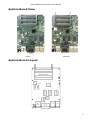
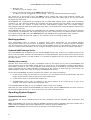
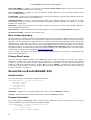
RouterBOARD 433/433AH
CPU
Atheros AR7130 300MHz / AR7161 680MHz
Memory
64/128MB DDR SDRAM onboard memory
Boot loader
RouterBOOT
Data storage
64MB onboard NAND memory chip
Ethernet
Three 10/100 Mbit/s Fast Ethernet ports supporting Auto-MDI/X
MiniPCI slot
Three MiniPCI Type IIIA/IIIB slots
Serial port
One DB9 RS232C asynchronous serial port
LEDs
Power and User LED
Beeper
Present
Power
Power over Ethernet: 10..28V DC (except power over datalines)
Power jack: 10..28V DC
Fan control
Two DC fan power output headers with rotation sensor and automatic fan
switching (maximum output current - 500mA total)
Dimensions
105 mm x 150 mm (4.13 in x 5.91 in)
Weight
140 g
Temperature
Operational: -20°C to +65°C (-4°F to 149°F)
Humidity
Power consumption
Operational: up to 70% relative humidity (non-condensing)
~3W without extension cards, maximum – 25W (18W output to extension cards)
Hardware Guide
Memory and Storage Devices
Onboard Memory
The RB433 is equipped with 64 MB DDR SDRAM onboard memory. RB433AH boards are equipped with 128
MB DDR SDRAM onboard memory.
Onboard NAND Storage Device
The boards are equipped with one 64MB NAND nonvolatile memory chip.
Extension Slots
MiniPCI Slots
The board has three MiniPCI Type IIIA slots with 3.3V only power signaling. They also accept MiniPCI Type
IIIB standard cards. The board has been tested to operate with 3 Ubiquity SR2 high power cards if ambient
temperature and adequate cooling is ensured.
NOTE: that RB400 series currently does not support Senao 8602 cards, Atheros AR5211 or older chipset and
Prism chipset based cards. Wireless compression is not supported on RB400 series devices.
Supplied power for the extension cards (excluding CPU and onboard Ethernet ports):
+3.3V: 5.5A max
Input/Output Ports
LAN1 Port with PoE
This Fast Ethernet port is recognized as the first LAN interface. It is compatible with passive (non-standard)
Power over Ethernet. The board accepts voltage input from 10 to 28 V DC. It is suggested to use the higher
voltage for power over long cables because of better efficiency (less power is lost in the cable itself and
4