1
KHD2-IVI-AB1
Command Overview
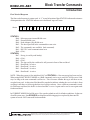
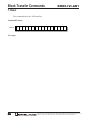
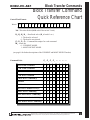
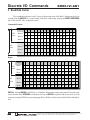
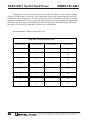
The following three special commands handle data a page at a time. A page is a 32 byte (or 16 word) memory
page in the data carrier’s memory. The IDC-1k (type D4) has 4 pages and the IMC-40-64k and IMC-40256k (type D3) have 256 and 1024 pages respectively. Only the page address needs to be specified since the
length is implied. These commands can only be used with Block Transfer because the data size is much too
large for the DIO rack I/O size.
NOTE: The IDC-1K can only be read with page commands. It cannot be written.
NOTE: When using the IMC (type D3) tags, immediately after power-up or a reset, the ID system must
be changed into type D3 mode via the “SET DATA CARRIER TYPE” command since the IVI interfaces do not have a type D3 start-up setting.
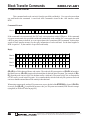
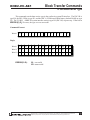
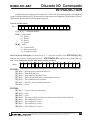
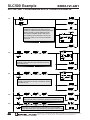
1 - “PAGE READ” - This command works like the “READ CODE CARRIER” command with the
addition of a data carrier starting page address to specify the location on the tag from which to read data.
Any combination of three read heads can be activated (due to the 64 word BT limit) and the reply contains the
codes for all active read heads. This command can be performed in CURRENT or MOST RECENT modes.
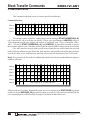
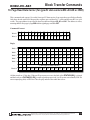
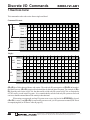
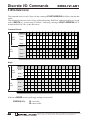
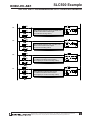
2 - “PAGE B.A.R. DATA CARRIER” - This command works like the “BAR CODE CARRIER” command with the addition of a data carrier starting page address specify the location of data requested from the
data carrier. This command activates all read heads (up to 4 total) connected to the ID system and continuously
reads for BT’s. This command is performed only in MOST RECENT mode.
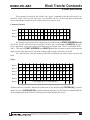
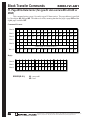
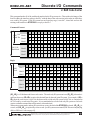
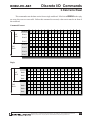
3 - “PAGE WRITE” - Only for IMC series data carriers. This command writes a page of data at a
certain starting page address on a read/write data carrier. Only one read head may be specified and this
function is performed only once with BT only. (This would be CURRENT mode.)
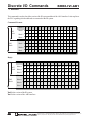
NOTE: The first bit (MSB) of each data word is not allowed to be used, regardless of the overall size of
the data because we need it for the FIRST BIT convention. This means that the value of the high byte
of each and every data word MAY NOT EXCEED 7F. The low byte has no restrictions (value can be
anything from 00-FF). Keep this in mind, especially when sending ASCII characters.
Pepperl+Fuchs® Inc. • 1600 Enterprise Parkway • Twinsburg, Ohio 44087-2245 • E-mail: [email protected]
Telephone (330) 425-3555 • FAX (330) 425-4607 • World Wide Web Site: http://www.pepperl-fuchs.com
23