1
1. Introduction
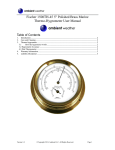
Thank you for your purchase of the Fischer Instruments 146-01 Stainless Steel Traditional
Temperature + Humidity Comfortmeter with Synthetic Hair Hygrometer. The following is a guide for
preparation, care and operation of your marine weather instrument.
Note: Some of the images are generic and may not match your exact model.
2. Installation, Care and Cleaning
To measure exact temperature and humidity, the Comfortmeter must be suspended vertically.
Relative humidity is closely correlated to and dependent upon air temperature, so it provides the best
data when not exposed to rapidly changing temperatures. For the best measure of the humidity, avoid
placing the instrument in direct sunlight or in line with strong breezes. Locate the instrument in a
place that best represents the average temperature of the local environment. Avoid outside walls that
might be cooler than average, and avoid direct exposure to heat sources that would be warmer than
average.
Avoid use of harsh household cleaners and coarse paper towels, which can scratch the bezel or lens.
Fingerprints and dirt may be removed the lenses and bezels with a soft cloth lightly dampened with a
mixture of water and mild dishwashing liquid. Be sure to dry the lens and bezel with a soft cloth
after cleaning.
3. The ComfortMeter
The calibration and positioning of the hands are designed to indicate perfect comfort conditions in
room atmosphere: when both hands cross in a limited area of the dial, or the “COMFORT zone”.
There is no one temperature and humidity condition at which everyone is comfortable. People are
comfortable at a range of temperature and humidity. Research conducted over many years on large
numbers of people by the American Society of Heating, Refrigeration, and Air Conditioning Engineers
concluded there is a range of combined temperature and humidity that provides comfort to most
people.
In general, a healthy room climate is optimized at humidity levels between 45 and 60% rh. Your
personal comfort zone may vary based on your climate, season, body type and activity.
3.1 How the Hygrometer Works
The hygrometer measures the indoor relative humidity.
The sensor element is a specially treated synthetic fiber whose length is sensitive to the humidity in
the air. For a given tension on the fiber bundle, the length increases with increasing relative humidity.
Changes in its length are then magnified with precision gears to display the relative humidity of the
air.
In contrast to real hair hygrometers, which must be chemically cleaned and rejuvenated often, this
synthetic-fiber model provides the same high precision and fast response time without that required
maintenance.
Version 1.0
©Copyright 2015, Ambient LLC. All Rights Reserved.
Page 2