1
Page 3 of 33
USER MANUAL
AQUALINE FRØYARING – FLOATING COLLAR
9.2 Storage on shore
For storage on shore, the ground must be even to avoid point loads on the floater
tubes. See the product certificate regarding area.
10 Unwanted Incidents
10.1 Extreme Situations
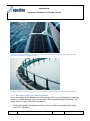
If, during extreme situations, the floating collar should be damaged, it will normally
not sink as it is filled with expanding polystyrene.
The operations manager must assess whether the floating collar must be repaired
immediately or if the repair may wait. We recommend contacting Aqualine AS to
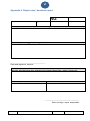
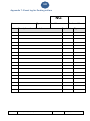
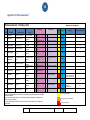
discuss the issue. Such incidents should be logged for inspection and maintenance,
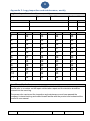
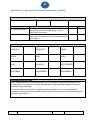
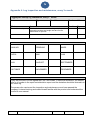
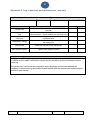
see appendix 1-7.
Subsequent to weather conditions and incidents which may have caused damage to
the equipment beyond the ordinary, one should, as a minimum, carry out a monthly
control of the floating collar.
10.2 Rupture or damage to the floater tube
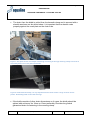
If a rupture or damage occurs to parts of the floating collar, the construction will
normally keep its shape and prevent total collapse. The clamps which are connected
to a dimensioning main supporting system in the horizontal plane, will keep the
construction together. The floating collar’s remaining capacity will normally prevent
that the cage net will collapse.
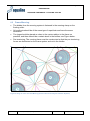
Aqualine FrøyaRingen floating collars are delivered with floater tubes filled with rods
made out of expanded polystyrene. The rods are there to maintain the buoyancy in
case of damage or puncture. In case of punctures in both floater tubes, the net
buoyancy is reduced in accordance with table 2:
Dimension floater tube [mm]
Reduction of net buoyancy
in case of puncture of both floater tubes
315
About 9%
400
About 4%
450
About 28%
500
About 39%
630
About 50%
Table 3: Reduction of net buoyancy in case of puncture of both floater tubes.
Aqualine AS
Prepared by: Kjell Roger, Odd Erland & Anders
Rev. 07.06.2013
© Copyright, must not be copied