1
1
Parallel Assertion Processing
using Memory Snapshots
Junaid Haroon Siddiqui, Muhammad Faisal Iqbal, Derek Chiou
The University of Texas at Austin
{iqbal, jsiddiqui, derek}@ece.utexas.edu
Abstract—Assertions are valuable in producing quality software but some assertions like those checking data structure
invariants are costly by nature. The authors of this paper propose
that costly assertions be queued up for later execution by a
free processor. The state of data is preserved using a memory
snapshot. Such a scheme will extract further parallelism from a
given application and improve its speed up on a parallel machine.
Three schemes for end user programs to use memory snapshots
are discussed. One is based on memory mapping like mmap.
Second scheme uses unused virtual address space bits for
snapshot identifier. The third scheme uses a software library.
Merits and demerits of user interface schemes are identified.
Three methods for backend implementation of memory snapshots are discussed. One is based on physical address space
versioning. It proposes modifications to memory controller in
a way similar to transactional memory. It goes on to introduce
a snapshot aware cache coherence protocol. The second method
is based on virtual address space versioning and suggests kernel
modifications. The last method is totally supported in a user
library. Advantages and disadvantages of different implementations are compared.
Evaluation is not extensive, given the large matrix of implementation possibilities. However basic memory controller
snapshot capability is implemented in M5 simulator. Additionally,
a software library approach is implemented. Most valuable
results of this evaluation are the pros and cons of various
approaches discussed. The feasibility study of various implementation schemes is also an important groundwork for future
research on memory snapshots. Based on these experiments, the
authors believe that memory snapshot capability is a powerful
tool that allows parallelism where it is not natural without such
a capability.
Index Terms—Assertions, Parallelization, Memory Snapshots
I. I NTRODUCTION
Commodity machines are now getting dual and quad core
processing power. Industry is targeting many more cores on
every desktop. The 80 core prototype of Intel [1] is one such
effort. This creates a big challenge for software writers who
are accustomed to sequential programming. First efforts to face
this challenge were introducing explicit thread creation and
management libraries like pthreads [2]. This is the only widely
adopted scheme but has many drawbacks. Several new parallel
programming models are proposed to address these drawbacks.
One example of such a language is cilk [3].
Whatever parallel programming model is used, efficiency
usually decreases with an increase in speed up. According to
Eager, “Along with an increase in speedup comes a decrease
in efficiency: as more processors are devoted to the execution
of a software system, the total amount of processor idle
time can be expected to increase, due to factors such as
contention, communication, and software structure” [4]. Due
to this, any further parallelism that can be extracted would
improve efficiency and speed up. The current research body
has a lot of material on compile time extracting of parallelism
from loops [5], [6], [7]. This paper is also concerned about
extracting parallelism but is focused on the single domain of
assertions. This allows domain-specific optimizations and a
scheme for removing dependencies on the code following the
assertion.
Use of assertions allows catching bugs early, resolving them
quickly, and consequently improve the quality of software [8].
Increased density of assertions in the code results in decrease
in bug density [9]. Experience demonstrates that designers
can save up to 50% of debug time using assertions and thus
improving the time to market [10]. Assertions are also useful
in production software. Many modern software applications
have a facility to report back failed assertions. The developers
use this information to remove the bug, resulting in improved
customer satisfaction and quality of future versions.
Some assertions are simple checks but some are costly
validations of data structure invariants. Literature refers to
these checks as repOk [11]. The performance penalty of
such assertions limits their use in production software and
sometimes in debugging sessions too. Traditionally this high
overhead is reduced by limiting the use of assertions [12] and
thus compromising the quality. The repOk method for a simple
binary tree is shown in Figure 1. A binary tree should be
acyclic and every node should have distinct children. Checking
these properties is linear in time and space. These invariants
should be evaluated whenever the data structure is altered.
However, with these assertions present, binary tree performs
worse than a simple array.
The authors propose that costly assertions like these be
queued up for later execution by an idle processor. Since idle
time increases with parallelism [4], we can potentially run
these assertions at no added cost. The programmer’s view of
assertions is slightly altered. The program is stopped when
an assertion fails, but at a point later than the assertion.
The debugging benefits can still be achieved, because the
exact assertion that failed is identified. However in production
environments, some assertions may need to be evaluated
sequentially if they precede some critical non-volatile change.
To solve this problem, the authors suggest that this scheme be
improved in the future to support rollback.
The biggest challenge in this scheme is that assertions
2
class BinaryTree {
Node* root; // root node
static class Node {
Node* left; // left child
Node* right; // right child
// data
}
bool repOk() {
std::set<Node*> nodes;
return repOk_node(root, nodes);
}
bool repOk_node(Node* n, std::set<Node*>& nodes) {
if(n->left == n->right) return false;
if(n && nodes.find(n) != nodes.end())
return false;
nodes.insert(n);
return repOk_node(n->left) && repOk_node(n->right);
}
};
Fig. 1.
repOk method for a Binary Tree
require the state of memory as it was, when the assertion was
queued. The authors propose an implementation of memory
snapshots to make this possible. A low cost snapshot will
be taken when the assertion is queued. This old data is used
for assertion processing on the idle processor, after which the
resources for this snapshot are freed. This makes it possible to
have optional assertions which only run when sufficient idle
cycles and snapshot resources are available. Or compulsory
assertions that block the main thread, and wait for previous
assertions to complete and make resources available.
The performance of this scheme depends on the overhead of
taking, maintaining, and releasing a snapshot compared to the
overhead of assertion itself. The snapshot overheads in turn
depend on the characteristics of the main application itself.
The schemes proposed below use copy-on-write, and if more
copies have to be made, more resources will be occupied and
performance will be worse. If the writes are infrequent, the
overhead will be much lower. This means that applications
have to be individually evaluated, where this scheme gives a
performance boost.
The rest of the paper is organized as follows. Section II gives
a step by step overview of the proposed scheme. Section III
discusses three ways that memory snapshots can be used. Section IV details three implementations of memory snapshots.
Preliminary evaluation of two of these schemes, some basic
results, and feasibility study for more evaluations is contained
in Section V. Section VI concludes along with possible future
work in this direction.
II. PARALLEL A SSERTION P ROCESSING
The steps for parallel assertion processing are described in
two parts; the steps taken when an assertion point is reached in
main code, and the steps taken when an idle processor picks
up the assertion task. The communication medium between
the two entities is an assertion task queue. The first section
lays out the queue structure, the next two sections list the
steps involved, while the fourth section discusses schemes to
allocate processors to do assertion tasks.
predicate
data
snapshot id
b
head
Fig. 2.
b
b
tail
Structure of Assertion Task Queue
A. Assertion Task Queue
The assertion task queue is implemented as a fixed size
circular buffer. This enables lock-free insertion when there is
a single main thread producing assertions. When the original
application is already parallel, there should be one queue
per thread so that no locking is involved when queuing an
assertion. The performance effect of having a single queue
with locking, or multiple queues without producer locks are
not investigated in this paper.
Structure of assertion task queue is shown in Figure 2. Each
entry contains the address of a predicate routine, data to be
passed to that routine, and a snapshot identifier. The number
of entries in this queue bounds the number of outstanding
assertions. However each entry needs a snapshot so there is no
reason to have more queue locations than supported snapshots.
The space overhead of this queue is therefore negligible.
B. Steps at Assertion Point
There are two steps to be taken at an assertion point. A
take snapshot step and a queue step.
1) Take Snapshot: A memory snapshot is taken. There is
an identifier associated with each snapshot. Since memory
snapshots take resources, it is possible that these resources
are not available right away. The caller has the option of waiting for resources (blocking snapshot), execute the assertion
sequentially, or ignoring the assertion altogether. The first two
are schemes to make compulsory assertions, while the last
option results in optional assertions.
2) Enqueue Assertion Task: A predicate function, a pointer
to some data structure, and a snapshot identifier are queued in
assertion task queue. Whatever the number of assertion task
processors, there is no locking needed to insert in the queue
as there is a single producer.
The main thread will proceed execution after queuing this
assertion and may modify the data structure being asserted and
may issue more assertions.
C. Steps at Assertion Task Processing
When a processor decides to take up an assertion task, it
does a dequeue step, an assert step, a possible halt step, and
3
finally a release snapshot step.
1) Dequeue Assertion Task: An entry is dequeued from
assertion task queue containing a predicate function, a pointer
to be passed to this function, and a snapshot identifier. If the
system has multiple assertion task queues, then they all have
to be queried for an available task. If they all have tasks there
is a fairness issue and a performance issue in determining the
order to process them. The performance issue exists because
resource requirements of snapshots grow as time passes.
2) Evaluate Assertion: The predicate function is then called
with the given pointer and snapshot identifier. The predicate
function has to use one of the schemes discussed in section
on user interface to access data in the old snapshot. There is
a performance penalty to doing this, which means assertions
are now running slower than they were originally running.
However the contention is that they are using idle time, and
the main thread has less work to do now, and therefore the
overall performance will improve.
3) Possible Halt: Execution has to be halted if the assertion
fails. There is an issue of semantics here. Programmers are
accustomed to the semantics of assertion halting right at the
assertion point. For example, they may see more console
output from after the assertion point. There are two issues to
this. Most important is finding the exact point for debugging,
and the given mechanism still points the exact assertion point
that failed even though it was evaluated much later. There
is another issue of undesirable side effects from after the
assertion point. The authors believe that given this snapshot
capability it is easy to implement a memory rollback facility.
Such a facility would eliminate side effects in memory. If
there are possible side effects on external media or memory,
such an assertion should be executed sequentially. There is
an added advantage to rollback facility. We can modify the
current halt step which a more sophisticated rollback and halt
step that would make an attached debugger break at assertion
point, rather than assertion processing point. Rollback is not
discussed any further in this paper and is left as a future work.
4) Release Snapshot: The last step is to release the snapshot. This will free any resources occupied by the snapshot
due to modifications from the main thread.
Depending on the assertion task processor allocation model,
the thread can go on and serve more assertions, or go back to
some other real work that is now available for it to perform.
D. Processor Allocation for Assertion Tasks
Based on the parallelism model adopted by the application,
an appropriate model can be chosen for processing assertion
tasks. One model is creating one or more dedicated assertion
processing tasks. These tasks should preferably be bound to
processors so that caching benefits can be used. For example,
if a data structure invariant is repeatedly checked, most of the
data can be found in processor cache. This binding of tasks
to processors is called processor affinity. Popular operating
system provide calls for this purpose [13], [14].
Another model is that of a work queue based system. In such
a system, assertion can go in the same work queue possibly
with low priority. Another model to use in custom event driven
systems, is that a thread that picks and serves an event serve
its own assertions after signaling that the event is served. The
thread can have cache benefits even on the first run. At the
same time, any dependent events can start in parallel since
completion has been signaled.
There can be many other models. The critical aspect is
separating assertion point from assertion processing and as
soon as that is done, models for parallel assertion processing
best suited for a given application are not hard to come up
with.
III. U SER I NTERFACE TO M EMORY S NAPSHOTS
The scheme proposed above needs a take snapshot operation, a release snapshot operation, and a mechanism to
access data within a snapshot. This section discusses multiple
semantics for these operations, and compares them.
A. Accessing Snapshots by Memory Mapping
A flexible scheme for taking and accessing snapshot is a
mmap like system call with the following signature.
void* mmap_snapshot(void* p, size_t len);
This would form a snapshot of len bytes starting at p,
and make it accessible at the returned pointer. This scheme
gives the flexibility of making snapshots of a specific area.
However, dynamically allocated node based structures are not
contiguous. The best in that case would be to snapshot the
whole heap. No separated snapshot identifier is needed. The
returned pointer can serve this purpose.
This scheme however requires that the kernel setup page
tables for this new area and set them for copy-on-write
behavior. This means an overhead at the time of taking a
snapshot. Additionally there is overhead when the main thread
changes its data causing copy-on-write. The assertion overhead
has to be much more to offset these overheads.
B. Accessing Snapshots using Virtual Address bits
Another scheme for taking snapshots of whole memory and
avoiding overhead of setting up new page tables is to use
virtual address bits. This means that the virtual address space
is divided in parts, where one part is the current version, and
the rest of the parts are snapshots of the current version.
In 32-bit processors, the virtual address space is already
scarce, but in 64-bit processors, there is much more space
available. However no 64-bit processor has a 64-bit virtual
address space. For example, Alpha EV5 [15] has a 43-bit
virtual address space. If rest of the 21 bits in 64-bit pointers
could have been used, they are enough for a snapshot identifier.
Unfortunately, the Alpha ISA also uses this information and
encodes only 43 bits in addresses contained in instructions.
The ISA needs to be changed to support an alternate instruction encoding.
The other approach is to use some bits in the valid address
space. This is the only scheme applicable in 32-bit machines.
This means that the operating system has to change its process
address space model. This is a significant change in the
kernel. Many user applications also make assumptions about
4
class snapshot_manager {
snapshot_id take(bool block);
void release(snapshot_id id);
void modify_notification(void* p, size_t len);
void* read_ptr(void* p, snapshot_id id);
};
class assertion_queue {
assertion_queue(snapshot_manager& sm);
bool queue(predicate_type pred, void* data, bool block);
bool process(bool block);
};
snapshot
bit vector
block data
b
b
b
Fig. 4.
Fig. 3.
block id
Structure of Snapshot Cache
Software Library for Parallel Assertion Processing
A. Snapshots of Physical Address Space
the address space. However, ignoring those applications, it is
possible to support this in the kernel.
When a page fault occurs in the snapshot area of the virtual
address space, the kernel has to perform a mapping. However
the kernel can calculate this mapping at fault time. This means
that the cost of setting up page tables is transferred from
main thread to assertion processing thread. If this scheme
is compiled with physical memory snapshot implementation
below, then no fault will be generated and the kernel will not
be bothered.
C. Accessing Snapshots from a Software Library
There is a pure software solution to this problem. The
overheads however are much higher, and there is an added
cost on the software developer. It is useful therefore in fewer
circumstances. However being in software, it is available
everywhere.
Two classes, snapshot_manager and assertion_queue
are proposed. There methods are listed in Figure 3. Class
assertion_queue uses snapshot_manager to implement
parallel assertions. Other applications that want to use snapshots can use snapshot_manager directly.
To implement copy-on-write in software, the data structure
has to inform the snapshot manager of any changes its going to
make. For example a binary tree would inform it of any nodes
it is going to delete, or any nodes whose internal pointers it is
going to change. This needs changes in the data structure but
is not hugely demanding. There are fairly limited and easily
identifiable places where data structure is altered.
Snapshot data is accessed using read_ptr which may return
an old copy or the latest data if it is still unchanged. There
is a synchronization issue here that the assertion thread does
not want the main thread to modify data while it is reading it.
Calling read_ptr poses an overhead but this overhead is only
for the assertion thread. Overheads for the main thread are
modify_notification and the synchronization issue when
the assertion thread is accessing latest data. More about these
issues are discussed in Section IV-C.
IV. I MPLEMENTATION OF M EMORY S NAPSHOTS
Three schemes are discussed to implement memory snapshots. One in which the hardware supports snapshots using
physical address space bits, one in which the kernel supports
snapshots, and the third is a pure software solution.
This scheme uses bits in physical address space for snapshots. This is again restrictive for 32-bit machines, as maximum allowed memory will decrease. However for 64-bit
machines, there are enough bits that few can be used for
snapshot identifier.
A mechanism for taking and releasing snapshots needs to
be introduced. Being in hardware, the maximum number of
snapshots has to be fixed. The following details are described
for 16 snapshots. Four high order bits will be reserved for
snapshot identification. A 16-bit register in memory controller
remembers which snapshots are taken and which are released.
For example if bit X is set, then snapshot X has been taken.
This register is referred below as the snapshot register The
snapshot register will be accessed using memory mapped I/O
to take and release snapshots.
For copy-on-write behavior, the memory controller has
to divide memory in blocks, referred here as just blocks.
Experimentation can determine the granularity best suited to
most applications. Potentially it can be as small as a cache
line and as large as a page. However larger blocks result in
longer copy-on-write operations while smaller blocks result in
more copy-on-write operations.
Other than snapshot register, the memory controller keeps a
block cache for old copies of data, called snapshot cache. This
is similar to the way transactional memory implementations
keep a second copy [16]. Unlike Herlihy’s transactional cache
contained in the processor, this scheme keeps the transactional
cache with the memory controller. Snapshot cache structure is
shown in Figure 4. The purpose of the fields is as under:
• The snapshot bit vector tells which snapshots contain the
state of memory given in this entry.
• Block of memory this entry is about is the block identifier.
• Old copy of data is contained in data field.
Behavior of memory controller is changed as follows.
• When a snapshot is taken, the memory controller sets the
bit in snapshot register.
• When memory is written, the memory controller finds
the affected block and finds the snapshots that already
have this block in snapshot cache. For snapshots that do
not have this in snapshot cache, a new entry is made. It
contains these snapshots in the snapshot bit vector, the
memory block identifier, and the actual current data of
memory.
• When a snapshot is released, the memory controller has
to traverse the snapshot cache, reset the corresponding
bit in every entry, and then reset the corresponding bit in
5
snapshot
bit vector
tag
state
data
011101000
000000001
X
X
Shared
Exclusive
...
...
Fig. 5.
Cache entry duplicated on being written to
snapshot register. This is a long operation but it can be
done lazily. However if someone tries to take a snapshot
with the same identifier, it has to be blocked until the
lazy release operation finishes.
So far this scheme needs no help from caches. Two copies
of same memory from different snapshots have different tags
in the cache. The advantage of this scheme is that any cache
coherence protocol and unmodified processor core can be used
with this memory controller. The disadvantage, on the other
hand, is that the potential advantage of hitting snapshot’s data
in the cache is now gone. It can be argued that snapshot
is being taken for another processor to use, so there is no
advantage to hitting the snapshot data in the cache. This is
however not true, because the other process may have touched
the data some time ago just for performance. Also in the
case of parallel assertion processing, an assertion thread may
have the data cached from the last time it processed the same
assertion. Therefore it is always useful to have a snapshot
aware cache.
To solve this problem, support for snapshots is added to
caches. The cache is aware of the snapshot identifier bits in
the physical address. It contains its own snapshot register as
well. Any access to the snapshot register will still go on the
bus for other caches and memory controller to update their
state. On a non-bus system, broadcast has to be used. Each
entry in the cache is modified to contain a snapshot bit vector
implying the snapshots for which this entry is valid. This is
pictured in Figure 5.
The behavior of cache is modified as follows:
• When a snapshot is taken, the corresponding bit is marked
in every entry which is current. A current entry means that
it is in snapshot 0, which is the current state of memory.
• When data is read or written, the snapshot bits are
separated, the tag is separated which does not contain the
snapshot bits. Then an associative lookup is done using
tag for entries that have the corresponding bit set.
• When data is written and there is any bit other than the
current bit set in the cache line entry, a duplicate has to
be made in the cache. This can cause a write-back. This
duplicate will only have the current bit set, while the old
copy has it cleared as shown in Figure 5.
• When a snapshot is released, the corresponding bit is
cleared in every entry. This can again be a lazy operation,
as discussed for memory controller above. Any entry with
all bits cleared is now a free entry.
Giving preference to new copies in cache replacement algorithms can potentially improve performance. This is because
memory controller’s task is simplified and its limited snapshot
cache is better utilized.
The advantage of physical memory versioning is that most
of the operations are done in hardware and can be optimized
to do their specific tasks. There are several disadvantages as
well. The snapshot cache is limited in size and at some point
the memory controller has to discard some snapshots or block
further writer. The later is not practical as it will stall the
processor altogether. Another approach can be to run a special
handler once it reaches near its capacity.
Another problem with snapshots of physical memory is
that performance of one application is dependent on another.
Even though one application cannot change or access data
in another application, its changes are causing new entries in
snapshots made by the other. The logical conclusion from this
is applications are truly interested in snapshots of their own
virtual address space and not the global physical address space.
A related problem with snapshots of physical address space
is caused by demand paging. If something is on the disk, and
we are taking snapshots of physical address space, it does not
become part of the snapshot. There can be some ways around
it with kernel support. However kernel support directs us to
a more direct solution of making snapshots of virtual address
space.
B. Snapshots of Virtual Address Space
Operating system takes the central role in supporting snapshots of virtual address space. It can support them with
either of the three schemes discussed in Section III. Hardware
support can help in the performance of operating system.
To support a memory mapping based scheme, the operating
system would find and map a new range of memory to the
same physical range. It would then set the range for copy-onwrite behavior.
Supporting a scheme of virtual address space bits is similar.
However it needs to restrict its use of virtual address space
to the portion where snapshot identifier is zero. Other than
restricting its use of virtual address space, it has to setup the
address translation for snapshots. It can do by either setting up
all page tables right away like in a memory mapping scheme,
or like in fork. Alternately, page table can be setup as needed
on page faults. This is possible since the virtual to physical
mapping for snapshots is identical to current memory until
something is modified.
The problem however is that setting the complete address
space for copy-on-write is a significant overhead, both in
setting it up, and for future write operations by the main thread.
This is a special concern for operating systems using copyon-write for fork operation.
This gives rise to the third option of kernel support for a
software library. Two things that kernel has and user software
does not have are address translation control, and copy-onwrite. If software library has access to these, it can support a
mechanism where only the necessary pages are set for copyon-write, and the standard translation mechanism is used to
access old copies.
6
C. Snapshots User Library
memtest
This section discusses a software implementation of interfaces given in Section III-C. The assertion_queue can be
implemented using a simple queue with consumer locks. If
there are more than one producer, producer locks can be used
or alternately one queue per producer can be used.
The snapshot_manager keeps the snapshot cache in
a software map. The unit of storage in snapshot cache
is not fixed. Rather it is the same as passed to
modify_notification. Thus if different sized nodes are
reported to modify_notification, they will be copied using
dynamic allocation and stored in the map. The actions of
snapshot manager are as follows:
•
•
•
•
When a new snapshot is taken, it just remembers it in a
bit vector.
When a modify notification is given, it sees if the given
data has already been cached by active snapshots. It
makes a new cache entry for snapshots that do not already
have this data cached.
When a read request is received, it sees if it has data
for the requested version. It returns the cached data if
available, or else returns the same pointer. This means that
the data has not since changed. There is a synchronization
issue here that the data may be changed after returned
from this function. One way to handle this is blocking
the main thread until a new read_done function is called.
Another way is to have read return actual data and
not pointers. This results in more calls to read but can
possibly keep the main thread a bit faster.
When a snapshot is released, every entry in cache should
have its bit cleared. Any entries stored only for this
snapshot are freed. Lastly, its bit is reset in the snapshot
bit vector.
Major advantage of this scheme is that no changes in operating system or hardware are required. However, there is a big
performance overhead due to lookups of a software cache. A
hybrid software-kernel scheme should reduce these overheads
significantly, as discussed in the last section. Another potential
drawback is that missing a modify notification can result in
corrupted snapshots. In parallel assertion processing, it can
mean finding bugs harder, rather than easier.
V. E VALUATION AND R ESULTS
Two schemes are evaluated. A pure software approach
and a memory controller based scheme are investigated. In
the software approach the classes discussed in Section III-C
are implemented. Old snapshots can be correctly accessed.
Bounded Exhaustive Testing [17] of a Binary Search Tree was
then conducted with assertions on every insertion. This kind
of application is not suited to snapshots as the changes are
very frequent putting a strain on snapshot cache. Also the
only real work the application is doing is asserting. Due to
the nature of application, there was a significant slowdown
instead of speedup when assertions were executed in parallel.
The main application was blocking for assertions to finish, as
it was asserting at a high rate. Assertion processing is slower
memtest
altered to take
and access snapshots
cache
cache
bus
altered to access
old version in
snapshot cache
Fig. 6.
physical
memory
snapshot
cache
(NEW)
Memory Snapshot Capability in M5
due to accessing the snapshots. And due to this dependency
the main application is much slower.
The memory controller based scheme is implemented in
M5 [18] . Two other simulators were thoroughly investigated
for implementation but they did not allow sufficient infrastructure to implement this new controller. Gems [19] provides a
memory timing model, but does not provide a functional model
where a different data can be provided by changing code.
That part was contained in proprietary Simics code. The other
option investigated was PIN instrumentation tool [20] which
works by using the x86 trace flag. However x86 instructions
can generate more than one memory access per instruction,
and the data provided by each of these accesses has to be
controlled. Finally M5 gave this flexibility. However when an
ISA is used on top of M5, and a normal program is run,
virtual addresses have to be used. Using virtual addresses
poses new issues discussed above, which require the kernel
to be modified. To work around it, a special module was used
that replaced the ISA and worked directly with the memory
hierarchy. Using this module and a new physical memory
module with an attached snapshot cache, the authors were
able to experiment taking, releasing, and accessing snapshots
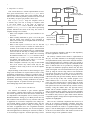
on M5. Figure 6 shows modules from M5 that are involved in
the evaluation. Gray boxes are ports which connect different
components together. Changes done for implementing memory
snapshots are highlighted.
There are lots of different components that need to be in
place for an extensive performance evaluation. Even then,
the behavior of application including its current speedup and
efficiency determine the results to a significant degree. This
paper is a start in identifying the issues and possible solutions
in this area. The authors believe that further research in this
direction will give more quantitative results.
7
VI. F UTURE W ORK AND C ONCLUSIONS
Programmers avoid costly assertions like validating data
structure invariants. However these assertions are as useful in
catching bugs early as the simpler checks that programmers
do use. Extracting costly assertions to be executed in parallel
can improve the parallel speed up of many applications. This
is important as current generation software is not scaling
to next generation parallel hardware. The exact performance
benefit depends on many factors including cost of queuing
and maintaining a snapshot, cost of the actual assertion, idle
parallel processors. The proposed scheme is most beneficial
when the cost of assertion is high and idle processors are
available, whereas cost of queuing and maintaining a snapshot
is low.
Our evaluation work shows the feasibility of implementing
a snapshot scheme, both in software and hardware. However
they are useful in different scenarios. We hope that a future
work would give a workload characterization where different
schemes are most useful.
There are numerous potential uses of a generic snapshot
scheme. The current paper is concentrated around parallelizing
assertions. We envision some interesting application if support
for rolling back to snapshots is added, which should not be
very hard. One of these applications is reverse debugging
where one can step back in the debugger. In fact a more
interesting and less resource hungry scheme would allow
rollback per stack frame. Other potential uses are memory
transactions and software controlled state rollback. The authors
will be investigating these potential uses in the future.
Another concept related to snapshots is having multiple
active versions. Snapshots are passive versions of memory
as no writes are allowed. Such a scheme can allow a new
parallelization model where threads work independently on
the same memory, and their work is merged later. This model
is similar to software development model where code is
developed independently and merged later.
R EFERENCES
[1] S. Vangal, J. Howard, G. Ruhl, S. Dighe, H. Wilson, J. Tschanz,
D. Finan, P. Iyer, A. Singh, A. Singh, T. Jacob, A10, S. Jain,
A11, S. Venkataraman, A12, Y. Hoskote, A13, N. Borkar, and
A14, “An 80-tile 1.28tflops network-on-chip in 65nm cmos,” in
Solid-State Circuits Conference, 2007. ISSCC 2007. Digest of Technical
Papers. IEEE International, 2007, pp. 98–589. [Online]. Available:
http://dx.doi.org/10.1109/ISSCC.2007.373606
[2] “pthreads: The open group base specifications issue 6, ieee std
1003.1, 2004 edition.” [Online]. Available: http://www.opengroup.org/
onlinepubs/009695399/basedefs/pthread.h.html
[3] R. D. Blumofe, C. F. Joerg, B. C. Kuszmaul, C. E. Leiserson, K. H.
Randall, and Y. Zhou, “Cilk: An efficient multithreaded runtime system,”
Journal of Parallel and Distributed Computing, vol. 37, no. 1, pp. 55–69,
1996. [Online]. Available: http://citeseer.ist.psu.edu/blumofe95cilk.html
[4] D. L. Eager, J. Zahorjan, and E. D. Lozowska, “Speedup versus
efficiency in parallel systems,” IEEE Trans. Comput., vol. 38, no. 3,
pp. 408–423, 1989.
[5] Y. Lin and D. A. Padua, “On the automatic parallelization of sparse
and irregular fortran programs,” in LCR ’98: Selected Papers from the
4th International Workshop on Languages, Compilers, and Run-Time
Systems for Scalable Computers. London, UK: Springer-Verlag, 1998,
pp. 41–56.
[6] M. J. Martı́n, D. E. Singh, n. Juan Touri and F. F. Rivera, “Exploiting
locality in the run-time parallelization of irregular loops,” in ICPP
’02: Proceedings of the 2002 International Conference on Parallel
Processing (ICPP’02). Washington, DC, USA: IEEE Computer Society,
2002, p. 27.
[7] M. Arenaz, n. Juan Touri and R. Doallo, “A gsa-based compiler
infrastructure to extract parallelism from complex loops,” in ICS ’03:
Proceedings of the 17th annual international conference on Supercomputing. New York, NY, USA: ACM, 2003, pp. 193–204.
[8] S. McConnell, Code complete: a practical handbook of software construction. Redmond, WA, USA: Microsoft Press, 1993.
[9] G. Kudrjavets, N. Nagappan, and T. Ball, “Assessing the relationship
between software assertions and faults: An empirical study,” IEEE
ISSRE’06, 2006.
[10] Y. Abarbanel, I. Beer, L. Glohovsky, S. Keidar, and Y. Wolfsthal,
Computer Aided Verification. Springer Berlin/ Heidelberg, 2000.
[11] A. Milicevic, S. Misailovic, D. Marinov, and S. Khurshid, “Korat: A
tool for generating structurally complex test inputs,” in ICSE ’07: Proceedings of the 29th International Conference on Software Engineering.
Washington, DC, USA: IEEE Computer Society, 2007, pp. 771–774.
[12] T. L. Dahlgren and P. T. Devanbu, “Improving scientific software
component quality through assertions,” ACM SE-HPCS, May 15 2005.
[13] MSDN Library: MSDNSetThreadAffinityMask Function. [Online]. Available: http://msdn.microsoft.com/en-us/library/ms686247(VS.85).aspx
[14] Linux User’s Manual: taskset. [Online]. Available: http://www.
linuxcommand.org/man pages/taskset1.html
[15] “Alpha 21164 microprocessor: Hardware reference manual,” Digital
Equipment Corporation, July 1996. [Online]. Available: http://h18002.
www1.hp.com/alphaserver/technology/literature/21164hrm.pdf
[16] M. Herlihy, J. Eliot, and B. Moss, “Transactional memory: Architectural
support for lock-free data structures,” Computer Architecture, 1993.,
Proceedings of the 20th Annual International Symposium on, pp. 289–
300, 16-19 May 1993.
[17] K. Sullivan, J. Yang, D. Coppit, S. Khurshid, and D. Jackson, “Software
assurance by bounded exhaustive testing,” in ISSTA ’04: Proceedings of
the 2004 ACM SIGSOFT international symposium on Software testing
and analysis. New York, NY, USA: ACM, 2004, pp. 133–142.
[18] N. L. Binkert, R. G. Dreslinski, L. R. Hsu, K. T. Lim, A. G. Saidi,
and S. K. Reinhardt, “The m5 simulator: Modeling networked systems,”
IEEE Micro, vol. 26, no. 4, pp. 52–60, 2006.
[19] M. M. K. Martin, D. J. Sorin, B. M. Beckmann, M. R. Marty, M. Xu,
A. R. Alameldeen, K. E. Moore, M. D. Hill, and D. A. Wood,
“Multifacet’s general execution-driven multiprocessor simulator (gems)
toolset,” SIGARCH Comput. Archit. News, vol. 33, no. 4, pp. 92–99,
2005.
[20] C.-K. Luk, R. Cohn, R. Muth, H. Patil, A. Klauser, G. Lowney,
S. Wallace, V. J. Reddi, and K. Hazelwood, “Pin: building customized
program analysis tools with dynamic instrumentation,” in PLDI ’05:
Proceedings of the 2005 ACM SIGPLAN conference on Programming
language design and implementation. New York, NY, USA: ACM,
2005, pp. 190–200.