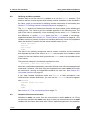
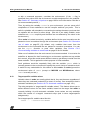
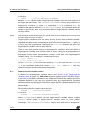
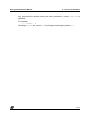
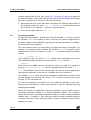
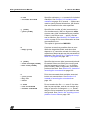
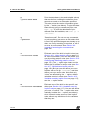
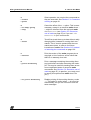
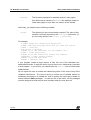
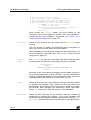
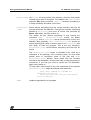
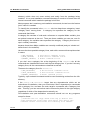
1
ST9+ V6 Software Toolchain — gmake Reference Manual Release 6.1 March 2001 Ref: DOC-ST9V6-GM USE IN LIFE SUPPORT DEVICES OR SYSTEMS MUST BE EXPRESSLY AUTHORIZED. STMicroelectronics PRODUCTS ARE NOT AUTHORIZED FOR USE AS CRITICAL COMPONENTS IN LIFE SUPPORT DEVICES OR SYSTEMS WITHOUT THE EXPRESS WRITTEN APPROVAL OF STMicroelectronics. As used herein: 1. Life support devices or systems are those which (a) are intended for surgical implant into the body, or (b) support or sustain life, and whose failure to perform, when properly used in accordance with instructions for use provided with the product, can be reasonably expected to result in significant injury to the user. 2. A critical component is any component of a life support device or system whose failure to perform can reasonably be expected to cause the failure of the life support device or system, or to affect its safety or effectiveness. Table of Contents Chapter 1: 1.1 1.2 1.3 1.4 1.5 1.6 1.7 Chapter 2: 2.1 2.2 2.3 2.4 2.5 2.6 2.7 Chapter 3: 3.1 3.2 3.3 3.4 3.5 3.6 3.7 Chapter 4: 4.1 4.2 4.3 4.4 4.5 4.6 4.7 4.8 4.9 Introduction . . . . . . . . . . . . . . . . . . . . . . . . . . . . . . . . . . . . . . . . . . 7 Preparing and running make ........................................................................ 7 How to read this manual ............................................................................... 7 Problems and bugs ....................................................................................... 8 Limitations of make for win32 ....................................................................... 8 About the ST9+ toolchain documentation set ............................................... 9 About this manual... .................................................................................... 10 Legal ........................................................................................................... 10 Introduction to Makefiles . . . . . . . . . . . . . . . . . . . . . . . . . . . . . . . 11 What a rule looks like .................................................................................. 11 A simple makefile ........................................................................................ 12 How make processes a makefile ................................................................ 13 Variables make makefiles simpler .............................................................. 14 Letting make deduce the commands .......................................................... 15 Another style of makefile ............................................................................ 16 Rules for cleaning the directory .................................................................. 17 Writing Makefiles . . . . . . . . . . . . . . . . . . . . . . . . . . . . . . . . . . . . . 19 What makefiles contain ............................................................................... 19 What name to give your makefile ............................................................... 20 Including other makefiles ............................................................................ 20 The variable MAKEFILES ........................................................................... 22 How makefiles are remade ......................................................................... 22 Overriding part of another makefile ............................................................ 24 How make reads a makefile ....................................................................... 25 Writing Rules . . . . . . . . . . . . . . . . . . . . . . . . . . . . . . . . . . . . . . . . 27 Rule example .............................................................................................. 27 Rule syntax ................................................................................................. 27 Using wildcard characters in file names ..................................................... 28 Searching directories for prerequisites ....................................................... 31 Phony targets .............................................................................................. 36 Rules without commands or prerequisites .................................................. 38 Empty target files to record events ............................................................. 39 Special built-in target names ...................................................................... 39 Multiple targets in a rule .............................................................................. 41 3/185 Table of Contents 4.10 4.11 4.12 4.13 Chapter 5: 5.1 5.2 5.3 5.4 5.5 5.6 5.7 5.8 Chapter 6: 6.1 6.2 6.3 6.4 6.5 6.6 6.7 6.8 6.9 6.10 6.11 Chapter 7: 7.1 7.2 7.3 Chapter 8: 8.1 8.2 8.3 4/185 Multiple rules for one target ........................................................................ 42 Static pattern rules ...................................................................................... 43 Double-colon rules ...................................................................................... 45 Generating prerequisites automatically ...................................................... 46 Writing Commands in Rules . . . . . . . . . . . . . . . . . . . . . . . . . . . . 49 Command echoing ...................................................................................... 49 Command execution ................................................................................... 50 Parallel execution ....................................................................................... 51 Errors in commands .................................................................................... 53 Interrupting or killing make .......................................................................... 54 Recursive use of make ............................................................................... 55 Defining canned command sequences ....................................................... 61 Using empty commands ............................................................................. 62 How to Use Variables . . . . . . . . . . . . . . . . . . . . . . . . . . . . . . . . . . 63 Basics of variable references ...................................................................... 63 The two flavors of variables ........................................................................ 64 Advanced features for reference to variables ............................................. 67 How variables get their values .................................................................... 70 Setting variables ......................................................................................... 70 Appending more text to variables ............................................................... 71 The override directive ............................................................................. 73 Defining variables verbatim ........................................................................ 74 Variables from the environment .................................................................. 74 Target-specific variable values ................................................................... 75 Pattern-specific variable values .................................................................. 76 Conditional Parts of Makefiles . . . . . . . . . . . . . . . . . . . . . . . . . . 79 Example of a conditional ............................................................................. 79 Syntax of conditionals ................................................................................. 80 Conditionals that test flags .......................................................................... 82 Functions to Transform Text . . . . . . . . . . . . . . . . . . . . . . . . . . . . 85 Function call syntax .................................................................................... 85 Functions for string substitution and analysis ............................................. 86 Functions for file names .............................................................................. 89 Table of Contents 8.4 8.5 8.6 8.7 8.8 8.9 Chapter 9: 9.1 9.2 9.3 9.4 9.5 9.6 9.7 The foreach function ................................................................................ 92 The if function ........................................................................................... 93 The call function ...................................................................................... 94 The origin function .................................................................................. 95 The shell function .................................................................................... 97 Functions that control make ........................................................................ 97 How to Run Make . . . . . . . . . . . . . . . . . . . . . . . . . . . . . . . . . . . . . 99 Arguments to specify the makefile .............................................................. 99 Arguments to specify the goals ................................................................... 99 Instead of executing the commands ......................................................... 102 Avoiding recompilation of some files ........................................................ 103 Overriding variables .................................................................................. 104 Testing the compilation of a program ....................................................... 105 Summary of options .................................................................................. 106 Chapter 10: Implicit Rules . . . . . . . . . . . . . . . . . . . . . . . . . . . . . . . . . . . . . . . 111 10.1 10.2 10.3 10.4 10.5 10.6 10.7 10.8 Using implicit rules .................................................................................... 111 Catalog of implicit rules ............................................................................. 113 Variables used by implicit rules ................................................................ 117 Chains of implicit rules .............................................................................. 119 Defining and redefining pattern rules ........................................................ 121 Defining last-resort default rules ............................................................... 128 Old-fashioned suffix rules ......................................................................... 129 Implicit rule search algorithm .................................................................... 130 Chapter 11: Updating Archive Files . . . . . . . . . . . . . . . . . . . . . . . . . . . . . . . 133 11.1 11.2 11.3 11.4 Archive members as targets ..................................................................... 133 Implicit rule for archive member targets .................................................... 133 Dangers when using archives ................................................................... 135 Suffix rules for archive files ....................................................................... 135 Chapter 12: Features of GNU Make . . . . . . . . . . . . . . . . . . . . . . . . . . . . . . . . 137 Chapter 13: Incompatibilities & Missing Features . . . . . . . . . . . . . . . . . . . . 141 Chapter 14: Makefile Conventions . . . . . . . . . . . . . . . . . . . . . . . . . . . . . . . . 143 14.1 General conventions for makefiles ........................................................... 143 5/185 Table of Contents 14.2 14.3 14.4 14.5 14.6 Utilities in makefiles .................................................................................. 144 Variables for specifying commands .......................................................... 145 Variables for installation directories .......................................................... 147 Standard targets for users ........................................................................ 153 Install command categories ...................................................................... 157 Appendix A: Quick Reference . . . . . . . . . . . . . . . . . . . . . . . . . . . . . . . . . . . . . 161 Appendix B: Errors Generated by Make . . . . . . . . . . . . . . . . . . . . . . . . . . . . . 167 Appendix C: Complex Makefile Example . . . . . . . . . . . . . . . . . . . . . . . . . . . . 171 Product Support . . . . . . . . . . . . . . . . . . . . . . . . . . . . . . . . . . . . . . . . . . . . . . . . 177 Software Updates ................................................................................................... 177 Contact list .............................................................................................................. 177 Index . . . . . . . . . . . . . . . . . . . . . . . . . . . . . . . . . . . . . . . . . . . . . . . . . . . . . . . . . . 179 6/185 ST9+ gmake Reference Manual 1 1 - Introduction INTRODUCTION This manual describes GNU make, which was implemented by Richard Stallman and Roland McGrath. Development since Version 3.76 has been handled by Paul D. Smith. GNU make conforms to section 6.2 of IEEE Standard 1003.2-1992 (POSIX.2). The make utility automatically determines which pieces of a large program need to be recompiled, and issues commands to recompile them. Our examples show C programs, since they are most common, but you can use make with any programming language whose compiler can be run with a shell command. Indeed, make is not limited to programs. You can use it to describe any task where some files must be updated automatically from others whenever the others change. 1.1 Preparing and running make To prepare to use make, you must write a file called the makefile that describes the relationships among files in your program and provides commands for updating each file. In a program, typically, the executable file is updated from object files, which are in turn made by compiling source files. Once a suitable makefile exists, each time you change some source files, this simple shell command: make suffices to perform all necessary recompilations. The make program uses the makefile data base and the last-modification times of the files to decide which of the files need to be updated. For each of those files, it issues the commands recorded in the data base. You can provide command line arguments to make to control which files should be recompiled, or how. Refer to Section 9: How to Run Make on page 99 for more information. 1.2 How to read this manual If you are new to make, or are looking for a general introduction, read the first few sections of each chapter, skipping the later sections. In each chapter, the first few sections contain introductory or general information and the later sections contain specialized or technical information. The exception is the second chapter, Chapter 2: Introduction to Makefiles on page 11 all of which is introductory. 7/185 1 - Introduction ST9+ gmake Reference Manual If you are familiar with other make programs, refer to Chapter 12: Features of GNU Make on page 137, which lists the enhancements GNU make has, and Chapter 13: Incompatibilities & Missing Features on page 141, which explains the few things GNU make lacks that others have. For a quick summary, see Appendix A: Quick Reference on page 161, Section 9.7: Summary of options on page 106 and Section 4.8: Special built-in target names on page 39. 1.3 Problems and bugs If you have problems with GNU make or think you’ve found a bug, please report it to the developers; we cannot promise to do anything but we might well want to fix it. Before reporting a bug, make sure you’ve actually found a real bug. Carefully reread the documentation and see if it really says you can do what you’re trying to do. If it’s not clear whether you should be able to do something or not, report that too; it’s a bug in the documentation! Before reporting a bug or trying to fix it yourself, try to isolate it to the smallest possible makefile that reproduces the problem. Then send us the makefile and the exact results make gave you. Also say what you expected to occur; this will help us decide whether the problem was really in the documentation. Once you’ve got a precise problem, please send electronic mail to: [email protected] Please include the version number of make you are using. You can get this information with the command make --version. Be sure also to include the type of machine and operating system you are using. If possible, include the contents of the file config.h that is generated by the configuration process. 1.4 Limitations of make for win32 Since make comes from the Unix world, some differences (especially with file paths) must be considered if a standard shell is used (command.com for MS-DOS, Windows 95 and Windows 98 and cmd.exe for Windows NT). If shells such as sh or bash (from the Unix world) are used, then there is no need to consider these differences. 1.4.1 Path separator The path separator used in make is ‘/’. However the DOS style separator ‘\’ can be used anywhere in wildcard expansions to quote characters. 8/185 ST9+ gmake Reference Manual 1.4.2 1 - Introduction Driver letter The MS-Windows and MS-DOS driver letter representation uses the ‘:’ character, this presents a problem as ‘:’ represents a separator in make. So, as a workaround make for win32 interprets ‘x:/’ as ‘x:/’ and not as ‘x’ and ‘/’. The drawback to this is that a one character directory may be interpreted as a driver letter. In this case ‘;’ must be used instead of ‘:’ as the separator. ‘:’ is recommended for portability. 1.4.3 Spaces in pathnames MS-Windows allows spaces in file and directory names to be interpreted as separators. For example: VPATH /all sources In this case the /all sources directory is interpreted as two directories. 1.4.4 Command separation Commands follow rules depending on the shell used, so the possibility of having separate commands on the same line with a ‘;’ separator is a feature which is implemented in the sh shell (for example) but not in the command.com shell. 1.4.5 The ‘~’ character The ‘~’ character at the beginning of a file name either represents your home directory or the home directory of the user name following it. On systems such as MS-DOS or MS-Windows which don’t have a home directory for each user, this functionality can be simulated by setting the HOME environment variable. 1.4.6 Double and simple quotes The use of double quotes, for example within a variable may cause problems on Windows 95 and Windows 98. The use of simple quotes instead of double quotes should work around the problem. For example, in a makefile do not write: FLAGS = Wl,"-Map $(APPLI).map", where APPLI is another variable defined in the makefile, but write: FLAGS = Wl,'-Map $(APPLI).map’. 1.5 About the ST9+ toolchain documentation set The ST9+ toolchain documentation set is comprised of the following: • ST9+ gcc9, Libraries & Startup Files Reference Manual. • ST9+ ELF, as9, ld9 & Binutils Reference Manual. 9/185 1 - Introduction 1.6 • ST9+ User Manual. • ST9+ V4 to V6 Migration Notes. • ST9+ gmake Reference Manual. • STVD On-line Help. ST9+ gmake Reference Manual About this manual... The following conventions are used in this manual: Bold type: Used to emphasize new or special terminology, tool names and product names. Teletype: Used to distinguish command line examples, code fragments, and program listings from normal text. Blue italicized: Used to indicate a cross-reference—you can link directly to the reference by clicking on it while viewing with Acrobat Reader. Italic type: Used to indicate book titles. Braces {}: Used to denote optional items in command syntax. Brackets []: Used in command syntax to denote optional items on the command line. Ellipsis ...: In general terms, used to denote the continuation of a series. For example, in syntax definitions denotes a list of one or more items. l: In command syntax, separates two mutually exclusive alternatives. 1.7 Legal Copyright (C) 1991, 92, 93, 94, 95, 96, 97, 98, 99, 2000, 2001 Free Software Foundation, Inc. Permission is granted to make and distribute verbatim copies of this manual provided the copyright notice and this permission notice are preserved on all copies. Permission is granted to copy and distribute modified versions of this manual under the conditions for verbatim copying, provided that the entire resulting derived work is distributed under the terms of a permission notice identical to this one. Permission is granted to copy and distribute translations of this manual into another language, under the above conditions for modified versions. 10/185 ST9+ gmake Reference Manual 2 2 - Introduction to Makefiles INTRODUCTION TO MAKEFILES You need a file called a makefile to tell make what to do. Most often, the makefile tells make how to compile and link a program. In this chapter, we will discuss a simple makefile that describes how to compile and link a text editor which consists of eight C source files and three header files. The makefile can also tell make how to run miscellaneous commands when explicitly asked (for example, to remove certain files as a clean-up operation). To see a more complex example of a makefile, see Appendix C: Complex Makefile Example on page 171. When make recompiles the editor, each changed C source file must be recompiled. If a header file has changed, each C source file that includes the header file must be recompiled to be safe. Each compilation produces an object file corresponding to the source file. Finally, if any source file has been recompiled, all the object files, whether newly made or saved from previous compilations, must be linked together to produce the new executable editor. 2.1 What a rule looks like A simple makefile consists of “rules” with the following format: TARGET ... : PREREQUISITES ... COMMAND ... ... A “target” is usually the name of a file that is generated by a program; examples of targets are executable or object files. A target can also be the name of an action to carry out, such as clean (see Section 4.5: Phony targets on page 36 for more information). A “prerequisite” is a file that is used as input to create the target. A target often depends on several files. A “command” is an action that make carries out. A rule may have more than one command, each on its own line. Note: You need to put a tab character at the beginning of every command line! This is an obscurity that catches the unwary. Usually a command is in a rule with prerequisites and serves to create a target file if any of the prerequisites change. However, the rule that specifies commands for the target need not have prerequisites. For example, the rule containing the delete command associated with the target clean does not have prerequisites. 11/185 2 - Introduction to Makefiles ST9+ gmake Reference Manual A “rule”, then, explains how and when to remake certain files which are the targets of the particular rule. make carries out the commands on the prerequisites to create or update the target. A rule can also explain how and when to carry out an action. See Section 4: Writing Rules on page 27. A makefile may contain other text besides rules, but a simple makefile need only contain rules. Rules may look somewhat more complicated than shown in this template, but all fit the pattern more or less. 2.2 A simple makefile Here is a straightforward makefile that describes the way an executable file called edit depends on eight object files which, in turn, depend on eight C source and three header files. In this example, all the C files include defs.h, but only those defining editing commands include command.h, and only low level files that change the editor buffer include buffer.h. edit : main.o kbd.o command.o display.o \ insert.o search.o files.o utils.o cc -o edit main.o kbd.o command.o display.o \ insert.o search.o files.o utils.o main.o : main.c defs.h cc -c main.c kbd.o : kbd.c defs.h command.h cc -c kbd.c command.o : command.c defs.h command.h cc -c command.c display.o : display.c defs.h buffer.h cc -c display.c insert.o : insert.c defs.h buffer.h cc -c insert.c search.o : search.c defs.h buffer.h cc -c search.c files.o : files.c defs.h buffer.h command.h cc -c files.c utils.o : utils.c defs.h cc -c utils.c clean : rm edit main.o kbd.o command.o display.o \ insert.o search.o files.o utils.o We split each long line into two lines using backslash-newline; this is like using one long line, but is easier to read. To use this makefile to create the executable file called edit, type: make 12/185 ST9+ gmake Reference Manual 2 - Introduction to Makefiles To use this makefile to delete the executable file and all the object files from the directory, type: make clean In the example makefile, the targets include the executable file edit, and the object files main.o and kbd.o. The prerequisites are files such as main.c and defs.h. In fact, each .o file is both a target and a prerequisite. Commands include cc -c main.c and cc -c kbd.c. When a target is a file, it needs to be recompiled or relinked if any of its prerequisites change. In addition, any prerequisites that are themselves automatically generated should be updated first. In this example, edit depends on each of the eight object files; the object file main.o depends on the source file main.c and on the header file defs.h. A shell command follows each line that contains a target and prerequisites. These shell commands say how to update the target file. A tab character must come at the beginning of every command line to distinguish commands lines from other lines in the makefile. (Bear in mind that make does not know anything about how the commands work. It is up to you to supply commands that will update the target file properly. All make does is execute the commands in the rule you have specified when the target file needs to be updated.) The target clean is not a file, but merely the name of an action. Since you normally do not want to carry out the actions in this rule, clean is not a prerequisite of any other rule. Consequently, make never does anything with it unless you tell it specifically. Note: This rule not only is not a prerequisite, it also does not have any prerequisites, so the only purpose of the rule is to run the specified commands. Targets that do not refer to files but are just actions are called “phony targets”. See Section 4.5: Phony targets on page 36 for information about this kind of target. See Section 5.4: Errors in commands on page 53, to see how to cause make to ignore errors from rm or any other command. 2.3 How make processes a makefile By default, make starts with the first target (not targets whose names start with ‘.’). This is called the “default goal”. (“Goals” are the targets that make strives ultimately to update. See Section 9.2: Arguments to specify the goals on page 99.) In the simple example of the previous section, the default goal is to update the executable program 7; therefore, we put that rule first. 13/185 2 - Introduction to Makefiles ST9+ gmake Reference Manual Thus, when you give the command: make make reads the makefile in the current directory and begins by processing the first rule. In the example, this rule is for relinking edit; but before make can fully process this rule, it must process the rules for the files that edit depends on, which in this case are the object files. Each of these files is processed according to its own rule. These rules say to update each .o file by compiling its source file. The recompilation must be done if the source file, or any of the header files named as prerequisites, is more recent than the object file, or if the object file does not exist. The other rules are processed because their targets appear as prerequisites of the goal. If some other rule is not depended on by the goal (or anything it depends on, etc.), that rule is not processed, unless you tell make to do so (with a command such as make clean). Before recompiling an object file, make considers updating its prerequisites, the source file and header files. This makefile does not specify anything to be done for them--the .c and .h files are not the targets of any rules--so make does nothing for these files. But make would update automatically generated C programs, such as those made by Bison or Yacc, by their own rules at this time. After recompiling whichever object files need it, make decides whether to relink edit. This must be done if the file edit does not exist, or if any of the object files are newer than it. If an object file was just recompiled, it is now newer than edit, so edit is relinked. Thus, if we change the file insert.c and run make, make will compile that file to update insert.o, and then link edit. If we change the file command.h and run make, make will recompile the object files kbd.o, command.o and files.o and then link the file edit. 2.4 Variables make makefiles simpler In our example, we had to list all the object files twice in the rule for edit (repeated here): edit : main.o kbd.o command.o display.o \ insert.o search.o files.o utils.o cc -o edit main.o kbd.o command.o display.o \ insert.o search.o files.o utils.o Such duplication is error-prone; if a new object file is added to the system, we might add it to one list and forget the other. We can eliminate the risk and simplify the makefile by using a variable. “Variables” allow a text string to be defined once 14/185 ST9+ gmake Reference Manual 2 - Introduction to Makefiles and substituted in multiple places later (see Chapter 6: How to Use Variables on page 63.) It is standard practice for every makefile to have a variable named objects, OBJECTS, objs, OBJS, obj, or OBJ which is a list of all object file names. We would define such a variable objects with a line like this in the makefile: objects = main.o kbd.o command.o display.o \ insert.o search.o files.o utils.o Then, each place we want to put a list of the object file names, we can substitute the variable’s value by writing $(objects), see Chapter 6: How to Use Variables on page 63. Here is how the complete simple makefile looks when you use a variable for the object files: objects = main.o kbd.o command.o display.o \ insert.o search.o files.o utils.o edit : $(objects) cc -o edit $(objects) main.o : main.c defs.h cc -c main.c kbd.o : kbd.c defs.h command.h cc -c kbd.c command.o : command.c defs.h command.h cc -c command.c display.o : display.c defs.h buffer.h cc -c display.c insert.o : insert.c defs.h buffer.h cc -c insert.c search.o : search.c defs.h buffer.h cc -c search.c files.o : files.c defs.h buffer.h command.h cc -c files.c utils.o : utils.c defs.h cc -c utils.c clean : rm edit $(objects) 2.5 Letting make deduce the commands It is not necessary to spell out the commands for compiling the individual C source files, because make can figure them out: it has an “implicit rule” for updating a .o file from a correspondingly named .c file using a cc -c command. For example, it will use the command cc -c main.c -o main.o to compile main.c into main.o. We can therefore omit the commands from the rules for the object files. See Section 10.1: Using implicit rules on page 111 for more information. 15/185 2 - Introduction to Makefiles ST9+ gmake Reference Manual When a .c file is used automatically in this way, it is also automatically added to the list of prerequisites. We can therefore omit the .c files from the prerequisites, provided we omit the commands. Here is the entire example, with both of these changes, and a variable objects as suggested above: objects = main.o kbd.o command.o display.o \ insert.o search.o files.o utils.o edit : $(objects) cc -o edit $(objects) main.o : defs.h kbd.o : defs.h command.h command.o : defs.h command.h display.o : defs.h buffer.h insert.o : defs.h buffer.h search.o : defs.h buffer.h files.o : defs.h buffer.h command.h utils.o : defs.h .PHONY : clean clean : -rm edit $(objects) This is how we would write the makefile in actual practice. (The complications associated with clean are described elsewhere. See Section 4.5: Phony targets on page 36 and Section 5.4: Errors in commands on page 53 for more information). Because implicit rules are so convenient, they are important. You will see them used frequently. 2.6 Another style of makefile When the objects of a makefile are created only by implicit rules, an alternative style of makefile is possible. In this style of makefile, you group entries by their prerequisites instead of by their targets. Here is what one looks like: objects = main.o kbd.o command.o display.o \ insert.o search.o files.o utils.o edit : $(objects) cc -o edit $(objects) $(objects) : defs.h kbd.o command.o files.o : command.h 16/185 ST9+ gmake Reference Manual 2 - Introduction to Makefiles display.o insert.o search.o files.o : buffer.h Here defs.h is given as a prerequisite of all the object files; command.h and buffer.h are prerequisites of the specific object files listed for them. Whether this is better is a matter of taste: it is more compact, but some people dislike it because they find it clearer to put all the information about each target in one place. 2.7 Rules for cleaning the directory Compiling a program is not the only thing you might want to write rules for. Makefiles commonly tell how to do a few other things besides compiling a program: for example, how to delete all the object files and executables so that the directory is clean. Here is how we could write a make rule for cleaning our example editor: clean: rm edit $(objects) In practice, we might want to write the rule in a somewhat more complicated manner to handle unanticipated situations. We would do this: .PHONY : clean clean : -rm edit $(objects) This prevents make from getting confused by an actual file called clean and causes it to continue in spite of errors from rm. (See Section 4.5: Phony targets on page 36, and Section 5.4: Errors in commands on page 53 for more information.) A rule such as this should not be placed at the beginning of the makefile, because we do not want it to run by default! Thus, in the example makefile, we want the rule for edit, which recompiles the editor, to remain the default goal. Since clean is not a prerequisite of edit, this rule will not run at all if we give the command make with no arguments. In order to make the rule run, we have to type make clean. Refer to Section 9: How to Run Make on page 99 for more information. 17/185 2 - Introduction to Makefiles 18/185 ST9+ gmake Reference Manual ST9+ gmake Reference Manual 3 3 - Writing Makefiles WRITING MAKEFILES The information that tells make how to recompile a system comes from reading a data base called the makefile. 3.1 What makefiles contain Makefiles contain five kinds of things: explicit rules, implicit rules, variable definitions, directives and comments. Rules, variables, and directives are described at length in later chapters. • An “explicit rule” says when and how to remake one or more files, called the rule’s targets. It lists the other files that the targets depend on, call the “prerequisites” of the target, and may also give commands to use to create or update the targets. (See Section 4: Writing Rules on page 27.) • An “implicit rule” says when and how to remake a class of files based on their names. It describes how a target may depend on a file with a name similar to the target and gives commands to create or update such a target. (See Section 10.1: Using implicit rules on page 111.) • A “variable definition” is a line that specifies a text string value for a variable that can be substituted into the text later. The simple makefile example shows a variable definition for objects as a list of all object files (see Section 2.4: Variables make makefiles simpler on page 14.) • A “directive” is a command for make to do something special while reading the makefile. These include: • - Reading another makefile (see Section 3.3: Including other makefiles on page 20.) - Deciding (based on the values of variables) whether to use or ignore a part of the makefile (see Chapter 7: Conditional Parts of Makefiles on page 79.) - Defining a variable from a verbatim string containing multiple lines (see Section 6.8: Defining variables verbatim on page 74.) # in a line of a makefile starts a “comment”. It and the rest of the line are ignored, except that a trailing backslash not escaped by another backslash will continue the comment across multiple lines. Comments may appear on any of the lines in the makefile, except within a define directive, and perhaps within commands (where the shell decides what is a comment). A line containing just a comment (with perhaps spaces before it) is effectively blank, and is ignored. 19/185 3 - Writing Makefiles 3.2 ST9+ gmake Reference Manual What name to give your makefile By default, when make looks for the makefile, it tries the following names, in order: GNUmakefile, makefile and Makefile. Normally you should call your makefile either makefile or Makefile. (We recommend Makefile because it appears prominently near the beginning of a directory listing, right near other important files such as README.) The first name checked, GNUmakefile, is not recommended for most makefiles. You should use this name if you have a makefile that is specific to GNU make, and will not be understood by other versions of make. Other make programs look for makefile and Makefile, but not GNUmakefile. If make finds none of these names, it does not use any makefile. Then you must specify a goal with a command argument, and make will attempt to figure out how to remake it using only its built-in implicit rules. See Section 10.1: Using implicit rules on page 111 for more information. If you want to use a nonstandard name for your makefile, you can specify the makefile name with the -f or --file option. The arguments -f NAME or -file=NAME tell make to read the file NAME as the makefile. If you use more than one -f or --file option, you can specify several makefiles. All the makefiles are effectively concatenated in the order specified. The default makefile names GNUmakefile, makefile and Makefile are not checked automatically if you specify -f or --file. 3.3 Including other makefiles The include directive tells make to suspend reading the current makefile and read one or more other makefiles before continuing. The directive is a line in the makefile that looks like this: include FILENAMES... FILENAMES can contain shell file name patterns. Extra spaces are allowed and ignored at the beginning of the line, but a tab is not allowed. (If the line begins with a tab, it will be considered a command line.) Whitespace is required between include and the file names, and between file names; extra whitespace is ignored there and at the end of the directive. A comment starting with # is allowed at the end of the line. If the file names contain any variable or function references, they are expanded. See Chapter 6: How to Use Variables on page 63. 20/185 ST9+ gmake Reference Manual 3 - Writing Makefiles For example, if you have three .mk files, a.mk, b.mk, and c.mk, and $(bar) expands to bish bash, then the following expression include foo *.mk $(bar) is equivalent to include foo a.mk b.mk c.mk bish bash When make processes an include directive, it suspends reading of the containing makefile and reads from each listed file in turn. When that is finished, make resumes reading the makefile in which the directive appears. One occasion for using include directives is when several programs, handled by individual makefiles in various directories, need to use a common set of variable definitions (see Section 6.5: Setting variables on page 70.) or pattern rules (see Section 10.5: Defining and redefining pattern rules on page 121.) Another such occasion is when you want to generate prerequisites from source files automatically; the prerequisites can be put in a file that is included by the main makefile. This practice is generally cleaner than that of somehow appending the prerequisites to the end of the main makefile as has been traditionally done with other versions of make. See Section 4.13: Generating prerequisites automatically on page 46. If the specified name does not start with a slash, and the file is not found in the current directory, several other directories are searched. First, any directories you have specified with the -I or --include-dir option are searched (see Section 9.7: Summary of options on page 106 for more information.) Then the following directories (if they exist) are searched, in this order: PREFIX/include (normally /usr/local/include(1)) /usr/gnu/include, /usr/local/include, /usr/include. If an included makefile cannot be found in any of these directories, a warning message is generated, but it is not an immediately fatal error; processing of the makefile containing the include continues. Once it has finished reading makefiles, make will try to remake any that are out of date or don’t exist. See Section 3.5: How makefiles are remade on page 22. Only after it has tried to find a way to remake a makefile and failed, will make diagnose the missing makefile as a fatal error. 1) GNU Make compiled for MS-DOS and MS-Windows behaves as if PREFIX has been defined to be the root of the DJGPP tree hierarchy 21/185 3 - Writing Makefiles ST9+ gmake Reference Manual If you want make to simply ignore a makefile which does not exist and cannot be remade, with no error message, use the -include directive instead of include, like this: -include FILENAMES... This is acts like include in every way except that there is no error (not even a warning) if any of the FILENAMES do not exist. For compatibility with some other make implementations, sinclude is another name for -include. 3.4 The variable MAKEFILES If the environment variable MAKEFILES is defined, make considers its value as a list of names (separated by whitespace) of additional makefiles to be read before the others. This works much like the include directive: various directories are searched for those files (see Section 3.3: Including other makefiles on page 20.) In addition, the default goal is never taken from one of these makefiles and it is not an error if the files listed in MAKEFILES are not found. The main use of MAKEFILES is in communication between recursive invocations of make (see Section 5.6: Recursive use of make on page 55.) It usually is not desirable to set the environment variable before a top-level invocation of make, because it is usually better not to mess with a makefile from outside. However, if you are running make without a specific makefile, a makefile in MAKEFILES can do useful things to help the built-in implicit rules work better, such as defining search paths (see Section 4.4.3: How directory searches are performed on page 33 for more information.) Some users are tempted to set MAKEFILES in the environment automatically on login, and program makefiles to expect this to be done. This is a very bad idea, because such makefiles will fail to work if run by anyone else. It is much better to write explicit include directives in the makefiles. See Section 3.3: Including other makefiles on page 20. 3.5 How makefiles are remade Sometimes makefiles can be remade from other files, such as RCS or SCCS files. If a makefile can be remade from other files, you probably want make to get an upto-date version of the makefile to read in. To this end, after reading in all makefiles, make will consider each as a goal target and attempt to update it. If a makefile has a rule which says how to update it (found either in that very makefile or in another one) or if an implicit rule applies to it (see Section 10.1: Using implicit rules on page 111 for more information), it will be updated if necessary. After all makefiles have been checked, if any have actually 22/185 ST9+ gmake Reference Manual 3 - Writing Makefiles been changed, make starts with a clean slate and reads all the makefiles over again. (It will also attempt to update each of them over again, but normally this will not change them again, since they are already up to date.) If you know that one or more of your makefiles cannot be remade and you want to keep make from performing an implicit rule search on them, perhaps for efficiency reasons, you can use any normal method of preventing implicit rule lookup to do so. For example, you can write an explicit rule with the makefile as the target, and an empty command string (see Section 5.8: Using empty commands on page 62 for more information.) If the makefiles specify a double-colon rule to remake a file with commands but no prerequisites, that file will always be remade (see Section 4.12: Double-colon rules on page 45.) In the case of makefiles, a makefile that has a double-colon rule with commands but no prerequisites will be remade every time make is run, and then again after make starts over and reads the makefiles in again. This would cause an infinite loop: make would constantly remake the makefile, and never do anything else. So, to avoid this, make will *not* attempt to remake makefiles which are specified as targets of a double-colon rule with commands but no prerequisites. If you do not specify any makefiles to be read with -f or --file options, make will try the default makefile names; see Section 3.2: What name to give your makefile on page 20. Unlike makefiles explicitly requested with -f or --file options, make is not certain that these makefiles should exist. However, if a default makefile does not exist but can be created by running make rules, you probably want the rules to be run so that the makefile can be used. Therefore, if none of the default makefiles exists, make will try to make each of them in the same order in which they are searched for (see Section 3.2: What name to give your makefile on page 20) until it succeeds in making one, or it runs out of names to try. Note: It is not an error if make cannot find or make any makefile; a makefile is not always necessary. When you use the -t or --touch option (see Section 9.3: Instead of executing the commands on page 102), you would not want to use an out-of-date makefile to decide which targets to touch. So the -t option has no effect on updating makefiles; they are really updated even if -t is specified. Likewise, -q (or -question) and -n (or --just-print) do not prevent updating of makefiles, because an out-of-date makefile would result in the wrong output for other targets. Thus, make -f mfile -n foo will update mfile, read it in, and then print the commands to update foo and its prerequisites without running them. The 23/185 3 - Writing Makefiles ST9+ gmake Reference Manual commands printed for foo will be those specified in the updated contents of mfile. However, on occasion you might actually wish to prevent updating of even the makefiles. You can do this by specifying the makefiles as goals in the command line as well as specifying them as makefiles. When the makefile name is specified explicitly as a goal, the options -t and so on do apply to them. Thus, make -f mfile -n mfile foo would read the makefile mfile, print the commands needed to update it without actually running them, and then print the commands needed to update foo without running them. The commands for foo will be those specified by the existing contents of mfile. 3.6 Overriding part of another makefile Sometimes it is useful to have a makefile that is mostly just like another makefile. You can often use the include directive to include one in the other, and add more targets or variable definitions. However, if the two makefiles give different commands for the same target, make will not let you just do this. But there is another way. In the containing makefile (the one that wants to include the other), you can use a match-anything pattern rule to say that to remake any target that cannot be made from the information in the containing makefile, make should look in another makefile. See Section 4.11: Static pattern rules on page 43, for more information on pattern rules. For example, if you have a makefile called Makefile that says how to make the target foo (and other targets), you can write a makefile called GNUmakefile that contains: foo: frobnicate > foo %: force @$(MAKE) -f Makefile $@ force: ; If you say make foo, make will find GNUmakefile, read it, and see that to make foo, it needs to run the command frobnicate > foo. If you say make bar, make will find no way to make bar in GNUmakefile, so it will use the commands from the pattern rule: make -f Makefile bar. If Makefile provides a rule for updating bar, make will apply the rule. And likewise for any other target that GNUmakefile does not say how to make. 24/185 ST9+ gmake Reference Manual 3 - Writing Makefiles The way this works is that the pattern rule has a pattern of just %, so it matches any target whatever. The rule specifies a prerequisite force, to guarantee that the commands will be run even if the target file already exists. We give force target empty commands to prevent make from searching for an implicit rule to build it-otherwise it would apply the same match-anything rule to force itself and create a prerequisite loop! 3.7 How make reads a makefile GNU make does its work in two distinct phases. During the first phase it reads all the makefiles, included makefiles, etc. and internalizes all the variables and their values, implicit and explicit rules, and constructs a dependency graph of all the targets and their prerequisites. During the second phase, make uses these internal structures to determine what targets will need to be rebuilt and to invoke the rules necessary to do so. It’s important to understand this two-phase approach because it has a direct impact on how variable and function expansion happens; this is often a source of some confusion when writing makefiles. Here we will present a summary of the phases in which expansion happens for different constructs within the makefile. We say that expansion is “immediate” if it happens during the first phase: in this case make will expand any variables or functions in that section of a construct as the makefile is parsed. We say that expansion is “deferred” if expansion is not performed immediately. Expansion of deferred construct is not performed until either the construct appears later in an immediate context, or until the second phase. You may not be familiar with some of these constructs yet. You can reference this section as you become familiar with them, in later chapters. 3.7.1 Variable assignment Variable definitions are parsed as follows: IMMEDIATE = DEFERRED IMMEDIATE ?= DEFERRED IMMEDIATE := IMMEDIATE IMMEDIATE += DEFERRED or IMMEDIATE define IMMEDIATE DEFERRED endef For the append operator, +=, the right-hand side is considered immediate if the variable was previously set as a simple variable (:=), and deferred otherwise. 25/185 3 - Writing Makefiles 3.7.2 ST9+ gmake Reference Manual Conditional syntax All instances of conditional syntax are parsed immediately, in their entirety; this includes the ifdef, ifeq, ifndef, and ifneq forms. 3.7.3 Rule definition A rule is always expanded the same way, regardless of the form: IMMEDIATE : IMMEDIATE ; DEFERRED DEFERRED That is, the target and prerequisite sections are expanded immediately, and the commands used to construct the target are always deferred. This general rule is true for explicit rules, pattern rules, suffix rules, static pattern rules, and simple prerequisite definitions. 26/185 ST9+ gmake Reference Manual 4 4 - Writing Rules WRITING RULES A “rule” appears in the makefile and says when and how to remake certain files, called the rule’s “targets” (most often only one per rule). It lists the other files that are the “prerequisites” of the target, and “commands” to use to create or update the target. The order of rules is not significant, except for determining the “default goal”: the target for make to consider, if you do not otherwise specify one. The default goal is the target of the first rule in the first makefile. If the first rule has multiple targets, only the first target is taken as the default. There are two exceptions: a target starting with a period is not a default unless it contains one or more slashes, /, as well; and, a target that defines a pattern rule has no effect on the default goal. See Section 10.5: Defining and redefining pattern rules on page 121. Therefore, we usually write the makefile so that the first rule is the one for compiling the entire program or all the programs described by the makefile (often with a target called all). See Section 9.2: Arguments to specify the goals on page 99. 4.1 Rule example Here is an example of a rule: foo.o : foo.c defs.h cc -c -g foo.c # module for twiddling the frobs Its target is foo.o and its prerequisites are foo.c and defs.h. It has one command, which is cc -c -g foo.c. The command line starts with a tab to identify it as a command. This rule says two things: 4.2 • How to decide whether foo.o is out of date: it is out of date if it does not exist, or if either foo.c or defs.h is more recent than it. • How to update the file foo.o: by running cc as stated. The command does not explicitly mention defs.h, but we presume that foo.c includes it, and that that is why defs.h was added to the prerequisites. Rule syntax In general, a rule looks like this: TARGETS : PREREQUISITES COMMAND ... 27/185 4 - Writing Rules ST9+ gmake Reference Manual or like this: TARGETS : PREREQUISITES ; COMMAND COMMAND ... The TARGETS are file names, separated by spaces. Wildcard characters may be used (see Section 4.3: Using wildcard characters in file names on page 28) and a name of the form A(M) represents member M in archive file A (see Section 11.1: Archive members as targets on page 133.) Usually there is only one target per rule, but occasionally there is a reason to have more (see Section 4.9: Multiple targets in a rule on page 41.) The COMMAND lines start with a tab character. The first command may appear on the line after the prerequisites, with a tab character, or may appear on the same line, with a semicolon. Either way, the effect is the same. See Chapter 5: Writing Commands in Rules on page 49. Because dollar signs are used to start variable references, if you really want a dollar sign in a rule you must write two of them, $$ (see Chapter 6: How to Use Variables on page 63.) You may split a long line by inserting a backslash followed by a newline, but this is not required, as make places no limit on the length of a line in a makefile. A rule tells make two things: when the targets are out of date, and how to update them when necessary. The criterion for being out of date is specified in terms of the PREREQUISITES, which consist of file names separated by spaces. Wildcards and archive members (see Chapter 11: Updating Archive Files on page 133) are allowed here too. A target is out of date if it does not exist or if it is older than any of the prerequisites (by comparison of last-modification times). The idea is that the contents of the target file are computed based on information in the prerequisites, so if any of the prerequisites changes, the contents of the existing target file are no longer necessarily valid. How to update is specified by COMMANDS. These are lines to be executed by the shell (normally sh), but with some extra features (see Chapter 5: Writing Commands in Rules on page 49.) 4.3 Using wildcard characters in file names A single file name can specify many files using “wildcard characters”. The wildcard characters in make are *, ? and [...], the same as in the Bourne shell. For example, *.c specifies a list of all the files (in the working directory) whose names end in .c. 28/185 ST9+ gmake Reference Manual 4 - Writing Rules The character ~ at the beginning of a file name also has special significance. If alone, or followed by a slash, it represents your home directory. For example ~/bin expands to /home/you/bin. If the ~ is followed by a word, the string represents the home directory of the user named by that word. For example ~john/bin expands to /home/john/bin. On systems which don’t have a home directory for each user (such as MS-DOS or MS-Windows), this functionality can be simulated by setting the environment variable HOME. Wildcard expansion happens automatically in targets, in prerequisites, and in commands (where the shell does the expansion). In other contexts, wildcard expansion happens only if you request it explicitly with the wildcard function. The special significance of a wildcard character can be turned off by preceding it with a backslash. Thus, foo\*bar would refer to a specific file whose name consists of foo, an asterisk, and bar. 4.3.1 Wildcard examples Wildcards can be used in the commands of a rule, where they are expanded by the shell. For example, here is a rule to delete all the object files: clean: rm -f *.o Wildcards are also useful in the prerequisites of a rule. With the following rule in the makefile, make print will print all the .c files that have changed since the last time you printed them: print: *.c lpr -p $? touch print This rule uses print as an empty target file; see Section 4.7: Empty target files to record events on page 39. (The automatic variable $? is used to print only those files that have changed; see Section 10.5.3: Automatic variables on page 123.) Wildcard expansion does not happen when you define a variable. Thus, if you write this: objects = *.o then the value of the variable objects is the actual string *.o. However, if you use the value of objects in a target, prerequisite or command, wildcard expansion will take place at that time. To set objects to the expansion, instead use: objects := $(wildcard *.o) See Section 4.3.3: The function wildcard on page 30 for more information. 29/185 4 - Writing Rules 4.3.2 ST9+ gmake Reference Manual Pitfalls of using wildcards Now here is an example of a naive way of using wildcard expansion, that does not do what you would intend. Suppose you would like to say that the executable file foo is made from all the object files in the directory, and you write this: objects = *.o foo : $(objects) cc -o foo $(CFLAGS) $(objects) The value of objects is the actual string *.o. Wildcard expansion happens in the rule for foo, so that each *existing* .o file becomes a prerequisite of foo and will be recompiled if necessary. But what if you delete all the .o files? When a wildcard matches no files, it is left as it is, so then foo will depend on the oddly-named file *.o. Since no such file is likely to exist, make will give you an error saying it cannot figure out how to make *.o. This is not what you want! Actually it is possible to obtain the desired result with wildcard expansion, but you need more sophisticated techniques, including the wildcard function and string substitution. See Section 4.3.3: The function wildcard on page 30. Microsoft operating systems (MS-DOS and MS-Windows) use backslashes to separate directories in pathnames, like so: c:\foo\bar\baz.c This is equivalent to the Unix-style c:/foo/bar/baz.c (the c: part is the socalled drive letter). When make runs on these systems, it supports backslashes as well as the Unix-style forward slashes in pathnames. However, this support does *not* include the wildcard expansion, where backslash is a quote character. Therefore, you *must* use Unix-style slashes in these cases. 4.3.3 The function wildcard Wildcard expansion happens automatically in rules. But wildcard expansion does not normally take place when a variable is set, or inside the arguments of a function. If you want to do wildcard expansion in such places, you need to use the wildcard function, like this: $(wildcard PATTERN...) This string, used anywhere in a makefile, is replaced by a space-separated list of names of existing files that match one of the given file name patterns. If no existing file name matches a pattern, then that pattern is omitted from the output of the wildcard function. Note: 30/185 This is different from how unmatched wildcards behave in rules, where they are used verbatim rather than ignored. ST9+ gmake Reference Manual 4 - Writing Rules One use of the wildcard function is to get a list of all the C source files in a directory, like this: $(wildcard *.c) We can change the list of C source files into a list of object files by replacing the .c suffix with .o in the result, like this: $(patsubst %.c,%.o,$(wildcard *.c)) Here we have used another function, patsubst. See Section 8.2: Functions for string substitution and analysis on page 86. Thus, a makefile to compile all C source files in the directory and then link them together could be written as follows: objects := $(patsubst %.c,%.o,$(wildcard *.c)) foo : $(objects) cc -o foo $(objects) This takes advantage of the implicit rule for compiling C programs, so there is no need to write explicit rules for compiling the files. See Section 6.2: The two flavors of variables on page 64, for an explanation of :=, which is a variant of =. 4.4 Searching directories for prerequisites For large systems, it is often desirable to put sources in a separate directory from the binaries. The “directory search” features of make facilitate this by searching several directories automatically to find a prerequisite. When you redistribute the files among directories, you do not need to change the individual rules, just the search paths. 4.4.1 VPATH: search path for all prerequisites The value of the make variable VPATH specifies a list of directories that make should search. Most often, the directories are expected to contain prerequisite files that are not in the current directory; however, VPATH specifies a search list that make applies for all files, including files which are targets of rules. Thus, if a file that is listed as a target or prerequisite does not exist in the current directory, make searches the directories listed in VPATH for a file with that name. If a file is found in one of them, that file may become the prerequisite (see below). Rules may then specify the names of files in the prerequisite list as if they all existed in the current directory. See Section 4.4.4: Writing shell commands with directory search on page 34 for more information. In the VPATH variable, directory names are separated by colons or blanks. The order in which directories are listed is the order followed by make in its search. (On 31/185 4 - Writing Rules ST9+ gmake Reference Manual MS-DOS and MS-Windows, semi-colons are used as separators of directory names in VPATH, since the colon can be used in the pathname itself, after the drive letter.) For example, VPATH = src:../headers specifies a path containing two directories, src and ../headers, which make searches in that order. With this value of VPATH, the following rule, foo.o : foo.c is interpreted as if it were written like this: foo.o : src/foo.c assuming the file foo.c does not exist in the current directory but is found in the directory src. 4.4.2 The vpath directive Similar to the VPATH variable, but more selective, is the vpath directive (note lower case), which allows you to specify a search path for a particular class of file names: those that match a particular pattern. Thus you can supply certain search directories for one class of file names and other directories (or none) for other file names. There are three forms of the vpath directive: vpath PATTERN DIRECTORIES Specify the search path DIRECTORIES for file names that match PATTERN. The search path, DIRECTORIES, is a list of directories to be searched, separated by colons (semi-colons on MS-DOS and MS-Windows) or blanks, just like the search path used in the VPATH variable. vpath PATTERN Clear out the search path associated with PATTERN. vpath Clear all search paths previously specified with vpath directives. A vpath pattern is a string containing a % character. The string must match the file name of a prerequisite that is being searched for, the % character matching any sequence of zero or more characters (as in pattern rules; see Section 10.5: Defining and redefining pattern rules on page 121). For example, %.h matches files that end in .h. (If there is no %, the pattern must match the prerequisite exactly, which is not useful very often.) 32/185 ST9+ gmake Reference Manual 4 - Writing Rules % characters in a vpath directive’s pattern can be quoted with preceding backslashes (\). Backslashes that would otherwise quote % characters can be quoted with more backslashes. Backslashes that quote % characters or other backslashes are removed from the pattern before it is compared to file names. Backslashes that are not in danger of quoting % characters go unmolested. When a prerequisite fails to exist in the current directory, if the PATTERN in a vpath directive matches the name of the prerequisite file, then the DIRECTORIES in that directive are searched just like (and before) the directories in the VPATH variable. For example, vpath %.h ../headers tells make to look for any prerequisite whose name ends in .h in the directory ../headers if the file is not found in the current directory. If several vpath patterns match the prerequisite file’s name, then make processes each matching vpath directive one by one, searching all the directories mentioned in each directive. make handles multiple vpath directives in the order in which they appear in the makefile; multiple directives with the same pattern are independent of each other. Thus, vpath %.c foo vpath % blish vpath %.c bar will look for a file ending in .c in foo, then blish, then bar, while vpath %.c foo:bar vpath % blish will look for a file ending in .c in foo, then bar, then blish. 4.4.3 How directory searches are performed When a prerequisite is found through directory search, regardless of type (general or selective), the pathname located may not be the one that make actually provides you in the prerequisite list. Sometimes the path discovered through directory search is thrown away. The algorithm make uses to decide whether to keep or abandon a path found via directory search is as follows: 1 If a target file does not exist at the path specified in the makefile, directory search is performed. 33/185 4 - Writing Rules ST9+ gmake Reference Manual 2 If the directory search is successful, that path is kept and this file is tentatively stored as the target. 3 All prerequisites of this target are examined using this same method. 4 After processing the prerequisites, the target may or may not need to be rebuilt: a If the target does *not* need to be rebuilt, the path to the file found during directory search is used for any prerequisite lists which contain this target. In short, if make doesn’t need to rebuild the target then you use the path found via directory search. b If the target *does* need to be rebuilt (is out-of-date), the pathname found during directory search is *thrown away*, and the target is rebuilt using the file name specified in the makefile. In short, if make must rebuild, then the target is rebuilt locally, not in the directory found via directory search. This algorithm may seem complex, but in practice it is quite often exactly what you want. Other versions of make use a simpler algorithm: if the file does not exist, and it is found via directory search, then that pathname is always used whether or not the target needs to be built. Thus, if the target is rebuilt it is created at the pathname discovered during directory search. If, in fact, this is the behavior you want for some or all of your directories, you can use the GPATH variable to indicate this to make. GPATH has the same syntax and format as VPATH (that is, a space- or colondelimited list of pathnames). If an out-of-date target is found by directory search in a directory that also appears in GPATH, then that pathname is not thrown away. The target is rebuilt using the expanded path. 4.4.4 Writing shell commands with directory search When a prerequisite is found in another directory through directory search, this cannot change the commands of the rule; they will execute as written. Therefore, you must write the commands with care so that they will look for the prerequisite in the directory where make finds it. This is done with the “automatic variables” such as $^ (see Section 10.5.3: Automatic variables on page 123.) For instance, the value of $^ is a list of all the prerequisites of the rule, including the names of the directories in which they were found, and the value of $@ is the target. Thus: foo.o : foo.c cc -c $(CFLAGS) $^ -o $@ 34/185 ST9+ gmake Reference Manual 4 - Writing Rules (The variable CFLAGS exists so you can specify flags for C compilation by implicit rules; we use it here for consistency so it will affect all C compilations uniformly; see Section 10.3: Variables used by implicit rules on page 117 for more information.) Often the prerequisites include header files as well, which you do not want to mention in the commands. The automatic variable $< is just the first prerequisite: VPATH = src:../headers foo.o : foo.c defs.h hack.h cc -c $(CFLAGS) $< -o $@ 4.4.5 Directory search and implicit rules The search through the directories specified in VPATH or with vpath also happens during consideration of implicit rules (See Section 10.1: Using implicit rules on page 111 for more information.) For example, when a file foo.o has no explicit rule, make considers implicit rules, such as the built-in rule to compile foo.c if that file exists. If such a file is lacking in the current directory, the appropriate directories are searched for it. If foo.c exists (or is mentioned in the makefile) in any of the directories, the implicit rule for C compilation is applied. The commands of implicit rules normally use automatic variables as a matter of necessity; consequently they will use the file names found by directory search with no extra effort. 4.4.6 Directory search for link libraries Directory search applies in a special way to libraries used with the linker. This special feature comes into play when you write a prerequisite whose name is of the form -lNAME. (You can tell something strange is going on here because the prerequisite is normally the name of a file, and the *file name* of a library generally looks like libNAME.a, not like -lNAME.) When a prerequisite’s name has the form -lNAME, make handles it specially by searching for the file libNAME.so in the current directory, in directories specified by matching vpath search path and the VPATH search path, and then in the directories /lib, /usr/lib, and PREFIX/lib (normally /usr/local/lib, but MS-DOS/MS-Windows versions of make behave as if PREFIX is defined to be the root of the DJGPP installation tree). If that file is not found, then the file libNAME.a is searched for, in the same directories as above. 35/185 4 - Writing Rules ST9+ gmake Reference Manual For example, if there is a /usr/lib/libcurses.a library on your system (and no /usr/lib/libcurses.so file), then foo : foo.c -lcurses cc $^ -o $@ would cause the command cc foo.c /usr/lib/libcurses.a -o foo to be executed when foo is older than foo.c or than /usr/lib/libcurses.a. Although the default set of files to be searched for is libNAME.so and libNAME.a, this is customizable via the .LIBPATTERNS variable. Each word in the value of this variable is a pattern string. When a prerequisite like -lNAME is seen, make will replace the percent in each pattern in the list with NAME and perform the above directory searches using that library filename. If no library is found, the next word in the list will be used. The default value for .LIBPATTERNS is "lib%.so lib%.a", which provides the default behavior described above. You can turn off link library expansion completely by setting this variable to an empty value. 4.5 Phony targets A phony target is one that is not really the name of a file. It is just a name for some commands to be executed when you make an explicit request. There are two reasons to use a phony target: to avoid a conflict with a file of the same name, and to improve performance. If you write a rule whose commands will not create the target file, the commands will be executed every time the target comes up for remaking. Here is an example: clean: rm *.o temp Because the rm command does not create a file named clean, probably no such file will ever exist. Therefore, the rm command will be executed every time you say make clean. The phony target will cease to work if anything ever does create a file named clean in this directory. Since it has no prerequisites, the file clean would inevitably be considered up to date, and its commands would not be executed. To avoid this problem, you can explicitly declare the target to be phony, using the special target .PHONY (see Section 4.8: Special built-in target names on page 39.) as follows: .PHONY : clean Once this is done, make clean will run the commands regardless of whether there is a file named clean. 36/185 ST9+ gmake Reference Manual 4 - Writing Rules Since it knows that phony targets do not name actual files that could be remade from other files, make skips the implicit rule search for phony targets (see Chapter 10: Implicit Rules on page 111.) This is why declaring a target phony is good for performance, even if you are not worried about the actual file existing. Thus, you first write the line that states that clean is a phony target, then you write the rule, like this: .PHONY: clean clean: rm *.o temp Another example of the usefulness of phony targets is in conjunction with recursive invocations of make. In this case the makefile will often contain a variable which lists a number of subdirectories to be built. One way to handle this is with one rule whose command is a shell loop over the subdirectories, like this: SUBDIRS = foo bar baz subdirs: for dir in $(SUBDIRS); do \ $(MAKE) -C $$dir; \ done There are a few of problems with this method, however. First, any error detected in a submake is not noted by this rule, so it will continue to build the rest of the directories even when one fails. This can be overcome by adding shell commands to note the error and exit, but then it will do so even if make is invoked with the -k option, which is unfortunate. Second, and perhaps more importantly, you cannot take advantage of the parallel build capabilities of make using this method, since there is only one rule. By declaring the subdirectories as phony targets (you must do this as the subdirectory obviously always exists; otherwise it won’t be built) you can remove these problems: SUBDIRS = foo bar baz .PHONY: subdirs $(SUBDIRS) subdirs: $(SUBDIRS) $(SUBDIRS): $(MAKE) -C $ foo: baz Here we’ve also declared that the foo subdirectory cannot be built until after the baz subdirectory is complete; this kind of relationship declaration is particularly important when attempting parallel builds. A phony target should not be a prerequisite of a real target file; if it is, its commands are run every time make goes to update that file. As long as a phony target is never a prerequisite of a real target, the phony target commands will be executed only 37/185 4 - Writing Rules ST9+ gmake Reference Manual when the phony target is a specified goal (see Section 9.2: Arguments to specify the goals on page 99.) Phony targets can have prerequisites. When one directory contains multiple programs, it is most convenient to describe all of the programs in one makefile ./Makefile. Since the target remade by default will be the first one in the makefile, it is common to make this a phony target named all and give it, as prerequisites, all the individual programs. For example: all : prog1 prog2 prog3 .PHONY : all prog1 : prog1.o utils.o cc -o prog1 prog1.o utils.o prog2 : prog2.o cc -o prog2 prog2.o prog3 : prog3.o sort.o utils.o cc -o prog3 prog3.o sort.o utils.o Now you can say just make to remake all three programs, or specify as arguments the ones to remake (as in make prog1 prog3). When one phony target is a prerequisite of another, it serves as a subroutine of the other. For example, here make cleanall will delete the object files, the difference files, and the file program: .PHONY: cleanall cleanobj cleandiff cleanall : cleanobj cleandiff rm program cleanobj : rm *.o cleandiff : rm *.diff 4.6 Rules without commands or prerequisites If a rule has no prerequisites or commands, and the target of the rule is a nonexistent file, then make imagines this target to have been updated whenever its rule is run. This implies that all targets depending on this one will always have their commands run. An example will illustrate this: clean: FORCE rm $(objects) FORCE: 38/185 ST9+ gmake Reference Manual 4 - Writing Rules Here the target FORCE satisfies the special conditions, so the target clean that depends on it is forced to run its commands. There is nothing special about the name FORCE, but that is one name commonly used this way. As you can see, using FORCE this way has the same results as using .PHONY: clean. Using .PHONY is more explicit and more efficient. However, other versions of make do not support .PHONY; thus FORCE appears in many makefiles. See Section 4.5: Phony targets on page 36 for more information. 4.7 Empty target files to record events The “empty target” is a variant of the phony target; it is used to hold commands for an action that you request explicitly from time to time. Unlike a phony target, this target file can really exist; but the file’s contents do not matter, and usually are empty. The purpose of the empty target file is to record, with its last-modification time, when the rule’s commands were last executed. It does so because one of the commands is a touch command to update the target file. The empty target file should have some prerequisites (otherwise it doesn’t make sense). When you ask to remake the empty target, the commands are executed if any prerequisite is more recent than the target; in other words, if a prerequisite has changed since the last time you remade the target. Here is an example: print: foo.c bar.c lpr -p $? touch print With this rule, make print will execute the leper command if either source file has changed since the last make print. The automatic variable $? is used to print only those files that have changed (see Section 10.5.3: Automatic variables on page 123.) 4.8 Special built-in target names Certain names have special meanings if they appear as targets. .PHONY The prerequisites of the special target .PHONY are considered to be phony targets. When it is time to consider such a target, make will run its commands unconditionally, regardless of whether a file with that name exists or what its lastmodification time is. See Section 4.5: Phony targets on page 36 for more information. 39/185 4 - Writing Rules ST9+ gmake Reference Manual .SUFFIXES The prerequisites of the special target .SUFFIXES are the list of suffixes to be used in checking for suffix rules. See Section 10.7: Old-fashioned suffix rules on page 129. .DEFAULT The commands specified for .DEFAULT are used for any target for which no rules are found (either explicit rules or implicit rules). If .DEFAULT commands are specified, every file mentioned as a prerequisite, but not as a target in a rule, will have these commands executed on its behalf. See Section 10.8: Implicit rule search algorithm on page 130. .PRECIOUS The targets which .PRECIOUS depends on are given the following special treatment: if make is killed or interrupted during the execution of their commands, the target is not deleted. See Section 5.5: Interrupting or killing make on page 54. Also, if the target is an intermediate file, it will not be deleted after it is no longer needed, as is normally done. See Section 10.4: Chains of implicit rules on page 119 for more information. You can also list the target pattern of an implicit rule (such as %.o) as a prerequisite file of the special target .PRECIOUS to preserve intermediate files created by rules whose target patterns match that file’s name. .INTERMEDIATE The targets which .INTERMEDIATE depends on are treated as intermediate files. See Section 10.4: Chains of implicit rules on page 119 for more information. .INTERMEDIATE with no prerequisites has no effect. .SECONDARY The targets which .SECONDARY depends on are treated as intermediate files, except that they are never automatically deleted. See Section 10.4: Chains of implicit rules on page 119 for more information. .SECONDARY with no prerequisites marks all file targets mentioned in the makefile as secondary. .DELETE_ON_ERROR If .DELETE_ON_ERROR is mentioned as a target anywhere in the makefile, then make will delete the target of a rule if it has changed and its commands exit with a nonzero exit status, just as it does when it receives a signal. See Section 5.4: Errors in commands on page 53. 40/185 ST9+ gmake Reference Manual 4 - Writing Rules .IGNORE If you specify prerequisites for .IGNORE, then make will ignore errors in execution of the commands run for those particular files. The commands for .IGNORE are not meaningful. If mentioned as a target with no prerequisites, .IGNORE says to ignore errors in execution of commands for all files. This usage of .IGNORE is supported only for historical compatibility. Since this affects every command in the makefile, it is not very useful; we recommend you use the more selective ways to ignore errors in specific commands. See Section 5.4: Errors in commands on page 53. .SILENT If you specify prerequisites for .SILENT, then make will not print the commands to remake those particular files before executing them. The commands for .SILENT are not meaningful. If mentioned as a target with no prerequisites, .SILENT says not to print any commands before executing them. This usage of .SILENT is supported only for historical compatibility. We recommend you use the more selective ways to silence specific commands. See Section 5.1: Command echoing on page 49. If you want to silence all commands for a particular run of make, use the -s or --silent option (see Section 9.7: Summary of options on page 106.) .EXPORT_ALL_VARIABLES Simply by being mentioned as a target, this tells make to export all variables to child processes by default. See Section 5.6.2: Communicating variables to a submake on page 56. Any defined implicit rule suffix also counts as a special target if it appears as a target, and so does the concatenation of two suffixes, such as .c.o. These targets are suffix rules, an obsolete way of defining implicit rules (but a way still widely used). In principle, any target name could be special in this way if you break it in two and add both pieces to the suffix list. In practice, suffixes normally begin with ., so these special target names also begin with .. See Section 10.7: Old-fashioned suffix rules on page 129. 4.9 Multiple targets in a rule A rule with multiple targets is equivalent to writing many rules, each with one target, and all identical aside from that. The same commands apply to all the targets, but their effects may vary because you can substitute the actual target name into the command using $@. The rule contributes the same prerequisites to all the targets also. 41/185 4 - Writing Rules ST9+ gmake Reference Manual This is useful in two cases: • You want just prerequisites, no commands. For example: kbd.o command.o files.o: command.h gives an additional prerequisite to each of the three object files mentioned. • Similar commands work for all the targets. The commands do not need to be absolutely identical, since the automatic variable $@ can be used to substitute the particular target to be remade into the commands (see Section 10.5.3: Automatic variables on page 123.) For example: bigoutput littleoutput : text.g generate text.g -$(subst output,,$@) > $@ is equivalent to bigoutput : text.g generate text.g -big > bigoutput littleoutput : text.g generate text.g -little > littleoutput Here we assume the hypothetical program generate makes two types of output, one if given -big and one if given -little. See Section 8.2: Functions for string substitution and analysis on page 86, for an explanation of the subst function. Suppose you would like to vary the prerequisites according to the target, much as the variable $@ allows you to vary the commands. You cannot do this with multiple targets in an ordinary rule, but you can do it with a “static pattern rule”. See Section 4.11: Static pattern rules on page 43. 4.10 Multiple rules for one target One file can be the target of several rules. All the prerequisites mentioned in all the rules are merged into one list of prerequisites for the target. If the target is older than any prerequisite from any rule, the commands are executed. There can only be one set of commands to be executed for a file. If more than one rule gives commands for the same file, make uses the last set given and prints an error message. (As a special case, if the file’s name begins with a dot, no error message is printed. This odd behavior is only for compatibility with other implementations of make.) There is no reason to write your makefiles this way; that is why make gives you an error message. An extra rule with just prerequisites can be used to give a few extra prerequisites to many files at once. For example, one usually has a variable named objects containing a list of all the compiler output files in the system being made. An easy 42/185 ST9+ gmake Reference Manual 4 - Writing Rules way to say that all of them must be recompiled if config.h changes is to write the following: objects = foo.o bar.o foo.o : defs.h bar.o : defs.h test.h $(objects) : config.h This could be inserted or taken out without changing the rules that really specify how to make the object files, making it a convenient form to use if you wish to add the additional prerequisite intermittently. Another wrinkle is that the additional prerequisites could be specified with a variable that you set with a command argument to make (see Section 9.5: Overriding variables on page 104.) For example, extradeps= $(objects) : $(extradeps) means that the command make extradeps=foo.h will consider foo.h as a prerequisite of each object file, but plain make will not. If none of the explicit rules for a target has commands, then make searches for an applicable implicit rule to find some commands, see Section 10.1: Using implicit rules on page 111 for more information. 4.11 Static pattern rules “Static pattern rules” are rules which specify multiple targets and construct the prerequisite names for each target based on the target name. They are more general than ordinary rules with multiple targets because the targets do not have to have identical prerequisites. Their prerequisites must be *analogous*, but not necessarily *identical*. 4.11.1 Syntax of static pattern rules Here is the syntax of a static pattern rule: TARGETS ...: TARGET-PATTERN: DEP-PATTERNS ... COMMANDS ... The TARGETS list specifies the targets that the rule applies to. The targets can contain wildcard characters, just like the targets of ordinary rules (see Section 4.3: Using wildcard characters in file names on page 28. The TARGET-PATTERN and DEP-PATTERNS say how to compute the prerequisites of each target. Each target is matched against the TARGETPATTERN to extract a part of the target name, called the “stem”. This stem is 43/185 4 - Writing Rules ST9+ gmake Reference Manual substituted into each of the DEP-PATTERNS to make the prerequisite names (one from each DEP-PATTERN). Each pattern normally contains the character % just once. When the TARGETPATTERN matches a target, the % can match any part of the target name; this part is called the “stem”. The rest of the pattern must match exactly. For example, the target foo.o matches the pattern %.o, with foo as the stem. The targets foo.c and foo.out do not match that pattern. The prerequisite names for each target are made by substituting the stem for the % in each prerequisite pattern. For example, if one prerequisite pattern is %.c, then substitution of the stem foo gives the prerequisite name foo.c. It is legitimate to write a prerequisite pattern that does not contain %; then this prerequisite is the same for all targets. % characters in pattern rules can be quoted with preceding backslashes (\). Backslashes that would otherwise quote % characters can be quoted with more backslashes. Backslashes that quote % characters or other backslashes are removed from the pattern before it is compared to file names or has a stem substituted into it. Backslashes that are not in danger of quoting % characters go unmolested. For example, the pattern the\%weird\\%pattern\\ has the%weird\ preceding the operative % character, and pattern\\ following it. The final two backslashes are left alone because they cannot affect any % character. Here is an example, which compiles each of foo.o and bar.o from the corresponding .c file: objects = foo.o bar.o all: $(objects) $(objects): %.o: %.c $(CC) -c $(CFLAGS) $< -o $@ Here $< is the automatic variable that holds the name of the prerequisite and $@ is the automatic variable that holds the name of the target; see Section 10.5.3: Automatic variables on page 123. Each target specified must match the target pattern; a warning is issued for each target that does not. If you have a list of files, only some of which will match the pattern, you can use the filter function to remove non-matching file names (see Section 8.2: Functions for string substitution and analysis on page 86): files = foo.elc bar.o lose.o $(filter %.o,$(files)): %.o: %.c $(CC) -c $(CFLAGS) $< -o $@ $(filter %.elc,$(files)): %.elc: %.el 44/185 ST9+ gmake Reference Manual 4 - Writing Rules emacs -f batch-byte-compile $< In this example the result of $(filter %.o,$(files)) is bar.o lose.o, and the first static pattern rule causes each of these object files to be updated by compiling the corresponding C source file. The result of $(filter %.elc,$(files)) is foo.elc, so that file is made from foo.el. Another example shows how to use $* in static pattern rules: bigoutput littleoutput : %output : text.g generate text.g -$* > $@ When the generate command is run, $* will expand to the stem, either big or little. 4.11.2 Static pattern rules versus implicit rules A static pattern rule has much in common with an implicit rule defined as a pattern rule (see Section 10.5: Defining and redefining pattern rules on page 121.) Both have a pattern for the target and patterns for constructing the names of prerequisites. The difference is in how make decides *when* the rule applies. An implicit rule *can* apply to any target that matches its pattern, but it *does* apply only when the target has no commands otherwise specified, and only when the prerequisites can be found. If more than one implicit rule appears applicable, only one applies; the choice depends on the order of rules. By contrast, a static pattern rule applies to the precise list of targets that you specify in the rule. It cannot apply to any other target and it invariably does apply to each of the targets specified. If two conflicting rules apply, and both have commands, that’s an error. The static pattern rule can be better than an implicit rule for these reasons: 4.12 • You may wish to override the usual implicit rule for a few files whose names cannot be categorized syntactically but can be given in an explicit list. • If you cannot be sure of the precise contents of the directories you are using, you may not be sure which other irrelevant files might lead make to use the wrong implicit rule. The choice might depend on the order in which the implicit rule search is done. With static pattern rules, there is no uncertainty: each rule applies to precisely the targets specified. Double-colon rules “Double-colon” rules are rules written with :: instead of : after the target names. They are handled differently from ordinary rules when the same target appears in more than one rule. 45/185 4 - Writing Rules ST9+ gmake Reference Manual When a target appears in multiple rules, all the rules must be the same type: all ordinary, or all double-colon. If they are double-colon, each of them is independent of the others. Each double-colon rule’s commands are executed if the target is older than any prerequisites of that rule. This can result in executing none, any, or all of the double-colon rules. Double-colon rules with the same target are in fact completely separate from one another. Each double-colon rule is processed individually, just as rules with different targets are processed. The double-colon rules for a target are executed in the order they appear in the makefile. However, the cases where double-colon rules really make sense are those where the order of executing the commands would not matter. Double-colon rules are somewhat obscure and not often very useful; they provide a mechanism for cases in which the method used to update a target differs depending on which prerequisite files caused the update, and such cases are rare. Each double-colon rule should specify commands; if it does not, an implicit rule will be used if one applies. See Section 10.1: Using implicit rules on page 111 for more information. 4.13 Generating prerequisites automatically In the makefile for a program, many of the rules you need to write often say only that some object file depends on some header file. For example, if main.c uses defs.h via an #include, you would write: main.o: defs.h You need this rule so that make knows that it must remake main.o whenever defs.h changes. You can see that for a large program you would have to write dozens of such rules in your makefile. And, you must always be very careful to update the makefile every time you add or remove an #include. To avoid this hassle, most modern C compilers can write these rules for you, by looking at the #include lines in the source files. Usually this is done with the -M option to the compiler. For example, the command: cc -M main.c generates the output: main.o : main.c defs.h Thus you no longer have to write all those rules yourself. The compiler will do it for you. Note: 46/185 Such a prerequisite constitutes mentioning main.o in a makefile, so it can never be considered an intermediate file by implicit rule search. This means that make won’t ever ST9+ gmake Reference Manual 4 - Writing Rules remove the file after using it; see Section 10.4: Chains of implicit rules on page 119 for more information. With old make programs, it was traditional practice to use this compiler feature to generate prerequisites on demand with a command like make depend. That command would create a file depend containing all the automatically-generated prerequisites; then the makefile could use include to read them in (see Section 3.3: Including other makefiles on page 20.) In GNU make, the feature of remaking makefiles makes this practice obsolete--you need never tell make explicitly to regenerate the prerequisites, because it always regenerates any makefile that is out of date. See Section 3.5: How makefiles are remade on page 22. The practice we recommend for automatic prerequisite generation is to have one makefile corresponding to each source file. For each source file NAME.c there is a makefile NAME.d which lists what files the object file NAME.o depends on. That way only the source files that have changed need to be re-scanned to produce the new prerequisites. Here is the pattern rule to generate a file of prerequisites (i.e., a makefile) called NAME.d from a C source file called NAME.c: %.d: %.c set -e; $(CC) -M $(CPPFLAGS) $< \ | sed ’s/\($*\)\.o[ :]*/\1.o $@ : /g’ > $@; \ [ -s $@ ] || rm -f $@ See Section 4.11: Static pattern rules on page 43, for information on defining pattern rules. The -e flag to the shell makes it exit immediately if the $(CC) command fails (exits with a nonzero status). Normally the shell exits with the status of the last command in the pipeline (sed in this case), so make would not notice a nonzero status from the compiler. With the GNU C compiler, you may wish to use the -MM flag instead of -M. This omits prerequisites on system header files. The purpose of the sed command is to translate (for example): main.o : main.c defs.h into: main.o main.d : main.c defs.h This makes each .d file depend on all the source and header files that the corresponding .o file depends on. make then knows it must regenerate the prerequisites whenever any of the source or header files changes. 47/185 4 - Writing Rules ST9+ gmake Reference Manual Once you’ve defined the rule to remake the .d files, you then use the include directive to read them all in. See Section 3.3: Including other makefiles on page 20. For example: sources = foo.c bar.c include $(sources:.c=.d) This example uses a substitution variable reference to translate the list of source files foo.c bar.c into a list of prerequisite makefiles, foo.d bar.d. See Section 6.3.1: Substitution references on page 67 for full information on substitution references. Since the .d files are makefiles like any others, make will remake them as necessary with no further work from you. See Section 3.5: How makefiles are remade on page 22. 48/185 ST9+ gmake Reference Manual 5 5 - Writing Commands in Rules WRITING COMMANDS IN RULES The commands of a rule consist of shell command lines to be executed one by one. Each command line must start with a tab, except that the first command line may be attached to the target-and-prerequisites line with a semicolon in between. Blank lines and lines of just comments may appear among the command lines; they are ignored. (But beware, an apparently “blank” line that begins with a tab is *not* blank! It is an empty command; see Section 5.8: Using empty commands on page 62 for more information.) Users use many different shell programs, but commands in makefiles are always interpreted by /bin/sh unless the makefile specifies otherwise. See Section 5.2: Command execution on page 50. The shell that is in use determines whether comments can be written on command lines, and what syntax they use. When the shell is /bin/sh, a # starts a comment that extends to the end of the line. The # does not have to be at the beginning of a line. Text on a line before a # is not part of the comment. 5.1 Command echoing Normally make prints each command line before it is executed. We call this “echoing” because it gives the appearance that you are typing the commands yourself. When a line starts with @, the echoing of that line is suppressed. The @ is discarded before the command is passed to the shell. Typically you would use this for a command whose only effect is to print something, such as an echo command to indicate progress through the makefile: @echo About to make distribution files When make is given the flag -n or --just-print it only echoes commands, it won’t execute them. See Section 9.7: Summary of options on page 106 for more information. In this case and only this case, even the commands starting with ‘’ are printed. This flag is useful for finding out which commands make thinks are necessary without actually doing them. The -s or --silent flag to make prevents all echoing, as if all commands started with @. A rule in the makefile for the special target .SILENT without prerequisites has the same effect (see Section 4.8: Special built-in target names on page 39.) .SILENT is essentially obsolete since @ is more flexible. 49/185 5 - Writing Commands in Rules 5.2 ST9+ gmake Reference Manual Command execution When it is time to execute commands to update a target, they are executed by making a new subshell for each line. (In practice, make may take shortcuts that do not affect the results.) Note: This implies that shell commands such as cd that set variables local to each process will not affect the following command lines. On MS-DOS, the value of current working directory is *global*, so changing it *will* affect the following command lines on those systems. If you want to use cd to affect the next command, put the two on a single line with a semicolon between them. Then make will consider them a single command and pass them, together, to a shell which will execute them in sequence. For example: foo : bar/lose cd bar; gobble lose > ../foo If you would like to split a single shell command into multiple lines of text, you must use a backslash at the end of all but the last subline. Such a sequence of lines is combined into a single line, by deleting the backslash-newline sequences, before passing it to the shell. Thus, the following is equivalent to the preceding example: foo : bar/lose cd bar; \ gobble lose > ../foo The program used as the shell is taken from the variable SHELL. By default, the program /bin/sh is used. On MS-DOS, if SHELL is not set, the value of the variable COMSPEC (which is always set) is used instead. The processing of lines that set the variable SHELL in Makefiles is different on MSDOS. The stock shell, command.com, is ridiculously limited in its functionality and many users of make tend to install a replacement shell. Therefore, on MS-DOS, make examines the value of SHELL, and changes its behavior based on whether it points to a Unix-style or DOS-style shell. This allows reasonable functionality even if SHELL points to command.com. If SHELL points to a Unix-style shell, make on MS-DOS additionally checks whether that shell can indeed be found; if not, it ignores the line that sets SHELL. In MS-DOS, GNU make searches for the shell in the following places: 50/185 1 In the precise place pointed to by the value of SHELL. For example, if the makefile specifies SHELL = /bin/sh, make will look in the directory /bin on the current drive. 2 In the current directory. 3 In each of the directories in the PATH variable, in order. ST9+ gmake Reference Manual 5 - Writing Commands in Rules In every directory it examines, make will first look for the specific file (sh in the example above). If this is not found, it will also look in that directory for that file with one of the known extensions which identify executable files. For example .exe, .com, .bat, .btm, .sh, and some others. If any of these attempts is successful, the value of SHELL will be set to the full pathname of the shell as found. However, if none of these is found, the value of SHELL will not be changed, and thus the line that sets it will be effectively ignored. This is so make will only support features specific to a Unix-style shell if such a shell is actually installed on the system where make runs. Note: This extended search for the shell is limited to the cases where SHELL is set from the Makefile; if it is set in the environment or command line, you are expected to set it to the full pathname of the shell, exactly as things are on Unix. The effect of the above DOS-specific processing is that a Makefile that says SHELL = /bin/sh (as many Unix makefiles do), will work on MS-DOS unaltered if you have e.g. sh.exe installed in some directory along your PATH. Unlike most variables, the variable SHELL is never set from the environment. This is because the SHELL environment variable is used to specify your personal choice of shell program for interactive use. It would be very bad for personal choices like this to affect the functioning of makefiles. See Section 6.9: Variables from the environment on page 74. However, on MS-DOS and MS-Windows the value of SHELL in the environment *is* used, since on those systems most users do not set this variable, and therefore it is most likely set specifically to be used by make. On MS-DOS, if the setting of SHELL is not suitable for make, you can set the variable MAKESHELL to the shell that make should use; this will override the value of SHELL. 5.3 Parallel execution GNU make knows how to execute several commands at once. Normally, make will execute only one command at a time, waiting for it to finish before executing the next. However, the -j or --jobs option tells make to execute many commands simultaneously. On MS-DOS, the -j option has no effect, since that system doesn’t support multiprocessing. If the -j option is followed by an integer, this is the number of commands to execute at once; this is called the number of “job slots”. If there is nothing looking like an integer after the -j option, there is no limit on the number of job slots. The 51/185 5 - Writing Commands in Rules ST9+ gmake Reference Manual default number of job slots is one, which means serial execution (one thing at a time). One unpleasant consequence of running several commands simultaneously is that output generated by the commands appears whenever each command sends it, so messages from different commands may be interspersed. Another problem is that two processes cannot both take input from the same device; so to make sure that only one command tries to take input from the terminal at once, make will invalidate the standard input streams of all but one running command. This means that attempting to read from standard input will usually be a fatal error (a Broken pipe signal) for most child processes if there are several. It is unpredictable which command will have a valid standard input stream (which will come from the terminal, or wherever you redirect the standard input of make). The first command run will always get it first, and the first command started after that one finishes will get it next, and so on. We will change how this aspect of make works if we find a better alternative. In the mean time, you should not rely on any command using standard input at all if you are using the parallel execution feature; but if you are not using this feature, then standard input works normally in all commands. Finally, handling recursive make invocations raises issues. For more information on this, see Section 5.6.3: Communicating options to a sub-make on page 58. If a command fails (is killed by a signal or exits with a nonzero status), and errors are not ignored for that command (see Section 5.4: Errors in commands on page 53), the remaining command lines to remake the same target will not be run. If a command fails and the -k or --keep-going option was not given (see Section 9.7: Summary of options on page 106 for more information), make aborts execution. If make terminates for any reason (including a signal) with child processes running, it waits for them to finish before actually exiting. When the system is heavily loaded, you will probably want to run fewer jobs than when it is lightly loaded. You can use the -l option to tell make to limit the number of jobs to run at once, based on the load average. The -l or --max-load option is followed by a floating-point number. For example, -l 2.5 will not let make start more than one job if the load average is above 2.5. The -l option with no following number removes the load limit, if one was given with a previous -l option. 52/185 ST9+ gmake Reference Manual 5 - Writing Commands in Rules More precisely, when make goes to start up a job, and it already has at least one job running, it checks the current load average; if it is not lower than the limit given with -l, make waits until the load average goes below that limit, or until all the other jobs finish. By default, there is no load limit. 5.4 Errors in commands After each shell command returns, make looks at its exit status. If the command completed successfully, the next command line is executed in a new shell; after the last command line is finished, the rule is finished. If there is an error (the exit status is nonzero), make gives up on the current rule, and perhaps on all rules. Sometimes the failure of a certain command does not indicate a problem. For example, you may use the mkdir command to ensure that a directory exists. If the directory already exists, mkdir will report an error, but you probably want make to continue regardless. To ignore errors in a command line, write a - at the beginning of the line’s text (after the initial tab). The - is discarded before the command is passed to the shell for execution. For example, clean: -rm -f *.o This causes rm to continue even if it is unable to remove a file. When you run make with the -i or --ignore-errors flag, errors are ignored in all commands of all rules. A rule in the makefile for the special target .IGNORE has the same effect, if there are no prerequisites. These ways of ignoring errors are obsolete because - is more flexible. When errors are to be ignored, because of either a - or the -i flag, make treats an error return just like success, except that it prints out a message that tells you the status code the command exited with, and says that the error has been ignored. When an error happens that make has not been told to ignore, it implies that the current target cannot be correctly remade, and neither can any other that depends on it either directly or indirectly. No further commands will be executed for these targets, since their preconditions have not been achieved. Normally make gives up immediately in this circumstance, returning a nonzero status. However, if the -k or --keep-going flag is specified, make continues to consider the other prerequisites of the pending targets, remaking them if 53/185 5 - Writing Commands in Rules ST9+ gmake Reference Manual necessary, before it gives up and returns nonzero status. For example, after an error in compiling one object file, make -k will continue compiling other object files even though it already knows that linking them will be impossible. See Section 9.7: Summary of options on page 106 for more information. The usual behavior assumes that your purpose is to get the specified targets up to date; once make learns that this is impossible, it might as well report the failure immediately. The -k option says that the real purpose is to test as many of the changes made in the program as possible, perhaps to find several independent problems so that you can correct them all before the next attempt to compile. This is why Emacs’ compile command passes the -k flag by default. Usually when a command fails, if it has changed the target file at all, the file is corrupted and cannot be used—or at least it is not completely updated. Yet the file’s timestamp says that it is now up to date, so the next time make runs, it will not try to update that file. The situation is just the same as when the command is killed by a signal, see below. So generally the right thing to do is to delete the target file if the command fails after beginning to change the file. make will do this if .DELETE_ON_ERROR appears as a target. This is almost always what you want make to do, but it is not historical practice; so for compatibility, you must explicitly request it. 5.5 Interrupting or killing make If make gets a fatal signal while a command is executing, it may delete the target file that the command was supposed to update. This is done if the target file’s lastmodification time has changed since make first checked it. The purpose of deleting the target is to make sure that it is remade from scratch when make is next run. Why is this? Suppose you type Ctrl-c while a compiler is running, and it has begun to write an object file foo.o. The Ctrl-c kills the compiler, resulting in an incomplete file whose last-modification time is newer than the source file foo.c. But make also receives the Ctrl-c signal and deletes this incomplete file. If make did not do this, the next invocation of make would think that foo.o did not require updating--resulting in a strange error message from the linker when it tries to link an object file half of which is missing. You can prevent the deletion of a target file in this way by making the special target .PRECIOUS depend on it. Before remaking a target, make checks to see whether it appears on the prerequisites of .PRECIOUS, and thereby decides whether the target should be deleted if a signal happens. Some reasons why you might do this are that the target is updated in some atomic fashion, or exists only to record a 54/185 ST9+ gmake Reference Manual 5 - Writing Commands in Rules modification-time (its contents do not matter), or must exist at all times to prevent other sorts of trouble. 5.6 Recursive use of make Recursive use of make means using make as a command in a makefile. This technique is useful when you want separate makefiles for various subsystems that compose a larger system. For example, suppose you have a subdirectory subdir which has its own makefile, and you would like the containing directory’s makefile to run make on the subdirectory. You can do it by writing this: subsystem: cd subdir && $(MAKE) or, equivalently, this (see Section 9.7: Summary of options on page 106 for more information): subsystem: $(MAKE) -C subdir You can write recursive make commands just by copying this example, but there are many things to know about how they work and why, and about how the submake relates to the top-level make. For your convenience, GNU make sets the variable CURDIR to the pathname of the current working directory for you. If -C is in effect, it will contain the path of the new directory, not the original. The value has the same precedence it would have if it were set in the makefile (by default, an environment variable CURDIR will not override this value). Note: Setting this variable has no effect on the operation of make. 5.6.1 How the MAKE variable works Recursive make commands should always use the variable MAKE, not the explicit command name make, as shown here: subsystem: cd subdir && $(MAKE) The value of this variable is the file name with which make was invoked. If this file name was /bin/make, then the command executed is cd subdir && /bin/make. If you use a special version of make to run the top-level makefile, the same special version will be executed for recursive invocations. As a special feature, using the variable MAKE in the commands of a rule alters the effects of the -t (--touch), -n (--just-print), or -q (--question) option. Using the MAKE variable has the same effect as using a + character at the 55/185 5 - Writing Commands in Rules ST9+ gmake Reference Manual beginning of the command line. See Section 9.3: Instead of executing the commands on page 102. Consider the command make -t in the above example. (The -t option marks targets as up to date without actually running any commands.) Following the usual definition of -t, a make -t command in the example would create a file named subsystem and do nothing else. What you really want it to do is run cd subdir && make -t; but that would require executing the command, and -t says not to execute commands. The special feature makes this do what you want: whenever a command line of a rule contains the variable MAKE, the flags -t, -n and -q do not apply to that line. Command lines containing MAKE are executed normally despite the presence of a flag that causes most commands not to be run. The usual MAKEFLAGS mechanism passes the flags to the sub-make (see Section 5.6.3: Communicating options to a sub-make on page 58), so your request to touch the files, or print the commands, is propagated to the subsystem. 5.6.2 Communicating variables to a sub-make Variable values of the top-level make can be passed to the sub-make through the environment by explicit request. These variables are defined in the sub-make as defaults, but do not override what is specified in the makefile used by the submake makefile unless you use the -e switch (see Section 9.7: Summary of options on page 106 for more information). To pass down, or “export”, a variable, make adds the variable and its value to the environment for running each command. The sub-make, in turn, uses the environment to initialize its table of variable values. See Section 6.9: Variables from the environment on page 74. Except by explicit request, make exports a variable only if it is either defined in the environment initially or set on the command line, and if its name consists only of letters, numbers, and underscores. Some shells cannot cope with environment variable names consisting of characters other than letters, numbers, and underscores. The special variables SHELL and MAKEFLAGS are always exported (unless you unexport them). MAKEFILES is exported if you set it to anything. make automatically passes down variable values that were defined on the command line, by putting them in the MAKEFLAGS variable. Variables are *not* normally passed down if they were created by default by make (see Section 10.3: 56/185 ST9+ gmake Reference Manual 5 - Writing Commands in Rules Variables used by implicit rules on page 117.) The sub-make will define these for itself. If you want to export specific variables to a sub-make, use the export directive, like this: export VARIABLE ... If you want to *prevent* a variable from being exported, use the unexport directive, like this: unexport VARIABLE ... As a convenience, you can define a variable and export it at the same time by doing: export VARIABLE = value has the same result as: VARIABLE = value export VARIABLE and export VARIABLE := value has the same result as: VARIABLE := value export VARIABLE Likewise, export VARIABLE += value is just like: VARIABLE += value export VARIABLE See Section 6.6: Appending more text to variables on page 71. You may notice that the export and unexport directives work in make in the same way they work in the shell, sh. If you want all variables to be exported by default, you can use export by itself: export This tells make that variables which are not explicitly mentioned in an export or unexport directive should be exported. Any variable given in an unexport directive will still *not* be exported. If you use export by itself to export variables by default, variables whose names contain characters that are other than alphanumeric and underscores will not be exported unless specifically mentioned in an export directive. The behavior elicited by an export directive by itself was the default in older versions of GNU make. If your makefiles depend on this behavior and you want to 57/185 5 - Writing Commands in Rules ST9+ gmake Reference Manual be compatible with old versions of make, you can write a rule for the special target.EXPORT_ALL_VARIABLES instead of using the export directive. This will be ignored by old makes, while the export directive will cause a syntax error. Likewise, you can use unexport by itself to tell make *not* to export variables by default. Since this is the default behavior, you would only need to do this if export had been used by itself earlier (in an included makefile, perhaps). You *cannot* use export and unexport by themselves to have variables exported for some commands and not for others. The last export or unexport directive that appears by itself determines the behavior for the entire run of make. As a special feature, the variable MAKELEVEL is changed when it is passed down from level to level. This variable’s value is a string which is the depth of the level as a decimal number. The value is 0 for the top-level make; 1 for a sub-make, 2 for sub-sub-make, and so on. The increment happens when make sets up the environment for a command. The main use of MAKELEVEL is to test it in a conditional directive (see Chapter 7: Conditional Parts of Makefiles on page 79); this way you can write a makefile that behaves one way if run recursively and another way if run directly by you. You can use the variable MAKEFILES to cause all sub-make commands to use additional makefiles. The value of MAKEFILES is a whitespace-separated list of file names. This variable, if defined in the outer-level makefile, is passed down through the environment; then it serves as a list of extra makefiles for the sub-make to read before the usual or specified ones. See Section 3.4: The variable MAKEFILES on page 22. 5.6.3 Communicating options to a sub-make Flags such as -s and -k are passed automatically to the sub-make through the variable MAKEFLAGS. This variable is set up automatically by make to contain the flag letters that make received. Thus, if you do make -ks then MAKEFLAGS gets the value ks. As a consequence, every sub-make gets a value for MAKEFLAGS in its environment. In response, it takes the flags from that value and processes them as if they had been given as arguments. See Section 9.7: Summary of options on page 106 for more information. Likewise variables defined on the command line are passed to the sub-make through MAKEFLAGS. Words in the value of MAKEFLAGS that contain =, make treats as variable definitions just as if they appeared on the command line. See Section 9.5: Overriding variables on page 104. 58/185 ST9+ gmake Reference Manual 5 - Writing Commands in Rules The options -C, -f, -o, and -W are not put into MAKEFLAGS; these options are not passed down. The -j option is a special case (see Section 5.3: Parallel execution on page 51.) If you set it to some numeric value N and your operating system supports it (most any UNIX system will; others typically won’t), the parent make and all the sub-makes will communicate to ensure that there are only N jobs running at the same time between them all. Note: Any job that is marked recursive (see Section 9.3: Instead of executing the commands on page 102.) doesn’t count against the total jobs (otherwise we could get N sub-makes running and have no slots left over for any real work! If your operating system doesn’t support the above communication, then -j 1 is always put into MAKEFLAGS instead of the value you specified. This is because if the -j option were passed down to sub-makes, you would get many more jobs running in parallel than you asked for. If you give -j with no numeric argument, meaning to run as many jobs as possible in parallel, this is passed down, since multiple infinities are no more than one. If you do not want to pass the other flags down, you must change the value of MAKEFLAGS, like this: subsystem: cd subdir && $(MAKE) MAKEFLAGS= The command line variable definitions really appear in the variable MAKEOVERRIDES, and MAKEFLAGS contains a reference to this variable. If you do want to pass flags down normally, but don’t want to pass down the command line variable definitions, you can reset MAKEOVERRIDES to empty, like this: MAKEOVERRIDES = This is not usually useful to do. However, some systems have a small fixed limit on the size of the environment, and putting so much information into the value of MAKEFLAGS can exceed it. If you see the error message Arg list too long, this may be the problem. (For strict compliance with POSIX.2, changing MAKEOVERRIDES does not affect MAKEFLAGS if the special target .POSIX appears in the makefile. You probably do not care about this.) A similar variable MFLAGS exists also, for historical compatibility. It has the same value as MAKEFLAGS except that it does not contain the command line variable definitions, and it always begins with a hyphen unless it is empty (MAKEFLAGS begins with a hyphen only when it begins with an option that has no single-letter version, such as --warn-undefined-variables). MFLAGS was traditionally used explicitly in the recursive make command, like this: 59/185 5 - Writing Commands in Rules ST9+ gmake Reference Manual subsystem: cd subdir && $(MAKE) $(MFLAGS) but now MAKEFLAGS makes this usage redundant. If you want your makefiles to be compatible with old make programs, use this technique; it will work fine with more modern make versions too. The MAKEFLAGS variable can also be useful if you want to have certain options, such as -k (see Section 9.7: Summary of options on page 106 for more information), set each time you run make. You simply put a value for MAKEFLAGS in your environment. You can also set MAKEFLAGS in a makefile, to specify additional flags that should also be in effect for that makefile. Note: You cannot use MFLAGS this way. That variable is set only for compatibility; make does not interpret a value you set for it in any way. When make interprets the value of MAKEFLAGS (either from the environment or from a makefile), it first adds a hyphen if the value does not already begin with one. Then it chops the value into words separated by blanks, and parses these words as if they were options given on the command line (except that -C, -f, -h, -o, -W, and their long-named versions are ignored; and there is no error for an invalid option). If you do put MAKEFLAGS in your environment, you should be sure not to include any options that will drastically affect the actions of make and undermine the purpose of makefiles and of make itself. For instance, the -t, -n, and -q options, if put in one of these variables, could have disastrous consequences and would certainly have at least surprising and probably annoying effects. 5.6.4 The --print-directory option If you use several levels of recursive make invocations, the -w or --printdirectory option can make the output a lot easier to understand by showing each directory as make starts processing it and as make finishes processing it. For example, if make -w is run in the directory /u/gnu/make, make will print a line of the form: make: Entering directory ‘/u/gnu/make’. before doing anything else, and a line of the form: make: Leaving directory ‘/u/gnu/make’. when processing is completed. Normally, you do not need to specify this option because make does it for you: -w is turned on automatically when you use the -C option, and in sub-makes. make 60/185 ST9+ gmake Reference Manual 5 - Writing Commands in Rules will not automatically turn on -w if you also use -s, which says to be silent, or if you use --no-print-directory to explicitly disable it. 5.7 Defining canned command sequences When the same sequence of commands is useful in making various targets, you can define it as a canned sequence with the define directive, and refer to the canned sequence from the rules for those targets. The canned sequence is actually a variable, so the name must not conflict with other variable names. Here is an example of defining a canned sequence of commands: define run-yacc yacc $(firstword $^) mv y.tab.c $@ endef Here run-yacc is the name of the variable being defined; endef marks the end of the definition; the lines in between are the commands. The define directive does not expand variable references and function calls in the canned sequence; the $ characters, parentheses, variable names, and so on, all become part of the value of the variable you are defining. See Section 6.8: Defining variables verbatim on page 74: Defining, for a complete explanation of define. The first command in this example runs Yacc on the first prerequisite of whichever rule uses the canned sequence. The output file from Yacc is always named y.tab.c. The second command moves the output to the rule’s target file name. To use the canned sequence, substitute the variable into the commands of a rule. You can substitute it like any other variable (see Section 6.1: Basics of variable references on page 63.) Because variables defined by define are recursively expanded variables, all the variable references you wrote inside the define are expanded now. For example: foo.c : foo.y $(run-yacc) foo.y will be substituted for the variable $^ when it occurs in run-yacc’s value, and foo.c for $@. This is a realistic example, but this particular one is not needed in practice because make has an implicit rule to figure out these commands based on the file names involved (see Section 10.1: Using implicit rules on page 111 for more information.) In command execution, each line of a canned sequence is treated just as if the line appeared on its own in the rule, preceded by a tab. In particular, make invokes a separate subshell for each line. You can use the special prefix characters that 61/185 5 - Writing Commands in Rules ST9+ gmake Reference Manual affect command lines (@, -, and +) on each line of a canned sequence. See Chapter 5: Writing Commands in Rules on page 49. For example, using this canned sequence: define frobnicate @echo "frobnicating target $@" frob-step-1 $< -o $@-step-1 endef make will not echo the first line, the echo command. But it *will* echo the following two command lines. On the other hand, prefix characters on the command line that refers to a canned sequence apply to every line in the sequence. So the rule: frob.out: frob.in @$(frobnicate) does not echo *any* commands. (See Section 5.1: Command echoing on page 49 for a full explanation of @.) 5.8 Using empty commands It is sometimes useful to define commands which do nothing. This is done simply by giving a command that consists of nothing but whitespace. For example: target: ; defines an empty command string for target. You could also use a line beginning with a tab character to define an empty command string, but this would be confusing because such a line looks empty. You may be wondering why you would want to define a command string that does nothing. The only reason this is useful is to prevent a target from getting implicit commands (from implicit rules or the .DEFAULT special target; see Chapter 10: Implicit Rules on page 111. and Section 10.6: Defining last-resort default rules on page 128 for more information. You may be inclined to define empty command strings for targets that are not actual files, but only exist so that their prerequisites can be remade. However, this is not the best way to do that, because the prerequisites may not be remade properly if the target file actually does exist. See Section 4.5: Phony targets on page 36 for a better way to do this. 62/185 ST9+ gmake Reference Manual 6 6 - How to Use Variables HOW TO USE VARIABLES A “variable” is a name defined in a makefile to represent a string of text, called the variable’s “value”. These values are substituted by explicit request into targets, prerequisites, commands, and other parts of the makefile. (In some other versions of make, variables are called “macros”.) Variables and functions in all parts of a makefile are expanded when read, except for the shell commands in rules, the right-hand sides of variable definitions using =, and the bodies of variable definitions using the define directive. Variables can represent lists of file names, options to pass to compilers, programs to run, directories to look in for source files, directories to write output in, or anything else you can imagine. A variable name may be any sequence of characters not containing :, #, =, or leading or trailing whitespace. However, variable names containing characters other than letters, numbers, and underscores should be avoided, as they may be given special meanings in the future, and with some shells they cannot be passed through the environment to a sub-make (see Section 5.6.2: Communicating variables to a sub-make on page 56. Variable names are case-sensitive. The names foo, FOO, and Foo all refer to different variables. It is traditional to use upper case letters in variable names, but we recommend using lower case letters for variable names that serve internal purposes in the makefile, and reserving upper case for parameters that control implicit rules or for parameters that the user should override with command options (see Section 9.5: Overriding variables on page 104.) A few variables have names that are a single punctuation character or just a few characters. These are the “automatic variables”, and they have particular specialized uses. See Section 10.5.3: Automatic variables on page 123. 6.1 Basics of variable references To substitute a variable’s value, write a dollar sign followed by the name of the variable in parentheses or braces: either $(foo) or ${foo} is a valid reference to the variable foo. This special significance of $ is why you must write $$ to have the effect of a single dollar sign in a file name or command. Variable references can be used in any context: targets, prerequisites, commands, most directives, and new variable values. Here is an example of a common case, where a variable holds the names of all the object files in a program: 63/185 6 - How to Use Variables ST9+ gmake Reference Manual objects = program.o foo.o utils.o program : $(objects) cc -o program $(objects) $(objects) : defs.h Variable references work by strict textual substitution. Thus, the rule: foo = c prog.o : prog.$(foo) $(foo)$(foo) -$(foo) prog.$(foo) could be used to compile a C program prog.c. Since spaces before the variable value are ignored in variable assignments, the value of foo is precisely c. (Don’t actually write your makefiles this way!) A dollar sign followed by a character other than a dollar sign, open-parenthesis or open-brace treats that single character as the variable name. Thus, you could reference the variable x with $x. However, this practice is strongly discouraged, except in the case of the automatic variables (see Section 10.5.3: Automatic variables on page 123). 6.2 The two flavors of variables There are two ways that a variable in GNU make can have a value; we call them the two “flavors” of variables. The two flavors are distinguished in how they are defined and in what they do when expanded. The first flavor of variable is a “recursively expanded” variable. Variables of this sort are defined by lines using = (see Section 6.5: Setting variables on page 70) or by the define directive (see Section 6.8: Defining variables verbatim on page 74). The value you specify is installed verbatim; if it contains references to other variables, these references are expanded whenever this variable is substituted (in the course of expanding some other string). When this happens, it is called “recursive expansion”. For example, foo = $(bar) bar = $(ugh) ugh = Huh? all:;echo $(foo) will echo Huh?: $(foo) expands to $(bar) which expands to $(ugh) which finally expands to Huh?. This flavor of variable is the only sort supported by other versions of make. It has its advantages and its disadvantages. An advantage (most would say) is that: CFLAGS = $(include_dirs) -O include_dirs = -Ifoo -Ibar 64/185 ST9+ gmake Reference Manual 6 - How to Use Variables will do what was intended: when CFLAGS is expanded in a command, it will expand to -Ifoo -Ibar -O. A major disadvantage is that you cannot append something on the end of a variable, as in CFLAGS = $(CFLAGS) -O because it will cause an infinite loop in the variable expansion. (Actually make detects the infinite loop and reports an error.) Another disadvantage is that any functions (see Section 8: Functions to Transform Text on page 85) referenced in the definition will be executed every time the variable is expanded. This makes make run slower; worse, it causes the wildcard and shell functions to give unpredictable results because you cannot easily control when they are called, or even how many times. To avoid all the problems and inconveniences of recursively expanded variables, there is another flavor: simply expanded variables. “Simply expanded variables” are defined by lines using := (see Section 6.5: Setting variables on page 70). The value of a simply expanded variable is scanned once and for all, expanding any references to other variables and functions, when the variable is defined. The actual value of the simply expanded variable is the result of expanding the text that you write. It does not contain any references to other variables; it contains their values *as of the time this variable was defined*. Therefore, x := foo y := $(x) bar x := later is equivalent to y := foo bar x := later When a simply expanded variable is referenced, its value is substituted verbatim. Here is a somewhat more complicated example, illustrating the use of := in conjunction with the shell function. (See Section 8.8: The shell function on page 97.) This example also shows use of the variable MAKELEVEL, which is changed when it is passed down from level to level. (See Section 5.6.2: Communicating variables to a sub-make on page 56 for information about MAKELEVEL.) ifeq (0,${MAKELEVEL}) cur-dir := $(shell pwd) whoami := $(shell whoami) host-type := $(shell arch) MAKE := ${MAKE} host-type=${host-type} whoami=${whoami} endif 65/185 6 - How to Use Variables ST9+ gmake Reference Manual An advantage of this use of := is that a typical descend into a directory command then looks like this: ${subdirs}: ${MAKE} cur-dir=${cur-dir}/$@ -C $@ all Simply expanded variables generally make complicated makefile programming more predictable because they work like variables in most programming languages. They allow you to redefine a variable using its own value (or its value processed in some way by one of the expansion functions) and to use the expansion functions much more efficiently (see Section 8: Functions to Transform Text on page 85.) You can also use them to introduce controlled leading whitespace into variable values. Leading whitespace characters are discarded from your input before substitution of variable references and function calls; this means you can include leading spaces in a variable value by protecting them with variable references, like this: nullstring := space := $(nullstring) # end of the line Here the value of the variable space is precisely one space. The comment # end of the line’ is included here just for clarity. Since trailing space characters are *not* stripped from variable values, just a space at the end of the line would have the same effect (but be rather hard to read). If you put whitespace at the end of a variable value, it is a good idea to put a comment like that at the end of the line to make your intent clear. Conversely, if you do *not* want any whitespace characters at the end of your variable value, you must remember not to put a random comment on the end of the line after some whitespace, such as this: dir := /foo/bar # directory to put the frobs in Here the value of the variable dir is /foo/bar (with four trailing spaces), which was probably not the intention. (Imagine something like $(dir)/file with this definition!) There is another assignment operator for variables, ?=. This is called a conditional variable assignment operator, because it only has an effect if the variable is not yet defined. This statement: FOO ?= bar is exactly equivalent to this (see Section 8.7: The origin function on page 95): ifeq ($(origin FOO), undefined) FOO = bar endif Note: 66/185 A variable set to an empty value is still defined, so ?= will not set that variable. ST9+ gmake Reference Manual 6.3 6 - How to Use Variables Advanced features for reference to variables This section describes some advanced features you can use to reference variables in more flexible ways. 6.3.1 Substitution references A “substitution reference” substitutes the value of a variable with alterations that you specify. It has the form $(VAR:A=B) (or ${VAR:A=B}) and its meaning is to take the value of the variable VAR, replace every A at the end of a word with B in that value, and substitute the resulting string. When we say “at the end of a word”, we mean that A must appear either followed by whitespace or at the end of the value in order to be replaced; other occurrences of A in the value are unaltered. For example: foo := a.o b.o c.o bar := $(foo:.o=.c) sets bar to a.c b.c c.c. See Section 6.5: Setting variables on page 70. A substitution reference is actually an abbreviation for use of the patsubst expansion function (see Section 8.2: Functions for string substitution and analysis on page 86. We provide substitution references as well as patsubst for compatibility with other implementations of make. Another type of substitution reference lets you use the full power of the patsubst function. It has the same form $(VAR:A=B) described above, except that now A must contain a single % character. This case is equivalent to $(patsubst A,B,$(VAR)). See Section 8.2: Functions for string substitution and analysis on page 86 for a description of the patsubst function. For example: foo := a.o b.o c.o bar := $(foo:%.o=%.c) sets bar to a.c b.c c.c. 6.3.2 Computed variable names Computed variable names are a complicated concept needed only for sophisticated makefile programming. For most purposes you need no consider them, except to know that making a variable with a dollar sign in its name might have strange results. However, if you are the type that wants to understand everything, or you are actually interested in what they do, read on. Variables may be referenced inside the name of a variable. This is called a “computed variable name” or a “nested variable reference”. 67/185 6 - How to Use Variables ST9+ gmake Reference Manual For example, x = y y = z a := $($(x)) defines a as z: the $(x) inside $($(x)) expands to y, so $($(x)) expands to $(y) which in turn expands to z. Here the name of the variable to reference is not stated explicitly; it is computed by expansion of $(x). The reference $(x) here is nested within the outer variable reference. The previous example shows two levels of nesting, but any number of levels is possible. For example, here are three levels: x y z a = y = z = u := $($($(x))) Here the innermost $(x) expands to y, so $($(x)) expands to $(y) which in turn expands to z; now we have $(z), which becomes u. References to recursively-expanded variables within a variable name are reexpanded in the usual fashion. For example: x y z a = $(y) = z = Hello := $($(x)) defines a as Hello: $($(x)) becomes $($(y)) which becomes $(z) which becomes Hello. Nested variable references can also contain modified references and function invocations (see Section 8: Functions to Transform Text on page 85), just like any other reference. For example, using the subst function (see Section 8.2: Functions for string substitution and analysis on page 86): x = variable1 variable2 := Hello y = $(subst 1,2,$(x)) z = y a := $($($(z))) eventually defines a as Hello. It is doubtful that anyone would ever want to write a nested reference as convoluted as this one, but it works: $($($(z))) expands to $($(y)) which becomes $($(subst 1,2,$(x))). This gets the value variable1 from x and changes it by substitution to variable2, so that the entire string becomes $(variable2), a simple variable reference whose value is Hello. 68/185 ST9+ gmake Reference Manual 6 - How to Use Variables A computed variable name need not consist entirely of a single variable reference. It can contain several variable references, as well as some invariant text. For example, a_dirs := dira dirb 1_dirs := dir1 dir2 a_files := filea fileb 1_files := file1 file2 ifeq "$(use_a)" "yes" a1 := a else a1 := 1 endif ifeq "$(use_dirs)" "yes" df := dirs else df := files endif dirs := $($(a1)_$(df)) will give dirs the same value as a_dirs, 1_dirs, a_files or 1_files depending on the settings of use_a and use_dirs. Computed variable names can also be used in substitution references: a_objects := a.o b.o c.o 1_objects := 1.o 2.o 3.o sources := $($(a1)_objects:.o=.c) defines sources as either a.c b.c c.c or 1.c 2.c 3.c, depending on the value of a1. The only restriction on this sort of use of nested variable references is that they cannot specify part of the name of a function to be called. This is because the test for a recognized function name is done before the expansion of nested references. For example, ifdef do_sort func := sort else func := strip endif bar := a d b g q c foo := $($(func) $(bar)) 69/185 6 - How to Use Variables ST9+ gmake Reference Manual attempts to give foo the value of the variable sort a d b g q c or strip a d b g q c, rather than giving a d b g q c as the argument to either the sort or the strip function. This restriction could be removed in the future if that change is shown to be a good idea. You can also use computed variable names in the left-hand side of a variable assignment, or in a define directive, as in: dir = foo $(dir)_sources := $(wildcard $(dir)/*.c) define $(dir)_print lpr $($(dir)_sources) endef This example defines the variables dir, foo_sources, and foo_print. Note: “Nested variable references” are quite different from “recursively expanded variables” (see Section 6.2: The two flavors of variables on page 64), though both are used together in complex ways when doing makefile programming. 6.4 How variables get their values Variables can get values in several different ways: 6.5 • You can specify an overriding value when you run make. See Section 9.5: Overriding variables on page 104. • You can specify a value in the makefile, either with an assignment (see Section 6.5: Setting variables on page 70) or with a verbatim definition (see Section 6.8: Defining variables verbatim on page 74). • Variables in the environment become make variables. See Section 6.9: Variables from the environment on page 74. • Several “automatic” variables are given new values for each rule. Each of these has a single conventional use. See Section 10.5.3: Automatic variables on page 123. • Several variables have constant initial values. See Section 10.3: Variables used by implicit rules on page 117. Setting variables To set a variable from the makefile, write a line starting with the variable name followed by = or :=. Whatever follows the = or := on the line becomes the value. For example, objects = main.o foo.o bar.o utils.o defines a variable named objects. Whitespace around the variable name and immediately after the = is ignored. 70/185 ST9+ gmake Reference Manual 6 - How to Use Variables Variables defined with = are “recursively expanded” variables. Variables defined with := are “simply expanded” variables; these definitions can contain variable references which will be expanded before the definition is made. See Section 6.2: The two flavors of variables on page 64. The variable name may contain function and variable references, which are expanded when the line is read to find the actual variable name to use. There is no limit on the length of the value of a variable except the amount of swapping space on the computer. When a variable definition is long, it is a good idea to break it into several lines by inserting backslash-newline at convenient places in the definition. This will not affect the functioning of make, but it will make the makefile easier to read. Most variable names are considered to have the empty string as a value if you have never set them. Several variables have built-in initial values that are not empty, but you can set them in the usual ways (see Section 10.3: Variables used by implicit rules on page 117.) Several special variables are set automatically to a new value for each rule; these are called the “automatic” variables (see Section 10.5.3: Automatic variables on page 123.) If you’d like a variable to be set to a value only if it’s not already set, then you can use the shorthand operator ?= instead of =. These two settings of the variable FOO are identical (see Section 8.7: The origin function on page 95): FOO ?= bar and ifeq ($(origin FOO), undefined) FOO = bar endif 6.6 Appending more text to variables Often it is useful to add more text to the value of a variable already defined. You do this with a line containing +=, like this: objects += another.o This takes the value of the variable objects, and adds the text another.o to it (preceded by a single space). Thus: objects = main.o foo.o bar.o utils.o objects += another.o sets objects to main.o foo.o bar.o utils.o another.o. Using += is similar to: objects = main.o foo.o bar.o utils.o objects := $(objects) another.o 71/185 6 - How to Use Variables ST9+ gmake Reference Manual but differs in ways that become important when you use more complex values. When the variable in question has not been defined before, += acts just like normal =: it defines a recursively-expanded variable. However, when there *is* a previous definition, exactly what += does depends on what flavor of variable you defined originally. See Section 6.2: The two flavors of variables on page 64 for an explanation of the two flavors of variables. When you add to a variable’s value with +=, make acts essentially as if you had included the extra text in the initial definition of the variable. If you defined it first with :=, making it a simply-expanded variable, += adds to that simply-expanded definition, and expands the new text before appending it to the old value just as := does (see Section 6.5: Setting variables on page 70), for a full explanation of :=). In fact, variable := value variable += more is exactly equivalent to: variable := value variable := $(variable) more On the other hand, when you use += with a variable that you defined first to be recursively-expanded using plain =, make does something a bit different. Recall that when you define a recursively-expanded variable, make does not expand the value you set for variable and function references immediately. Instead it stores the text verbatim, and saves these variable and function references to be expanded later, when you refer to the new variable (see Section 6.2: The two flavors of variables on page 64.) When you use += on a recursively-expanded variable, it is this unexpanded text to which make appends the new text you specify. variable = value variable += more is roughly equivalent to: temp = value variable = $(temp) more except that of course it never defines a variable called temp. The importance of this comes when the variable’s old value contains variable references. Take this common example: CFLAGS = $(includes) -O ... CFLAGS += -pg # enable profiling The first line defines the CFLAGS variable with a reference to another variable, includes. (CFLAGS is used by the rules for C compilation; see Section 10.2: Catalog of implicit rules on page 113 for more information.) Using = for the 72/185 ST9+ gmake Reference Manual 6 - How to Use Variables definition makes CFLAGS a recursively-expanded variable, meaning $(includes) -O is *not* expanded when make processes the definition of CFLAGS. Thus, includes need not be defined yet for its value to take effect. It only has to be defined before any reference to CFLAGS. If we tried to append to the value of CFLAGS without using +=, we might do it like this: CFLAGS := $(CFLAGS) -pg # enable profiling This is pretty close, but not quite what we want. Using := redefines CFLAGS as a simply-expanded variable; this means make expands the text $(CFLAGS) -pg before setting the variable. If includes is not yet defined, we get -O -pg, and a later definition of includes will have no effect. Conversely, by using += we set CFLAGS to the *unexpanded* value $(includes) -O -pg. Thus we preserve the reference to includes, so if that variable gets defined at any later point, a reference like $(CFLAGS) still uses its value. 6.7 The override directive If a variable has been set with a command argument (see Section 9.5: Overriding variables on page 104), then ordinary assignments in the makefile are ignored. If you want to set the variable in the makefile even though it was set with a command argument, you can use an override directive, which is a line that looks like this: override VARIABLE = VALUE or override VARIABLE := VALUE To append more text to a variable defined on the command line, use: override VARIABLE += MORE TEXT See Section 6.6: Appending more text to variables on page 71. The override directive was not invented for escalation in the war between makefiles and command arguments. It was invented so you can alter and add to values that the user specifies with command arguments. For example, suppose you always want the -g switch when you run the C compiler, but you would like to allow the user to specify the other switches with a command argument just as usual. You could use this override directive: override CFLAGS += -g You can also use override directives with define directives. This is done as you might expect: override define foo bar endef See Section 6.8: Defining variables verbatim on page 74. 73/185 6 - How to Use Variables 6.8 ST9+ gmake Reference Manual Defining variables verbatim Another way to set the value of a variable is to use the define directive. This directive has an unusual syntax which allows newline characters to be included in the value, which is convenient for defining canned sequences of commands (see Section 5.7: Defining canned command sequences on page 61.) The define directive is followed on the same line by the name of the variable and nothing more. The value to give the variable appears on the following lines. The end of the value is marked by a line containing just the word endef. Aside from this difference in syntax, define works just like =: it creates a recursivelyexpanded variable (see Section 6.2: The two flavors of variables on page 64.) The variable name may contain function and variable references, which are expanded when the directive is read to find the actual variable name to use. define two-lines echo foo echo $(bar) endef The value in an ordinary assignment cannot contain a newline; but the newlines that separate the lines of the value in a define become part of the variable’s value (except for the final newline which precedes the endef and is not considered part of the value). The previous example is functionally equivalent to this: two-lines = echo foo; echo $(bar) since two commands separated by semicolon behave much like two separate shell commands. However, note that using two separate lines means make will invoke the shell twice, running an independent subshell for each line. See Section 5.2: Command execution on page 50. If you want variable definitions made with define to take precedence over command-line variable definitions, you can use the override directive together with define: override define two-lines foo $(bar) endef See Section 6.7: The override directive on page 73. 6.9 Variables from the environment Variables in make can come from the environment in which make is run. Every environment variable that make sees when it starts up is transformed into a make variable with the same name and value. But an explicit assignment in the makefile, 74/185 ST9+ gmake Reference Manual 6 - How to Use Variables or with a command argument, overrides the environment. (If the -e flag is specified, then values from the environment override assignments in the makefile. See Section 9.7: Summary of options on page 106 for more information. But this is not recommended practice.) Thus, by setting the variable CFLAGS in your environment, you can cause all C compilations in most makefiles to use the compiler switches you prefer. This is safe for variables with standard or conventional meanings because you know that no makefile will use them for other things. (But this is not totally reliable; some makefiles set CFLAGS explicitly and therefore are not affected by the value in the environment.) When make is invoked recursively, variables defined in the outer invocation can be passed to inner invocations through the environment (see Section 5.6: Recursive use of make on page 55.) By default, only variables that came from the environment or the command line are passed to recursive invocations. You can use the export directive to pass other variables. See Section 5.6.2: Communicating variables to a sub-make on page 56 for full details. Other use of variables from the environment is not recommended. It is not wise for makefiles to depend for their functioning on environment variables set up outside their control, since this would cause different users to get different results from the same makefile. This is against the whole purpose of most makefiles. Such problems would be especially likely with the variable SHELL, which is normally present in the environment to specify the user’s choice of interactive shell. It would be very undesirable for this choice to affect make. So make ignores the environment value of SHELL (except on MS-DOS and MS-Windows, where SHELL is usually not set.) 6.10 Target-specific variable values Variable values in make are usually global; that is, they are the same regardless of where they are evaluated (unless they’re reset, of course). One exception to that is automatic variables (see Section 10.5.3: Automatic variables on page 123.) The other exception is “target-specific variable values”. This feature allows you to define different values for the same variable, based on the target that make is currently building. As with automatic variables, these values are only available within the context of a target’s command script (and in other target-specific assignments). Set a target-specific variable value like this: TARGET ... : VARIABLE-ASSIGNMENT 75/185 6 - How to Use Variables ST9+ gmake Reference Manual or like this: TARGET ... : override VARIABLE-ASSIGNMENT Multiple TARGET values create a target-specific variable value for each member of the target list individually. The VARIABLE-ASSIGNMENT can be any valid form of assignment; recursive (=), static (:=), appending (+=), or conditional (?=). All variables that appear within the VARIABLE-ASSIGNMENT are evaluated within the context of the target: thus, any previously-defined target-specific variable values will be in effect. Note: This variable is actually distinct from any “global” value: the two variables do not have to have the same flavor (recursive vs. static). Target-specific variables have the same priority as any other makefile variable. Variables provided on the command-line (and in the environment if the -e option is in force) will take precedence. Specifying the override directive will allow the target-specific variable value to be preferred. There is one more special feature of target-specific variables: when you define a target-specific variable, that variable value is also in effect for all prerequisites of this target (unless those prerequisites override it with their own target-specific variable value). So, for example, a statement like this: prog : CFLAGS = -g prog : prog.o foo.o bar.o will set CFLAGS to -g in the command script for prog, but it will also set CFLAGS to -g in the command scripts that create prog.o, foo.o, and bar.o, and any command scripts which create their prerequisites. 6.11 Pattern-specific variable values In addition to target-specific variable values (see Section 6.10: Target-specific variable values on page 75), GNU make supports pattern-specific variable values. In this form, a variable is defined for any target that matches the pattern specified. Variables defined in this way are searched after any target-specific variables defined explicitly for that target, and before target-specific variables defined for the parent target. Set a pattern-specific variable value like this: PATTERN ... : VARIABLE-ASSIGNMENT or like this: PATTERN ... : override VARIABLE-ASSIGNMENT where PATTERN is a %-pattern. As with target-specific variable values, multiple PATTERN values create a pattern-specific variable value for each pattern individually. The VARIABLE-ASSIGNMENT can be any valid form of assignment. 76/185 ST9+ gmake Reference Manual 6 - How to Use Variables Any command-line variable setting will take precedence, unless override is specified. For example: %.o : CFLAGS = -O will assign CFLAGS the value of -O for all targets matching the pattern %.o. 77/185 6 - How to Use Variables 78/185 ST9+ gmake Reference Manual ST9+ gmake Reference Manual 7 7 - Conditional Parts of Makefiles CONDITIONAL PARTS OF MAKEFILES A “conditional” causes part of a makefile to be obeyed or ignored depending on the values of variables. Conditionals can compare the value of one variable to another, or the value of a variable to a constant string. Conditionals control what make actually “sees” in the makefile, so they *cannot* be used to control shell commands at the time of execution. 7.1 Example of a conditional The following example of a conditional tells make to use one set of libraries if the CC variable is gcc, and a different set of libraries otherwise. It works by controlling which of two command lines will be used as the command for a rule. The result is that CC=gcc as an argument to make changes not only which compiler is used but also which libraries are linked. libs_for_gcc = -lgnu normal_libs = foo: $(objects) ifeq ($(CC),gcc) $(CC) -o foo $(objects) $(libs_for_gcc) else $(CC) -o foo $(objects) $(normal_libs) endif This conditional uses three directives: one ifeq, one else and one endif. The ifeq directive begins the conditional, and specifies the condition. It contains two arguments, separated by a comma and surrounded by parentheses. Variable substitution is performed on both arguments and then they are compared. The lines of the makefile following the ifeq are obeyed if the two arguments match; otherwise they are ignored. The else directive causes the following lines to be obeyed if the previous conditional failed. In the example above, this means that the second alternative linking command is used whenever the first alternative is not used. It is optional to have an else in a conditional. The endif directive ends the conditional. Every conditional must end with an endif. Unconditional makefile text follows. As this example illustrates, conditionals work at the textual level: the lines of the conditional are treated as part of the makefile, or ignored, according to the condition. This is why the larger syntactic units of the makefile, such as rules, may cross the beginning or the end of the conditional. 79/185 7 - Conditional Parts of Makefiles ST9+ gmake Reference Manual When the variable CC has the value gcc, the above example has this effect: foo: $(objects) $(CC) -o foo $(objects) $(libs_for_gcc) When the variable CC has any other value, the effect is this: foo: $(objects) $(CC) -o foo $(objects) $(normal_libs) Equivalent results can be obtained in another way by conditionalizing a variable assignment and then using the variable unconditionally: libs_for_gcc = -lgnu normal_libs = ifeq ($(CC),gcc) libs=$(libs_for_gcc) else libs=$(normal_libs) endif foo: $(objects) $(CC) -o foo $(objects) $(libs) 7.2 Syntax of conditionals The syntax of a simple conditional with no else is as follows: CONDITIONAL-DIRECTIVE TEXT-IF-TRUE endif The TEXT-IF-TRUE may be any lines of text, to be considered as part of the makefile if the condition is true. If the condition is false, no text is used instead. The syntax of a complex conditional is as follows: CONDITIONAL-DIRECTIVE TEXT-IF-TRUE else TEXT-IF-FALSE endif If the condition is true, TEXT-IF-TRUE is used; otherwise, TEXT-IF-FALSE is used instead. The TEXT-IF-FALSE can be any number of lines of text. The syntax of the CONDITIONAL-DIRECTIVE is the same whether the conditional is simple or complex. There are four different directives that test different conditions. Here is a list of them: ‘ifeq ‘ifeq ‘ifeq ‘ifeq ‘ifeq 80/185 (ARG1, ’ARG1’ "ARG1" "ARG1" ’ARG1’ ARG2)’ ’ARG2’’ "ARG2"’ ’ARG2’’ "ARG2"’ ST9+ gmake Reference Manual 7 - Conditional Parts of Makefiles Expand all variable references in ARG1 and ARG2 and compare them. If they are identical, the TEXT-IF-TRUE is effective; otherwise, the TEXT-IF-FALSE, if any, is effective. Often you want to test if a variable has a non-empty value. When the value results from complex expansions of variables and functions, expansions you would consider empty may actually contain whitespace characters and thus are not seen as empty. However, you can use the strip function to avoid interpreting whitespace as a non-empty value. For example: ifeq ($(strip $(foo)),) TEXT-IF-EMPTY endif will evaluate TEXT-IF-EMPTY even if the expansion of $(foo) contains whitespace characters. ‘ifneq ‘ifneq ‘ifneq ‘ifneq ‘ifneq (ARG1, ’ARG1’ "ARG1" "ARG1" ’ARG1’ ARG2)’ ’ARG2’’ "ARG2"’ ’ARG2’’ "ARG2"’ Expand all variable references in ARG1 and ARG2 and compare them. If they are different, the TEXT-IF-TRUE is effective; otherwise, the TEXT-IF-FALSE, if any, is effective. ‘ifdef VARIABLE-NAME’ If the variable VARIABLE-NAME has a non-empty value, the TEXT-IF-TRUE is effective; otherwise, the TEXT-IF-FALSE, if any, is effective. Variables that have never been defined have an empty value. Note that ifdef only tests whether a variable has a value. It does not expand the variable to ensure that the value is not empty. Consequently, tests using ifdef return true for all definitions except those like foo =. To test for an empty value, use ifeq ($(foo),). For example, bar = foo = $(bar) ifdef foo frobozz = yes else frobozz = no endif sets frobozz to yes, while: foo = ifdef foo frobozz = yes else 81/185 7 - Conditional Parts of Makefiles ST9+ gmake Reference Manual frobozz = no endif sets frobozz to no. ‘ifndef VARIABLE-NAME’ If the variable VARIABLE-NAME has an empty value, the TEXT-IF-TRUE is effective; otherwise, the TEXT-IF-FALSE, if any, is effective. Extra spaces are allowed and ignored at the beginning of the conditional directive line, but a tab is not allowed. (If the line begins with a tab, it will be considered a command for a rule.) Aside from this, extra spaces or tabs may be inserted with no effect anywhere except within the directive name or within an argument. A comment starting with # may appear at the end of the line. The other two directives that play a part in a conditional are else and endif. Each of these directives is written as one word, with no arguments. Extra spaces are allowed and ignored at the beginning of the line, and spaces or tabs at the end. A comment starting with # may appear at the end of the line. Conditionals affect which lines of the makefile make uses. If the condition is true, make reads the lines of the TEXT-IF-TRUE as part of the makefile; if the condition is false, make ignores those lines completely. It follows that syntactic units of the makefile, such as rules, may safely be split across the beginning or the end of the conditional. make evaluates conditionals when it reads a makefile. Consequently, you cannot use automatic variables in the tests of conditionals because they are not defined until commands are run (see Section 10.5.3: Automatic variables on page 123). To prevent intolerable confusion, it is not permitted to start a conditional in one makefile and end it in another. However, you may write an include directive within a conditional, provided you do not attempt to terminate the conditional inside the included file. 7.3 Conditionals that test flags You can write a conditional that tests make command flags such as -t by using the variable MAKEFLAGS together with the findstring function (see Section 8.2: Functions for string substitution and analysis on page 86.) This is useful when touch is not enough to make a file appear up to date. The findstring function determines whether one string appears as a substring of another. If you want to test for the -t flag, use t as the first string and the value of MAKEFLAGS as the other. 82/185 ST9+ gmake Reference Manual 7 - Conditional Parts of Makefiles For example, here is how to arrange to use ranlib -t to finish marking an archive file up to date: archive.a: ... ifneq (,$(findstring t,$(MAKEFLAGS))) +touch archive.a +ranlib -t archive.a else ranlib archive.a endif The + prefix marks those command lines as “recursive” so that they will be executed despite use of the -t flag. See Section 5.6: Recursive use of make on page 55. 83/185 7 - Conditional Parts of Makefiles 84/185 ST9+ gmake Reference Manual ST9+ gmake Reference Manual 8 8 - Functions to Transform Text FUNCTIONS TO TRANSFORM TEXT “Functions” allow you to do text processing in the makefile to compute the files to operate on or the commands to use. You use a function in a “function call”, where you give the name of the function and some text (the “arguments”) for the function to operate on. The result of the function’s processing is substituted into the makefile at the point of the call, just as a variable might be substituted. 8.1 Function call syntax A function call resembles a variable reference. It looks like this: $(FUNCTION ARGUMENTS) or like this: ${FUNCTION ARGUMENTS} Here FUNCTION is a function name; one of a short list of names that are part of make. You can also essentially create your own functions by using the call builtin function. The ARGUMENTS are the arguments of the function. They are separated from the function name by one or more spaces or tabs, and if there is more than one argument, then they are separated by commas. Such whitespace and commas are not part of an argument’s value. The delimiters which you use to surround the function call, whether parentheses or braces, can appear in an argument only in matching pairs; the other kind of delimiters may appear singly. If the arguments themselves contain other function calls or variable references, it is wisest to use the same kind of delimiters for all the references; write $(subst a,b,$(x)), not $(subst a,b,${x}). This is because it is clearer, and because only one type of delimiter is matched to find the end of the reference. The text written for each argument is processed by substitution of variables and function calls to produce the argument value, which is the text on which the function acts. The substitution is done in the order in which the arguments appear. Commas and unmatched parentheses or braces cannot appear in the text of an argument as written; leading spaces cannot appear in the text of the first argument as written. These characters can be put into the argument value by variable substitution. First define variables comma and space whose values are isolated comma and space characters, then substitute these variables where such characters are wanted, like this: 85/185 8 - Functions to Transform Text ST9+ gmake Reference Manual comma:= , empty:= space:= $(empty) $(empty) foo:= a b c bar:= $(subst $(space),$(comma),$(foo)) # bar is now ‘a,b,c’. Here the subst function replaces each space with a comma, through the value of foo, and substitutes the result. 8.2 Functions for string substitution and analysis Here are some functions that operate on strings: $(subst FROM,TO,TEXT) Performs a textual replacement on the text TEXT: each occurrence of FROM is replaced by TO. The result is substituted for the function call. For example, $(subst ee,EE,feet on the street) substitutes the string fEEt on the strEEt. $(patsubst PATTERN,REPLACEMENT,TEXT) Finds whitespace-separated words in TEXT that match PATTERN and replaces them with REPLACEMENT. Here PATTERN may contain a % which acts as a wildcard, matching any number of any characters within a word. If REPLACEMENT also contains a %, the % is replaced by the text that matched the % in PATTERN. % characters in patsubst function invocations can be quoted with preceding backslashes (\). Backslashes that would otherwise quote % characters can be quoted with more backslashes. Backslashes that quote % characters or other backslashes are removed from the pattern before it is compared file names or has a stem substituted into it. Backslashes that are not in danger of quoting % characters go unmolested. For example, the pattern the\%weird\\%pattern\\ has the%weird\ preceding the operative % character, and pattern\\ following it. The final two backslashes are left alone because they cannot affect any % character. Whitespace between words is folded into single space characters; leading and trailing whitespace is discarded. For example, $(patsubst %.c,%.o,x.c.c bar.c) produces the value x.c.o bar.o. Substitution references (see Section 6.3.1: Substitution references on page 67) are a simpler way to get the effect of the patsubst function: 86/185 ST9+ gmake Reference Manual 8 - Functions to Transform Text $(VAR:PATTERN=REPLACEMENT) is equivalent to $(patsubst PATTERN,REPLACEMENT,$(VAR)) The second shorthand simplifies one of the most common uses of patsubst: replacing the suffix at the end of file names. $(VAR:SUFFIX=REPLACEMENT) is equivalent to $(patsubst %SUFFIX,%REPLACEMENT,$(VAR)) For example, you might have a list of object files: objects = foo.o bar.o baz.o To get the list of corresponding source files, you could simply write: $(objects:.o=.c) instead of using the general form: $(patsubst %.o,%.c,$(objects)) $(strip STRING) Removes leading and trailing whitespace from STRING and replaces each internal sequence of one or more whitespace characters with a single space. Thus, $(strip a b c) results in a b c. The function strip can be very useful when used in conjunction with conditionals. When comparing something with the empty string ‘’ using ifeq or ifneq, you usually want a string of just whitespace to match the empty string (see Section 7: Conditional Parts of Makefiles on page 79.) Thus, the following may fail to have the desired results: .PHONY: all ifneq "$(needs_made)" "" all: $(needs_made) else all:;@echo ’Nothing to make!’ endif Replacing the variable reference $(needs_made) with the function call $(strip $(needs_made)) in the ifneq directive would make it more robust. $(findstring FIND,IN) Searches IN for an occurrence of FIND. If it occurs, the value is FIND; otherwise, the value is empty. You can use this function in a conditional to test for the presence of a specific substring in a given string. Thus, the two examples, $(findstring a,a b c) $(findstring a,b c) 87/185 8 - Functions to Transform Text ST9+ gmake Reference Manual produce the values a and ‘’ (the empty string), respectively. See Section 7.3: Conditionals that test flags on page 82, for a practical application of findstring. $(filter PATTERN...,TEXT) Returns all whitespace-separated words in TEXT that *do* match any of the PATTERN words, removing any words that *do not* match. The patterns are written using %, just like the patterns used in the patsubst function above. The filter function can be used to separate out different types of strings (such as file names) in a variable. For example: sources := foo.c bar.c baz.s ugh.h foo: $(sources) cc $(filter %.c %.s,$(sources)) -o foo says that foo depends of foo.c, bar.c, baz.s and ugh.h but only foo.c, bar.c and baz.s should be specified in the command to the compiler. $(filter-out PATTERN...,TEXT) Returns all whitespace-separated words in TEXT that *do not* match any of the PATTERN words, removing the words that *do* match one or more. This is the exact opposite of the filter function. Removes all whitespace-separated words in TEXT that *do* match the PATTERN words, returning only the words that *do not* match. This is the exact opposite of the filter function. For example, given: objects=main1.o foo.o main2.o bar.o mains=main1.o main2.o the following generates a list which contains all the object files not in mains: $(filter-out $(mains),$(objects)) $(sort LIST) Sorts the words of LIST in lexical order, removing duplicate words. The output is a list of words separated by single spaces. Thus, $(sort foo bar lose) returns the value bar foo lose. Incidentally, since sort removes duplicate words, you can use it for this purpose even if you don’t care about the sort order. Here is a realistic example of the use of subst and patsubst. Suppose that a makefile uses the VPATH variable to specify a list of directories that make should search for prerequisite files (see Section 4.4.1: VPATH: search path for all 88/185 ST9+ gmake Reference Manual 8 - Functions to Transform Text prerequisites on page 31). This example shows how to tell the C compiler to search for header files in the same list of directories. The value of VPATH is a list of directories separated by colons, such as src:../headers. First, the subst function is used to change the colons to spaces: $(subst :, ,$(VPATH)) This produces src ../headers. Then patsubst is used to turn each directory name into a -I flag. These can be added to the value of the variable CFLAGS, which is passed automatically to the C compiler, like this: override CFLAGS += $(patsubst %,-I%,$(subst :, ,$(VPATH))) The effect is to append the text -Isrc -I../headers to the previously given value of CFLAGS. The override directive is used so that the new value is assigned even if the previous value of CFLAGS was specified with a command argument (see Section 6.7: The override directive on page 73.) 8.3 Functions for file names Several of the built-in expansion functions relate specifically to taking apart file names or lists of file names. Each of the following functions performs a specific transformation on a file name. The argument of the function is regarded as a series of file names, separated by whitespace (leading and trailing whitespace is ignored). Each file name in the series is transformed in the same way and the results are concatenated with single spaces between them. $(dir NAMES...) Extracts the directory-part of each file name in NAMES. The directory-part of the file name is everything up through (and including) the last slash in it. If the file name contains no slash, the directory part is the string ./. For example, $(dir src/foo.c hacks) produces the result src/ ./. $(notdir NAMES...) Extracts all but the directory-part of each file name in NAMES. If the file name contains no slash, it is left unchanged. Otherwise, everything through the last slash is removed from it. A file name that ends with a slash becomes an empty string. This is unfortunate, because it means that the result does not always have the same number of 89/185 8 - Functions to Transform Text ST9+ gmake Reference Manual whitespace-separated file names as the argument had; but we do not see any other valid alternative. For example, $(notdir src/foo.c hacks) produces the result foo.c hacks. $(suffix NAMES...) Extracts the suffix of each file name in NAMES. If the file name contains a period, the suffix is everything starting with the last period. Otherwise, the suffix is the empty string. This frequently means that the result will be empty when NAMES is not, and if NAMES contains multiple file names, the result may contain fewer file names. For example, $(suffix src/foo.c src-1.0/bar.c hacks) produces the result .c .c. $(basename NAMES...) Extracts all but the suffix of each file name in NAMES. If the file name contains a period, the basename is everything starting up to (and not including) the last period. Periods in the directory part are ignored. If there is no period, the basename is the entire file name. For example, $(basename src/foo.c src-1.0/bar hacks) produces the result src/foo src-1.0/bar hacks. $(addsuffix SUFFIX,NAMES...) The argument NAMES is regarded as a series of names, separated by whitespace; SUFFIX is used as a unit. The value of SUFFIX is appended to the end of each individual name and the resulting larger names are concatenated with single spaces between them. For example, $(addsuffix .c,foo bar) produces the result foo.c bar.c. $(addprefix PREFIX,NAMES...) The argument NAMES is regarded as a series of names, separated by whitespace; PREFIX is used as a unit. The value of PREFIX is added to the front of each individual name and the resulting larger names are concatenated with single spaces between them. For example, $(addprefix src/,foo bar) produces the result src/foo src/bar. 90/185 ST9+ gmake Reference Manual 8 - Functions to Transform Text $(join LIST1,LIST2) Concatenates the two arguments word by word: the two first words (one from each argument) concatenated form the first word of the result, the two second words form the second word of the result, and so on. So the Nth word of the result comes from the Nth word of each argument. If one argument has more words that the other, the extra words are copied unchanged into the result. For example, $(join a b,.c .o) produces a.c b.o. Whitespace between the words in the lists is not preserved; it is replaced with a single space. This function can merge the results of the dir and notdir functions, to produce the original list of files which was given to those two functions. $(word N,TEXT) Returns the Nth word of TEXT. The legitimate values of N start from 1. If N is bigger than the number of words in TEXT, the value is empty. For example, $(word 2, foo bar baz) returns bar. $(wordlist S,E,TEXT) Returns the list of words in TEXT starting with word S and ending with word E (inclusive). The legitimate values of S and E start from 1. If S is bigger than the number of words in TEXT, the value is empty. If E is bigger than the number of words in TEXT, words up to the end of TEXT are returned. If S is greater than E, make swaps them for you. For example, $(wordlist 2, 3, foo bar baz) returns bar baz. $(words TEXT) Returns the number of words in TEXT. Thus, the last word of TEXT is $(word $(words TEXT),TEXT). $(firstword NAMES...) The argument NAMES is regarded as a series of names, separated by whitespace. The value is the first name in the series. The rest of the names are ignored. For example, $(firstword foo bar) produces the result foo. Although $(firstword TEXT) is the same as $(word 1,TEXT), the firstword function is retained for its simplicity. 91/185 8 - Functions to Transform Text ST9+ gmake Reference Manual $(wildcard PATTERN) The argument PATTERN is a file name pattern, typically containing wildcard characters (as in shell file name patterns). The result of wildcard is a spaceseparated list of the names of existing files that match the pattern. See Section 4.3: Using wildcard characters in file names on page 28. 8.4 The foreach function The foreach function is very different from other functions. It causes one piece of text to be used repeatedly, each time with a different substitution performed on it. It resembles the for command in the shell sh and the foreach command in the Cshell csh. The syntax of the foreach function is: $(foreach VAR,LIST,TEXT) The first two arguments, VAR and LIST, are expanded before anything else is done; note that the last argument, TEXT, is *not* expanded at the same time. Then for each word of the expanded value of LIST, the variable named by the expanded value of VAR is set to that word, and TEXT is expanded. Presumably TEXT contains references to that variable, so its expansion will be different each time. The result is that TEXT is expanded as many times as there are whitespaceseparated words in LIST. The multiple expansions of TEXT are concatenated, with spaces between them, to make the result of foreach. This simple example sets the variable files to the list of all files in the directories in the list dirs: dirs := a b c d files := $(foreach dir,$(dirs),$(wildcard $(dir)/*)) Here TEXT is $(wildcard $(dir)/*). The first repetition finds the value a for dir, so it produces the same result as $(wildcard a/*); the second repetition produces the result of $(wildcard b/*); and the third, that of $(wildcard c/*). This example has the same result (except for setting dirs) as the following example: files := $(wildcard a/* b/* c/* d/*) When TEXT is complicated, you can improve readability by giving it a name, with an additional variable: find_files = $(wildcard $(dir)/*) dirs := a b c d files := $(foreach dir,$(dirs),$(find_files)) 92/185 ST9+ gmake Reference Manual 8 - Functions to Transform Text Here we use the variable find_files this way. We use plain = to define a recursively-expanding variable, so that its value contains an actual function call to be re-expanded under the control of foreach; a simply-expanded variable would not do, since wildcard would be called only once at the time of defining find_files. The foreach function has no permanent effect on the variable VAR; its value and flavor after the foreach function call are the same as they were beforehand. The other values which are taken from LIST are in effect only temporarily, during the execution of foreach. The variable VAR is a simply-expanded variable during the execution of foreach. If VAR was undefined before the foreach function call, it is undefined after the call. See Section 6.2: The two flavors of variables on page 64. You must take care when using complex variable expressions that result in variable names because many strange things are valid variable names, but are probably not what you intended. For example, files := $(foreach Esta escrito en espanol!,b c ch,$(find_files)) might be useful if the value of find_files references the variable whose name is Esta escrito en espanol! (es un nombre bastante largo, no?), but it is more likely to be a mistake. 8.5 The if function The if function provides support for conditional expansion in a functional context (as opposed to the GNU make makefile conditionals such as ifeq (see Section 7.2: Syntax of conditionals on page 80.) An if function call can contain either two or three arguments: $(if CONDITION,THEN-PART[,ELSE-PART]) The first argument, CONDITION, first has all preceding and trailing whitespace stripped, then is expanded. If it expands to any non-empty string, then the condition is considered to be true. If it expands to an empty string, the condition is considered to be false. If the condition is true then the second argument, THEN-PART, is evaluated and this is used as the result of the evaluation of the entire if function. If the condition is false then the third argument, ELSE-PART, is evaluated and this is the result of the if function. If there is no third argument, the if function evaluates to nothing (the empty string). Note: Only one of the THEN-PART or the ELSE-PART will be evaluated, never both. Thus, either can contain side-effects (such as shell function calls, etc.) 93/185 8 - Functions to Transform Text 8.6 ST9+ gmake Reference Manual The call function The call function is unique in that it can be used to create new parameterized functions. You can write a complex expression as the value of a variable, then use call to expand it with different values. The syntax of the call function is: $(call VARIABLE,PARAM,PARAM,...) When make expands this function, it assigns each PARAM to temporary variables $(1), $(2), etc. The variable $(0) will contain VARIABLE. There is no maximum number of parameter arguments. There is no minimum, either, but it doesn’t make sense to use call with no parameters. Then VARIABLE is expanded as a make variable in the context of these temporary assignments. Thus, any reference to $(1) in the value of VARIABLE will resolve to the first PARAM in the invocation of call. Note that VARIABLE is the *name* of a variable, not a *reference* to that variable. Therefore you would not normally use a $ or parentheses when writing it. (You can, however, use a variable reference in the name if you want the name not to be a constant.) If VARIABLE is the name of a built-in function, the built-in function is always invoked (even if a make variable by that name also exists). Some examples may make this clearer. This macro simply reverses its arguments: reverse = $(2) $(1) foo = a b bar = $(call reverse,$(foo)) Here bar will contain b a. This one is slightly more interesting: it defines a macro to search for the first instance of a program in PATH: pathsearch = $(firstword $(wildcard $(addsufix /$(1),$(subst :, ,$(PATH))))) LS := $(call pathsearch,ls) Now the variable LS contains /bin/ls or similar. The call function can be nested. Each recursive invocation gets its own local values for $(1), etc. that mask the values of higher-level call. For example, here is an implementation of a “map” function: map = $(foreach a,$(2),$(call $(1),$(a))) Now you can MAP a function that normally takes only one argument, such as origin, to multiple values in one step: 94/185 ST9+ gmake Reference Manual 8 - Functions to Transform Text o = $(call map,origin,o map MAKE) and end up with O containing something like file file default. A final caution: be careful when adding whitespace to the arguments to call. As with other functions, any whitespace contained in the second and subsequent arguments is kept; this can cause strange effects. It’s generally safest to remove all extraneous whitespace when providing parameters to call. 8.7 The origin function The origin function is unlike most other functions in that it does not operate on the values of variables; it tells you something *about* a variable. Specifically, it tells you where it came from. The syntax of the origin function is: $(origin VARIABLE) Note that VARIABLE is the *name* of a variable to inquire about; not a *reference* to that variable. Therefore you would not normally use a $ or parentheses when writing it. (You can, however, use a variable reference in the name if you want the name not to be a constant.) The result of this function is a string telling you how the variable VARIABLE was defined: undefined If VARIABLE was never defined. default If VARIABLE has a default definition, as is usual with CC and so on. See Section 10.3: Variables used by implicit rules on page 117. Note: If you have redefined a default variable, the origin function will return the origin of the later definition. environment If VARIABLE was defined as an environment variable and the -e option is *not* turned on (see Section 9.7: Summary of options on page 106 for more information.) environment override If VARIABLE was defined as an environment variable and the -e option *is* turned on (see Section 9.7: Summary of options on page 106 for more information.) 95/185 8 - Functions to Transform Text ST9+ gmake Reference Manual file If VARIABLE was defined in a makefile. command line If VARIABLE was defined on the command line. override If VARIABLE was defined with an override directive in a makefile (see Section 6.7: The override directive on page 73.) automatic If VARIABLE is an automatic variable defined for the execution of the commands for each rule (see Section 10.5.3: Automatic variables on page 123.) This information is primarily useful (other than for your curiosity) to determine if you want to believe the value of a variable. For example, suppose you have a makefile foo that includes another makefile bar. You want a variable bletch to be defined in bar if you run the command make -f bar, even if the environment contains a definition of bletch. However, if foo defined bletch before including bar, you do not want to override that definition. This could be done by using an override directive in foo, giving that definition precedence over the later definition in bar; unfortunately, the override directive would also override any command line definitions. So, bar could include: ifdef bletch ifeq "$(origin bletch)" "environment" bletch = barf, gag, etc. endif endif If bletch has been defined from the environment, this will redefine it. If you want to override a previous definition of bletch if it came from the environment, even under -e, you could instead write: ifneq "$(findstring environment,$(origin bletch))" "" bletch = barf, gag, etc. endif Here the redefinition takes place if $(origin bletch) returns either environment or environment override. See Section 8.2: Functions for string substitution and analysis on page 86. 96/185 ST9+ gmake Reference Manual 8.8 8 - Functions to Transform Text The shell function The shell function is unlike any other function except the wildcard function (see Section 4.3.3: The function wildcard on page 30.) in that it communicates with the world outside of make. The shell function performs the same function that backquotes (‘‘’) perform in most shells: it does “command expansion”. This means that it takes an argument that is a shell command and returns the output of the command. The only processing make does on the result, before substituting it into the surrounding text, is to convert each newline or carriage-return / newline pair to a single space. It also removes the trailing (carriage-return and) newline, if it’s the last thing in the result. The commands run by calls to the shell function are run when the function calls are expanded. In most cases, this is when the makefile is read in. The exception is that function calls in the commands of the rules are expanded when the commands are run, and this applies to shell function calls like all others. Here are some examples of the use of the shell function: contents := $(shell cat foo) sets contents to the contents of the file foo, with a space (rather than a newline) separating each line. files := $(shell echo *.c) sets files to the expansion of *.c. Unless make is using a very strange shell, this has the same result as $(wildcard *.c). 8.9 Functions that control make These functions control the way make runs. Generally, they are used to provide information to the user of the makefile or to cause make to stop if some sort of environmental error is detected. $(error TEXT...) Generates a fatal error where the message is TEXT. Note that the error is generated whenever this function is evaluated. So, if you put it inside a command script or on the right side of a recursive variable assignment, it won’t be evaluated until later. The TEXT will be expanded before the error is generated. For example, ifdef ERROR1 $(error error is $(ERROR1)) endif will generate a fatal error during the read of the makefile if the make variable ERROR1 is defined. Or, 97/185 8 - Functions to Transform Text ST9+ gmake Reference Manual ERR = $(error found an error!) .PHONY: err err: ; $(ERR) will generate a fatal error while make is running, if the err target is invoked. $(warning TEXT...) This function works similarly to the error function, above, except that make doesn’t exit. Instead, TEXT is expanded and the resulting message is displayed, but processing of the makefile continues. The result of the expansion of this function is the empty string. 98/185 ST9+ gmake Reference Manual 9 9 - How to Run Make HOW TO RUN MAKE A makefile that says how to recompile a program can be used in more than one way. The simplest use is to recompile every file that is out of date. Usually, makefiles are written so that if you run make with no arguments, it does just that. But you might want to update only some of the files; you might want to use a different compiler or different compiler options; you might want just to find out which files are out of date without changing them. By giving arguments when you run make, you can do any of these things and many others. The exit status of make is always one of three values: 9.1 • 0 — The exit status is zero if make is successful. • 2 — The exit status is two if make encounters any errors. messages describing the particular errors. • 1 — The exit status is one if you use the -q flag and make determines that some target is not already up to date. See Section 9.3: Instead of executing the commands on page 102. It will print Arguments to specify the makefile The way to specify the name of the makefile is with the -f or --file option (-makefile also works). For example, -f altmake says to use the file altmake as the makefile. If you use the -f flag several times and follow each -f with an argument, all the specified files are used jointly as makefiles. If you do not use the -f or --file flag, the default is to try GNUmakefile, makefile, and Makefile, in that order, and use the first of these three which exists or can be made (see Chapter 3: Writing Makefiles on page 19.) 9.2 Arguments to specify the goals The “goals” are the targets that make should strive ultimately to update. Other targets are updated as well if they appear as prerequisites of goals, or prerequisites of prerequisites of goals, etc. By default, the goal is the first target in the makefile (not counting targets that start with a period). Therefore, makefiles are usually written so that the first target is for compiling the entire program or programs they describe. If the first rule in the makefile has several targets, only the first target in the rule becomes the default goal, not the whole list. 99/185 9 - How to Run Make ST9+ gmake Reference Manual You can specify a different goal or goals with arguments to make. Use the name of the goal as an argument. If you specify several goals, make processes each of them in turn, in the order you name them. Any target in the makefile may be specified as a goal (unless it starts with - or contains an =, in which case it will be parsed as a switch or variable definition, respectively). Even targets not in the makefile may be specified, if make can find implicit rules that say how to make them. Make will set the special variable MAKECMDGOALS to the list of goals you specified on the command line. If no goals were given on the command line, this variable is empty. Note: This variable should be used only in special circumstances. An example of appropriate use is to avoid including .d files during clean rules (see Section 4.13: Generating prerequisites automatically on page 46), so make won’t create them only to immediately remove them again: sources = foo.c bar.c ifneq ($(MAKECMDGOALS),clean) include $(sources:.c=.d) endif One use of specifying a goal is if you want to compile only a part of the program, or only one of several programs. Specify as a goal each file that you wish to remake. For example, consider a directory containing several programs, with a makefile that starts like this: .PHONY: all all: size nm ld ar as If you are working on the program size, you might want to say make size so that only the files of that program are recompiled. Another use of specifying a goal is to make files that are not normally made. For example, there may be a file of debugging output, or a version of the program that is compiled specially for testing, which has a rule in the makefile but is not a prerequisite of the default goal. Another use of specifying a goal is to run the commands associated with a phony target (see Section 4.5: Phony targets on page 36 for more information) or empty target (see Section 4.7: Empty target files to record events on page 39). Many makefiles contain a phony target named clean which deletes everything except source files. Naturally, this is done only if you request it explicitly with make clean. Following is a list of typical phony and empty target names. See Section 100/185 ST9+ gmake Reference Manual 9 - How to Run Make 14.5: Standard targets for users on page 153, for a detailed list of all the standard target names which GNU software packages use. all Make all the top-level targets the makefile knows about. clean Delete all files that are normally created by running make. mostlyclean Like clean, but may refrain from deleting a few files that people normally don’t want to recompile. For example, the mostlyclean target for GCC does not delete libgcc.a, because recompiling it is rarely necessary and takes a lot of time. distclean realclean clobber Any of these targets might be defined to delete *more* files than clean does. For example, this would delete configuration files or links that you would normally create as preparation for compilation, even if the makefile itself cannot create these files. install Copy the executable file into a directory that users typically search for commands; copy any auxiliary files that the executable uses into the directories where it will look for them. print Print listings of the source files that have changed. tar Create a tar file of the source files. shar Create a shell archive (shar file) of the source files. dist Create a distribution file of the source files. This might be a tar file, or a shar file, or a compressed version of one of the above, or even more than one of the above. TAGS Update a tags table for this program. check test Perform self tests on the program this makefile builds. 101/185 9 - How to Run Make 9.3 ST9+ gmake Reference Manual Instead of executing the commands The makefile tells make how to tell whether a target is up to date, and how to update each target. But updating the targets is not always what you want. Certain options specify other activities for make. -n --just-print --dry-run --recon “No-op”. The activity is to print what commands would be used to make the targets up to date, but not actually execute them. -t --touch “Touch”. The activity is to mark the targets as up to date without actually changing them. In other words, make pretends to compile the targets but does not really change their contents. -q --question “Question”. The activity is to find out silently whether the targets are up to date already; but execute no commands in either case. In other words, neither compilation nor output will occur. -W FILE --what-if=FILE --assume-new=FILE --new-file=FILE “What if”. Each -W flag is followed by a file name. The given files’ modification times are recorded by make as being the present time, although the actual modification times remain the same. You can use the -W flag in conjunction with the -n flag to see what would happen if you were to modify specific files. With the -n flag, make prints the commands that it would normally execute but does not execute them. With the -t flag, make ignores the commands in the rules and uses (in effect) the command touch for each target that needs to be remade. The touch command is also printed, unless -s or .SILENT is used. For speed, make does not actually invoke the program touch. It does the work directly. With the -q flag, make prints nothing and executes no commands, but the exit status code it returns is zero if and only if the targets to be considered are already up to date. If the exit status is one, then some updating needs to be done. If make encounters an error, the exit status is two, so you can distinguish an error from a target that is not up to date. 102/185 ST9+ gmake Reference Manual 9 - How to Run Make It is an error to use more than one of these three flags in the same invocation of make. The -n, -t, and -q options do not affect command lines that begin with + characters or contain the strings $(MAKE) or ${MAKE}. Note that only the line containing the + character or the strings $(MAKE) or ${MAKE} is run regardless of these options. Other lines in the same rule are not run unless they too begin with + or contain $(MAKE) or ${MAKE} (See Section 5.6.1: How the MAKE variable works on page 55.) The -W flag provides two features: • If you also use the -n or -q flag, you can see what make would do if you were to modify some files. • Without the -n or -q flag, when make is actually executing commands, the -W flag can direct make to act as if some files had been modified, without actually modifying the files. Note: The options -p and -v allow you to obtain other information about make or about the makefiles in use (see Section 9.7: Summary of options on page 106 for more information.) 9.4 Avoiding recompilation of some files Sometimes you may have changed a source file but you do not want to recompile all the files that depend on it. For example, suppose you add a macro or a declaration to a header file that many other files depend on. Being conservative, make assumes that any change in the header file requires recompilation of all dependent files, but you know that they do not need to be recompiled and you would rather not waste the time waiting for them to compile. If you anticipate the problem before changing the header file, you can use the -t flag. This flag tells make not to run the commands in the rules, but rather to mark the target up to date by changing its last-modification date. You would follow this procedure: 1 Use the command make to recompile the source files that really need recompilation. 2 Make the changes in the header files. 3 Use the command make -t to mark all the object files as up to date. The next time you run make, the changes in the header files will not cause any recompilation. If you have already changed the header file at a time when some files do need recompilation, it is too late to do this. Instead, you can use the -o FILE flag, which 103/185 9 - How to Run Make ST9+ gmake Reference Manual marks a specified file as “old” (see Section 9.7: Summary of options on page 106 for more information.) This means that the file itself will not be remade, and nothing else will be remade on its account. Follow this procedure: 9.5 1 Recompile the source files that need compilation for reasons independent of the particular header file, with make -o HEADERFILE. If several header files are involved, use a separate -o option for each header file. 2 Touch all the object files with make -t. Overriding variables An argument that contains = specifies the value of a variable: V=X sets the value of the variable V to X. If you specify a value in this way, all ordinary assignments of the same variable in the makefile are ignored; we say they have been “overridden” by the command line argument. The most common way to use this facility is to pass extra flags to compilers. For example, in a properly written makefile, the variable CFLAGS is included in each command that runs the C compiler, so a file foo.c would be compiled something like this: cc -c $(CFLAGS) foo.c Thus, whatever value you set for CFLAGS affects each compilation that occurs. The makefile probably specifies the usual value for CFLAGS, like this: CFLAGS=-g Each time you run make, you can override this value if you wish. For example, if you say make CFLAGS=‘-g -O’, each C compilation will be done with cc -c g -O. (This illustrates how you can use quoting in the shell to enclose spaces and other special characters in the value of a variable when you override it.) The variable CFLAGS is only one of many standard variables that exist just so that you can change them this way. See Section 10.3: Variables used by implicit rules on page 117 for a complete list. You can also program the makefile to look at additional variables of your own, giving the user the ability to control other aspects of how the makefile works by changing the variables. When you override a variable with a command argument, you can define either a recursively-expanded variable or a simply-expanded variable. The examples shown above make a recursively-expanded variable; to make a simply-expanded variable, write := instead of =. But, unless you want to include a variable reference or function call in the *value* that you specify, it makes no difference which kind of variable you create. 104/185 ST9+ gmake Reference Manual 9 - How to Run Make There is one way that the makefile can change a variable that you have overridden. This is to use the override directive, which is a line that looks like this: override VARIABLE = VALUE (see Section 6.7: The override directive on page 73.) 9.6 Testing the compilation of a program Normally, when an error happens in executing a shell command, make gives up immediately, returning a nonzero status. No further commands are executed for any target. The error implies that the goal cannot be correctly remade, and make reports this as soon as it knows. When you are compiling a program that you have just changed, this is not what you want. Instead, you would rather that make try compiling every file that can be tried, to show you as many compilation errors as possible. On these occasions, you should use the -k or --keep-going flag. This tells make to continue to consider the other prerequisites of the pending targets, remaking them if necessary, before it gives up and returns nonzero status. For example, after an error in compiling one object file, make -k will continue compiling other object files even though it already knows that linking them will be impossible. In addition to continuing after failed shell commands, make -k will continue as much as possible after discovering that it does not know how to make a target or prerequisite file. This will always cause an error message, but without k, it is a fatal error (see Section 9.7: Summary of options on page 106 for more information.) The usual behavior of make assumes that your purpose is to get the goals up to date; once make learns that this is impossible, it might as well report the failure immediately. The -k flag says that the real purpose is to test as much as possible of the changes made in the program, perhaps to find several independent problems so that you can correct them all before the next attempt to compile. This is why Emacs’ M-x compile command passes the -k flag by default. 105/185 9 - How to Run Make 9.7 ST9+ gmake Reference Manual Summary of options Here is a list of all the options make understands: -b -m These options are ignored for compatibility with other versions of make. -C DIR --directory=DIR Change to directory DIR before reading the makefiles. If multiple -C options are specified, each is interpreted relative to the previous one: -C / -C etc is equivalent to -C /etc. This is typically used with recursive invocations of make (see Section 5.6: Recursive use of make on page 55.) -d --debug Print debugging information in addition to normal processing. The debugging information says which files are being considered for remaking, which file-times are being compared and with what results, which files actually need to be remade, which implicit rules are considered and which are applied--everything interesting about how make decides what to do. Give variables taken from the environment pre-e --environment-overrides cedence over variables from makefiles. See Section 6.9: Variables from the environment on page 74. 106/185 -f FILE --file=FILE --makefile=FILE Read the file named FILE as a makefile. See Chapter 3: Writing Makefiles on page 19. -h --help Remind you of the options that make understands and then exit. -i --ignore-errors Ignore all errors in commands executed to remake files. See Section 5.4: Errors in commands on page 53. ST9+ gmake Reference Manual 9 - How to Run Make -I DIR --include-dir=DIR Specifies a directory DIR to search for included makefiles. See Section 3.3: Including other makefiles on page 20. If several -I options are used to specify several directories, the directories are searched in the order specified. -j [JOBS] --jobs=[JOBS] Specifies the number of jobs (commands) to run simultaneously. With no argument, make runs as many jobs simultaneously as possible. If there is more than one -j option, the last one is effective. See Section 5.3: Parallel execution on page 51 for more information on how commands are run. This option is ignored on MS-DOS. -k --keep-going Continue as much as possible after an error. While the target that failed, and those that depend on it, cannot be remade, the other prerequisites of these targets can be processed all the same. See Section 9.6: Testing the compilation of a program on page 105. -l [LOAD] --load-average[=LOAD] --max-load[=LOAD] Specifies that no new jobs (commands) should be started if there are other jobs running and the load average is at least LOAD (a floatingpoint number). With no argument, removes a previous load limit. See Section 9.3: Instead of executing the commands on page 102. -n --just-print --dry-run --recon Print the commands that would be executed, but do not execute them. See Section 9.3: Instead of executing the commands on page 102. -o FILE --old-file=FILE --assume-old=FILE Do not remake the file FILE even if it is older than its prerequisites, and do not remake anything on account of changes in FILE. Essentially the file is treated as very old and its rules are ignored. See Section 9.4: Avoiding recompilation of some files on page 103. 107/185 9 - How to Run Make 108/185 ST9+ gmake Reference Manual -p --print-data-base Print the data base (rules and variable values) that results from reading the makefiles; then execute as usual or as otherwise specified. This also prints the version information given by the -v switch (see below). To print the data base without trying to remake any files, use make -qp. To print the data base of predefined rules and variables, use make -p -f /dev/null. -q --question “Question mode”. Do not run any commands, or print anything; just return an exit status that is zero if the specified targets are already up to date, one if any remaking is required, or two if an error is encountered. See Section 9.3: Instead of executing the commands on page 102. -r --no-builtin-rules Eliminate use of the built-in implicit rules (see Section 10.1: Using implicit rules on page 111 for more information.) You can still define your own by writing pattern rules (see Section 10.5: Defining and redefining pattern rules on page 121.) The -r option also clears out the default list of suffixes for suffix rules (see Section 10.7: Old-fashioned suffix rules on page 129.) But you can still define your own suffixes with a rule for .SUFFIXES, and then define your own suffix rules. Note that only *rules* are affected by the -r option; default variables remain in effect (see Section 10.3: Variables used by implicit rules on page 117); see the -R option below. -R --no-builtin-variables Eliminate use of the built-in rule-specific variables (see Section 10.3: Variables used by implicit rules on page 117.) You can still define your own, of course. The -R option also automatically enables the -r option (see above), since it doesn’t make sense to have implicit rules without any definitions for the variables that they use. ST9+ gmake Reference Manual 9 - How to Run Make -s --silent --quiet Silent operation; do not print the commands as they are executed. See Section 5.1: Command echoing on page 49. -S --no-keep-going --stop Cancel the effect of the -k option. This is never necessary except in a recursive make where k might be inherited from the top-level make via MAKEFLAGS (see Section 5.6: Recursive use of make on page 55) or if you set -k in MAKEFLAGS in your environment. -t --touch Touch files (mark them up to date without really changing them) instead of running their commands. This is used to pretend that the commands were done, in order to fool future invocations of make. See Section 9.3: Instead of executing the commands on page 102. -v --version Print the version of the make program plus a copyright, a list of authors, and a notice that there is no warranty; then exit. -w --print-directory Print a message containing the working directory both before and after executing the makefile. This may be useful for tracking down errors from complicated nests of recursive make commands. See Section 5.6: Recursive use of make on page 55. (In practice, you rarely need to specify this option since make does it for you.) --no-print-directory Disable printing of the working directory under -w. This option is useful when -w is turned on automatically, but you do not want to see the extra messages. 109/185 9 - How to Run Make 110/185 ST9+ gmake Reference Manual -W FILE --what-if=FILE --new-file=FILE --assume-new=FILE Pretend that the target FILE has just been modified. When used with the -n flag, this shows you what would happen if you were to modify that file. Without -n, it is almost the same as running a touch command on the given file before running make, except that the modification time is changed only in the imagination of make. See Section 9.3: Instead of executing the commands on page 102. --warn-undefinedvariables Issue a warning message whenever make sees a reference to an undefined variable. This can be helpful when you are trying to debug makefiles which use variables in complex ways. ST9+ gmake Reference Manual 10 10 - Implicit Rules IMPLICIT RULES Certain standard ways of remaking target files are used very often. For example, one customary way to make an object file is from a C source file using the C compiler, cc. “Implicit rules” tell make how to use customary techniques so that you do not have to specify them in detail when you want to use them. For example, there is an implicit rule for C compilation. File names determine which implicit rules are run. For example, C compilation typically takes a .c file and makes a .o file. So make applies the implicit rule for C compilation when it sees this combination of file name endings. A chain of implicit rules can apply in sequence; for example, make will remake a .o file from a .y file by way of a .c file. The built-in implicit rules use several variables in their commands so that, by changing the values of the variables, you can change the way the implicit rule works. For example, the variable CFLAGS controls the flags given to the C compiler by the implicit rule for C compilation. You can define your own implicit rules by writing “pattern rules”. “Suffix rules” are a more limited way to define implicit rules. Pattern rules are more general and clearer, but suffix rules are retained for compatibility. 10.1 Using implicit rules To allow make to find a customary method for updating a target file, all you have to do is refrain from specifying commands yourself. Either write a rule with no command lines, or don’t write a rule at all. Then make will figure out which implicit rule to use based on which kind of source file exists or can be made. For example, suppose the makefile looks like this: foo : foo.o bar.o cc -o foo foo.o bar.o $(CFLAGS) $(LDFLAGS) Because you mention foo.o but do not give a rule for it, make will automatically look for an implicit rule that tells how to update it. This happens whether or not the file foo.o currently exists. If an implicit rule is found, it can supply both commands and one or more prerequisites (the source files). You would want to write a rule for foo.o with no command lines if you need to specify additional prerequisites, such as header files, that the implicit rule cannot supply. 111/185 10 - Implicit Rules ST9+ gmake Reference Manual Each implicit rule has a target pattern and prerequisite patterns. There may be many implicit rules with the same target pattern. For example, numerous rules make .o files: one, from a .c file with the C compiler; another, from a .p file with the Pascal compiler; and so on. The rule that actually applies is the one whose prerequisites exist or can be made. So, if you have a file foo.c, make will run the C compiler; otherwise, if you have a file foo.p, make will run the Pascal compiler; and so on. Of course, when you write the makefile, you know which implicit rule you want make to use, and you know it will choose that one because you know which possible prerequisite files are supposed to exist. See Section 10.2: Catalog of implicit rules on page 113 for a catalog of all the predefined implicit rules. Above, we said an implicit rule applies if the required prerequisites “exist or can be made”. A file “can be made” if it is mentioned explicitly in the makefile as a target or a prerequisite, or if an implicit rule can be recursively found for how to make it. When an implicit prerequisite is the result of another implicit rule, we say that “chaining” is occurring. See Section 10.4: Chains of implicit rules on page 119 for more information. In general, make searches for an implicit rule for each target, and for each doublecolon rule, that has no commands. A file that is mentioned only as a prerequisite is considered a target whose rule specifies nothing, so implicit rule search happens for it. See Section 10.8: Implicit rule search algorithm on page 130 for the details of how the search is done. Note: Explicit prerequisites do not influence implicit rule search. For example, consider this explicit rule: foo.o: foo.p The prerequisite on foo.p does not necessarily mean that make will remake foo.o according to the implicit rule to make an object file, a .o file, from a Pascal source file, a .p file. For example, if foo.c also exists, the implicit rule to make an object file from a C source file is used instead, because it appears before the Pascal rule in the list of predefined implicit rules (see Section 10.2: Catalog of implicit rules on page 113 for more information.) If you do not want an implicit rule to be used for a target that has no commands, you can give that target empty commands by writing a semicolon (see Section 5.8: Using empty commands on page 62 for more information.) 112/185 ST9+ gmake Reference Manual 10.2 10 - Implicit Rules Catalog of implicit rules Here is a catalog of predefined implicit rules which are always available unless the makefile explicitly overrides or cancels them. See Section 10.5.6: Canceling implicit rules on page 128, for information on canceling or overriding an implicit rule. The -r or --no-builtin-rules option cancels all predefined rules. Not all of these rules will always be defined, even when the -r option is not given. Many of the predefined implicit rules are implemented in make as suffix rules, so which ones will be defined depends on the “suffix list” (the list of prerequisites of the special target .SUFFIXES). The default suffix list is: .out, .a, .ln, .o, .c, .cc, .C, .p, .f, .F, .r, .y, .l, .s, .S, .mod, .sym, .def, .h, .info, .dvi, .tex, .texinfo, .texi, .txinfo, .w, .ch .web, .sh, .elc, .el. All of the implicit rules described below whose prerequisites have one of these suffixes are actually suffix rules. If you modify the suffix list, the only predefined suffix rules in effect will be those named by one or two of the suffixes that are on the list you specify; rules whose suffixes fail to be on the list are disabled. See Section 10.7: Old-fashioned suffix rules on page 129 for full details on suffix rules. 10.2.1 Compiling C programs N.o is made automatically from N.c with a command of the form $(CC) $(CPPFLAGS) $(CFLAGS). 10.2.2 -c Compiling C++ programs N.o is made automatically from N.cc or N.C with a command of the form $(CXX) -c $(CPPFLAGS) $(CXXFLAGS). We encourage you to use the suffix .cc for C++ source files instead of .C. 10.2.3 Compiling Pascal programs N.o is made automatically from N.p with the command $(PC) -c $(PFLAGS). 10.2.4 Compiling Fortran and Ratfor programs N.o is made automatically from N.r, N.F or N.f by running the Fortran compiler. The precise command used is as follows: ‘.f’ ‘$(FC) -c $(FFLAGS)’. ‘.F’ ‘$(FC) -c $(FFLAGS) $(CPPFLAGS)’. ‘.r’ ‘$(FC) -c $(FFLAGS) $(RFLAGS)’. 113/185 10 - Implicit Rules 10.2.5 ST9+ gmake Reference Manual Preprocessing Fortran and Ratfor programs N.f is made automatically from N.r or N.F. This rule runs just the preprocessor to convert a Ratfor or preprocessable Fortran program into a strict Fortran program. The precise command used is as follows: ‘.F’ ‘$(FC) -F $(CPPFLAGS) $(FFLAGS)’. ‘.r’ ‘$(FC) -F $(FFLAGS) $(RFLAGS)’. 10.2.6 Compiling Modula-2 programs N.sym is made from N.def with a command of the form $(M2C) $(M2FLAGS) $(DEFFLAGS). N.o is made from N.mod; the form is: $(M2C) $(M2FLAGS) $(MODFLAGS). 10.2.7 Assembling and preprocessing assembler programs N.o is made automatically from N.s by running the assembler, as. The precise command is $(AS) $(ASFLAGS). N.s is made automatically from N.S by running the C preprocessor, cpp. The precise command is $(CPP) $(CPPFLAGS). 10.2.8 Linking a single object file N is made automatically from N.o by running the linker (usually called ld) via the C compiler. The precise command used is $(CC) $(LDFLAGS) N.o $(LOADLIBES) $(LDLIBS). This rule does the right thing for a simple program with only one source file. It will also do the right thing if there are multiple object files (presumably coming from various other source files), one of which has a name matching that of the executable file. Thus, x: y.o z.o when x.c, y.c and z.c all exist will execute: cc cc cc cc rm rm rm 114/185 -c x.c -o x.o -c y.c -o y.o -c z.c -o z.o x.o y.o z.o -o x -f x.o -f y.o -f z.o ST9+ gmake Reference Manual 10 - Implicit Rules In more complicated cases, such as when there is no object file whose name derives from the executable file name, you must write an explicit command for linking. Each kind of file automatically made into .o object files will be automatically linked by using the compiler ($(CC), $(FC) or $(PC); the C compiler $(CC) is used to assemble .s files) without the -c option. This could be done by using the .o object files as intermediates, but it is faster to do the compiling and linking in one step, so that’s how it’s done. 10.2.9 Yacc for C programs N.c is made automatically from N.y by running Yacc with the command $(YACC) $(YFLAGS). 10.2.10 Lex for C programs N.c is made automatically from N.l by running Lex. The actual command is $(LEX) $(LFLAGS). 10.2.11 Lex for Ratfor programs N.r is made automatically from N.l by running Lex. The actual command is $(LEX) $(LFLAGS). The convention of using the same suffix .l for all Lex files regardless of whether they produce C code or Ratfor code makes it impossible for make to determine automatically which of the two languages you are using in any particular case. If make is called upon to remake an object file from a .l file, it must guess which compiler to use. It will guess the C compiler, because that is more common. If you are using Ratfor, make sure make knows this by mentioning N.r in the makefile. Or, if you are using Ratfor exclusively, with no C files, remove .c from the list of implicit rule suffixes with: .SUFFIXES: .SUFFIXES: .o .r .f .l ... 10.2.12 Making Lint Libraries from C, Yacc, or Lex programs N.ln is made from N.c by running lint. The precise command is $(LINT) $(LINTFLAGS) $(CPPFLAGS) -i. The same command is used on the C code produced from N.y or N.l. 115/185 10 - Implicit Rules 10.2.13 ST9+ gmake Reference Manual TeX and Web N.dvi is made from N.tex with the command $(TEX). N.tex is made from N.web with $(WEAVE), or from N.w (and from N.ch if it exists or can be made) with $(CWEAVE). N.p is made from N.web with $(TANGLE) and N.c is made from N.w (and from N.ch if it exists or can be made) with $(CTANGLE). 10.2.14 Texinfo and Info N.dvi is made from N.texinfo, N.texi, or N.txinfo, with the command $(TEXI2DVI) $(TEXI2DVI_FLAGS). N.info is made from N.texinfo, N.texi, or N.txinfo, with the command $(MAKEINFO) $(MAKEINFO_FLAGS). 10.2.15 RCS Any file N is extracted if necessary from an RCS file named either N,v or RCS/N,v. The precise command used is $(CO) $(COFLAGS). N will not be extracted from RCS if it already exists, even if the RCS file is newer. The rules for RCS are terminal (see Section 10.5.5: Match-anything pattern rules on page 126), so RCS files cannot be generated from another source; they must actually exist. 10.2.16 SCCS Any file N is extracted if necessary from an SCCS file named either s.N or SCCS/s.N. The precise command used is $(GET) $(GFLAGS). The rules for SCCS are terminal (see Section 10.5.5: Match-anything pattern rules on page 126), so SCCS files cannot be generated from another source; they must actually exist. For the benefit of SCCS, a file N is copied from N.sh and made executable (by everyone). This is for shell scripts that are checked into SCCS. Since RCS preserves the execution permission of a file, you do not need to use this feature with RCS. We recommend that you avoid using of SCCS. RCS is widely held to be superior, and is also free. By choosing free software in place of comparable (or inferior) proprietary software, you support the free software movement. Usually, you want to change only the variables listed above, which are documented in the following section. However, the commands in built-in implicit rules actually use variables such as COMPILE.c, LINK.p, and PREPROCESS.S, whose values contain the commands listed above. 116/185 ST9+ gmake Reference Manual 10 - Implicit Rules make follows the convention that the rule to compile a .X source file uses the variable COMPILE.X. Similarly, the rule to produce an executable from a .X file uses LINK.X; and the rule to preprocess a .X file uses PREPROCESS.X. Every rule that produces an object file uses the variable OUTPUT_OPTION. make defines this variable either to contain -o$@, or to be empty, depending on a compile-time option. You need the -o option to ensure that the output goes into the right file when the source file is in a different directory, as when using VPATH (see Section 4.4.3: How directory searches are performed on page 33). However, compilers on some systems do not accept a -o switch for object files. If you use such a system, and use VPATH, some compilations will put their output in the wrong place. A possible workaround for this problem is to give OUTPUT_OPTION the value ; mv $*.o $@. 10.3 Variables used by implicit rules The commands in built-in implicit rules make liberal use of certain predefined variables. You can alter these variables in the makefile, with arguments to make, or in the environment to alter how the implicit rules work without redefining the rules themselves. You can cancel all variables used by implicit rules with the -R or --no-builtin-variables option. For example, the command used to compile a C source file actually says $(CC) c $(CFLAGS) $(CPPFLAGS). The default values of the variables used are cc and nothing, resulting in the command cc -c. By redefining CC to ncc, you could cause ncc to be used for all C compilations performed by the implicit rule. By redefining CFLAGS to be -g, you could pass the -g option to each compilation. *All* implicit rules that do C compilation use $(CC) to get the program name for the compiler and *all* include $(CFLAGS) among the arguments given to the compiler. The variables used in implicit rules fall into two classes: those that are names of programs (like CC) and those that contain arguments for the programs (like CFLAGS). (The “name of a program” may also contain some command arguments, but it must start with an actual executable program name.) If a variable value contains more than one argument, separate them with spaces. Here is a list of variables used as names of programs in built-in rules: AR Archive-maintaining program; default ar. AS Program for doing assembly; default as. CC Program for compiling C programs; default cc. 117/185 10 - Implicit Rules ST9+ gmake Reference Manual CXX Program for compiling C++ programs; default g++. CO Program for extracting a file from RCS; default co. CPP Program for running the C preprocessor, with results to standard output; default $(CC) -E. FC Program for compiling or preprocessing Fortran and Ratfor programs; default f77. GET Program for extracting a file from SCCS; default get. LEX Program to use to turn Lex grammars into C programs or Ratfor programs; default lex. PC Program for compiling Pascal programs; default pc. YACC Program to use to turn Yacc grammars into C programs; default yacc. YACCR Program to use to turn Yacc grammars into Ratfor programs; default yacc -r. MAKEINFO Program to convert a Texinfo source file into an Info file; default makeinfo. TEX Program to make TeX DVI files from TeX source; default tex. TEXI2DVI Program to make TeX DVI files from Texinfo source; default texi2dvi. WEAVE Program to translate Web into TeX; default weave. CWEAVE Program to translate C Web into TeX; default cweave. TANGLE Program to translate Web into Pascal; default tangle. CTANGLE Program to translate C Web into C; default ctangle. RM Command to remove a file; default rm -f. Here is a list of variables whose values are additional arguments for the programs above. The default values for all of these is the empty string, unless otherwise noted. ARFLAGS 118/185 Flags to give the archive-maintaining program; default rv. ST9+ gmake Reference Manual 10.4 10 - Implicit Rules ASFLAGS Extra flags to give to the assembler (when explicitly invoked on a .s or .S file). CFLAGS Extra flags to give to the C compiler. CXXFLAGS Extra flags to give to the C++ compiler. COFLAGS Extra flags to give to the RCS co program. CPPFLAGS Extra flags to give to the C preprocessor and programs that use it (the C and Fortran compilers). FFLAGS Extra flags to give to the Fortran compiler. GFLAGS Extra flags to give to the SCCS get program. LDFLAGS Extra flags to give to compilers when they are supposed to invoke the linker, ld. LFLAGS Extra flags to give to Lex. PFLAGS Extra flags to give to the Pascal compiler. RFLAGS Extra flags to give to the Fortran compiler for Ratfor programs. YFLAGS Extra flags to give to Yacc. Chains of implicit rules Sometimes a file can be made by a sequence of implicit rules. For example, a file N.o could be made from N.y by running first Yacc and then cc. Such a sequence is called a “chain”. If the file N.c exists, or is mentioned in the makefile, no special searching is required: make finds that the object file can be made by C compilation from N.c; later on, when considering how to make N.c, the rule for running Yacc is used. Ultimately both N.c and N.o are updated. However, even if N.c does not exist and is not mentioned, make knows how to envision it as the missing link between N.o and N.y! In this case, N.c is called an “intermediate file”. Once make has decided to use the intermediate file, it is entered in the data base as if it had been mentioned in the makefile, along with the implicit rule that says how to create it. Intermediate files are remade using their rules just like all other files. intermediate files are treated differently in two ways. But 119/185 10 - Implicit Rules ST9+ gmake Reference Manual The first difference is what happens if the intermediate file does not exist. If an ordinary file B does not exist, and make considers a target that depends on B, it invariably creates B and then updates the target from B. But if B is an intermediate file, then make can leave well enough alone. It won’t bother updating B, or the ultimate target, unless some prerequisite of B is newer than that target or there is some other reason to update that target. The second difference is that if make *does* create B in order to update something else, it deletes B later on after it is no longer needed. Therefore, an intermediate file which did not exist before make also does not exist after make. make reports the deletion to you by printing a rm -f command showing which file it is deleting. Ordinarily, a file cannot be intermediate if it is mentioned in the makefile as a target or prerequisite. However, you can explicitly mark a file as intermediate by listing it as a prerequisite of the special target .INTERMEDIATE. This takes effect even if the file is mentioned explicitly in some other way. You can prevent automatic deletion of an intermediate file by marking it as a “secondary” file. To do this, list it as a prerequisite of the special target .SECONDARY. When a file is secondary, make will not create the file merely because it does not already exist, but make does not automatically delete the file. Marking a file as secondary also marks it as intermediate. You can list the target pattern of an implicit rule (such as %.o) as a prerequisite of the special target .PRECIOUS to preserve intermediate files made by implicit rules whose target patterns match that file’s name; see Section 5.5: Interrupting or killing make on page 54. A chain can involve more than two implicit rules. For example, it is possible to make a file foo from RCS/foo.y,v by running RCS, Yacc and cc. Then both foo.y and foo.c are intermediate files that are deleted at the end. No single implicit rule can appear more than once in a chain. This means that make will not even consider such a ridiculous thing as making foo from foo.o.o by running the linker twice. This constraint has the added benefit of preventing any infinite loop in the search for an implicit rule chain. There are some special implicit rules to optimize certain cases that would otherwise be handled by rule chains. For example, making foo from foo.c could be handled by compiling and linking with separate chained rules, using foo.o as an intermediate file. But what actually happens is that a special rule for this case does the compilation and linking with a single cc command. The optimized rule is used in preference to the step-by-step chain because it comes earlier in the ordering of rules. 120/185 ST9+ gmake Reference Manual 10.5 10 - Implicit Rules Defining and redefining pattern rules You define an implicit rule by writing a “pattern rule”. A pattern rule looks like an ordinary rule, except that its target contains the character % (exactly one of them). The target is considered a pattern for matching file names; the % can match any non-empty substring, while other characters match only themselves. The prerequisites likewise use % to show how their names relate to the target name. Thus, a pattern rule %.o : %.c says how to make any file STEM.o from another file STEM.c. Note: Expansion using % in pattern rules occurs *after* any variable or function expansions, which take place when the makefile is read. See Chapter 6: How to Use Variables on page 63 and Section 8: Functions to Transform Text on page 85. 10.5.1 Introduction to pattern rules A pattern rule contains the character % (exactly one of them) in the target; otherwise, it looks exactly like an ordinary rule. The target is a pattern for matching file names; the % matches any non-empty substring, while other characters match only themselves. For example, %.c as a pattern matches any file name that ends in .c. s.%.c as a pattern matches any file name that starts with s., ends in .c and is at least five characters long. (There must be at least one character to match the %.) The substring that the % matches is called the “stem”. % in a prerequisite of a pattern rule stands for the same stem that was matched by the % in the target. In order for the pattern rule to apply, its target pattern must match the file name under consideration, and its prerequisite patterns must name files that exist or can be made. These files become prerequisites of the target. Thus, a rule of the form %.o : %.c ; COMMAND... specifies how to make a file N.o, with another file N.c as its prerequisite, provided that N.c exists or can be made. There may also be prerequisites that do not use %; such a prerequisite attaches to every file made by this pattern rule. These unvarying prerequisites are useful occasionally. A pattern rule need not have any prerequisites that contain %, or in fact any prerequisites at all. Such a rule is effectively a general wildcard. It provides a way to make any file that matches the target pattern. 121/185 10 - Implicit Rules ST9+ gmake Reference Manual Pattern rules may have more than one target. Unlike normal rules, this does not act as many different rules with the same prerequisites and commands. If a pattern rule has multiple targets, make knows that the rule’s commands are responsible for making all of the targets. The commands are executed only once to make all the targets. When searching for a pattern rule to match a target, the target patterns of a rule other than the one that matches the target in need of a rule are incidental: make worries only about giving commands and prerequisites to the file presently in question. However, when this file’s commands are run, the other targets are marked as having been updated themselves. The order in which pattern rules appear in the makefile is important since this is the order in which they are considered. Of equally applicable rules, only the first one found is used. The rules you write take precedence over those that are built in. Note however, that a rule whose prerequisites actually exist or are mentioned always takes priority over a rule with prerequisites that must be made by chaining other implicit rules. 10.5.2 Pattern rule examples Here are some examples of pattern rules actually predefined in make. First, the rule that compiles .c files into .o files: %.o : %.c $(CC) -c $(CFLAGS) $(CPPFLAGS) $< -o $@ defines a rule that can make any file X.o from X.c. The command uses the automatic variables $@ and $< to substitute the names of the target file and the source file in each case where the rule applies (see Section 10.5.3: Automatic variables on page 123.) Here is a second built-in rule: % :: RCS/%,v $(CO) $(COFLAGS) $< defines a rule that can make any file X whatsoever from a corresponding file X,v in the subdirectory RCS. Since the target is %, this rule will apply to any file whatever, provided the appropriate prerequisite file exists. The double colon makes the rule “terminal”, which means that its prerequisite may not be an intermediate file (see Section 10.5.5: Match-anything pattern rules on page 126.) This pattern rule has two targets: %.tab.c %.tab.h: %.y bison -d $< This tells make that the command bison -d X.y will make both X.tab.c and X.tab.h. If the file foo depends on the files parse.tab.o and scan.o and the 122/185 ST9+ gmake Reference Manual 10 - Implicit Rules file scan.o depends on the file parse.tab.h, when parse.y is changed, the command bison -d parse.y will be executed only once, and the prerequisites of both parse.tab.o and scan.o will be satisfied. (Presumably the file parse.tab.o will be recompiled from parse.tab.c and the file scan.o from scan.c, while foo is linked from parse.tab.o, scan.o, and its other prerequisites, and it will execute happily ever after.) 10.5.3 Automatic variables Suppose you are writing a pattern rule to compile a .c file into a .o file: how do you write the cc command so that it operates on the right source file name? You cannot write the name in the command, because the name is different each time the implicit rule is applied. What you do is use a special feature of make, the “automatic variables”. These variables have values computed afresh for each rule that is executed, based on the target and prerequisites of the rule. In this example, you would use $@ for the object file name and $< for the source file name. Here is a list of automatic variables: $@ The file name of the target of the rule. If the target is an archive member, then $@ is the name of the archive file. In a pattern rule that has multiple targets (see Section 10.5.1: Introduction to pattern rules on page 121), $@ is the name of whichever target caused the rule’s commands to be run. $% The target member name, when the target is an archive member. See Chapter 11: Updating Archive Files on page 133. For example, if the target is foo.a(bar.o) then $% is bar.o and $@ is foo.a. $% is empty when the target is not an archive member. $< The name of the first prerequisite. If the target got its commands from an implicit rule, this will be the first prerequisite added by the implicit rule (see Section 10: Implicit Rules on page 111). $? The names of all the prerequisites that are newer than the target, with spaces between them. For prerequisites which are archive members, only the member named is used (see Chapter 11: Updating Archive Files on page 133.) 123/185 10 - Implicit Rules ST9+ gmake Reference Manual $^ The names of all the prerequisites, with spaces between them. For prerequisites which are archive members, only the member named is used (see Chapter 11: Updating Archive Files on page 133.) A target has only one prerequisite on each other file it depends on, no matter how many times each file is listed as a prerequisite. So if you list a prerequisite more than once for a target, the value of $^ contains just one copy of the name. $+ This is like $^, but prerequisites listed more than once are duplicated in the order they were listed in the makefile. This is primarily useful for use in linking commands where it is meaningful to repeat library file names in a particular order. $* The stem with which an implicit rule matches (see Section 10.5.4: How patterns match on page 126.) If the target is dir/a.foo.b and the target pattern is a.%.b then the stem is dir/foo. The stem is useful for constructing names of related files. In a static pattern rule, the stem is part of the file name that matched the % in the target pattern. In an explicit rule, there is no stem; so $* cannot be determined in that way. Instead, if the target name ends with a recognized suffix (see Section 10.7: Oldfashioned suffix rules on page 129), $* is set to the target name minus the suffix. For example, if the target name is foo.c, then $* is set to foo, since .c is a suffix. GNU make does this bizarre thing only for compatibility with other implementations of make. You should generally avoid using $* except in implicit rules or static pattern rules. If the target name in an explicit rule does not end with a recognized suffix, $* is set to the empty string for that rule. $? is useful even in explicit rules when you wish to operate on only the prerequisites that have changed. For example, suppose that an archive named lib is supposed to contain copies of several object files. This rule copies just the changed object files into the archive: lib: foo.o bar.o lose.o win.o ar r lib $? Of the variables listed above, four have values that are single file names, and three have values that are lists of file names. These seven have variants that get just the file’s directory name or just the file name within the directory. The variant variables’ names are formed by appending D or F, respectively. These variants are semiobsolete in GNU make since the functions dir and notdir can be used to get a 124/185 ST9+ gmake Reference Manual 10 - Implicit Rules similar effect (see Section 8.3: Functions for file names on page 89.) Note, however, that the F variants all omit the trailing slash which always appears in the output of the dir function. Here is a list of the variants: Note: $(@D) The directory part of the file name of the target, with the trailing slash removed. If the value of $@ is dir/foo.o then $(@D) is dir. This value is ‘.’ if $@ does not contain a slash. $(@F) The file-within-directory part of the file name of the target. If the value of $@ is dir/foo.o then $(@F) is foo.o. $(@F) is equivalent to $(notdir $@). $(*D) $(*F) The directory part and the file-within-directory part of the stem; dir and foo in this example. $(%D) $(%F) The directory part and the file-within-directory part of the target archive member name. This makes sense only for archive member targets of the form ARCHIVE(MEMBER) and is useful only when MEMBER may contain a directory name. (See Section 11.1: Archive members as targets on page 133.) $(<D) $(<F) The directory part and the file-within-directory part of the first prerequisite. $(^D) $(^F) Lists of the directory parts and the file-within-directory parts of all prerequisites. $(?D) $(?F) Lists of the directory parts and the file-within-directory parts of all prerequisites that are newer than the target. Note that we use a special stylistic convention when we talk about these automatic variables; we write “the value of $<“, rather than “the variable <“ as we would write for ordinary variables such as objects and CFLAGS. We think this convention looks more natural in this special case. Please do not assume it has a deep significance; $< refers to the variable named < just as $(CFLAGS) refers to the variable named CFLAGS. You could just as well use $(<) in place of $<. 125/185 10 - Implicit Rules 10.5.4 ST9+ gmake Reference Manual How patterns match A target pattern is composed of a % between a prefix and a suffix, either or both of which may be empty. The pattern matches a file name only if the file name starts with the prefix and ends with the suffix, without overlap. The text between the prefix and the suffix is called the “stem”. Thus, when the pattern %.o matches the file name test.o, the stem is test. The pattern rule prerequisites are turned into actual file names by substituting the stem for the character %. Thus, if in the same example one of the prerequisites is written as %.c, it expands to test.c. When the target pattern does not contain a slash (and it usually does not), directory names in the file names are removed from the file name before it is compared with the target prefix and suffix. After the comparison of the file name to the target pattern, the directory names, along with the slash that ends them, are added on to the prerequisite file names generated from the pattern rule’s prerequisite patterns and the file name. The directories are ignored only for the purpose of finding an implicit rule to use, not in the application of that rule. Thus, e%t matches the file name src/eat, with src/a as the stem. When prerequisites are turned into file names, the directories from the stem are added at the front, while the rest of the stem is substituted for the %. The stem src/a with a prerequisite pattern c%r gives the file name src/car. 10.5.5 Match-anything pattern rules When a pattern rule’s target is just %, it matches any file name whatever. We call these rules “match-anything” rules. They are very useful, but it can take a lot of time for make to think about them, because it must consider every such rule for each file name listed either as a target or as a prerequisite. Suppose the makefile mentions foo.c. For this target, make would have to consider making it by linking an object file foo.c.o, or by C compilation-andlinking in one step from foo.c.c, or by Pascal compilation-and-linking from foo.c.p, and many other possibilities. We know these possibilities are ridiculous since foo.c is a C source file, not an executable. If make did consider these possibilities, it would ultimately reject them, because files such as foo.c.o and foo.c.p would not exist. But these possibilities are so numerous that make would run very slowly if it had to consider them. To gain speed, we have put various constraints on the way make considers matchanything rules. There are two different constraints that can be applied, and each time you define a match-anything rule you must choose one or the other for that rule. 126/185 ST9+ gmake Reference Manual 10 - Implicit Rules One choice is to mark the match-anything rule as “terminal” by defining it with a double colon. When a rule is terminal, it does not apply unless its prerequisites actually exist. Prerequisites that could be made with other implicit rules are not good enough. In other words, no further chaining is allowed beyond a terminal rule. For example, the built-in implicit rules for extracting sources from RCS and SCCS files are terminal; as a result, if the file foo.c,v does not exist, make will not even consider trying to make it as an intermediate file from foo.c,v.o or from RCS/SCCS/s.foo.c,v. RCS and SCCS files are generally ultimate source files, which should not be remade from any other files; therefore, make can save time by not looking for ways to remake them. If you do not mark the match-anything rule as terminal, then it is non-terminal. A non-terminal match-anything rule cannot apply to a file name that indicates a specific type of data. A file name indicates a specific type of data if some nonmatch-anything implicit rule target matches it. For example, the file name foo.c matches the target for the pattern rule %.c : %.y (the rule to run Yacc). Regardless of whether this rule is actually applicable (which happens only if there is a file foo.y), the fact that its target matches is enough to prevent consideration of any non-terminal match-anything rules for the file foo.c. Thus, make will not even consider trying to make foo.c as an executable file from foo.c.o, foo.c.c, foo.c.p, etc. The motivation for this constraint is that non-terminal match-anything rules are used for making files containing specific types of data (such as executable files) and a file name with a recognized suffix indicates some other specific type of data (such as a C source file). Special built-in dummy pattern rules are provided solely to recognize certain file names so that non-terminal match-anything rules will not be considered. These dummy rules have no prerequisites and no commands, and they are ignored for all other purposes. For example, the built-in implicit rule %.p : exists to make sure that Pascal source files such as foo.p match a specific target pattern and thereby prevent time from being wasted looking for foo.p.o or foo.p.c. Dummy pattern rules such as the one for %.p are made for every suffix listed as valid for use in suffix rules (see Section 10.7: Old-fashioned suffix rules on page 129.) 127/185 10 - Implicit Rules 10.5.6 ST9+ gmake Reference Manual Canceling implicit rules You can override a built-in implicit rule (or one you have defined yourself) by defining a new pattern rule with the same target and prerequisites, but different commands. When the new rule is defined, the built-in one is replaced. The new rule’s position in the sequence of implicit rules is determined by where you write the new rule. You can cancel a built-in implicit rule by defining a pattern rule with the same target and prerequisites, but no commands. For example, the following would cancel the rule that runs the assembler: %.o : %.s 10.6 Defining last-resort default rules You can define a last-resort implicit rule by writing a terminal match-anything pattern rule with no prerequisites (see Section 10.5.5: Match-anything pattern rules on page 126). This is just like any other pattern rule; the only thing special about it is that it will match any target. So such a rule’s commands are used for all targets and prerequisites that have no commands of their own and for which no other implicit rule applies. For example, when testing a makefile, you might not care if the source files contain real data, only that they exist. Then you might do this: %:: touch $@ to cause all the source files needed (as prerequisites) to be created automatically. You can instead define commands to be used for targets for which there are no rules at all, even ones which don’t specify commands. You do this by writing a rule for the target .DEFAULT. Such a rule’s commands are used for all prerequisites which do not appear as targets in any explicit rule, and for which no implicit rule applies. Naturally, there is no .DEFAULT rule unless you write one. If you use .DEFAULT with no commands or prerequisites: .DEFAULT: the commands previously stored for .DEFAULT are cleared. Then make acts as if you had never defined .DEFAULT at all. If you do not want a target to get the commands from a match-anything pattern rule or .DEFAULT, but you also do not want any commands to be run for the target, you can give it empty commands (see Section 5.8: Using empty commands on page 62 for more information.) 128/185 ST9+ gmake Reference Manual 10 - Implicit Rules You can use a last-resort rule to override part of another makefile. See Section 3.6: Overriding part of another makefile on page 24. 10.7 Old-fashioned suffix rules “Suffix rules” are the old-fashioned way of defining implicit rules for make. Suffix rules are obsolete because pattern rules are more general and clearer. They are supported in GNU make for compatibility with old makefiles. They come in two kinds: “double-suffix” and “single-suffix”. A double-suffix rule is defined by a pair of suffixes: the target suffix and the source suffix. It matches any file whose name ends with the target suffix. The corresponding implicit prerequisite is made by replacing the target suffix with the source suffix in the file name. A two-suffix rule whose target and source suffixes are .o and .c is equivalent to the pattern rule %.o : %.c. A single-suffix rule is defined by a single suffix, which is the source suffix. It matches any file name, and the corresponding implicit prerequisite name is made by appending the source suffix. A single-suffix rule whose source suffix is .c is equivalent to the pattern rule % : %.c. Suffix rule definitions are recognized by comparing each rule’s target against a defined list of known suffixes. When make sees a rule whose target is a known suffix, this rule is considered a single-suffix rule. When make sees a rule whose target is two known suffixes concatenated, this rule is taken as a double-suffix rule. For example, .c and .o are both on the default list of known suffixes. Therefore, if you define a rule whose target is .c.o, make takes it to be a double-suffix rule with source suffix .c and target suffix .o. Here is the old-fashioned way to define the rule for compiling a C source file: .c.o: $(CC) -c $(CFLAGS) $(CPPFLAGS) -o $@ $< Suffix rules cannot have any prerequisites of their own. If they have any, they are treated as normal files with funny names, not as suffix rules. Thus, the rule: .c.o: foo.h $(CC) -c $(CFLAGS) $(CPPFLAGS) -o $@ $< tells how to make the file .c.o from the prerequisite file foo.h, and is not at all like the pattern rule: %.o: %.c foo.h $(CC) -c $(CFLAGS) $(CPPFLAGS) -o $@ $< which tells how to make .o files from .c files, and makes all .o files using this pattern rule also depend on foo.h. 129/185 10 - Implicit Rules ST9+ gmake Reference Manual Suffix rules with no commands are also meaningless. They do not remove previous rules as do pattern rules with no commands (see Section 10.5.6: Canceling implicit rules on page 128.) They simply enter the suffix or pair of suffixes concatenated as a target in the data base. The known suffixes are simply the names of the prerequisites of the special target .SUFFIXES. You can add your own suffixes by writing a rule for .SUFFIXES that adds more prerequisites, as in: .SUFFIXES: .hack .win which adds .hack and .win to the end of the list of suffixes. If you wish to eliminate the default known suffixes instead of just adding to them, write a rule for .SUFFIXES with no prerequisites. By special dispensation, this eliminates all existing prerequisites of .SUFFIXES. You can then write another rule to add the suffixes you want. For example, .SUFFIXES: .SUFFIXES: .c .o .h # Delete the default suffixes # Define our suffix list The -r or --no-builtin-rules flag causes the default list of suffixes to be empty. The variable SUFFIXES is defined to the default list of suffixes before make reads any makefiles. You can change the list of suffixes with a rule for the special target .SUFFIXES, but that does not alter this variable. 10.8 Implicit rule search algorithm Here is the procedure make uses for searching for an implicit rule for a target T. This procedure is followed for each double-colon rule with no commands, for each target of ordinary rules none of which have commands, and for each prerequisite that is not the target of any rule. It is also followed recursively for prerequisites that come from implicit rules, in the search for a chain of rules. Suffix rules are not mentioned in this algorithm because suffix rules are converted to equivalent pattern rules once the makefiles have been read in. For an archive member target of the form ARCHIVE(MEMBER), the following algorithm is run twice, first using the entire target name T, and second using (MEMBER) as the target T if the first run found no rule. 130/185 1 Split T into a directory part, called D, and the rest, called N. For example, if T is src/foo.o, then D is src/ and N is foo.o. 2 Make a list of all the pattern rules one of whose targets matches T or N. If the target pattern contains a slash, it is matched against T; otherwise, against N. ST9+ gmake Reference Manual 10 - Implicit Rules 3 If any rule in that list is *not* a match-anything rule, then remove all non-terminal match-anything rules from the list. 4 Remove from the list all rules with no commands. 5 For each pattern rule in the list: a Find the stem S, which is the non-empty part of T or N matched by the % in the target pattern. b Compute the prerequisite names by substituting S for %; if the target pattern does not contain a slash, append D to the front of each prerequisite name. c Test whether all the prerequisites exist or ought to exist. (If a file name is mentioned in the makefile as a target or as an explicit prerequisite, then we say it ought to exist.) d If all prerequisites exist or ought to exist, or there are no prerequisites, then this rule applies. 6 If no pattern rule has been found so far, try harder. For each pattern rule in the list: a If the rule is terminal, ignore it and go on to the next rule. b Compute the prerequisite names as before. c Test whether all the prerequisites exist or ought to exist. d For each prerequisite that does not exist, follow this algorithm recursively to see if the prerequisite can be made by an implicit rule. e 7 If all prerequisites exist, ought to exist, or can be made by implicit rules, then this rule applies. If no implicit rule applies, the rule for .DEFAULT, if any, applies. In that case, give T the same commands that .DEFAULT has. Otherwise, there are no commands for T. Once a rule that applies has been found, for each target pattern of the rule other than the one that matched T or N, the % in the pattern is replaced with S and the resultant file name is stored until the commands to remake the target file T are executed. After these commands are executed, each of these stored file names are entered into the data base and marked as having been updated and having the same update status as the file T. When the commands of a pattern rule are executed for T, the automatic variables are set corresponding to the target and prerequisites. See Section 10.5.3: Automatic variables on page 123. 131/185 10 - Implicit Rules 132/185 ST9+ gmake Reference Manual ST9+ gmake Reference Manual 11 11 - Updating Archive Files UPDATING ARCHIVE FILES “Archive files” are files containing named subfiles called “members”; they are maintained with the program ar and their main use is as subroutine libraries for linking. 11.1 Archive members as targets An individual member of an archive file can be used as a target or prerequisite in make. You specify the member named MEMBER in archive file ARCHIVE as follows: ARCHIVE(MEMBER) This construct is available only in targets and prerequisites, not in commands! Most programs that you might use in commands do not support this syntax and cannot act directly on archive members. Only ar and other programs specifically designed to operate on archives can do so. Therefore, valid commands to update an archive member target probably must use ar. For example, this rule says to create a member hack.o in archive foolib by copying the file hack.o: foolib(hack.o) : hack.o ar cr foolib hack.o In fact, nearly all archive member targets are updated in just this way and there is an implicit rule to do it for you. Note: The c flag to ar is required if the archive file does not already exist. To specify several members in the same archive, you can write all the member names together between the parentheses. For example: foolib(hack.o kludge.o) is equivalent to: foolib(hack.o) foolib(kludge.o) You can also use shell-style wildcards in an archive member reference. See Section 4.3: Using wildcard characters in file names on page 28. For example, foolib(*.o) expands to all existing members of the foolib archive whose names end in .o; perhaps foolib(hack.o) foolib(kludge.o). 11.2 Implicit rule for archive member targets Recall that a target that looks like A(M) stands for the member named M in the archive file A. When make looks for an implicit rule for such a target, as a special feature it considers implicit rules that match (M), as well as those that match the actual target A(M). 133/185 11 - Updating Archive Files ST9+ gmake Reference Manual This causes one special rule whose target is (%) to match. This rule updates the target A(M) by copying the file M into the archive. For example, it will update the archive member target foo.a(bar.o) by copying the *file* bar.o into the archive foo.a as a *member* named bar.o. When this rule is chained with others, the result is very powerful. Thus, make "foo.a(bar.o)" (the quotes are needed to protect the ( and ) from being interpreted specially by the shell) in the presence of a file bar.c is enough to cause the following commands to be run, even without a makefile: cc -c bar.c -o bar.o ar r foo.a bar.o rm -f bar.o Here make has envisioned the file bar.o as an intermediate file. See Section 10.4: Chains of implicit rules on page 119 for more information. Implicit rules such as this one are written using the automatic variable $%. See Section 10.5.3: Automatic variables on page 123 for more information. An archive member name in an archive cannot contain a directory name, but it may be useful in a makefile to pretend that it does. If you write an archive member target foo.a(dir/file.o), make will perform automatic updating with this command: ar r foo.a dir/file.o which has the effect of copying the file dir/file.o into a member named file.o. In connection with such usage, the automatic variables %D and %F may be useful. 11.2.1 Updating archive symbol directories An archive file that is used as a library usually contains a special member named __.SYMDEF that contains a directory of the external symbol names defined by all the other members. After you update any other members, you need to update __.SYMDEF so that it will summarize the other members properly. This is done by running the ranlib program: ranlib ARCHIVEFILE Normally you would put this command in the rule for the archive file, and make all the members of the archive file prerequisites of that rule. For example, libfoo.a: libfoo.a(x.o) libfoo.a(y.o) ... ranlib libfoo.a The effect of this is to update archive members x.o, y.o, etc., and then update the symbol directory member __.SYMDEF by running ranlib. The rules for updating the members are not shown here; most likely you can omit them and use the 134/185 ST9+ gmake Reference Manual 11 - Updating Archive Files implicit rule which copies files into the archive, as described in the preceding section. This is not necessary when using the GNU ar program, which updates the __.SYMDEF member automatically. 11.3 Dangers when using archives It is important to be careful when using parallel execution (the -j switch; see Section 5.3: Parallel execution on page 51.) and archives. If multiple ar commands run at the same time on the same archive file, they will not know about each other and can corrupt the file. Possibly a future version of make will provide a mechanism to circumvent this problem by serializing all commands that operate on the same archive file. But for the time being, you must either write your makefiles to avoid this problem in some other way, or not use -j. 11.4 Suffix rules for archive files You can write a special kind of suffix rule for dealing with archive files. See Section 10.7: Old-fashioned suffix rules on page 129, for a full explanation of suffix rules. Archive suffix rules are obsolete in GNU make, because pattern rules for archives are a more general mechanism. But they are retained for compatibility with other makes. To write a suffix rule for archives, you simply write a suffix rule using the target suffix .a (the usual suffix for archive files). For example, here is the old-fashioned suffix rule to update a library archive from C source files: .c.a: $(CC) $(CFLAGS) $(CPPFLAGS) -c $< -o $*.o $(AR) r $@ $*.o $(RM) $*.o This works just as if you had written the pattern rule: (%.o): %.c $(CC) $(CFLAGS) $(CPPFLAGS) -c $< -o $*.o $(AR) r $@ $*.o $(RM) $*.o In fact, this is just what make does when it sees a suffix rule with .a as the target suffix. Any double-suffix rule .X.a is converted to a pattern rule with the target pattern (%.o) and a prerequisite pattern of %.X. Since you might want to use .a as the suffix for some other kind of file, make also converts archive suffix rules to pattern rules in the normal way (see Section 10.7: 135/185 11 - Updating Archive Files ST9+ gmake Reference Manual Old-fashioned suffix rules on page 129.) Thus a double-suffix rule .X.a produces two pattern rules: (%.o): %.X and %.a: %.X. 136/185 ST9+ gmake Reference Manual 12 12 - Features of GNU Make FEATURES OF GNU MAKE Here is a summary of the features of GNU make, for comparison with and credit to other versions of make. We consider the features of make in 4.2 BSD systems as a baseline. If you are concerned with portable makefiles, you should not use the features of make listed here, nor the ones in Missing. Many features come from the version of make in System V. • The VPATH variable and its special meaning. See Section 4.4: Searching directories for prerequisites on page 31. This feature exists in System V make, but is undocumented. It is documented in 4.3 BSD make (which says it mimics System V’s VPATH feature). • Included makefiles. See Section 3.3: Including other makefiles on page 20. Allowing multiple files to be included with a single directive is a GNU extension. • Variables are read from and communicated via the environment. See Section 6.9: Variables from the environment on page 74. • Options passed through the variable MAKEFLAGS to recursive invocations of make. See Section 5.6.3: Communicating options to a sub-make on page 58. • The automatic variable $% is set to the member name in an archive reference. See Section 10.5.3: Automatic variables on page 123. • The automatic variables $@, $*, $<, $%, and $? have corresponding forms like $(@F) and $(@D). We have generalized this to $^ as an obvious extension. See Section 10.5.3: Automatic variables on page 123. • Substitution variable references. See Section 6.1: Basics of variable references on page 63. • The command-line options -b and -m, accepted and ignored. In System V make, these options actually do something. • Execution of recursive commands to run make via the variable MAKE even if n, -q or -t is specified. See Section 5.6: Recursive use of make on page 55. • Support for suffix .a in suffix rules. This feature is obsolete in GNU make, because the general feature of rule chaining (see Section 10.4: Chains of implicit rules on page 119 for more information) allows one pattern rule for installing members in an archive to be sufficient. • The arrangement of lines and backslash-newline combinations in commands is retained when the commands are printed, so they appear as they do in the makefile, except for the stripping of initial whitespace. 137/185 12 - Features of GNU Make ST9+ gmake Reference Manual The following features were inspired by various other versions of make. In some cases it is unclear exactly which versions inspired which others. 138/185 • Pattern rules using %. This has been implemented in several versions of make. We’re not sure who invented it first, but it’s been spread around a bit. See Section 10.5: Defining and redefining pattern rules on page 121 for more information. • Rule chaining and implicit intermediate files. This was implemented by Stu Feldman in his version of make for AT&T Eighth Edition Research Unix, and later by Andrew Hume of AT&T Bell Labs in his mk program (where he terms it “transitive closure”). We do not really know if we got this from either of them or thought it up ourselves at the same time. See Section 10.4: Chains of implicit rules on page 119 for more information. • The automatic variable $^ containing a list of all prerequisites of the current target. We did not invent this, but we have no idea who did. See Section 10.5.3: Automatic variables on page 123. The automatic variable $+ is a simple extension of $^. • The “what if” flag (-W in GNU make) was (as far as we know) invented by Andrew Hume in mk. See Section 9.3: Instead of executing the commands on page 102. • The concept of doing several things at once (parallelism) exists in many incarnations of make and similar programs, though not in the System V or BSD implementations. See Section 5.2: Command execution on page 50. • Modified variable references using pattern substitution come from SunOS 4. See Section 6.1: Basics of variable references on page 63. This functionality was provided in GNU make by the patsubst function before the alternate syntax was implemented for compatibility with SunOS 4. It is not altogether clear who inspired whom, since GNU make had patsubst before SunOS 4 was released. • The special significance of + characters preceding command lines (see Section 9.3: Instead of executing the commands on page 102.) is mandated by IEEE Standard 1003.2-1992 (POSIX.2). • The += syntax to append to the value of a variable comes from SunOS 4 make. See Section 6.6: Appending more text to variables on page 71. • The syntax ARCHIVE(MEM1 MEM2...) to list multiple members in a single archive file comes from SunOS 4 make. See Section 11.1: Archive members as targets on page 133. ST9+ gmake Reference Manual • 12 - Features of GNU Make The -include directive to include makefiles with no error for a nonexistent file comes from SunOS 4 make. (But note that SunOS 4 make does not allow multiple makefiles to be specified in one -include directive.) The same feature appears with the name sinclude in SGI make and perhaps others. The remaining features are inventions new in GNU make: • Use the -v or --version option to print version and copyright information. • Use the -h or --help option to summarize the options to make. • Simply-expanded variables. See Section 6.2: The two flavors of variables on page 64. • Pass command-line variable assignments automatically through the variable MAKE to recursive make invocations. See Section 5.6: Recursive use of make on page 55. • Use the -C or --directory command option to change directory. See Section 9.7: Summary of options on page 106 for more information. • Make verbatim variable definitions with define. See Section 6.8: Defining variables verbatim on page 74. • Declare phony targets with the special target .PHONY. Andrew Hume of AT&T Bell Labs implemented a similar feature with a different syntax in his mk program. This seems to be a case of parallel discovery. See Section 4.5: Phony targets on page 36 for more information. • Manipulate text by calling functions. See Section 8: Functions to Transform Text on page 85. • Use the -o or --old-file option to pretend a file’s modification-time is old. See Section 9.4: Avoiding recompilation of some files on page 103. • Conditional execution. This feature has been implemented numerous times in various versions of make; it seems a natural extension derived from the features of the C preprocessor and similar macro languages and is not a revolutionary concept. See Chapter 7: Conditional Parts of Makefiles on page 79. • Specify a search path for included makefiles. See Section 3.3: Including other makefiles on page 20. • Specify extra makefiles to read with an environment variable. See Section 3.4: The variable MAKEFILES on page 22. • Strip leading sequences of ./ from file names, so that ./FILE and FILE are 139/185 12 - Features of GNU Make ST9+ gmake Reference Manual considered to be the same file. 140/185 • Use a special search method for library prerequisites written in the form lNAME. See Section 4.4.6: Directory search for link libraries on page 35. • Allow suffixes for suffix rules (see Section 10.7: Old-fashioned suffix rules on page 129.) to contain any characters. In other versions of make, they must begin with ‘.’ and not contain any / characters. • Keep track of the current level of make recursion using the variable MAKELEVEL. See Section 5.6: Recursive use of make on page 55. • Provide any goals given on the command line in the variable MAKECMDGOALS. See Section 9.2: Arguments to specify the goals on page 99. • Specify static pattern rules. See Section 4.11: Static pattern rules on page 43. • Provide selective vpath search. See Section 4.4: Searching directories for prerequisites on page 31. • Provide computed variable references. See Section 6.1: Basics of variable references on page 63. • Update makefiles. See Section 3.5: How makefiles are remade on page 22. System V make has a very, very limited form of this functionality in that it will check out SCCS files for makefiles. • Various new built-in implicit rules. See Section 10.2: Catalog of implicit rules on page 113 for more information. • The built-in variable MAKE_VERSION gives the version number of make. ST9+ gmake Reference Manual 13 13 - Incompatibilities & Missing Features INCOMPATIBILITIES & MISSING FEATURES The make programs in various other systems support a few features that are not implemented in GNU make. The POSIX.2 standard (IEEE Standard 1003.2-1992) which specifies make does not require any of these features. • A target of the form FILE((ENTRY)) stands for a member of archive file FILE. The member is chosen, not by name, but by being an object file which defines the linker symbol ENTRY. This feature was not put into GNU make because of the non-modularity of putting knowledge into make of the internal format of archive file symbol tables. See Section 11.2.1: Updating archive symbol directories on page 134. • Suffixes (used in suffix rules) that end with the character ~ have a special meaning to System V make; they refer to the SCCS file that corresponds to the file one would get without the ~. For example, the suffix rule .c~.o would make the file N.o from the SCCS file s.N.c. For complete coverage, a whole series of such suffix rules is required. See Section 10.7: Old-fashioned suffix rules on page 129. In GNU make, this entire series of cases is handled by two pattern rules for extraction from SCCS, in combination with the general feature of rule chaining. See Section 10.4: Chains of implicit rules on page 119 for more information. • In System V make, the string $$@ has the strange meaning that, in the prerequisites of a rule with multiple targets, it stands for the particular target that is being processed. This is not defined in GNU make because $$ should always stand for an ordinary $. It is possible to get portions of this functionality through the use of static pattern rules (see Section 4.11: Static pattern rules on page 43.) The System V make rule: $(targets): [email protected] lib.a can be replaced with the GNU make static pattern rule: $(targets): %: %.o lib.a • In System V and 4.3 BSD make, files found by VPATH search (see Section 4.4: Searching directories for prerequisites on page 31.) have their names changed inside command strings. We feel it is much cleaner to always use automatic variables and thus make this feature obsolete. • In some Unix makes, the automatic variable $* appearing in the prerequisites of a rule has the amazingly strange “feature” of expanding to the full name of 141/185 13 - Incompatibilities & Missing Features ST9+ gmake Reference Manual the *target of that rule*. We cannot imagine what went on in the minds of Unix make developers to do this; it is utterly inconsistent with the normal definition of $*. • In some Unix makes, implicit rule search (see Section 10.1: Using implicit rules on page 111 for more information) is apparently done for *all* targets, not just those without commands. This means you can do: foo.o: cc -c foo.c and Unix make will intuit that foo.o depends on foo.c. We feel that such usage is broken. The prerequisite properties of make are well-defined (for GNU make, at least), and doing such a thing simply does not fit the model. • GNU make does not include any built-in implicit rules for compiling or preprocessing EFL programs. If we hear of anyone who is using EFL, we will gladly add them. • It appears that in SVR4 make, a suffix rule can be specified with no commands, and it is treated as if it had empty commands (see Section 5.8: Using empty commands on page 62 for more information.) For example: .c.a: will override the built-in .c.a suffix rule. We feel that it is cleaner for a rule without commands to always simply add to the prerequisite list for the target. The above example can be easily rewritten to get the desired behavior in GNU make: .c.a: ; • 142/185 Some versions of make invoke the shell with the -e flag, except under -k (see Section 9.6: Testing the compilation of a program on page 105. The -e flag tells the shell to exit as soon as any program it runs returns a nonzero status. We feel it is cleaner to write each shell command line to stand on its own and not require this special treatment. ST9+ gmake Reference Manual 14 14 - Makefile Conventions MAKEFILE CONVENTIONS This node describes conventions for writing the Makefiles for GNU programs. Using Automake will help you write a Makefile that follows these conventions. 14.1 General conventions for makefiles Every Makefile should contain this line: SHELL = /bin/sh to avoid trouble on systems where the SHELL variable might be inherited from the environment. (This is never a problem with GNU make.) Different make programs have incompatible suffix lists and implicit rules, and this sometimes creates confusion or misbehavior. So it is a good idea to set the suffix list explicitly using only the suffixes you need in the particular Makefile, like this: .SUFFIXES: .SUFFIXES: .c .o The first line clears out the suffix list, the second introduces all suffixes which may be subject to implicit rules in this Makefile. Don’t assume that ‘.’ is in the path for command execution. When you need to run programs that are a part of your package during the make, please make sure that it uses ./ if the program is built as part of the make or $(srcdir)/ if the file is an unchanging part of the source code. Without one of these prefixes, the current search path is used. The distinction between ./ (the “build directory”) and $(srcdir)/ (the “source directory”) is important because users can build in a separate directory using the -srcdir option to configure. A rule of the form: foo.1 : foo.man sedscript sed -e sedscript foo.man > foo.1 will fail when the build directory is not the source directory, because foo.man and sedscript are in the source directory. When using GNU make, relying on VPATH to find the source file will work in the case where there is a single dependency file, since the make automatic variable $< will represent the source file wherever it is. (Many versions of make set $< only in implicit rules.) A Makefile target like: foo.o : bar.c $(CC) -I. -I$(srcdir) $(CFLAGS) -c bar.c -o foo.o should instead be written as: foo.o : bar.c $(CC) -I. -I$(srcdir) $(CFLAGS) -c $< -o $@ 143/185 14 - Makefile Conventions ST9+ gmake Reference Manual in order to allow VPATH to work correctly. When the target has multiple dependencies, using an explicit $(srcdir) is the easiest way to make the rule work well. For example, the target above for foo.1 is best written as: foo.1 : foo.man sedscript sed -e $(srcdir)/sedscript $(srcdir)/foo.man > $@ GNU distributions usually contain some files which are not source files--for example, Info files, and the output from Autoconf, Automake, Bison or Flex. Since these files normally appear in the source directory, they should always appear in the source directory, not in the build directory. So Makefile rules to update them should put the updated files in the source directory. However, if a file does not appear in the distribution, then the Makefile should not put it in the source directory, because building a program in ordinary circumstances should not modify the source directory in any way. Try to make the build and installation targets, at least (and all their subtargets) work correctly with a parallel make. 14.2 Utilities in makefiles Write the Makefile commands (and any shell scripts, such as configure) to run in sh, not in csh. Don’t use any special features of ksh or bash. The configure script and the Makefile rules for building and installation should not use any utilities directly except these: cat cmp cp diff echo egrep expr false grep install-info ln ls mkdir mv pwd rm rmdir sed sleep sort tar test touch true The compression program gzip can be used in the dist rule. Stick to the generally supported options for these programs. For example, don’t use mkdir -p, convenient as it may be, because most systems don’t support it. It is a good idea to avoid creating symbolic links in makefiles, since a few systems don’t support them. The Makefile rules for building and installation can also use compilers and related programs, but should do so via make variables so that the user can substitute alternatives. Here are some of the programs we mean: ar bison cc flex install ld ldconfig lex make makeinfo ranlib texi2dvi yacc Use the following make variables to run those programs: $(AR) $(BISON) $(CC) $(FLEX) $(INSTALL) $(LD) $(LDCONFIG) $(LEX) $(MAKE) $(MAKEINFO) $(RANLIB) $(TEXI2DVI) $(YACC) When you use ranlib or ldconfig, you should make sure nothing bad happens if the system does not have the program in question. Arrange to ignore an error 144/185 ST9+ gmake Reference Manual 14 - Makefile Conventions from that command, and print a message before the command to tell the user that failure of this command does not mean a problem. (The Autoconf AC_PROG_RANLIB macro can help with this.) If you use symbolic links, you should implement a fallback for systems that don’t have symbolic links. Additional utilities that can be used via Make variables are: chgrp chmod chown mknod It is ok to use other utilities in Makefile portions (or scripts) intended only for particular systems where you know those utilities exist. 14.3 Variables for specifying commands Makefiles should provide variables for overriding certain commands, options, and so on. In particular, you should run most utility programs via variables. Thus, if you use Bison, have a variable named BISON whose default value is set with BISON = bison, and refer to it with $(BISON) whenever you need to use Bison. File management utilities such as ln, rm, mv, and so on, need not be referred to through variables in this way, since users don’t need to replace them with other programs. Each program-name variable should come with an options variable that is used to supply options to the program. Append FLAGS to the program-name variable name to get the options variable name--for example, BISONFLAGS. (The names CFLAGS for the C compiler, YFLAGS for yacc, and LFLAGS for lex, are exceptions to this rule, but we keep them because they are standard.) Use CPPFLAGS in any compilation command that runs the preprocessor, and use LDFLAGS in any compilation command that does linking as well as in any direct use of ld. If there are C compiler options that *must* be used for proper compilation of certain files, do not include them in CFLAGS. Users expect to be able to specify CFLAGS freely themselves. Instead, arrange to pass the necessary options to the C compiler independently of CFLAGS, by writing them explicitly in the compilation commands or by defining an implicit rule, like this: CFLAGS = -g ALL_CFLAGS = -I. $(CFLAGS) .c.o: $(CC) -c $(CPPFLAGS) $(ALL_CFLAGS) $< Do include the -g option in CFLAGS, because that is not *required* for proper compilation. You can consider it a default that is only recommended. If the package 145/185 14 - Makefile Conventions ST9+ gmake Reference Manual is set up so that it is compiled with GCC by default, then you might as well include -O in the default value of CFLAGS as well. Put CFLAGS last in the compilation command, after other variables containing compiler options, so the user can use CFLAGS to override the others. CFLAGS should be used in every invocation of the C compiler, both those which do compilation and those which do linking. Every Makefile should define the variable INSTALL, which is the basic command for installing a file into the system. Every Makefile should also define the variables INSTALL_PROGRAM and INSTALL_DATA. (The default for each of these should be $(INSTALL).) Then it should use those variables as the commands for actual installation, for executables and non-executables respectively. Use these variables as follows: $(INSTALL_PROGRAM) foo $(bindir)/foo $(INSTALL_DATA) libfoo.a $(libdir)/libfoo.a Optionally, you may add the value of DESTDIR to the target filename. Doing this allows the installer to create a snapshot of the installation to be copied onto the real target filesystem later. Do not set the value of DESTDIR in your Makefile, and do not include it in any installed files. With support for DESTDIR, the above examples become: $(INSTALL_PROGRAM) foo $(DESTDIR)$(bindir)/foo $(INSTALL_DATA) libfoo.a $(DESTDIR)$(libdir)/libfoo.a Always use a file name, not a directory name, as the second argument of the installation commands. Use a separate command for each file to be installed. 146/185 ST9+ gmake Reference Manual 14.4 14 - Makefile Conventions Variables for installation directories Installation directories should always be named by variables, so it is easy to install in a nonstandard place. The standard names for these variables are described below. They are based on a standard filesystem layout; variants of it are used in SVR4, 4.4BSD, Linux, Ultrix v4, and other modern operating systems. These two variables set the root for the installation. All the other installation directories should be subdirectories of one of these two, and nothing should be directly installed into these two directories. prefix A prefix used in constructing the default values of the variables listed below. The default value of prefix should be /usr/local. When building the complete GNU system, the prefix will be empty and /usr will be a symbolic link to /. (If you are using Autoconf, write it as @prefix@.) Running make install with a different value of prefix from the one used to build the program should NOT recompile the program. exec_prefix A prefix used in constructing the default values of some of the variables listed below. The default value of exec_prefix should be $(prefix). (If you are using Autoconf, write it as @exec_prefix@.) Generally, $(exec_prefix) is used for directories that contain machine-specific files (such as executables and subroutine libraries), while $(prefix) is used directly for other directories. Running make install with a different value of exec_prefix from the one used to build the program should NOT recompile the program. Executable programs are installed in one of the following directories: bindir The directory for installing executable programs that users can run. This should normally be /usr/local/bin, but write it as $(exec_prefix)/bin. (If you are using Autoconf, write it as @bindir@.) 147/185 14 - Makefile Conventions ST9+ gmake Reference Manual sbindir The directory for installing executable programs that can be run from the shell, but are only generally useful to system administrators. This should normally be /usr/local/sbin, but write it as $(exec_prefix)/sbin. (If you are using Autoconf, write it as @sbindir@.) libexecdir The directory for installing executable programs to be run by other programs rather than by users. This directory should normally be /usr/local/libexec, but write it as $(exec_prefix)/libexec. (If you are using Autoconf, write it as @libexecdir@.) Data files used by the program during its execution are divided into categories in two ways. • Some files are normally modified by programs; others are never normally modified (though users may edit some of these). • Some files are architecture-independent and can be shared by all machines at a site; some are architecture-dependent and can be shared only by machines of the same kind and operating system; others may never be shared between two machines. This makes for six different possibilities. However, we want to discourage the use of architecture-dependent files, aside from object files and libraries. It is much cleaner to make other data files architecture-independent, and it is generally not hard. Therefore, here are the variables Makefiles should use to specify directories: datadir 148/185 The directory for installing read-only architecture independent data files. This should normally be /usr/local/share, but write it as $(prefix)/share. (If you are using Autoconf, write it as @datadir@.) As a special exception, see $(infodir) and $(includedir) below. ST9+ gmake Reference Manual sysconfdir 14 - Makefile Conventions The directory for installing read-only data files that pertain to a single machine-that is to say, files for configuring a host. Mailer and network configuration files, /etc/passwd, and so forth belong here. All the files in this directory should be ordinary ASCII text files. This directory should normally be /usr/local/etc, but write it as $(prefix)/etc. (If you are using Autoconf, write it as @sysconfdir@.) Do not install executables here in this directory (they probably belong in $(libexecdir) or $(sbindir)). Also do not install files that are modified in the normal course of their use (programs whose purpose is to change the configuration of the system excluded). Those probably belong in $(localstatedir). sharedstatedir The directory for installing architecture-independent data files which the programs modify while they run. This should normally be /usr/local/com, but write it as $(prefix)/com. (If you are using Autoconf, write it as @sharedstatedir@.) localstatedir The directory for installing data files which the programs modify while they run, and that pertain to one specific machine. Users should never need to modify files in this directory to configure the package’s operation; put such configuration information in separate files that go in $(datadir) or $(sysconfdir). $(localstatedir) should normally be /usr/local/var, but write it as $(prefix)/var. (If you are using Autoconf, write it as @localstatedir@.) libdir The directory for object files and libraries of object code. Do not install executables here, they probably ought to go in $(libexecdir) instead. The value of libdir should normally be /usr/local/lib, but write it as $(exec_prefix)/lib. (If you are using Autoconf, write it as @libdir@.) infodir The directory for installing the Info files for this package. By default, it should be /usr/local/info, but it should be written as $(prefix)/info. (If you are using Autoconf, write it as @infodir@.) 149/185 14 - Makefile Conventions lispdir ST9+ gmake Reference Manual The directory for installing any Emacs Lisp files in this package. By default, it should be /usr/local/share/emacs/site-lisp, but it should be written as $(prefix)/share/emacs/site-lisp. If you are using Autoconf, write the default as @lispdir@. In order to make @lispdir@ work, you need the following lines in your configure.in file: lispdir=’${datadir}/emacs/site-lisp’ AC_SUBST(lispdir) includedir The directory for installing header files to be included by user programs with the C #include preprocessor directive. This should normally be /usr/local/include, but write it as $(prefix)/include. (If you are using Autoconf, write it as @includedir@.) Most compilers other than GCC do not look for header files in directory /usr/local/include. So installing the header files this way is only useful with GCC. Sometimes this is not a problem because some libraries are only really intended to work with GCC. But some libraries are intended to work with other compilers. They should install their header files in two places, one specified by includedir and one specified by oldincludedir. 150/185 ST9+ gmake Reference Manual 14 - Makefile Conventions oldincludedir The directory for installing #include header files for use with compilers other than GCC. This should normally be /usr/include. (If you are using Autoconf, you can write it as @oldincludedir@.) The Makefile commands should check whether the value of oldincludedir is empty. If it is, they should not try to use it; they should cancel the second installation of the header files. A package should not replace an existing header in this directory unless the header came from the same package. Thus, if your Foo package provides a header file foo.h, then it should install the header file in the oldincludedir directory if either (1) there is no foo.h there or (2) the foo.h that exists came from the Foo package. To tell whether foo.h came from the Foo package, put a magic string in the file--part of a comment--and grep for that string. Unix-style man pages are installed in one of the following: mandir The top-level directory for installing the man pages (if any) for this package. It will normally be /usr/local/man, but you should write it as $(prefix)/man. (If you are using Autoconf, write it as @mandir@.) man1dir The directory for installing section 1 man pages. Write it as $(mandir)/man1. man2dir The directory for installing section 2 man pages. Write it as $(mandir)/man2 ... Don’t make the primary documentation for any GNU software be a man page. Write a manual in Texinfo instead. Man pages are just for the sake of people running GNU software on Unix, which is a secondary application only.* manext The file name extension for the installed man page. This should contain a period followed by the appropriate digit; it should normally be .1. man1ext The file name extension for installed section 1 man pages. 151/185 14 - Makefile Conventions ST9+ gmake Reference Manual man2ext The file name extension for installed section 2 man pages. ... Use these names instead of manext if the package needs to install man pages in more than one section of the manual. And finally, you should set the following variable: srcdir The directory for the sources being compiled. The value of this variable is normally inserted by the configure shell script. (If you are using Autconf, use srcdir = @srcdir@.) For example: # Common prefix for installation directories. # NOTE: This directory must exist when you start the install. prefix = /usr/local exec_prefix = $(prefix) # Where to put the executable for the command ‘gcc’. bindir = $(exec_prefix)/bin # Where to put the directories used by the compiler. libexecdir = $(exec_prefix)/libexec # Where to put the Info files. infodir = $(prefix)/info If your program installs a large number of files into one of the standard userspecified directories, it might be useful to group them into a subdirectory particular to that program. If you do this, you should write the install rule to create these subdirectories. Do not expect the user to include the subdirectory name in the value of any of the variables listed above. The idea of having a uniform set of variable names for installation directories is to enable the user to specify the exact same values for several different GNU packages. In order for this to be useful, all the packages must be designed so that they will work sensibly when the user does so. 152/185 ST9+ gmake Reference Manual 14.5 14 - Makefile Conventions Standard targets for users All GNU programs should have the following targets in their Makefiles: all Compile the entire program. This should be the default target. This target need not rebuild any documentation files; Info files should normally be included in the distribution, and DVI files should be made only when explicitly asked for. By default, the Make rules should compile and link with -g, so that executable programs have debugging symbols. Users who don’t mind being helpless can strip the executables later if they wish. install Compile the program and copy the executables, libraries, and so on to the file names where they should reside for actual use. If there is a simple test to verify that a program is properly installed, this target should run that test. Do not strip executables when installing them. Devil-may-care users can use the install-strip target to do that. If possible, write the install target rule so that it does not modify anything in the directory where the program was built, provided make all has just been done. This is convenient for building the program under one user name and installing it under another. The commands should create all the directories in which files are to be installed, if they don’t already exist. This includes the directories specified as the values of the variables prefix and exec_prefix, as well as all subdirectories that are needed. One way to do this is by means of an installdirs target as described below. Use - before any command for installing a man page, so that make will ignore any errors. This is in case there are systems that don’t have the Unix man page documentation system installed. The way to install Info files is to copy them into $(infodir) with $(INSTALL_DATA), and then run the install-info program if it is present. install-info is a program that edits the Info dir file to add or update the menu entry for the given Info file; it is part of the Texinfo package. Here is a sample rule to install an Info file: $(DESTDIR)$(infodir)/foo.info: foo.info $(POST_INSTALL) # There may be a newer info file in . than in srcdir. -if test -f foo.info; then d=.; \ else d=$(srcdir); fi; \ $(INSTALL_DATA) $$d/foo.info $(DESTDIR)$@; \ 153/185 14 - Makefile Conventions ST9+ gmake Reference Manual # # # # # Run install-info only if it exists. Use ‘if’ instead of just prepending ‘-’ to the line so we notice real errors from install-info. We use ‘$(SHELL) -c’ because some shells do not fail gracefully when there is an unknown command. if $(SHELL) -c ’install-info --version’ \ >/dev/null 2>&1; then \ install-info --dir-file=$(DESTDIR)$(infodir)/dir \ $(DESTDIR)$(infodir)/foo.info; \ else true; fi When writing the install target, you must classify all the commands into three categories: normal ones, “pre-installation”, commands and “post-installation” commands. See Section 14.6: Install command categories on page 157. uninstall Delete all the installed files--the copies that the install target creates. This rule should not modify the directories where compilation is done, only the directories where files are installed. The uninstallation commands are divided into three categories, just like the installation commands. See Section 14.6: Install command categories on page 157. installstrip Like install, but strip the executable files while installing them. In many cases, the definition of this target can be very simple: install-strip: $(MAKE) INSTALL_PROGRAM=’$(INSTALL_PROGRAM) -s’ \ install Normally we do not recommend stripping an executable unless you are sure the program has no bugs. However, it can be reasonable to install a stripped executable for actual execution while saving the unstripped executable elsewhere in case there is a bug. 154/185 clean Delete all files from the current directory that are normally created by building the program. Don’t delete the files that record the configuration. Also preserve files that could be made by building, but normally aren’t because the distribution comes with them. Delete .dvi files here if they are not part of the distribution. distclean Delete all files from the current directory that are created by configuring or building the program. If you have unpacked the source and built the program without creating any other files, make distclean should leave only the files that were in the distribution. ST9+ gmake Reference Manual 14 - Makefile Conventions mostlyclean Like clean, but may refrain from deleting a few files that people normally don’t want to recompile. For example, the mostlyclean target for GCC does not delete libgcc.a, because recompiling it is rarely necessary and takes a lot of time. maintainer- Delete almost everything from the current directory that can be clean reconstructed with this Makefile. This typically includes everything deleted by distclean, plus more: C source files produced by Bison, tags tables, Info files, and so on. The reason we say “almost everything” is that running the command make maintainer-clean should not delete configure even if configure can be remade using a rule in the Makefile. More generally, make maintainer-clean should not delete anything that needs to exist in order to run configure and then begin to build the program. This is the only exception; maintainer-clean should delete everything else that can be rebuilt. The maintainer-clean target is intended to be used by a maintainer of the package, not by ordinary users. You may need special tools to reconstruct some of the files that make maintainer-clean deletes. Since these files are normally included in the distribution, we don’t take care to make them easy to reconstruct. If you find you need to unpack the full distribution again, don’t blame us. To help make users aware of this, the commands for the special maintainer-clean target should start with these two: @echo ’This command is intended for maintainers to use; it’ @echo ’deletes files that may need special tools to rebuild.’ TAGS Update a tags table for this program. 155/185 14 - Makefile Conventions info ST9+ gmake Reference Manual Generate any Info files needed. The best way to write the rules is as follows: info: foo.info foo.info: foo.texi chap1.texi chap2.texi $(MAKEINFO) $(srcdir)/foo.texi You must define the variable MAKEINFO in the Makefile. It should run the makeinfo program, which is part of the Texinfo distribution. Normally a GNU distribution comes with Info files, and that means the Info files are present in the source directory. Therefore, the Make rule for an info file should update it in the source directory. When users build the package, ordinarily Make will not update the Info files because they will already be up to date. dvi Generate DVI files for all Texinfo documentation. For example: dvi: foo.dvi foo.dvi: foo.texi chap1.texi chap2.texi $(TEXI2DVI) $(srcdir)/foo.texi You must define the variable TEXI2DVI in the Makefile. It should run the program texi2dvi, which is part of the Texinfo distribution. Alternatively, write just the dependencies, and allow GNU make to provide the command. Note: dist texi2dvi uses TeX to do the real work of formatting. TeX is not distributed with Texinfo. Create a distribution tar file for this program. The tar file should be set up so that the file names in the tar file start with a subdirectory name which is the name of the package it is a distribution for. This name can include the version number. For example, the distribution tar file of GCC version 1.40 unpacks into a subdirectory named gcc-1.40. The easiest way to do this is to create a subdirectory appropriately named, use ln or cp to install the proper files in it, and then tar that subdirectory. Compress the tar file with gzip. For example, the actual distribution file for GCC version 1.40 is called gcc-1.40.tar.gz. The dist target should explicitly depend on all non-source files that are in the distribution, to make sure they are up to date in the distribution. 156/185 ST9+ gmake Reference Manual check 14 - Makefile Conventions Perform self-tests (if any). The user must build the program before running the tests, but need not install the program; you should write the self-tests so that they work when the program is built but not installed. The following targets are suggested as conventional names, for programs in which they are useful. installcheck Perform installation tests (if any). The user must build and install the program before running the tests. You should not assume that $(bindir) is in the search path. installdirs It’s useful to add a target named installdirs to create the directories where files are installed, and their parent directories. There is a script called mkinstalldirs which is convenient for this; you can find it in the Texinfo package. You can use a rule like this: # Make sure all installation directories (e.g. $(bindir)) # actually exist by making them if necessary. installdirs: mkinstalldirs $(srcdir)/mkinstalldirs $(bindir) $(datadir) \ $(libdir) $(infodir) \ $(mandir) This rule should not modify the directories where compilation is done. It should do nothing but create installation directories. 14.6 Install command categories When writing the install target, you must classify all the commands into three categories: normal ones, "pre-installation" commands and "post-installation" commands. Normal commands move files into their proper places, and set their modes. They may not alter any files except the ones that come entirely from the package they belong to. Pre-installation and post-installation commands may alter other files; in particular, they can edit global configuration files or data bases. Pre-installation commands are typically executed before the normal commands, and post-installation commands are typically run after the normal commands. The most common use for a post-installation command is to run install-info. This cannot be done with a normal command, since it alters a file (the Info 157/185 14 - Makefile Conventions ST9+ gmake Reference Manual directory) which does not come entirely and solely from the package being installed. It is a post-installation command because it needs to be done after the normal command which installs the package’s Info files. Most programs don’t need any pre-installation commands, but we have the feature just in case it is needed. To classify the commands in the install rule into these three categories, insert "category lines" among them. A category line specifies the category for the commands that follow. A category line consists of a tab and a reference to a special Make variable, plus an optional comment at the end. There are three variables you can use, one for each category; the variable name specifies the category. Category lines are noops in ordinary execution because these three Make variables are normally undefined (and you *should not* define them in the makefile). Here are the three possible category lines, each with a comment that explains what it means: $(PRE_INSTALL) $(POST_INSTALL) $(NORMAL_INSTALL) # Pre-install commands follow. # Post-install commands follow. # Normal commands follow. If you don’t use a category line at the beginning of the install rule, all the commands are classified as normal until the first category line. If you don’t use any category lines, all the commands are classified as normal. These are the category lines for uninstall: $(PRE_UNINSTALL) $(POST_UNINSTALL) $(NORMAL_UNINSTALL) # Pre-uninstall commands follow. # Post-uninstall commands follow. # Normal commands follow. Typically, a pre-uninstall command would be used for deleting entries from the Info directory. If the install or uninstall target has any dependencies which act as subroutines of installation, then you should start *each* dependency’s commands with a category line, and start the main target’s commands with a category line also. This way, you can ensure that each command is placed in the right category regardless of which of the dependencies actually run. Pre-installation and post-installation commands should not run any programs except for these: [ basename bash cat chgrp chmod chown cmp cp dd diff echo egrep expand expr false fgrep find getopt grep gunzip gzip hostname install install-info kill ldconfig ln ls md5sum 158/185 ST9+ gmake Reference Manual 14 - Makefile Conventions mkdir mkfifo mknod mv printenv pwd rm rmdir sed sort tee test touch true uname xargs yes The reason for distinguishing the commands in this way is for the sake of making binary packages. Typically a binary package contains all the executables and other files that need to be installed, and has its own method of installing them--so it does not need to run the normal installation commands. But installing the binary package does need to execute the pre-installation and post-installation commands. Programs to build binary packages work by extracting the pre-installation and postinstallation commands. Here is one way of extracting the pre-installation commands: make -n install -o all \ PRE_INSTALL=pre-install \ POST_INSTALL=post-install \ NORMAL_INSTALL=normal-install \ | gawk -f pre-install.awk where the file pre-install.awk could contain this: $0 ~ /^\t[ \t]*(normal_install|post_install)[ \t]*$/ {on = 0} on {print $0} $0 ~ /^\t[ \t]*pre_install[ \t]*$/ {on = 1} The resulting file of pre-installation commands is executed as a shell script as part of installing the binary package. 159/185 14 - Makefile Conventions 160/185 ST9+ gmake Reference Manual ST9+ gmake Reference Manual Appendix A: Quick Reference APPENDIX A: QUICK REFERENCE This appendix summarizes the directives, text manipulation functions, and special variables which GNU make understands. See Section 10.2: Catalog of implicit rules on page 113 and Section 9.7: Summary of options on page 106, for other summaries. The following table summarizes the directives that GNU make understands: Directives Description define VARIABLE - endef Define a multi-line, recursively-expanded variable. See Section 5.7: Defining canned command sequences on page 61. ifdef VARIABLE - ifndef VARIABLE - ifeq (A,B) - ifeq "A" "B" - ifeq ’A’ ’B’ - ifneq (A,B) - ifneq "A" "B" - ifneq ’A’ ’B’ - else - endif Conditionally evaluate part of the makefile. See Chapter 7: Conditional Parts of Makefiles on page 79. include FILE - -include FILE - sinclude FILE Include another makefile. See Section 3.3: Including other makefiles on page 20. override VARIABLE = VALUE - override VARIABLE := VALUE - override VARIABLE += VALUE - 161/185 Appendix A: Quick Reference ST9+ gmake Reference Manual Directives Description override VARIABLE ?= VALUE - override define VARIABLE - endef Define a variable, overriding any previous definition, even one from the command line. See Section 6.7: The override directive on page 73. export Tell make to export all variables to child processes by default. See Section 5.6.2: Communicating variables to a submake on page 56. export VARIABLE - export VARIABLE = VALUE - export VARIABLE := VALUE - export VARIABLE += VALUE - export VARIABLE ?= VALUE - unexport VARIABLE Tell make whether or not to export a particular variable to child processes. See Section 5.6.2: Communicating variables to a sub-make on page 56. vpath PATTERN PATH Specify a search path for files matching a % pattern. See Section 4.4.2: The vpath directive on page 32. vpath PATTERN Remove all search paths previously specified for PATTERN. vpath Remove all search paths previously specified in any vpath directive. 162/185 ST9+ gmake Reference Manual Appendix A: Quick Reference The following table summarizes the text manipulation functions that GNU make understands: Text manipulation functions Description $(subst FROM,TO,TEXT) Replace FROM with TO in TEXT. See Section 8.2: Functions for string substitution and analysis on page 86. $(patsubst PATTERN,REPLACEMENT,TEXT) Replace words matching PATTERN with REPLACEMENT in TEXT. See Section 8.2: Functions for string substitution and analysis on page 86. $(strip STRING) Remove excess whitespace characters from STRING. See Section 8.2: Functions for string substitution and analysis on page 86. $(findstring FIND,TEXT) Locate FIND in TEXT. See Section 8.2: Functions for string substitution and analysis on page 86. $(filter PATTERN...,TEXT) Select words in TEXT that match one of the PATTERN words. See Section 8.2: Functions for string substitution and analysis on page 86. $(filter-out PATTERN...,TEXT) Select words in TEXT that *do not* match any of the PATTERN words. See Section 8.2: Functions for string substitution and analysis on page 86. $(sort LIST) Sort the words in LIST lexicographically, removing duplicates. See Section 8.2: Functions for string substitution and analysis on page 86. $(dir NAMES...) Extract the directory part of each file name. See Section 8.3: Functions for file names on page 89. $(notdir NAMES...) Extract the non-directory part of each file name. See Section 8.3: Functions for file names on page 89. $(suffix NAMES...) Extract the suffix (the last ‘.’ and following characters) of each file name. See Section 8.3: Functions for file names on page 89. $(basename NAMES...) Extract the base name (name without suffix) of each file name. See Section 8.3: Functions for file names on page 89. $(addsuffix SUFFIX,NAMES...) Append SUFFIX to each word in NAMES. See Section 8.3: Functions for file names on page 89. 163/185 Appendix A: Quick Reference Text manipulation functions ST9+ gmake Reference Manual Description $(addprefix PREFIX,NAMES...) Prepend PREFIX to each word in NAMES. See Section 8.3: Functions for file names on page 89. $(join LIST1,LIST2) Join two parallel lists of words. See Section 8.3: Functions for file names on page 89. $(word N,TEXT) Extract the Nth word (one-origin) of TEXT. See Section 8.3: Functions for file names on page 89. $(words TEXT) Count the number of words in TEXT. See Section 8.3: Functions for file names on page 89. $(wordlist S,E,TEXT) Returns the list of words in TEXT from S to E. See Section 8.3: Functions for file names on page 89. $(firstword NAMES...) Extract the first word of NAMES. See Section 8.3: Functions for file names on page 89. $(wildcard PATTERN...) Find file names matching a shell file name pattern (*not* a % pattern). See Section 4.3.3: The function wildcard on page 30. $(error TEXT...) When this function is evaluated, make generates a fatal error with the message TEXT. See Section 8.9: Functions that control make on page 97. $(warning TEXT...) When this function is evaluated, make generates a warning with the message TEXT. See Section 8.9: Functions that control make on page 97. $(shell COMMAND) Execute a shell command and return its output. See Section 8.8: The shell function on page 97. $(origin VARIABLE) Return a string describing how the make variable VARIABLE was defined. See Section 8.7: The origin function on page 95. $(foreach VAR,WORDS,TEXT) Evaluate TEXT with VAR bound to each word in WORDS, and concatenate the results. See Section 8.4: The foreach function on page 92. $(call VAR,PARAM,...) Evaluate the variable VAR replacing any references to $(1), $(2) with the first, second, etc. PARAM values. See Section 8.6: The call function on page 94. 164/185 ST9+ gmake Reference Manual Appendix A: Quick Reference The following table summarizes the automatic variables that GNU make understands: Automatic variables Description $@ The file name of the target. $% The target member name, when the target is an archive member. $< The name of the first prerequisite. $? The names of all the prerequisites that are newer than the target, with spaces between them. For prerequisites which are archive members, only the member named is used (see Chapter 11: Updating Archive Files on page 133.) $^/$+ The names of all the prerequisites, with spaces between them. For prerequisites which are archive members, only the member named is used (see Chapter 11: Updating Archive Files on page 133.) The value of $^ omits duplicate prerequisites, while $+ retains them and preserves their order. $* The stem with which an implicit rule matches (see Section 10.5.4: How patterns match on page 126). $(@D)/$(@F) The directory part and the file-within-directory part of $@. $(*D)/$(*F) The directory part and the file-within-directory part of $*. $(%D)/$(%F) The directory part and the file-within-directory part of $%. $(<D)/$(<F) The directory part and the file-within-directory part of $<. $(^D)/$(^F) The directory part and the file-within-directory part of $^. $(+D)/$(+F) The directory part and the file-within-directory part of $+. $(?D)/$(?F) The directory part and the file-within-directory part of $?. 165/185 Appendix A: Quick Reference ST9+ gmake Reference Manual The following table summarizes the variables that GNU make understands: Variables MAKEFILES Description Makefiles to be read on every invocation of make. See Section 3.4: The vari- able MAKEFILES on page 22. VPATH Directory search path for files not found in the current directory. See Section 4.4.1: VPATH: search path for all prerequisites on page 31. SHELL The name of the system default command interpreter, usually /bin/sh. You can set SHELL in the makefile to change the shell used to run commands. See Section 5.2: Command execution on page 50. MAKESHELL On MS-DOS only, the name of the command interpreter that is to be used by make. This value takes precedence over the value of SHELL. MAKE The name with which make was invoked. Using this variable in commands has special meaning. See Section 5.6.1: How the MAKE variable works on page 55. MAKELEVEL The number of levels of recursion (sub-makes). See Section 5.6: Recursive use of make on page 55. MAKEFLAGS The flags given to make. You can set this in the environment or a makefile to set flags. See Section 5.6.3: Communicating options to a sub-make on page 58. MAKECMDGOALS The targets given to make on the command line. Setting this variable has no effect on the operation of make. See Section 9.2: Arguments to specify the goals on page 99. CURDIR Set to the pathname of the current working directory (after all -C options are processed, if any). Setting this variable has no effect on the operation of make. See Section 5.6: Recursive use of make on page 55. SUFFIXES The default list of suffixes before make reads any makefiles. .LIBPATTERNS Defines the naming of the libraries make searches for, and their order. See Sec- tion 4.4.6: Directory search for link libraries on page 35. 166/185 ST9+ gmake Reference Manual Appendix B: Errors Generated by Make APPENDIX B: ERRORS GENERATED BY MAKE This appendix lists most of the common errors you might see generated by make, and some information about what they mean and how to fix them. Sometimes make errors are not fatal, especially in the presence of a - prefix on a command script line, or the -k command line option. Errors that are fatal are prefixed with the string ***. Error messages are all either prefixed with the name of the program (usually make), or, if the error is found in a makefile, the name of the file and line number containing the problem. In the list below, these common prefixes are left off. B.1 [FOO] Error NN [FOO] SIGNAL DESCRIPTION These errors are not really make errors at all. They mean that a program that make invoked as part of a command script returned a non-0 error code (Error NN), which make interprets as failure, or it exited in some other abnormal fashion (with a signal of some type). See Section 5.4: Errors in commands on page 53 for more information. If no *** is attached to the message, then the subprocess failed but the rule in the makefile was prefixed with the - special character, so make ignored the error. B.2 missing separator. Stop. missing separator (did you mean TAB instead of 8 spaces?). Stop. This means that make could not understand much of anything about the command line it just read. GNU make looks for various kinds of separators (:, =, TAB characters, etc.) to help it decide what kind of command line it’s seeing. This means it couldn’t find a valid one. One of the most common reasons for this message is that you (or perhaps your ohso-helpful editor, as is the case with many MS-Windows editors) have attempted to indent your command scripts with spaces instead of a TAB character. In this case, make will use the second form of the error above. Remember that every line in the command script must begin with a TAB character. Eight spaces do not count. See Section 4.2: Rule syntax on page 27 for more information. 167/185 Appendix B: Errors Generated by Make B.3 ST9+ gmake Reference Manual commands commence before first target. Stop. missing rule before commands. Stop. This means the first thing in the makefile seems to be part of a command script: it begins with a TAB character and doesn’t appear to be a legal make command (such as a variable assignment). Command scripts must always be associated with a target. The second form is generated if the line has a semicolon as the first nonwhitespace character; make interprets this to mean you left out the "target: prerequisite" section of a rule. See Section 4.2: Rule syntax on page 27. B.4 No rule to make target ‘XXX’. No rule to make target ‘XXX’, needed by ‘YYY’. This means that make decided it needed to build a target, but then couldn’t find any instructions in the makefile on how to do that, either explicit or implicit (including in the default rules database). If you want that file to be built, you will need to add a rule to your makefile describing how that target can be built. Other possible sources of this problem are typos in the makefile (if that filename is wrong) or a corrupted source tree (if that file is not supposed to be built, but rather only a prerequisite). B.5 No targets specified and no makefile found. Stop. No targets. Stop. The former means that you didn’t provide any targets to be built on the command line, and make couldn’t find any makefiles to read in. The latter means that some makefile was found, but it didn’t contain any default target and none was given on the command line. GNU make has nothing to do in these situations. See Section 9.1: Arguments to specify the makefile on page 99. B.6 Makefile ‘XXX’ was not found. Included makefile ‘XXX’ was not found. A makefile specified on the command line (first form) or included (second form) was not found. B.7 warning: overriding commands for target ‘XXX’ warning: ignoring old commands for target ‘XXX’ GNU make allows commands to be specified only once per target (except for double-colon rules). If you give commands for a target which already has been defined to have commands, this warning is issued and the second set of 168/185 ST9+ gmake Reference Manual Appendix B: Errors Generated by Make commands will overwrite the first set. See Section 4.10: Multiple rules for one target on page 42. B.8 Circular XXX <- YYY dependency dropped. This means that make detected a loop in the dependency graph: after tracing the prerequisite YYY of target XXX, and its prerequisites, etc., one of them depended on XXX again. B.9 Recursive variable ‘XXX’ references itself (eventually). Stop. This means you’ve defined a normal (recursive) make variable XXX that, when it’s expanded, will refer to itself (XXX). This is not allowed; either use simplyexpanded variables (:=) or use the append operator (+=). See Chapter 6: How to Use Variables on page 63. B.10 Unterminated variable reference. Stop. This means you forgot to provide the proper closing parenthesis or brace in your variable or function reference. B.11 insufficient arguments to function ‘XXX’. Stop. This means you haven’t provided the requisite number of arguments for this function. See the documentation of the function for a description of its arguments. See Section 8: Functions to Transform Text on page 85. B.12 missing target pattern. Stop. multiple target patterns. Stop. target pattern contains no ‘%’. Stop. These are generated for malformed static pattern rules. The first means there’s no pattern in the target section of the rule, the second means there are multiple patterns in the target section, and the third means the target doesn’t contain a pattern character (%). See Section 4.11.1: Syntax of static pattern rules on page 43. B.13 warning: -jN forced in submake: disabling jobserver mode. This warning and the next are generated if make detects error conditions related to parallel processing on systems where sub-makes can communicate (see Section 5.6.3: Communicating options to a sub-make on page 58. This warning is generated if a recursive invocation of a make process is forced to have -jN in its argument list (where N is greater than one). This could happen, for example, if you set the MAKE environment variable to make -j2. In this case, the sub-make 169/185 Appendix B: Errors Generated by Make ST9+ gmake Reference Manual doesn’t communicate with other make processes and will simply pretend it has two jobs of its own. B.14 warning: jobserver unavailable: using -j1. Add ‘+’ to parent make rule. In order for make processes to communicate, the parent will pass information to the child. Since this could result in problems if the child process isn’t actually a make, the parent will only do this if it thinks the child is a make. The parent uses the normal algorithms to determine this (see Section 5.6.1: How the MAKE variable works on page 55.) If the makefile is constructed such that the parent doesn’t know the child is a make process, then the child will receive only part of the information necessary. In this case, the child will generate this warning message and proceed with its build in a sequential manner. 170/185 ST9+ gmake Reference Manual Appendix C: Complex Makefile Example APPENDIX C: COMPLEX MAKEFILE EXAMPLE Here is the makefile for the GNU tar program. This is a moderately complex makefile. Because it is the first target, the default goal is all. An interesting feature of this makefile is that testpad.h is a source file automatically created by the testpad program, itself compiled from testpad.c. If you type make or make all, then make creates the tar executable, the rmt daemon that provides remote tape access, and the tar.info Info file. If you type make install, then make not only creates tar, rmt, and tar.info, but also installs them. If you type make clean, then make removes the .o files, and the tar, rmt, testpad, testpad.h, and core files. If you type make distclean, then make not only removes the same files as does make clean but also the TAGS, Makefile, and config.status files. (Although it is not evident, this makefile (and config.status) is generated by the user with the configure program, which is provided in the tar distribution, but is not shown here.) If you type make realclean, then make removes the same files as does make distclean and also removes the Info files generated from tar.texinfo. In addition, there are targets shar and dist that create distribution kits. # Generated automatically from Makefile.in by configure. # Un*x Makefile for GNU tar program. # Copyright (C) 1991 Free Software Foundation, Inc. # This program is free software; you can redistribute # it and/or modify it under the terms of the GNU # General Public License ... ... ... SHELL = /bin/sh #### Start of system configuration section. #### srcdir = . # # # # If you use gcc, you should either run the fixincludes script that comes with it or else use gcc with the -traditional option. Otherwise ioctl calls will be compiled incorrectly on some systems. 171/185 Appendix C: Complex Makefile Example ST9+ gmake Reference Manual CC = gcc -O YACC = bison -y INSTALL = /usr/local/bin/install -c INSTALLDATA = /usr/local/bin/install -c -m 644 # # # # # # # # # # # # # # # # # # # # # # # # # # # # # # # # # # # # # # # # # # # # 172/185 Things you might add to DEFS: -DSTDC_HEADERS If you have ANSI C headers and libraries. -DPOSIX If you have POSIX.1 headers and libraries. -DBSD42 If you have sys/dir.h (unless you use -DPOSIX), sys/file.h, and st_blocks in ‘struct stat’. -DUSG If you have System V/ANSI C string and memory functions and headers, sys/sysmacros.h, fcntl.h, getcwd, no valloc, and ndir.h (unless you use -DDIRENT). -DNO_MEMORY_H If USG or STDC_HEADERS but do not include memory.h. -DDIRENT If USG and you have dirent.h instead of ndir.h. -DSIGTYPE=int If your signal handlers return int, not void. -DNO_MTIO If you lack sys/mtio.h (magtape ioctls). -DNO_REMOTE If you do not have a remote shell or rexec. -DUSE_REXEC To use rexec for remote tape operations instead of forking rsh or remsh. -DVPRINTF_MISSING If you lack vprintf function (but have _doprnt). -DDOPRNT_MISSING If you lack _doprnt function. Also need to define -DVPRINTF_MISSING. -DFTIME_MISSING If you lack ftime system call. -DSTRSTR_MISSING If you lack strstr function. -DVALLOC_MISSING If you lack valloc function. -DMKDIR_MISSING If you lack mkdir and rmdir system calls. -DRENAME_MISSING If you lack rename system call. -DFTRUNCATE_MISSING If you lack ftruncate system call. -DV7 On Version 7 Unix (not tested in a long time). -DEMUL_OPEN3 If you lack a 3-argument version of open, and want to emulate it ST9+ gmake Reference Manual # # -DNO_OPEN3 # # # -DXENIX # Appendix C: Complex Makefile Example with system calls you do have. If you lack the 3-argument open and want to disable the tar -k option instead of emulating open. If you have sys/inode.h and need it 94 to be included. DEFS = -DSIGTYPE=int -DDIRENT -DSTRSTR_MISSING \ -DVPRINTF_MISSING -DBSD42 # Set this to rtapelib.o unless you defined NO_REMOTE, # in which case make it empty. RTAPELIB = rtapelib.o LIBS = DEF_AR_FILE = /dev/rmt8 DEFBLOCKING = 20 CDEBUG = -g CFLAGS = $(CDEBUG) -I. -I$(srcdir) $(DEFS) \ -DDEF_AR_FILE=\"$(DEF_AR_FILE)\" \ -DDEFBLOCKING=$(DEFBLOCKING) LDFLAGS = -g prefix = /usr/local # Prefix for each installed program, # normally empty or ‘g’. binprefix = # The directory to install tar in. bindir = $(prefix)/bin # The directory to install the info files in. infodir = $(prefix)/info #### End of system configuration section. #### SRC1 = SRC2 = SRC3 = SRCS = OBJ1 = OBJ2 = OBJ3 = OBJS = AUX = tar.c create.c extract.c buffer.c \ getoldopt.c update.c gnu.c mangle.c version.c list.c names.c diffarch.c \ port.c wildmat.c getopt.c getopt1.c regex.c getdate.y $(SRC1) $(SRC2) $(SRC3) tar.o create.o extract.o buffer.o \ getoldopt.o update.o gnu.o mangle.o version.o list.o names.o diffarch.o \ port.o wildmat.o getopt.o getopt1.o regex.o getdate.o $(RTAPELIB) $(OBJ1) $(OBJ2) $(OBJ3) README COPYING ChangeLog Makefile.in \ makefile.pc configure configure.in \ 173/185 Appendix C: Complex Makefile Example ST9+ gmake Reference Manual tar.texinfo tar.info* texinfo.tex \ tar.h port.h open3.h getopt.h regex.h \ rmt.h rmt.c rtapelib.c alloca.c \ msd_dir.h msd_dir.c tcexparg.c \ level-0 level-1 backup-specs testpad.c all: tar rmt tar.info tar: $(OBJS) $(CC) $(LDFLAGS) -o $@ $(OBJS) $(LIBS) rmt: rmt.c $(CC) $(CFLAGS) $(LDFLAGS) -o $@ rmt.c tar.info: tar.texinfo makeinfo tar.texinfo install: all $(INSTALL) tar $(bindir)/$(binprefix)tar -test ! -f rmt || $(INSTALL) rmt /etc/rmt $(INSTALLDATA) $(srcdir)/tar.info* $(infodir) $(OBJS): tar.h port.h testpad.h regex.o buffer.o tar.o: regex.h # getdate.y has 8 shift/reduce conflicts. testpad.h: testpad ./testpad testpad: testpad.o $(CC) -o $@ testpad.o TAGS: $(SRCS) etags $(SRCS) clean: rm -f *.o tar rmt testpad testpad.h core distclean: clean rm -f TAGS Makefile config.status realclean: distclean rm -f tar.info* shar: $(SRCS) $(AUX) shar $(SRCS) $(AUX) | compress \ > tar-‘sed -e ’/version_string/!d’ \ -e ’s/[^0-9.]*\([0-9.]*\).*/\1/’ \ -e q 174/185 ST9+ gmake Reference Manual Appendix C: Complex Makefile Example version.c‘.shar.Z dist: $(SRCS) $(AUX) echo tar-‘sed \ -e ’/version_string/!d’ \ -e ’s/[^0-9.]*\([0-9.]*\).*/\1/’ \ -e q version.c‘ > .fname -rm -rf ‘cat .fname‘ mkdir ‘cat .fname‘ ln $(SRCS) $(AUX) ‘cat .fname‘ tar chZf ‘cat .fname‘.tar.Z ‘cat .fname‘ -rm -rf ‘cat .fname‘ .fname tar.zoo: $(SRCS) $(AUX) -rm -rf tmp.dir -mkdir tmp.dir -rm tar.zoo for X in $(SRCS) $(AUX) ; do \ echo $$X ; \ sed ’s/$$/^M/’ $$X \ > tmp.dir/$$X ; done cd tmp.dir ; zoo aM ../tar.zoo * -rm -rf tmp.dir 175/185 Appendix C: Complex Makefile Example 176/185 ST9+ gmake Reference Manual ST9+ gmake Reference Manual Product Support PRODUCT SUPPORT Software Updates You can get software updates from the ST Internet web site: http://mcu.st.com For information on firmware and hardware revisions, call your distributor or ST using the contact list given above. If you experience any problems with a software tool, contact the distributor or ST sales office nearest you. Contact list Note: For American and Canadian customers seeking technical support the US/Canada is split in 3 territories. According to your area, contact the following sales office and ask to be transferred to an 8-bit microcontroller Field Applications Engineer (FAE). Canada and East Coast STMicroelectronics Lexington Corporate Center 10 Maguire Road, Building 1, 3rd floor Lexington, MA 02421 Phone: 781-402-2650 Mid West STMicroelectronics 1300 East Woodfield Road, Suite 410 Schaumburg, IL 60173 Phone: 847-585-3000 West coast STMicroelectronics, Inc. 28202 Cabot Road Suite 650 Laguna Niguel, CA Phone: (949) 347-0717 Europe France (33-1) 47407575 Germany (49-89) 460060 U.K. (44-1628) 890800 Asia/Pacific Region 177/185 Product Support Japan (81-3) 3280-4120 Hong-Kong (852) 2861 5700 Sydney (61-2) 9580 3811 Taipei (886-2) 2378-8088 178/185 ST9+ gmake Reference Manual Index Symbols .DEFAULT......................................................... 40 .DELETE_ON_ERROR..................................... 40 .EXPORT_ALL_VARIABLES ............................ 41 .IGNORE ........................................................... 41 .INTERMEDIATE .............................................. 40 .PHONY .................................................... 39, 139 .PRECIOUS ...................................................... 40 .SECONDARY .................................................. 40 .SILENT ............................................................ 41 .SUFFIXES ....................................................... 40 A addprefix ........................................................... 90 addsuffix............................................................ 90 AR ................................................................... 117 Archive files..................................................... 133 Archive symbol directories updating .................................................. 134 ARFLAGS ....................................................... 118 AS ................................................................... 117 ASFLAGS ....................................................... 119 Assembler programs assembling.............................................. 114 preprocessing ......................................... 114 Automatic variables......................................... 123 B -b ..................................................................... 137 basename ......................................................... 90 bindir ............................................................... 147 Built-in target names ......................................... 39 C -C .................................................................... 139 C programs compiling................................................. 113 C++ programs compiling................................................. 113 call..................................................................... 94 Canned command sequences defining ..................................................... 61 CC ................................................................... 117 CFLAGS ......................................................... 119 CO .................................................................. 118 COFLAGS ...................................................... 119 Commands echoing ..................................................... 49 empty........................................................ 62 errors in .................................................... 53 execution .................................................. 50 parallel execution...................................... 51 Compilation of a program testing ..................................................... 105 Conditional syntax ............................................ 26 Conditionals ...................................................... 79 example of ................................................ 79 syntax of ................................................... 80 that test flags ............................................ 82 CPP ................................................................ 118 CPPFLAGS .................................................... 119 CTANGLE....................................................... 118 CWEAVE ........................................................ 118 CXX ................................................................ 118 CXXFLAGS .................................................... 119 D datadir............................................................. 148 dir...................................................................... 89 Directives summary of............................................. 161 vpath ......................................................... 32 --directory ....................................................... 139 Directory search for link libraries ......................................... 35 Directory searches performing ................................................ 33 Double-colon rules............................................ 45 E Empty commands ............................................. 62 Empty target files.............................................. 39 error .................................................................. 97 Errors generated by make ................................. 167 Events recording................................................... 39 exec_prefix ..................................................... 147 179/185 Index F G FC ................................................................... 118 FFLAGS .......................................................... 119 filter ................................................................... 88 filter-out ............................................................. 88 findstring ........................................................... 87 firstword ............................................................ 91 Flags testing ....................................................... 82 foreach .............................................................. 92 Fortran programs compiling................................................. 113 preprocessing ......................................... 114 Function call syntax of.................................................... 85 Function wildcard .............................................. 30 Functions .......................................................... 85 addprefix ................................................... 90 addsuffix.................................................... 90 basename ................................................. 90 call............................................................. 94 controlling make........................................ 97 dir .............................................................. 89 error .......................................................... 97 filter ........................................................... 88 filter-out ..................................................... 88 findstring ................................................... 87 firstword .................................................... 91 for analysis................................................ 86 for string substitution................................. 86 foreach ...................................................... 92 if ................................................................ 93 join ............................................................ 91 notdir ......................................................... 89 origin ......................................................... 95 patsubst .................................................... 86 shell........................................................... 97 sort ............................................................ 88 strip ........................................................... 87 subst ......................................................... 86 suffix.......................................................... 90 summary of ............................................. 161 warning ..................................................... 98 wildcard..................................................... 92 word .......................................................... 91 wordlist...................................................... 91 words ........................................................ 91 GET ................................................................ 118 GFLAGS ......................................................... 119 Goals ................................................................ 99 180/185 H -h .................................................................... 139 --help .............................................................. 139 I if........................................................................ 93 Implicit rules and directory search ................................. 35 cancelling................................................ 128 catalog .................................................... 113 for archive member targets..................... 133 last-resort................................................ 128 search algorithm ..................................... 130 versus static pattern rules......................... 45 includedir ........................................................ 150 Info.................................................................. 116 infodir.............................................................. 149 Install command categories............................ 157 J join .................................................................... 91 L LDFLAGS ....................................................... 119 LEX................................................................. 118 Lex for C programs......................................... 115 Lex for Ratfor programs.................................. 115 LFLAGS.......................................................... 119 libdir ................................................................ 149 libexecdir ........................................................ 148 Limitations .......................................................... 8 Link libraries ..................................................... 35 Linking ............................................................ 114 Lint Libraries ................................................... 115 lispdir .............................................................. 150 localstatedir .................................................... 149 Index M O -m .................................................................... 137 Make features of ............................................... 137 incompatibilities....................................... 141 interrupting of ............................................ 54 killing of ..................................................... 54 missing features...................................... 141 recursive use of......................................... 55 win32 limitations.......................................... 8 MAKE variable .................................................. 55 MAKE_VERSION............................................ 140 MAKECMDGOALS ......................................... 100 Makefiles conditional syntax ..................................... 26 contents .................................................... 19 conventions............................................. 143 example .................................................. 171 including.................................................... 20 naming ...................................................... 20 overiding ................................................... 24 processing................................................. 13 reading ...................................................... 25 remaking ................................................... 22 rule definition............................................. 26 specifying name of .................................... 99 utilities ..................................................... 144 variable ..................................................... 22 variable assignment .................................. 25 variables.................................................... 14 MAKEFLAGS .................................................... 56 MAKEINFO ..................................................... 118 man1dir ........................................................... 151 man1ext .......................................................... 151 man2ext .......................................................... 152 mandir ............................................................. 151 manext ............................................................ 151 Modula-2 programs compiling................................................. 114 Multiple rules for one target............................................. 42 Multiple targets.................................................. 41 -o .................................................................... 139 --old-file........................................................... 139 oldincludedir ................................................... 151 Options --assume-new ......................................... 110 --assume-old........................................... 107 -b ............................................................ 106 -C............................................................ 106 -d ............................................................ 106 --debug ................................................... 106 --directory ............................................... 106 --dry-run .................................................. 107 -e ............................................................ 106 --environment ......................................... 106 -f ............................................................. 106 --file......................................................... 106 -h ............................................................ 106 --help ...................................................... 106 -I ............................................................. 107 -i.............................................................. 106 --ignore-errors......................................... 106 --include-dir............................................. 107 -j.............................................................. 107 --jobs....................................................... 107 --just-print ............................................... 107 -k............................................................. 107 --keep-going ........................................... 107 -l.............................................................. 107 --load-average ........................................ 107 -m ........................................................... 106 --makefile ................................................ 106 --max-load .............................................. 107 -n ............................................................ 107 --new-file................................................. 110 --no-builtin-rules...................................... 108 --no-builtin-variables ............................... 108 --no-keep-going ...................................... 109 --no-print-directory .................................. 109 -o ............................................................ 107 --old-file................................................... 107 -overrides................................................ 106 -p ............................................................ 108 --print-data-base ..................................... 108 --print-directory ................................. 60, 109 -q ............................................................ 108 --question................................................ 108 N -n ..................................................................... 137 notdir ................................................................. 89 181/185 Index --quiet...................................................... 109 -R ............................................................ 108 -r.............................................................. 108 --recon..................................................... 107 -S ............................................................ 109 -s ............................................................. 109 --silent ..................................................... 109 --stop....................................................... 109 -t.............................................................. 109 --touch..................................................... 109 -v ............................................................. 109 --version .................................................. 109 -W ........................................................... 110 -w ...................................................... 60, 109 --warn-undefined-variables ..................... 110 --what-if ................................................... 110 Overriding makefiles................................................... 24 P Pascal programs compiling................................................. 113 patsubst ............................................................ 86 Pattern rules defining ................................................... 121 example .................................................. 122 match anything........................................ 126 PC ................................................................... 118 PFLAGS .......................................................... 119 Phony targets .................................................... 36 prefix ............................................................... 147 Prerequisites generating automatically ........................... 46 searching directories for............................ 31 --print-directory.................................................. 60 Q -q ..................................................................... 137 R Ratfor programs compiling................................................. 113 preprocessing ......................................... 114 RCS ................................................................ 116 Reading 182/185 makefiles .................................................. 25 Recording events.............................................. 39 Reference to variables advanced features of ................................ 67 Remakeing makefiles .................................................. 22 RFLAGS ......................................................... 119 RM .................................................................. 118 Rule definition................................................... 26 Rule syntax....................................................... 27 Rules double-colon ............................................. 45 example .................................................... 27 without commands or prerequisites.......... 38 S sbindir ............................................................. 148 SCCS.............................................................. 116 sharedstatedir................................................. 149 SHELL .............................................................. 56 shell .................................................................. 97 Shell commands writing ....................................................... 34 sort.................................................................... 88 Standard targets ............................................. 153 Static pattern rules............................................ 43 syntax ....................................................... 43 versus implicit rules .................................. 45 strip................................................................... 87 Sub-make communicating options to......................... 58 variables ................................................... 56 subst ................................................................. 86 Substitution references..................................... 67 suffix ................................................................. 90 Suffix rules...................................................... 129 for archive files ....................................... 135 support contact numbers for................................ 177 for development kit ................................. 177 Syntax of a rule..................................................... 27 sysconfdir ....................................................... 149 T -t ..................................................................... 137 TANGLE ......................................................... 118 Index Target names .DEFAULT................................................. 40 .DELETE_ON_ERROR............................. 40 .EXPORT_ALL_VARIABLES.................... 41 .IGNORE................................................... 41 .INTERMEDIATE ...................................... 40 .PHONY .................................................... 39 .PRECIOUS .............................................. 40 .SECONDARY .......................................... 40 .SILENT .................................................... 41 .SUFFIXES ............................................... 40 all ............................................................ 101 built-in ....................................................... 39 check....................................................... 101 clean ....................................................... 101 clobber .................................................... 101 dist .......................................................... 101 distclean.................................................. 101 install....................................................... 101 mostlyclean ............................................. 101 print ......................................................... 101 realclean ................................................. 101 shar ......................................................... 101 TAGS ...................................................... 101 tar............................................................ 101 test .......................................................... 101 Targets standard .................................................. 153 TEX ................................................................. 118 TeX ................................................................. 116 TEXI2DVI ........................................................ 118 Texinfo ............................................................ 116 U Using implicit rules .......................................... 111 V -v ..................................................................... 139 Variable assignment ......................................... 25 Variable names computed .................................................. 67 Variable references ........................................... 63 Variables ........................................................... 14 appending text to ...................................... 71 AR ........................................................... 117 ARFLAGS ............................................... 118 AS ........................................................... 117 ASFLAGS ............................................... 119 bindir....................................................... 147 CC .......................................................... 117 CFLAGS ................................................. 119 CO .......................................................... 118 COFLAGS .............................................. 119 CPP ........................................................ 118 CPPFLAGS ............................................ 119 CTANGLE............................................... 118 CWEAVE ................................................ 118 CXX ........................................................ 118 CXXFLAGS ............................................ 119 datadir..................................................... 148 exec_prefix ............................................. 147 FC ........................................................... 118 FFLAGS.................................................. 119 flavors of ................................................... 64 for installation directories........................ 147 for specifying commands........................ 145 GET ........................................................ 118 GFLAGS ................................................. 119 includedir ................................................ 150 infodir...................................................... 149 LDFLAGS ............................................... 119 LEX......................................................... 118 LFLAGS.................................................. 119 libdir ........................................................ 149 libexecdir ................................................ 148 lispdir ...................................................... 150 localstatedir ............................................ 149 Make ......................................................... 55 MAKEFLAGS............................................ 56 MAKEINFO............................................. 118 man1dir................................................... 151 man1ext.................................................. 151 man2dir................................................... 151 man2ext.................................................. 152 mandir..................................................... 151 manext.................................................... 151 oldincludedir ........................................... 151 overriding ................................................ 104 PC........................................................... 118 PFLAGS ................................................. 119 prefix....................................................... 147 RFLAGS ................................................. 119 RM .......................................................... 118 sbindir ..................................................... 148 setting ....................................................... 70 sharedstatedir......................................... 149 183/185 Index SHELL....................................................... 56 summary of ............................................. 161 sysconfdir................................................ 149 TANGLE.................................................. 118 TEX ......................................................... 118 TEXI2DVI ................................................ 118 used by implicit rules............................... 117 using ......................................................... 63 values........................................................ 70 WEAVE ................................................... 118 YACC ...................................................... 118 YACCR ................................................... 118 YFLAGS.................................................. 119 --version .......................................................... 139 VPATH .............................................................. 31 vpath ............................................................... 140 warning ............................................................. 98 WEAVE........................................................... 118 Web ................................................................ 116 Wildcard examples .................................................. 29 wildcard ............................................................ 92 Wildcard characters in file names ............................................. 28 Wildcards pitfalls of using .......................................... 30 word .................................................................. 91 wordlist ............................................................. 91 words ................................................................ 91 Writing rules...................................................... 27 W YACC.............................................................. 118 Yacc for C programs....................................... 115 YACCR ........................................................... 118 YFLAGS ......................................................... 119 -W ................................................................... 138 -w ...................................................................... 60 184/185 Y 1 8 Information furnished is believed to be accurate and reliable. However, STMicroelectronics assumes no responsibility for the consequences of use of such information nor for any infringement of patents or other rights of third parties which may result f rom its use. No license is granted by implication or otherwise under any patent or patent rights of STMicroelectronics. Specifications mentioned in this publication are subject to change without notice. This publication supersedes and replaces all information previously supplied. STMicroelectronics products are not authorized for use as critical components in life support devices or systems without the express written approval of STMicroelectronics. The ST logo is a registered trademark of STMicroelectronics. Intel® is a U.S. registered trademark of Intel Corporation. Microsoft®, Windows ® and Windows NT® are U.S. registered trademarks of Microsoft Corporation. 2001 STMicroelectronics - All Rights Reserved. Purchase of I2C Components by STMicroelectronics conveys a license under the Philips I2C Patent. Rights to use these components in an I2C system is granted provided that the system conforms to the I2C Standard Specification as defined by Philips. STMicroelectronics Group of Companies Australia - Brazil - China - Finland - France - Germany - Hong Kong - India - Italy - Japan - Malaysia - Malta - Morocco - Singapore - Spain Sweden - Switzerland - United Kingdom - U.S.A. http://www.st.com