1
GETTING STARTED
INTRODUCTION
Congratulations and thank you for your purchase of the BBE Max-X3. You have acquired an extremely efficient
and universal stereo crossover with an integral BBE® Sonic Maximizer™.
GETTING STARTED
READ BEFORE USING
Before starting to use the crossover in your sound system there is some information you should know and procedures you should follow.
The Max-X3 is a fourth order Linkwitz-Riley electronic crossover.
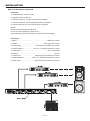
These units can be used both in stereo and mono modes allowing the following configurations:
• Stereo mode 2-way
• Mono mode 3-way
Stereo and mono modes can be easily set by pushing the rear panel switch and connecting inputs
and outputs properly.
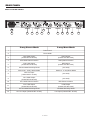
FEATURE LIST
• Single rack unit (1U)
• Robust and compact design
• Phase inversion switches
• Servo-balanced XLR inputs/outputs. 1/4”TRS input/outputs for any combination of balanced and
unbalanced operation
• State-variable Linkwitz/Riley 24dB/Octave filters
• Switchable Constant Directivity horn equalization circuit for use with horns requiring a high frequency boost
• Clip LED indicators
• Mute switches
• Designed for the most precise control
• Top audio performance with high slew rate circuity
• Over 115dB dynamic range
• Manufactured Under ISO9001 Certified management system
INPUTS & OUTPUTS
All inputs and outputs are floating and balanced when connected via a tip, ring, sleeve 1/4” connector to other
floating and balanced equipment. Any combination of balanced and unbalanced operation is permitted (see also
“Connection Cables”).
SONIC MAXIMIZER
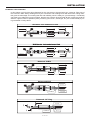
Loudspeakers have difficulty working with the electronic signals supplied by an amplifier. These difficulties
cause such major phase and amplitude distortion that the sound reproduced by speaker differs significantly from
the sound produced by the original source.
In the past, these problems proved unsolvable and were thus delegated to a position of secondary importance
in audio system design. However, phase and amplitude integrity is essential to accurate sound reproduction.
Research shows that the information which the listener translates into the recognizable characteristics of a live
performance are intimately tied into complex time and amplitude relationships between the fundamental and
harmonic components of a given musical note or sound. These relationships define a sound’s “sound”.
When these complex relationships pass through a speaker, the proper order is lost. The higher frequencies are
delayed. A lower frequency may reach the listener’s ear first or perhaps simultaneously with that of a higher
frequency. In some cases, the fundamental components may be so time-shifted that they reach the listener’s
ear ahead of some or all of the harmonic components.
— 1 —