1
Agent
An agent is an installed program designed to control a particular resource type. VCS includes
a set of predefined resource types, and each has a corresponding agent which is designed to
control the resource. Agents control resources according to information hardcoded into the
agent itself, or by running scripts. Agents act as the “intermediary” between a resource and
VCS. The agent recognizes the resource requirements and communicates them to VCS. For
example, for VCS to bring an Oracle® resource online it does not need to understand Oracle;
it simply passes the online command to the Oracle agent, which calls the server manager
and issues the appropriate startup command. Agents can be proactive: they can restart a
failed resource prior to declaring it as faulted. A resource cannot be brought online or taken
offline without an agent, and the actions required to do either differ significantly from
resource to resource. For example, bringing a disk group online requires importing the Disk
Group, but bringing an Oracle database online requires starting the database manager
process and issuing the appropriate startup command. VCS agents are multithreaded: a
single VCS agent monitors multiple resources of the same resource type on one host. For
example, the Disk agent manages all disk resources. VCS agents are located in the
/opt/VRTSvcs/bin directory. For example, the Disk agent and its online, offline, and monitor
scripts are located in the directory /opt/VRTSvcs/bin/Disk.
Entry point
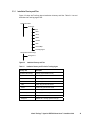
A VCS agent is implemented via entry points. An entry point is a user-defined plug-in that is
called when an event occurs within the VCS agent. An entry point can be a C++ function or a
script. The VCS agent framework supports the entry points listed below. With the exception
of VCSAgStartup and monitor, all entry points are optional.
VCSAgStartup
Monitor (supported by TrueCopy Agent)
Online (supported by TrueCopy Agent)
Offline (supported by TrueCopy Agent)
Clean (supported by TrueCopy Agent)
Attr
Changed
Open (supported by TrueCopy Agent)
Close (supported by TrueCopy Agent)
Shutdown
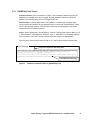
Network partition
Under normal conditions, when a VCS system ceases heartbeat communication with its peers
due to an event such as power loss or a system crash, the peers assume that the system has
failed and issue a new, “regular” membership excluding the departed system. A designated
system in the cluster then takes over the service groups running on the departed system,
ensuring that the application remains highly available. However, heartbeats can also fail due
to network failures. If all network connections between any two groups of systems fail
simultaneously, a network partition occurs. When this happens, systems on both sides of the
partition can restart applications from the other side, resulting in duplicate services, or
“split-brain.”
4
Chapter 1 Overview of the TrueCopy Agent for VERITAS Cluster Server™