1
Bronchial Provocation Test
Bronchodilator test
Note: Read carefully the
contraindications in Chapter 1.
Bronchodilators are administered routinely in the PFT laboratory to determine whether
airflow obstruction is reversible. Bronchodilators increase airway calibre by relaxing
airway smooth muscle.
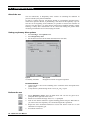
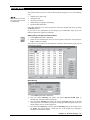
The test consists of comparing results between the reference FVC (FVC PRE) and the
FVC POST performed after the administration of the drug. Increasing value of 13-15%
of FEV1, respect to the basal value (FVC Pre) is considered as a reversible condition.
Main parameters are the following:
DFEV1%pre
Change of FEV1 as a percentage of test PRE
DFVC%pre
Change of FVC as a percentage of test PRE
DPEF%pre
Change of PEF as a percentage of test PRE
Some authors states that the above mentioned parameters are too dependent from the
FVC Pre, hence latest reference (ERS93, [A comparison of six different ways of
expressing the bronchodilating response in asthma and COPD; reproducibility and
dependence of pre bronchodilator FEV1: E. Dompeling, C.P. van Schayck et Al; ERJ
1992, 5, 975-981]) recommend the following parameters:
DFEV1%pred Change of FVC as a percentage of predicted value
DFEV1%poss Change of FEV1 as a percentage of “possible value”
Methacholine and Histamine Bronchial provocation Tests
The most common indication for performing methacholine and histamine bronchial
challenges is to diagnose hyperresponsive airways. Some patients demonstrate normal
baseline pulmonary function despite complaints of “tightness” wheezing, cough, and a
little or not response to bronchoconstrictor. Other patients demonstrate spirometric
improvement after use of bronchoconstrictor have diurnal variation in peak flows. In
this groups aerosolised bronchial challenges are used to confirm a diagnosis of Asthma.
We can summarise the use of the test as follows:
1. Diagnose asthma
2. Confirm a diagnosis of asthma
3. Document the severity of hyperresponsivness
4. Follow changes in hyperresponsivness
When patients with hyperresponsive airways inhale certain pharmacologic agents (i.e.
Methacholine or histamine) the airways respond by constricting.
Test consists of executing repeated FVC following the pharmacologic agents inhalation
according to an established protocol. The fall of the FEV1 parameter is used to calculate
the bronchial hyperresponsivness. The most important parameter is the PD20 that is
amount of drug (mg/ml) that causes a reduction of 20% of the FEV1 respect the basal
value (without drug).
Main parameters are:
P10 Dose that causes a 10% fall of FEV1.
P15 Dose that causes a 15% fall of FEV1.
P20 Dose that causes a 20% fall of FEV1.
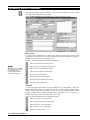
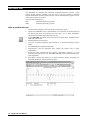
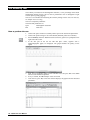
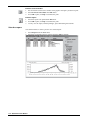
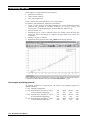
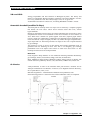
The representative plot is the Dose/response curve, showing the percentage variation of
FEV1 versus the Drug dose in logarithmic scale.
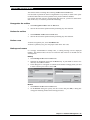
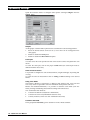
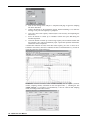
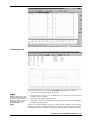
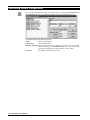
The program assumes as the baseline test the best FVC pre carried out during the
today’s visit. You can change the reference pre test editing the Post test.
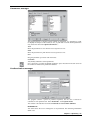
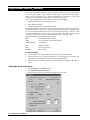
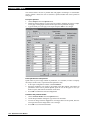
The name of the drug, its quantity and its unit of measurement, can be typed
immediately before any FVC post manoeuvre (manual protocol) or can be stored in a
database of bronchoprovocation (File/Bronchial Provocation protocols Database…).
Chapter 6 - Spirometry - 71