1
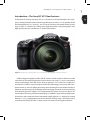
Introduction—The Sony SLT-A77: New Features
5
The absence of a hinged mirror provides several advantages. Perhaps the most
obvious is automatic focusing when recording movies. While other DSLRs can do
this, only Sony uses a high-speed phase detection system. Other cameras, assuming they automatically focus while recording movies, use the slower contrast
detection method.
A second advantage is a high burst rate: the camera can rapidly fire multiple
shots with a single press of the shutter button. Most cameras have a mirror that
must be swung out of the light path to the sensor and then returned to its rest
position to again direct light to the optical viewfinder. This cycle limits how fast
the camera can be fired.
Finally, an underappreciated aspect of translucent mirror technology is the
inclusion of an electronic first curtain shutter. Because of the fixed mirror design
and this shutter, there is no mechanical movement for initiating exposure. This
means that the camera is virtually vibration-free, an advantage for discriminating users who do not want to sacrifice sharpness because of camera movement.
Sony replaced the optical viewfinder with an electronic one. Early designs of
the electronic viewfinder were inadequate: they lacked sharpness, and movement appeared to flicker when viewing rapidly moving objects. Now, the A77’s
electronic viewfinder is sharp enough to be used for focusing, and subjects move
smoothly across the screen. You can also see how settings affect the image before
releasing the shutter.
The Sony 24.3 megapixel sensor works best at ISO 100, providing the greatest dynamic range and generating the least noise. The ISO can be reduced to 50
on bright days when you wish to use a long shutter speed to blur motion. Under
lower light levels, the ISO can be increased to 1600, which provides an acceptable
image. For surveillance work under extremely low lighting conditions, the ISO can
be raised to a maximum of 16000. Because the A77 sensor’s high pixel density
requires using smaller photosites, the generation of sensor noise is theoretically
greater. However, with the improvement in sensor design, the Sony A77 generates
good images at ISO 1600. For us, this is not a limitation since we rarely go above
this setting. Previously, when working with the A33 and the A55, the ISO’s range
was smaller, ranging from 100 to 12800, whereas the A77 has an expanded ISO
range from 50 to 16000.
If you want one camera that can do an excellent job for still and movie work,
this is the camera for you.
1