1
Espace Créatis, Av. Archimède
Z.A. Bois de la Chocque
F-02100 Saint-Quentin, France
tel:(+33) (0)323 67 8922
fax: (+33) (0)323 67 8949
web : www.geopolymer.org
DATOBE K™ and DATOBE Na-K™ Binders
Description:
DATOBE K-Poly(silate-siloxo) PSS and DATOBE (Na-K)-Poly(silate-siloxo) PSS
are geopolymeric binders. They have been successfully introduced into industry.
They yield synthetic mineral products with such properties as hard surfaces, thermal
stability, and high surface smoothness and precise moldability. Such products are useful for
tooling, for molding art objets, ceramics, and the like.
DATOBE K-PSS and DATOBE (Na-K)-PSS are organic solvent free mineral base
thermo-setting materials, that can be cast or foamed or used as a Gel-Coat. They should
always be used with fillers and can achieve ceramic-like material using low cure temperature.
An initial cure at 85°C will create a part or mold stable enough to be dried by itself in stages
up to 400°C.
The chemical formula of DATOBE K-PSS is:
[1,3 K2O][Al2O3.4,55 SiO2]
The chemical formula of DATOBE Na-K-PSS is:
[0,6 Na2O.0,65 K2O][AL2O3.4,6 Si02]
This results in a 1000°C stable ceramic-like material. This system can be used with
different fillers (non-hydrophilic minerals) to vary hardness and eliminate possible shrinkage.
In most applications, the use of fillers with mixed grain sizes will provide the best results.
Information:
More information is available in our Web site www.geopolymer.org, where you can
download additional papers and order the Géopolymère ’88 & '99 Proceedings including
numerous scientific articles with tests and data on selected materials.
Properties:
1- Polycondensation, Exothermicity:
DATOBE™ (geopolymeric) binders, are prepared by mixing various silico-aluminates
precondensates with alkali hardeners. Fillers can then be added from 50% to 200% by weight.
The pot life of the unfilled system can be extended by refrigeration (up to several days).
DATOBE binders should be oven cured for best results. If the material is exposed
(open cast), the back of the casting should be covered with a film for effecting a stable cure,
to prevent any water evaporation. Geopolymerization is exothermic. Speed and intensity of
the exothermic polycondensation and setting time are a function of the curing conditions as
set forth in Figure 1. Inflexion point S marks the begin of hardening. Water is expelled
outside the tridimensional framework and condenses on the interface between mold and
geopolymer.
Figure 1: Exothermic polycondensation of K-PSS geopolymeric binders
for various curing temperatures.
Post curing after the initial cure is sometimes recommended due to the difference of
shapes and thickness of the piece or mould. Surface condensation could be wiped off, and it is
recommended that the part or mold be enclosed in a bag and left to stand over night or oven
dried at a low temperature. The post cure conditioning temperature should not exceed the cure
temperature. This conditioning allows the polycondensation water to migrate from the interior
to the exterior without causing change to the geopolymeric structure.
2- Shrinkage on dehydration and dehydroxylation:
Part of the reaction water generated remains within the tridimensionnal geopolymeric
frameworks (zeolitical water). Hydroxyl groups OH are also present at the edges of each
structures.
When oven drying at temperature higher than 100°C, dehydration and dehydroxylation
could cause the formation of cracks due to shrinkage.
Figure 2: Shrinkage on dehydration and dehydroxylation; DTA and TGA curves
(relative H2O loss in per cent); relative shrinkage value in per cent; DATOBE binder.
More than 70% of the reaction water evaporates before 100°C (DTA and TGA curves
of Figure 2) without causing any damaging stress. The remaining 30% water contributes to
90% of the total shrinkage measured when heating the sample from 20°C to 500°C (see
Figure 2).
3- Summary of the characteristics of K-PSS DATOBE binders:
Polycondensation of K-Poly(sialate-siloxo) resins at ambient temperature or between 20 °C
and 85 °C
pH of the resin: 14
pH after polycondensation and dehydroxylation
Thermal treatment 85 °C
300 °C
700 °C
pH
10.5
9.5
7.5
Shrinkage on dehydroxylation:
at 400 °C : 0,2% to 1%
at 800 °C : 0,2% to 2%
Linear expansion (depending on fillers and after shrinkage):
2,1 x10⁻⁶ to 4,5 x 10⁻⁶ from 0 °C to 1000 °C (see Figure 3)
Figure 3: Linear expansion of geopolymers containing ceramic fillers, after heat treatment at
650°C during 2 hours. Thermo-setting (geopolymerisation) at 65°C, during 4 hours.
Fusion temperature of the pure geopolymer:
1050 °C to 1250 °C
Surface hardness:
4 to 7 on the Mohs Scale (7=quartz) (according to fillers)
Surface quality:
Faithful reproduction of mould or die surface; precision, fineness, polish, brilliance.
E. MODUL: 14.000 to 50.000 MPa (according to fillers)
Chemical stability:
Excellent in organic solvent,
Excellent in alkaline and saline conditions,
Good in concentrated H2SO4 to poor in concentrated HCl.
Density:
Approx. 1.4g/cm3 for the Geopolymer;
Strength at elevated temperatures (see Figure 3)
High-resolution Nuclear Magnetic Resonance, MAS-NMR spectroscopy:
Magic-angle spinning MAS-NMR spectroscopy provides useful structural data for
silico-aluminate species (zeolites, clays, ceramics, cements, geopolymers). In particular 29Si
and 27Al MAS-NMR studies represent a very powerful tool. Explanations and data concerning
this interesting techniques are outlined in several papers presented in the GEOPOLYMER '88
and GEOPOLYMERE '99 Proceedings. They should be taken for granted in the following
discussion.
27
Al MAS-NMR spectroscopy of all (Na,K)-PSS and K-PSS showed 27Al chemical
shifts in the range of 55 ppm from [Al(H2O)6]3+ identical to the spectrum displayed in Figure
4, which indicates that the aluminium is of the AlQ4(4Si) type and is tetrahedrally
coordinated. The absence of any other resonance and the extremely narrow peak at 55 ppm,
excludes any residual singular building units of low molecular weight such as dimers and
trimers. (Na,K)-PSS and K-PSS are true three-dimensional framework silico-aluminates with
polymeric building units.
Figure 4: 27Al MAS-NMR spectra for DATOBE K-PSS.
However, 27Al MAS-NMR cannot differentiate between the various frameworks
proposed for geopolymeric materials based on poly(sialate-siloxo) (Si-O-Al-O-Si-O-)n
polymeric building units.
29
Si MAS-NMR Spectroscopy:
As displayed in Figure 5, DATOBE K-PSS gives a broad resonance at -94,5 ppm
associated with a signal at -87 ppm, a small resonance at -81,5 ppm and a small peak at -79
ppm. The later resonance at -79 ppm is narrow which means that it relates to an ordered
environment different from the disordered main part of the matrix. Broad resonances are
generally found in zeolitic gels, before crystallization of the zeolites.
Studies have shown that the chemical shift of 29Si in an amorphous or highly
disordered environment is increased by approximately 5 ppm. The resonances found for
"disordered" 29Si in K-PSS, namely -81,5 ppm, -87 ppm and -94,5 ppm, relate to "ordered"
29
Si chemical shifts of 86,5 ppm, -92 ppm, -99,5 ppm which can be assigned to Q(4Al),
Q(3Al) and Q(2Al) respectively. The Q(4Al) resonance does not necessarily imply the
presence of poly(sialate) (Si-O-Al-O) type species (kaliophilite for example).
Figure 5: 29Si MAS-NMR spectra for DATOBE K-PSS
Indeed, silico-aluminates, with an atomic ratio Si/Al >2, generally display several 29Si
resonances suggesting that the Si and Al tetrahedras are not regularly ordered along the
polymeric chains. Table 2 displays 29Si MAS-NMR data for several natural and synthetic
silico-aluminates which clearly shows the presence of all Q(nAl) sites within the frameworks.
On the contrary, silico-aluminates with atomic ratio Si/Al=1, only exhibit Si(4Al) sites.
The K-PSS 29Si MAS-NMR spectrum suggests that the structural model of K-PSS
could be assigned to hydrated Leucite, in agreement with the proposed chemical mechanism
proposed in earlier studies.
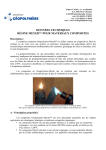
Mode d’emploi DATOBE Na-K FS™
Directions for use DATOBE Na-K FS™
Ce mode d’emploi s’applique à la DATOBE
pour la fabrication d'outillage, de moule d'objets d'art, de
céramique, et d'autres applications de ce genre. Nous
vous montrons ici la méthode la plus simple d’utilisation
à la main. Il va de soi que l’utilisation de machines de
laboratoire facilite la mise en œuvre. Le manipulateur
devra utiliser une blouse et des gants, et respecter les
conditions d’hygiène et de sécurité qui s’applique à son
laboratoire. Le manipulateur sera assisté d’une personne
chargée de nettoyer immédiatement les ustensiles à l’eau
avant le début de la prise.
La DATOBE devra être conservée dans un
congélateur à une température inférieure à -18°C. Elle
peut être conservée pendant 6 semaines à cette
température de congélation.
Le liant DATOBE Na-K FS a une durée de
manipulation d'environ 2 heures 30 à température
ambiante.
This DATOBE user’s manual describes the
manufacture of tooling, moulds, art objets, ceramics, and
the like. We show here the easiest method to do it. It is
obvious that the use of laboratory equipments makes the
operation easier. The lab. technician should use overall
and gloves, and respect the the safety and security rules
that apply to his laboratory. He may be assisted by a
second technician in charge of cleaning the tools,
immediately in water, before the hardening of the binder.
Voici le mode d’emploi pour une utilisation
simple de la DATOBE :
1 - Préparez 1 part en poids de liant DATOBE et entre 50
et 200% en poids de charge selon la granulométrie.
2 – Notez que la DATOBE Na-K FS™ est pâteuse après
sa sortie du congélateur. Après avoir pesé la quantité de
DATOBE Na-K FS voulue, il est préférable d'attendre 15
minutes qu'elle se réchauffe.
3 – Préparez la charge puis versez la DATOBE dans la
charge.
4 – Mélangez le tout.
5 – Coulez le mélange dans un moule hermétiquement
fermé. Placez le moule dans un four à 60°C pendant 2
heures. ATTENTION, la réaction géopolymérique de la
DATOBE est exothermique. Le moule doit résister à une
température supérieure à 100 °C.
6 – L’outillage se nettoie très facilement à l’eau lorsque
le mélange n’est pas encore durci.
7 – Maintenant, vous pouvez faire subir des tests à cet
échantillon. Notez que nous avons utilisé exprès un
moule plastique qui n'a pas résisté à l'exothermicité.
Le Client accepte que Institut Géopolymère
ne délivre aucune garantie, exprès ou implicite,
incluant de manière non limitative les garanties
légales et commerciales et autres certifications,
concernant la chimie des géopolymères et son
utilisation, sa fabrication et sa commercialisation,
seule ou associée aux produits du Client. En aucun
cas, même en cas de force majeure ou cas fortuit,
Institut Géopolymère ne sera responsable des
dommages directs, indirects, spéciaux ou consécutifs
survenant de l'utilisation, fabrication, distribution ou
vente des produits du Client ou faites par une tierce
partie.
Le brevet de la DATOBE™ est en cours.
The DATOBE should be kept in a freezer in a
temperature lower than -18°C. It can be used for 6 weeks
when kept at this frozen temperature.
The DATOBE Na-K FS has a pot life of around
2 hours 30 minutes at room temperature.
Directions for use of DATOBE for simple
applications:
1 – Prepare 1 part by weight of DATOBE binder and
between 50% and 200% by weight of fillers depending
on its granulometry.
2 – Notice that DATOBE Na-K FS™ is pasty after
taking it out of the freezer. After weighing the desired
quantity of DATOBE Na-K FS, you should wait 15
minutes so that it warms up.
3 – Prepare the fillers and pour DATOBE binder into the
fillers.
4 – Mix the whole.
5 – Cast the mixture in a hermetically closed mould.
Place the mould in an oven at 60°C for 2 hours.
ATTENTION, the DATOBE geopolymeric reaction is
exothermal. The mould must withstand a temperature
higher than 100 °C.
6 – You can very easily clean the equipment with water
as long as the mixture has not yet hardened.
7 – Now, you can carry out preliminary testing on this
sample. Note that we intentionally used a plastic mould
that did not withstand the exothermicity.
The Client agrees that Institut Géopolymère
makes no warranties, express or implied, including
without limitation the implied warranties of
merchantability and fitness for a particular purpose,
regarding the geopolymer chemistry or its use and
operation alone or in combination with the Client
products. In no event will Institut Géopolymère be
liable for special, incidental or consequential damages
arising from the use, sale or distribution of the Client
products or any third party.
The DATOBE™ is patent pending.
1
2
3a
3b
4
5
6
7
Safety Data Sheet
DATOBE Na-K FS
1. Identification of the substance/preparation and of the company
1.1 Identification of the substance or preparation :
Ingredient and trade material name :
DATOBE Na-K FS
Potassium and sodium silicate, amorphous silicate, and aluminium oxide solution in water.
1.2 Utilisation of the substance : Resin used especially for ceramic materials and tooling.
1.3 Company/undertaking identification :
Institut Géopolymère.
Espace Créatis, Av. Archimède, Z.A. Bois de la Chocque
F-02100 Saint-Quentin, France
1.4 Emergency telephone number : +33/ (0)3 23 67 89 22
2 Composition/information on ingredients (Preparation) :
Chemical names : CAS: 1312-76-1 (potassium silicate), 1344-09-8 (sodium silicate), 1344-28-1
(aluminium oxide), 7631-86-9 (amorphous silica), and 7732-18-5 (water)
Concentration or range of concentration that may be hazardous:
Potassium and sodium silicate > 25%
EC Classification : Xi -Irritant
R36/38 - S24/25 S36/37/39
3. Hazards information (Security) :
Critical hazards to human : Alkaline solution. Risk of serious damage to eyes. Irritant to skin.
Critical hazards to environment : The alkalinity of this material will have a local effect on ecosystems
sensitive to changes in pH.
4. First-aid measures :
Eye contact : Flush with large amounts of water for 15 minutes. Contact a physician
Skin contact : Wash with soap and water.
Ingestion : Do not induce vomiting. Wash out mouth with water. Contact a physician or regional
Poison Control Centre immediately.
Inhalation : Long term overexposure to inhalation of mist or dust of dried down particles may cause
tissue response in the lung (Pneumoconiosis).
5. Fire-fighting measures :
Suitable extinguishing media : In adaptation to materials stored in the immediate neighbourhood.
Extinguishing media which must not be used for safety reasons : none
Special exposure hazards arising in fire-fighting : not flammable.
Special protective equipment for fire-fighters : Does not produce any known toxic fumes (water
based mineral materials).
6. Accidental release measures :
Personal protection : Avoid contact to skin.
Necessity or not to alert neighbourhood: Dependant on local regulations with regard to pH controls.
Environmental protection : Discharge of this product to sewage treatment works is dependant on
local regulations with regard to pH controls.
Methods for cleaning up, neutralising, absorbing, retrieving, throwing away (and what to avoid) :
Neutralise excess with acid solution or dilute with plenty of water. Or, Use absorbent material or
scrape up dried material and place into containers.
7. Handling and storage :
7.1 Handling : Material is stable at room temperature. Hazardous polymerisation will not occur.
7.2 Storage : Store the material at freezing conditions, below – 18 deg. C.
Chemical incompatibilities: iron hydroxide, strong oxidisers and acids.
Conditions to avoid : Temperature above – 15 deg. C., and excessive heat, otherwise it will harden.
Hazardous decomposition Product : None.
Materials to avoid : will react with aluminium, zinc, tin and their alloys evolving hydrogen.
8. Exposure controls/personal protection :
Maximum exposition value (V.M.E.) : N/A
Personal protective equipment :
Respiratory protection : none.
Ventilation: normal room ventilation.
Skin protection : Protective gloves (latex or vinyl) required.
Eye protection : Safety glasses recommended.
Body protection : Blouse required.
9. Physical and chemical properties :
Appearance : light grey and viscous.
Odour : non
pH : pH: 13, strongly alkaline
Melting point temperature : N/D
Boiling point temperature : 104 deg. C
Water solubility : yes
Low explosive range : N/D
High explosive range : N/D
Flash Point : N/D
10. Stability and reactivity :
Stability : Material is stable at room temperature. Hazardous polymerisation will not occur.
Conditions to avoid : Temperature above – 15 deg. C., and excessive heat, otherwise it will harden.
Materials to avoid : iron hydroxide, halogen oxides, ethylene oxide, fluorine, hydrogen halides, nitrates,
vinyl acetate.
Will react with aluminium, zinc, tin and their alloys evolving hydrogen.
Hazardous decomposition products : N/D
11. Toxicological information :
N/D
On the basis of the morphology of the product, no hazardous properties are to be expected when it is
handled and used with appropriate care.
The product should be handled with the usual care when dealing with chemicals.
12. Ecological information :
Biologic degradation : Upon dilution, rapidly depolymerise into molecular species indistinguishable
from natural dissolved silica.
Ecotoxic effects : N/D
Toxicity : The alkalinity of this material will have a local effect on ecosystems sensitive to changes in
pH.
Further ecologic data : when it is handled and used with appropriate care, no harmful ecological effects
are to be expected.
13. Disposal considerations :
Product : When still in frozen state : is classified as hazardous waste under EEC Directive
91/689/EEC (Property H4, European Waste Classification code 06 02 05). Dispose of according to
state or local standards.
When HARDENED and DRIED: is not classified as hazardous waste under EEC Directive
91/689/EEC, (European Waste Classification code 01 04 08).
When DILUTED in water to form a mud: is not classified as hazardous waste under EEC
Directive 91/689/EEC, (European Waste Classification code 01 04 12).
Packaging : is recyclable after cleaning it with water.
14. Transport information :
Not subject to transport regulations.
Special transport care :
Avoid temperature above - 15 deg. C.
15. Regulatory information :
EC Label
Symbol : Xi
Risks sentences (R) : R36/38 : Irritating to eyes and skin.
Security sentences (S) : S24/25 Avoid contact with skin and eyes., S36/37/39 Wear suitable
protective clothing, gloves and eye/face protection.
16. Other information :
N/A : Not Applicable, N/D : Not Determined
This EC Safety Datasheet is written according to the directive 91/155/EEC, 93/112/EEC,
2001/59/EC, and has 3 pages.
The information contained herein is based on the present state of our knowledge. It characterizes the
product with regard to the appropriate safety precautions. It does not represent a guarantee of the
properties of the product. We believe that such information is accurate and reliable as of the date of
this safety data sheet; but no representation, guarantee or warranty, express or implied, is made. We
urge persons receiving this information to make their own determination about the product as to the
information's suitability and completeness for their particular application. We further urge purchasers
to determine compatibility of this product for their application prior to use by making their own tests,
also with regard to possible applicational influences. The abidance of conditions or methods of
handling, storage, use and disposal of the product by the client are beyond our control and may be
beyond our knowledge. For this and other reasons we do not assume responsibility and expressly
disclaim liability for loss, damage or expense arising out of or in any way with the handling, storage,
use or disposal of the product.
May 2007