1
120
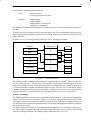
throughput of the message passing machine. We will call this ratio the grain ( ) of the architecture, and measure it as operations/operand. For simplicity, we will assume that a processor performs an operation in one clock tick, so that we can measure the grain in ticks/operand.
The importance of achieving a good balance between computation and communication can be
understood by considering a simple example. Suppose that a two dimensional image is to be processed by an array of transputers. Each transputer stores and processes a portion of the image.
Each step of the computation involves updating every element of the image in parallel. Assume
that at every step of the computation, every element of the array a[i,j] is to be updated to:
f(a[i,j], a[i-1,j], a[i+1,j], a[i,j-1], a[i,j+1])
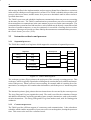
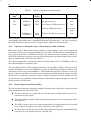
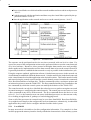
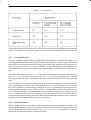
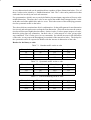
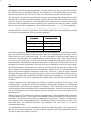
and that function f involves 4 operations. The following table shows the operations performed
for each item communicated for four possible mappings.
elements per
transputer
operations per
communication
1
1
4
2
16
4
256
16
If we chose a mapping which allocates one element to each transputer, we would need each transputer to perform one operation in the same time that it can communicate one data item. This is
often referred to as fine grain processing. If, on the other hand, we allocate a large number of
elements to each transputer, the communications requirements are small. This is often referred
to as coarse grain processing. It can be seen from the example that as the grain is decreased, the
communications capability becomes the limiting factor. At this point, it is impossible to use more
transputers to increase performance, but easy to use more transputers to process a larger image.
Specialised transputer configurations can often be used to provide fine grain processing. In the
above example a two-dimensional array of transputers could be used, as communication is required only between adjacent transputers in the array. However, a general purpose machine
should be able to provide fine grain processing for a wide variety of algorithms, and for software
portability it should allow automatic allocation of processes to transputers. To do this it must
support a high rate of non-local communication, which can be achieved with a suitable network
of routers.
Another important factor affecting the performance of parallel computers is the latency (l) in
communication. A transputer may idle awaiting data from another transputer even though the
communication rate between the transputers is adequate. This is normally overcome by using
extra parallelism in the algorithms to hide communication delays. Instead of executing one process on each transputer, we use the transputer process scheduler to execute several processes on
each transputer.
Whenever a process is delayed as a result of a communication, it is descheduled and the transputer
activates another process. This in turn will eventually become descheduled as a result of a communication. Execution proceeds in this way through several processes. Whenever a communication completes, the corresponding process is rescheduled ready for subsequent execution. Provided that there are sufficient processes, the transputer will never idle as a result of
communication delays.
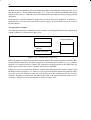
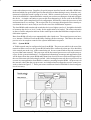
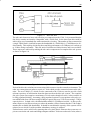
To understand the use of excess parallelism, consider the following simple worker process suitable for use in a processing farm. In a typical farm a controller process would hand out packets
of work to many such worker processes.