1
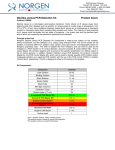
3430 Schmon Parkway Thorold, ON, Canada L2V 4Y6 Phone: 866-667-4362 (905) 227-8848 Fax: (905) 227-1061 Email: [email protected] Penicillium sp. PCR Detection Kit Product Insert Product # 33200 Pathogen Information Penicillium is major causative agents of food spoilage (dairy products, fruits, vegetables and meat) and postharvest decay. The genus causes significant economic losses to the fruit industry and is also of potential public health significance since Penicillium species produce a number of mycotoxins known to cause harmful effects in humans and animals. Penicillium is also a huge problem in the wine industry. Its presence in wine and grape juice during the various stages of fermentation is highly detrimental to the quality of the wine due to the production of compounds such as Geosmin (trans 1,10-dimethyl-trans-9-decalol) an earthy-musty compound which produces off odours and flavours. For these reasons the rapid and specific detection of Penicillium species are important for ensuring microbiological quality and safety of fruits and juices among other foods. Principle of the Test Norgen’s Penicillium sp. PCR Detection Kit constituents a ready-to-use system for the isolation and detection of Penicillium sp. using end-point PCR. The kit first allows for the isolation of fungal DNA from the plant samples using spin-column chromatography based on Norgen’s proprietary resin. Fungal DNA can be isolated from fungi growing on culture plates, or from plant tissue or fruit using this kit. The DNA is isolated free from inhibitors, and can then be used as the template in a PCR reaction for Penicillium sp. detection using the provided Penicillium sp. Master Mix. The Penicillium sp. Master Mix contains reagents and enzymes for the specific amplification of a 327 bp region of the fungal genome. In addition, Norgen’s Penicillium sp. PCR Detection Kit contains a second heterologous amplification system to identify possible PCR inhibition and/or inadequate isolation. The amplification and detection of either the Isolation Control (IsoC) or the PCR control (PCRC) does not reduce the detection limit of the analytical Penicillium sp. PCR. This kit is designed to allow for the testing of 24 samples. Kit Components: Component Contents Lysis Solution Wash Solution 15 mL 9 mL Elution Buffer 3 mL Bead Tubes 24 Spin Columns 24 Collection Tubes 24 Elution tubes (1.7 mL) 24 PN 2x PCR Master Mix 0.35 mL PN IsoC* a 0.3 mL 0.1 mL PN PosC* b Nuclease Free-Water 1.25 mL Norgen’s DNA Marker 0.1 mL Product Insert 1 * IsoC = Isolation Control ; PosC= Positive Control a b The isolation control is a cloned PCR product. The positive control is Penicillium sp. genomic DNA Customer-Supplied Reagents and Equipment Disposable powder-free gloves Benchtop microcentrifuge 1.5 mL microcentrifuge tubes 65°C water bath or heating block 96 – 100% ethanol 70% ethanol RNase A (optional) Lyticase (optional) Storage Conditions and Product Stability All buffers should be kept tightly sealed and stored at room temperature (15-25oC). Buffers can be stored for up to 1 year without showing any reduction in performance. The Penicillium sp. 2x PCR Master Mix, Penicillium sp. Positive Control (PosC) and the Penicillium sp. Isolation Control (IsoC) should be kept tightly sealed and stored at -20oC for up to 1 year without showing any reduction in performance. Repeated thawing and freezing (> 2 x) should be avoided, as this may reduce the sensitivity. If the reagents are to be used only intermittently, they should be frozen in aliquots. General Precautions The user should exercise the following precautions when using the kit: Use sterile pipette tips with filters. Store and extract positive material (specimens, controls and amplicons) separately from all other reagents and add it to the reaction mix in a spatially separated facility. Thaw all components thoroughly at room temperature before starting an assay. When thawed, mix the components and centrifuge briefly. Work quickly on ice. Quality Control In accordance with Norgen’s ISO 9001 and ISO 13485-certified Quality Management System, each lot of Norgen’s Penicillium sp. PCR Detection Kit, including the Penicillium sp 2x PCR Master Mix, Penicillium sp Isolation Control (IsoC) and Penicillium sp Positive Control (PosC) are tested against predetermined specifications to ensure consistent product quality. Product Use Limitations Norgen’s Penicillium sp. PCR Detection Kit is designed for research purposes only. It is not intended for human or diagnostic use. Product Warranty and Satisfaction Guarantee NORGEN BIOTEK CORPORATION guarantees the performance of all products in the manner described in our product manual. The customer must determine the suitability of the product for its particular use. Safety Information Ensure that a suitable lab coat, disposable gloves and protective goggles are worn when working with chemicals. For more information, please consult the appropriate Material Safety Data Sheets (MSDSs). These are available as convenient PDF files online at www.norgenbiotek .com. CAUTION: DO NOT add bleach or acidic solutions directly to the sample-preparati on waste. Protocol A. Penicillium sp. Genomic DNA Isolation Important Notes Prior to Beginning Protocol: A variable speed centrifuge should be used for maximum kit performance. If a variable speed centrifuge is not available a fixed speed centrifuge can be used, however reduced yields may be observed. Ensure that all solutions are at room temperature prior to use, and that no precipitates have formed. If necessary, warm the solutions and mix well until the solutions become clear again. Prepare a working concentration of the Wash Solution by adding 21 mL of 96 - 100 % ethanol (provided by the user) to the supplied bottle containing the concentrated Wash Solution. This will give a final volume of 30 mL. The label on the bottle has a box that may be checked to indicate that the ethanol has been added. Lysate can be prepared from either fungi growing on plates, plant tissue or fruit. Please ensure that you follow the proper procedure for lysate preparation in Step 1a. For the isolation of genomic DNA from fungi growing on plates, Collection Solution must be prepared. Collection Solution consists of 0.9% (w/v) NaCl prepared with distilled water. Preheat a water bath or heating block to 65°C. Penicillium sp. Isolation Control ( IsoC) A Penicillium sp. Isolation Control (IsoC) is supplied. This allows the user to control the DNA isolation procedure. For this assay, add the Penicillium sp. Isolation Control (IsoC) to the lysate during the isolation procedure The Penicillium sp. Isolation Control (IsoC) must not be added to the sample material directly. Do not freeze and thaw the Penicillium sp. Isolation Control (IsoC) more than 2 times. The Penicillium sp. Isolation Control (IsoC) must be kept on ice at all times during the isolation procedure. The PCR components of the Penicillium sp. PCR Detection Kit should remain at -20oC until DNA is extracted and ready for PCR amplification. 1. Lysate Preparation a. Fungi Growing on Plates: Add approximately 5 mL (volume can be adjusted based on density of fungal growth) of Collection Solution (see notes before use) to the plate and gently collect fungal spores and mycelium with an inoculation loop or autoclaved pipette tip, ensuring not to collect any agar debris. Transfer up to 1 mL of washed spores and wet mycelium to a microcentrifuge tube (provided by user). Fungi from Plant Tissue or Fruit: Wash the tissue or fruit with an appropriate amount of DNAse free water with vortexing. Transfer up to 1 mL of washed spores and wet mycelium to a microcentrifuge tube (provided by user). b. Centrifuge at 14,000 x g (~14,000 RPM) for 2 minutes to pellet the cells. Pour off the supernatant carefully so as not to disturb or dislodge the cell pellet. c. Add 500 L of Lysis Solution to the cell pellet. Resuspend the cells by gentle vortexing. d. Transfer the mixture to a provided Bead Tube and secure the tube horizontally on a flat-bed vortex pad with tape, or in any commercially available bead beater equipment (e.g. Scientific TM Industries’ Disruptor Genie ). e. Vortex for 5 minutes at maximum speed or optimize the condition for any commercially available bead beater equipment. Note: Foaming during the homogenization is common. This foaming is due to detergents present in the Lysis Buffer and will not affect the protocol. Incubate the Bead Tube with lysate at 65°C for 10 minutes. Occasionally mix the lysate 2 or 3 times during incubation by inverting the tube. g. Briefly spin the tube to remove liquid from the cap, and transfer all of the lysate, including cell debris, to a DNase-free microcentrifuge tube (provided by the user) by pipetting. Ensure that the beads are not transferred during the pipetting. h. Centrifuge the tube for 2 minute at 14000 × g (~14,000 RPM). i. Carefully transfer clean supernatant to a new DNase-free microcentrifuge tube (provided by the user) without disturbing the pellet. Note the volume. j. Add an equal volume of 70% ethanol (provided by the user) to the lysate collected above (100 µL of ethanol is added to every 100 µL of lysate). Vortex to mix. k. Proceed to Step 2: Binding to Column f. 2. Binding DNA to Column a. Assemble a spin column with one of the provided collection tubes. b. Add 10 L of Penicillium sp.Isolation Control (PN IsoC) to the lysate mixture. c. Apply up to 600 µL of the lysate with ethanol onto the column and centrifuge for 1 minute at 14,000 x g (~14,000 RPM). Discard the flowthrough and reassemble the spin column with the collection tube. Note: Ensure the entire lysate volume has passed through into the collection tube by inspecting the column. If the entire lysate volume has not passed, spin for an additional minute. d. Depending on your lysate volume, repeat step 2c if necessary. 3. Column Wash a. Apply 500 µL of Wash Solution to the column and centrifuge for 1 minute. Note: Ensure the entire wash solution has passed through into the collection tube by inspecting the column. If the entire wash volume has not passed, spin for an additional minute. b. c. d. e. Discard the flowthrough and reassemble the column with its collection tube. Repeat step 3a to wash column a second time. Discard the flowthrough and reassemble the spin column with its collection tube. Spin the column for 2 minutes in order to thoroughly dry the resin. Discard the collection tube. 4. DNA Elution a. Place the column into a fresh 1.7 mL Elution tube provided with the kit. b. Add 75 µL of Elution Buffer to the column. c. Centrifuge for 2 minutes at 200 x g (~2,000 RPM), followed by a 1 minute spin at 14,000 x g (~14,000 RPM). Note the volume eluted from the column. If the entire volume has not been eluted, spin the column at 14,000 x g (~14,000 RPM) for 1 additional minute. 5. Storage of DNA The purified DNA may be stored at –20°C for a few days. It is recommended that samples be placed at –70°C for long term storage. B. Penicillium sp. PCR Assay Preparation Notes: Before use, suitable amounts of all PCR components should be completely thawed at room temperature, vortexed and centrifuged briefly. The amount of Penicillium sp. 2X PCR Master Mix provided is enough for up to 32 PCR reactions (24 sample PCR, 4 positive control PCR and 4 no template control PCR). For every PCR run, one reaction containing Penicillium sp. Positive Control (PosC) and one reaction as no template control must be included for proper interpretation of results. The recommended minimum number of DNA samples tested per PCR run is 6. Using a lower volume from the sample than recommended may affect the sensitivity of Penicillium sp. Limit of Detection. 1. Prepare the PCR for sample detection as shown in Table 1 below. The recommended amount of sample DNA to be used is 5 µL. However, a volume between 1 and 10 µL of sample DNA may be used as template. Adjust the final volume of the PCR reaction to 20 µL using the Nuclease-Free Water provided. Table 1. PCR Assay Preparation PCR Components Volume Per PCR Reaction Penicillium sp 2X PCR Master Mix 10 µL Sample DNA 2 to 5 µL Nuclease-Free Water Up to 10 µL Total Volume 20 µL 2. For every PCR run, prepare one positive control PCR as shown in Table 2 below: Table 2. PCR Positive Control Preparation PCR Components Volume Per PCR Reaction Penicillium sp 2X PCR Master Mix 10 µL Penicillium sp Positive Control (PosC) 10 µL Total Volume 20 µL 3. For every PCR run, prepare one no template control PCR as shown in Table 3 below: Table 3. PCR Negative Control Preparation PCR Components Volume Per PCR Reaction Penicillium sp 2X PCR Master Mix 10 µL Nuclease-Free Water 10 µL Total Volume 20 µL C. Penicillium sp. PCR Assay Programming 1. Program the thermocylcer according to the program shown in Table 4 below. 2. Run PCR. Table 4. Penicillium sp. Assay Program PCR Cycle Step Temperature Duration Cycle 1 Step 1 95oC 3 min Step 1 o 94 C 15 sec Step 2 60oC 30 sec Step 3 o 72 C 45 sec Step 1 72oC 5 min Step 1 o ∞ Cycle 2 (40x) Cycle 3 Cycle 4 4C D. Penicillium sp. PCR Assay Results Interpretation 1. For the analysis of the PCR data, the entire 15-20 µL PCR Reaction should be loaded on a 1X TAE 1.7% Agarose DNA gel along with 10 L of Norgen’s DNA Marker (provided). 2. The PCR products should be resolved on the 1X TAE 1.7% Agarose gel at 150V for 30 minutes. 3. Sample results are provided below: M 1 2 3 4 5 6 M Penicillium Iso C Penicillium sp. PCR C Figure 1: A representative 1X TAE 1.7% agarose gel showing the amplification of Penicillium sp. at different concentrations (Penicillium sp.Target). The size of the Penicillium sp.target amplicon corresponds to 327 bp as represented by the provided DNA Marker (M). The size of the Penicillium sp. Isolation Control (PN Iso C) corresponds to 550bp as represented by the provided DNA Marker (M). The PN 2X PCR Master Mix contains a Penicillium sp.PCR Control (PN PCRC). The Penicillium sp. PCRC controls for PCR inhibition. The size of the Penicillium sp.PCRC corresponds to 171bp as represented by the provided DNA Marker (M). The amplification from each lane is interpreted as shown below. Lane 1: Positive: All three PCR amplicons were detected Lane 2: Penicillium sp. not detected: Detection of Penicillium sp. IsoC and Penicillium sp. PCRC, suggesting that the DNA isolation was successful but no Penicillium sp.DNA was present in the sample Lane 3: No IsoC and Template– Only Penicillium sp.PCRC was detected. Lane 4 to 6: Penicillium sp. detected: Lanes showed the detection of all three PCR amplicons. Table 5. Interpretation of PCR Assay Results Input Type Penicillium sp.Iso C Band (550 bp) Penicillium sp.Target Band (327 bp) Penicillium sp.PCR C Band (171 bp) Interpretation Positive Control X X X Valid Negative Control X X Valid Sample X X Positive Sample X X Negative Sample X Sample Sample X Negative X X Sample X Positive X Positive X Positive ** For results obtained that are not covered in Table 5 above, please refer to the Troubleshooting Section. E. Penicillium sp. PCR Assay Specificity and Sensitivity The specificity of Norgen’s Penicillium sp.PCR Detection Kit is first and foremost ensured by the selection of the Penicillium sp.-specific primers, as well as the selection of stringent reaction conditions. The primers were checked for possible homologies to all in GenBank published sequences by sequence comparison analysis. The specific delectability of all relevant strains has thus been ensured by a database alignment and by PCR amplification with the following bacteria commonly found in filed samples. o o o o o o o o Aspergillus niger Cladosporium sp. Botrytis cinerea Mucor racemosus Alterneria tenuissima Rhizopus oryzae Penicillum sp. Fusarium oxysporum F. Linear Range The linear range (analytical measurement) of Norgen’s Penicillium sp.PCR Detection Kit was determined by analysing a dilution series of a Penicillium sp.quantification standards ranging from 1 x 10⁶ cfu/µl to 1 x 101 cfu/µl. Each dilution has been tested in replicates (n = 4) using Norgen’s Penicillium sp. PCR Detection Kit on a 1X TAE 1.7% agarose gel. The linear range of Norgen’s Penicillium sp.PCR Detection Kit has been determined to cover concentrations from 18 pg to 18 ng Under the conditions of the Norgen’s Penicillium sp.DNA Isolation procedure, Norgen’s Penicillium sp.PCR Detection Kit covers a linear range from 640 copies to 6.4 x 10⁵ copies. Frequently Asked Questions 1. How many samples should be included per PCR run? Norgen’s Penicillium sp.PCR Detection Kit is designed to test 24 samples. For every 6 samples, a non-template control (Nuclease Free Water) and a Positive Control must be included. It is preferable to pool and test 6 samples at a time. If not, the provided Positive Control is enough to run 3 samples at a time. 2. How can I interpret my results if neither the Penicillium sp.PCR control nor the Penicillium sp.Isolation Control (IsoC) amplifies? If neither the Penicillium sp.PCR control nor the Penicillium sp.Isolation Control (IsoC) amplifies, the sample must be re-tested. If the positive control showed amplification, then the problem occurred during the isolation, where as if the Positive control did not amplify, therefore the problem has occurred during the setup of the PCR assay reaction. 3. How should it be interpreted if only the Penicillium sp. PCR control showed amplification but neither the Penicillium sp.target nor the Penicillium sp. Isolation Control (IsoC) amplified for a sample? This indicates a poor isolation. The isolation procedure must be repeated. 4. How should it be interpreted if only the Penicillium sp.Isolation Control (IsoC) was amplified in a sample? The sample tested can be considered as Penicillium sp.negative. 5. How should it be interpreted if the Penicillium sp.PCR control and the Penicillium sp.target showed amplification in a sample? The sample tested can be considered positive. It could happen when too much template was added to the reaction. 6. How should it be interpreted if only the Penicillium sp.target and the Penicillium sp.PCR control were amplified in a sample? The sample tested can be considered as Penicillium sp.positive. 7. How should it be interpreted if only the Penicillium sp.target was amplified in a sample? The sample tested should be considered as Penicillium sp.positive. At high Penicillium sp.cell input, the Penicillium sp.amplicon will be predominant and thus the Penicillium sp.PCR control as well as the Penicillium sp.Isolation control may not amplify as they compete for PCR resources. 8. How should it be interpreted if only the Penicillium sp.PCR control and the Penicillium sp.Isolation Control (IsoC) showed amplification in a sample? The sample tested can be considered negative 9. What if I forgot to do a dry spin after my second wash? Your first DNA elution will be contaminated with the Wash Solution. This may dilute the DNA yield in your first elution and it may interfere with the PCR detection, as ethanol is known to be a PCR inhibitor. 10. What if I forgot to add the Penicillium sp.Isolation Control (IsoC) during the isolation? It is recommended that the isolation is repeated. Related Products Product # Fungi/Yeast Genomic DNA Isolation kit 27300 Bacterial Genomic DNA Isolation Kit 17900 Plant/Fungi DNA Isolation Kit 26200 Technical Assistance NORGEN’s Technical Service Department is staffed by experienced scientists with extensive practical and theoretical expertise in sample and assay technologies and the use of NORGEN products. If you have any questions or experience any difficulties regarding Norgen’s Urine DNA Isolation Mini Kit (Slurry Format) or NORGEN products in general, please do not hesitate to contact us. NORGEN customers are a valuable source of information regarding advanced or specialized uses of our products. This information is helpful to other scientists as well as to the researchers at NORGEN. We therefore encourage you to contact us if you have any suggestions about product performance or new applications and techniques. For technical assistance and more information, please contact our Technical Support Team between the hours of 8:30 and 5:30 (Eastern Standard Time) at (905) 227 -8848 or Toll Free at 1-866-667-4362 or call one of the NORGEN local distributors (www.norgenbiotek.com ) or through email at [email protected] . 3430 Schmon Parkway, Thorold, ON Canada L2V 4Y6 Phone: (905) 227-8848 Fax: (905) 227-1061 Toll Free in North America: 1-866-667-4362 ©2014 Norgen Biotek Corp. PI33200-5