1
B O A R D
D A T A
S H E E T
Power Supply
The MDL-BDC is designed primarily for use with 12 V sealed lead-acid batteries, although
other power sources can be used as long as the voltage range is not exceeded. See the
Brushed DC Motor Control Reference Design Kit (RDK) User’s Manual for more detail.
NOTE: MDL-BDC does not have reverse polarity input protection.
Motor Selection
The MDL-BDC operates 12 V brushed DC motors. Typical motors include the BI802-001A
model from CIM and the RS-555PH-S255 model from Mabuchi. Some very small DC
motors or motors in lightly loaded applications may have a limited useful speed range. See
the Brushed DC Motor Control Reference Design Kit (RDK) User’s Manual for additional
information on motor selection.
The MDL-BDC can also drive resistive loads with some de-rating to allow for increased
ripple current inside the module.
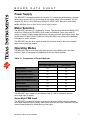
Operating Modes
The MDL-BDC can be controlled using either the servo-style PWM input or the CAN
interface. Table 10 compares the capabilities of the two control methods.
Table 10. Comparison of Control Methods
Control Method
Servo-Style PWM Input
CAN Interface
Speed Control
Yes
Yes
Analog Position Control
No
Yes
Encoder Position Control
No
Yes
Configurable Parameters
No
Yes
Voltage, Current Measurement
No
Yes
Limit Switches
Yes
Yes
Coast/Brake Feature
Yes
Yes
Firmware Update
No
Yes
The MDL-BDC does support the simultaneous use of CAN for monitoring and the
servo-style input for speed.
Servo-Style PWM Input
The MDL-BDC incorporates support for speed and direction control using the standard
servo-style interface found on many radio-control receivers and robot controllers. See the
electrical specifications for default timing of this signal.
Brushed DC Motor Control Module
7