1
QuickSpecs
HP 9000 Superdome Servers (PA-8600, PA-8700, PA8800 and PA-8900)
Overview
This subchapter pertains to all HP 9000 Superdome servers (running PA-8600, PA-8700, PA-8800, or PA-8900 processors) for all
markets. With Superdome, HP launches a new strategy to ensure a positive Total Customer Experience is achieved via industry
leading HP Services. Our experience has shown us that large solution implementations most often succeed as a result of appropriate
skills and attention being applied to the solution design and implementation. To address this on the implementation side, for
Superdome, HP is responding to Customer and Industry feedback and delivering Superdome Configurations via three, pre
configured Services levels: Critical Service, Proactive Service, and Foundation Service. With Superdome, we introduced a new role,
the TCE Manager, who manages the fulfillment of an integrated business solution based on customer requirements. For each
customer account, the TCE Manager will facilitate the selection of the appropriate configuration. For ordering instructions, please
consult the ordering guide.
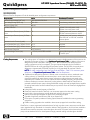
Superdome Service Solutions
Superdome continues to provide the same positive Total Customer Experience via industry leading HP Services as with existing
Superdome servers. The HP Services component of Superdome is described here:
Solution Life Cycle
HP customers have consistently achieved higher levels of satisfaction when key components of their IT
infrastructures are implemented using the Solution Life Cycle.
Cycle The Solution Life Cycle focuses on rapid
productivity and maximum availability by examining customers' specific needs at each of five distinct
phases (plan, design, integrate, install, and manage) and then designing their Superdome solution
around those needs.
DA - 11721
Worldwide — Version 27 — February 1, 2008
Page 1
QuickSpecs
HP 9000 Superdome Servers (PA-8600, PA-8700, PA8800 and PA-8900)
Overview
Service Solutions
HP offers three pre configured service solutions for Superdome that provide customers with a choice of
lifecycle services to address their own individual business requirements.
Foundation Service Solution: This solution reduces design problems, speeds time to production,
and lays the groundwork for long term system reliability by combining pre installation preparation
and integration services, hands on training and reactive support. This solution includes HP Support
Plus 24 to provide an integrated set of 24×7 hardware and software services as well as software
updates for selected HP and third party products.
Proactive Service Solution: This solution builds on the Foundation Service Solution by enhancing
the management phase of the Solution Life Cycle with HP Proactive 24 to complement your
internal IT resources with proactive assistance and reactive support. Proactive Service Solution
helps reduce design problems, speed time to production, and lay the groundwork for long term
system reliability by combining pre installation preparation and integration services with hands on
staff training and transition assistance. With HP Proactive 24 included in your solution, you
optimize the effectiveness of your IT environment with access to an HP certified team of experts that
can help you identify potential areas of improvement in key IT processes and implement necessary
changes to increase availability.
Critical Service Solution: Mission Critical environments are maintained by combining proactive
and reactive support services to ensure maximum IT availability and performance for companies
that can't tolerate downtime without serious business impact. Critical Service Solution
encompasses the full spectrum of deliverables across the Solution Lifecycle and is enhanced by HP
Critical Service as the core of the management phase. This total solution provides maximum
system availability and reduces design problems, speeds time to production, and lays the
groundwork for long term system reliability by combining pre installation preparation and
integration services, hands on training, transition assistance, remote monitoring, and mission
critical support. As part of HP Critical Service, you get the services of a team of HP certified experts
that will assist with the transition process, teach your staff how to optimize system performance,
and monitor your system closely so potential problems are identified before they can affect
availability.
Other Services
HP's Mission Critical Partnership: This service offering provides customers the opportunity to
create a custom agreement with Hewlett Packard to achieve the level of service that you need to
meet your business requirements. This level of service can help you reduce the business risk of a
complex IT infrastructure, by helping you align IT service delivery to your business objectives,
enable a high rate of business change, and continuously improve service levels. HP will work with
you proactively to eliminate downtime, and improve IT management processes.
Service Solution Enhancements: HP's full portfolio of services is available to enhance your
Superdome Service Solution in order to address your specific business needs. Services focused
across multi operating systems as well as other platforms such as storage and networks can be
combined to compliment your total solution
DA - 11721
Worldwide — Version 27 — February 1, 2008
Page 2
QuickSpecs
HP 9000 Superdome Servers (PA-8600, PA-8700, PA8800 and PA-8900)
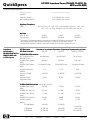
Standard Features
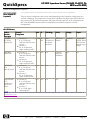
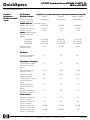
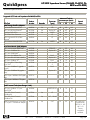
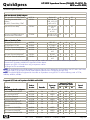
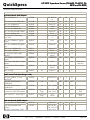
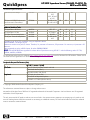
NOTE: Given that PA-8600/PA-8700 are single core processors and PA-8800 and PA-8900 are dual core processors, the columns
listed in this table refer to 16 processor, 32 processor and 64 processor. This terminology refers to 16 cores, 32 cores and 64 cores
for Superdome PA-8600/PA-8700 and 32 cores, 64 cores and 128 cores for Superdome PA-8800 and PA-8900 systems.
System Size
16 Processors
Processor cores
Memory
Cell Boards
PCI Chassis
32 Processors
Processor cores
Memory
Cell Boards
PCI Chassis
64 Processors
Processor cores
Memory
Cell Boards
PCI Chassis
Standard Features
Minimum System
PA-8600 or
PA-8800 or PA-8900
PA-8700
1
1
2 GB
2 GB
1 Cell Board
1 Cell Board
1 12-slot chassis
1 12-slot chassis
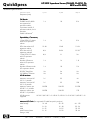
Maximum SPU Capacities
PA-8800 or PA-8900
PA-8600 or
PA-8700
16
32
64 GB
256 GB
4 Cell Boards
4 Cell Boards
4 12-slot chassis
4 12-slot chassis
1
2 GB
1 Cell Board
1 12-slot chassis
2
2 GB
1 Cell Board
1 12-slot chassis
32
128 GB
8 Cell Boards
8 12-slot chassis
64
512 GB
8 Cell Boards
8 12-slot chassis
6
6 GB
2
6 GB
64
256 GB
128
1024 GB
NOTE: 512 GB per
partition
16 Cell Boards
16 12-slot chassis
3 Cell Boards
2 Cell Boards
16 Cell Boards
1 12-slot chassis
1 12-slot chassis
16 12-slot chassis
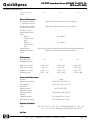
Redundant Power Supply
Redundant Fans
HP-UX operating system with unlimited user license
Factory Integration of memory and I/O Cards
Installation Guide, Operators Guide, and Architecture Manual
HP Site planning and Installation
One year warranty with same business day on-site service response
DA - 11721
Worldwide — Version 27 — February 1, 2008
Page 3
QuickSpecs
HP 9000 Superdome Servers (PA-8600, PA-8700, PA8800 and PA-8900)
Configuration
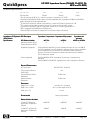
There are three basic building blocks in the Superdome system architecture: the cell, the crossbar backplane, and the I/O
subsystem. Please note that Superdome with PA-8800 and PA-8900 is based on a different chip set (sx1000 or sx2000) than
Superdome with PA-8600 or PA-8700. For more information on the sx1000 and sx2000 chip sets, please refer to: HP Integrity
Superdome QuickSpec.
Cabinets
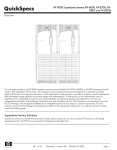
A Superdome system can consist of up to four different types of cabinet assemblies:
At least one Superdome left cabinet. The Superdome cabinets contain all of the processors,
memory and core devices of the system. They will also house most (usually all) of the system's I/O
cards. Systems may include both left and right cabinet assemblies containing, a left or right
backplane respectively.
One or more HP Universal Rack cabinets. These 19-inch rack cabinets are used to hold the system
peripheral devices such as disk drives.
Optionally, one or more I/O expansion cabinets (utilizing the Universal Rack). An I/O expansion
cabinet is required when a customer requires more PCI cards than can be accommodated in their
Superdome cabinets.
Superdome cabinets are serviced from the front and rear of the cabinet only. This enables customers to
arrange the cabinets of their Superdome system in the traditional row fashion found in most computer
rooms. The width of the cabinet accommodates moving it through common doorways in the U.S. and
Europe. The intake air to the main (cell) card cage is filtered. This filter can be removed for
cleaning/replacement while the system is fully operational.
A status display is be located on the outside of the front and rear doors of each cabinet. The customer
and field engineers can therefore determine basic status of each cabinet without opening any cabinet
doors.
For PA-8800 and PA-8900 processors (dual core per processor):
Superdome 32 processor cores: single cabinet (a left cabinet)
Superdome 64 processor cores: single cabinet (a left cabinet)
Superdome 128 processor cores: dual cabinet (a left cabinet and a right cabinet)
Each cabinet may contain a specific number of cell boards (consisting of processors and memory) and
I/O. See the following sections for configuration rules pertaining to each cabinet. The base configuration
product numbers for each of the models are as follows:
DA - 11721
Worldwide — Version 27 — February 1, 2008
Page 4
HP 9000 Superdome Servers (PA-8600, PA-8700, PA8800 and PA-8900)
QuickSpecs
Configuration
Cells (Processors and
Memory)
A cell, or cell board, is the basic building block of a Superdome system. It is a symmetric multi-processor
(SMP), containing:
Four processor sockets that can hold PA 8600, PA 8700, PA 8800 or PA-8900 processors (only
one type is allowed per cell)
Memory (up to 16-GB RAM with 512-MB DIMMs, 32-GB RAM with 1-GB DIMMs and 64-GB
with 2-GB DIMMs.
NOTE: Only 1 GB and 2 GB DIMMs are supported with Superdome PA 8800 and PA 8900).
One cell controller (CC)
Power converters
Data buses
Optional link to I/O card cage
Please note the following:
PA-8600 and PA-8700 processors can be mixed within a Superdome system, but must reside on
different cells and in different partitions (nPars). PA-8800 and PA-8900 processors cannot be
mixed within a Superdome system with PA-8600 or PA-8700 processors.
A Superdome PA-8800 and PA-8900 system can support up to 1 TB of memory with 2 GB
DIMMs. However, due to the limitation of HP-UX 11i, the maximum amount of memory supported
in a partition is 512 GB.
For PA-8600 and PA-8700 processors: The minimum configuration includes one active processor
and 2 GB memory per cell board. The maximum configuration includes four active processor and
16 GB memory per cell board. Each cell board ships with four PA-8600 or PA-8700 processors.
However, based on the number of active processors ordered, from one through four processors
are activated prior to shipment.
For PA-8800 and PA-8900 processors: The minimum configuration includes one active processor
and 2 GB of memory per cell board. The maximum configuration includes eight active processors
and 64 GB of memory per cell board using 2 GB DIMMs. The minimum number of active
processors on each cell board is one. Additional processors on the cell board can be activated
individually (not in pairs).
512 MB, 1 GB and 2 GB DIMMs can be mixed on a cell board in Superdome PA 8800 and PA
8900 systems only.
Crossbar Backplane
Each Crossbar backplane contains two sets of two crossbar chips that provide a non blocking
connection between eight cells and the other backplane. Each backplane cabinet can support up to
eight resulting in a Superdome PA-8600 or Superdome PA-8700 32 processor or Superdome PA-8800
or PA-8900 64 processor system. A backplane supporting four cells would result in a Superdome PA
8600 or Superdome PA-8700 16 processor and a Superdome PA-8800 or PA-8900 32 processor
system. Two backplanes can be linked together with flex cables to produce a cabinet that can support up
to 16 cells resulting in a Superdome PA-8600 or Superdome PA-8700 64 processor core or Superdome
PA-8800 or PA-8900 128 processor core system.
DA - 11721
Worldwide — Version 27 — February 1, 2008
Page 5
QuickSpecs
HP 9000 Superdome Servers (PA-8600, PA-8700, PA8800 and PA-8900)
Configuration
I/O Subsystem
Each I/O chassis provides twelve I/O slots. Superdome PA-8600 and Superdome PA-8700 support I/O
chassis with 12 PCI 66 capable slots, eight supported via single (1x) ropes (266 MB/s peak) and four
supported via dual (2x) ropes (533 MB/s peak). Superdome PA-8800 and PA-8900 supports I/O
chassis with 12 PCI-X 133 capable slots, eight supported via single enhanced (2x) ropes (533 MB/s
peak) and four supported via dual enhanced (4x) ropes (1066 MB/s peak).
Each Superdome cabinet supports a maximum of four internal I/O chassis. The optional I/O expansion
cabinet can support three I/O chassis enclosures (ICE), each of which supports two I/O chassis for a
maximum of six I/O chassis per I/O expansion cabinet.
Each Each cell board connects to at most one I/O chassis, and therefore the number of I/O chassis
supported is dependent on the number of cells present in the system. A Superdome system can have
more cells than I/O chassis. For instance, an 8 cell Superdome can have one to eight I/O chassis. Each
partition must have at least one I/O chassis with the number of I/O chassis not exceeding the number of
cells.
A 4-cell Superdome supports four I/O chassis for a maximum of 48 PCI slots.
An 8-cell Superdome supports eight I/O chassis for a maximum of 96 PCI slots. Since a single
Superdome cabinet only supports four I/O chassis, an I/O expansion cabinet and two I/O chassis
enclosures are required to support all eight I/O chassis.
A 16-cell Superdome supports 16 I/O chassis for a maximum of 192 PCI slots. Since two Superdome
cabinets (left and right) only support eight I/O chassis, two I/O expansion cabinets and four I/O chassis
enclosures are required to support all 16 I/O chassis. The four I/O chassis enclosures are spread across
the two I/O expansion cabinets, either three ICE in one I/O expansion cabinet and one ICE in the other
or two ICE in each.
Core I/O
Superdome's core I/O provides the base set of I/O functions required by every Superdome partition. Each
partition must have at least one core I/O card in order to boot. Multiple core I/O cards may be present
within a partition (one core I/O card is supported per I/O backplane); however, only one may be active
at a time. Core I/O will utilize the standard long card PCI form factor but will add a second card cage
connection to the I/O backplane for additional non-PCI signals (USB and utilities). This secondary
connector will not impede the ability to support standard PCI cards in the core slot when a core I/O card
is not installed.
Newer sx2000 based systems (which support only the PA-8900) do not require and do not support the
traditional core I/O card. These systems do require LAN connectivity at a minimum to support system
boot. Other I/O cards can be added to this basic functionality.
Any I/O chassis can support a Core I/O card that is required for each independent partition. A system
configured with 16 cells, each with its own I/O chassis and core I/O card could support up to 16
independent partitions. Note that cells can be configured without I/O chassis attached, but an I/O
chassis cannot be configured in the system unless attached to a cell.
The core I/O card's primary functions are:
Partitions (console support) including USB and RS-232 connections
10/100Base-T LAN (general purpose)
Other common functions, such as Ultra/Ultra2 SCSI, Fibre Channel, and Gigabit Ethernet, are not
included on the core I/O card. These functions are, of course, supported as normal add in cards.
The unified 100Base-T Core LAN driver code searches to verify whether there is a cable connection on an
DA - 11721
Worldwide — Version 27 — February 1, 2008
Page 6
QuickSpecs
HP 9000 Superdome Servers (PA-8600, PA-8700, PA8800 and PA-8900)
Configuration
RJ-45 port or on an AUI port. If no cable connection is found on the RJ-45 port, there is a busy wait
pause of 150 ms when checking for an AUI connection. By installing the loopback connector (description
below) in the RJ-45 port, the driver would think an RJ 45 cable was connected and would not continue to
search for an AUI connection, hence eliminate the 150 ms busy wait state:
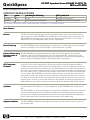
Product/Option Number Description
A7108A
RJ-45 Loopback Connector
0D1
Factory integration RJ-45 Loopback Connector
I/O Expansion Cabinet
The I/O expansion functionality is physically partitioned into four rack mounted chassis-the I/O
expansion utilities chassis (XUC), the I/O expansion rear display module (RDM), the I/O expansion
power chassis (XPC) and the I/O chassis enclosure (ICE). Each ICE supports up to two 12-slot I/O
chassis.
Factory Integration
When an I/O Expansion cabinet is ordered as an upgrade to a Superdome system, it includes the factory
testing and integration of any components that are ordered at the same time as the cabinet. This
includes any I/O Chassis, PCI or PCI-X cards and peripherals. If it is ordered as an upgrade but not at
the time of the Superdome system, additional installation assistance may be required and can be
ordered as field installation products.
Field Racking
The only field rackable I/O expansion components are the ICE and the 12 slot I/O chassis. Either
component would be field installed when the customer has ordered additional I/O capability for a
previously installed I/O expansion cabinet.
No I/O expansion cabinet components will be delivered to be field installed in a customer's existing rack
other than a previously installed I/O expansion cabinet. The I/O expansion components were not
designed to be installed in racks other than the 10K G2 Universal Rack. In other words, they are not
designed for Rosebowl I, pre merger Compaq, Rittal, or other third party racks.
The I/O expansion cabinet is based on the 10K G2 Universal Rack and all expansion components
mount in the rack. Each component is designed to install independently in the rack. The 10K G2
Universal Rack has been modified to allow I/O interface cables to route between the ICE and cell
boards in the Superdome cabinet. I/O expansion components are not designed for installation behind a
rack front door. The components are designed for use with the 10K G2 Universal Rack perforated rear
door.
I/O Chassis Enclosure
(ICE)
The I/O chassis enclosure (ICE) provides expanded I/O capability for Superdome. Each ICE supports up
to 24 I/O slots by using two 12 slot Superdome I/O chassis. The I/O chassis installation in the ICE puts
the I/O cards in a horizontal position. An ICE supports one or two 12 slot I/O chassis. The I/O chassis
enclosure (ICE) is designed to mount in a 10K G2 Universal Rack and consumes 9U of vertical rack
space.
To provide online addition/replacement/deletion access to I/O cards and hot swap access for I/O fans,
all I/O chassis are mounted on a sliding shelf inside the ICE.
Four (N+1) I/O fans mounted in the rear of the ICE provide cooling for the chassis. Air is pulled through
the front as well as the I/O chassis lid (on the side of the ICE) and exhausted out the rear. The I/O fan
assembly is hot swappable. An LED on each I/O fan assembly indicates that the fan is operating.
DA - 11721
Worldwide — Version 27 — February 1, 2008
Page 7
HP 9000 Superdome Servers (PA-8600, PA-8700, PA8800 and PA-8900)
QuickSpecs
Configuration
Cabinet Height and
Although the individual I/O expansion cabinet components are designed for installation in any Rack
Configuration Limitations System E cabinet, rack size limitations have been agreed upon. IOX Cabinets will ship in either the 1.6meter (33U) or 1.96-meter (41U) cabinet. In order to allay service access concerns, the factory will not
install IOX components higher than 1.6 meters from the floor. Open space in an IOX cabinet will be
available for peripheral installation.
Refer to the 10K G2 Series Rack Best Practices Guide for information on rack deployment, stabilization,
and transportation. Go to http://HP.com/go/rackandpower for more information.
Peripheral Support
All peripherals qualified for use with Superdome and/or for use in a Rack System E are supported in the
I/O expansion cabinet as long as there is available space. Peripherals not connected to or associated
with the Superdome system to which the I/O expansion cabinet is attached may be installed in the I/O
expansion cabinet.
Server Support
No servers except those required for Superdome system management such as Superdome Support
Management Station or ISEE may be installed in an I/O expansion cabinet.
Peripherals installed in the I/O expansion cabinet cannot be powered by the XPC. Provisions for
peripheral AC power must be provided by a PDU or other means.
Standalone I/O
Expansion Cabinet
If an I/O expansion cabinet is ordered alone, its field installation can be ordered via option 750 in the
ordering guide (option 950 for Superdome Advanced Architect Program Channel partners).
DVD Solution
The DVD solution for Superdome requires the following components per partition. External racks
AF004A or AF014A must also be ordered with the DVD solution.
NOTE: One DVD and one DAT is required per nPartition.
Superdome DVD Solutions
Description
PCI Ultra160 SCSI Adapter or PCI Dual Channel Ultra160 SCSI
Adapter
Surestore Tape Array 5300
HP DVD+RW Array Module (one per partition)
NOTE: HP DVD-ROM Array Module for the TA5300 (C7499B) is
replaced by HP DVD+RW Array Module (Q1592A) to give
customers read capabilities for loading software from CD or DVD,
DVD write capabilities for small amount of data (up to 4 GB) and
offline hot-swap capabilities.
HP DAT 40m Array Module
HP DAT 72 Array Module (carbon)
DDS-4/DAT40 (one per partition)
PCI LVD/SE SCSI card
NOTE: A5149A supports the MSA30 SB/DB as a boot device on
Superdome running HP-UX 11i.
Jumper SCSI Cable for DDS-4 (optional) 1
SCSI Cable 10m VHD/HDTS68 LVD/SE ILT M/M
DA - 11721
Part Number
A6828A or
A6829A
C7508AZ
Q1592A
Option Number
0D1
C7497A
Q1524B
C7497B
A5149A
0D1
C2978B
C7556A
0D1
Worldwide — Version 27 — February 1, 2008
0D1
0D1
0D1
Page 8
QuickSpecs
HP 9000 Superdome Servers (PA-8600, PA-8700, PA8800 and PA-8900)
Configuration
SCSI cable 5 meter
SCSI Terminator
C7520A
C2364A
0D1
0D1
1
0.5-meter HD-HDTS68 is required if DDS-4 is used.
If using DAT72, it is recommended to use an A6829A dual port SCSI with daisy chaining to connect the
DVD and the DAT72 leaving the second port available to connect a SCSI data storage device.
Partitions
Hardware Partitions
A hardware partition (nPar) consists of one or more cells that communicate coherently over a high
bandwidth, low latency crossbar fabric. Individual processors on a single cell board cannot be separately
partitioned. nPars are logically isolated from each other such that transactions in one nPar are not visible
to other nPars within the same complex.
Each nPar runs its own independent operating system. Different nPars may be executing the same or
different revisions of an operating system. On HP Integrity Superdome systems, nPars may be executing
different operating systems altogether (HP-UX, Windows Server 2003 or Linux). Please refer to the HP
Integrity Superdome section for details on these operating systems.
Each nPar has its own independent processors, memory and I/O resources consisting of the resources of
the cells that make up the nPar. Resources may be removed from one nPar and added to another
without having to physically manipulate the hardware just by using commands that are part of the System
Management interface.
Superdome HP-UX 11i supports static nPars. Static nPars imply that any nPar configuration change
requires a reboot of that nPar. In a future HP-UX release, dynamic nPars will be supported. Dynamic
nPars imply that the nPar configuration changes do not require a reboot of that nPar. Using the related
capabilities of dynamic reconfiguration (i.e. on-line addition, on-line removal), new resources may be
added to an nPar and failed modules may be removed and replaced while the nPar continues in
operation.
NOTE: It is possible for PA-8800 and PA-8900 nPars to co exist with Itanium 2 1.6 GHz nPars in the
same Superdome system, but on different partitions. Customers can configure an Itanium 2 1.6 GHz
nPar in an HP-9000 Superdome running PA-8800 or PA-8900 (and vice versa) in the field only.
only Factory
orders for mixed Itanium and PA RISC nPars are not allowed.
Virtual Partitions
A virtual partition (vPar) provides the capability of dividing a system into different HP UX operating system
images.
VPars is available on HP-UX 11i and therefore can run on Superdome PA 8600/PA 8700 servers. vPars
on Superdome PA-8800 and PA-8900 is also supported.
Mixing of PA-RISC and
Itanium Cells in
Superdome
1) Which processors can be mixed in a Superdome?
The first step in determining which processors can be mixed within a Superdome is to look at the chipset.
A Superdome can only support one type of chipset (legacy chipset or sx1000 chipset or sx2000) at a
time.
The legacy chipset only supports the PA RISC architecture. The PA 8600, PA 8700, and PA 8700+
processors were supported with this chipset. As a result, they can be mixed within the Superdome but they
cannot be mixed with processors supported by other chipsets (i.e., Itanium 9M with the sx1000 chipset).
With the sx1000 and sx2000 chipsets, processors of like architectures (PA RISC and Itanium architectures)
DA - 11721
Worldwide — Version 27 — February 1, 2008
Page 9
HP 9000 Superdome Servers (PA-8600, PA-8700, PA8800 and PA-8900)
QuickSpecs
Configuration
that are supported by the specific chipset can be mixed in separate hard partitions. For example, the HP
9000 Superdome supports mixing the PA 8800 and PA 8900 processors in separate hard partitions. As
an example, a subset of the PA RISC and Itanium processors (PA 8800, PA 8900 and Itanium 9M
processors) can be supported at the same time in different hard partitions within a Superdome.
The table below highlights which processors can co-exist on a Superdome in separate hard partitions.
PA-8600
PA-8700
PA-8700
+
PA-8800
PA-8900
Itanium 2
6M
Itanium 2
9M
mx2 dualcore
processor
module
Montecito*
Montecito
Montvale*
Montvale
PA8600
PA8700
PA8700
+
PA8800
PA- Itanium Itanium
8900 2 6M 2 9M
mx2 Montecito Montvale
dualcore
processor
module
No
No
No
No
No
No
No
No
No
NA
Yes
Yes
Yes
NA
Yes
Yes
Yes
NA
No
No
No
No
No
No
No
No
No
No
No
No
No
No
No
No
No
No
No
No
No
NA
Yes
No
Yes
NA
No
No
No
NA
Yes
Yes
Yes
No
No
Yes
No
Yes*
No
No
Yes*
No
No
No
No
Yes
Yes
Yes
NA
Yes
No
No
No
No
No
No
No
Yes
Yes
NA
No
No
No
No
No
No
No
No
No
No
Yes
Yes
No
No
No
No
No
No
NA
Yes
Yes
NA
*Requires the sx2000 chipset
2) In order to run an Itanium-based partition in an HP 9000 server, what changes are required?
In order to add a new partition with Itanium 2 9M processors on an HP 9000 Superdome, the following
steps are required:
Step #1: Upgrade firmware on PA-RISC based partitions
Step #2: Create a new hard partition in the Superdome for Itanium 2-based cell (s)
Step #3: Plug in cell boards for Itanium 2-based cells
Step #4: Some I/O cards may need to be added for that specific hard partition (Windows does not
support the identical set of I/O cards that HP-UX 11i supports)
Step #5: Load operating system for Itanium 2-based partition
Upgrading a PA-RISC partition to support Itanium 2 processors would require similar steps:
Step #1: Upgrade firmware on PA-RISC based partitions
Step #2: Pull out existing PA-RISC cell boards
DA - 11721
Worldwide — Version 27 — February 1, 2008
Page 10
QuickSpecs
HP 9000 Superdome Servers (PA-8600, PA-8700, PA8800 and PA-8900)
Configuration
Step #3: Swap existing memory into cell boards for Intel Itanium 2 processor (protects investment in
current memory)
Step #4: Plug in cell boards for Itanium 2-based cell boards
Step #5: Some I/O cards may need to be added for that specific hard partition (Windows does not
support the identical set of I/O cards that HP-UX 11i supports)
Step #6: Load operating system for Itanium 2-based partition
The in-box addition of Itanium 2 processors can be done with no additional hardware, no new chassis
and no change to backplane.
3) When will mixing of PA-RISC and Itanium 2 processors be available?
Support for mixing PA RISC and Itanium 2 processors within systems based on the sx1000 and/or sx2000
chipsets (in separate hard partitions) is available now
4) Is mixing of PA-RISC and Itanium processors factory configurable?
NO. The way to do this is to enable PA RISC systems that shipped from the factory to add Itanium
partitions later on in the field. In addition, HP offers the ability to enable Itanium based systems that
shipped from the factory to add PA RISC partitions later on in the field.
The current policy is not to allow PA RISC or Intel Itanium based partitions to be added to systems in the
factory. However, depending on the geographic region, shipment of Superdome systems with a mix of PA
RISC and Intel Itanium based partitions may be possible.
5) How long does it take to add an Itanium-based partition in an HP 9000 customers?
The effort required to add an Itanium-based partition to an HP 9000 Superdome is slightly more than
what is required to add a new PA-RISC-based partition. In both cases you have to create a new hard
partition in the Superdome, plug in cell boards for the new processors and load the operating system.
There are no hardware changes required to support mixing of processor types. The only known difference
at this time is that a customer would need to upgrade the firmware to support the Itanium architecture.
The process is currently being tested by R&D. This document will be updated as we learn more through
testing.
6) Will mixing impact the overall performance of a Superdome (i.e. would an Itanium-based partition
have the same performance in a mixed Superdome as in a Superdome only populated with Itanium 2
processors)?
No. For example, suppose you have a hard partition with 16 Intel Itanium 2 9M processors. This partition
would have the same performance in a system with a mix of PA-RISC and Itanium 2-based hard partitions
as a server where all of the other partitions are Itanium 2-based. This is assuming that besides the type of
processors, all of the other configuration options are the same (memory, cell board locations, number of
partitions, etc).
7) Can I add PA-RISC processors to an Itanium-based Integrity Superdome?
Yes. HP offers the ability to enable Itanium-based systems that shipped from the factory to add PA-RISC
partitions later on in the field. This serves as a safety net/insurance policy. If the customer determines after
the fact that a specific application is not ready for the Itanium technology, they can simply add a PA-RISC
hard partition to that Integrity Superdome and continue the execution of the application while it is
certified.
DA - 11721
Worldwide — Version 27 — February 1, 2008
Page 11
QuickSpecs
HP 9000 Superdome Servers (PA-8600, PA-8700, PA8800 and PA-8900)
Configuration
8) Why can't PA-8700+ processors be mixed with Itanium 2 9M processors?
For years, HP has had a high level of investment protection with the HP 9000 Superdome. Customers
have been provided with the maximum investment protection level by keeping their investment in PA8600
and PA8700 processors while adding the higher speed PA8700+. In addition, each processor type runs
at its rated speed so there is no downgrading of the higher speed processors (some competitors are
erroneously saying Superdome has to downgrade the higher speed processors). For example, the PA8700
runs at a full 750 MHz while the PA8600 runs at 550 MHz-there is no forcing of the PA8700 down to
550 MHz just to obtain compatibility. This is possible because the processor speeds are independent from
the bus speeds.
The Intel Itanium processor family is an advanced architecture featuring exceptional floating point and
SSL performance. The Itanium 2 processors have the processing power that is consistent with a
Superdome class high-end server. In addition, the Itanium processor accesses cache memory using a
data block that is greater than twice the size of the PA8600, PA8700, and PA8700+. Thus, the Itanium
processor family and subsequent PA-8800 and PA-8900 processors require a different chipset than the
PA8600, PA8700, or PA8700+ processors. One of the key restrictions in mixing processors is that all cell
boards in a given Superdome must have the same chipset. The PA-8700+ is supported by a legacy
chipset that only supported PA-RISC processors. As a result, the PA-8700+ can only be mixed with PA8700 and PA-8600 processors. In order to support Itanium 2 9M processors in their current HP 9000
Superdome, the customer would be required first to upgrade all of their PA-8700+ processors to PA8800 or PA-8900 processors utilizing the sx1000 chipset. Once this is complete, the customer would
then have the option of adding the Itanium 2 9M processor in a separate partition because it is also
supported by the sx1000 chipset.
9) Why aren't Itanium 6M processors and mx2 dual core processor modules supported?
The original plan was to enable PA RISC systems that shipped from the factory to add Itanium based
partitions later on. The plan was not to allow PA RISC based partitions to be added to systems that
shipped from the factory as Itanium based servers with Itanium 6M processors and/or mx2 dual core
processor modules. This is the only case where we encounter a problem with no support for Itanium 6M
processors and mx2 dual core processor modules. If a customer has already made the decision to go
with Integrity Superdomes, it is very unlikely that they will take a back step to PA RISC based partitions.
Conversely, if a customer wants to upgrade a PA RISC based partition to be Itanium based, they are
much more likely to use the Itanium 9M processor than the Itanium 6M processors or mx2 dual core
processor modules because of the added performance and larger cache sizes.
Finally, this feature requires a significant amount of resources to test the different type of configurations
supported in a Superdome. In order to provide this functionality in a timely basis to customers, we had to
narrow the scope. Thus, the decision was made to not support Itanium 2 6M processors and mx2 dual
core processors in a mixed processor type of system.
If a customer with Itanium 6M processors or mx2 dual core processor modules wants to add PA RISC
modules, they would need to first upgrade the partitions with Itanium 6M processors or mx2 dual core
processor modules to Itanium 9M processors and then they could add a PA RISC based partition to the
Superdome.
10) Which versions of the HP-UX 11i operating system will be supported?
Currently HP supports HP UX 11.11 (HP UX 11i v1) for the PA RISC architecture as well as 11.23 (HP UX
11i v2) for Itanium processors and PA RISC processors in a mixed environment. Based on HP's testing,
using HP UX 11.11 (HP UX 11i v1) in a mixed configuration requires a PA RISC Firmware update.
11) Does a customer have to power down when they add an Itanium-based partition to a PA-RISCbased Superdome?
DA - 11721
Worldwide — Version 27 — February 1, 2008
Page 12
HP 9000 Superdome Servers (PA-8600, PA-8700, PA8800 and PA-8900)
QuickSpecs
Configuration
It depends. If the existing PA-RISC based partitions are running HP-UX 11i v2 and PDC 22.1 (released in
December 2004) then an Itanium-based partition may be added while the PA-RISC partitions are active.
If the customer is running WLM it must be patched for proper operation in a mixed environment. We are
currently checking with the WLM team to see what impact this would have on the PA-RISC partitions.
HP's shipping firmware for PA RISC processors does not fully support mixing if the PA RISC partitions are
running HP UX 11i v1. In this case, downtime for all PA RISC based partitions would be required to
update to the new PDC. The partitions could all be updated independently if desired. The above
comment regarding WLM also applies.
12) What are the minimum firmware requirements for mixing various operating environments?
The matrix below describes the minimum firmware requirements:
Mixing Mad9M with PA8800/PA-8900
11i v1
11i v2
Mixing Scenarios:
operating systems,
firmware and
management tools
11i v2 HWE0409
11i v2 HWE0505 (no vPars)
Windows Server 2003
Linux
PDC 22.3
IPF 2.54
MFW 15.14
PDC 22.1
IPF 2.50
MFW 15.14
11i v2 HWE0505 (vPars)
PDC 22.3
IPF 3.x
MFW 15.20
PDC 22.1
IPF 3.x
MFW 15.20
The following table summarizes the various operating environments supported on the PA-8800, PA-8900
and Intel Itanium 2 1.6 GHz processors:
Processor
PA-8800
PA-8900
Itanium 2 1.6 GHz
Operating System
HP-UX 11.i v1 HWE 0312 (with patches)
HP-UX 11.i v1 HWE 0406
HP-UX 11.i v1 HWE 0412
HP-UX 11.i v2 HWE 0409
HP-UX 11.i v2 HWE 0505
HP-UX 11.i v1 HWE 0412
HP-UX 11.i v2 HWE 0409
HP-UX 11.i v2 HWE 0505
HP-UX 11.i v2 HWE 0409
HP-UX 11.i v2 HWE 0505
Linux RHEL3 U3 (and higher)
Linux SLES 9 (and higher)
Windows 2003 Server, Smart Setup 3.1 (and higher)
The following table lists the minimum firmware requirements for mixing:
Processor
PA-8800
PA-8900
Itanium 2 1.6 GHz A1
Itanium 2 1.6 GHz A2
DA - 11721
Supported
PDC 22.1 (SMS rel_5.0) or above
PDC 22.1 (SMS rel_5.0) or above
IPF 2.50 (SMS rel_5.0) or above
IPF 2.52 (SMS rel_5.1) or above
Not Supported
PDC 20.8, 21.2
n/a
n/a
n/a
Worldwide — Version 27 — February 1, 2008
Page 13
QuickSpecs
HP 9000 Superdome Servers (PA-8600, PA-8700, PA8800 and PA-8900)
Configuration
NOTE: PDC 20.8 and PDC 21.2 do not contain the required enhancements for mixing. Customers who
are running on either of these PDC versions will be required to upgrade to PDC 22.1 to enable mixing.
PDC 22.1 also happens the minimum firmware required to support PA-8900.
Any of the above operating environments may be used on a mixed Superdome. In the process of testing
all of the above combinations some issues and restrictions were discovered with WLM, gWLM and the
GUI version of partition manager on HP-UX 11i v1. Firmware, operating system or application updates
can resolve these issues. However, such updates may not always be possible or practical.
The following mixing scenarios serve to illustrate the issues that were found during testing and possible
ways to work around or resolve them. For simplicity, the first three scenarios assume that all the PA
partitions in the Superdome are running the same version of HP-UX. The fourth scenario explains the
more general case where the PA partitions are running different versions of HP-UX.
Scenario 1: PA-8800 Partitions running HP-UX 11i v1 HWE 0312 or 0406 mixed with Itanium 2 1.6
GHz
Known issue with the GUI version of Parmgr
Parmgr:
Both of these HWEs shipped with Parmgr V1. This version of Parmgr and the stack that sits under it are
not capable of managing Integrity partitions. Parmgr generates error messages when trying to access the
Integrity cells and display information about them.
Alternatives to running Parmgr GUI on the PA partitions:
Integrity partitions (and PA partitions) may be managed from the SMS
Integrity partitions (and PA partitions) may be managed by parcmds from any partition
Integrity partitions (and PA partitions) may be managed by the GUI version of Parmgr on any
Integrity partition
The minimum firmware listed in the table above is sufficient for running this configuration.
Possible Upgrades:
If it is important to be able to use the parmgr GUI on the PA HP UX 11i v1 you can upgrade HP UX to
HWE 0412 and follow the process in Scenario 2. If a customer upgrades to any 11i v1 HWE beyond
HWE 0412 (HWE 0509 and later) then the proper nPar provider is already included in the HWE and the
firmware upgrades in Scenario 2 are sufficient to get full functionality.
Scenario 2: PA 8800 partitions or PA 8900 partitions running 11i v1 HWE 0412 mixed with Itanium
1.6 GHz
Known issue with the GUI version of Parmgr
Parmgr:
HP-UX 11i v1 HWE 0412 introduced Parmgr V2. This version of Parmgr will exhibit the same issues as
Scenario 1 with the minimum required firmware from the table. However, upgrades to firmware and the
nPar provider will make this version of Parmgr fully functional and capable of managing Integrity
partitions. See the upgrade section below for details.
Alternatives to running Parmgr GUI on the PA partitions:
These are essentially the same as Scenario 1.
Integrity partitions (and PA partitions) may be managed from the SMS
Integrity partitions (and PA partitions) may be managed by parcmds from any partition
Integrity partitions (and PA partitions) may be managed by the GUI version of Parmgr on any
Integrity partition
The minimum firmware listed in the table above is sufficient for running this configuration.
Possible upgrades:
DA - 11721
Worldwide — Version 27 — February 1, 2008
Page 14
QuickSpecs
HP 9000 Superdome Servers (PA-8600, PA-8700, PA8800 and PA-8900)
Configuration
If it is important to be able to use the parmgr GUI on the PA partitions to manage the Integrity partitions
the following updates must be made to the system:
PDC must be at revision 22.3 or higher in the 11.i v1 partition. This version of PDC contains a single fix
on top of PDC 22.1 that compensates for the byte reversal in the cell info structure between PA and
Integrity (this is due to the different "endianness" of the processors). PDC 22.3 will be released as part of
SMS rel_6.0 in September 2005.
Integrity firmware must be upgraded to the version that supports vPars. This version of Integrity firmware
contains a fix that populates I/O slot information in cell info structures used by the PA partition
management stack. Currently shipping Integrity firmware does not populate this information and causes
the PA management stack to report errors for Integrity cells. This version of Integrity firmware will be
released as part of SMS rel_6.0 in September 2005.
The nPartition provider ("nPar" bundle) must be updated to version B.11.11.01.04 or above. This version
will first be released on HP UX 11.i v1 HWE 0509. The version of nPar provider that shipped with HWE
0412 did not properly handle the single core Madison 9M processors.
Scenario 3: PA-8800 partition or PA-8900 partition running 11.i v2 (HWE 0409 or 0505) mixed with
Itanium 1.6 GHz
This is the simplest scenario. The minimum firmware listed in the table is sufficient and all the partition
management tools just work. The PA partition can manage other PA partitions and the Integrity partition
and vice versa. Enjoy.
Scenario 4: PA-8800 or PA-8900 partitions running a mixture of the above scenarios mixed with
Itanium 1.6 GHz
The previous scenarios apply to the individual partition pairs. For instance, say you have a Superdome
with a PA8800 11.i v1 HWE0406 partition, a PA8900 11.i v1 HWE0412 partition a PA8800 11.i v2
partition and an Integrity partition. As described in Scenario 1 the PA8800 11.i v1 HWE0406 partition
will not be able to recognize the Integrity cells. Manage the Integrity partition from the SMS, the PA8800
11.i v2 partition or using parcmds. As described in Scenario 2, the PA8900 11.i v1 HWE0412 partition
cannot manage the Integrity partition with out the firmware and nPar provider upgrades outlined above.
Use the SMS, the PA 11.i v2 partition or parcmds to manage the Integrity partition.
Workload Manager (WLM)
WLM currently uses the UNIX command "uname -i" to ensure that all the partitions it is managing are on
the same Superdome. WLM verifies that all the managed partitions "uname -i" values match. It turns out
the Integrity partitions and PA partitions on the same Superdome do not return the same value for "uname
-i". This prevents WLM from properly managing all the partitions on a single Superdome in a mixed
environment with iCAP. The WLM team has provided patches WLM A.03.00 for both 11.i v1
(PHSS_33499 s700_800 11.11 WLM A.03.00 Cumulative Patch) and 11.i v2 (PHSS_33477 s700_800
11.23 WLM A.03.00 Cumulative Patch) to resolve this issue. Customers who wish to use WLM in a mixed
environment with iCAP will need to install/upgrade to version A.03.00 and install the appropriate patch.
Customers who are using either WLM A.02.x or A.03.x in a non iCAP environment can use their current
version of WLM with no upgrade/patch. Future versions of WLM (A.03.00.01 and later) will not require a
patch.
Global Workload Manager (gWLM)
gWLM 1.1.1 was first released with HP UX 11.i v2 HWE0505. It has the same issue with "uname -i" as
WLM. This only affects gWLM iCAP SRDs. VPAR, PSET and FSS SRDs work correctly in mixed
environments. The gWLM team plans to remedy this issue in the first maintenance release of gWLM.
Contact [email protected] for a workaround if you have a gWLM 1.1.1 customer who needs to
DA - 11721
Worldwide — Version 27 — February 1, 2008
Page 15
QuickSpecs
HP 9000 Superdome Servers (PA-8600, PA-8700, PA8800 and PA-8900)
Configuration
deploy an iCAP SRD on a mixed complex before the first maintenance release is available.
High Availability
NOTE: Online addition/replacement for cell boards is not currently supported and will be available in a
future HP UX release. Online addition/replacement of individual processors and memory DIMMs will
never be supported.)
Superdome high availability offering is as follows:
Processor: The features below nearly eliminate the down time associated with processor cache
errors (which are the majority of processor errors).
Dynamic processor resilience w/ Instant Capacity enhancement.
Processor cache ECC protection and automatic de allocation
Processor bus parity protection
Redundant DC conversion
Memory:
Memory The memory subsystem design is such that a single SDRAM chip does not contribute
more than 1 bit to each ECC word. Therefore, the only way to get a multiple-bit memory error
from SDRAMs is if more than one SDRAM failed at the same time (rare event). The system is also
resilient to any cosmic ray or alpha particle strike because these failure modes can only affect
multiple bits in a single SDRAM. If a location in memory is "bad", the physical page is de-allocated
dynamically and is replaced with a new page without any OS or application interruption. In
addition, a combination of hardware and software scrubbing is used for memory. The software
scrubber reads/writes all memory locations periodically. However, it does not have access to
"locked-down" pages. Therefore, a hardware memory scrubber is provided for full coverage.
Finally data is protected by providing address/control parity protection.
Memory DRAM fault tolerance (i.e., recovery of a single SDRAM failure)
DIMM address/control parity protection
Dynamic memory resilience (i.e., page de-allocation of bad memory pages during
operation)
Hardware and software memory scrubbing
Redundant DC conversion
Cell COD
I/O:
I/O Partitions configured with dual path I/O can be configured to have no shared components
between them, thus preventing I/O cards from creating faults on other I/O paths. I/O cards in
hardware partitions (nPars) are fully isolated from I/O cards in other hard partitions. It is not
possible for an I/O failure to propagate across hard partitions. It is possible to dynamically repair
and add I/O cards to an existing running partition.
Full single-wire error detection and correction on I/O links
I/O cards fully isolated from each other
Hardware for the prevention of silent corruption of data going to I/O
On-line addition/replacement (OLAR) for individual I/O cards, some external peripherals,
SUB/HUB
Parity protected I/O paths
Dual path I/O
Crossbar and Cabinet Infrastructure:
Infrastructure
Recovery of a single crossbar wire failure
Localization of crossbar failures to the partitions using the link
Automatic de-allocation of bad crossbar link upon boot
Redundant and hotswap DC converters for the crossbar backplane
ASIC full burn-in and "high quality" production process
Full "test to failure" and accelerated life testing on all critical assemblies
Strong emphasis on quality for multiple-nPartition single points of failure (SPOFs)
System resilience to Management Processor (MP)
Isolation of nPartition failure
DA - 11721
Worldwide — Version 27 — February 1, 2008
Page 16
QuickSpecs
HP 9000 Superdome Servers (PA-8600, PA-8700, PA8800 and PA-8900)
Configuration
Protection of nPartitions against spurious interrupts or memory corruption
Hot swap redundant fans (main and I/O) and power supplies (main and backplane power
bricks)
Dual power source
Phone-Home capability
"HA Cluster-In-A-Box" Configuration:
Configuration The "HA Cluster-In-A-Box" allows for failover of users'
applications between hardware partitions (nPars) on a single Superdome system. All providers of
mission critical solutions agree that failover between clustered systems provides the safest
availability-no single points of failures (SPOFs) and no ability to propagate failures between
systems. However, HP supports the configuration of HA cluster software in a single system to allow
the highest possible availability for those users that need the benefits of a non-clustered solution,
such as scalability and manageability. Superdome with this configuration will provide the greatest
single system availability configurable. Since no single-system solution in the industry provides
protection against a SPOF, users that still need this kind of safety and HP's highest availability
should use HA cluster software in a multiple system HA configuration. Multiple Serviceguard or
Serviceguard Extension for RAC clusters can be configured within a single Superdome system (i.e.,
two 4-node clusters configured within a 32-processor Superdome system).
Multi-system High
Availability
Any Superdome partition with PA-RISC processors that is protected by Serviceguard or Serviceguard
Extension for RAC can be configured in a cluster with:
Another Superdome with PA-RISC processors
One or more standalone non Superdome systems with PA-RISC processors
Another partition within the same single cabinet Superdome (refer to "HA Cluster-in-a-Box" above
for specific requirements)
Separate partitions within the same Superdome system can be configured as part of different
Serviceguard clusters.
Please note that when you add nodes or initially create a cluster, all nodes must be at the same version
of the operating system and Serviceguard. This means that you may have to load an operating system
update for hardware enablement of the newer hardware, even on older systems. Please refer to the
"Compatibility and Feature Matrix" at
http://docs.hp.com/hpux/onlinedocs/4076/SG%20SGeRAC%20EMS%20Support%20Matrix_10 3
03.htm
Geographically Dispersed The following Geographically Dispersed Cluster solutions fully support cluster configurations using
Cluster Configurations
Superdome systems. The existing configuration requirements for non-Superdome systems also apply to
configurations that include Superdome systems. An additional recommendation, when possible, is to
configure the nodes of cluster in each datacenter within multiple cabinets to allow for local failover in the
case of a single cabinet failure. Local failover is always preferred over a remote failover to the other
datacenter. The importance of this recommendation increases as the geographic distance between
datacenters increases.
Extended Campus Clusters (using Serviceguard with Mirrordisk/UX)
MetroCluster with Continuous Access XP
MetroCluster with EMC SRDF
ContinentalClusters
From an HA perspective, it is always better to have the nodes of an HA cluster spread across as many
system cabinets (Superdome and non Superdome systems) as possible. This approach maximizes
redundancy to further reduce the chance of a failure causing down time.
DA - 11721
Worldwide — Version 27 — February 1, 2008
Page 17
QuickSpecs
HP 9000 Superdome Servers (PA-8600, PA-8700, PA8800 and PA-8900)
Management Features
Supportability and management features on HP 9000 Superdome are covered in the next section.
Service Processor (MP)
The service processor (MP) utility hardware is an independent support system for nPartition servers. It
provides a way for you to connect to a server complex and perform administration or monitoring tasks
for the server hardware and its nPartitions. The main features of the service processor include the
Command menu, nPartition consoles, console logs, chassis code viewers, and partition Virtual Front
Panels (live displays of nPartition and cell states).
Access to the MP is restricted by user accounts. Each user account is password protected and provides a
specific level of access to the Superdome complex and service processor commands. Multiple users can
independently interact with the service processor because each service processor login session is private.
Up to 16 users can simultaneously log in to the service processor through its network (customer LAN)
interface and they can independently manage nPartitions or view the server complex hardware states.
Two additional service processor login sessions can be supported by the local and remote serial ports.
These allow for serial port terminal access(through the local RS 232 port) and external modem access
(through the remote RS 232 port).
In general, the service processor (MP) on Superdome servers is similar to the service processor on other
HP servers, while providing enhanced features necessary for managing a multiple nPartition server. For
example, the service processor manages the complex profile, which defines nPartition configurations as
well as complex wide settings for the server. The service processor also controls power, reset, and TOC
capabilities, displays and records system events (chassis codes), and can display detailed information
about the various internal subsystems.
The primary features available through the service processor are:
Functional capabilities:
The Service Processor Command Menu:
Menu provides commands for
system service, status, access configuration, and manufacturing tasks.
Partition Consoles:
Consoles Each nPartition in a server complex has its own
console. Each nPartition's console provides access to Boot Console
Handler (BCH) interface and the HP-UX console for the nPartition.
Console Logs:
Logs Each nPartition has its own console log, which has a
history of the nPartition console's output, including boot output, BCH
activity, and any HP-UX console login activity.
Chassis Logs Viewers (Live and Recorded Chassis Codes): Three types
of chassis code log views are available: activity logs, error logs, and
live chassis code logs.
Virtual Front Panels: Each nPartition's Virtual Front Panel (VFP)
displays real-time status of the nPartition boot status and activity, and
details about all cells assigned to the nPartition. The VFP display
automatically updates as cell and nPartition status changes.
DA - 11721
Worldwide — Version 27 — February 1, 2008
Page 18
QuickSpecs
HP 9000 Superdome Servers (PA-8600, PA-8700, PA8800 and PA-8900)
Management Features
Support Management
Station (SMS)
The Support Management Station (SMS) runs the Superdome scan tools that enhance the diagnosis and
testability of Superdome. The SMS and associated tools also provide for faster and easier upgrades and
hardware replacement.
The purpose of the SMS is to provide Customer Engineers with an industry-leading set of support tools,
and thereby enable faster troubleshooting and more precise problem root-cause analysis. It also enables
remote support by factory experts who consult with and back up the HP Customer Engineer. The SMS
complements the proactive role of HP's Instant Support Enterprise Edition (ISEE) that is offered to Mission
Critical customers by focusing on reactive diagnosis for both mission-critical and non-mission-critical
Superdome customers.
The user of the SMS is the HP Customer Engineer and HP Factory Support Engineer. The Superdome
customer benefits from their use of the SMS by receiving faster return to normal operation of their
Superdome server and improved accuracy of fault diagnosis, resulting in fewer callbacks. HP can offer
better service through reduced installation time.
Functional Capabilities:
Capabilities
The SMS basic functional capabilities are:
Remote access via customer LAN
Modem access (PA-8800 and PA-8900 SMS only)
Ability to be disconnected from the Superdome platform(s) and not disrupt their operation.
Ability to connect a new Superdome platform to the SMS and be recognized by scan software.
Support for up to sixteen Superdome systems
Ability to support multiple, heterogeneous Superdome platforms (scan software capability).
System scan and diagnostics
Utility firmware updates
Enhanced IPMI logging capabilities (Windows-based ProLiant SMS only)
Console Access
The optimal configuration of console device(s) depends on a number of factors, including the customer's
data center layout, console security needs, customer engineer access needs, and the degree with which
an operator must interact with server or peripheral hardware and a partition (i.e. changing disks, tapes).
This section provides a few guidelines. However the configuration that makes best sense should be
designed as part of site preparation, after consulting with the customer's system administration staff and
the field engineering staff.
Customer data centers exhibit a wide range of configurations in terms of the preferred physical location
of the console device. (The term "console device" refers to the physical screen/keyboard/mouse that
administrators and field engineers use to access and control the server.) The Superdome server enables
many different configurations by its flexible configuration of access to the MP, and by its support for
multiple geographically distributed console devices.
Three common data center styles are:
The secure site where both the system and its console are physically secured in a small area.
The "glass room" configuration where all the systems' consoles are clustered in a location
physically near the machine room.
The geographically dispersed site, where operators administer systems from consoles in remote
offices.
These can each drive different solutions to the console access requirement.
The considerations listed below apply to the design of provision of console access to the server. These
must be considered during site preparation.
DA - 11721
Worldwide — Version 27 — February 1, 2008
Page 19
HP 9000 Superdome Servers (PA-8600, PA-8700, PA8800 and PA-8900)
QuickSpecs
Management Features
The Superdome server can be operated from a VT100 or an hpterm compatible terminal
emulator. However some programs (including some of those used by field engineers) have a
friendlier user interface when operated from an hpterm.
LAN console device users connect to the MP (and thence to the console) using terminal emulators
that establish telnet connections to the MP. The console device(s) can be anywhere on the network
connected to either port of the MP.
Telnet data is sent between the client console device and the MP "in the clear", i.e. unencrypted.
This may be a concern for some customers, and may dictate special LAN configurations.
If an HP-UX workstation is used as a console device, an hpterm window running telnet is the
recommended way to connect to the MP. If a PC is used as a console device, Reflection1
configured for hpterm emulation and telnet connection is the recommended way to connect to the
MP.
The MP currently supports a maximum of 16 telnet connected users at any one time.
It is desirable, and sometimes essential for rapid time to repair to provide a reliable way to get
console access that is physically close to the server, so that someone working on the server
hardware can get immediate access to the results of their actions. There are a few options to
achieve this:
Place a console device close to the server.
Ask the field engineer to carry in a laptop, or to walk to the operations center.
Use a system that is already in close proximity of the server such as the Instant Support Enterprise
Edition (ISEE) or the System Management Station as a console device close to the system.
The system administrator is likely to want to run X applications or a browser using the same client
that they access the MP and partition consoles with. This is because the partition configuration
tool, parmgr, has a graphical interface. The system administrator's console device(s) should have X
window or browser capability, and should be connected to the system LAN of one or more
partitions.
Support
The following matrix describes the supported SMS and recommended console devices for all
Superdomes.
SMS and Console Support Matrix
PA-8700 (pre March 1, 2004)
PA-8700 (post March 1, 2004)
PA-8700 upgraded to Integrity
or PA-8800/PA-8900
Integrity or PA-8800/PA-8900
SMS
Console
Legacy UNIX SMS 1
PC/workstation
UNIX rx2600 bundle
TFT5600 + Ethernet switch
Legacy UNIX SMS with software PC/workstation
upgrade2
UNIX rx2600 bundle3
TFT5600 + Ethernet switch
Windows SMS/Console (ProLiant ML350)
Windows SMS/Console (ProLiant ML350)
UNIX SMS/Console (rx2600)
1
A legacy UNIX SMS could be an A400, A500, rp2430 or rp2470 bundle, depending on when it was
ordered
2 In order for a legacy SMS to be upgraded to support Integrity or PA-8800/PA-8900, it must be running
HP-UX 11.0 or later, as sx1000 scan tools are not supported on HP-UX 10.20.
3 rx2600 SMS bundles ordered and installed prior to October 2004 will require a software upgrade in
order to support an sx1000-based Superdome. As of October 2004, all rx2600 SMS bundles support
PA-8800/PA-8900 and Integrity Superdomes without this upgrade.
DA - 11721
Worldwide — Version 27 — February 1, 2008
Page 20
QuickSpecs
HP 9000 Superdome Servers (PA-8600, PA-8700, PA8800 and PA-8900)
Management Features
PA-8700
Hardware Requirement
NOTE: HP-UX BASED SMS UNITS ARE NO LONGER OFFERED, as of October 1, 2007.
Customers ordering an SMS for the first time for a new PA 8700 Superdome should order the rx2600
SMS. The rx2600 SMS can also be used to manage PA8800/PA-8900 and Integrity Superdomes.
Customers using the earlier-released A180 SMS must replace it with the rx2600 if they expect to use it
with new Superdome or Integrity servers. Customers may use an existing rp2470 or A500 SMS to
manage any new PA 8700 Superdome.
One rx2600 SMS can support up to 16 Superdomes using a switch. Please note, however, that certain
datacenters are so large that the networking structure will not permit the sharing of one SMS for the
entire datacenter. The SMS is connected to each PA 8700 Superdome system on a private LAN. It is
beneficial to have the SMS in close physical proximity to the Superdome(s) because the Customer
Engineer (CE) requires SMS access to service the Superdome hardware. The physical connection from
the Superdome is a private Ethernet connection and thus, the absolute maximum distance is determined
by the Ethernet specification.
The UNIX rx2600 SMS bundle is comprised of:
HP rx2600 1.0G 1.5MB processor server Solution
Factory rack kit for rx2600
1GB DDR memory
36GB 15K HotPlug Ultra320 HDD
HP-UX 11iv2 Foundation OE
1 x HP Tape Array 5300 with DVD-ROM and DAT 40
HP ProCurve Switch 2124
CAT 5e Cables
By default, the rx2600 SMS does not come with a display monitor or keyboard unless explicitly ordered
to enable console access (the TFT5600 rackmounted display/mouse/keyboard is the recommended
solution). See the ordering guide for details on the additional components that are required in order to
use the rx2600 SMS as a console.
Software Requirements
All SMS software is preloaded in the factory and delivered to the customer as a complete solution. The
rx2600 SMS supports only HP UX 11i at this time. Current versions of the SMS software have not been
qualified for 64 bit Windows. To ensure only optimal diagnostic solutions are used, an integrated
Windows/Linux SMS/Console is not available for PA 8700 Superdomes. All SMS software is preloaded
in the factory and delivered to the customer as a complete solution.
DA - 11721
Worldwide — Version 27 — February 1, 2008
Page 21
QuickSpecs
HP 9000 Superdome Servers (PA-8600, PA-8700, PA8800 and PA-8900)
Management Features
SMS Connectivity
PA-8700 Superdome requires scan traffic to be isolated from console traffic, therefore two distinct
networks are required for the SMS and/or console. The rx2600 SMS has two LAN connections on the
integrated multifunction I/O that can support and connect to two LAN interfaces on the Superdome MP:
the Private LAN and the Customer LAN. These two LAN connections allow SMS and console operations
to be performed remotely.
The 10/100Base TX port on the rx2600 is required, and is connected to the Private LAN on the
Superdome MP. This connection is solely used for the various diagnostics supported by the SMS. The
10/100/1000Base TX port on the rx2600 can optionally be connected to the Superdome MP's
Customer LAN for console access to the MP (and the Superdome partitions) from the existing
management network. More details on console use of the rx2600 is provided later in this chapter.
For use as an SMS only, the rx2600's 10/100Base-TX port is connected to the Private LAN port on the
Superdome MP. This can be done with a direct-connect crossover cable, or by using an Ethernet switch.
HP recommends the switched connect configuration for the rx2600 SMS in order for the SMS to be
shared with other Superdomes, and remotely accessed.
The SMS can be accessed remotely from the Management LAN, or directly via RS 232 on an as needed
basis. If the customer chooses to access the SMS from the Customer Management LAN, the SMS traffic is
on a distinct and private network. Console traffic goes to Customer LAN port on MP. This diagram
assumes that the Customer provides the console infrastructure. Note as well that the UNIX rx2600 SMS is
supported for use on all current models of Superdome.
Providing the Ethernet switch is configured with the UNIX rx2600 SMS, additional Superdomes can be
easily added into the existing infrastructure with minimal disruption and downtime. Each additional
Superdome MP's Private LAN port should be connected to the Ethernet switch. Note this will share SMS
scan functionality only, not console access.
Console Connectivity
PA-8700 Superdomes require scan and console to be on separate networks.
Existing PA-8700 Superdome customers may have a Legacy UNIX SMS (e.g. A500 or rp2470) that
required a separate console device. Typically a Unix workstation or PC was configured in these
environments. These customers may continue to use their existing console device to access any new PA8700 Superdomes.
A Superdome console must meet the following requirements:
HP Workstation running HP UX 11.0 or 11i v1
PC running Windows NT, XP, 2000
C1099A terminal server (limited functionality due to text mode only operation)
10Base-T Ethernet connection or an RS 232 port or both.
X windows emulator for console access on the PC (i.e., Reflection for HP with NS/VT).
For new environments, the UNIX rx2600 SMS can also be used as a console for a PA8700 Superdome
by creating a distinct network for the console traffic and including a display and keyboard. Separate
networks can be created via two Ethernet hubs or one Ethernet switch. The Customer LAN port on the
Superdome MP is then connected through the console hub/switch to the 10/100/1000Base TX port on
the integrated I/O of the rx2600.
In order to use the UNIX rx2600 SMS as a console for PA8700 Superdome, the following components
must be ordered:
TFT5600 retractable keyboard/display/mouse
CAT5e cables to create new console network
DA - 11721
Worldwide — Version 27 — February 1, 2008
Page 22
HP 9000 Superdome Servers (PA-8600, PA-8700, PA8800 and PA-8900)
QuickSpecs
Management Features
Additional PA-8700 Superdomes must have the Private LAN port connected into the scan network and
the Customer LAN port connected into the Console Access network. For graphical access to partitions,
the nPar Core I/O cards can be connected into the Console Access switch as well.
PA-8800/PA-8900
Hardware Requirements
NOTE: HP-UX BASED SMS UNITS ARE NO LONGER OFFERED, as of October 1, 2007.
The UNIX rx2600 can also be used as an SMS for PA-8800 and PA-8900 Superdomes. The same
hardware requirements as detailed in the previous section for the PA8700 SMS apply.
The Windows ProLiant ML350 SMS/Console solution is supported on sx1000-based (i.e. PA-8800/PA8900 and Integrity) Superdomes only. It is not supported on PA-8700 Superdomes.
The Windows ProLiant SMS:
Allows local access to SMS by CE.
Provides integrated console access, providing hpterm emulation over telnet and web browser,
connecting over LAN or serial to a Superdome system
Provides remote access over a LAN or dialup connection:
ftp server with capability to ftp the firmware files and logs
dialup modem access support (i.e., PC Anywhere or VNC)
Provides seamless integration with data center level management.
Provides partition logon capability, providing hpterm emulation over telnet, X windows, and
Windows Terminal Services capabilities.
Provides following diagnostics tools:
Runs HP's proven highly effective JTAG scan diagnostic tools, which offer rapid fault resolution to
the failing wire.
Console log storage and viewing
Event log storage and viewing
Partition and memory adviser flash applications
Supports updating platform and system firmware.
Always on event and console logging for Superdome systems, which captures and stores very long
event and console histories, and allows HP specialists to analyze the first occurrence of a problem.
Allows more than one LAN connected response center engineer to look at SMS logs
simultaneously.
Can be disconnected from the Superdome systems and not disrupt their operation.
Provides ability to connect a new Superdome system to the SMS and be recognized by scan
software.
Scans one Superdome system while other Superdome systems are connected (and not disrupt the
operational systems).
Supports multiple, heterogeneous Superdome platforms.
The Windows ProLiant SMS/Console is comprised of a ProLiant ML350 G3/G4 and a TFT5600
retractable display monitor/keyboard/mouse to enable console access. This solution also requires (and
includes) a switch. This is because scan diagnostics will not work properly if more than one IP address
exists on the ProLiant SMS/Console. An important difference between the UNIX rx2600 SMS and the
Windows ProLiant SMS/Console is that the ProLiant SMS, by default, provides console functionality
whereas the UNIX rx2600 SMS does not. The TFT5600 retractable display/keyboard which is an
optional add-on for the UNIX-based rx2600 SMS, is included by default with the Windows ProLiant SMS.
Additionally, the Windows ProLiant SMS/Console includes an internal modem that is intended for
DA - 11721
Worldwide — Version 27 — February 1, 2008
Page 23
QuickSpecs
HP 9000 Superdome Servers (PA-8600, PA-8700, PA8800 and PA-8900)
Management Features
connection to a phone line. This is for cases in which the Customer does not want the SMS to be on a
public network, and HP Field Services needs to access the SMS (they would then access the SMS via the
phone line and PCAnywhere.)
A customer may not substitute any PC running Windows Server 2000 SP4 for the ProLiant SMS/Console
due to the specialized software applications that have been qualified on the hardware and OS. Utilizing
any other device as the SMS will void the warranty on the Superdome system and degrade the ability to
service the system.
The Windows ProLiant SMS bundle is comprised of:
One HP ProLiant server ML350 G3/G4
One Intel Xeon DP 3.06 GHz processor
Two 256 MB
36 GB 10K U320 HDD
One internal DVD
One internal V.90 56K modem with phone cord
Windows 2000 Server SP4
Two 25 foot CAT5e cables
One 4 foot CAT5e cable
Ethernet switch and jumper cord
Retractable display/keyboard/mouse
Third party applications
Software Requirements
All SMS software is preloaded in the factory and delivered to the customer as a complete solution.
The UNIX rx2600 SMS supports only HP UX 11i at this time. Current versions of the SMS software have
not been qualified for 64 bit Windows.
The Windows ProLiant SMS/Console will run Windows 2000 SP4 as the default operating system. The
ProLiant SMS/Console will follow the Windows OS roadmap and support later versions of this operating
system as needed. The version of the scan tools used on the sx1000 Superdomes also does not require
scan traffic to be isolated from console traffic.
SMS/Console
Connectivity
One SMS can support up to 16 Superdomes using a switch (the Windows ProLiant SMS can support
Integrity Superdomes only, and the UNIX rx2600 SMS can support both Integrity and HP 9000
Superdomes). Please note, however, that certain datacenters are so large that the networking structure
will not permit the sharing of one SMS for the entire datacenter. It is beneficial to have the SMS in close
physical proximity to the Superdome(s) because the Customer Engineer (CE) requires SMS access to
service the Superdome hardware. The physical connection from the Superdome is a private Ethernet
connection and thus, the absolute maximum distance is determined by the Ethernet specification.
Console capabilities are integrated with the Windows ProLiant SMS solution. The ProLiant SMS includes
the necessary display, keyboard and mouse, and only one LAN port on the MP is required to be
connected. The Windows ProLiant SMS can support and connect to either of the MP LAN interfaces
(known as the Private and Customer LAN ports). Both LAN ports on the MP have identical functionality so
there is no preference in using one over the other. Only one IP port on the Superdome MP is required to
be connected to the ProLiant SMS. Since scan and console traffic can co-exist on the same network, only
one IP address exists (and is supported) on the ProLiant SMS.
The PA-8800 and PA-8900 sx1000-based Superdome scan tools use TCP/IP, not UDP, for scan
diagnostics. Therefore it is not necessary to isolate scan and console traffic on PA-8800 and PA-8900
Superdomes.
DA - 11721
Worldwide — Version 27 — February 1, 2008
Page 24
QuickSpecs
HP 9000 Superdome Servers (PA-8600, PA-8700, PA8800 and PA-8900)
Management Features
The Core I/O cards from each nPar can optionally be connected to the Ethernet switch in order to
facilitate graphical console functionality (i.e., parmgr). However, security concerns may dictate that a
partition NIC not be connected to the management LAN. Alternatives are to access from a management
station to a partition LAN through a secure router, or to use text mode access to commands via the
console.
Additional PA-8800/PA-8900 Superdomes can be added to this configuration. Each new PA-8800/PA8900 Superdome will require only one CAT5e LAN cable for connection of the Customer/Private LAN
port on the Superdome MP to the existing switch.
Customers using the UNIX rx2600 SMS solution for PA-8800/PA-8900 Superdome can also use the
rx2600 as a console device. In order to use the UNIX based rx2600 SMS as a console for PA-8800/PA8900 Superdome, the only component that must be ordered is the TFT5600 retractable
keyboard/display/mouse. See the ordering guide for more details.
Additional PA-8800/PA-8900 Superdomes require only a CAT5e LAN cable for connection of the
Private/Customer LAN port to the existing switch. PA 8700 Superdomes can also be added to this
configuration, but require separate scan and console networks. Details on mixed Superdome
environments follow later in this section.
Mixed Superdome Environments
Some important rules regarding SMS/Console support in mixed Superdome environments:
1. PA-8700 Superdomes require scan and console traffic to be isolated on separate networks
2. PA-8800/PA-8900 Superdomes do not require scan and console traffic to be isolated on separate networks
3. The Windows ProLiant SMS cannot be used to manage PA-8700 Superdomes
4. The UNIX rx2600 SMS can be used to manage all current models of Superdome
5. A legacy UNIX SMS can manage PA-8800/PA-8900 Superdomes as long as it undergoes a software upgrade and is running HPUX 11.0
Upgrading a PA-8700
Superdome to PA-8800
Once a PA-8700 Superdome has been upgraded to PA-8800/PA-8900, a software upgrade must be
performed on the SMS in order to have the correct scan tools for the sx1000 chipset. Alternatively, a new
Windows ProLiant SMS or a UNIX rx2600 SMS can be ordered.
After performing the software upgrade, scan and console traffic from the SMS to the newly upgraded
Superdome can co-exist on the same network. Note that if there are other PA-8700 Superdomes still
connected to the SMS, those Superdomes will still require the two separate networks (see Adding a PA8800/PA-8900 Superdome to a PA-8700 Environment, below).
Adding a PA-8800/PAWhen adding a PA-8800/PA-8900 Superdome to a PA 8700 environment, the Customer can choose to
8900 Superdome to a PA purchase a new SMS/Console (either the Windows or UNIX version) to manage the new PA-8800/PA8700 Superdome
8900 Superdome, and continue to use their existing legacy SMS to manage the PA-8700 Superdomes.
management environment
A simpler solution is to upgrade the software on the legacy UNIX SMS so that it may manage the new
PA-8800/PA-8900 Superdome. The upgraded UNIX SMS is able to determine which Superdomes are
PA-8700 and which are PA-8800 or PA-8900, and will separate scan traffic from console traffic on the
PA-8700 Superdomes.
To support this, the separate scan and console networks should be maintained for all PA-8700
Superdomes. The new PA 8800/PA-8900 Superdome requires only one connection to the SMS from its
Private/Customer LAN port on the MP.
DA - 11721
Worldwide — Version 27 — February 1, 2008
Page 25
QuickSpecs
HP 9000 Superdome Servers (PA-8600, PA-8700, PA8800 and PA-8900)
System Management Features
HP-UX
HP-UX Systems Insight Manager is an easy-to-use multi-system management solution with web-enabled
and command line interfaces. HP Systems Insight Manager delivers multi system access to all key system
administration tools for fault monitoring, configuration, and workload management. HP Systems Insight
Manager will replace HP Servicecontrol Manager. It is available for download from the web now and
will be included in the system soon. Service Insight Manager integrates with many other HP-UX-specific
system management tools, including the following:
Ignite-UX-Ignite-UX
addresses the need for HP-UX system administrators to perform fast
Ignite-UX
deployment for one or many servers. It provides the means for creating and reusing standard
system configurations, enables replication of systems, permits post installation customizations, and
is capable of both interactive and unattended operating modes.
Software Distributor (SD) is the HP-UX administration tool set used to deliver and maintain HP-UX
operating systems and layered software applications. Delivered as part of HP-UX, SD can help you
manage your HP-UX operating system, patches, and application software.
System Administration Manager (SAM) is used to manage accounts for users and groups,
perform auditing and security, and handle disk and file system management and peripheral device
management. Service Insight Manager enables these tasks to be distributed to multiple systems
and delegated using role based security.
HP-UX Kernel Configuration-for
self-optimizing kernel changes. The new HP-UX Kernel
Configuration
Configuration tool allows users to tune both dynamic and static kernel parameters quickly and
easily from a Web-based GUI to optimize system performance. This tool also sets kernel
parameter alarms that notify you when system usage levels exceed thresholds.
Partition Manager creates and manages nPartitions-hard partitions for high-end servers. Once the
partitions are created, the systems running on those partitions can be managed consistently with
all the other tools integrated into Service Insight Manager. Key features include:
Easy to use, familiar graphical user interface.
Runs locally on a partition, or remotely. The Partition Manager application can be run
remotely on any system running HP-UX 11i remotely manage a complex either by 1)
communicating with a booted OS on an nPartition in the target complex via WBEM, or 2)
communicating with the service processor in the target complex via IPMI over LAN. The
latter is especially significant because a complex can be managed with NONE of the
nPartitions booted.
Full support for creating, modifying, and deleting hardware partitions.
Automatic detection of configuration and hardware problems.
Ability to view and print hardware inventory and status.
Big picture views that allow system administrators to graphically view the resources in a
server and the partitions that the resources are assigned to.
Complete interface for the addition and replacement of PCI devices.
Comprehensive online help system.
Security Patch Check determines how current a systems security patches are, recommends
patches for continuing security vulnerabilities and warns administrators about recalled patches still
present on the system.
System Inventory Manager is for change and asset management. It allows you to easily collect,
store and manage inventory and configuration information for HP-UX based servers. It provides an
easy-to-use, Web based interface, superior performance, and comprehensive reporting
capabilities
Event Monitoring Service (EMS) keeps the administrator of multiple systems aware of system
operation throughout the cluster, and notifies the administrator of potential hardware or software
problems before they occur. HP Service Insight Manager can launch the EMS interface and
configure EMS monitors for any node or node group that belongs to the cluster, resulting in
increased reliability and reduced downtime.
Process Resource Manager (PRM) controls the resources that processes use during peak system
load. PRM can manage the allocation of processor, memory resources, and disk bandwidth. It
DA - 11721
Worldwide — Version 27 — February 1, 2008
Page 26
QuickSpecs
HP 9000 Superdome Servers (PA-8600, PA-8700, PA8800 and PA-8900)
System Management Features
allows administrators to run multiple mission critical applications on a single system, improve
response time for critical users and applications, allocate resources on shared servers based on
departmental budget contributions, provide applications with total resource isolation, and
dynamically change configuration at any time-even under load. (fee based)
HP-UX Workload Manager (WLM) A key differentiator in the HP-UX family of management tools,
Workload Manager provides automatic processor resource allocation and application
performance management based on prioritized service level objectives (SLOs). In addition, WLM
allows administrators to set real memory and disk bandwidth entitlements (guaranteed minimums)
to fixed levels in the configuration. The use of workload groups and SLOs improves response time
for critical users, allows system consolidation, and helps manage user expectations for
performance. (Fee based)
HP's Management Processor enables remote server management over the Web regardless
of the system state. In the unlikely event that none of the nPartitions are booted, the
Management Processor can be accessed to power cycle the server, view event logs and
status logs, enable console redirection, and more. The Management Processor is
embedded into the server and does not take a PCI slot. And, because secure access to the
Management Processor is available through SSL encryption, customers can be confident
that its powerful capabilities will be available only to authorized administrators.
OpenView Operations Agent-collects
and correlates OS and application events (fee-based)
Agent
OpenView Performance Agent-determines
OS and application performance trends (fee-based)
Agent
OpenView GlancePlus-shows
real time OS and application availability and performance data to
GlancePlus
diagnose problems (fee-based)
OpenView Data Protector (Omniback II)-backs
up and recovers data (fee-based)
II)In addition, the Network Node Manager (NNM) management station automatically discovers, draws
(maps), and monitors networks and the systems connected to them.
All other OpenView management tools, such as OpenView Operations, Service Desk, and Service
Reporter, will be able to collect and process information from the agents running on the server.
General Site Preparation Rules
AC Power Requirements
The modular, N+1 power shelf assembly is called the Front End Power Subsystem (FEPS). The
redundancy of the FEPS is achieved with 6 internal Bulk Power Supplies (BPS), any five of which can
support the load and performance requirements.
DA - 11721
Worldwide — Version 27 — February 1, 2008
Page 27
HP 9000 Superdome Servers (PA-8600, PA-8700, PA8800 and PA-8900)
QuickSpecs
System Management Features
Input Power Options
PDCA Product
Number
Source Source Voltage (nominal)
Type
PDCA Input Current
Power Required
Required Per Phase (200240 VAC
A5800A
3Voltage range 200-240 VAC, phase- 4-wire 44 A Maximum 2.5 meter UL power cord and OL
Option 006
phase to-phase, 50/60 Hz
per phase
approved plug provided. The customer
must provide the mating in line
connector or purchase quantity one
A6440A opt 401 to receive a mating
in line connector. An electrician must
hardwire the in line connector to
60 A/63 A site power.a,b,c
A5800A
3Voltage range 200-240 VAC, phase- 5-wire 24 A Maximum 2.5 meter <HAR> power cord and
Option 007
phase to-neutral, 50/60 Hz
per phase
VDE approved plug provided. The
customer must provide the mating in
line connector or purchase quantity 1
A6440A opt 501 to receive a mating
in line connector. An electrician must
hardwire the in line connector to
30 A/32 A site power.a,b,d
a. A dedicated branch is required for each PDCA installed.
b. In the U.S.A, site power is 60 Amps; in Europe site power is 63 Amps.
c. Refer to Option 006 and 007 Specifics Table below for detailed specifics related to this option.
d. In the U.S.A. site power is 30 Amps; in Europe site power is 32 Amps.
Option 006 and 007 Specificsa
Customer-Provided Part
PDCA Product Number Attached Power Cord
Attached Plug
Panel-Mount Receptacle
In-Line Connector
A5800A Option 006
OLFLEX 190 (PN
Mennekes ME 460P9 3- Mennekes ME 460C9 3- Mennekes ME 460R9 3600804), four conductor, phase, 4-wire, 60-Amp, phase, 4-wire, 60-amp, phase, 4-wire, 60-amp,
6-AWG (16-mm2), 600- 250-Volt, UL approved. 250-Volt, UL approved. 250-Volt, UL approved.
Volt, 60-Amp, 90-degree Color blue, IEC 309-1, Color blue, IEC 309-1, Color blue, IEC 309-1,
C, UL, and CSA
IEC 309-1, grounded at IEC 309-1, grounded at IEC 309-1, grounded at
approved, conforms to
3:00
9:00.a
9:00.b
CE directives GN/YW
ground wire.
A5800A Option 007
Five conductors, 10Mennekes ME 532P6-14 Mennekes ME 532C6-16 Mennekes ME532R6AWG (6-mm2),
3-phase, 5-wire, 323-phase, 5-wire, 321276 3-phase, 5-wire,
450/475-Volt, 32-Amp, Amp, 450/475-volt, VDE Amp, 450/475-Volt, VDE 32-Amp, 450/475-Volt,
<HAR> European wire certified, color red, IEC certified, color red, IEC VDE certified, color red,
cordage, GN/YW ground 309-1, IEC 309- 2,
309-1, IEC 309-2,
IEC 309-1, IEC 309-2,
wire.
grounded at 6:00.
grounded at 6:00.c
grounded at 6:00.b
a. In-line connector is available from HP by purchasing A6440A, Option 401.
b. Panel-mount receptacles must be purchased by the customer from a local Mennekes supplier.
c. In-line connector is available from HP by purchasing A6440A, Option 501.
NOTE: A qualified electrician must wire the PDCA in-line connector to site power using copper wire and in compliance with all local
codes.
DA - 11721
Worldwide — Version 27 — February 1, 2008
Page 28
HP 9000 Superdome Servers (PA-8600, PA-8700, PA8800 and PA-8900)
QuickSpecs
System Management Features
Input Requirements
Reference the Site Preparation Guide for detailed power configuration requirements.
Requirements
Nominal Input Voltage (VAC rms)
Input Voltage Range (VAC rms)
Frequency Range (Hz)
Number of Phases
Value
200/208/220/230/240
200-240
50/60
3
Maximum Input Current (A rms), 3-Phase
5-wire
Maximum Input Current (A rms), 3-Phase
4-wire
20
Maximum Inrush Current (A peak)
Circuit Breaker Rating (A), 3-Phase 5-wire
Circuit Breaker Rating (A), 3-Phase 4-wire
Power Factor Correction
Ground Leakage Current (mA)
90
25 A
45 A
0.95 minimum
>3.5 mA, with 6 BPSs installed
Cooling Requirements
40
Conditions/Comments
Auto selecting. Measure at input terminals.
3-phase 5-wire with power cord;
3-phase 4-wire with power cord
3-phase source with a source voltage of
220 VAC measured phase to neutral
3-phase source with a source voltage of
either 208 VAC or 230 VAC measured
phase-to-phase
Per phase
Per phase
Warning label applied to the PDCA at the
AC Mains input
The cooling system in Superdome was designed to maintain reliable operation of the system in the
specified environment as shown in the Superdome Specifications Table.
Table In addition, the system is
designed to provide a redundant cooling (i.e. N+1 fans and blowers) that allows all of the
cooling components to be "hot swapped." The typical power dissipation for the PA-8600 is
28,850 BTUs/hour for a fully populated 32-processor cabinet. For PA 8700, the typical power
dissipation is approximately 23,660 BTUs/hour for a fully populated 32-processor cabinet.
NOTE: For other configurations see "Site Prep Guide 6th Edition", Table 5. For maximum power
dissipation, see Superdome Specifications Table under Site Preparation.
Superdome was designed to operate in all data center environments with any traditional room
cooling scheme (i.e. raised floor environments) but in some cases where data centers have
previously installed high power density systems, alternative cooling solutions may need to be
explored by the customer. Since no such system has been available previously, HP teamed with
Liebert to develop an innovative data room cooling solution called DataCool. DataCool is a
patented overhead climate system utilizing fluid based cooling coils and localized blowers capable
of cooling heat loads of several hundred watts per square foot. Some of DataCool's highlights are
listed below:
Liebert has filed for several patents on DataCool
DataCool, based on Liebert's TeleCool, is an innovative approach to data room cooling
Liquid cooling heat exchangers provide distributed cooling at the point of use
Delivers even cooling throughout the data center preventing hot spots
Capable of high heat removal rates (500 W per square foot)
Floor space occupied by traditional cooling systems becomes available for revenue generating
equipment.
Enables cooling upgrades when installed in data rooms equipped with raised floor cooling
DataCool is a custom-engineered overhead solution for both new data center construction and for data
room upgrades for high heat loads. It is based on Liebert's TeleCool product, which has been installed in
600 telecommunications equipment rooms throughout the world. The system utilizes heat exchanger
pump units to distribute fluid in a closed system through patented cooling coils throughout the data
DA - 11721
Worldwide — Version 27 — February 1, 2008
Page 29
QuickSpecs
HP 9000 Superdome Servers (PA-8600, PA-8700, PA8800 and PA-8900)
System Management Features
center. The overhead cooling coils are highly efficient heat exchangers with blowers that direct the
cooling where required. The blowers are adjustable to allow flexibility for changing equipment
placement or room configurations. Equipment is protected from possible leaks in the cooling coils by the
patented monitoring system and purge function that detects any leak and safely purges all fluid from the
affected coils. DataCool has interleaved cooling coils to enable the system to withstand a single point of
failure and maintain cooling capability.
Features and Benefits
For More Information
Fully distributed cooling with localized distribution
Even cooling over long distances
High heat load cooling capacity (up to 500 W per square foot)
Meets demand for narrow operating temperature for computing systems
Allows computer equipment upgrade for existing floor cooled data rooms
Floor space savings from removal of centralized air distribution
Withstand single point of failures
http://www.liebert.com/assets/products/english/products/env/datacool/60hz/bro_8pg/
acrobat/sl_16700.pdf
HP has entered into an agreement with Liebert to reference sell the DataCool solution.
The HP/Liebert business relationship will be managed by HP Complementary Products Division.
DataCool will be reference by HP. Installation, service and support will be performed by Liebert.
HP will compensate the HP Sales Representative and District Manager for each DataCool that
Liebert sells to a customer referred by HP.
An HP/Liebert DataCool website will be setup to get more information on the product and to
manage the reference sales process. Please go to http://hpcp.grenoble.hp.com/ for more
information.
Environmental
Uninterruptible Power
Supplies (UPS)
20-30 degrees C inlet ambient temperature
0-10,000 feet
2600 CFM with N+1 blowers. 2250 CFM with N.
65 dBA noise level
HP will be reselling high-end (10 kW and above) three-phase UPS systems from our partners. We will test
and qualify a three-phase UPS for Superdome. The UPS is planned to be available Q1 FY01.
All third-party UPS resold by HP will be tested and qualified by HP to ensure interoperability with
our systems
We plan to include ups_mond UPS communications capability in the third-party UPS(s), thus
ensuring consistent communications strategy with our PowerTrust UPS(s)
We will also establish a support strategy with our third party UPS partners to ensure the
appropriate level of support our customer have come to expect from HP.
For more information on the product and to manage the reference sales process. Please go to
http://hpcp.grenoble.hp.com/ for more information.
DA - 11721
Worldwide — Version 27 — February 1, 2008
Page 30
HP 9000 Superdome Servers (PA-8600, PA-8700, PA8800 and PA-8900)
QuickSpecs
System Management Features
APC Uninterruptible
Power Supplies for
Superdome
The Superdome team has qualified the APC Silcon 3-phase 20-kW UPS for Superdome.
There are several configurations that can be utilized depending on the Superdome configuration your
customer is deploying. They range from a 64-processor Superdome with dual cord and dual UPS with
main tie main to a 32-processor Superdome with single cord and single UPS. In all configurations the
APC Silcon SL20KFB2 has been tested and qualified by the Superdome engineers to ensure
interoperability.
HP UPS Solutions
Product
Number/
Description
SL20KFB2
APC Silcon
3-phase UPS
Quantity/
Configuration
Watt
VA
Technology
Family
Package
Output
Quantity 2/
20 kW 20
Delta
APC Silcon
Standalone
Configurable
8- or 16-cell dual
kVA conversion on- 3-phase
rack
for 200: 208 or
cord/dual UPS with main
line double
220V 3-phase
tie main
conversion
nominal output
Quantity 1/
voltage
32- or 64-processor
single-cord/single-UPS
QJB22830
Quantity 1/
N/A N/A N/A
Customer
N/A
N/A
Switch Gear
8- or 16-cell dual
Design for
cord/dual UPS with mainSuperdome
tie-main
Quantity 0/
32- or 64-processor
single-cord/single-UPS
WSTRUP5X8Quantity 2/
N/A N/A N/A
N/A
N/A
N/A
SL10
8- or 16-cell dual
Start-Up Service
cord/dual UPS with maintie-main
Quantity 1/
32- or 64-processor
single-cord/single-UPS
WONSITENBDQuantity 2/
N/A N/A N/A
N/A
N/A
N/A
SL10
8- or 16-cell dual
Next Business
cord/dual UPS with mainDay On site
tie-main
Service
Quantity 1/
8- or 16-cell singlecord/single-UPS
NOTE: The APC Silcon 3-phase UPS solutions for Superdome must be ordered directly from APC. Please contact Ron Seredian at
[email protected].
DA - 11721
Worldwide — Version 27 — February 1, 2008
Page 31
QuickSpecs
HP 9000 Superdome Servers (PA-8600, PA-8700, PA8800 and PA-8900)
System Management Features
Superdome Server Watt Ratings for UPS loading
Class
Superdome
Superdome
Models
8-cell
16-cell
Watt Rating for UPS loading
19 kW*
19 kW each cabinet; 38 kW total*
UPSs Typically Used
SL20KFB2; 20 kW/20 kVA
SL20KFB2; 20 kW/20 kVA; Quantity 2
*For maximum inrush power, not the runtime power value. See Table 2.17.1 for maximum values
Power Protection
Runtimes
The UPS will provide battery backup to allow for a graceful shutdown in the event of a power failure.
Typical runtime on the APC SL20KFB2 Silcon 3 Phase UPS varies with the kW rating and the load. The
APC SL20KFB2 UPS provides a typical runtime of 36.7 minutes at half load and 10.7 at full load. If
additional run time is needed please contact your APC representative.
Power Conditioning
The APC SL20KFB2 provides unparalleled power conditioning with its Delta-Conversion on-line double
conversion technology. This is especially helpful in regions were power is unstable.
Continuous Power during The APC SL20KFB2 will provide battery backup to allow for continuous power to the connected
Short Interruptions of
equipment in the event of a brief interruption in the input power to the UPS. Transaction activity will
Input Power
continue during brief power outage periods as long as qualified UPS units are used to provide backup
power to the SPU, the Expansion Modules, and all disk and disk array products.
UPS Configuration
Guidelines
In general, the sum of the "Watt rating for UPS sizing" for all of the connected equipment should not
exceed the watt rating of the UPS from which they all draw power. In previous configuration guides, this
variable was called the "VA rating for UPS sizing." With Unity Power Factor, the Watt rating was the same
as the kVA rating, so it didn't matter which one we used. VA is calculated by multiplying the voltage times
the current. Watts, which is a measurement of true power, may be less than VA if the current and voltage
are not in phase. APC SL20KFB2 has Unity Power Factory correction, so the kW rating equals the kVA
rating. Be sure to add in the needs for the other peripherals and connected equipment. When sizing the
UPS, allow for future growth as well. If the configuration guide or data sheet of the equipment you want
to protect gives a VA rating, use this as the watt rating. If the UPS does not provide enough power for the
additional devices such as system console and mass storage devices, additional UPSs may be required.
Superdome
The only qualified UPS available for use with Superdome is the APC SL20KFB2 Silcon 3 Phase 20 kW
UPS.
The APC SL20KFB2 can provide power protection for the SPU and peripherals. If the system console and
primary mass storage devices (such as HP High Availability Disk Array Model 20) also require power
protection (which is highly recommended) they may require one or more additional UPSs depending on
the total Watts. Make sure that the total watts do not exceed the UPS's voltage rating.
Integration/Installation
The APC SL20KFB2 includes both field integration start up service and next day on site service for one
year provide by APC.
DA - 11721
Worldwide — Version 27 — February 1, 2008
Page 32
HP 9000 Superdome Servers (PA-8600, PA-8700, PA8800 and PA-8900)
QuickSpecs
System Management Features
Power Connections with the APC SL20KFB2
Product Number Watts
SL20KFB2
20 kW
NOM Out
115/200 3PH, 120/208 3PH, 127/220 3PHV
Output Receptacles
Hardwire
Input Receptacles
Hardwire
Communications
Connections
A DB-25 RS-232 Contact Closure connection is standard on all APC SL20KFB2 UPS. A WEB/SNMP
card is also included.
Power Management
Description
General Features
Network interface cards that provide standards based remote management of UPSs
Boot-P support, Built-in Web/SNMP management, Event logging, Flash Upgradeable, MD5
Authentication Security, Password Security, SNMP Management, Telnet Management, Web Management
Includes
Documentation
CD with software, User Manual
User Manual
Installation Guide
Type of UPSs
Some customers may experience chronic "brown out" situations or have power sources that are
consistently at the lower spectrum of the standard voltage range. For example, the AC power may come
in consistently at 92 VAC in a 110 VAC area. Heavy-load electrical equipment or power rationing are
some of the reasons these situations arise. The APC SL20KFB2 units are designed to kick in before the
AC power drops below the operating range of the HP Superdome Enterprise Server. Therefore, these
UPS units may run on battery frequently if the AC power source consistently dips below the threshold
voltage. This may result in frequent system shutdowns and will eventually wear out the battery. Although
the on-line units can compensate for the AC power shortfall, the battery life may be shortened. The best
solution is to use a good quality boost transformer to "correct" the power source before it enters the UPS
unit.
Ordering Guidelines
The APC SL20KFB2 Silcon 3-phase UPS units may be ordered as part of a new Superdome system
order or as a field upgrade to an existing system.
For new systems order please contact APC at Ron Seredian [email protected] during the
Superdome pre-consulting phase. APC will coordinate with HP to ensure the UPS is installed to
meet the Superdome installation schedule.
For field upgrades please contact APC at Ron Seredian [email protected] when you determine
a customer is in need and/or interested in power protection for Superdome. APC will coordinate
with the customer to ensure the UPS is installed to meet their requirements.
Numerous options can be ordered to compliment APC SL20KFB2 Silcon 3-phase UPS units. Your
APC consultant can review these option with you are you can visit the APC website at
http://www.apcc.com
DA - 11721
Worldwide — Version 27 — February 1, 2008
Page 33
QuickSpecs
HP 9000 Superdome Servers (PA-8600, PA-8700, PA8800 and PA-8900)
System Management Features
Multi-cabinet
Configurations
In order to support the maximum number of PCI slots, a 16-cell Superdome system requires 16 I/O
chassis. The two Superdome cabinets (left and right) that make up a 16-cell Superdome system only
provide eight I/O chassis, therefore four I/O chassis enclosures, each with two I/O chassis are needed.
The I/O chassis enclosures are placed in the I/O expansion cabinet. Each I/O expansion cabinet
supports up to three I/O chassis, so two I/O expansion chassis are needed. Please note that in order to
have 16 I/O chassis, there must also be 16 cells configured.
When configuring Superdome systems that consist of more than one cabinet and include I/O expansion
cabinets, certain guidelines must be followed, specifically the I/O interface cabling between the
Superdome cabinet and the I/O expansion cabinet can only cross one additional cabinet due to cable
length restrictions.
Configuration Rules
SuperDome Configuration Guidelines/Rules
Rule Index
Rule Description
Category
1
Every Superdome complex requires connectivity to a Support Management Station (SMS). For
General
Superdome PA-8800, the PC-based SMS also serves as the system console. For Superdome PA8600/PA-8700, a separate system console is needed.
2
Every cell in a Superdome complex must be assigned to a valid physical location.
3
All processors in a cell are the same type, same Front Side Bus (FSB) frequency and same core
Processor
frequency. Every cell within a partition must be of the same type, same Front Side Bus (FSB)
frequency and same core frequency with no mixing. With PA-8800, the entire cabinet must consist
of only PA-8800 cell boards.
4
Configurations with 8, 16 and 32 DIMM slots are recommended (i.e. are fully qualified and offer
Memory
the best bandwidth performance.
5
Configurations with 4 and 24 DIMM slots are supported (i.e. are fully qualified, but don't
necessarily offer the best bandwidth performance).
6
DIMMs can be deallocated in 2 DIMM increments (to support HA) in Superdome PA-8800
systems. ). DIMMs are deallocated in 4 DIMM increments for Superdome PA-8600/8700
systems.
7
only: Mixed DIMM sizes within a cell board are supported, but only in
Superdome PA-8800 only
separate Mbat interleaving groups. At the time of boot, the system firmware gathers information
on which DIMMs are present and how to best interleave the memory. Thus, DIMMs of different
sizes will not be in the same Mbat interleaving group. From a customer perspective, it is it
automatically done by the system firmware.
8
only: System orders from the factory provide mixed DIMM sizes in
Superdome PA-8800 only
recommended configurations only.
9
For system orders from the factory, the same memory configuration must be used for all cells
within a partition.
10
DIMMs in the same rank must have SDRAMs with the same number of banks and row and
column bits.
11
Size of memory within an interleave group must be power of 2.
12
DIMMs within the same interleave group must be same size and have same number of banks,
row bits, and column bits.
13
There are currently no restrictions on mixing DIMMs (of the same type) with different vendor
SDRAMs.
DA - 11721
Worldwide — Version 27 — February 1, 2008
Page 34
QuickSpecs
HP 9000 Superdome Servers (PA-8600, PA-8700, PA8800 and PA-8900)
System Management Features
I/O
14
15
16
17
18
19
20
21
Category
Performance
Rule Index
22
23
24
25
26
27
28
One cell in every partition must be connected to an I/O chassis that contains a Core I/O card, a
card connected to boot media, a card connected to removable media, and a network card with a
connected network.
A partition cannot have more I/O chassis than it has active cells.
Removable media device controller should be in slot 8 of the I/O chassis.
Core I/O card must be in slot 0 of the I/O chassis.
Boot device controller should be in slot 1 of the I/O chassis
PCI X high bandwidth I/O cards should be in the high bandwidth slots in the I/O chassis
Every I/O card in an I/O chassis must be assigned to a valid physical location.
Every I/O chassis in a Superdome complex must be assigned to a valid physical location
Rule Description
NOTE: Only Superdome PA-8800 supports 1 GB and 2 GB DIMM sizes. The amount of memory
on a cell should be evenly divisible by 4 GB if using 512-MB DIMMs or 8 GB if using 1-GB
DIMMs or 16 GB if using 2-GB DIMMs, i.e. 8, 16 or 32 DIMMs. The cell has four memory
subsystems and each subsystem should have an echelon (2 DIMMs) populated. The loading order
of the DIMMs alternates among the four subsystems. This rule provides maximum memory
bandwidth on the cell, by equally populating all four memory subsystems.
Superdome PA-8600/8700 supports 512MB DIMMs only. The amount of memory on one of
these cells should be evenly divisible by 4GB, i.e. 8, 16 or 32 DIMMs. These cells have two
memory subsystems and each subsystem should have a rank (4 DIMMs) populated. The loading
order of the DIMMs alternates between the two subsystems. This rule provides maximum memory
bandwidth on the cell by equally populating both memory subsystems.
All cells in a partition should have the same number of processors.
The number of active processors per cell should be balanced across the partition, however minor
differences are OK. (Example: 4 active processors on one cell and three active processors on the
second cell)
If memory is going to be configured as fully interleaved, all cells in a partition should have the
same amount of memory (symmetric memory loading). Asymmetrically distributed memory affects
the interleaving of cache lines across the cells. Asymmetrically distributed memory can create
memory regions that are non optimally interleaved. Applications whose memory pages land in
memory interleaved across just one cell can see up to 16 times less bandwidth than ones whose
pages are interleaved across all cells.
If a partition contains 4 or fewer cells, all the cells should be linked to the same crossbar (quad)
in order to eliminate bottlenecks and the sharing of crossbar bandwidth with other partitions. In
each Superdome cabinet, slots 0, 1, 2 and 3 link to the same crossbar and slots 4, 5, 6 and 7
link to the same crossbar.
A Core I/O card should not be selected as the main network interface to a partition. A Core I/O
card is a PCI 1X card that possibly produces lower performance than a comparable PCI 2X 66MHz or PCI X 2X 133-MHz PCI-X card.
The number of cells in a partition should be a power of two, i.e., 2, 4, 8, or 16.
Optimal interleaving of memory across cells requires that the number of cells be a power of two.
Building a partition that does not meet this requirement can create memory regions that are non
optimally interleaved. Applications whose memory pages land in the memory that is interleaved
across just one cell can experience up to 16 times less bandwidth than pages which are
interleaved across all 16 cells.
DA - 11721
Worldwide — Version 27 — February 1, 2008
Page 35
QuickSpecs
HP 9000 Superdome Servers (PA-8600, PA-8700, PA8800 and PA-8900)
System Management Features
29
Before consolidating partitions in a Superdome 32-processor or 64-processor system, the
following link load calculation should be performed for each link between crossbars in the
proposed partition.
Links loads less then 1 are best. As the link load begins to approach 2 performance bottlenecks
may occur.
For crossbars X and Y
Link Load = Qx * Qy / Qt / L, where
- Qx is the number of cells connected to crossbar X (quad)
- Qy is the number of cells connected to crossbar Y (quad)
- Qt is the total number of cells in the partition
- L is the number of links between crossbar X and Y (2 for Superdome 32-processor systems and
1 for Superdome 64-processor systems)
30
31
32
33
34
35
Category
Single System
High
Availability
Rule Index
36
37
38
39
40
41
Maximum performance for optimal configurations is power of two cells, uniform memory across
cells and power of two DIMM ranks per cell.
(If rule #30 cannot be met, rule #31 is recommended) Non power of two cells, but still uniform
memory across cells, power of two DIMM ranks per cell, uniform type of DIMM.
NOTE: Only Superdome PA-8800 supports 1 GB and 2 GB DIMMs. (If rule #30 or #31 cannot
be met, rule #32 is recommended) Same amount of memory in each cell, but possibly different
memory types in each cell (for instance, a two cell configuration with 8 512MB DIMMs in one
cell, and 4 1GB DIMMs in the other). Differences in memory across different cells within the same
partition should be minimal for the best performance.
NOTE: Only Superdome PA-8800 supports 1 GB and 2 GB DIMMs. Same amount of memory in
each cell, but non optimal and/or mixed loading within a cell (for instance, a two cell
configuration with 16 512MB DIMMs and 8 1GB DIMMs in each cell).
Non-uniform amount of memory across cells (this needs to boot and run, but performance is
whatever you get).
Superdome PA-8800 only: For the same amount of total memory, best performance is with a
larger number of smaller size DIMMs.
Rule Description
Superdome PA-8600/PA-8700:
PA-8600/PA-8700 Each cell should have at least two active processors.
Superdome PA-8800:
PA-8800 Each cell should have at least four active processors.
NOTE: Only Superdome PA 8800 supports 1-GB DIMMs. Each cell should have at least 4 GB (8
DIMMs) of memory using 512-MB DIMMs and at least 8 GB of memory using 1-GB DIMMs or at
least 16 GB of memory using 2-GB DIMMs..
I/O chassis ownership must be localized as much as possible. One way is to assign I/O chassis
to partitions in sequential order starting from INSIDE the single cabinet, then out to the I/O
expansion cabinet 'owned' by the single cabinet.
I/O expansion cabinets can be used only when the main system cabinet holds maximum number
of I/O card cages. Thus, the cabinet must first be filled with I/O card cages before using an I/O
expansion cabinet.
Single cabinets connected to form a dual cabinet (using flex cables) should use a single I/O
expansion cabinet if possible.
Spread enough connections across as many I/O chassis as it takes to become 'redundant' in I/O
chassis'. In other words, if an I/O chassis fails, the remaining chassis have enough connections to
keep the system up and running, or in the worst case, have the ability to reboot with the
connections to peripherals and networking intact.
DA - 11721
Worldwide — Version 27 — February 1, 2008
Page 36
QuickSpecs
HP 9000 Superdome Servers (PA-8600, PA-8700, PA8800 and PA-8900)
System Management Features
42
43
44
45
46
47
Category
Rule Index
48
Multi-System
High
Availability
(Please also
refer to MultiSystem High
Availability
section following
this table)
49
Traditional
Multi-System
High
Availability
50
51
52
53
54
All SCSI cards are configured in the factory as unterminated. Any auto termination is defeated. If
auto termination is not defeatable by hardware, the card is not used at first release. Terminated
cable would be used for connection to the first external device. In the factory and for shipment, no
cables are connected to the SCSI cards. In place of the terminated cable, a terminator is placed
on the cable port to provide termination until the cable is attached. This is needed to allow HP UX
to boot. The customer does not need to order the terminators for these factory integrated SCSI
cards, since the customer will probably discard them. The terminators are provided in the factory
by use of constraint net logic.
Partitions whose I/O chassis are contained within a single cabinet have higher availability than
those partitions that have their I/O chassis spread across cabinets.
A partition's core I/O chassis should go in a system cabinet, not an I/O expansion cabinet.
A partition should be connected to at least two I/O chassis containing Core I/O cards. This
implies that all partitions should be at least 2 cells in size. The lowest number cell or I/O chassis
is the 'root' cell; the second lowest number cell or I/O chassis combo in the partition is the
'backup root' cell.
A partition should consist of at least two cells.
Not more than one partition should span a cabinet or a crossbar link. When crossbar links are
shared, the partition is more at risk relative to a crossbar failure that may bring down all the cells
connected to it.
Rule Description
Multi-initiator support is required for Serviceguard.
To configure a cluster with no SPOF, the membership must extend beyond a single cabinet. The
cluster must be configured such that the failure of a single cabinet does not result in the failure of
a majority of the nodes in the cluster. The cluster lock device must be powered independently of
the cabinets containing the cluster nodes. Alternative cluster lock solution is the Quorum Service,
which resides outside the Serviceguard cluster providing arbitration services.
A cluster lock is required if the cluster is wholly contained within two single cabinets (i.e., two
Superdome 16- processor or 32-processor systems or two Superdome PA 8800/PA 8900 32processor or 64-processor systems) or two dual cabinets (i.e. two Superdome 64-processor core
systems or two Superdome PA 8800/PA 8900 128 processor core systems). This requirement is
due to a possible 50% cluster failure.
Serviceguard only supports cluster lock up to four nodes. Thus a two cabinet configuration is
limited to four nodes (i.e., two nodes in one dual cabinet Superdome 64-processor system or
Superdome PA 8800/PA 8900 128-processor core system and two nodes in another dual
cabinet Superdome 64-processor core system or Superdome PA 8800/PA 8900 128-processor
core system). The Quorum Service can support up to 50 clusters or 100 nodes (can be arbitrator
to both HP UX and Linux clusters).
Two cabinet configurations must evenly divide nodes between the cabinets (i.e. 3 and 1 is not a
legal 4-node configuration).
Cluster lock must be powered independently of either cabinet.
Root volume mirrors must be on separate power circuits.
DA - 11721
Worldwide — Version 27 — February 1, 2008
Page 37
QuickSpecs
HP 9000 Superdome Servers (PA-8600, PA-8700, PA8800 and PA-8900)
System Management Features
55
Redundant heartbeat paths are required and can be accomplished by using either multiple
heartbeat subnets or via standby interface cards.
Redundant heartbeat paths should be configured in separate I/O chassis when possible.
Redundant paths to storage devices used by the cluster are required and can be accomplished
using either disk mirroring or via LVM's pvlinks.
Redundant storage device paths should be configured in separate I/O chassis when possible.
Dual power connected to independent power circuits is recommended.
56
57
58
59
Category
Rule Index
60
Heterogeneous
Multi-System
61
High
Availability
62
63
64
65
66
67
68
69
70
Power Redundancy
Rule Description
Cluster configurations can contain a mixture of Superdome and non-Superdome nodes.
Care must be taken to configure an even or greater number of nodes outside of the Superdome
cabinet
If half the nodes of the cluster are within a Superdome cabinet, a cluster lock is required (4-node
maximum cluster size)
If more than half the nodes of a cluster are outside the Superdome cabinet, no cluster lock is
required (16-node maximum Serviceguard cluster size).
Up to a 4 node cluster is supported within a single cabinet system (Superdome 16-processor or
Superdome PA 8800/PA 8900 32-processor)
Up to an 8 node cluster is supported within a single cabinet system* (Superdome 32-processor or
Superdome PA 8800/PA 8900 64-processor)
Up to a 16 node cluster is supported within a dual cabinet system* (Superdome 64-processor or
Superdome PA 8800/PA 8900 128-processor core)
Cluster lock is required for 2-node configurations
Cluster lock must be powered independently of the cabinet.
Root volume mirrors must be on separate power circuits.
Dual power connected to independent power circuits is highly recommended.
Superdome servers, by default, provide an additional power supply for N+1 protection. As a result,
Superdome servers will continue to operate in the event of a single power supply failure. The failed
power supply can be replaced without taking the system down.
Instant Capacity (iCAP) (formerly known as Instant Capacity on Demand [iCOD]) and Pay Per Use Programs. For a complete
description of how to configure Instant Capacity and Pay Per Use, please refer to the following URL:
http://h18000.www1.hp.com/products/quickspecs/11723_div/11723_div.HTML
DA - 11721
Worldwide — Version 27 — February 1, 2008
Page 38
QuickSpecs
HP 9000 Superdome Servers (PA-8600, PA-8700, PA8800 and PA-8900)
Upgrades
For information on Superdome Server Upgrades, please refer to the Superdome Server Upgrades QuickSpec.
DA - 11721
Worldwide — Version 27 — February 1, 2008
Page 39
HP 9000 Superdome Servers (PA-8600, PA-8700, PA8800 and PA-8900)
QuickSpecs
Technical Specifications
Superdome
Specifications –
PA-8900 with sx2000
chip set
SPU Description
Superdome 16 processor Superdome 32 processor Superdome 64 processor
A9833A
A9834A
A9834A+A9835A
SPU Product Number
TPC-C disclosure (PANot disclosed
Not disclosed
Not Disclosed
8900 @ 1.086 GHz)
PA-8900 Attributes (with sx2000 chip set)
PA-8900 Clock Speed
1.068 GHz
1.068 GHz
1.068 GHz
PA-8900 L2 Cache Size
64 MB
64 MB
64 MB
Number of cores
1-32
1-64
4-128
Memory (sx2000 memory
comes in chunks of 8
DIMMs)
1 GB DIMMs
8-128 GB
8-256 GB
16-512 GB
2 GB DIMMs
16-256 GB
16-512 GB
32-1024 GB
4 GB DIMMs
32-512 GB
32-1024 GB
64-2048 GB
Maximum Power
5,054
9,038
18,076
Dissipation (watts)
Cell Boards
PA-8900 is supported in
1 processor module
Expandability / Connectivity
12-slot PCI-X I/O chassis
without I/O expansion
cabinet
PCI-X slots without I/O
expansion cabinet
PCI-X slots with I/O
expansion cabinet2
12-slot PCI-X I/O chassis
with I/O expansion
cabinet
Number of Partitions
without I/O expansion
cabinet
Number of Partitions with
I/O expansion cabinet
HP-UX Attributes
Maximum cores per HPUX 11i v1 partition
Maximum cores per HPUX 11i v2 partition
Maximum memory per
HP-UX 11i v1 partition
Maximum memory per
HP-UX 11i v2 partition
DA - 11721
1-4
1-8
2-16
1-4
1-4
3-16
12-48
12-48
12-96
N/A
24-96
12-1921
N/A
8
165
1-4
1-4
1-8
1-4
1-8
1-16
16
32
64
32
64
128
128 GB
256 GB
512 GB
128 GB
256 GB
1 TB
Worldwide — Version 27 — February 1, 2008
Page 40
HP 9000 Superdome Servers (PA-8600, PA-8700, PA8800 and PA-8900)
QuickSpecs
Technical Specifications
HP-UX revisions
supported
HP-UX 11i v1, v2, v3
HP-UX 11i v1, v2, v3
Maximum I/O Cards See supported I/O table for specific products
Mass Storage
16 - 48
32 - 96
LAN
8 - 24
16 - 48
WAN
8 - 25
16 -25
Multi-Function (Mass
8 - 16
16 -32
Storage / LAN)
Additional Interface
8
8 -16
Cards
Electrical Characteristics
AC input power-Option
7: 3-phase 5-wire input
AC input power-Option
6: 3-phase 4-wire input
Maximum Current
requirements at 220V
240V:
Option 7:
3-phase 5-wire
input
Option 6:
3-phase 4-wire
input
Required Power
Receptacle-Options 6
and 7
HP-UX 11i v1, v2, v3
64 - 192
32 - 96
25 -32
32 -64
8 -32
200-240 VAC phase-to-neutral, 5-wire, 50/60 Hz
200-240 VAC phase-to-phase, 4-wire, 50/60 Hz
24 A/Phase
44 A/Phase
None. Cord, plug and included. Receptacle should be ordered separately.
Electrician must hard wire receptacle to site power.
Site Preparation
Site planning and
installation included
Yes
Yes
Yes
Depth (mm / inches)
Width (mm / inches)
Height (mm / inches)
Weight (Kg / lbs)
1,220 / 48.1
762 / 30
1,960 / 77.2
500 / 1,123
1,220 / 48.1
762 / 30
1,960 / 77.2
598 / 1,343
1,220 / 48.1
1,524 / 60
1,960 / 77.2
1,196 / 2,685
Environmental Characteristics
Acoustics
Operating temperature
Non-operating
temperature
Maximum rate of
temperature change
DA - 11721
65 dB
68° to 86° F (20° to 30° C)
-40° to 158° F (-40° to 70° C)
68° F/hr (20° C/hr)
Worldwide — Version 27 — February 1, 2008
Page 41
QuickSpecs
HP 9000 Superdome Servers (PA-8600, PA-8700, PA8800 and PA-8900)
Technical Specifications
Operating relative
humidity
Operating altitude
Non-operating altitude
Regulatory Compliance
Safety
Key Dates
First CPL date
First ship date
15% to 80% @ 86° F (30° C)
0 to 10,000 ft (0 to 3.1 km)
0 to 15,000 ft (0 to 4.6 km)
IEC 950:1991+A1, +A2, +A3, +A4; EN60950:1992+A1, +A2, +A3,
+A4, +A11; UL 1950, 3rd edition; cUL CSA C22.2 No. 950-95
2/2007
2Q/2007
2/2007
2Q/2007
2/2007
2Q/2007
1 A second I/O expansion cabinet is required for if number of PCI slots is greater than 168
2 SPU cabinet must be filled first before placing I/O chassis in I/O expansion cabinet
3 A second I/O expansion cabinet is required if number of I/O chassis is greater than 14
Superdome
Specifications –
PA-8600/PA-8700, PA8800/PA-8900 with
sx1000 chip set
SPU Description
Superdome 16 processor Superdome 32 processor Superdome 64 processor
A6113A
A5201A
A5201A+A5202A
SPU Product Number
PA-8600/PA-8700 Attributes
TPC-C disclosure (PANot Disclosed
Not Disclosed
541,674 tpm
8700)/875 MHz
PA-8600 Clock Speed
552 MHz
552 MHz
552 MHz
(MHz)
PA-8700 Clock Speed
750 MHz/875 MHz
750 MHz/875 MHz
750 MHz/875 MHz
(MHz)
Number of processor
1-16
1-32
6-64
modules
Memory (512 MB
2-64 GB
2-128 GB
6-256 GB
DIMMs)
Maximum Power
5,820
8,460
16,920
Dissipation (watts)
PA 8800/PA 8900 Attributes (with sx1000 chip set)
PA-8800 Clock Speed
1.0 GHz
(MHz)
PA-8800 L2 Cache Size
32 MB
PA-8900 Clock Speed
1.1 GHz
(MHz)
PA-8900 L2 Cache Size
64 MB
Number of cores
1-32
Memory
512 MB DIMMs
2-64 GB
1 GB DIMMs
2 GB DIMMs
DA - 11721
4-128 GB
8-256 GB
1.0 GHz
1.0 GHz
32 MB
1.1 GHz
32 MB
1.1 GHz
64 MB
1-64
64 MB
6-128
2-128 GB
4-256 GB
8-512 GB
Worldwide — Version 27 — February 1, 2008
6-256 GB
12-512 GB
24-1024 GB1
Page 42
QuickSpecs
HP 9000 Superdome Servers (PA-8600, PA-8700, PA8800 and PA-8900)
Technical Specifications
Maximum Power
Dissipation (watts)
Cell Boards2
PA-8800 and PA-8900
are supported in 1
processor module,
2 processor module, 3
processor module, and 4
processor
module cell boards.7
5,054
9,038
18,076
1-4
1-8
3-16
Expandability / Connectivity
12-slot PCI-X I/O chassis
1-4
1-4
3-16
without I/O expansion
cabinet
PCI-X slots without I/O
12-48
12-48
12-96
expansion cabinet
PCI-X slots with I/O
N/A
24-96
12-1921
expansion cabinet2
12-slot PCI-X I/O chassis
N/A
8
165
with I/O expansion
cabinet
Number of Partitions
1-4
1-4
1-8
without I/O expansion
cabinet
Number of Partitions with
1-4
1-8
1-16
I/O expansion cabinet
RS 232C Serial Ports
Yes
Yes
Yes
10/100Base T Ethernet
Yes
Yes
Yes
HP-UX Attributes
Maximum cores per HP16
32
64
UX 11i v1 partition
Maximum cores per HP16
32
128
UX 11i v2 partition
Maximum memory per
128 GB
256 GB
512 GB
HP-UX 11i v1 partition
Maximum memory per
128 GB
256 GB
1 TB
HP-UX 11i v2 partition4
HP-UX revisions
HP-UX 11i/HP-UX 11i v2 HP-UX 11i/HP-UX 11i v2 HP-UX 11i/HP-UX 11i v2
supported
Maximum I/O Cards (See supported I/O table for specific products)
Mass Storage
16 - 48
32 - 96
LAN
8 - 24
16 - 48
WAN
8 - 25
16 -25
Multi-Function (Mass
8 - 16
16 -32
Storage / LAN)
DA - 11721
Worldwide — Version 27 — February 1, 2008
64 - 192
32 - 96
25 -32
32 -64
Page 43
HP 9000 Superdome Servers (PA-8600, PA-8700, PA8800 and PA-8900)
QuickSpecs
Technical Specifications
Additional Interface
Cards
Electrical Characteristics
AC input power-Option
7: 3-phase 5-wire input
AC input power-Option
6: 3-phase 4-wire input
Maximum Current
requirements at 220V
240V:
Option 7:
3-phase 5-wire
input
Option 6:
3-phase 4-wire
input
Required Power
Receptacle-Options 6
and 7
8
8 -16
8 -32
200-240 VAC phase-to-neutral, 5-wire, 50/60 Hz
200-240 VAC phase-to-phase, 4-wire, 50/60 Hz
24 A/Phase
44 A/Phase
None. Cord, plug and included. Receptacle should be ordered separately.
Electrician must hard wire receptacle to site power.
Site Preparation
Site planning and
installation included
Yes
Yes
Yes
Depth (mm / inches)
Width (mm / inches)
Height (mm / inches)
Weight (Kg / lbs)
1,220 / 48.1
762 / 30
1,960 / 77.2
500 / 1,123
1,220 / 48.1
762 / 30
1,960 / 77.2
598 / 1,343
1,220 / 48.1
1,524 / 60
1,960 / 77.2
1,196 / 2,685
Environmental Characteristics
Acoustics
Operating temperature
Non-operating
temperature
Maximum rate of
temperature change
Operating relative
humidity
Operating altitude
Non-operating altitude
Regulatory Compliance
Safety
65 dB
68° to 86° F (20° to 30° C)
-40° to 158° F (-40° to 70° C)
68° F/hr (20° C/hr)
15% to 80% @ 86° F (30° C)
0 to 10,000 ft (0 to 3.1 km)
0 to 15,000 ft (0 to 4.6 km)
IEC 950:1991+A1, +A2, +A3, +A4; EN60950:1992+A1, +A2, +A3,
+A4, +A11; UL 1950, 3rd edition; cUL CSA C22.2 No. 950-95
Key Dates
DA - 11721
Worldwide — Version 27 — February 1, 2008
Page 44
HP 9000 Superdome Servers (PA-8600, PA-8700, PA8800 and PA-8900)
QuickSpecs
Technical Specifications
First CPL date
9/00
9/00
9/00
First ship date
4Q/00
4Q/00
1Q/01
1 Due to limitation of HP UX 11i, maximum memory in a partition is 512 GB
2 Superdome PA 8600/PA 8700 support only fully populated cells. Superdome PA 8800 and PA 8900
support both half and fully populated cells.
3 A second I/O expansion cabinet is required for if number of PCI slots is greater than 168
4 SPU cabinet must be filled first before placing I/O chassis in I/O expansion cabinet
5 A second I/O expansion cabinet is required if number of I/O chassis is greater than 14
6 PCI X supported with PA 8800 and PA 8900 only
7 Other PA RISC processors are supported in 4 processor module cell boards
Superdome I/O Expansion SPU Description
(IOX) Cabinet
Specifications
SPU Product Number
Superdome 16 processor Superdome 32 processor
A6113A
3
A5201A
3
Superdome 64
processor
A5201A+A5202A
3
Maximum Number of I/O
Chassis Enclosures (ICEs)*
Peripherals Supported
All peripherals qualified for use with Superdome and/or for use in an RBII D
rack are supported in the I/O expansion cabinet as long as there is available
space. Peripherals not connected to or associated with the Superdome
system to which the I/O expansion cabinet is attached may be installed in
the I/O expansion cabinet.
Servers Supported
With PA-8600/PA-8700: Superdome 32 processor, Superdome 64
processor
With PA-8800 and PA-8900: Superdome 64 cores, Superdome 128 cores
Electrical Characteristics
AC input power
Current requirements at
200V-240V
Typical Maximum Power
Dissipation
Maximum Power
Dissipation
200-240 VAC, 50/60 Hz
16A
2,290 watts
3,200 watts
Dimensions
Height (mm / inches)
Depth (mm / inches)
Width (mm / in)
1.6 meters or 1.96 meters
45.5 in (same depth as 32 W)
24.0 in
Environmental
Same as Superdome
Relevant Product Numbers
12 slot PCI Chassis for
Rack System E Expansion
Cabinet
12 slot PCI -X Chassis for
Rack System E Expansion
Cabinet
DA - 11721
A48564Z
A48564Z
A48564Z
A6864Z
A6864Z
A6864Z
Worldwide — Version 27 — February 1, 2008
Page 45
HP 9000 Superdome Servers (PA-8600, PA-8700, PA8800 and PA-8900)
QuickSpecs
Technical Specifications
I/O Expansion Cabinet
Power and Utilities
Subsystem
I/O Expansion Power and
Utilities Subsystem
Graphite color
I/O Chassis Enclosure for
12 slot PCI X Chassis
A5861A
A5861A
A5861A
A5861D
A5861D
A5861D
A5862A
A5862A
A5862A
Key Dates
First CPL Date
First Ship Date
*Each ICE holds two I/O card cages or 24 PCI X I/O slots.
APC SL20KFB2
Specifications
Description
General Features
Includes
Spare parts kits
Documentation
Input
Batteries
DA - 11721
9 / 00
2Q / 01
APC Silcon, 20000VA/20000W, Input 115/200 3PH, 120/208 3PH,
127/220 3PHV/ Output 115/200 3PH, 120/208 3PH, 127/220 3PHV,
Interface Port DB-25 RS-232, Contact Closure
0% to 95% non-condensing, 200% overload capability, Audible Alarms,
Built in static bypass switch, Delta Conversion On line Technology,
Environmental Protection, Event logging, Extendable Run Time, Full rated
output available in kW, Input Power Factor Correction, Intelligent Battery
Management, LCD Alphanumeric Display, Overload Indicator, Paralleling
Capability, Sine wave output, SmartSlot, Software, Web Management
Parallel Card, Triple Chassis for three SmartSlots, User Manual, Web/SNMP
Management Card
See APC website http://www.apcc.com
User Manual and Installation Guide
Nominal input voltage
115/200 3PH, 120/208 3PH, 127/220 3PH V
Input frequency
50 Hz programmable +/- 0.5, 1, 2, 4, 6, 8%;
60 Hz programmable +/- 0.5, 1, 2, 4, 6, 8%
Input connection type
Hardwire 5-wire (3PH + N + G)
Input voltage range for
170-230 (200 V), 177-239 (208 V), 187-242
main operations
(220 V) V
Typical backup time at
36.7 minutes
half load
Typical backup time at full 10.7 minutes
load
Battery type
Maintenance-free sealed Lead-Acid battery with
suspended electrolyte: leak proof
Typical recharge time**
2 hours
Worldwide — Version 27 — February 1, 2008
Page 46
QuickSpecs
HP 9000 Superdome Servers (PA-8600, PA-8700, PA8800 and PA-8900)
Technical Specifications
Physical
Maximum height
dimensions
Maximum width
dimensions
Maximum depth
dimensions
Net weight
Shipping Weight
Shipping Height
Shipping Width
Shipping Depth
Color
Environmental
Units per Pallet
Interface port
Smart Slot Interface
Quantity
Pre-Installed SmartSlot
Cards
Control panel
Audible alarm
Emergency Power Off
(EPO)
Optional Management
Device
Operating Environment
Conformance
Operating Relative
Humidity
Operating Elevation
Storage Temperature
Storage Relative Humidity
Storage Elevation
Audible noise at 1 meter
from surface of unit
Online thermal dissipation
Protection Class
Approvals
Communications and
Management
Standard warranty
55.12 in (140.00 cm)
39.37 in (100.00 cm)
31.50 in (80.01 cm)
1,290.00 lbs (586.36 kg)
1,340.00 lbs (609.09 kg)
66.93 in (170.00 cm)
43.31 in (110.00 cm)
35.43 in(90.00 cm)
Dark green (NCS 7020 B50G), Light gray (NCS
2703 G84Y)
1.0
DB-25 RS-232, Contact Closure
2
AP9606
Multi-function LCD status and control console
Beep for each 52 alarm conditions
Yes
See APC website http://www.apcc.com
68° to 86° F (20° to 30 °C) (recommended is
68° to 77° F (20° to 25° C))
15% to 80% at 86°F (30°C)
0 to 10000 ft (0 to 3050 m)
-40° to 158° F (-40° to 70° C)
0% to 90%
0 to 15,000 ft (0 to 4575 m)
55 dBA
4,094 BTU/hour
NEMA 1, NEMA 12
EN 55022 Class A, ISO 9001, ISO 14001, UL
1778, UL Listed, cUL Listed
One-year repair or replace, optional on-site
warranties available, optional extended
warranties available
See APC website http://www.apcc.com
Optional New Service
* Without TAX/VAT
** The time to recharge to 90% of full battery capacity following a discharge to shutdown using a load
rated for 1/2 the full load rating of the UPS
DA - 11721
Worldwide — Version 27 — February 1, 2008
Page 47
HP 9000 Superdome Servers (PA-8600, PA-8700, PA8800 and PA-8900)
QuickSpecs
Technical Specifications
Supported I/O Cards with Superdome PA-8600/PA-8700
Product
Number
I/O Card
Mass Storage Host Bus Adapters
Fast/Wide/Differential SCSI4
PCI 1 port 2x Fibre Channel4
Dual port FWD SCSI4
PCI 2 Gb/s Fibre Channel4
PCI X 2 channel 2 Gb /sFibre
Channel4
PCI 2 channel Ultra320 SCSI
Local Area Network (LAN) Adapters
PCI 1 port Universal FDDI LAN4
PCI 1 port 1000Base SX4
PCI 1 port 1000 BaseT4
PCI 1 port 10/100Base TX4
PCI 1 port ATM 622 Mb/s (MMF)4
PCI 4 port 100Base TX4
PCI 1 port 802.5 Token Ring
4/16/1004
PCI 1 port 1000Base T (gigabit
copper)
PCI 1 port 1000Base SX (gigabit
fiber)
PCI-X 2-port 1000Base-SX Gigabit
Adpt
PCI-X 2-port 1000Base-T Gigabit
Adpt
Bootable
Connector
Type(s)
Maximum Cards by
processors per System
64
16
32
A4800A
A5158A
A5159B
A6795A
A6826A
Yes
Yes
Yes
HD
Duplex SC
VHDCI
LC
LC
48
48
24
48
16
483
483
48
96
32
963
963
96
192
64
A7173A
Yes
VHDCI
48
96
192
FDDI SC
Duplex SC
16
16
16
24
8
8
8
32
32
32
48
16
16
16
64
64
64
96
32
32
32
16
32
64
16
32
64
A7011A
16
32
64
A7012A
16
32
64
VHDCI/RJ-45
8
16
32
Yes
LC
16
32
64
Yes
1 LC, 1 RJ-45
16
32
64
Yes
2 LC
16
32
64
A3739B
A4926A
A4929A
A5230A
A5483A
A5506B
A5783A
A6825A
RJ-45
Duplex SC
RJ-45
RJ-45 and DB
9
RJ-45
A6847A
Duplex SC
Multi-Function Cards (Mass Storage / LAN)
PCI 2 port 100Base T/ 2 port
A5838A
Ultra2 SCSI4
PCI-X 2Gb Fibre Channel /
A9782A
1000BaseSX
PCI-X 2Gb Fibre Channel /
A9784A
1000BaseTX4
HP PCI-X Multifunction 2-port 2Gb
AB465A
FC / 2-port 1 Gb Ethernet Adapter
DA - 11721
Worldwide — Version 27 — February 1, 2008
Special
Notes
3.3 volts only.
Supported on
HP-UX 11i, HPUX 11i v2.
Factory
integration
available.
Page 48
HP 9000 Superdome Servers (PA-8600, PA-8700, PA8800 and PA-8900)
QuickSpecs
Technical Specifications
Wide Area Network (WAN) Adapters
PCI 1 port ATM 155 Mbps (MMF)4
2 port Programmable Serial
Interface
(PSI) X.25 / Frame Relay / SDLC
4 port X.25/Frame Relay4
PCI 8 port X.25/BX.25 Advance
Communications Controller4
A5513A
J3525A
Duplex SC
RS-530, RS232, V.35, RS449 or X.21
RS-530, RS
232
V.35, RS-449
or X.21
RS-232, V.35,
RS-449 or X.21
J3526A
Z7340A
Additional Interface Cards
PCI HyperFabric 4X Fiber2
PCI HyperFabric 2 Fibre
PCI 8-port Terminal Multiplexer4
PCI 64-port Terminal Multiplexer4,1
8
8
16
16
32
32
8
16
32
25
25
25
A6092A
A6386A
A6748A
A6749A
DB - 37
8
8
8
LC Duplex
8
8
8
RS-232
8
14
14
RS-232 or RS8
14
14
422
PCI 8-port Terminal Multiplexer4
J3592A
RS-232
8
16
32
PCI 64-port Terminal Multiplexer4
J3593A
RS-232 or RS8
16
32
422
1Must order option 001 for Port Module Accessory Kit that enables the cables to connect the MUX to the port modules.
2Discontinued. Upgrade to A6386A PCI HyperFabric2 fiber adapter
3Supports up to 96 or 192 cards when using an expansion cabinet
4No longer on CPL-not orderable
NOTE: All cards listed have the OLAR capability except for SNA over X.25. Additionally, the Superdome core I/O card in slot 0 does
not support OLAR. X.25 dual port (J3525A) needs separate cables for each card port (2 ports per card).
NOTE: The MSA30 SB/DB are supported as a boot disk on Superdome running HP UX 11i with the following cards: A7173A,
A6828A, A6829A, A5838A
Supported I/O Cards with Superdome PA-8800 and PA-8900
I/O Card
Mass Storage Host Bus Adapters
Fast/Wide/Differential SCSI2
PCI 1 port Ultra2 SCSI2
PCI 2x Fibre Channel2
Dual port FWD SCSI2
PCI 2 Gb/s Fibre Channel2
PCI X 2 channel 2 Gb /sFibre
Channel2
PCI 1 channel U160 SCSI2
PCI 2 channel U160 SCSI2
PCI 2 channel Ultra320 SCSI
Maximum Cards by
Processors per System
64
16
32
Product
Number
Bootable
Connector
Type(s)
A4800A
A5149A
A5158A
A5159B
A6795A
A6826A
Yes
Yes
Yes
Yes
Yes
Yes
HD
VHDCI
LC
VHDCI
LC
LC
48
48
48
24
48
48
48
481
481
48
481
481
96
961
961
96
961
961
A6828A
A6829A
A7173A
Yes
Yes
Yes
VHDCI
VHDCI
VHDCI
48
48
48
481
481
96
961
961
192
DA - 11721
Worldwide — Version 27 — February 1, 2008
Special
Notes
Page 49
HP 9000 Superdome Servers (PA-8600, PA-8700, PA8800 and PA-8900)
QuickSpecs
Technical Specifications
Local Area Network (LAN) Adapters
PCI 10/100 Base-T2
A3738A
AUI, BNC, RJ45
FDDI SC
Duplex SC
RJ-45
RJ-45
Duplex SC
RJ-45
RJ-45 and DB9
24
48
96
16
16
16
24
8
8
8
32
32
32
48
16
16
16
64
64
64
96
32
32
32
PCI 1 port Universal FDDI LAN2
PCI 1 port 1000Base SX2
PCI 1 port 1000 BaseT2
PCI 1 port 10/100Base TX2
PCI 1 port ATM 622 Mb/s (MMF)
PCI 4 port 100Base TX2
PCI 1 port 802.5 Token Ring
4/16/1002
A3739B
A4926A
A4929A
A5230A
A5483A
A5506B
A5783A
PCI 1 port 1000Base T (gigabit
copper)
PCI 1 port 1000Base SX (gigabit
fiber)
PCI-X 2-port 1000Base-SX
PCI-X 2-port 1000Base-T
PCI -X 2 port 4x Fabric (HPC)
Adapter2
PCI-X 133MHz 10GbE SR Fiber
Adapter
PCI-X 4-port 1000 Base-T Gigabit
Adapter
PCI -X 24 port 4x Fabric Copper
Switch2
PCI-X 10 GigE
A6825A
RJ-45
16
32
64
A6847A
Duplex SC
16
32
64
A7011A
A7012A
AB286A
Duplex SC
RJ-45
4x Infiniband
Copper
Duplex LC
16
16
8
32
32
8
64
64
8
83
163
323
Yes
RJ-45
16
32
64
8
8
8
No
4x Infiniband
Copper
Duplex LC
2
2
2
Yes
VHDCI/RJ-45
8
16
32
Yes
LC
48
481
961
Yes
1 LC, 1 RJ-45
48
96
192
Yes (SCSI and SCSI - LVD / SE
GigE)
LAN - RJ 45
Yes (FC and
2 LC
GigE)
2 RJ-45
48
96
192
48
96
192
Duplex SC
RS-530, RS232, V.35, RS449 or X.21
8
8
16
16
32
32
AB287A
AB545A
AB399A
AB287A
Multi-Function Cards (Mass Storage / LAN)
PCI 2 port 100Base T/ 2 port
A5838A
Ultra2 SCSI2
PCI-X 2Gb Fibre Channel /
A9782A
1000BaseSX
PCI-X 2Gb Fibre Channel /
A9784A
1000BaseTX2
PCI-X multifunction 2-port 1000BT
AB290A
and dual-port U320 SCSI adapter
PCI-X 2-port FC + 2-port GigE-T
AB465A
Wide Area Network (WAN) Adapters
PCI 1 port ATM 155 Mbps (MMF)2
2 port Programmable Serial
Interface
(PSI) X.25 / Frame Relay / SDLC
A5513A
J3525A
DA - 11721
Worldwide — Version 27 — February 1, 2008
Stand-alone
shipments
Available July
2005
Available July
2005
Page 50
HP 9000 Superdome Servers (PA-8600, PA-8700, PA8800 and PA-8900)
QuickSpecs
Technical Specifications
4 port X.25/Frame Relay2
J3526A
PCI 8 port X.25/BX.25 Advanced
Communications Controller2,4
Z7340A
Additional Interface Cards
PCI HyperFabric 4X Fiber2
PCI HyperFabric 2 Fibre
PCI 8-port Terminal Multiplexer2
PCI 64-port Terminal Multiplexer2
RS-530, RS
232
V.35, RS-449
or X.21
RS-232, V.35,
RS-449 or X.21
A6092A
A6386A
A6748A
A6749A
DB - 37
LC Duplex
RS-232
RS-232 or RS422
8
16
32
25
25
25
8
8
8
8
8
8
16
16
8
8
32
32
1 Supports up to 96 or 192 cards when using an expansion cabinet
2 Not Orderable - No longer on CPL
3 Maximum cards are two per I/O chassis. Therefore, 16 processor=8 maximum, 32 processor=16 maximum, 64 processor=32
maximum.
4 Not supported on on the sx2000 chipset, for either PA8800/PA8900
NOTE: The MSA30 SB/DB are supported as a boot disk on Superdome running HP-UX 11i with the following cards: A7173A,
A6828A, A6829A, A5838A.
For HP Storage connectivity, the webpage: http://spock.corp.hp.com/index.aspx has all of the detail for HP hardware. Please consult
this matrix for HP supported on-line and near-line storage.
Peripherals Required Per Partition (nPar)
I/O Cards
Peripherals
HP-UX 11i version 1 (HWE)
Core I/O (Slot 0) provides console and LAN
Default boot device (Slot 1)
Removable media card (Slot 8)
DVD hard drive (boot disk)
DDS-4/DAT-40 tape backup drive
C7508AZ or C7508A (Qualec device)
© Copyright 2008 Hewlett-Packard Development Company, L.P.
The information contained herein is subject to change without notice.
Microsoft and Windows Server 2003 are US registered trademarks of Microsoft Corporation. Intel and Itanium are US registered
trademarks of Intel Corporation.
The only warranties for HP products and services are set forth in the express warranty statements accompanying such products and
services. Nothing herein should be construed as constituting an additional warranty. HP shall not be liable for technical or editorial
errors or omissions contained herein.
DA - 11721
Worldwide — Version 27 — February 1, 2008
Page 51