1
Data Sheet
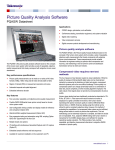
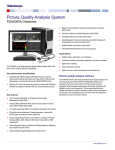
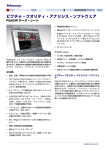
User Interface of PQASW. Showing reference, test sequences, with difference map and
statistical graph.
Compressed Video Requires New Test Methods
The true measure of any television system is viewer satisfaction. While
the quality of analog and full-bandwidth digital video can be characterized
indirectly by measuring the distortions of static test signals, compressed
television systems pose a far more difficult challenge. Picture quality in a
compressed system can change dynamically based on a combination of
data rate, picture complexity, and the encoding algorithm employed. The
static nature of test signals does not provide true characterization of picture
quality.
2
www.tektronix.com
Human viewer testing has been traditionally conducted as described in
ITU-R Rec. BT.500-11. A test scene with natural content and motion
is displayed in a tightly controlled environment, with human viewers
expressing their opinion of picture quality to create a Differential Mean
Opinion Score, or DMOS. Extensive testing using this method can be
refined to yield a consistent subjective rating. However, this method of
evaluating the capabilities of a compressed video system can be inefficient,
taking several weeks to months to perform the experiments. This test
methodology can be extremely expensive to complete, and often the results
are not repeatable. Thus, subjective DMOS testing with human viewers
is impractical for the CODEC design phase, and inefficient for ongoing
operational quality evaluation. The PQASW provides a fast, practical,
repeatable, and objective measurement alternative to subjective DMOS
evaluation of picture quality.
System Evaluation
The PQASW can be used for installation, verification, and troubleshooting
of each block of the video system because it is video technology agnostic:
any visible differences between video input and output from processing
components in the system chain can be quantified and assessed for video
quality degradation. Not only can CODEC technologies be assessed in a
system, but any process that has potential for visible differences can also
be assessed. For example, digital transmission errors, format conversion
(i.e. 1080i to 480p in set-top box conversions), 3-2 pull-down, analog
transmission degradation, data errors, slow display response times, frame
rate reduction (for mobile transmission and videophone teleconferencing),
and more can all be evaluated, separately or in any combination.