1
EPSON Research and Development
Vancouver Design Center
Page 9
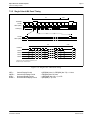
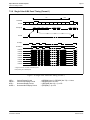
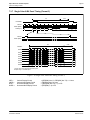
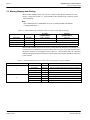
2.2 Generic #2 Interface Mode
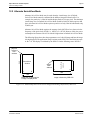
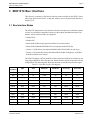
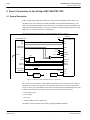
Generic #2 interface mode is a general and non-processor-specific interface mode on the
SED1374/75. The Generic # 2 interface mode was chosen for this interface due to its
compatibility with the PC Card interface.
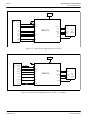
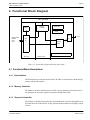
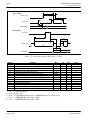
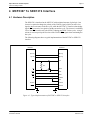
The interface requires the following signals:
• BUSCLK is a clock input which synchronizes transfers between the host CPU and the
SED1374/75. BUSCLK is separate from the input clock (CLKI) and is typically driven
by the host CPU system clock.
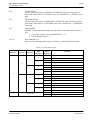
• The address inputs AB0 through AB15, and the data bus DB0 through DB15, connect
directly to the CPU address and data bus, respectively. On 32-bit big endian architectures such as the Power PC, the data bus would connect to the high-order data lines; on
little endian hosts, or 16-bit big endian hosts, they would connect to the low-order data
lines. The hardware engineer must ensure that CNF3 selects the proper endian mode
upon reset.
• Chip Select (CS#) is driven by decoding the high-order address lines to select the proper
memory address space.
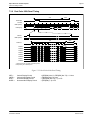
• WE1# is the high byte enable for both read and write cycles and WE0# is the enable
signal for a write access. These must be generated by external decode hardware based
upon the control outputs from the host CPU.
• RD# is the read enable for the SED1374/75, to be driven low when the host CPU is
reading data from the SED1374/75. RD# must be generated by external decode hardware based upon the control outputs from the host CPU.
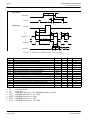
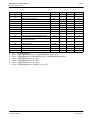
• WAIT# is a signal which is output from the SED1374/75 to the host CPU that indicates
when data is ready (read cycle) or accepted (write cycle) on the host bus. Since host
CPU accesses to the SED1374/75 may occur asynchronously to the display update, it is
possible that contention may occur in accessing the 1374/75 internal registers and/or
refresh memory. The WAIT# line resolves these contentions by forcing the host to wait
until the resource arbitration is complete. This signal is active low and may need to be
inverted if the host CPU wait state signal is active high.
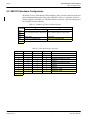
• The Bus Status (BS#) and Read/Write (RD/WR#) signals are not used in the bus interface for Generic #2 mode. However, BS# is used to configure the SED1374/75 for
Generic #2 mode and must be tied high (connected to IOVDD = 3.3V). RD/WR# must
also be tied high.
SDU1374/75-TMPR3912/22U CPU Module
Issue Date: 98/12/23
X00A-G-004-01