1
Introduction
As enterprise networks continue to change and evolve, budget pressures are pushing most
IT managers to look at new network architectures. Many are considering the use of passive
optical networks (PON) within a local area network (LAN) environment. As a point-to-multipoint
solution, PON uses passive optical splitters, as opposed to active Ethernet switches, to distribute
all data, voice, and video signals throughout the enterprise. A single strand of singlemode
optical fiber enables network administrators to converge existing networks—including voice,
video, data, wireless access, security, surveillance and building automation—over a single
infrastructure. The potential cost savings in terms of cabling installation, equipment costs, and
energy expenses can be significant, depending on how the architecture is deployed.
CommScope has developed this design guide to introduce you to our portfolio of passive
optical LAN (POL) solutions and help you in designing a distribution network that meets
your needs. This guide profiles the available active POL components as well as the passive
distribution network and provides helpful information regarding network design and proper
installation.
More detailed and comprehensive information can be found on CommScope’s website and
through the courses offered at the CommScope Infrastructure Academy.
Passive optical LAN (POL)
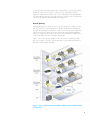
A POL is comprised of two main active (powered) components—an optical line terminal (OLT),
typically located in the data center or equipment room, and optical network units (ONUs)
that provide service to the end users. A network of singlemode fiber (SMF) and passive (nonpowered) optical splitters connects the OLT to the ONUs. The fiber and passive equipment
between the OLT and ONUs are often simply referred to as the optical distribution network
(ODN).
The OLT provides the interface between the network’s core switch and the ONUs. The OLT
encodes Ethernet data for transmission to the ONUs and manages the upstream data traffic
from the ONUs to the OLT through the ODN. The ONUs then distribute the signal wirelessly
or via twisted pair data cable to a variety of Internet protocol (IP)-enabled devices, such as
computers, wireless access points (WAPs) and Voice-over-IP (VoIP) phones.
Benefits, limitations and uses
In designing any LAN solution that delivers the desired technical performance as well as the
required CapEx and OpEx savings, performance and cost savings depend on the specific
environment in which the solution is deployed, as well as how it is deployed. In the case of a
POL, the following are some examples of factors that should be considered:
• Choosing the OLT size—how many users need to be supported
• Geographic distributions of user groups
• Types of network services to be supported, such as data, video, voice, surveillance, etc.
• Bandwidth requirement of each user group or individual user
• Optical distribution network topology optimization
• Short-term CapEx and long-term OpEx evaluation
• Placement of the ONUs at the work station
3