1
Section 2 – Programming
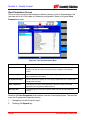
•
Gang Count
•
Auto Increment
•
Cycle time out
•
Torque Filter
•
Fault backout speed*
•
Fault backout angle*
•
Final fault backout Hi torque*
•
Retry fault action*
•
Number of retries*
•
Final fault backout angle*
•
Fault action*
•
Tube nut reverse speed
•
Tube nut reverse threshold
* Powerhead function only
Some of these parameters are self explanatory or are described in the Appendix 1 –
System Parameters section of this manual. The Gang Count, Auto Increment and
Torque Filter parameters require further description.
Gang Count
Some assemblies have multiple bolts that must be fastened in sequence (called a
"Gang"). For example, if you have a four-bolt assembly you can set the Gang Count to 4.
Insight will then keep track of each fastening and when all four fastenings have been
completed within specification, a "Gang Complete" message will appear on the display
screen.
If the Gang Count is successfully completed, in addition to displaying “Gang Complete”
on the screen, the controller provides a gang complete output signal on the spindle’s I/O
connector. There are two ways to reset the Gang Count.
1.
There is a dedicated reset conductor on the spindle I/O connector.
2.
While on the Run Main screen, pressing 0 (zero) and then the Enter key will reset
the Gang Count for spindle 1. For a two-spindle controller, pressing 0 twice (00) and
then Enter will reset spindle 2.
Auto Increment
Auto Increment allows the Insight to move through a specific sequence of fastening
configurations. For example, if you have programmed six different configurations
numbered 1 – 6, you can instruct the Insight to perform fastening in the sequence 1-4-6
and 2-3-5. To do this you set the Auto Increment parameter, which is one of the
parameters in the Engage strategy drop box. By using this parameter to tell the Insight
which configuration to go to next, the system will continue to step through all
Page 32
© Ingersoll-Rand Company 2004