1
2.2
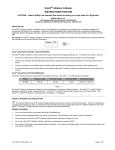
Placing the catheter at the GEJ
Warning: Wipe down the catheter prior to use with IPA.
1.
Apply a lubricant to the balloon (if desired). Note: do not pre-inflate the
balloon.
2.
Introduce the catheter orally alongside the endoscope and carefully advance it
into the esophagus under direct endoscopic visualization and through the GEJ
as far as the stomach so that the proximal end of the balloon sits just below the
GEJ. Use the catheter markings as a guide.
Warning: Avoid using excessive force during insertion and withdrawal. If the catheter is difficult
to advance, remove and retry the insertion. A 0.035” guide-wire may be used to assist insertion by
sliding the EsoFLIP® catheter tip over the pre-inserted guide-wire.
3.
Inflating the balloon
a.
Fill the EsoFLIP® balloon to 30ml.
b.
Slowly pull back until you feel some resistance and the GEJ can be
seen at the centre of the measurement area on the screen of the
EndoFLIP system. If you cannot retract the catheter, reduce the
amount of fluid in the balloon.
Maximum Balloon
Diameter: 30mm
Catheter
markings are
referenced
from center of
the balloon,
0 mm = center
Balloon working length:
Measurement = 70mm
Dilation = 80mm.
Balloon end to end length
including cones: 125mm
Guide-wire (0.035”) tip
Figure 4: EsoFLIP® Balloon Dilation Catheter assembly
Note: The markings on the catheter are referenced from the center of balloon.
4.
Secure/hold the catheter once it is properly positioned in the GEJ, to reduce the
risk of slippage.
5.
Inflate the balloon to dilate the GEJ, continue checking that the balloon is
correctly located within the GEJ. Note the Balloon Rated Burst Pressure limit in
the Specifications section below.
Warning: Do not exceed the maximum inflation pressure of 1.5 ATM (152 kPa).
6.
After dilating the GEJ, you may deflate the balloon to assess the GEJ opening
diameter post-dilation.
EsoFLIP® ES-330 Catheter Instructions for Use, DD-639 Rev A
7