1
Aquamax KF Coulometric v08.10
TRANSFORMER/INSULATING OILS
(ASTM D 1533, BS EN 60814, IEC 60814)
Due to the viscosity of these samples, and the fact that typical water content levels are in the range 5 – 40
ppm, it is usually necessary to inject sample volumes of 1 ml. This means that upto 50 samples would fill
the titration cell. Provided that the other criteria governing reagent life, (total water titrated and reagent
age), have not been reached, then it is possible to switch off the titrator and allow the oil to separate from
the reagent. The oil can then be siphoned off and the instrument switched on again. After this operation it
may take upto 30 minutes before the instrument settles down to a stable baseline. If it takes longer than 30
minutes then it is advisable to clean the cell and recharge with fresh reagents. For optimum performance
use Cou-Lo “Formula A” reagent.
TURBINE / LUBRICATING OILS
For most Lube Oil applications a sample size of 1ml is sufficient. However, if it is suspected that the water
content is above 1 %, then a sample size of 0 × 2 to 0× 5 ml is suggested.
Some lubricating oils contain additives which can coat the detector electrode or block the glass frit of the
generator electrode. These problems can be reduced by modifying the Anode reagent with 20 – 40 %
volume Chloroform. If difficulties continue, contact G. R. Scientific Ltd for further information.
KETONES AND AMINES
These can react with the Methanol present in most coulometric reagents resulting in inaccurate results and,
in extreme conditions, titration end point being unattainable. For samples containing ketones, amines or
aldehydes the use of specially formulated coulometric reagents for ketone samples is recommended.
POWDER SAMPLES
One of the main advantages of the coulometric technique is that reagents do not have to be replenished
after every analysis, therefore the introduction into the titration cell of solid samples, which do not dissolve,
is not recommended.
Three options available:·
Powder samples which readily dissolve in the Anode reagent can be introduced using the optional
powder sampler, part no. 2000-9511. Calculation mode W/w.
·
Powder samples which cannot be dissolved in the Anode reagent should be extracted or dissolved in a
suitable solvent and then an aliquot injected. Calculation mode W/K.
·
If neither of above methods are suitable you may need to use a ADP 511 oven in conjunction with the
Aquamax KF titrator.
Powder sampler
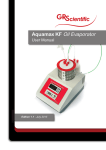
ADP 511 Evaporator
22