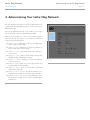
1
LaCie 5big Network
User Manual
RAID and Disks
page 54
5.5. RAID 6
RAID 6
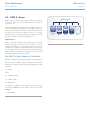
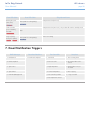
In RAID 6, data is striped across all disks (minimum of four) and a
two parity blocks for each data block (p and q in Fig. 87) is written
on the same stripe. If one physical disk fails, the data from the failed
disk can be rebuilt onto a replacement disk. This Raid mode can
support up to two disk failures with no data loss. RAID 6 provides
for faster rebuilding of data from a failed disk.
A1
A2
A3
Ap
B1
B2
Bp
Bq
B3
C1
Dp
Cp
Dq
Cq
D2
C3
D3
C3
D3
Disk 1
Disk 2
Disk 3
Disk 4
Disk 5
Applications
RAID 6 provides data reliability with the addition of efficient rebuilding in the case of a failed drive. RAID 6 is therefore useful for people
who need serious security with less of an emphasis on performance.
How RAID 6 Capacity Is Calculated
Each disk in a RAID 6 system should have the same capacity.
Storage capacity in a RAID 6 configuration is calculated by subtracting the number of drives by two and multiplying by the disk
capacity, or
C = (n-2)*d
where:
C = available capacity
n = number of disks
d = disk capacity
For example, in a RAID 6 array with five drives each with a capacity of 1000GB, the total capacity of the array would be 3000GB:
C = (5-2)*1000
Fig. 87
Aq