1
Control
Standard EN 378 specifies that the room in which you install your
appliance must have a volume of 1 m 2 per 8 g of R 600a refrigerant used in the appliance. If the room in which the appliance is
installed is too small, a flammable gas-air mixture may form in the
event of a leakage in the refrigeration circuit. The quantity of
refrigerant used in your appliance is indicated on the type plate
on the inside of the appliance.
WARNING
Fire hazard due to dampness!
If live parts or the mains lead become damp this may cause short
circuits.
u The appliance is designed for use in enclosed areas. Do not
operate the appliance outdoors or in areas where it is exposed
to splash water or damp conditions.
WARNING
Fire hazard due to refrigerant!
The refrigerant R 600a is environmentally friendly but flammable.
Escaping refrigerant may ignite.
u Do not damage the piping of the refrigeration circuit.
WARNING
Fire hazard and danger of damage!
u Do not place appliances emitting heat e.g. microwaves,
toasters etc. on the appliance!
WARNING
Fire hazard and risk of damage due to blocked ventilation grille!
u Always keep the ventilation grille free. Always ensure that the
appliance is properly ventilated.
u Detach the connecting cable from the rear of the appliance,
removing the cable holder at the same time because otherwise there will be vibratory noise!
After installation:
u Remove the protective film from the decorative trims.
u Remove all transit supports.
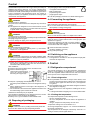
u Unscrew the red transport lock.
Close the vacated retaining
hole using the stopper (60).
The packaging is made of recyclable materials:
- corrugated board/cardboard
- EPS moulded parts
- polythene bags and sheets
- polypropylene straps
u Take the packaging material to an official collecting point.
4.4 Connecting the appliance
NOTICE
Risk of damage to the electronic control system!
u Do not use stand-alone inverters (conversion of d.c. to a.c./
three-phase) or energy saving plugs.
WARNING
Fire and overheating hazard!
u Do not use extension cables or multiple socket outlets.
The type of current (alternating current) and voltage at the installation site have to conform with the data on the type plate (see
Appliance at a glance).
Connect the appliance only with a properly installed
socket outlet with earthing contact. The socket outlet
must be fused with 10 A or higher.
u Check the electrical connection.
u Clean the appliance (see 6.2) .
u Plug in the power plug.
4.5 Switching on the appliance
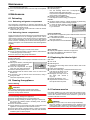
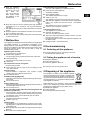
u Press On/Off button Fig. 2 (1).
w The appliance is switched on. The temperature display indicates the set temperature.
5 Control
5.1 Refrigerator compartment
The natural circulation of air in the refrigerator compartment
results in zones differing in temperature. It is coldest directly
above the vegetable drawers and at the rear wall. It is warmest
at the top front of the compartment and in the door.
5.1.1 Food refrigeration
u Dispose of packaging material (see 4.3) .
For Side-by-Side installation, freezer and refrigerator side by
side:
u Always install the freezer on the right of the refrigerator, as
seen from the front.
w No condensate forms between the appliances thanks to the
side wall heating system foamed in on the left.
Ventilation is effected by way of the plinth.
If the appliance is installed in a very damp environment, condensate may form on the outside of the appliance.
u Always see to good ventilation at the installation site.
4.3 Disposing of packaging
WARNING
Danger of suffocation due to packing material and plastic film!
u Do not allow children to play with packing material.
4
u Store perishable food such as ready-to-serve dishes, meat
products and sausages in the coldest zone. Place butter and
preserves in the upper area and in the door (see Appliance
at a glance).
u Use recyclable plastic, metal, aluminium and glass containers
and cling film for wrapping.
u Do not store food too close together to enable good air circulation.
u To safeguard bottles from tipping over: move the bottle holder.
5.1.2 Setting the temperature
The temperature depends on the following factors:
- the door opening frequency
- the room temperature at the site where the appliance is
installed
- the type, temperature and quantity of frozen food
Temperature setting to be recommended: 5 °C
An average temperature of approx. –18 °C is then established in
the freezer compartment.
The temperature can be changed continuously. Once the 1 °C
setting is reached, it starts again with 9 °C.