1
Daikin Streamer Discharge Tech no
eliminates harmful substances
Vi
Influ
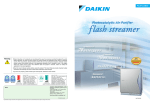
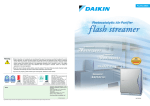
What is the Daikin Streamer Discharge Technology ?
“Streamer Discharge” is a type of plasma discharge in which high speed electrons capable of oxidative
decomposition are generated. It has the ability to eliminate bacteria and mould as well as hazardous
chemical substances and allergens, etc. Compared to standard plasma discharge (glow discharge), the
discharge range of Daikin's Streamer Discharge is wider, which makes electrons easier to collide with
oxygen and nitrogen in the air. This enables high speed electrons to be generated three dimensionally over
a wide area, which results in an oxidative decomposition speed that is over 1000 times greater with the
same electrical power. Daikin’s Streamer Discharge technology has proven successful in stably generating
high speed electrons, a feat that has been considered difficult up to now.
Befo
Afte
How the decomposition mechanism of Streamer Discharge Technology works.
If it were thermal energy, the decomposition strength would be comparable to a heat of approximately 100,000°C*1.
*1 Comparison of oxidation decomposition. This does not mean temperature will become high.
Electron discharge
Streamer Discharge
Membranous protein (M)
Al
Nucleoprotein (NP)
Hou
Genomic RNA (8 segments)
Neuraminidase (NA)
Hemagglutinin (HA)
Befo
Massive streamer discharge hits viruses.
Streamer discharge hits viruses and
decomposes the surface protein through
oxidation.
The protein destroyed through oxidative
decomposition gets fragmented and the
streamer discharge reverts to safe nitrogen
atoms, oxygen atoms, and water molecules.
Surface protein (HA and NA)
destroyed by oxidative
decomposition.
A clean technology that’s recognised by public institutions in Japan
and abroad.
Tests that prove the effectiveness of the Streamer Technology
Afte
Following experiments were practised by third parties based on Daikin industries, Ltd's request.
Target of experiment
Virus
Bacteria
Mould
Public institutions (Testing organization)
Test method
National Institute of Hygiene and Epidemiology (Vietnam)
CPE and TCID50
Kitasato Research Center of Environmental Sciences
CPE and TCID50
Kobe University Graduate School
ELISA method
Yamagata University
Scanning electron microscope
Japan Food Research Laboratories
PCR method
The Jikei University
CFU
Japan Food Research Laboratories
Pour plate culture method
Target of experiment
Public institutions (Testing organization)
Test method
Pollen based allergens
Allergens from animate beings
Allergens
Wakayama Medical University
ELISA method
Adjuvant (DEP)
Yamagata University
ELISA method
Adjuvant (VOC)
Tohoku Bunka Gakuen University
Damping technique
Adjuvant inhibiting effect
Wakayama Medical University,
National institute for Environmental Studies
ELISA method
Formaldehyde
Tohoku Bunka Gakuen University
Constant generation method
Fungal allergens
Flour
Hazardous
chemical
substances
H
Viruses and bacteria that have been proven to be deactivated by Streamer Technology
Influenza virus (type A, H1N1)
Highly virulent avian influenza virus (type A, H5N1)
Pseudomonas aeruginosa
Tuberculosis bacteria
Toxins (enterotoxins)
Bacillus coli, O-157
Norovirus
Staphylococcus aureus
Allergens that have been proven to be decomposed by Streamer Technology
Fungal allergens: sooty moulds, aspergillus, eurotium, aspergillus niger, fusarium, penicillium
Pollen based allergens: cedar pollen, alder pollen, birch pollen, Japanese cypress pollen, pencil cedar pollen, bald cypress pollen, mugwort pollen, orchard grass pollen, ragwood
pollen, sweet vernal grass pollen, timothy grass pollen, fleawort pollen, Japanese beech
Allergens from animate beings: house dust mite [dermatophagoides pteronyssinus] (droppings and dead mites), house dust mite [dermatophagoides farinae] (droppings and dead
mites), American cockroach (droppings), German cockroach (droppings), flea (droppings), dog epidermis (dander), cat epidermis (dander), hamster epidermis (dander)
Other: wheat flour
*2 Test method: constant generation method; Test room: 22 to 24 m3; Temperature: 23 ±3°C; Humidity: 50 ±20%; Ventilation condition: When concentration
of 0.2 ppm is continually emanated, a removal capacity of 0.08 ppm is maintained at 36 m3/h, which is within the guideline of the Ministry of Health,
Labour and Welfare (Japan). (This equates to the ventilation capacity of an approximately 65 m3 room.)
1
This
etc.
This
gene
mea
insta
This
This
If yo
The
This