1
to obtain the soil parameters being used. This understanding can be obtained by each having
training in the other's specialty.
To this end, the primary focus of this text will be on analysis and design of the interfacing
elements for buildings, machines, and retaining structures and on those soil mechanics principles used to obtain the necessary soil parameters required to accomplish the design. Specific
foundation elements to be considered include shallow elements such as footings and mats and
deep elements such as piles and drilled piers. Retaining structures will also be considered in
later chapters.
Geotechnical considerations will primarily be on strength and deformation and those soilwater phenomena that affect strength and deformation. With the current trend to using sites
with marginal soil parameters for major projects, methods to improve the strength and deformation characteristics through soil improvement methods will be briefly considered in
Chap. 6.
1-3 FOUNDATIONS: CLASSIFICATIONS
AND SELECT DEFINITIONS
Foundations may be classified based on where the load is carried by the ground, producing:
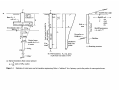
Shallow foundations—termed bases, footings, spread footings, or mats. The depth is generally D/B < 1 but may be somewhat more. Refer to Fig. 1-la.
Deep foundations—piles, drilled piers, or drilled caissons. Lp/B > 4+ with a pile illustrated in Fig. l-\b.
Figure 1-1 illustrates general cases of the three basic foundation types considered in this
text and provides some definitions commonly used in this type of work. Because all the definitions and symbols shown will be used throughout the text, the reader should give this figure
careful study.
The superstructure brings loads to the soil interface using column-type members. The loadcarrying columns are usually of steel or concrete with allowable design compressive stresses
on the order of 14O+ MPa (steel) to 1O+ MPa (concrete) and therefore are of relatively small
cross-sectional area. The supporting capacity of the soil, from either strength or deformation
considerations, is seldom over 1000 kPa but more often on the order of 200 to 250 kPa. This
means the foundation is interfacing two materials with a strength ratio on the order of several
hundred. As a consequence the loads must be "spread" to the soil in a manner such that its
limiting strength is not exceeded and resulting deformations are tolerable. Shallow foundations accomplish this by spreading the loads laterally, hence the term spread footing. Where
a spread footing (or simply footing) supports a single column, a mat is a special footing used
to support several randomly spaced columns or to support several rows of parallel columns
and may underlie a portion of or the entire building. The mat may also be supported, in turn,
by piles or drilled piers. Foundations supporting machinery and such are sometimes termed
bases. Machinery and the like can produce a substantial load intensity over a small area, so
the base is used as a load-spreading device similar to the footing.
Deep foundations are analogous to spread footings but distribute the load vertically rather
than horizontally. A qualitative load distribution over depth for a pile is shown in Fig. 1-1 b.
The terms drilled pier and drilled caisson are for the pile type member that is constructed by
drilling a 0.76 + -m diameter hole in the soil, adding reinforcing as necessary, and backfilling