1
ATLAS HYDROSWEEP DS-2
2 Description of the ATLAS HYDROSWEEP DS-2
Product Description
space. This trajectory is used to generate a number of so called soft-beams that are used in
conjunction with the hard-beams to arrive at an improved angular resolution of the bottom.
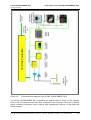
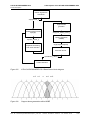
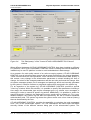
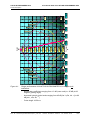
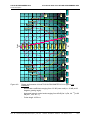
The following processing steps are carried out (see also figure 2-5):
-
The per stave data from the transducer is processed in a classical time-delay
Beamformer.
-
The per beam amplitude information is smoothed and noise is reduced with a noise
reduction algorithm.
-
A number of arithmetic support beams are generated.
-
From the amplitude information of the soft-beams the angle and amplitude function is
computed.
-
The individual amplitude-angle information is associated with the corresponding softbeams.
-
The per beam information off the soft-beams is used to detect the bottom using a
weighted soft-beam approach.
-
Where no information on the bottom could be gained through HDBE, the depth is
detected using the hard-beam patterns.
Considering the required accuracy and the actual signal-to-noise ratio, between 120 and 240
beams can be handled by HDBE. For broadband applications, the current configuration is
preset to 140 nominal beams.
Experience with this innovative beam forming concept have been gained with a variety of
different ATLAS HYDROSWEEP MD-2 and ATLAS HYDROSWEEP DS-2 system
installations (see, for example, the list of delivered ATLAS deep sea systems in chapter 6).
Doc. Id.: HYD-DS2_ProductDescription_16c.doc
Edition: 05.2003 / Version: 1.2/ Status: Final
2-7