1
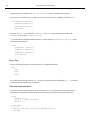
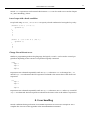
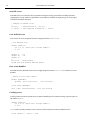
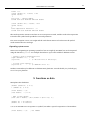
Code Patterns
®
in newLISP
Version 2012 June 12th
newLISP v.10.4.3
Copyright © 2012 Lutz Mueller, www.nuevatec.com. All rights reserved.
Permission is granted to copy, distribute and/or modify this document under the terms of the GNU Free Documentation
License, Version 1.2 or any later version published by the Free Software Foundation; with no Invariant Sections, no FrontCover Texts, and no Back-Cover Texts. A copy of the license is included in the section entitled GNU Free Documentation
License.
newLISP is a registered trademark of Lutz Mueller.
Code Patterns in newLISP
Contents
1. Introduction
6
2. newLISP script files
6
Command line options
6
Scripts as pipes
7
File filters
7
3. Writing software in modules
8
Structuring an application
8
More than one context per file
9
The default function
10
Packaging data with contexts
11
Passing objects by reference
11
4. Local variables
12
Locals in looping functions
12
Locals in let and letn
12
Unused parameters as locals
13
Default variable values
13
args as local substitute
13
5. Walking through lists
14
Recursion or iteration?
14
Speed up with memoization
14
Walking a tree
15
Walking a directory tree
16
6. Modifying and searching lists
16
push and pop
17
Extend using extend
17
Accessing lists
17
Selecting more elements
18
Filtering and differencing lists
19
Changing list elements
19
The anaphoric variable
19
replace in simple lists
20
replace in nested lists
20
Passing lists by reference
21
Variable expansion
22
Destructuring nested lists
23
Code Patterns in newLISP
7. Program flow
23
Loops
23
Blocks
24
Branching
25
Fuzzy flow
26
Flow with catch and throw
26
Leave loops with a break condition
26
Change flow with and or or
27
8. Error handling
27
newLISP errors
27
User defined errors
28
Error event handlers
28
Catching errors
28
Operating system errors
29
9. Functions as data
29
Mapping and applying
30
Functions making functions
30
Functions with memory
30
Functions using self modifying code
31
10. Text processing
32
Regular expressions
32
Scanning text
32
Appending strings
33
Growing strings
34
Rearranging strings
34
Modifying strings
34
11. Dictionaries and hashes
35
Hash-like key → value access
35
Saving and loading dictionaries
36
12. TCP/IP client server
36
Open connection
36
Closed transaction
37
13. UDP communications
37
Open connection
37
Closed transaction
38
Multi-cast communications
38
14. Non-blocking communications
39
Using net-select
39
Using net-peek
39
Code Patterns in newLISP
15. Controlling other applications
39
Using exec
39
STD I/O pipes
40
Communicate via TCP/IP
40
Communicate via named FIFO
41
Communicate via UDP
41
16. Launching apps blocking
41
Shell execution
41
Capturing std-out
42
17. Semaphores, shared memory
42
18. Multiprocessing and Cilk
43
Watching progress
44
Event driven notification
44
19. Message exchange
44
Blocking messages exchange
45
Non blocking message exchange
45
Message timeouts
46
Evaluating messages
46
Acting as a proxy
47
20. Databases and lookup tables
47
Association lists
47
Nested associations
48
Updating nested associations
49
Combining associations and hashes
49
21. Distributed computing
49
Setting up in server mode
50
Start a state-full server
50
Stateless server with inetd
50
Test the server with telnet
51
Test with netcat on Unix
52
Test from the command line
52
Test HTTP with a browser
52
Evaluating remotely
52
Setting up the ‘net-eval’ parameter structure
54
Transferring files
55
Loading and saving data
56
Local domain Unix sockets
56
Code Patterns in newLISP
22. HTTPD web server only mode
56
Environment variables
57
Pre-processing the request
57
CGI processing in HTTP mode
58
Media types in HTTP modes
58
23. Extending newLISP
59
Simple versus extended FFI interface
59
A shared library in C
59
Compile on Unix
60
Compile a DLL on Win32
60
Importing data structures
61
Memory management
62
Unevenly aligned structures
62
Passing parameters
63
Writing library wrappers
64
Registering callbacks in external libraries
66
24. newLISP as a shared library
66
Evaluating code in the shared library
66
Registering callbacks
67
GNU Free Documentation License
70
Code Patterns in newLISP
1. Introduction
When programming in newLISP, certain functions and usage patterns occur repeatedly. For some
problems, an optimal way to solve them evolves over time. The following chapters present example
code and explanations for the solution of specific problems when programming in newLISP.
Some content is overlapping with material covered in the newLISP Users Manual and Reference or
presented here with a different slant.
Only a subset of newLISP’s total function repertoire is used here. Some functions demonstrated
have additional calling patterns or applications not mentioned on these pages.
This collection of patterns and solutions is a work in progress. Over time, material will be added or
existing material improved.
2. newLISP script files
Command line options
On Linux/Unix, put the following in the first line of the script/program file:
#!/usr/bin/newlisp
specifying a bigger stack:
#!/usr/bin/newlisp -s 100000
or
#!/usr/bin/newlisp -s100000
Operating systems’ shells behave differently when parsing the first line and extracting parameters.
newLISP takes both attached or detached parameters. Put the following lines in small script to
test the behavior of the underlying OS and platform. The script changes the stack size allocated to
100,000 and limits newLISP cell memory to about 10 M bytes.
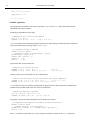
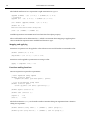
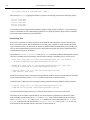
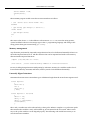
`
#!/usr/bin/newlisp -s 100000 -m 10
(println (main-args))
(println (sys-info))
(exit) ; important
A typical output executing the script from the system shell would be:
./arg-test
(“/usr/bin/newlisp” “-s” “100000” “-m” “10” “./arg-test”)
(308 655360 299 2 0 100000 8410 2)
Code Patterns in newLISP
Note that few programs in newLISP need a bigger stack configured; most programs run on the internal default of 2048. Each stack position takes an average of 80 bytes. Other options are available to
start newLISP. See the Users Manual for details.
Scripts as pipes
The following example shows how a file can be piped into a newLISP script.
#!/usr/bin/newlisp
#
# uppercase - demo filter script as pipe
#
# usage:
#
./uppercase < file-spec
#
# example:
#
./uppercase < my-text
#
#
(while (read-line) (println (upper-case (current-line))))
(exit)
The file will be printed to std-out translated to uppercase.
The following program would also work with binary non-textual information containing 0’s :
#!/usr/bin/newlisp
;
; inout - demo binary pipe
;
; read from stdin into buffer
; then write to stdout
;
; usage: ./inout < inputfile > outputfile
;
(while (read 0 buffer 1024)
(write 1 buffer 1024))
(exit)
Set buffersize to best performance.
File filters
The following script works like a Unix grep utility iterating through files and filtering each line in a
file using a regular expression pattern.
#!/usr/bin/newlisp
#
# nlgrep - grep utility on newLISP
#
# usage:
#
./nlgrep “regex-pattern” file-spec
Code Patterns in newLISP
#
# file spec can contain globbing characters
#
# example:
#
./nlgrep “this|that” *.c
#
# will print all lines containing ‘this’ or ‘that’ in *.c files
#
(dolist (fname (3 (main-args)))
(set ‘file (open fname “read”))
(println “file ---> “ fname)
(while (read-line file)
(if (find (main-args 2) (current-line) 0)
(write-line)))
(close file))
(exit)
The expression:
(3 (main-args))
is a short form of writing:
(rest (rest (rest (main-args))))
It returns a list of all the filenames. This form of specifying indexes for rest is called implicit indexing. See the Users Manual for implicit indexing with other functions. The expression (main-args 2)
extracts the 3rd argument from the command line containing the regular expression pattern.
3. Writing software in modules
Structuring an application
When writing bigger applications or when several programmers are working on the same code base,
it is necessary to divide the code base into modules. Modules in newLISP are implemented using
contexts, which are namespaces. Namespaces allow lexical isolation between modules. Variables of
the same name in one module cannot clash with variables of the same name in another module.
Typically, modules are organized in one context per file. One file module may contain database access routines.
; database.lsp
;
(context ‘db)
(define (update x y z)
...
)
(define (erase x y z)
...
)
Code Patterns in newLISP
Another module may contain various utilities
; auxiliary.lsp
;
(context ‘aux)
(define (getval a b) ...)
Typically, there will be one MAIN module that loads and controls all others:
; application.lsp
;
(load “auxiliary.lsp”)
(load “database.lsp”)
(define (run)
(db:update ....)
(aux:putval ...)
...
...
)
(run)
More than one context per file
When using more than one context per file, each context section should be closed with a
(context MAIN) statement:
; myapp.lsp
;
(context ‘A)
(define (foo ...) ...)
(context MAIN)
(context ‘B)
(define (bar ...) ...)
(context MAIN)
(define (main-func)
(A:foo ...)
(B:bar ...)
)
Note that in the namespace statements for contexts A and B that the context names are quoted
because they are newly created, but MAIN can stay unquoted because it already exists when newLISP
starts up. However, quoting it does not present a problem.
The line (context MAIN) that closes a context can be omitted by using the following technique:
Code Patterns in newLISP
10
; myapp.lsp
;
(context ‘A)
(define (foo ...) ...)
(context ‘MAIN:B)
(define (bar ...) ...)
(context ‘MAIN)
(define (main-func)
(A:foo ...)
(B:bar ...)
)
The line (context ‘MAIN:B) switches back to MAIN then opens the new context B.
The default function
A function in a context may have the same name as the host context itself. This function has special
characteristics:
(context ‘foo)
(define (foo:foo a b c)
...
)
The function foo:foo is called the default function, because when using the context name foo like a
function, it will default to foo:foo
(foo x y z)
; same as
(foo:foo x y z)
The default function makes it possible to write functions which look like normal functions but carry
their own lexical namespace. We can use this to write functions which keep state:
(context ‘generator)
(define (generator:generator)
(inc acc)) ; when acc is nil, assumes 0
(context MAIN)
(generator) → 1
(generator) → 2
(generator) → 3
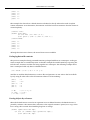
The following is a more complex example for a function generating a Fibonacci sequence:
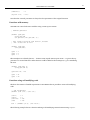
(define (fibo:fibo)
(if (not fibo:mem) (set ‘fibo:mem ‘(0 1)))
(last (push (+ (fibo:mem -1) (fibo:mem -2)) fibo:mem -1)))
Code Patterns in newLISP
(fibo)
(fibo)
(fibo)
(fibo)
(fibo)
...
→
→
→
→
→
1
2
3
5
8
This example also shows how a default function is defined on-the-fly without the need of explicit
context statements. As an alternative, the function could also have been written so that the context is
created explicitly:
(context ‘fibo)
(define (fibo:fibo)
(if (not mem) (set ‘mem ‘(0 1)))
(last (push (+ (mem -1) (mem -2)) mem -1)))
(context MAIN)
(fibo)
(fibo)
(fibo)
(fibo)
(fibo)
→
→
→
→
→
1
2
3
5
8
Although the first form is shorter, the second form is more readable.
Packaging data with contexts
The previous examples already presented functions packaged with data in a namespace. In the generator example the acc variable kept state. In the fibo example the variable mem kept a growing list.
In both cases, functions and data are living together in a namespace. The following example shows
how a namespace holds only data in a default functor:
(set ‘db:db ‘(a “b” (c d) 1 2 3 x y z))
Just like we used the default function to refer to fibo and generator we can refer to the list in db:db
by only using db. This will work in all situations where we do list indexing:
(db
(db
(db
(db
(db
0)
1)
2 1)
-1)
-3)
→
→
→
→
→
a
“b”
d
z
x
(3 db)
→ (1 2 3 x y z)
(2 1 db) → ((c d))
(-6 2 db) → (1 2)
Passing objects by reference
When the default functor is used as an argument in a user defined function, the default functor is
passed by reference. This means that a reference to the original contents is passed, not a copy of the
list or string. This is useful when handling large lists or strings:
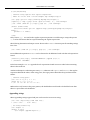
(define (update data idx expr)
(if (not (or (lambda? expr) (primitive? expr)))
(setf (data idx) expr)
11
Code Patterns in newLISP
12
(setf (data idx) (expr $it))))
(update db 0 99) → a
db:db → (99 “b” (c d) 1 2 3 x y z)
(update db 1 upper-case) → “b”
db:db → (99 “B” (c d) 1 2 3 x y z)
(update db 4 (fn (x) (mul 1.1 x))) →
db:db → (99 “B” (c d) 1 2.2 3 x y z)
The data in db:db is passed via the update function parameter data, which now holds a reference
to the context db. The expr parameter passed is checked to determine if it is a built-in function,
operator or a user defined lambda expression and then works on $it, the anaphoric system variable
containing the old content referenced by (data idx).
Whenever a function in newLISP asks for a string or list in a parameter, a default functor can be
passed by its context symbol. Another example:
(define (pop-last data)
(pop data -1))
(pop-last db) → z
db:db
→ (99 “B” (c d) 1 2.2 3 x y)
The function update is also a good example of how to pass operators or functions as a function argument (upper-case working on $it). Read more about this in the chapter Functions as data.
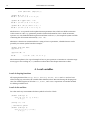
4. Local variables
Locals in looping functions
All looping functions like doargs, dolist, dostring, dotimes, dotree and for use local variables. During loop execution, the variable takes different values. But after leaving the looping function, the variable regains its old value. let, define, and lambda expressions are another method
for making variables local:
Locals in let and letn
let is the usual way in newLISP to declare symbols as local to a block.
(define (sum-sq a b)
(let ((x (* a a)) (y (* b b)))
(+ x y)))
(sum-sq 3 4) → 25
; alternative syntax
(define (sum-sq a b)
(let (x (* a a) y (* b b))
(+ x y)))
Code Patterns in newLISP
The variables x and y are initialized, then the expression (+ x y) is evaluated. The let form is just
an optimized version and syntactic convenience for writing:
((lambda (sym1 [sym2 ...]) exp-body ) exp-init1 [ exp-init2 ...])
When initializing several parameters, a nested let, letn can be used to reference previously initialized variables in subsequent initializer expressions:
(letn ((x 1) (y (+ x 1)))
(list x y))
→ (1 2)
Unused parameters as locals
In newLISP, all parameters in user defined functions are optional. Unused parameters are filled with
nil and are of local scope to the dynamic scope of the function. Defining a user function with more
parameters than required is a convenient method to create local variable symbols:
(define
(set
(set
(+ x
(sum-sq a b , x y)
‘x (* a a))
‘y (* b b))
y))
The comma is not a special syntax feature but only a visual helper to separate normal parameters
from local variable symbols. (Technically, the comma, like x and y, is a local variable and is set to
nil.)
Default variable values
In the definition of a function default values can be specified:
(define (foo (a 1) (b 2))
(list a b))
(foo)
(foo 3)
(foo 3 4)
→
→
→
(1 2)
(3 2)
(3 4)
args as local substitute
Using the args function no parameter symbols need to be used at all and args returns a list of all
parameters passed but not taken by declared parameters:
(define (foo)
(args))
(foo 1 2 3)
→ (1 2 3)
(define (foo a b)
(args))
(foo 1 2 3 4 5)
→ (3 4 5)
The second example shows how args only contains the list of arguments not bound by the variable
symbols a and b.
13
Code Patterns in newLISP
14
Indices can be used to access members of the (args) list:
(define (foo)
(+ (args 0) (args 1)))
(foo 3 4)
→ 7
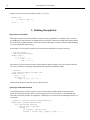
5. Walking through lists
Recursion or iteration?
Although recursion is a powerful feature to express many algorithms in a readable form, it can also
be inefficient in some instances. newLISP has many iterative constructs and high level functions like
flat or the built-in XML functions, which use recursion internally. In many cases this makes defining
a recursive algorithm unnecessary.
Some times a non-recursive solution can be much faster and lighter on system resources.
; classic recursion
; slow and resource hungry
(define (fib n)
(if (< n 2) 1
(+ (fib (- n 1))
(fib (- n 2)))))
The recursive solution is slow because of the frequent calling overhead. Also, the recursive solution
uses a lot of memory for holding intermediate and frequently redundant results.
; iteration
; fast and also returns the whole list
(define (fibo n , f)
(set ‘f ‘(1 0))
(dotimes (i n)
(push (+ (f 0) (f 1)) f)) )
The iterative solution is fast and uses very little memory.
Speed up with memoization
A memoizing function caches results for faster retrieval when called with the same parameters
again. The following function makes a memoizing function from any built-in or user defined function with an arbitrary number of arguments. A namespace is created for the memoizing function as a
cache data.
; speed up a recursive function using memoization
(define-macro (memoize mem-func func)
(set (sym mem-func mem-func)
(letex (f func c mem-func)
(lambda ()
(or (context c (string (args)))
(context c (string (args)) (apply f (args))))))))
Code Patterns in newLISP
(define (fibo n)
(if (< n 2) 1
(+ (fibo (- n 1))
(fibo (- n 2)))))
(memoize fibo-m fibo)
(time (fibo-m 25)) → 148
(time (fibo-m 25)) → 0
The function creates a context and default function for the original function with a new name and
stores all results in symbols in the same context.
When memoizing recursive functions, include the raw lambda specification of the function so recursive calls are memoized too:
(memoize fibo
(lambda (n)
(if(< n 2) 1
(+ (fibo (- n 1))
(fibo (- n 2))))))
(time (fibo 100)) → 1
(fibo 80)
→ 37889062373143906
The fibo function in the last example would take hours to calculate without memoization. The
memoized version takes only about a milli-second for an argument of 100.
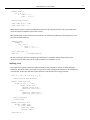
Walking a tree
Tree walks are a typical pattern in traditional LISP and in newLISP as well for walking through a
nested list. But many times a tree walk is only used to iterate through all elements of an existing tree
or nested list. In this case the built-in flat function is much faster than using recursion:
(set ‘L ‘(a b c (d e (f g) h i) j k))
; classic car/cdr and recursion
;
(define (walk-tree tree)
(cond ((= tree ‘()) true)
((atom? (first tree))
(println (first tree))
(walk-tree (rest tree)))
(true
(walk-tree (first tree))
(walk-tree (rest tree)))))
; classic recursion
; 3 times faster
;
(define (walk-tree tree)
(dolist (elmnt tree)
(if (list? elmnt)
(walk-tree elmnt)
(println elmnt))))
(walk-tree L) →
15
Code Patterns in newLISP
16
a
b
c
d
e
...
Using the built-in flat in newLISP a nested list can be transformed into a flat list. Now the list can be
processed with a dolist or map:
; fast and short using ‘flat’
; 30 times faster with map
;
(map println (flat L))
; same as
(dolist (item (flat L)) (println item))
Walking a directory tree
Walking a directory tree is a task where recursion works well:
; walks a disk directory and prints all path-file names
;
(define (show-tree dir)
(if (directory dir)
(dolist (nde (directory dir))
(if (and (directory? (append dir “/” nde))
(!= nde “.”) (!= nde “..”))
(show-tree (append dir “/” nde))
(println (append dir “/” nde))))))
In this example recursion is the only solution, because the entire nested list of files is not available
when the function is called but gets created recursively during function execution.
6. Modifying and searching lists
newLISP has facilities for multidimensional indexing into nested lists. There are destructive functions like push, pop, setf, set-ref, set-ref-all, sort and reverse and many others for nondestructive operations, like nth, ref, ref-all, first, last and rest etc.. Many of the list functions in newLISP also work on strings.
Note that any list or string index in newLISP can be negative starting with -1 from the right side of a
list:
(set ‘L ‘(a b c d))
(L -1)
→ d
(L -2)
→ c
(-3 2 L) → (b c)
(set ‘S
“abcd”)
(S -1)
→ d
Code Patterns in newLISP
(S -2)
→ c
(-3 2 S) → “bc”)
push and pop
To add to a list use push, to eliminate an element from a list use pop. Both functions are destructive,
changing the contents of a list:
(set ‘L ‘(b c d e f))
(push ‘a L) → (a
(push ‘g L -1) ;
(pop L)
;
(pop L -1)
;
(pop L -2)
;
(pop L 1)
;
b c d e f)
push to the end with negative index
pop first a
pop last g
pop second to last e
pop second c
L → (b d f)
; multidimensional push / pop
(set ‘L ‘(a b (c d (e f) g) h i))
(push ‘x L 2 1) → (a b (c x d (e f) g) h i)
L → (a b (c x d (e f) g) h i)
(pop L 2 1) → x
Pushing to the end of a list repeatedly is optimized in newLISP and as fast as pushing in front of a
list.
When pushing an element with index vector V it can be popped with the same index vector V:
(set ‘L ‘(a b (c d (e f) g) h i))
(set ‘V ‘(2 1))
(push ‘x L V)
L → (a b (c x d (e f) g) h i))
(ref ‘x L) → (2 1) ; search for a nested member
(pop L V) → ‘x
Extend using extend
Using extend lists can be appended destructively. Like push and pop, extend modifies the list in the
first argument.
(set ‘L ‘(a b c))
(extend L ‘(d e) ‘(f g))
L → ‘(a b c d e f g)
; extending in a place
(set ‘L ‘(a b “CD” (e f)))
(extend (L 3) ‘(g))
L → (a b “CD” (e f g))
17
Code Patterns in newLISP
18
Accessing lists
Multiple indexes can be specified to access elements in a nested list structure:
(set ‘L ‘(a b (c d (e f) g) h i))
; old syntax only for one index
(nth 2 L) → (c d (e f) g)
; use new syntax for multiple indices
(nth ‘(2 2 1) L) → f
(nth ‘(2 2) L) → (e f)
; vector indexing
(set ‘vec ‘(2 2))
(nth vec L) → (e f)
; implicit indexing
(L 2 2 1) → f
(L 2 2)
→ (e f)
; implicit indexing with vector
(set ‘vec ‘(2 2 1))
(L vec)
→ f
Implicit indexing shown in the last example can make code more readable. Indexes before a list
select subsections of a list, which in turn are always lists.
Implicit indexing is also available for rest and slice:
(rest ‘(a b c d e))
→ (b c d e)
(rest (rest ‘(a b c d e) → (c d e)
; same as
(1 ‘(a b c d e)) → (b c d e)
(2 ‘(a b c d e)) → (c d e)
; negative indices
(-2 ‘(a b c d e)) → (d e)
; slicing
(2 2 ‘(a b c d e f g)) → (c d)
(-5 3 ‘(a b c d e f g)) → (c d e)
Selecting more elements
Sometimes more than one element must be selected from a list. This is done using select:
; pick several elements from a list
(set ‘L ‘(a b c d e f g))
(select L 1 2 4 -1) → (b c e g)
; indices can be delivered in an index vector:
(set ‘vec ‘(1 2 4 -1))
(select L vec) → (b c e g)
The selecting process can re-arrange or double elements at the same time:
(select L 2 2 1 1) → (c c b b)
Code Patterns in newLISP
Filtering and differencing lists
Lists can be filtered, returning only those elements that meet a specific condition:
(filter (fn(x) (< 5 x)) ‘(1 6 3 7 8))
→ (6 7 8)
(filter symbol? ‘(a b 3 c 4 “hello” g)) → (a b c g)
(difference ‘(1 3 2 5 5 7) ‘(3 7)) → (1 2 5)
The first example could be written more concisely, as follows:
(filter (curry < 5) ‘(1 6 3 7 8))
The curry function makes a one argument function out of a two argument function:
(curry < 5) → (lambda (_x) (< 5 _x))
With curry, a function taking two arguments can be quickly converted into a predicate taking one
argument.
Changing list elements
setf can be used to change a list element by referencing it with either nth or assoc:
; modify a list at an index
(set ‘L ‘(a b (c d (e f) g) h i))
(setf (L
L → (a b
(setf (L
L → (a b
2 2 1) ‘x) → x
(c d (e x) g) h i)
2 2) ‘z) → z
(c d z g) h i)
; modify an association list
(set ‘A ‘((a 1) (b 2) (c 3)))
; using setf with assoc
(setf (assoc ‘b A) ‘(b 22)) → (b 22)
A → ((a 1) (b 22) (c 3))
; using setf with lookup
(setf (lookup ‘c A) 33) → 33
A → ((a 1) (b 22) (c 33))
The anaphoric variable
The internal anaphoric system variable $it holds the old list element. This can be used to configure
the new one:
(set ‘L ‘(0 0 0))
(setf (L 1) (+ $it 1)) → 1 ; the new value
(setf (L 1) (+ $it 1)) → 2
(setf (L 1) (+ $it 1)) → 4
L → ‘(0 3 0)
The following functions use the anaphoric $it: find-all, replace, set-ref, set-ref-all and
setf setq.
19
Code Patterns in newLISP
20
replace in simple lists
replace, which can also be used on strings, can search for and replace multiple elements in a list
at once. Together with match and unify complex search patterns can be specified. Like with setf, the
replacement expression can use the old element contents to form the replacement.
(set ‘aList ‘(a b c d e a b c d))
(replace ‘b aList ‘B) → (a B c d e a B c d)
The function replace can take a comparison function for picking list elements:
; replace all numbers where 10 < number
(set ‘L ‘(1 4 22 5 6 89 2 3 24))
(replace 10 L 10 <) → (1 4 10 5 6 10 2 3 10)
Using the built-in functions match and unify more complex selection criteria can be defined:
; replace only sublists starting with ‘mary’
(set ‘AL ‘((john 5 6 4) (mary 3 4 7) (bob 4 2 7 9) (jane 3)))
(replace ‘(mary *) AL (list ‘mary (apply + (rest $it))) match)
→ ((john 5 6 4) (mary 14) (bob 4 2 7 9) (jane 3))
; make sum in all expressions
(set ‘AL ‘((john 5 6 4) (mary 3 4 7) (bob 4 2 7 9) (jane 3)))
(replace ‘(*) AL (list ($it 0) (apply + (rest $it))) match)
→ ((john 15) (mary 14) (bob 22) (jane 3))
$0 → 4
; replacements made
; change only sublists where both elements are the same
(replace ‘(X X) ‘((3 10) (2 5) (4 4) (6 7) (8 8)) (list ($it 0) ‘double ($it 1))
unify)
→ ((3 10) (2 5) (4 double 4) (6 7) (8 double 8))
$0 → 2
; replacements made
During replacements $0 and the anaphoric system variable $it contain the current found expression.
After a replacement statement is executed the newLISP system variable $0 contains the number of
replacements made.
Replace in nested lists
Sometimes lists are nested, e.g. the SXML results from parsing XML. The functions
ref-set, set-ref and set-ref-all can be used to find a single element or all elements in a nested
list, and replace it or all.
(set ‘data ‘((monday (apples 20 30) (oranges 2 4 9)) (tuesday (apples 5) (oranges
Code Patterns in newLISP
32 1))))
(set-ref ‘monday data tuesday)
→ ((tuesday (apples 20 30) (oranges 2 4 9)) (tuesday (apples 5) (oranges 32 1)))
The function set-ref-all does a set-ref multiple times, replacing all found occurrences of an element.
(set ‘data ‘((monday (apples 20 30) (oranges 2 4 9)) (tuesday (apples 5) (oranges
32 1))))
(set-ref-all ‘apples data “Apples”)
→ ((monday (“Apples” 20 30) (oranges 2 4 9)) (tuesday (“Apples” 5) (oranges 32
1)))
Like find, replace, ref and ref-all, more complex searches can be expressed using match or
unify:
(set ‘data ‘((monday (apples 20 30) (oranges 2 4 9)) (tuesday (apples 5) (oranges
32 1))))
(set-ref-all ‘(oranges *) data (list (first $0) (apply + (rest $it))) match)
→ ((monday (apples 20 30) (oranges 15)) (tuesday (apples 5) (oranges 33)))
The last example shows how $0 can be used to access the old list element in the updating expression.
In this case the numbers for oranges records have been summed. Instead of $0 the anaphoric system
variable $it can also be used.
Passing lists by reference
Sometimes a larger list (more than a few hundred elements) must be passed to a user-defined function for elements in it to be changed. Normally newLISP passes all parameters to user-defined functions by value. But the following snippet shows a technique that can be used to pass a bigger list or
string object by reference:
(set ‘data:data ‘(a b c d e f g h))
(define (change db i value)
(setf (db i) value))
(change data 3 999) → d
data:data → ‘(a b c 999 d e f g h)
In this example the list is encapsulated in a context named data holding a variable data with the
same name.
Whenever a function in newLISP looks for a string or list parameter, a context can be passed, which
will then be interpreted as the default functor.
When returning a list or array or an element belonging to a list or array referenced by a symbol,
many built-in functions return a //reference// to the list – not a copy. This can be used to nest builtin functions when modifying a list:
21
Code Patterns in newLISP
22
(set ‘L ‘(r w j s r b))
(pop (sort L)) → b
L → (j r r s w)
Variable expansion
Two functions are available to do macro-expansion: expand and letex. The expand function has
three different syntax patterns.
Symbols get expanded to their value:
; expand from one or more listed symbols
(set ‘x 2 ‘a ‘(d e))
(expand ‘(a x (b c x)) ‘x ‘a) → ((d e) 2 (b c 2))
expand is useful when composing lambda expressions or when doing variable expansion inside func-
tions and function macros (fexpr with define-macro):
; use expansion inside a function
(define (raise-to power)
(expand (fn (base) (pow base power)) ‘power))
(define square (raise-to 2))
(define cube (raise-to 3))
(square 5) → 25
(cube 5)
→ 125
expand can take an association list:
; expand from an association list
(expand ‘(a b c) ‘((a 1) (b 2)))
(expand ‘(a b c) ‘((a 1) (b 2) (c (x y z))))
→ (1 2 c)
→ (1 2 (x y z))
and the value part in associations can be evaluated first:
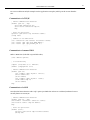
; evaluate the value parts in the association list before expansion
(expand ‘(a b) ‘((a (+ 1 2)) (b (+ 3 4))))
→ ((+ 1 2) (+ 3 4))
(expand ‘(a b) ‘((a (+ 1 2)) (b (+ 3 4))) true) → (3 7)
expand does its work on variables starting with an uppercase letter when expansion variables have
neither been specified stand-alone nor in an association list.
; expand from uppercase variables
(set ‘A 1 ‘Bvar 2 ‘C nil ‘d 5 ‘e 6)
(expand ‘(A (Bvar) C d e f)) → (1 (2) C d e f)
Using this, a previous function definition can be made even shorter.
; use expansion from uppercase variables in function factories
(define (raise-to Power)
(expand (fn (base) (pow base Power))))
(define cube (raise-to 3)) → (lambda (base) (pow base 3))
(cube 4) → 64
The letex function works like expand, but expansion symbols are local to the letex expression.
Code Patterns in newLISP
; use letex for variable expansion
(letex ( (x 1) (y ‘(a b c)) (z “hello”) ) ‘(x y z)) → (1 (a b c) “hello”)
Note that in the example the body expression in letex: (x y z) is quoted to prevent evaluation.
Destructuring nested lists
The following method can be used to bind variables to subparts of a nested list:
; uses unify together with bind for destructuring
(set ‘structure ‘((one “two”) 3 (four (x y z))))
(set ‘pattern ‘((A B) C (D E)))
(bind (unify pattern structure))
A → one
B → “two”
C → 3
D → four
E → (x y z)
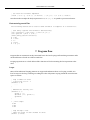
7. Program flow
Program flow in newLISP is mostly functional but it also has looping and branching constructs and a
catch and throw to break out of the normal flow.
Looping expressions as a whole behave like a function or block returning the last expression evaluated.
Loops
Most of the traditional looping patterns are supported. Whenever there is a looping variable, it is
local in scope to the loop, behaving according the rules of dynamic scoping inside the current namespace or context:
; loop a number of times
; i goes from 0 to N - 1
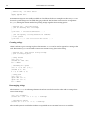
(dotimes (i N)
....
)
; demonstrate locality of i
(dotimes (i 3)
(print i “:”)
(dotimes (i 3) (print i))
(println)
)
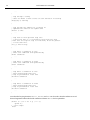
→ ; will output
0:012
1:012
2:012
; loop through a list
; takes the value of each element in aList
(dolist (e aList)
23
Code Patterns in newLISP
24
...
)
; loop through a string
; takes the ASCII or UTF-8 value of each character in aString
(dostring (e aString)
...
)
; loop through the symbols of a context in
; alphabetical order of the symbol name
(dotree (s CTX)
...
)
; loop from to with optional step size
; i goes from init to <= N inclusive with step size step
; Note that the sign in step is irrelevant, N can be greater
; or less then init.
(for (i init N step)
...
)
; loop while a condition is true
; first test condition then perform body
(while condition
...
)
; loop while a condition is false
; first test condition then perform body
(until condition
...
)
; loop while a condition is true
; first perform body then test
; body is performed at least once
(do-while condition
...
)
; loop while a condition is false
; first perform body then test
; body is performed at least once
(do-until condition
...
)
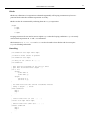
Note that the looping functions dolist, dotimes and for can also take a break condition as an additional argument. When the break condition evaluates to true the loop finishes:
(dolist (x ‘(a b c d e f g) (= x ‘e))
(print x))
→ ; will output
abcd
Code Patterns in newLISP
Blocks
Blocks are collections of s-expressions evaluated sequentially. All looping constructs may have expression blocks after the condition expression as a body.
Blocks can also be constructed by enclosing them in a begin expression:
(begin
s-exp1
s-exp2
...
s-expN)
Looping constructs do not need to use an explicit begin after the looping conditions. begin is mostly
used to block expressions in if and cond statements.
The functions and, or, let, letn and local can also be used to form blocks and do not require
begin for blocking statements.
Branching
(if condition true-expr false-expr)
;or when no false clause is present
(if condition true-expr)
;or unary if for (filter if ‘(...))
(if condition)
; more than one statement in the true or false
; part must be blocked with (begin ...)
(if (= x Y)
(begin
(some-func x)
(some-func y))
(begin
(do-this x y)
(do-that x y))
)
; the when form can take several statements without
; using a (begin ...) block
(when condition
exp-1
exp-2
...
)
; if-not works like (if (not ...) ...)
(if-not true-expr false-expr)
; unless works like (when (not ...) ...)
(unless condition
exp-1
exp-2
...
)
25
Code Patterns in newLISP
26
Depending on the condition, the exp-true or exp-false part is evaluated and returned.
More than one condition/exp-true pair can occur in an if expression, making it look like a cond:
(if condition-1 exp-true-1
condition-2 exp-true-2
...
condition-n exp-true-n
expr-false
)
The first exp-true-i for which the condition-i is not nil is evaluated and returned, or the
exp-false if none of the condition-i is true.
cond works like the multiple condition form of if but each part of condition-i exp-true-i must
be braced in parentheses:
(cond
(condition-1 exp-true-1 )
(condition-2 exp-true-2 )
...
(condition-n exp-true-n )
(true exp-true)
)
Fuzzy flow
Using amb the program flow can be regulated in a probabilistic fashion:
(amb
exp-1
exp-2
...
exp-n
)
One of the alternative expressions exp-1 to exp-n is evaluated with a probability of p = 1/n and the
result is returned from the amb expression.
Flow with catch and throw
Any loop or other expression block can be enclosed in a catch expression. The moment a throw
expression is evaluated, the whole catch expression returns the value of the throw expression.
(catch
(dotimes (i 10)
(if (= i 5) (throw “The End”))
(print i “ “))
)
; will output
0 1 2 3 4
; and the return value of the catch expression will be
→ “The End”
Code Patterns in newLISP
Several catch expressions can be nested. The function catch can also catch errors. See the chapter
on //Error Handling// below.
Leave loops with a break condition
Loops built using dotimes, dolist or for can specify a break condition for leaving the loop early:
(dotimes (x 10 (> (* x x) 9))
(println x))
→
0
1
2
3
(dolist (i ‘(a b c nil d e) (not i))
(println i))
→
a
b
c
Change flow with and or or
Similar to programming in the Prolog language, the logical and and or can be used to control program flow depending on the outcome of expressions logically connected:
(and
expr-1
expr-2
...
expr-n)
Expressions are evaluated sequentially until one expr-i evaluates to nil or the empty list () or
until all expr-i are exhausted. The last expression evaluated is the return value of the whole and
expression.
(or
expr-1
expr-2
...
expr-n)
Expressions are evaluated sequentially until one expr-i evaluates to not nil and not () or until all
expr-i are exhausted. The last expression evaluated is the return value of the whole or expression.
8. Error handling
Several conditions during evaluation of a newLISP expression can cause error exceptions. For a
complete list of errors see the Appendix in the newLISP Reference Manual.
27
Code Patterns in newLISP
28
newLISP errors
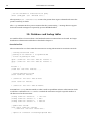
newLISP errors are caused by the programmer using the wrong syntax when invoking functions,
supplying the wrong number of parameters or parameters with the wrong data type, or by trying to
evaluate nonexistent functions.
; examples of newLISP errors
;
(foo foo)
→ invalid function : (foo foo)
(+ “hello”) → value expected in function + : “hello”
User defined errors
User errors are error exceptions thrown using the function throw-error:
; user defined error
;
(define (double x)
(if (= x 99) (throw-error “illegal number”))
(+ x x)
)
(double 8)
→ 16
(double 10) → 20
(double 99)
→
user error : illegal number
called from user defined function double
Error event handlers
newLISP and user defined errors can be caught using the function error-event to define an event
handler.
; define an error event handler
;
(define (MyHandler)
(println (last (last-error))
“ has occurred”))
(error-event ‘MyHandler)
(foo) → ERR: invalid function : (foo) has occurred
Catching errors
A finer grained and more specific error exception handling can be achieved using a special syntax of
the function catch.
(define (double x)
(if (= x 99) (throw-error “illegal number”))
(+ x x))
catch with a second parameter can be used to catch both system and user-defined errors:
(catch (double 8) ‘result) → true
Code Patterns in newLISP
result → 16
(catch (double 99) ‘result) → nil
(print result)
→
user error : illegal number
called from user defined function double
(catch (double “hi”) ‘result) → nil
(print result)
→
value expected in function + : x
called from user defined function double
The catch expression returns true when no error exception occurred, and the result of the expression
is found in the symbol result specified as a second parameter.
If an error exception occurs, it is caught and the catch clause returns nil. In this case the symbol
result contains the error message.
Operating system errors
Some errors originating at operating system level are not caught by newLISP, but can be inspected
using the function sys-error. For example the failure to open a file could have different causes:
; trying to open a nonexistent file
(open “blahbla” “r”) → nil
(sys-error)
→ (2 “No such file or directory”)
; to clear errno specify 0
(sys-error 0)
→ (0 “Unknown error: 0”)
Numbers returned may be different on different Unix platforms. Consult the file /usr/include/sys/
errno.h on your platform.
9. Functions as data
Manipulate after definition
(define (double x) (+ x x))
→ (lambda (x) (+ x x))
(first double) → (x)
(last double) → (+ x x)
; make a fuzzy double
(setf (nth 1 double) ‘(mul (normal x (div x 10)) 2))
(double 10) → 20.31445313
(double 10) → 19.60351563
lambda in newLISP is not an operator or symbol, but rather a special s-expression or list attribute:
(first double) → (x)
; not lambda
29
Code Patterns in newLISP
30
The lambda attribute of an s-expression is right-associative in append:
(append (lambda) ‘((x) (+ x x))) → (lambda (x) (+ x x))
; or shorter
(append (fn) ‘((x) (+ x x))) → (lambda (x) (+ x x))
(set ‘double (append (lambda) ‘((x) (+ x x)))
(double 10) → 20
and left-associative when using cons:
(cons ‘(x) (lambda) → (lambda (x))
Lambda expressions in newLISP never lose their first class object property.
The word lambda can be abbreviated as fn, which is convenient when mapping or applying functions to make the expression more readable and shorter to type.
Mapping and applying
Functions or operators can be applied to a list of data at once and all results are returned in a list
(define (double (x) (+ x x))
(map double ‘(1 2 3 4 5)) → (2 4 6 8 10)
Functions can be applied to parameters occurring in a list:
(apply + (sequence 1 10)) → 55
Functions making functions
Here an expression is passed as a parameter:
; macro expansion using expand
(define (raise-to power)
(expand (fn (base) (pow base power)) ‘power))
; or as an alternative using letex
(define (raise-to power)
(letex (p power) (fn (base) (pow base p))))
(define square (raise-to 2))
(define cube (raise-to 3))
(square 5)
(cube 5)
→ 25
→ 125
The built-in function curry can be used to make a function taking one argument from a function
taking two arguments.
(define add-one (curry add 1))
→ (lambda () (add 1 ($args 0)))
(define by-ten (curry mul 10))
→ (lambda () (mul 10 ($args 0)))
Code Patterns in newLISP
(add-one 5)
→ 6
(by-ten 1.23)
→ 12.3
Note that the ‘curried’ parameter is always the first parameter of the original function.
Functions with memory
newLISP can create local state variables using a name-space context:
; newLISP generator
(define (gen:gen)
(setq gen:sum
(if gen:sum (inc gen:sum) 1)))
; this could be written even shorter, because
; ‘inc’ treats nil as zero
(define (gen:gen)
(inc gen:sum))
(gen) → 1
(gen) → 2
(gen) → 3
The example uses a default functor — fuctions name equals names-space name — to give it the appearance of a normal function. Other fuctions could be added to the namespace, e.g. for initializing
the sum.
(define (gen:init x)
(setq gen:sum x))
(gen:init 20) → 20
(gen) → 21
(gen) → 22
Functions using self modifying code
The first class nature of lambda expressions in newLISP makes it possible to write self modifying
code:
;; sum accumulator
(define (sum (x 0)) (inc 0 x))
(sum 1)
(sum 2)
(sum 100)
(sum)
sum
→
→
→
→
1
3
103
103
→ (lambda ((x 0)) (inc 103 x))
The following example shows a function making a self modifying stream function using expand :
31
Code Patterns in newLISP
32
(define (make-stream lst)
(letex (stream lst)
(lambda () (pop ‘stream))))
(set ‘lst ‘(a b c d e f g h))
(define mystream (make-stream lst))
(mystream)
(mystream)
(mystream)
→ a
→ b
→ c
Because pop works on both lists and strings, the same function factory can be used for a string
stream:
(set ‘str “abcddefgh”)
(define mystream (make-stream str))
(mystream)
(mystream)
→ “a”
→ “c”
10. Text processing
Regular expressions
Regular expressions in newLISP can be used in a number of functions:
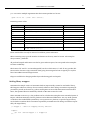
function
function description
directory
Return a list of files whose names match a pattern.
ends-with
Test if a string ends with a key string or pattern.
find
Find the position of a pattern.
find-all
Assemble a list of all patterns found.
parse
Break a string into tokens at patterns found between tokens.
regex
Find patterns and returns a list of all sub patterns found, with offset and
length.
replace
Replace found patterns with a user defined function, which can take as input
the patterns themselves
search
Search for a pattern in a file.
starts-with
Test if a string starts with a key string or pattern.
The functions find, regex, replace and search store pattern matching results in the system
variables $0 to $15. See the newLISP Users Manual for details.
The following paragraphs show frequently-used algorithms for scanning and tokenizing text.
Scanning text
The replace function, together with a regular expression pattern, can be used to scan text. The pattern in this case describes the tokens scanned for. As each token is found, it is pushed on a list. The
work is done in the replacement expression part of replace. This example saves all files linked on a
web page:
Code Patterns in newLISP
#!/usr/bin/newlisp
; tokenize using replace with regular expressions
; names are of the form <a href=”example.lsp”>example.lsp</a>
(set ‘page (get-url “http://newlisp.digidep.net/scripts/”))
(replace {>(.*lsp)<} page (first (push $1 links)) 0) ; old technique
;(set ‘links (find-all {>(.*lsp)<} page $1)) ; new technique
(dolist (fname links)
(write-file fname (get-url (append “http://newlisp.digidep.net/scripts/”
fname)))
(println “->” fname))
(exit)
Curly braces ({,}) are used in the regular expression pattern to avoid having to escape the quotes
(“) or other characters that have special meanings in regular expressions.
The following alternative technique is even shorter. The find-all function puts all matching strings
into a list:
(set ‘links (find-all {>(.*lsp)<} page $1)) ; new technique
In an additional expression find-all can be directed to do additional work with the sub expressions
found:
(find-all {(new)(lisp)} “newLISPisNEWLISP” (append $2 $1) 1)
→ (“LISPnew” “LISPNEW”)
In the last example find-all appends the sub expressions found in reverse order before returning
them in the result list.
Another technique for tokenizing text uses parse. Whereas with replace and find-all the regular
expression defined the token, when using parse, the regex pattern describes the space between the
tokens:
; tokenize using parse
(set ‘str “1 2,3,4 5, 6 7 8”)
(parse str {,\ *|\ +,*} 0)
→ (“1” “2” “3” “4” “5” “6” “7” “8”)
Without the curly braces in the parse pattern, the backslashes would need to be doubled. Note that
there is a space after each backslash.
Appending strings
When appending strings append and join can be used to form a new string:
(set ‘lstr (map string (rand 1000 100)))
→ (“976” “329” ... “692” “425”)
; the wrong slowest way
(set ‘bigStr “”)
(dolist (s lstr)
(set ‘bigStr (append bigStr s)))
33
Code Patterns in newLISP
34
; smarter way - 50 times faster
;
(apply append lstr)
Sometimes strings are not readily available in a list like in the above examples. In this case push can
be used to push strings on a list while they get produced. The list then can be used as an argument
for join, making the fastest method for putting strings together from existing pieces:
; smartest way - 300 times faster
; join an existing list of strings
;
(join lstr) → “97632936869242555543 ....”
; join can specify a string between the elements
; to be joined
(join lstr “-”) → “976-329-368-692-425-555-43 ....”
Growing strings
Often it is best to grow a string in place. The function extend can be used to append to a string at the
end. The function push can be used to insert new content at any place in the string.
; smartest way - much faster on big strings
; grow a string in place
; using extend
(set ‘str “”)
(extend str “AB” “CD”)
str → “ABCD”
; extending in a place
(set ‘L ‘(a b “CD” (e f)))
(extend (L 2) “E”)
L → (a b “CDE” (e f))
; using push
(set ‘str “”)
(push “AB” str -1)
(push “CD” str -1)
str → “ABCD”
Rearranging strings
The function select for selecting elements from lists can also be used to select and re-arrange characters from strings:
(set ‘str “eilnpsw”)
(select str ‘(3 0 -1 2 1 -2 -3)) → “newlisp”
; alternative syntax
(select str 3 0 -1 2 1 -2 -3) → “newlisp”
The second syntax is useful when indexes are specified not as constants but occur as variables.
Code Patterns in newLISP
Modifying strings
newLISP has a variety of functions, which can destructively change a string:
function
description
extend
Extend a string with another string.
push pop
Insert or extract one or more characters at a specific position.
replace
Replace all occurrences of a string or string pattern with a string.
setf
Replace a character in a string with one or more characters.
replace can also be used to remove all occurrences of string or string pattern when specifying an
empty string “” as replacement.
When indexing strings with either nth or implicit indexing, the string is addressed at character
rather than byte boundaries to work correctly on UTF-8 enabled versions of newLISP. A UTF-8
character can contain more than one byte.
11. Dictionaries and hashes
Hash-like key → value access
newLISP has functions to create and manipulate symbols using the functions sym and a special
syntax of the function context. In older versions of newLISP, these functions were used to program
hash-like creation and access of key-value pairs. Now a shorter and more convenient method is
available, using the uninitialized default functor of a namespace context:
(define Myhash:Myhash) ; establish the namespace and default functor
As an alternative to the above methods, the predefined namespace and default functor Tree can be
used to instantiate a new one:
(new Tree ‘Myhash)
Both methods produce the same result.
A default functor is the symbol with the same name as the namespace (context) it belongs to. If this
default functor symbol does not contain anything except nil, it works like a hash function:
(Myhash “var” 123) ; create and set variable/value pair
(Myhash “var”) → 123 ; retrieve value
(Myhash “foo” “hello”)
(Myhash “bar” ‘(q w e r t y))
(Myhash “!*@$” ‘(a b c))
35
Code Patterns in newLISP
36
Setting a hash symbol to nil will effectively erase it:
(Myhash “bar” nil)
The key can be any string; newLISP prevents symbol clashes with built-in newLISP symbols by
prepending an underscore character (_) to all key strings internally. The value can be any string,
number or any other newLISP s-expression.
The Myhash namespace can be transformed in an association list:
(Myhash) → ((“!*@$” (a b c)) (“foo” “hello”) (“var” 123))
Or the raw contents of Myhash can be shown using the symbols function:
(symbols Myhash) → (Myhash:Myhash Myhash:_!*@$ Myhash:_foo Myhash:_var)
Dictionaries can be built by converting an existing association list:
(set ‘aList ‘((“one” 1) (“two” 2) (“three”)))
(Myhash aList)
(Myhash) → ((“!*@$” (a b c)) (“foo” “hello”) (“one” 1) (“three” nil) (“two” 2)
(“var” 123))
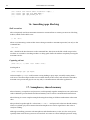
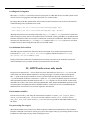
Saving and loading dictionaries
The dictionary can be easily saved to a file by serializing the namespace Myhash:
(save “Myhash.lsp” ‘Myhash)
The whole namespace is saved to the file Myhash.lsp and can be reloaded into newLISP at a later
time:
(load “Myhash”)
Note that hashes create contexts similar to the bayes-train function. All string keys are prepended
with an underscore and then transformed into a symbol. This means that namespaces created using
bayes-train can be used like hashes to retrieve words and their statistics. See the bayes-train
function in the manual for more detail.
12. TCP/IP client server
Open connection
In this pattern the server keeps the connection open until the client closes the connection, then the
server loops into a new net-accept:
; sender listens
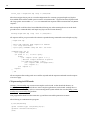
(constant ‘max-bytes 1024)
(if (not (set ‘listen (net-listen 123)))
(print (net-error)))
Code Patterns in newLISP
(while (not (net-error))
(set ‘connection (net-accept listen)) ; blocking here
(while (not (net-error))
(net-receive connection message-from-client max-bytes)
.... process message from client ...
.... configure message to client ...
(net-send connection message-to-client))
)
and the client:
; client connects to sender
(if (not (set ‘connection (net-connect “host.com” 123)))
(println (net-error)))
; maximum bytes to receive
(constant ‘max-bytes 1024)
; message send-receive loop
(while (not (net-error))
.... configure message to server ...
(net-send connection message-to-server)
(net-receive connection message-from-server max-bytes)
.... process message-from-server ...
)
Closed transaction
In this pattern the server closes the connection after each transaction exchange of messages.
; sender
(while (not (net-error))
(set ‘connection (net-accept listen)) ; blocking here
(net-receive connection message-from-client max-bytes)
.... process message from client ...
.... configure message to client ...
(net-send connection message-to-client)
(close connection)
)
and the client again tries to connect to the sender:
; client
(unless (set ‘connection (net-connect “host.com” 123))
(println (net-error))
(exit))
; maximum bytes to receive
(constant ‘max-bytes 1024)
.... configure message to server ...
(net-send connection message-to-server)
(net-receive connection message-from-server max-bytes)
.... process message-from-server ...
There are many different ways to set up a client/server connection, see also the examples in the
newLISP manual.
37
Code Patterns in newLISP
38
13. UDP communications
They are fast and need less setup than TCP/IP and offer multi casting. UDP is also less reliable
because the protocol does less checking, i.e. of correct packet sequence or if all packets are received.
This is normally no problem when not working on the Internet but in a well controlled local network
or when doing machine control. A simple more specific protocol could be made part of the message.
Open connection
In this example the server keeps the connection open. UDP communications with
net-listen, net-receive-from and net-send-to can block on receiving.
Note that both, the client and server use net-listen with the “udp” option. In this case net-listen
is used only for binding the socket to the address, it is not used for listening for a connection. The
server could receive messages from several clients. The net-send-to function extracts the target address from the message received.
The sender:
; sender
(set ‘socket (net-listen 10001 “” “udp”))
(if socket (println “server listening on port “ 10001)
(println (net-error)))
(while (not (net-error))
(set ‘msg (net-receive-from socket 255))
(println “->” msg)
(net-send-to (nth 1 msg) (nth 2 msg)
(upper-case (first msg)) socket)
)
and the client:
(set ‘socket (net-listen 10002 “” “udp”))
(if (not socket) (println (net-error)))
(while (not (net-error))
(print “->”)
(net-send-to “127.0.0.1” 10001 (read-line) socket)
(net-receive socket buff 255)
(println “→” buff)
)
Closed transaction
This form is sometimes used for controlling hardware or equipment. No setup is required, just one
function for sending, another one for receiving.
; wait for data gram with maximum 20 bytes
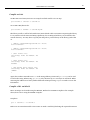
(net-receive-udp 1001 20)
; or
(net-receive-udp 1001 20 5000000) ; wait for max 5 seconds
; the sender
(net-send-udp “host.com” 1001 “Hello”)
Win32 and Unix’s show different behavior when sending less or more bytes than specified on the
Code Patterns in newLISP
receiving end.
Multi-cast communications
In this scheme the server subscribes to one of a range of multi cast addresses using the net-listen
function.
; example server
(net-listen 4096 “226.0.0.1” “multi”) → 5
(net-receive-from 5 20)
; example client I
(net-connect “226.0.0.1” 4096 “multi”) → 3
(net-send 3 “hello”)
; example client II
(net-connect “” 4096 “multi”) → 3
(net-send-to “226.0.0.1” 4096 “hello” 3)
The connection in the example is blocking on net-receive but could be de-blocked usin
net-select or net-peek
14. Non-blocking communications
Using net-select
In all previous patterns the client blocks when in receive. The net-select call can be used to unblock communications:
; optionally poll for arriving data with 100ms timeout
(while (not (net-select connection “r” 100000))
(do-something-while-waiting ...))
(net-receive...)
connection can be a single number for a connection socket or a list of numbers to wait on various
sockets.
Using net-peek
net-peek returns the number of characters pending to read.
(while ( = (net-peek aSock) 0)
(do-something-while-waiting ...))
(net-receive...)
39
Code Patterns in newLISP
40
15. Controlling other applications
Using exec
This method is only suited for short exchanges, executing one command and receiving the output.
(exec “ls *.c”) → (“.” “..” “util.c” “example.ls”)
The exec function opens a process pipe for the Unix command-line utility ls and collects each line of
STDOUT into a list of strings.
Most following examples use process to launch an application. This function returns immediately
after launching the other application and does not block.
In all of the following patterns the server is not independent but controlled by the client, which
launches the server and then communicates via a line oriented protocol:
→
→
←
→
←
launch server
talk to server
wait for response from server
talk to server
wait for response from server
...
Sometimes a sleep time is necessary on the client side to wait for the server to be ready loading.
Except for the first example, most of these are condensed snippets from GTK-Server from [http://
www.gtk-server.org www.gtk-server.org]. The basic program logic will be the same for any other application.
STD I/O pipes
The process function allows specifying 2 pipes for communications with the launched application.
; setup communications
(map set ‘(myin tcout) (pipe))
(map set ‘(tcin myout) (pipe))
(process “/usr/bin/wish” tcin tcout)
; make GUI
(write myout
[text]
wm geometry . 250x90
wm title . “Tcl/Tk and newLISP”
bind . <Destroy> {puts {(exit)}}
[/text])
; run event loop
(while (read-line myin)
(eval-string (current-line))
)
This is the preferred way to set up longer lasting, bidirectional communications with Unix command
line utilities and languages. For one-command exchanges the exec function does the job shorter.
Code Patterns in newLISP
For a more elaborate Tcl/Tk example see the application examples/tcltk.lsp in the source distribution.
Communicate via TCP/IP
; Define communication function
(define (gtk str , tmp)
(net-send connection str)
(net-receive connection tmp 64)
tmp)
; Start the gtk-server
(process “gtk-server tcp localhost:50000”)
(sleep 1000)
; Connect to the GTK-server
(set ‘connection (net-connect “localhost” 50000))
(set ‘result (gtk “gtk_init NULL NULL”))
(set ‘result (gtk “gtk_window_new 0”))
.....
Communicate via named FIFO
Make a FIFO first (looks like a special file node):
(exec “mkfifo myfifo”)
; or alternatively
(import “/lib/libc.so.6” “mkfifo”)
(mkfifo “/tmp/myfifo” 0777)
; Define communication function
(define (gtk str)
(set ‘handle (open “myfifo” “write”))
(write handle str)
(close handle)
(set ‘handle (open “myfifo” “read”))
(read handle tmp 20)
(close handle)
tmp)
Communicate via UDP
Note that the listen function with “udp” option just binds the sockets to a address/hardware but not
actually listens as in TCP/IP.
; Define communication function
(define (gtk str , tmp)
(net-send-to “localhost” 50000 str socket)
(net-receive socket ‘tmp net-buffer)
tmp)
; Start the gtk-server
(define (start)
(process “gtk-server udp localhost:50000”)
(sleep 500)
41
Code Patterns in newLISP
42
(set ‘socket (net-listen 50001 “localhost” “udp”)) )
(set ‘result (gtk “gtk_init NULL NULL”))
(set ‘result (gtk “gtk_window_new 0”))
.....
16. Launching apps blocking
Shell execution
This is frequently used from newLISP’s interactive command line to execute processes in a blocking
fashion, which need a shell to run:
(! “ls -ltr”)
There is an interesting variant of this form working not inside a newLISP expression, but only on the
command line:
!ls -ltr
The ! should be the first character on the command line. This form works like a shell escape in the
VI editor. It is useful for invoking an editor or doing quick shell work without completely leaving the
newLISP console.
Capturing std-out
(exec “ls /”) → (“bin” “etc” “home” “lib”)
Feeding std-in
(exec “script.cgi” cgi-input)
In this example cgi-input could contain a string feeding a query input, normally coming from a
web server. Note that output in this case is written directly to the screen, and cannot be returned to
newLISP. Use process and pipe for two way std i/o communications with other applications.
17. Semaphores, shared memory
Shared memory, semaphores and processes work frequently together. Semaphores can synchronize
tasks in different process threads and shared memory can be used to communicate between them.
The following is a more complex example showing the working of all three mechanisms at the same
time.
The producer loops through all n values from i = 0 to n - 1 and puts each value into shared memory
where it is picked up by the consumer thread. Semaphores are used to signal that a data value is
ready for reading.
Although controlling processes with semaphores and shared memory is fast, it is also error prone,
specially when more the two processes are involved. It is easier to control multiple processes using
Code Patterns in newLISP
the Cilk API and messaging between processes. See chapters 18. and 19. for these topics.
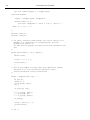
#!/usr/bin/newlisp
# prodcons.lsp - Producer/consumer
#
# usage of ‘fork’, ‘wait-pid’, ‘semaphore’ and ‘share’
(when (= ostype “Win32”)
(println “this will not run on Win32”)
(exit))
(constant ‘wait -1 ‘sig 1 ‘release 0)
(define (consumer n)
(set ‘i 0)
(while (< i n)
(semaphore cons-sem wait)
(println (set ‘i (share data)) “ <-”)
(semaphore prod-sem sig))
(exit))
(define (producer n)
(for (i 1 n)
(semaphore prod-sem wait)
(println “-> “ (share data i))
semaphore cons-sem sig))
(exit))
(define (run n)
(set ‘data (share))
(share data 0)
(set ‘prod-sem (semaphore)) ; get semaphores
(set ‘cons-sem (semaphore))
(set ‘prod-pid (fork (producer n))) ; start processes
(set ‘cons-pid (fork (consumer n)))
(semaphore prod-sem sig) ; get producer started
(wait-pid prod-pid) ; wait for processes to finish
(wait-pid cons-pid) ;
(semaphore cons-sem release) ; release semaphores
(semaphore prod-sem release))
(run 10)
(exit)
18. Multiprocessing and Cilk
On multiprocessor CPUs the operating system will distribute processes and child processes created
on different processor cores in an optimized fashion. newLISP offers a simple API which does all the
work of launching processes and does the synchronized collection of evaluation results. The Cilk API
consists of only 3 function calls, implemented in newLISP as spawn, sync and abort
Since v.10.1 newLISP’s message function enables communications between parent and child processes. For more details about this, see the next chapter 19. Message exchange.
43
Code Patterns in newLISP
44
Starting concurrent processes
; calculate primes in a range
(define (primes from to)
(let (plist ‘())
(for (i from to)
(if (= 1 (length (factor i)))
(push i plist -1)))
plist))
; start child processes
(set ‘start (time-of-day))
(spawn
(spawn
(spawn
(spawn
‘p1
‘p2
‘p3
‘p4
(primes
(primes
(primes
(primes
1 1000000))
1000001 2000000))
2000001 3000000))
3000001 4000000))
; wait for a maximum of 60 seconds for all tasks to finish
(sync 60000) ; returns true if all finished in time
; p1, p2, p3 and p4 now each contain a lists of primes
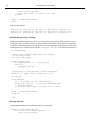
The example shows how the task of generating a range of prime numbers can be organized for parallel processing by splitting the range into sub-ranges. All spawn calls will return immediately, but
sync will block until all child processes have finished and the result lists are available in the four
variables p1 to p4.
Watching progress
When the timeout value specified is too short for all processes to finish, sync will return nil. This
can be used to watch progress:
; print a dot after each 2 seconds of waiting
(until (sync 2000) (println “.”))
When sync is called without parameters, it returns a list of still active process ids:
; show a list of pending process ids after
;each three-tenths of a second
(until (sync 300) (println (sync)))
Invoking spawn recursively
(define (fibo n)
(let (f1 nil f2 nil)
(if (< n 2) 1
(begin
(spawn ‘f1 (fibo (- n 1)))
(spawn ‘f2 (fibo (- n 2)))
(sync 10000)
(+ f1 f2)))))
(fibo 7)
→ 21
Code Patterns in newLISP
Event driven notification
When processes launched with spawn finish, an inlet function specified in the sync statement can
be called.
(define (report pid)
(println “process: “ pid “ has returned”))
; call the report function, when a child returns
(sync 10000 report)
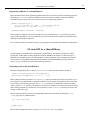
19. Message exchange
Parent and child processes started with spawn can exchange messages. Messages flow either from
the parent to child processes or from child processes to the parent. By means of evaluating messages
in the parent process, the parent process can be used as a proxy routing messages between child
peers.
Internally newLISP uses UNIX local domain sockets for dual message queues between parent and
child processes. When the receiving side of a queue is empty a receive call wil return nil. Likewise
when a queue is full, a send call will return nil. The looping function until can be used to make send
and receive statements blocking.
Blocking message sending and receiving
; blocking sender
(until (send pid msg))
; true when a msg queued up
; blocking receiver
(until (receive pid msg))
; true after a msg is read
Blocking messages exchange
The parent process loops through all child process IDs and uses the
(until (receive cpid msg)) form of receive to wait for pending messages. (sync) returns a list
of all child PIDs from processes launched by spawn.
#!/usr/bin/newlisp
; child process transmits random numbers
(define (child-process)
(set ‘ppid (sys-info -4)) ; get parent pid
(while true
(until (send ppid (rand 100))))
)
; parent starts 5 child processes, listens and displays
; the true flag enables usage of send and receive
(dotimes (i 5) (spawn ‘result (child-process) true))
(for (i 1 3)
(dolist (cpid (sync)) ; iterate thru pending child PIDs
45
Code Patterns in newLISP
46
(until (receive cpid msg))
(print “pid:” cpid “->>” (format “%-2d
(println)
“ msg)))
)
(abort) ; cancel child-processes
(exit)
generates this output:
pid:53181->47
pid:53181->59
pid:53181->6
pid:53180->61
pid:53180->12
pid:53180->56
pid:53179->75
pid:53179->20
pid:53179->96
pid:53178->39
pid:53178->77
pid:53178->78
pid:53177->3
pid:53177->47
pid:53177->18
Non blocking message exchange
Neither the sending child process nor the receiving parent process block. Each sends and receives
messages as fast as possible. There is no guarantee that all messages will be delivered. It depends
on the size of the sending queue and the speed of pick-up of messages by the parent process. If the
sending queue for a child process is full, the (send ppid (rand 100)) call will fail and return nil.
#!/usr/bin/newlisp
; child process transmits random numbers non-blocking
; not all calls succeed
(set ‘start (time-of-day))
(define (child-process)
(set ‘ppid (sys-info -4)) ; get parent pid
(while true
(send ppid (rand 100)))
)
; parent starts 5 child processes, listens and displays
(dotimes (i 5) (spawn ‘result (child-process) true))
(set ‘N 1000)
(until finished
(if (= (inc counter) N) (set ‘finished true))
(dolist (cpid (receive)) ; iterate thru ready child pids
(receive cpid msg)
(if msg (print “pid:” cpid “->” (format “%-2d \r” msg))))
)
(abort) ; cancel child-processes
(sleep 300)
(exit)
Message timeouts
A messaging statement can be made to block for a certain time:
(define (receive-timeout pid msec)
(let ( (start (time-of-day)) (msg nil))
(until (receive pid msg)
Code Patterns in newLISP
(if (> (- (time-of-day) start) 1000) (throw-error “timeout”)))
msg)
)
; use it
(receive-timeout pid 1000)
; return message or throw error after 1 second
In this example blocking will occur for 1000 ms. Many methods exist to implement timeout behavior.
Evaluating messages
Messages sent can contain expressions which can be evaluated in the recipient’s environment. This
way variables can be set in the evaluater’s environment, and messages can be routed to other processes. The following example implements a message router:
#!/usr/bin/newlisp
; sender child process of the message
(set ‘A (spawn ‘result
(begin
(dotimes (i 3)
(set ‘ppid (sys-info -4))
/* the following statement in msg will be evaluated in the proxy */
(set ‘msg ‘(until (send B (string “greetings from “ A))))
(until (send ppid msg)))
(until (send ppid ‘(begin
(sleep 200) ; make sure all else is printed
(println “parent exiting ...\n”)
(set ‘finished true))))) true))
; receiver child process of the message
(set ‘B (spawn ‘result
(begin
(set ‘ppid (sys-info -4))
(while true
(until (receive ppid msg))
(println msg)
(unless (= msg (string “greetings from “ A))
(println “ERROR in proxy message: “ msg)))) true))
(until finished (if (receive A msg) (eval msg))) ; proxy loop
(abort)
(exit)
Acting as a proxy
In the last example program the expression:
; content of message to be evaluated by proxy
(until (send B (string “greetings from “ A)))
A proramming statement sent from child process ID A to the parent, where it is evaluated, causing a
message to be sent to child process B. The parent process acts as a proxy agent for the child process
A.
47
Code Patterns in newLISP
48
; the set statement is evaluated in the proxy
(until (send ppid ‘(set ‘finished true)))
The expression (set ‘finished true) is sent to the parent where it gets evaluated and causes the
parent’s until loop to finish.
The sleep statement in the A process ensures that the “parent exiting ...” message does not appear
before all receved messages are reported by process identified with B.
20. Databases and lookup tables
For smaller tables of not more than a few hundered entries association lists can be used. For larger
databases use dictionaries and hashes as decribed in chapter 11.
Association lists
The association list is a classic LISP data structure for storing information for associative retrieval:
; creating association lists
; pushing at the end with -1 is optimized and
; as fast as pushing in front
(push ‘(“John Doe” “123-5555” 1200.00) Persons -1)
(push ‘(“Jane Doe” “456-7777” 2000.00) Persons -1)
.....
Persons → (
(“John Doe” “123-5555” 1200.00)
(“Jane Doe” “456-7777” 2000.00) ...)
; access/lookup data records
(assoc “John Doe” Persons)
→ (“John Doe” “123-5555” 1200.00 male)
(assoc “Jane Doe” Persons)
→ (“Jane Doe” “456-7777” 2000.00 female)
newLISP has a lookup function similar to what is used in spreadsheet software. This function which
works like a combination of assoc and nth can find the association and pick a specific member of
the data record at the same time:
(lookup
(lookup
(lookup
(lookup
“John
“John
“Jane
“Jane
Doe”
Doe”
Doe”
Doe”
Persons
Persons
Persons
Persons
0)
-1)
1)
-2)
→
→
→
→
“123-555”
male
2000.00
2000.00
; update data records
(setf (assoc “John Doe” Persons)
‘(“John Doe” “123-5555” 900.00 male))
; replace as a function of existing/replaced data
Code Patterns in newLISP
(setf (assoc “John Doe” Persons) (update-person $it))
; delete data records
(replace (assoc “John Doe” Persons) Persons)
Nested associations
If the data part of an association is itself an association list, we have a nested association:
(set ‘persons ‘(
(“Anne” (address (country “USA”) (city “New York”)))
(“Jean” (address (country “France”) (city “Paris”)))
))
A different syntax of the assoc function can be used to specify multiple keys:
; one key
(assoc “Anne” persons) → (“Anne” (address (country “USA”) (city “New York”)))
; two keys
(assoc ‘(“Anne” address) persons) → (address (country “USA”) (city “New York”))
; three keys
(assoc ‘(“Anne” address city) persons) → (city “New York”)
; three keys in a vector
(set ‘anne-city ‘(“Anne” address city))
(assoc anne-city persons) → (city “New York”)
When all keys are symbols, as is in address, country and city, simple and nested associations in
newLISP have the same format as newLISP FOOP (Functional Object Oriented Programming) objects. See the users manual chapter “18. Functional object-oriented programming” for details.
Updating nested associations
The functions assoc and setf can be used to update simple or nested associations:
(setf (assoc (“Anne” address city) persons) ‘(city “Boston”)) → (city “New York”)
setf always returns the newly set element.
Combining associations and hashes
Hashes and FOOP objects can be combined to form an in-memory database with keyed access.
In the following example, data records are stored in a hash namespace and access is with the name
of the person as a key.
setf and lookup are used to update nested FOOP objects:
(new
(new
(new
(new
Tree ‘Person)
Class ‘Address)
Class ‘City)
Class ‘Telephone)
49
Code Patterns in newLISP
50
(Person “John Doe” (Address (City “Small Town”) (Telephone 5551234)))
(lookup ‘Telephone (Person “John Doe”))
(setf (lookup ‘Telephone (Person “John Doe”)) 1234567)
(setf (lookup ‘City (Person “John Doe”)) (lower-case $it))
(Person “John Doe”) → (Address (City “small town”) (Telephone 1234567))
21. Distributed computing
Many of todays applications are distributed on to several computers on the network or distributed
on to several processes on one CPU. Often both methods of distributing an application are used at
the same time.
newLISP has facilities to evaluate many expressions in parallel on different network nodes or processes running newLISP. The net-eval function does all the work necessary to communicate to other
nodes, distribute expressions for evaluation and collect results in either a blocking or event driven
fashion.
The functions read-file, write-file, append-file and delete-file can also be used to access
with files on remote nodes when using URLs in file specifications. In a similar way the functions
load and save can be used to load and save code from and to remote nodes.
newLISP uses existing HTTP protocols and newLISP command line behavior to implement this
functionality. This means that programs can be debugged and tested using standard Unix applications like terminal, telnet or a web browser. This also enables easy integration of other tools and
programs into distributed applications built with newLISP. For example the Unix utility netcat (nc)
could be used to evaluate expressions remotely or a web browser could be used to retrieve webpages
from nodes running a newLISP server.
Setting up in server mode
A newLISP server node is essentially a newLISP process listening to a network port and behaving
like a newLISP command-line console and HTTP server for HTTP GET, PUT, POST and DELETE
requests. Since version 9.1 newLISP server mode also answers CGI queries received by either GET or
POST request.
Two methods are used to start a newLISP server node. One results in a state full server, maintaining state in between communications with different clients, the other method a server with no state,
reloading for every new client connection.
Start a state-full server
newlisp -c -d 4711 &
newlisp myprog.lsp -c -d 4711 &
newlisp myprog.lsp -c -w /home/node25 -d 4711 &
newLISP is now listening on port 4711, the & (ampersand) sign tells newLISP to run in the background (Unix only). The -c switch suppresses command line prompts. newLISP now behaves like
Code Patterns in newLISP
a newLISP console without prompts listening on port 4711 for command line like input. Any other
available port could have been chosen. Note that on Unix, ports below 1024 need administrator access rights.
The second example also pre-loads code. The third example also specifies a working directory using
the -w option. If no working directory is specified using -w, the startup directory is assumed to be
the working directory.
After each transaction, when a connection closes, newLISP will go through a reset process, reinitialize stack and signals and go to the MAIN context. Only the contents of program and variable symbols
will be preserved.
Stateless server with inetd
On Unix the inetd or xindetd facility can be used to start a stateless server. In this case the TCP/IP
net connections are managed by a special Unix utility with the ability to handle multiple requests
at the same time. For each connection made by a client the inetd or xinetd utility will start a fresh
newLISP process. After the connection is closed the newLISP process will shut down.
When nodes are not required to keep state, this is the preferred method for a newLISP server node,
for handling multiple connections at the same time.
The inetd or xinetd process needs to be configured using configuration files found in the /etc directory of most Unix installations.
For both the inetd and xinetd configurations add the following line to the /etc/services file:
net-eval
4711/tcp
# newLISP net-eval requests
Note that any other port than 4711 could be supplied.
When configuring inetd add also the following lines to the /etc/inetd.conf file:
net-eval
stream
tcp
nowait
root
/usr/bin/newlisp -c
# as an alternative, a program can also be preloaded
net-eval
stream
tcp
nowait
root
/usr/bin/newlisp myprog.lsp -c
# a working directory can also be specified
net-eval
stream
tcp
nowait
newlisp
/usr/bin/newlisp -c -w /usr/home/newlisp
The last line also specified a working directory and a user newlisp instead of the root user. This is
a more secure mode limiting newLISP server node access to a specific user account with restricted
permissions.
On some Unix system a modern flavor of inetd: the xinetd facility can be used. Add the following
configuration to a file /etc/xinet.d/net-eval:
51
Code Patterns in newLISP
52
service net-eval
{
socket_type = stream
wait = no
user = root
server = /usr/bin/newlisp
port = 4711
server_args = -c -w /home/node
}
Note that a variety of parameter combinations are possible to restrict access from different places or
limit access to certain users. Consult the man-pages for inetd and xinetd for details.
After configuring inetd or xinetd either process must be restarted to re-read the configuration files.
This can be accomplished by sending the Unix HUP signal to either the inetd or xinetd process using
the Unix kill or Unix nohup utility.
On Mac OS X the launchd facility can be used in a similar fashion. The newLISP source distribution contains the file org.newlisp.newlisp.plist in the util/ directory. This file can be used to launch
newlisp server during OS boot time as a persistent server.
Test the server with telnet
A newLISP server node can be tested using the Unix telnet utility:
telnet localhost 4711
; or when running on a different computer i.e. ip 192.168.1.100
telnet 192.168.1.100 4711
Multi-line expressions can be entered by enclosing them in [cmd], [/cmd] tags, each tag on a separate line. Both the opening and closing tags should be on separate lines. Although newLISP has a
second, new multi-line mode for the interactive shell since version 10.3.0 without tags, when using
netcat or other Unix utilities, multi-line expressions still have to be enclosed in [cmd], [/cmd]
tags.
Test with netcat on Unix
echo ‘(symbols) (exit)’ | nc localhost 4711
Or talking to a remote node:
echo ‘(symbols) (exit)’ | nc 192.168.1.100 4711
In both examples netcat will echo back the result of evaluating the (symbols) expression.
Multi-line expressions can be entered by enclosing them in [cmd], [/cmd] tags, each tag on a separate line.
Code Patterns in newLISP
Test from the command line
The net-eval function as a syntax form for connecting to only one remote server node. This mode is
practical for quick testing from the newLISP command line:
(net-eval “localhost” 4711 “(+ 3 4)” 1000) → 7
; to a remote node
(net-eval “192.168.1.100” 4711 {(upper-case “newlisp”)} 1000) → “NEWLISP”
In the second example curly braces {,} are used to limit the program string for evaluation. This way
quotes can be used to limit a string inside the expression.
No [cmd], [/cmd] tags are required when sending multi-line expressions. net-eval supplies these
tags automatically.
Test HTTP with a browser
A newLISP server also understands simple HTTP GET and PUT requests. Enter the full path of a file
in the address-bar of the browser:
http://localhost:4711//usr/share/newlisp/doc/newlisp_manual.html
The manual file is almost 800 Kbyte in size and will take a few seconds to load into the browser.
Specify the port-number with a colon separated from the host-name or host IP. Note the double
slash necessary to specify a file address relative to the root directory.
Evaluating remotely
When testing the correct installation of newLISP server nodes, we were already sending expressions
to remote node for evaluation. Many times remote evaluation is used to split up a lengthy task into
shorter subtasks for remote evaluation on different nodes.
The first example is trivial, because it only evaluates several very simple expressions remotely, but it
demonstrates the principles involved easily:
#!/usr/bin/newlisp
(set ‘result (net-eval ‘(
(“192.168.1.100” 4711
(“192.168.1.101” 4711
(“192.168.1.102” 4711
(“192.168.1.103” 4711
(“192.168.1.104” 4711
) 1000))
{(+
{(+
{(+
{(+
{(+
(println “result: “ result)
(exit)
3 4)})
5 6)})
7 8)})
9 10)})
11 12)})
53
Code Patterns in newLISP
54
Running this program will produce the following output:
result: (7 11 15 19 23)
When running Unix and using an inetd or xinetd configured newLISP server, the servers and programs can be run on just one CPU, replacing all IP numbers with “localhost” or the same local IP
number. The indetd or xinetd daemon will then start 5 independent newLISP processes. On Win32 5
state-full newLISP servers could be started on different port numbers to accomplish the same.
Instead of collecting all results at once on the return of net-eval, a callback function can be used to
receive and process results as they become available:
#!/usr/bin/newlisp
(define (idle-loop p)
(if p (println p)))
(set ‘result (net-eval ‘(
(“192.168.1.100” 4711
(“192.168.1.101” 4711
(“192.168.1.102” 4711
(“192.168.1.103” 4711
(“192.168.1.104” 4711
) 1000 idle-loop))
{(+
{(+
{(+
{(+
{(+
3 4)})
5 6)})
7 8)})
9 10)})
11 12)})
(exit)
While net-eval is waiting for results, it calls the function idle-loop repeatedly with parameter p.
The parameter p is nil when no result was received during the last 1000 milliseconds, or p contains
a list sent back from the remote node. The list contains the remote address and port and the evaluation result. The example shown would generate the following output:
(“192.168.1.100” 4711 7)
(“192.168.1.101” 4711 11)
(“192.168.1.102” 4711 15)
(“192.168.1.103” 4711 19)
(“192.168.1.104” 4711 23)
For testing on just one CPU, replace addresses with “localhost”; the Unix inetd or xinetd daemon
will start a separate process for each connection made and all listening on port 4711. When using a
state-full server on the same Win32 CPU specify a different port number for each server.
Setting up the ‘net-eval’ parameter structure
In a networked environment where an application gets moved around, or server nodes with changing IP numbers are used, it is necessary to set up the node parameters in the net-eval parameter
list as variables. The following more complex example shows how this can be done. The example
also shows how a bigger piece of program text can be transferred to a remote node for evaluation
and how this program piece can be customized for each node differently:
#!/usr/bin/newlisp
; node parameters
(set ‘nodes ‘(
(“192.168.1.100” 4711)
Code Patterns in newLISP
(“192.168.1.101”
(“192.168.1.102”
(“192.168.1.103”
(“192.168.1.104”
55
4711)
4711)
4711)
4711)
))
; program template for nodes
(set ‘program [text]
(begin
(map set ‘(from to node) ‘(%d %d %d))
(for (x from to)
(if (= 1 (length (factor x)))
(push x primes -1)))
primes)
[/text])
; call back routine for net-eval
(define (idle-loop p)
(when p
(println (p 0) “:” (p 1))
(push (p 2) primes))
)
(println “Sending request to nodes, and waiting ...”)
; machines could be on different IP addresses.
; For this test 5 nodes are started on localhost
(set ‘result (net-eval (list
(list (nodes 0 0) (nodes 0 1) (format program
(list (nodes 1 0) (nodes 1 1) (format program
(list (nodes 2 0) (nodes 2 1) (format program
(list (nodes 3 0) (nodes 3 1) (format program
(list (nodes 4 0) (nodes 4 1) (format program
) 20000 idle-loop))
0 99999 1))
100000 199999
200000 299999
300000 399999
400000 499999
2))
3))
4))
5))
(set ‘primes (sort (flat primes)))
(save “primes” ‘primes)
(exit)
At the beginning of the program a nodes list structure contains all the relevant node information for
hostname and port.
The program calculates all prime numbers in a given range. The from, to and node variables are configured into the program text using format. All instructions are placed into a begin expression block,
so only one expression result will be send back from the remote node.
Many other schemes to configure a net-eval parameter list are possible. The following scheme
without idle-loop would give the same results:
(set ‘node-eval-list (list
(list (nodes 0 0) (nodes
(list (nodes 1 0) (nodes
(list (nodes 2 0) (nodes
(list (nodes 3 0) (nodes
(list (nodes 4 0) (nodes
))
0
1
2
3
4
1)
1)
1)
1)
1)
(format
(format
(format
(format
(format
program
program
program
program
program
0 99999 1))
100000 199999
200000 299999
300000 399999
400000 499999
2))
3))
4))
5))
Code Patterns in newLISP
56
(set ‘result (net-eval node-eval-list
20000))
The function idle-loop aggregates all lists of primes received and generates the following output:
192.168.1.100:4711
192.168.1.101:4711
192.168.1.102:4711
192.168.1.103:4711
192.168.1.104:4711
As with the previous examples all IP numbers could be replaced with “localhost” or any other hostname or IP number to test a distributed application on a single host before deployment in a distributed environment with many networked hosts.
Transferring files
Files can be read from or written to remote nodes with the same functions used to read and write
files to a local file system. This functionality is currently only available on Unix systems when talking to newLISP servers. As functions are based on standard GET and PUT HTTP protocols they can
also be used communicating with web servers. Note that few Apache web-server installations have
enabled the PUT protocol by default.
The functions read-file, write-file and append-file can all take URLs in their filename specifications for reading from and writing to remote nodes running a newLISP server or a web-server:
(write-file “http://127.0.0.1:4711//Users/newlisp/afile.txt” “The message - “)
→ “14 bytes transferred for /Users/newlisp/afile.txt\r\n”
(append-file “http://127.0.0.1:4711//Users/newlisp/afile.txt” “more text”)
→ “9 bytes transferred for /Users/newlisp/afile.txt\r\n”
(read-file “http://127.0.0.1:4711//Users/newlisp/afile.txt”)
→ “The message - more text”
The first two function return a message starting with the numbers of bytes transferred and the name
of the remote file affected. The read-file function returns the contents received.
Under all error conditions an error message starting with the characters ERR: would be returned:
(read-file “http://127.0.0.1:4711//Users/newlisp/somefile.txt”)
→ “ERR:404 File not found: /Users/newlisp/somefile.txt\r\n”
Note the double backslash necessary to reference files relative to root on the server node.
All functions can be used to transfer binary non-ascii contents containing zero characters. Internally newLISP uses the functions get-url and put-url, which could be used instead of the functions read-file, write-file and append-file. Additional options like used with get-url and
put-url could be used with the functions read-file, write-file and append-file as well. For
more detail see the newLISP function reference for these functions.
Code Patterns in newLISP
Loading and saving data
The same load and save functions used to load program or LISP data from a local file system can be
used to load or save programs and LISP data from or to remote nodes.
By using URLs in the file specifications of load and save these functions can work over the network
communicating with a newLISP server node.:
(load “http://192.168.1.2:4711//usr/share/newlisp/mysql5.lsp”)
(save “http://192.168.1.2:4711//home/newlisp/data.lsp” ‘db-data)
Although the load and save functions internally use get-url and put-url to perform its works they
behave exactly as when used on a local file system, but instead of a file path URLs are specified. Both
function will timeout after 60 seconds if a connection could not be established. When finer control is
necessary use the functions get-url and put-url together with eval-string and source to realize
a similar result as when using the load and save in HTTP mode.
Local domain Unix sockets
newLISP supports named local domain sockets in newLISP server mode and using the builtin functions net-eval, net-listen, net-connect together with the functions net-accept,
net-receive, net-select and net-send.
Using local domain sockets fast communications between processes on the same file system and
with newLISP servers is possible. See the Users Manual for more details.
22. HTTPD web server only mode
In all previous chapters the -c server mode was used. This mode can act as a net-eval server and
at the same time answer HTTP requests for serving web pages or transfer of files and programs.
The -c mode is the preferred mode for secure operation behind a firewall. newLISP also has a
-http mode which works like a restricted -c mode. In -http mode only HTTP requests are served
and command-line like formatted requests and net-eval requests are not answered. In this mode
newLISP can act like a web server answering HTTP GET, PUT, POST and DELETE requests as well
as CGI requests, but additional efforts should be made to restrict the access to unauthorized files
and directories to secure the server when exposed to the internet.
Environment variables
In both server modes -c and -http the environment variables DOCUMENT_ROOT, REQUEST_METHOD,
SERVER_SOFTWARE and QUERY_STRING are set. The variables CONTENT_TYPE, CONTENT_LENGTH,
HTTP_HOST, HTTP_USER_AGENT and HTTP_COOKIE are set too if present in the HTTP header sent by
the client.
Pre-processing the request
When the newLISP server answers any kind of requests (HTTP and command line), the newLISP
function command-event can be used to pre-process the request. The pre-processing function can be
loaded from a file httpd-conf.lsp when starting the server:
57
Code Patterns in newLISP
58
server_args = httpd-conf.lsp -http -w /home/node
The above snippet shows part of a xinetd configuration file. A startup program httpd-conf.lsp has
been added which will be loaded upon invocation of newLISP. The -c options has been replaced with
the -http option. Now neither net-eval nor command-line requests will be answered but only HTTP
requests.
The startup file could also have been added the following way when starting the server in the background from a command shell, and httpd-conf.lsp is in the current directory:
newlisp httpd-conf.lsp -http -d 80 -w /home/www &
All requests will be pre-processed with a function specified using command-event in httpd-conf.lsp:
;
;
;
;
;
httpd-conf.lsp
filter and translate HTTP request for newLISP
-c or -http server modes
reject query commands using CGI with .exe files
(command-event (fn (s)
(let (request nil)
(if (find “?” s) ; is this a query
(begin
(set ‘request (first (parse s “?”)))
; discover illegal extension in queries
(if (ends-with request “.exe”)
(set ‘request “GET /errorpage.html”)
(set ‘request s)))
(set ‘request s))
request)
))
; eof
All CGI requests files ending with .exe would be rejected and the request translated into the request
of an error page.
CGI processing in HTTP mode
On http://www.newlisp.org various CGI examples can be found. In the download directory at
http://www.newlisp.org/downloads two more complex applications can be found: newlisp-ide is a
web based IDE and newlisp-wiki is a content management system which also runs the [http://www.
newlisp.org www.newlisp.org] website.
CGI program files must have the extension .cgi and have executable permission on Unix.
The following is a minimum CGI program:
#!/usr/bin/newlisp
(print “Content-type: text/html\r\n\r\n”)
(println “<h2>Hello World</h2>”)
(exit)
Code Patterns in newLISP
newLISP normally puts out a standard HTTP/1.0 200 OK\r\n response header plus a Server:
newLISP v. ...\r\n header line. If the first line of CGI program output starts with “Status:” then
newLISP’s standard header output is suppressed, and the CGI program must supply the full status
header by itself. The following example redirects a request to a new location:
#!/usr/bin/newlisp
(print “Status: 301 Moved Permanently\r\n”)
(print “Location: http://www.newlisp.org/index.cgi\r\n\r\n”)
(exit)
A newLISP installation contains a module file cgi.lsp. This module contains subroutines for extracting parameters from HTTP GET and POST requests, extract or set cookies and other useful routines
when writing CGI files. See the modules section at: http://www.newlisp.org/modules/.
Media types in HTTP modes
In both the -c and -http HTTP modes the following file types are recognized and a correctly formatted Content-Type: header is sent back:
file extension
media type
.avi
video/x-msvideo
.css
text/css
.gif
image/gif
.htm
text/htm
.html
text/html
.jpg
image/jpg
.js
application/javascript
.mov
video/quicktime
.mp3
audio/mpeg
.mpg
video/mpeg
.pdf
application/pdf
.png
image/png
.wav
audio/x-wav
.zip
application/zip
any other
text/plain
59
Code Patterns in newLISP
60
23. Extending newLISP
newLISP has an import function, which allows importing function from DLLs (Dynamic Link Libraries) on Win32 or shared libraries on Linux/Unix (ending in .so, ending in .dylib on Mac OS X).
Simple versus extended FFI interface
In version 10.4.0 newLISP introduced an extended syntax for the import, callback and struct
functions and for the pack and unpack support functions. This extended syntax is only available on
newLISP versions built with libffi . All standard binary versions distributed on www.newlisp.org are
enabled to use the new extensions additionally to the simpler API. The simpler API is used by all
standard extension modules part of the distribution except for the module gsl.lsp.
The extended syntax allows specifying C-language types for parameter and return values of imported functions and for functions registered as callbacks. The extended syntax also allows handling
of floating point values and C-structures in parameters and returns. Handling of floating point types
was either impossible or unreliable using the simple API that depended on pure cdecl calling conventions. These are not available on all platforms. The extended API also handles packing and unpacking of C-structures with automatic alignment of C-types on different CPU architectures. See the
extended syntax of the pack and unpack functions in the User Manual and Reference and OpenGL
demo.
The following chapters describe the older simple API. Much of it is applicable to the extended API as
well. For details on the new API, consult the User Manual and Reference for the functions import,
callback, struct, pack and unpack.
A shared library in C
This chapter shows how to compile and use libraries on both, Win32 and Linux/Unix platforms. We
will compile a DLL and a Linux/Unix shared library from the following ‘C’ program.
#include <stdio.h>
#include <stdlib.h>
#include <ctype.h>
int foo1(char * ptr, int number)
{
printf(“the string: %s the number: %d\n”, ptr, number);
return(10 * number);
}
char * foo2(char * ptr, int number)
{
char * upper;
printf(“the string: %s the number: %d\n”, ptr, number);
upper = ptr;
while(*ptr) { *ptr = toupper(*ptr); ptr++; }
return(upper);
}
/* eof */
Both functions foo1 and foo2 print their arguments, but while foo1 returns the number multiplied
10 times, foo2 returns the uppercase of a string to show how to return strings from ‘C’ functions.
Code Patterns in newLISP
Compile on Unix
On Mac OS X and Linux/Unix we can compile and link testlib.so in one step:
gcc testlib.c -shared -o testlib.so
Or On Mac OSX/darwin do:
gcc testlib.c -bundle -o testlib.dylib
The library testlib.so will be built with Linux/Unix default cdecl conventions. Importing the library
is very similar on both Linux and Win32 platforms, but on Win32 the library can be found in the
current directory. You may have to specify the full path or put the library in the library path of the
os:
> (import “/home/newlisp/testlib.so” “foo1”)
foo1 <6710118F>
> (import “/home/newlisp/testlib.so” “foo2”)
foo2 <671011B9>
> (foo1 “hello” 123)
the string: hello the number: 123
1230
> (foo2 “hello” 123)
the string: hello the number: 123
4054088
> (get-string (foo2 “hello” 123))
the string: hello the number: 123
“HELLO”
>
Again, the number returned from foo2 is the string address pointer and get-string can be used
to access the string. When using get-string only character up to a zero byte are returned. When
returning the addresses to binary buffers different techniques using unpack are used to access the
information.
Compile a DLL on Win32
DLLs on Win32 can be made using the MinGW, Borland or CYGWIN compilers. This example
shows, how to do it using the MinGW compiler.
Compile it:
gcc -c testlib.c -o testlib.o
Before we can transform testlib.o into a DLL we need a testlib.def declaring the exported functions:
61
Code Patterns in newLISP
62
LIBRARY
EXPORTS
testlib.dll
foo1
foo2
Now wrap the DLL:
dllwrap testlib.o --def testlib.def -o testlib.dll -lws2_32
The library testlib.dll will be built with default Win32 stdcall conventions. The following shows an
interactive session, importing the library and using the functions:
> (import “testlib.dll” “foo1”)
foo1 <6710118F>
> (import “testlib.dll” “foo2”)
foo2 <671011B9>
> (foo1 “hello” 123)
the string: hello the number: 123
1230
> (foo2 “hello” 123)
the string: hello the number: 123
4054088
> (get-string (foo2 “hello” 123))
the string: hello the number: 123
“HELLO”
>
; import a library compiled for cdecl
; calling conventions
> (import “foo.dll” “func” “cdecl”)
Note that the first time using foo2 the return value 4054088 is the memory address of the string returned. Using get-string the string belonging to it can be accessed. If the library is compiled using
cdecl calling conventions, the cdecl keyword must be used in the import expression.
Importing data structures
Just like ‘C’ strings are returned using string pointers, ‘C’ structures can be returned using structure
pointers and functions like get-string, get-int or get-char can be used to access the members.
The following example illustrates this:
typedef struct mystruc
{
int number;
char * ptr;
} MYSTRUC;
MYSTRUC * foo3(char * ptr, int num )
{
MYSTRUC * astruc;
astruc = malloc(sizeof(MYSTRUC));
astruc->ptr = malloc(strlen(ptr) + 1);
strcpy(astruc->ptr, ptr);
Code Patterns in newLISP
astruc->number = num;
return(astruc);
}
The newLISP program would access the structure members as follows:
> (set ‘astruc (foo3 “hello world” 123))
4054280
> (get-string (get-integer (+ astruc 4)))
“hello world”
> (get-integer astruc)
123
>
The return value from foo3 is the address to the structure astruc. To access the string pointer,
4 must be added as the size of an integer type in the ‘C’ programming language. The string in the
string pointer then gets accessed using get-string.
Memory management
Any allocation performed by imported foreign functions has to be deallocated manually if there’s no
call in the imported API to do so. The libc function free can be imported and used to free memory
allocated inside imported functions:
(import “/usr/lib/libc.so” “free”)
(free astruc) ; astruc contains memory address of allocated structure
In case of calling foreign functions with passing by reference, memory for variables needs to be allocated beforehand by newLISP, and hence, memory needs not be deallocated manually.
Unevenly aligned structures
Sometimes data structures contain data types of different length than the normal CPU register word:
struct mystruct
{
short int x;
int z;
short int y;
} data;
struct mystruct * foo(void)
{
data.x = 123;
data.y = 456;
data.z = sizeof(data);
return(&data);
}
The x and y variables are 16 bit wide and only z takes 32 bit. When a compiler on a 32-bit CPU packs
this structure the variables x and y will each fill up 32 bits instead of the 16 bit each. This is necessary so the 32-bit variable z can be aligned properly. The following code would be necessary to access the structure members:
63
Code Patterns in newLISP
64
> (import “/usr/home/nuevatec/test.so” “foo”)
foo <281A1588>
> (unpack “lu lu lu” (foo))
(123 12 456)
The whole structure consumes 3 by 4 = 12 bytes, because all members have to be aligned to 32 bit
borders in memory.
The following data structure packs the short 16 bit variables next to each other. This time only 8
bytes are required: 2 each for x and y and 4 bytes for z. Because x and y are together in one 32-bit
word, none of the variables needs to cross a 32-bit boundary:
struct mystruct
{
short int x;
short int y;
int z;
} data;
struct mystruct * foo(void)
{
data.x = 123;
data.y = 456;
data.z = sizeof(data);
return(&data);
}
This time the access code in newLISP reflects the size of the structure members:
> (import “/usr/home/nuevatec/test.so” “foo”)
foo <281A1588>
> (unpack “u u lu” (foo))
(123 456 8)
Passing parameters
data Type
newLISP call
C function call
integer
(foo 123)
foo(int number)
double float
(foo 1.234)
foo(double number)
float
(foo (flt 1.234))
foo(float number)
string
(foo “Hello World!”)
foo(char * string)
integer array
(foo (pack “d d d” 123 456 789))
foo(int numbers[])
float array
(foo (pack “f f f” 1.23 4.56 7.89))
foo(float[])
double array
(foo (pack “lf lf lf) 1.23 4.56 7.89)
foo(double[])
string array
(foo (pack “lu lu lu” “one” “two” “three”)))
foo(char * string[])
Note that floats and double floats are only passed correctly on x86 platforms with cdecl calling conventions or when passed by pointer reference as in variable argument functions, i.e: printf(). For
reliable handling of single and double precision floating point types and for advanced usage of pack
and unpack for handling C-structures, see the descriptions of the import, callback and struct
functions in the newLISP User Manual and Reference.
Code Patterns in newLISP
65
pack can receive multiple arguments after the format specifier in a list too:
(pack “lu lu lu” ‘(“one” “two” “three”))
Extracting return values
data Type
newLISP to extract return value
C return
integer
(set ‘number (foo x y z))
return(int number)
double float
n/a - only 32bit returns, use double float pointer instead
not available
double float
ptr
(set ‘number (get-float (foo x y z)))
return(double * numPtr)
float
not available
not available
string
(set ‘string (get-string (foo x y z)))
return(char * string)
integer array
(set ‘numList (unpack “ld ld ld” (foo x y z))) return(int numList[])
float array
(set ‘numList (unpack “f f f” (foo x y z)))
return(float numList[])
double array
(set ‘numList (unpack “lf lf lf”) (foo x y
z)))
return(double numList[])
string array
(set ‘stringList (map get-string (unpack “ld
ld ld” (foo x y z))))
return(char * string[])
Floats and doubles can only be returned via address pointer references.
When returning array types the number of elements in the array must be known. The examples
always assume 3 elements.
All pack and unpack and formats can also be given without spaces, but are spaced in the examples
for better readability.
The formats “ld” and “lu” are interchangeable, but the 16-bit formats “u” and “d” may produce different results, because of sign extension when going from unsigned 16 bits to signed 32 or 64-bits
bits of newLISP’s internal integer format.
Flags are available for changing endian byte order during pack and unpack.
Writing library wrappers
Sometimes the simple version of newLISP’s built-in import facility cannot be used with a library.
This happens whenever a library does not strictly adhere to cdecl calling conventions expecting all
parameters passed on the stack. E.g. when running Mac OS X on older PPC CPUs instead of Intel
CPUs, the OpenGL libraries installed by default on Mac OS X cannot be used.
Since newLISP version 10.4.0, the problem can be solved easiest using the newer extended syntax of
import, which automatically resolves platform and architectural differences. On very small systems
or whenever the needed libffi system libray is not present on a platform, a special wrapper library
can be built to translate cdecl conventions expected by newLISP into the calling conventions expected by the target library.
/* wrapper.c - demo for wrapping library function
compile:
gcc -m32 -shared wrapper.c -o wrapper.so
or:
Code Patterns in newLISP
66
gcc -m32 -bundle wrapper.c -o wrapper.dylib
usage from newLISP:
(import “./wrapper.dylib” “wrapperFoo”)
(define (glFoo x y z)
(get-float (wrapperFoo 5 (float x) (int y) (float z))) )
(glFoo 1.2 3 1.4) => 7.8
*/
#include <stdio.h>
#include <stdarg.h>
/* the glFoo() function would normally live in the library to be
wrapped, e.g. libopengl.so or libopengl.dylib, and this
program would link to it.
For demo and test purpose the function has been included in this
file
*/
double glFoo(double x, int y, double z)
{
double result;
result = (x + z) * y;
return(result);
}
/* this is the wrapper for glFoo which gets imported by newLISP
declaring it as a va-arg function guarantees ‘cdecl’
calling conventions on most architectures
*/
double * wrapperFoo(int argc, ...)
{
va_list ap;
double x, z;
static double result;
int y;
va_start(ap, argc);
x = va_arg(ap, double);
y = va_arg(ap, int);
z = va_arg(ap, double);
va_end(ap);
result = glFoo(x, y, z);
return(&result);
}
/* eof */
Code Patterns in newLISP
Registering callbacks in external libraries
Many shared libraries allow registering callback functions to call back into the controlling program.
The function callback is used in newLISP to extract the function address from a user-defined
newLISP function and pass it to the external library via a registering function:
(define (keyboard key x y)
(if (= (& key 0xFF) 27) (exit)) ; exit program with ESC
(println “key:” (& key 0xFF) “ x:” x “ y:” y))
(glutKeyboardFunc (callback 1 ‘keyboard))
The example is a snippet from the file opengl-demo.lsp in the newlisp-x.x.x/examples/ directory
of the source distribution. A file win32demo.lsp can be found in the same directory demonstrating
callbacks on the Windows platform.
For an advanced syntax of callback using C-type specifiers see newLISP User Manual and Reference.
24. newLISP as a shared library
On all platforms, newLISP can be compiled as a shared library. On Win32, the library is called
newlisp.dll, on Mac OS X newlisp.dylib and on Linux and BSDs, the library is called newlisp.so.
Makefiles are included in the source distribution for most platforms. Only on Win32, the installer
comes with a precompiled newlisp.dll and will install it in the WINDOWS\system32\ directory
(since v.10.3.3) and in the Program Files/newlisp/ directory.
Evaluating code in the shared library
The first example shows how to import newlispEvalStr from newLISP itself as the caller:
(import “/usr/lib/newlisp.so” “newlispEvalStr”)
(get-string (newlispEvalStr “(+ 3 4)”)) → “7\n”
When calling the library function newlispEvalStr, output normally directed to the console (e.g. return values or print statements) is returned in the form of an integer string pointer. The output can
be accessed by passing this pointer to the get-string function. To silence the output from return
values, use the silent function. All Results, even if they are numbers, are always returned as strings
and a trailing linefeed as in interactive console mode. Use the int or float functions to convert the
strings to other data types.
When passing multi-line source to newlispEvalStr, that source should be bracketed by [cmd],
[/cmd] tags, each on a different line:
(set ‘code [text][cmd]
...
...
...
[/cmd][/text])
The second example shows how to import newlispEvalStr into a C-program:
67
Code Patterns in newLISP
68
/* libdemo.c - demo for importing newlisp.so
*
* compile using:
*
gcc -ldl libdemo.c -o libdemo
*
* use:
*
*
./libdemo ‘(+ 3 4)’
*
./libdemo ‘(symbols)’
*
*/
#include <stdio.h>
#include <dlfcn.h>
int main(int argc, char * argv[])
{
void * hLibrary;
char * result;
char * (*func)(char *);
char * error;
if((hLibrary = dlopen(“/usr/lib/newlisp.so”,
RTLD_GLOBAL | RTLD_LAZY)) == 0)
{
printf(“cannot import library\n”);
exit(-1);
}
func = dlsym(hLibrary, “newlispEvalStr”);
if((error = dlerror()) != NULL)
{
printf(“error: %s\n”, error);
exit(-1);
}
printf(“%s\n”, (*func)(argv[1]));
return(0);
}
/* eof */
This program will accept quoted newLISP expressions and print the evaluated results.
Registering callbacks
Like many other share libraries, callbacks can be registerd in newLISP library. The function newlispCallback must be imported and is used for registering callback functions. The example shows
newLISP itself exporting newLISP library and registering a callback callme:
#!/usr/bin/newlisp
; path-name of the library depending on platform
(set ‘LIBRARY (if (= ostype “Win32”) “newlisp.dll” “newlisp.dylib”))
; import functions from the newLISP shared library
(import LIBRARY “newlispEvalStr”)
(import LIBRARY “newlispCallback”)
Code Patterns in newLISP
; set calltype platform specific
(set ‘CALLTYPE (if (= ostype “Win32”) “stdcall” “cdecl”))
; the callback function
(define (callme p1 p2 p3 result)
(println “p1 => “ p1 “ p2 => “ p2 “ p3 => “ p3)
result)
; register the callback with newLISP library
(newlispCallback “callme” (callback 0 ‘callme) CALLTYPE)
; the callback returns a string
(println (get-string (newlispEvalStr
{(get-string (callme 123 456 789 “hello world”))})))
; the callback returns a number
(println (get-string (newlispEvalStr
{(callme 123 456 789 99999)})))
Depending on the type of the return value, different code is used. The program shows the folllowing
output:
p1 => 123 p2 => 456 p3 => 789
“hello world”
p1 => 123 p2 => 456 p3 => 789
99999
Note that Win32 and many Unix flavors will look for newlisp.dll in the system library path, but Mac
OS X will look for newlisp.dylib first in the current directory, if the full file path is not specified. The
program above can also be found as callback in the source distribution in the newlisp-x.x.x/examples directory.
69
Code Patterns in newLISP
70
GNU Free Documentation License
Version 1.2, November 2002
Copyright (C) 2000,2001,2002 Free Software Foundation, Inc. 59 Temple Place, Suite 330, Boston,
MA 02111-1307 USA Everyone is permitted to copy and distribute verbatim copies of this license
document, but changing it is not allowed.
0. PREAMBLE
The purpose of this License is to make a manual, textbook, or other functional and useful document
“free” in the sense of freedom: to assure everyone the effective freedom to copy and redistribute it,
with or without modifying it, either commercially or noncommercially. Secondarily, this License
preserves for the author and publisher a way to get credit for their work, while not being considered
responsible for modifications made by others.
This License is a kind of “copyleft”, which means that derivative works of the document must themselves be free in the same sense. It complements the GNU General Public License, which is a copyleft license designed for free software.
We have designed this License in order to use it for manuals for free software, because free software
needs free documentation: a free program should come with manuals providing the same freedoms
that the software does. But this License is not limited to software manuals; it can be used for any
textual work, regardless of subject matter or whether it is published as a printed book. We recommend this License principally for works whose purpose is instruction or reference.
1. APPLICABILITY AND DEFINITIONS
This License applies to any manual or other work, in any medium, that contains a notice placed
by the copyright holder saying it can be distributed under the terms of this License. Such a notice
grants a world-wide, royalty-free license, unlimited in duration, to use that work under the conditions stated herein. The “Document”, below, refers to any such manual or work. Any member of the
public is a licensee, and is addressed as “you”. You accept the license if you copy, modify or distribute the work in a way requiring permission under copyright law.
A “Modified Version” of the Document means any work containing the Document or a portion of it,
either copied verbatim, or with modifications and/or translated into another language.
A “Secondary Section” is a named appendix or a front-matter section of the Document that deals
exclusively with the relationship of the publishers or authors of the Document to the Document’s
overall subject (or to related matters) and contains nothing that could fall directly within that overall
subject. (Thus, if the Document is in part a textbook of mathematics, a Secondary Section may not
explain any mathematics.) The relationship could be a matter of historical connection with the
subject or with related matters, or of legal, commercial, philosophical, ethical or political position
regarding them.
The “Invariant Sections” are certain Secondary Sections whose titles are designated, as being those
of Invariant Sections, in the notice that says that the Document is released under this License. If a
section does not fit the above definition of Secondary then it is not allowed to be designated as In-
Code Patterns in newLISP
variant. The Document may contain zero Invariant Sections. If the Document does not identify any
Invariant Sections then there are none.
The “Cover Texts” are certain short passages of text that are listed, as Front-Cover Texts or BackCover Texts, in the notice that says that the Document is released under this License. A Front-Cover
Text may be at most 5 words, and a Back-Cover Text may be at most 25 words.
A “Transparent” copy of the Document means a machine-readable copy, represented in a format
whose specification is available to the general public, that is suitable for revising the document
straightforwardly with generic text editors or (for images composed of pixels) generic paint programs or (for drawings) some widely available drawing editor, and that is suitable for input to text
formatters or for automatic translation to a variety of formats suitable for input to text formatters. A
copy made in an otherwise Transparent file format whose markup, or absence of markup, has been
arranged to thwart or discourage subsequent modification by readers is not Transparent. An image
format is not Transparent if used for any substantial amount of text. A copy that is not “Transparent” is called “Opaque”.
Examples of suitable formats for Transparent copies include plain ASCII without markup, Texinfo
input format, LaTeX input format, SGML or XML using a publicly available DTD, and standard-conforming simple HTML, PostScript or PDF designed for human modification. Examples of transparent image formats include PNG, XCF and JPG. Opaque formats include proprietary formats that can
be read and edited only by proprietary word processors, SGML or XML for which the DTD and/or
processing tools are not generally available, and the machine-generated HTML, PostScript or PDF
produced by some word processors for output purposes only.
The “Title Page” means, for a printed book, the title page itself, plus such following pages as are
needed to hold, legibly, the material this License requires to appear in the title page. For works in
formats which do not have any title page as such, “Title Page” means the text near the most prominent appearance of the work’s title, preceding the beginning of the body of the text.
A section “Entitled XYZ” means a named subunit of the Document whose title either is precisely
XYZ or contains XYZ in parentheses following text that translates XYZ in another language. (Here
XYZ stands for a specific section name mentioned below, such as “Acknowledgements”, “Dedications”, “Endorsements”, or “History”.) To “Preserve the Title” of such a section when you modify the
Document means that it remains a section “Entitled XYZ” according to this definition.
The Document may include Warranty Disclaimers next to the notice which states that this License
applies to the Document. These Warranty Disclaimers are considered to be included by reference in
this License, but only as regards disclaiming warranties: any other implication that these Warranty
Disclaimers may have is void and has no effect on the meaning of this License.
2. VERBATIM COPYING
You may copy and distribute the Document in any medium, either commercially or noncommercially, provided that this License, the copyright notices, and the license notice saying this License
applies to the Document are reproduced in all copies, and that you add no other conditions whatsoever to those of this License. You may not use technical measures to obstruct or control the reading
or further copying of the copies you make or distribute. However, you may accept compensation
in exchange for copies. If you distribute a large enough number of copies you must also follow the
conditions in section 3.
You may also lend copies, under the same conditions stated above, and you may publicly display
71
Code Patterns in newLISP
72
copies.
3. COPYING IN QUANTITY
If you publish printed copies (or copies in media that commonly have printed covers) of the Document, numbering more than 100, and the Document’s license notice requires Cover Texts, you must
enclose the copies in covers that carry, clearly and legibly, all these Cover Texts: Front-Cover Texts
on the front cover, and Back-Cover Texts on the back cover. Both covers must also clearly and legibly identify you as the publisher of these copies. The front cover must present the full title with all
words of the title equally prominent and visible. You may add other material on the covers in addition. Copying with changes limited to the covers, as long as they preserve the title of the Document
and satisfy these conditions, can be treated as verbatim copying in other respects.
If the required texts for either cover are too voluminous to fit legibly, you should put the first ones
listed (as many as fit reasonably) on the actual cover, and continue the rest onto adjacent pages.
If you publish or distribute Opaque copies of the Document numbering more than 100, you must
either include a machine-readable Transparent copy along with each Opaque copy, or state in or
with each Opaque copy a computer-network location from which the general network-using public
has access to download using public-standard network protocols a complete Transparent copy of the
Document, free of added material. If you use the latter option, you must take reasonably prudent
steps, when you begin distribution of Opaque copies in quantity, to ensure that this Transparent
copy will remain thus accessible at the stated location until at least one year after the last time you
distribute an Opaque copy (directly or through your agents or retailers) of that edition to the public.
It is requested, but not required, that you contact the authors of the Document well before redistributing any large number of copies, to give them a chance to provide you with an updated version of
the Document.
4. MODIFICATIONS
You may copy and distribute a Modified Version of the Document under the conditions of sections
2 and 3 above, provided that you release the Modified Version under precisely this License, with the
Modified Version filling the role of the Document, thus licensing distribution and modification of
the Modified Version to whoever possesses a copy of it. In addition, you must do these things in the
Modified Version:
A. Use in the Title Page (and on the covers, if any) a title distinct from that of the Document, and
from those of previous versions (which should, if there were any, be listed in the History section of
the Document). You may use the same title as a previous version if the original publisher of that version gives permission.
B. List on the Title Page, as authors, one or more persons or entities responsible for authorship of
the modifications in the Modified Version, together with at least five of the principal authors of the
Document (all of its principal authors, if it has fewer than five), unless they release you from this
requirement.
C. State on the Title page the name of the publisher of the Modified Version, as the publisher.
D. Preserve all the copyright notices of the Document.
E. Add an appropriate copyright notice for your modifications adjacent to the other copyright notices.
F. Include, immediately after the copyright notices, a license notice giving the public permission
to use the Modified Version under the terms of this License, in the form shown in the Addendum
below.
Code Patterns in newLISP
G. Preserve in that license notice the full lists of Invariant Sections and required Cover Texts given
in the Document’s license notice.
H. Include an unaltered copy of this License.
I. Preserve the section Entitled “History”, Preserve its Title, and add to it an item stating at least the
title, year, new authors, and publisher of the Modified Version as given on the Title Page. If there is
no section Entitled “History” in the Document, create one stating the title, year, authors, and publisher of the Document as given on its Title Page, then add an item describing the Modified Version
as stated in the previous sentence.
J. Preserve the network location, if any, given in the Document for public access to a Transparent
copy of the Document, and likewise the network locations given in the Document for previous versions it was based on. These may be placed in the “History” section. You may omit a network location for a work that was published at least four years before the Document itself, or if the original
publisher of the version it refers to gives permission.
K. For any section Entitled “Acknowledgements” or “Dedications”, Preserve the Title of the section,
and preserve in the section all the substance and tone of each of the contributor acknowledgements
and/or dedications given therein.
L. Preserve all the Invariant Sections of the Document, unaltered in their text and in their titles. Section numbers or the equivalent are not considered part of the section titles.
M. Delete any section Entitled “Endorsements”. Such a section may not be included in the Modified
Version.
N. Do not retitle any existing section to be Entitled “Endorsements” or to conflict in title with any
Invariant Section.
O. Preserve any Warranty Disclaimers.
If the Modified Version includes new front-matter sections or appendices that qualify as Secondary
Sections and contain no material copied from the Document, you may at your option designate some
or all of these sections as invariant. To do this, add their titles to the list of Invariant Sections in the
Modified Version’s license notice. These titles must be distinct from any other section titles.
You may add a section Entitled “Endorsements”, provided it contains nothing but endorsements of
your Modified Version by various parties--for example, statements of peer review or that the text has
been approved by an organization as the authoritative definition of a standard.
You may add a passage of up to five words as a Front-Cover Text, and a passage of up to 25 words as
a Back-Cover Text, to the end of the list of Cover Texts in the Modified Version. Only one passage of
Front-Cover Text and one of Back-Cover Text may be added by (or through arrangements made by)
any one entity. If the Document already includes a cover text for the same cover, previously added
by you or by arrangement made by the same entity you are acting on behalf of, you may not add
another; but you may replace the old one, on explicit permission from the previous publisher that
added the old one.
The author(s) and publisher(s) of the Document do not by this License give permission to use their
names for publicity for or to assert or imply endorsement of any Modified Version.
5. COMBINING DOCUMENTS
You may combine the Document with other documents released under this License, under the terms
defined in section 4 above for modified versions, provided that you include in the combination all
of the Invariant Sections of all of the original documents, unmodified, and list them all as Invariant Sections of your combined work in its license notice, and that you preserve all their Warranty
Disclaimers.
The combined work need only contain one copy of this License, and multiple identical Invariant
73
Code Patterns in newLISP
74
Sections may be replaced with a single copy. If there are multiple Invariant Sections with the same
name but different contents, make the title of each such section unique by adding at the end of it, in
parentheses, the name of the original author or publisher of that section if known, or else a unique
number. Make the same adjustment to the section titles in the list of Invariant Sections in the license notice of the combined work.
In the combination, you must combine any sections Entitled “History” in the various original documents, forming one section Entitled “History”; likewise combine any sections Entitled “Acknowledgements”, and any sections Entitled “Dedications”. You must delete all sections Entitled “Endorsements.”
6. COLLECTIONS OF DOCUMENTS
You may make a collection consisting of the Document and other documents released under this
License, and replace the individual copies of this License in the various documents with a single
copy that is included in the collection, provided that you follow the rules of this License for verbatim
copying of each of the documents in all other respects.
You may extract a single document from such a collection, and distribute it individually under this
License, provided you insert a copy of this License into the extracted document, and follow this
License in all other respects regarding verbatim copying of that document.
7. AGGREGATION WITH INDEPENDENT WORKS
A compilation of the Document or its derivatives with other separate and independent documents or
works, in or on a volume of a storage or distribution medium, is called an “aggregate” if the copyright resulting from the compilation is not used to limit the legal rights of the compilation’s users
beyond what the individual works permit. When the Document is included in an aggregate, this License does not apply to the other works in the aggregate which are not themselves derivative works
of the Document.
If the Cover Text requirement of section 3 is applicable to these copies of the Document, then if the
Document is less than one half of the entire aggregate, the Document’s Cover Texts may be placed
on covers that bracket the Document within the aggregate, or the electronic equivalent of covers if
the Document is in electronic form. Otherwise they must appear on printed covers that bracket the
whole aggregate.
8. TRANSLATION
Translation is considered a kind of modification, so you may distribute translations of the Document
under the terms of section 4. Replacing Invariant Sections with translations requires special permission from their copyright holders, but you may include translations of some or all Invariant Sections
in addition to the original versions of these Invariant Sections. You may include a translation of
this License, and all the license notices in the Document, and any Warranty Disclaimers, provided
that you also include the original English version of this License and the original versions of those
notices and disclaimers. In case of a disagreement between the translation and the original version
of this License or a notice or disclaimer, the original version will prevail.
If a section in the Document is Entitled “Acknowledgements”, “Dedications”, or “History”, the requirement (section 4) to Preserve its Title (section 1) will typically require changing the actual title.
9. TERMINATION
Code Patterns in newLISP
You may not copy, modify, sublicense, or distribute the Document except as expressly provided for
under this License. Any other attempt to copy, modify, sublicense or distribute the Document is
void, and will automatically terminate your rights under this License. However, parties who have
received copies, or rights, from you under this License will not have their licenses terminated so long
as such parties remain in full compliance.
10. FUTURE REVISIONS OF THIS LICENSE
The Free Software Foundation may publish new, revised versions of the GNU Free Documentation
License from time to time. Such new versions will be similar in spirit to the present version, but may
differ in detail to address new problems or concerns. See http://www.gnu.org/copyleft/.
Each version of the License is given a distinguishing version number. If the Document specifies that
a particular numbered version of this License “or any later version” applies to it, you have the option
of following the terms and conditions either of that specified version or of any later version that has
been published (not as a draft) by the Free Software Foundation. If the Document does not specify
a version number of this License, you may choose any version ever published (not as a draft) by the
Free Software Foundation.
75