1
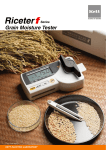
Grain Quality Analyzer RN-300, ALL IN ONE SPEC ANALYZER IS POPULAR AT ANY SITE.
GRAIN QUALITY ANALYZER
RN -300
It thoroughly inspects the external appearance of rice grain.
●This instrument was developed under Japan's research and development project for inspection instruments.
●Japan Mizuho Food Inspection Association approves this instrument with approval number 030101, 2/5/2003 for Uruchi (Japonica) brown rice
■ State of the art hardware is faithful to the human eye. It watches samples by observing reflectance and transmittance, like a human eye does.
●All-in-one type instrument. You can measure, display and print out at
the site
Camera, laptop PC, color LCD monitor and printer are all part of the one
instrument. You don't have to connect any cables nor buy any software.
You can measure, check on-screen, evaluate and file. External terminals
are equipped as standard.
●The featured measurement tray system is free from mechanical
troubles and minimizes optical contamination.
Since contamination of the sensor is fatal to the instrument, the sensor unit
of RN-300 is completely separated from the sample and is enclosed in
glass. This frees the optical measurement system from performance setbacks and mechanical troubles due to contamination. The measurement
tray is very easy to clean up.
●Optical
Measurement
Reflector
System Body
Rice
Sample
The sensor unit scans
Tray
the sample to receive
Glass
the RGB signals from
it. The travel of the
RGB
mechanism is deCCD
signed to be small to
Software
LCD
minimize vibration, so
Light Source Mirror
Sensor
Picture
that an accurate picture may be obtained.
Light Source + Sensor Unit Movement
●"Approval Mode" and "General Mode" selectable
"Approval Mode" classifies the brown rice grains in three criteria: ""Even
(Integral)", "Cracked", and "Other" in accordance with the analyzed values
of criteria approved by the Japan Food Inspection Association. "General
Mode" can classify it more finely up to a maximum of 21 criteria.
● You can construct a greater database
The numeric data may be filed in MS Excel format to use as a database.
Additionally, you can construct an even greater database using other database application software or the optional pre-install software "Kett Quality
Scan + DB Server" which works in accordance with the DLL format of the
developing environment. Contact us for the database construction details.
● The simple display is not a burden to the operator
Kett Quality Scan starts with the analyzer power being turned on. The
graphical user-friendly interface ensures easy operation. Just click the
"Measurement" button for normal use and select the functions with the "Select" button.
●Network capability is standard
A LAN terminal is equipped as standard. It enables you to share data, use
a printer or access the Internet.
●Emulating human eye observation is the target of the instrument
Kett's technical experience and know-how developed the RN-300 to display not only the numeric values as before but also the real video picture of
the grains. This highly integrated hardware and software now shows you
an image of the grains true to human eye observation. This is made possible by state of the art video picture technology and the exclusive software
"Kett Quality Scan".
● Displays data that fits the work at any site
The analyzer displays detailed data and pictures that are wanted at your
harvest site. In addition to the pictures, the amount of grains and the rate of
composition (grain amount in %, mass converted in %) are displayed for
each classified criterion. It also displays the histogram of the grain shape
analysis for you to confirm the uniformity of the grains. Each grain's quality,
typification rate, length, width, projected area size, etc. will also be displayed for you to see and utilize for your future farming projects and/or
breed refinement.
●Sure and versatile calibration function
The calibration function allows you to adjust the analyzer in case you want
to modify the accuracy or the result. It also allows you to adjust the measurement for unusual samples, where a normal analyzing function may not
be suitable. You can adjust the analyzer's inspection level to correspond to
a sample of which the component rate is already known.
● MS Excel format automatic save
All numerical measurement data with the date, time and the sample number can be saved automatically in MS Excel format. You can use the data
as is or edit it to suit your needs for your reference. All the data of the grain
components can be saved together in the same format when the instrument is connected with the component analyzer AN-800.
●Numeric printer as standard, color printer optional
Numeric data can be printed out on the spot from the attached standard
printer. Color pictures can be printed out with "Kett Quality Print", the optional color printing application. Here is a preview of the on-screen display
of the print menu and an example of a printout.
● Picture analysis
The shape and color analysis are carried out using the detected RGB signals. The size, length, width and proportion of each grain can be calculated
from the pixel number data. And from the color data discoloration, partial
discoloration, etc. can be detected. The color distribution pattern allows
recognition of "Even", "Immature", "Damaged", etc. The changes of color
concentration allow the instrument to recognize "Cracked", "Scraped
surface", "Partially discolored", "Germinated", "Unpolished (Germ remaining)", etc.
●You can construct an integrated quality grading system
Connect with the Kett Component Analyzer AN-800 to measure the inner
quality and build up your own "Rice quality grading system". AN-800 allows
you to view water content, protein, amylase and fatty acid (only in brown
rice) of brown or polished rice.
●One-to-one correlation of the sample and its picture
One measurement tray has 1148 (1152 minus 4) holes to line up sample
grains in 32 lines by 36 rows. Each hole has an address. Each picture
taken during measurement will be displayed with its corresponding address. [22-3] means the sample is located in the hole on the 22nd line, 3rd
row from the right. You can actually see and refer the picture to the measurement data.
■ "Kett Quality Scan" is the software suitable for use at any site.
●Brown rice and polished rice can be inspected in detail.
The quality of brown rice grain can be classified with 3 criteria at "Basic"
setting, 6 at "Standard", 21 at "Fine". For polished rice (optional) the following criteria are available: basic 4, standard 6 and fine 17. Furthermore,
remaining rate of germ can be displayed. The Japan Polished Rice Industrial Association and Kett coordinated to develop these criteria for polished
rice.
●Featuring a high performance laptop PC with large capacity hardware
The high performance laptop allows quick and easy processing of picture
data. 10,000 pictures of the measurement tray and the corresponding numeric data of the measurements can be stored in the HD memory.
●Tray measurement method ensures efficiency and practical
application
Being able to prepare more than one measurement tray allows a highly
efficient measurement when measuring various kinds of samples. It also
makes it easier for you to compare untested samples with ones you have
already measured. The automatic grain line former, TZ-700, is available as
an option.
RN-300 inspects and analyzes rice grain in a very similar manner to
the human eye. It displays its measurement results in numeric data
and video pictures. RN-300 is a portable machine. An excellent
optical measurement system combined with easily operated software
makes it the best partner for your rice quality evaluation.
On-screen display of the print menu by "Kett Quality
Print" software.
Example of a printout by the
attached printer.
●The analyzed data will be displayed on the standard color monitor
The detected picture and the numeric data will be displayed on the TFT
LCD screen. The color and shape are true to the sample. You can easily
look at the sample to compare it with the picture taken. During measurement you can always check by comparing the inspection of the analyzer to
an inspection by the human eye.
●24 sec. high speed process for data and picture display
The instrument takes only approx. 24 seconds to display the analyzed numeric data and the detected pictures of all 1,148 grains. For the rice grain
quality inspection, it is important to do a quick comparison check between
the human eye and the analyzer results. You can do several comparisons
using different people to confirm the analyzer's data.
Picture image processing
● Displays shown by the Kett Quality Scan
■ Thumbnail screen
■ Starting screen
Pictures of the sample appear on the left,
This display appears first when the power is
measured numeric data on the right of the
turned on. Select either "Approval Mode" or
screen. Numeric data includes crosswise grid
"General Mode". Also select brown rice or polnumber, quality, typification rate, length, width
ished rice (polished rice optional).
and projected size of all the grains. This may be
sorted to suit selected conditions.
RGB signal concentration distribution
■ Inspection result screen (Generic Mode)
■ Inspection result screen (Approval Mode)
On the upper left appears the histogram of the
On the upper left appears the histogram of the
shape analysis of the sample. On the right the
shape analysis of the sample. On the right the
amount of grains, mass converted to % for each
amount of grains, mass converted to % or the
of the 3 classified criteria.
grain amount in % for each classified criterion.
You can change the display from/to "Normal",
"Standard" and "Fine".
● Standard 6 classifications inspected by Kett Quality Scan
● Brown rice quality can be classified in 3 classes at "Basic", 6 at "Standard" and 21 at "Fine".
● Reflectance and the transmittance method (The glass, mirror and lens are not drawn in the illustration below.)
The optical system detects not only the front of the grain but also the color of the other side and/or cracks inside the grain.
(It is a simple mechanism that functions similarly to human eye observation.)
Reflector
Rice
Reflector
Reflector
Sample
tray
Rice
Sample
tray
Rice
Reflector
Sample
tray
Rice
Sample
tray
●Even, (Integral) ●Immature
●Dead
●Discolored
●Damaged (Cracked) ●Damaged (Deformed)
● Polished rice quality can be classified in 4 classes at "Basic", 6 at "Standard" and
17 at "Fine".
Light source
RGB
CCD
■ Even (Integral) grain
Light
reflects on the grain surface and reaches the RGB sensor.
Light
passes through the grain,
is reflected by the reflector and,
passing through the grain again,
reaches the RGB sensor.
Light source
RGB
CCD
■ Discolored grain (Upper side)
Light
reflects on the rice grain
surface and reaches the RGB sensor. Light
passes through the
grain and is colored before being
reflected by the reflector and,
passing through the grain again,
reaches the RGB sensor.
Light source
RGB
CCD
■ Discolored grain (Lower side)
Light
reflects on the colored
surface of the grain and reaches
the RGB sensor. Light
passes
through the grain, is reflected by
the reflector and, passing through
the grain again, reaches the RGB
sensor.
Light source
RGB
CCD
■ Cracked grain
Light
reflects on the grain surface and reaches the RGB sensor.
Light
is diffused and diminished
while passing through the crack
and, reflected by the reflector,
reaches the RGB sensor.
●Normal
●Powdered quality ●Damaged
●Discolored
●Crushed
●Heterogeneous
(Glutinous rice, etc)