Transcript
TGL
TRIGLYCERIDES
ENG
Reagent strips for the determination of Triglycerides concentration
To be used only with the 3in1.
Instructions for use
Introduction
Using the 3in1. Triglycerides strips it is possible to quickly check triglycerides levels in the blood. The level of triglycerides
in the blood is influenced from fat feeding or from alterations of the metabolism of lipids but also from diabetes mellitus,
nephrotic syndromes, pancreas problems, acute alcoholism. It is important to inform the family physician to find a suitable
therapy or to check-up on an existing therapy. Perform the test when you have not had anything to eat or drink (except water)
for at least 12 hours.
Test principle
The test is based on Lipase/Glycerol Kinase/ Phosphate Oxidase Glycerol /Peroxidase/Cromogen reaction. The intensity
the colour develops from the reaction is proportional to the concentration of triglycerides in the blood.
Composition
The reactive area of each strip contains: chromogen min. 0,017 mg; Lipase: 1,02 IU; Glycerol
3-phoshate
Oxidase 0,31 IU; Glycerol Kinase 0,41 IU; Peroxidase: 1.2 IU
Procedure
•Open the pack of 3in1. Triglycerides strips, pull out the data-chip of yellow color.
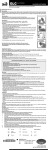
•Insert the data-chip into the proper space on the side of the meter (picture 1).
•Open the vial, take a strip and immediately close it.
•Insert the strip in the strip holder of the meter (picture 2), with the coloured side visible till to
hear an acoustic signal (“bip”)
•Check that TGL symbol appears on the display and check that the number on the strip vial
label is the same of the one on the display (picture 3).
•wash the hand with hot water and massage the finger that you choose for the pricking to
increase the blood flow.
Let your arm hang down for about one minute
•execute the puncture of the finger using the lancing device and a sterile lancet.
•remove the first drop with a sterile gauze and gently press the finger to obtain a second drop
(10 microliters)
•approach the pricked finger with the drop of blood to the lower part of the strip (picture
4), it is the part that come out of the instrument. The sample of blood will be automatically
aspirated by the strip. Do not remove the finger until the moving segments will appear on the
display (the instrument will emit an acoustic signal “bip”).
•After some seconds the result will be displayed
•Use the ejector key on the backside of the meter to remove the used strips in order to avoid
contaminations
Only one measurement has to be carried out for each finger pricking!
Carefully follow the instructions contained in the user manual.
All components of the pack has to be disposed properly, avoiding
contaminations.
Testing the system
A check-up of the user’s skills, the correct working of the 3in1. Triglycerides instrument and its strips, must be periodically
carried out through the use of the Triglycerides 3in1. Triglycerides Control Solutions and by following the included
instructions. The expected results for this test are printed on the vial’s label of the 3in1. Triglycerides strips that are being
used.
Storage and expiry date
Keep the reactive strips at temperatures between 5°C (41°F) and 30°C (86°F) and keep them in the original Do not expose
to direct sun light.
Close the vial with the original cap immediately after pull out the strip. In this way, the strips will last up to 3 after the first
opening.
The expiry date on the package of strips refers to a new unopened vial.
The use of expired strips can cause wrong results. Do not expose to excessive humidity. Do not freeze!
Table of results displayed
Below 50 mg/dL (0,5 mmol/L) = LO*
Between 50 mg/dL (0,5 mmol/L) and 500 mg/dL (5,6 mmol/L) = the numerical result
Above 500 mg/dL (5,6 mmol/L) = HI**
*Repeat the test.
**Such results mean that the Triglycerides concentration in the sample is very elevated
and it indicates a serious risk.
Contact a phisycian immediately.
Triglycerides values.
Less than 150 mg/dl (1,7mmol/L) = Normal
Borderline High= 150-199 mg/dL (1,7-2,2 mmol/L)
High= 200-499 mg/dL (2,3-5,6 mmol/L)
Very High= 500 mg/dL (5,6 mmol/L) or above
The analytical results have to be communicated to the physician.
The self-checking can be useful for the physician in order to formulate a diagnosis.
Warnings
•Long exposure to air and light can alter the results. It is recommended to keep the strips in the original vial with the cap at
room temperature between 5 and 30°C (41°F and 86°F).
•Avoid exposing to excessive humidity, do not freeze!
•Keep the 3in1. Triglycerides strips away from children.
•Do not perform any tests bellow 10° C (50°F) or above 40°C (104°F).
•Do not touch reacting strips with polluting agents, like for example dirty hands, the results could be seriously altered.
•Use the strip immediately after removing it from the vial.
•Make sure the vial is properly closed after removing the strip and use its original cap containing siccative material.
Do not place the strips in a different container.
•The 3in1. Triglycerides strips must be used within and not after the expiry date on the package.
Once the vial has been opened, use the strips within 3 months. The reactive area on the strip is white in optimal
conditions. Do not use the strip if the reactive area has a different colour.
•Notes for doctors and labs
•To measure the Triglycerides with the 3in1. system it is possible to use fresh capillary blood. Do not use serum or
plasma on the strip
Limitations
•If the value of triglycerides after testing does not correspond to the normal sensations felt by the patient and to the basic
knowledge of health conditions and symptoms, repeat the test.
Read the user manual to verify the correct determination procedure and consult your physician.
•The result is affected by high levels of hemoglobine, bilirubin and ascorbic acid.
•Inaccurate results can be obtained at high altitudes since the concentration of oxygen is lower.
•Abnormal values of hematocrit (higher than 50% or lower than 30%) can influence the results.
•Minimum volume of blood sample: 10 μL.
Accuracy
The average error of the 3in1. Triglycerides system compared to the reference method GPO is <10%.
In a series of measurements performed in a hospital, the following linear regression has been obtained y=0,9814x +3.8374.
Precision
Repeatability: the average inaccuracy is <5%, in a series of measurements performed in laboratory an average coefficient
of variation of 4.66% was obtained.
Reproducibility: the average inaccuracy is <5%, in a series of measurements performed in laboratory an average coefficient
of variation of 4.62% was obtained.
References. Onat A, Sari I, Yazici M, Can G, Hergenc G, Avci GS. Plasma triglycerides, an independent predictor of
cardiovascular disease in men: A prospective study based on a population with prevalent metabolic syndrome.
Int J Cardiol. 2005 Aug 4; [Epub ahead of print].
CE mark
Use until ...
Control Solutions
In Vitro
Diagnosticum
Batch number
Level 1
Store at ...
Follow instructions
Level 2
VPD Bled d.o.o.
Pot na Lisice 4, 4260 Bled, Slovenia
tel:
++386 4 574 50 70
fax:
++386 4 574 50 71
In vitro diagnostika
IN TGL ED2009 REV01-E-SL