1
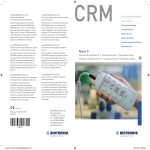
Cardiac Rhythm Management
BIOTRONIK Home Monitoring
Patient Information
Your heart is safe with us
BIOTRONIK Home Monitoring® – Your heart's link to your physician
BIOTRONIK Home Monitoring®
www.biotronik.com
Table of contents
Introduction
05
Messages Straight from the Heart: Technology That Makes Sense
07
What Is Home Monitoring?
09
Why Would I Need Home Monitoring?
11
How Does Home Monitoring Work?
14
Your Direct Connection to the Doctor
16
Studies Confirm the Benefits of Home Monitoring
17
Where Does Home Monitoring Work?
19
How Can Home Monitoring Help My Doctor Provide Even Better Care?
22
How Does My Doctor Use Home Monitoring?
25
What Is Everyday Life Like with the CardioMessenger?
31
How Do I Set Up My CardioMessenger?
32
Where Should I Set Up My CardioMessenger?
33
Do I Need to Recharge My Mobile CardioMessenger?
34
Do I Need to Recharge My Bedside CardioMessenger?
35
How Do I Set Up My CardioMessenger Charging Station?
36
What Do I Need to Know About Carrying My CardioMessenger?
37
Frequently Asked Questions
39
04 | 05
Introduction
Millions of people all over the world have an implanted pacemaker, defibrillator, or
cardiac resynchronization device. If you are one of these people, or if you are about to
have such a device implanted, you probably have a lot of questions and concerns. You may
already know that you will have to see your physician regularly, probably two, three or
more times a year to check on the device. But what if something changes between
check-ups? That is why we want to introduce you to an exciting technology that changes
the relationship between you, your doctor, and your heart.
It’s called Home Monitoring technology from BIOTRONIK.
BIOTRONIK Home Monitoring®
06 | 07
Messages Straight from the Heart
Technology That Makes Sense
BIOTRONIK has created a revolutionary new system that allows your pacemaker,
defibrillator or cardiac resynchronization device to connect to the cell phone network
or landline in such a way that it can communicate directly with your physician.
That’s right – your implanted device can communicate directly with the clinic, sending
up-to-the-minute information about your heart and your device to the doctor’s office.
It’s called Home Monitoring: and the best part about it is that it works automatically.
While there are some ways you can interact and initiate Home Monitoring
messages, most of the time — day in and day out — Home Monitoring operates
automatically, without your having to do a thing.
You probably have a lot of questions about Home Monitoring, which is why we’ve
created this booklet to help answer the most frequently asked questions. Nevertheless,
you should always speak with your doctor to get information that is right for you.
08 | 09
What is Home Monitoring?
Home Monitoring is a system that allows your implanted BIOTRONIK cardiac device to
communicate directly to your physician — automatically. Take the following examples –
wouldn’t it be ideal if your doctor was informed immediately if one of the following were to
occur?
Home Monitoring works together with a small device called the CardioMessenger.
The CardioMessenger is about the size of a large cell phone and is meant to be carried
with you on your belt, in your purse, or in your pocket (not the breast pocket). Its similarity
to a cell phone is very appropriate — CardioMessenger’s job is to communicate using
the worldwide cell phone network (sometimes called the GSM network). Standard landline
connectivity is also available in the USA and a few other countries.
Your implanted cardiac device contains a built-in antenna that periodically dispatches
reports on your heart and the device. The CardioMessenger picks up these signals and
forwards them to a service center, which processes the information and posts it on a
secure website for your doctor to review. Urgent matters may go directly to your doctor
by fax, email, or cell phone in addition to being posted on the physician’s secure website.
Home Monitoring with CardioMessenger works around the clock and can function just
about anywhere where there is cell phone access. In case you have never heard of
Home Monitoring before, don’t be surprised. Home Monitoring is a recently developed
mobile technology that is available from only one cardiac implant company in the world —
BIOTRONIK.
10 | 11
Why Would I Need Home Monitoring?
Home Monitoring keeps your doctor informed about what’s going on with your heart,
your implanted device, and how they are interacting.
An arrhythmia occurs
Your implanted defibrillator has to deliver therapy
The battery in your pacemaker is getting low
The insulated wires used by the implanted device are performing
out-of-specification
With an ordinary implanted device, your doctor may not know about such things until
the next time you come into the clinic. With Home Monitoring, the physician receives
information at regular intervals. Most of that information will be good news:
Your heart is beating normally
The pacemaker is operating appropriately
No arrhythmias have occurred
The battery of your implanted device has plenty of energy left
12 | 13
Why Would I Need Home Monitoring?
Home Monitoring Advantages
Most of the time, such reports just confirm that you and your device are doing fine.
But isn’t it comforting to know that if anything even seems a bit out of the ordinary,
Home Monitoring will report it to your physician right away?
Home Monitoring will monitor your implanted device constantly,
automatically, and around the clock
Home Monitoring notifies your doctor about concerns regarding your heart,
your device, or how you and your device are interacting
Home Monitoring can also be used by your physician to help monitor your
drug therapy
Home Monitoring works just about anywhere a cell phone works, which means you can lead an active life and even travel without losing the benefits of Home
Monitoring
Home Monitoring does not require you to fuss with complicated devices or learn some kind of software — it’s automatic and is as easy as carrying around
a cell phone
How Does Home Monitoring Work?
If you have or are about to receive a pacemaker, defibrillator or cardiac resynchronization
therapy device from BIOTRONIK with Home Monitoring, congratulations! You have access
to the world’s most advanced system of device-physician communication.
1.
2.
3.
4.
5.
Here’s how it works:
1. Your BIOTRONIK device with Home Monitoring has a tiny antenna built into the device.
At regular intervals, the device sends out reports about how it is functioning and what
your heart is doing. Most of the time, these reports confirm normal activity. If something
unusual occurs, the device will send out a special report — if you experience an episode
of atrial fibrillation or if your device battery starts to get low for example. This message
is transmitted wirelessly, silently, and automatically to the CardioMessenger.
14 | 15
2. The CardioMessenger (stationary communicator) is the device that sits on your bedside table or that you carry with you during the day (mobile communicator). It picks up
the messages sent out by your implanted device at regular nightly intervals, or when
some unusual event takes place.
3. The CardioMessenger receives the message and forwards it, via the telephone network, to a service center at BIOTRONIK. (In case you are interested in the technical
process, the data are transmitted as an encrypted medical message in SMS (Short
Message Service) format and are forwarded via the GSM network or a standard landline system to a secure data processing center.)
4. At the data processing center, the information is collected into special reports. These
reports appear on a secure website that your physician can visit from any computer
with internet access. (This means your doctor can still access Home Monitoring information even if he or she is out of town.)
5. Your physician can review Home Monitoring reports periodically and will be alerted if
something unusual is detected. If the physician needs to see you, he or she will call
you to make an appointment.
Your Direct Connection to the Doctor
Home Monitoring information comes to your doctor in the form of a CardioReport,
which he or she can view on the secure website.
Many physicians set up the Home Monitoring system like this:
The daily reports contain data that can be summarised in order to create detailed
reports on how your heart and implanted device are functioning over time.
Physicians call these reports “trend data”. Trend data can be very important in
assessing your progress or fine-tuning your therapy.
If you ever experience a sudden change in your heart function, your implanted
device, or how the two are interacting, your physician will be informed at once.
Your device will quickly send out a message to the CardioMessenger, which, in
turn, will send it to the service center and the doctor. Your physician will be
informed with a special message via fax, email, or cell phone, and the information
is immediately posted on the secure website for the physician’s private review as
well. This allows your doctor to be immediately informed of certain changes that
may require adjustments to your device or to your therapy.
16 | 17
Studies Confirm the Benefits of
Home Monitoring
Although Home Monitoring is a recent development, it has already been the subject of
numerous clinical studies. The first such study was published in 2002 and demonstrated
that Home Monitoring worked safely and reliably.1
This study also showed that for patients with heart failure, using Home Monitoring
actually decreased their risk of having to go back to the hospital and improved their
overall quality of care.
A recent clinical study presented at the American Heart Association in 2008 found
that Home Monitoring could safely decrease the number of check-ups that device
patients had to have. To date, the numerous clinical studies have shown over and over
that Home Monitoring is safe and effective.2
Sources:
1
Wallbrueck K, Stellbrink C, Santini M et al. The value of permanent follow-up of implantable
pace-makers-first results of a European trial. Biomed Tech (Berlin) 2002; 47(Suppl.1, Pt. 2): 950-3.
2
Varma, et al, American Heart Association (AHA) Scientific Sessions, Late-Breaking Clinical Trial
Abstracts 2008, Circulation 2008, 118, 2309-2317.
18 | 19
Where Does Home Monitoring Work?
Home Monitoring works where you are. Using the CardioMessenger, your device can
send information that can be forwarded to the service center and your physician just
about anywhere there is reliable cell phone access. In the rare situation that you reside
in an area of weak cellular access, a landline-based CardioMessenger may be an
option.
As a person with an implanted pacemaker, defibrillator, or cardiac resynchronization
device, you should always discuss your travel plans in advance with your physician –
especially if you are travelling out of the country or will be travelling for extended
periods of time.
Make sure you tell your doctor in advance if:
Your travels take you to countries that are not on this list
You are travelling outside of your time zone (since your doctor may want to reset when Home Monitoring sends its daily report)
Where Does Home Monitoring Work?
Countries where your CardioMessenger works
20 | 21
Andorra
Estonia
Japan
St. Vincent
Argentina
Finland
Jordan
in the Grenadines
Australia
France
Latvia
San Salvador
Austria
French Guiana
Liechtenstein
Saudi Arabia
Bahamas
Germany
Lithuania
Slovakia
Belgium
Great Britain
Luxemburg
Slovenia
Belize
Greece
Malta
Spain
Bolivia
Grenada
Mexico
Suriname
Brazil
Guatemala
Netherlands
Sweden
Canada
Guyana
New Zealand
Switzerland
Chile
Haiti
Nicaragua
Trinidad & Tobago
China
Honduras
Norway
Tunisia
Colombia
Hong Kong
Panama
Turkey
Costa Rica
Hungary
Paraguay
Uruguay
Cyprus
Iceland
Peru
United States of
Czech Republic
India
Poland
America
Denmark
Ireland
Portugal
Venezuela
Dominican Republic
Israel
Puerto Rico
Dutch Antilles
Italy
Romania
Ecuador
Jamaica
Russia
How Can Home Monitoring Help My Doctor
Provide Even Better Care?
Every patient is different. Even patients with the same heart condition and the same
device may have very different needs when it comes to their therapy and how their
doctors monitor them. That’s why there are important ways in which Home Monitoring
can help your physician provide you with the very highest level of care.
Fine-Tuning Your Therapy
Your heart will change over time — it happens to everyone. The medicines you take (or
stop taking) can affect how your heart behaves. While nothing can stop your heart from
changing over time, your doctor can re-adjust or fine-tune your therapy (with drugs or
on the device) to meet these changing conditions. Home Monitoring provides your doctor
with the information he or she needs to fine-tune your therapy so that it exactly meets
your needs at any given point.
22 | 23
Early Diagnosis
Sometimes, people with one type of arrhythmia develop another type of arrhythmia. With
Home Monitoring, your physician will know very early if you show signs of developing
another kind of rhythm disorder such as atrial fibrillation. Early diagnosis can allow your
doctor to treat the condition in its first stages, either with medication or by reprogramming your implantable device. With many conditions, early detection and early treatment
produce the best results.
Fewer Shocks
If you have or will receive a defibrillator, you know that the device can deliver lifesaving electrical shocks in the event that you experience a dangerous rhythm disorder.
The use of Home Monitoring can help keep these shocks to a minimum. Home Monitoring will notify your doctor whenever a shock has been delivered and will provide other
information about your heart that can be used to adjust your therapy. Fewer shocks can
make life more pleasant for defibrillator patients and could help extend the life of the
device’s battery, too.
24 | 25
How Does My Doctor Use Home Monitoring?
Home Monitoring provides your doctor with two main streams
of information:
Daily updates that are incorporated into Trend Reports to exhibit the long-term
performance of your heart and your implanted device
Early Detection reports that notify your doctor about unusual conditions
Your physician (or any colleague whom he or she designates) can check on your overall
condition by visiting the secure website. Your physician won’t likely do that every day, but
he or she can check up on you regularly “behind the scenes”. If you ever need to miss
or postpone an appointment, your physician can get information from the website as to
how you are doing. In fact, sometimes you may be permitted to skip certain check-ups
because Home Monitoring can fill in the gaps.
If something unusual is reported, your physician will be notified at once. While this information also appears on the website, clinics usually ask that it be sent to them by cell
phone, email, or fax. This alerts the physician quickly as to what is going on.
How Does My Doctor Use Home Monitoring?
Getting Your Symptoms on the Record
Many times, people call their doctors because they are experiencing certain symptoms —
but as soon as they arrive at the doctor’s office, the symptoms disappear! Wouldn’t it
be nice if you could have those symptoms “on the record” so your doctor could analyze
them? With Home Monitoring, you can!
When you visit your physician, he or she can use Home Monitoring to see how your heart
and your device have been behaving over the past few days, weeks, or months.
This is a great advantage to physicians, who can use actual cardiac data on which to
base their diagnosis. It also helps you, as a patient, since your doctor is getting the most
accurate information available. Depending on the situation, your physician may use this
information to adjust your implantable device, your medications, or both.
26 | 27
Time of Day
Another frustrating situation for people with a cardiac condition is that they may experience a peculiar episode … only to have it go away. If you have ever had a dizzy spell, felt
your heart racing, or have noticed strange sensations in your heart every night when you
go to bed, you can now use Home Monitoring to help better identify the cause of your
symptoms. Simply note the date and time when you experienced any unusual episode or
symptoms. Whether it occurred only once or happens every night, keep
a record of the time that they occur.
Your doctor can then use the Home Monitoring data to see what was actually going
on with your heart and with the implantable device during those time intervals. This may
take a bit of detective work and a few adjustments, but your physician can use Home
Monitoring to find out the story behind your episodes and adjust your therapy accordingly.
How Does My Doctor Use Home Monitoring?
Doctor, Is This Serious?
Many people are unsure when they should call their physician. On the one hand, it is
smart to be cautious and see the doctor about symptoms. On the other hand, people
should not run to the physician with every little complaint. How can you know if your
current symptoms are worth a trip to the doctor’s office? You can call the doctor’s
office and they can get information from Home Monitoring for the past few hours or
days. From this information, they can gauge what is going on with your heart and your
implantable device.
If it’s nothing serious, your doctor may allow you to stay home but warn you of other
symptoms to look out for. If it is something that may require a change in your treatment,
your physician can arrange for you to come into the office. The result is that you only see
your doctor when it’s really necessary.
28 | 29
30 | 31
What Is Everyday Life Like with the
CardioMessenger?
Your CardioMessenger was designed to be portable and easy to integrate into your
normal, everyday routine. The mobile version of the CardioMessenger can be worn on
your belt, put in a purse or carried in a briefcase. Although it should not be carried in
your breast pocket (too close to the implanted device), it may be put in your jacket
pocket nearest the waist. In many ways, it travels with you the same way you would take
your cell phone. At night, place the CardioMessenger on your nightstand. Since it doesn't
make any noise it can remain near to you while you’re asleep. (Remember, CardioMessenger typically sends its daily report in the middle of the night.) The CardioMessenger
is wireless, portable, and can go anywhere with you. It does not make any noise so it can
be carried into theaters, offices, libraries, and other quiet places without fear of creating
a disturbance.
You may need to get used to the CardioMessenger, but you will soon find out that it is
an easy habit to keep. Most people will not even notice your CardioMessenger unless
you point it out to them.
Depending on your condition and your preferences, your physician may allow you to
keep the CardioMessenger next to your bed all of the time, or may ask that you carry the
CardioMessenger with you during the day. Discuss with your physician which approach
is the best type of Home Monitoring for you.
How Do I Set Up My CardioMessenger?
You will receive your CardioMessenger device from your doctor in a ready-to-operate
condition. For the mobile CardioMessenger, you will also receive a charging station,
power cord, and an electrical adapter. Make sure you also receive a copy of the
CardioMessenger user’s manual, which you should keep in a safe place as a reference for
CardioMessenger set-up and operation. Your doctor or nurse will show you how to use the
CardioMessenger and verify that it is working properly before you leave the clinic.
32 | 33
Where Should I Set Up My
CardioMessenger?
Most doctors suggest that patients keep their mobile CardioMessenger in its charging
station near the bed, usually on your night table or headboard. In order for your mobile
or bedside CardioMessenger to be able to receive signals from your implantable device,
however, your CardioMessenger must be placed no less than 6 inches (20 cm) and no
more than 6 feet (2 meters) away from the implanted device.
In addition, your CardioMessenger should be able to establish a good connection to
the cell phone or standard telephone network. To check if this is the case, take your
CardioMessenger where you plan to set it up and turn it on. The light will start to blink
yellow. If the blinking yellow light turns green within five minutes, the location is favorable and data should be transmitted without any problems. If the light does not turn
green, turn the CardioMessenger off, find a different location, and try again.
You will also need to choose a location close to an electrical outlet so that the charging
station can be plugged in.
Do I Need to Recharge My Mobile
CardioMessenger?
Yes, you need to charge your CardioMessenger, just like you would charge a cell phone.
Just put your CardioMessenger into the charging station cradle and it will automatically
recharge. This should be done at least once per day. For further information regarding the
care of your CardioMessenger, please consult the user’s manual you receive together with
the CardioMessenger communicator.
34 | 35
Do I Need to Recharge My Bedside
CardioMessenger?
No. Since the bedside CardioMessenger uses household electricity (110 / 220 V), there is
no battery to recharge. You simply leave your device plugged into the electrical wall outlet
at all times. A green light will appear to indicate that the device is functioning properly.
For further information about the functioning of either CardioMessenger device, please
consult your physician, nurse or the CardioMessenger user’s manual.
How Do I Set Up My CardioMessenger
Charging Station?
You will receive a charging station with your CardioMessenger. Once you find an
appropriate location for your CardioMessenger, here is how to set up the charging
station as follows:
Plug the power cord into an ordinary wall outlet.
Plug the other end of the power cord into the adapter.
The adapter has a cord with a smaller plug that should be inserted into the
base of the charging station.
In the USA, you may also be provided with a phone cable to connect to your
standard telephone system. Insert one end into the base of the CardioMessenger
and the other into your telephone wall outlet as shown in the user’s manual
instructions. Your charging station is now ready for use.
36 | 37
What Do I Need to Know About Carrying
My CardioMessenger?
You can carry your mobile CardioMessenger on your belt, in a backpack, briefcase or
purse, or in your pocket — with the exception of your breast pocket. Do not carry the
CardioMessenger too close to the implantable device in order to avoid interference. It
must be kept at least 6 inches (20 cm) away from your implanted device to work properly
and it can be kept as far as 6 feet (2 meters) away.
Your doctor or nurse will show you how to turn the CardioMessenger on and off.
Turn it off whenever you are in an airplane (when they alert you to turn off all portable
electronic devices), in hospitals, or whenever you are around sensitive measuring
equipment or electronic devices. When you are no longer in such an environment simply
turn the CardioMessenger back on. A green light will reappear to indicate that your
CardioMessenger is once again functioning properly.
Do not allow your CardioMessenger to touch water or become submerged in water.
This will cause damage to the device.
38 | 39
Frequently Asked Questions
I know other pacemaker patients that do not have Home
Monitoring. Why do some people have Home Monitoring and
others do not?
Home Monitoring is only available with certain pacemakers, defibrillators, and cardiac
resynchronization therapy devices from BIOTRONIK. Your physician will help you decide
whether Home Monitoring is right for you.
When did BIOTRONIK invent Home Monitoring?
Home Monitoring is actually a type of telemedicine, which means that medical data can
be reviewed remotely. Telemedicine in pacing actually began many years ago with
something called trans-telephonic monitoring. Although quite primitive compared to
what we have today, pacemaker patients could send information from their implanted
device over a normal phone line to the doctor’s office as early as the 1980s. BIOTRONIK
developed a system that allowed more detailed information to be sent automatically
from an implanted device to the doctor’s office (not only with pacemakers, but with
defibrillators and cardiac resynchronization devices as well). Some of the first Home
Monitoring systems were already in operation in the year 2000. BIOTRONIK has made
many advances to their system since then.
Frequently Asked Questions
What kind of advances have been made in
Home Monitoring since 2000?
CardioMessenger represented a major advance. This allowed Home Monitoring patients
to be able to travel and move about freely without giving up Home Monitoring. Early
Detection, which allows the implantable advice to dispatch an urgent message if something out of the ordinary occurs, was another major milestone. Many of the other
advances involve ways in which messages are stored, transmitted, and reported. They
make Home Monitoring very easy for physicians and their patients to use on a daily basis.
Can Home Monitoring reduce the number of
check-ups I need?
That is a hard question to answer for all patients. In general, Home Monitoring can
reduce the number of check-ups you need. However, every patient is different and a
great deal depends on your overall health, your cardiac condition, other complications you
might have, and your physician. Discuss this with your physician – he or she is the expert
on your particular medical condition.
40 | 41
It was stated that people with heart failure have a lower risk of
going back to the hospital if they have Home Monitoring. How do
you explain that?
Heart failure is a progressive disorder, meaning that a person with heart failure has a
permanently changing cardiac condition. People with heart failure may need frequent
adjustments to their prescriptions, need to change or add new drugs, and those with
cardiac resynchronization therapy devices may need to make frequent adjustments to
their devices. In order to make those adjustments, the doctor must be able to assess
regularly the patient’s condition. People with heart failure are often rehospitalized
because their condition has gotten worse and because therapy was not adjusted quickly
enough or not at all. Home Monitoring can change that by providing the physician with
frequent updates on the patient’s status, letting him or her identify trends that indicate
the need for therapy adjustment.
Frequently Asked Questions
What happens if my doctor finds something wrong with my
heart using Home Monitoring?
There are cases on record where the doctor has used Home Monitoring to pick up
problems before the patient even knew something was wrong. If something like this
should happen, the doctor’s office will contact you and schedule an appointment.
You should make every effort to see your doctor as soon as you can. The doctor may
then want to adjust the device, change your medications, or suggest some other
therapy to address what is going on.
42 | 43
What are the disadvantages to Home Monitoring?
Apart from getting used to carrying around the CardioMessenger device, this system
really has no disadvantages. It works automatically and silently, so it is not difficult to use.
You have nothing to remember and no complicated technology to operate. It’s completely
painless; in fact, you will not even be aware that it’s working. You may even forget that you
have it after a while, as your physician will have no reason to contact you provided that all
reports come back normal. You can easily travel to many parts of the world without
compromising your care. And should you enter an environment where electronic devices
must be turned off (such as an airplane), it’s very simple to turn the CardioMessenger on
and off. Even if you are one of the people who is “not good with technology”, you’ll be able
to work with the CardioMessenger and Home Monitoring with ease and confidence from
the very start.
/ / 906
BIOTRONIK GmbH & Co. KG
Woermannkehre 1
12359 Berlin · Germany
Telefon +49 (0)30 68905-0
Fax +49 (0)30 6852804
[email protected]
www.biotronik.com
©BIOTRONIK GmbH & Co. KG
All rights reserved. Specifications
are subject to modification, revision
and improvement.