1
$D93B (PORTHI) – Port Address, HI BYTE.
5. Hard Drive Setup
Reflects the address of the SCSI controller in the CoCo’s
memory map.
$D93C (PORTLO) – Port Address, LO BYTE.
Once you have selected your hard drive, you will find that
setup is simple and straight forward. As always, the
instructions should be followed carefully if the best results
are expected.
(1) Turn OFF power to the Color Computer, Multi-Pak
Interface and any other equipment connected to the
computer.
(2) Locate your hard drive data cable and connect it to
your hard disk interface and the hard drive unit(s).
Be sure to install the cable properly (Pin 1 to Pin 1,
etc.).
(3) Plug your hard disk interface into the Multi-Pak
Interface or "Y" cable. If using the Multi-Pak
Interface, set the selector switch to the slot that
contains the HDB-DOS EPROM. If your HDB-DOS
EPROM is installed in your Floppy Disk controller set
your slot selector switch to the Floppy Disk
Controller's slot. If the EPROM was preinstalled in
your hard disk interface, set your slot selector switch
to the interface's slot.
(4) Plug any other accessories you may have into the
Multi-Pak Interface or "Y" cable, including the Floppy
Disk Controller.
14
Reflects the address of the SCSI controller in the CoCo’s
memory map.
$D93D (TIMOUT) – Timeout Value.
For SCSI this is used as a command timeout. For IDE, this
value is used at the startup of HDB-DOS to indicate how
long to wait for an IDE device to spin-up and become
available (in 1/10ths of a second).
$D93E (DEFID) – Default SCSI/IDE ID.
This is the SCSI/IDE ID of the main HDB-DOS drive. In the
case of SCSI, some drives, such as ZIP drives, can only be
set to SCSI IDs 5 or 6, and this is where that ID would be
placed. IDE allows only the values 0 (master) or 1 (slave).
RAM Variables
HDB-DOS utilizes certain portions of low RAM for its own
use. Here are the offsets and their designations.
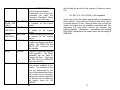
Address
$00F3
Name
VCMD
Usage
Up to 10 bytes used to store
the command data which is
sent to the SCSI/IDE device
during the COMMAND phase.
This VCMD+9 buffer is also
used to read SCSI sense
(error) information.
43