1
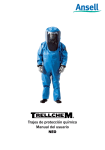
SPLASH 2000P
USER MANUAL
3
Index....................................................................................... Page
IMPORTANT!............................................................................... 5
Certificates and approvals..................................................... 6
Description of suit .......................................................................................6
EC type approval...........................................................................................6
Marking on the suit.................................................................. 7
Symbols/Pictograms....................................................................................7
Marking of components..............................................................................8
Size.....................................................................................................................8
Individual marking.........................................................................................8
Suit material................................................................................ 9
Gloves........................................................................................... 9
Footwear...................................................................................... 9
Air distribution system............................................................. 9
Description.......................................................................................................9
Technical information...................................................................................9
Undergarments........................................................................10
Safety considerations............................................................10
Preparations and check-ups before use..........................12
Donning......................................................................................13
Doffing........................................................................................19
Emergency procedure in case of a PAPR failure............................ 19
Storage instructions...............................................................20
Inspection..................................................................................21
Repair and maintenance.......................................................22
Repair of suit - general.............................................................................22
Repair of punctures and minor damages.........................................22
Repair of air distribution system...........................................................26
Trellchem Bayonet glove ring system - general.............................. 27
Replacement of rubber gloves (Trellchem Bayonet glove
ring system...................................................................................................29
3
Replacement of cuffs (PU-ring set)..................................................... 31
Maintenance instructions - Bayonet rings........................................ 37
Maintenance instructions - Gloves...................................................... 37
Maintenance instructions - Overpressure valve............................. 37
Spare part list..............................................................................................38
Cleaning instructions.............................................................38
Decontamination guidelines................................................39
Retirement and disposal.......................................................42
Chemical and technical data...............................................43
Suit material data.......................................................................................43
Glove data.....................................................................................................44
45
IMPORTANT!
This manual is valid only for the Trellchem® Splash 2000P suit. There is a
separate user manual for the PAPR unit. For information on filters, see the
PAPR manual.
The suit must be used with a Scott Proflow 2SC 160 PAPR. Do not use
without the PAPR. Only original Scott A2B2E2K2P3 filters may be used.
Before use all users must have undergone practical training of the donning,
use and doffing of the suit. Such training must include exit and doffing during
an emergency, such as a PAPR failure.
A risk analysis must be performed to determine the protection level and
type of protective clothing required before any work involving chemicals is
performed.
The suits may only be used by trained personnel that are familiar with the
contents of this manual. Failure to comply with any of the recommendations
given herein may result in serious injury or death.
Please check http://protective.ansell.com to make sure you have the latest
edition of this manual.
5
Certificates and approvals
General instructions for use, maintenance etc. are given below.
Description of suit
The Trellchem® Splash 2000P suit is intended for respiratory protection,
type 3 / liquid tight chemical protection and protection from infective agents.
The suit is of reusable type. The suit must be used with a Scott Proflow 2SC
160 PAPR. Do not use without the PAPR.
When used correctly the system provides respiratory protection that fulfils the
inward leakage requirement of EN 943-1:2002. The suit provides chemical
protection according to type 3 of EN 14605:2005 and type 3B protection
from infective agents according to EN 14126:2003. The system is tested
and approved with the Scott Proflow 2SC 160 using A2B2E2K2P3 filters.
For more information on filters, please see the PAPR manual. Important:
See ”Safety considerations” for safety considerations and limitations of use.
EC type approval
EC type approval for the Splash 2000P suit and the complete system has
been issued by FORCE Certification A/S, Park Allé 345, DK-2605 Bröndby,
Denmark, notified body 0200. EC type approval certificate DK-0200PPE-1791 ver.2. See the PAPR manual for information on the approval of
the PAPR unit.
The suit and system is CE marked according to the PPE directive 89/686/EC
as amended and is approved as a type 3 reusable chemical protective garment,
also providing protection from infective agents.
67
Marking on the suit
Symbols/Pictograms
This marking (CE-marking) indicates that the
suit has been subject to EC type examination
and complies with the Council Directive on
Personal Protective Equipment 89/686/EC.
This pictogram indicates that the suit offers
chemical protection.
This pictogram indicates that the suit offers protection against infective agents
(EN 14126).
This pictogram indicates that this manual as
well as the one for the PAPR unit have to be
read.
This pictogram indicates the size of the suit,
see below.
This pictogram indicates that the suit is only
to be hand washed (max. 40 °C/104 °F).
This pictogam indicates that the suit shall not
be tumbled dry.
7
This pictogram indicates that the suit shall
not be dry-cleaned.
Marking of components
The manufacturing date indicated on the label may be used and applied to the
suit as a whole, including its attached components except the PAPR, which
has its own marking. With the exception of the PAPR, individual components of the suit have no marking/label. See ”Recommended shelf life” for
shelf life of the suit. See ”Repair and maintenance” for service/replacement
intervals for components. See the separate PAPR user manual for marking
on the PAPR unit.
Size
The size of the suit is indicated by letters XS-XXL and by indicating the size
of the user in a pictogram as above. The figures in the pictogram indicate the
height and the chest/bust girth of the user in centimetres.
Available size range:
Size range
XS
S
M
L
XL
XXL
Height
Chest/bust girth (cm)
164-176
84-92
170-182
88-96
176-188
92-100
182-194
96-104
188-200
100-108
200-212
104-116
Individual marking
Marking can be made with a ”permanent marker” pen. Other means of marking may be available. Contact your supplier for advice.
89
Suit material
The suit material is made from a PVC coated fabric and the visor is made
from 1 mm rigid PVC.
Gloves
The standard glove for Splash 2000P suits with attached gloves is the Nitrile/
Chloroprene rubber glove. As an option, the Trellchem® Chloroprene rubber
glove may be used. Gloves are attached with the Trellchem® Bayonet glove ring
system. Optionally they may be attached with the PU-ring set. Information
on the chemical resistance of the gloves can be found in chapter ”Chemical
and technical data”.
Footwear
If the suit is fitted with boots, these are PVC safety boots.
Air distribution system
Description
The air supply inside the suit is distributed by a silencer breathing hose system,
which leads the air from the PAPR outlet through the silencer by tubing upon
the spine and over the head, ends in front of the visor.
Technical information
• PAPR flow rate: 160 litres/min
• Noise level: <75 dB(A)
• Suit/PAPR system respiratory protection fulfils the inward leakage requirement of EN 943-1:2002
9
Undergarments
For very cold weather and/or where there is a risk of contact with chemicals at
very low temperature, insulating undergarments like the Trellchem® Insulating
Underwear that protect the user from frost bite, should be used. Note: Make
sure you have the right size of suit depending on type of undergarment.
Safety considerations
All personnel should be acquainted with this manual before using the suits.
Limitations of use
The Trellchem® Splash 2000P suit is a type 3 liquid chemical protective garment. Together with the Scott Proflow 2SC 160 PAPR it will offer respiratory
protection that fulfils the inward leakage requirement of EN 943-1:2002. This
protection level may not be sufficient for toxic chemicals in high concentrations. This system is unsuitable for use in oxygen deficient atmospheres. Never
try to attach filters directly to the suit without the PAPR installed, i.e. the suit
must never be used without the PAPR. Before use the PAPR battery must be
fully charged. Only Scott A2B2E2K2P3 filters may be used. Other brands of
filters may not fit tightly in the passthrough coupling. Make sure these filters
provide the required protection. See the separate manual for recommended
use and limitations of use of the PAPR unit.
Do not work alone. Normally the zipper cannot be opened by the user himself,
so at least one person that is prepared to assist with doffing must be available
during all use of the suit.
Chemical response
Working with chemicals and working in chemically contaminated environments is a complex task and may involve chemicals other than those
stipulated as test chemicals in standards or in this documentation. Besides
the specific chemical(s) encountered other aspects such as the concentration,
temperature of the chemical, mixtures of chemicals, flammability, toxicity
etc. have to be considered.
11
10
Identify the chemicals before entering into the hazardous area in the chemical
protective suit. Minimize the exposure to chemicals during the mission. Avoid
direct contact with the chemicals as far as possible.
Before use all users must have undergone practical training of the donning,
use and doffing of the suit. Such training must include exit and doffing during
an emergency, such as a PAPR failure. Practice reaching and unscrewing the
emergency plug in the side of the hood before use (see ”Emergency procedure
in case of a PAPR failure”). Only users that are familiar with this procedure
may use the Splash 2000P suit.
Guidelines for use
Selecting the appropriate chemical protective suit, accessories and other
necessary equipment to work with chemicals, has to be made by qualified
safety professionals.
The Trellchem® Splash 2000P is not designed for use with a helmet.
Open legs and sock version suits should be worn together with a rubber or
PVC safety boot with nailguard and steel toe cap.
Make sure that someone is available to assist while donning, decontaminating
and doffing. Also make sure that the suit is decontaminated and inspected
before it is returned into service or storage. If the suit is damaged, take it out
of service and repair or replace as required. Make sure that the suit has not
passed its recommended storage life and that the suit is free from damage
before it is taken back into service.
Temperatures
The suit itself may be used in temperature ranges from -40 °C till +65 °C. Please
note the recommended temperatures of use in the separate PAPR unit manual.
Never use the suit near open flames or intense heat.
11
The risk of heat stress must always be taken into account when working in
coveralls and encapsulating suits. Depending on the type of work and clothing
this risk may be considerable even at moderate ambient temperatures.
Precaution must be taken when working with chemicals at low temperature.
We recommend using an insulating underwear.
Antistatic properties
The Trellchem® chemical protective suit is not considered an antistatic garment. All non-conductive materials including chemical protective suits may
cause static electric discharges which are more likely to occur in low humidity
environments. You can minimize static charges by spraying with water before
and during use.
Preparations and check-ups before use
Before using the suit, the following preparations/check-ups should be made:
• Make sure that the passthrough coupling is tightened and that the gasket is
properly fitted inside the female part of the Scott filter bushing.
• Only Scott A2B2E2K2P3 filters may be used. Other brands of filters may
not fit tightly in the passthrough coupling.
• Make sure that the silencer breathing hose is properly mounted inside the
hood and that the hose end is locked by a cable tie in front of the visor.
• The silencer breathing hose may be released from the Velcro® in order to
make the donning easier.
• Before use the PAPR battery must be fully charged.
• Make sure the emergency plug in the side of the hood is properly and tightly
attached.
• Normally the zipper cannot be opened by the user himself, so at least one
person that is prepared to assist with doffing must be available during all
use of the suit.
• Make sure all users have practiced emergency (e.g. PAPR failure) exit/doffing and also reaching and unscrewing the emergency plug in the side of
the hood before starting any work.
13
12
Donning
Make sure the suit
is visually inspected
and free from defects.
Have someone assist
you while dressing.
1. Put both legs into
the suit and pull
the suit waist-high.
Adjust and fasten the
internal waist strap
around your waist.
13
2. Insert left arm
into the left sleeve
and right arm into
the right sleeve of
the suit.
15
14
3. Place the breathing hose over your
left shoulder so that
the breathing hose
silencer hangs on
your back.
It is possible to
don the suit with
the breathing hose
attached but it may
complicate the donning.
4. Pull the hood
over your head.
15
5. Through the
opening in the back,
connect the breathing hose silencer
to the Proflow unit
connection. Close
the Velcro® straps
around the breathing hose.
6. From outside
the suit, turn on
the PAPR unit by
pushing the start
button.
17
16
7. Through the
opening in the back,
adjust the neck strap
so that the inner
collar fits properly
around your neck.
8. Close the zipper
and fold the splash
guard (flap) over it.
17
9. Put on the rubber gloves. For
suits fitted with the
Trellchem® Bayonet
glove ring system,
see ”Trellchem®
Bayonet glove ring
system”.
For suits fitted with
the PU-ring set, put
on the rubber glove
and put the two
elastic rubber bands
on top of the glove,
at the end of the
sleeve (see picture).
19
18
Doffing
A pre-decontamination must always be performed before doffing the suit.
Take off the suit in reverse order of that described above. Normally the zipper
cannot be opened by the user himself, so one person must always be prepared
to assist with doffing.
Emergency procedure in case of a PAPR failure
Normally the zipper on the Splash
2000P suit cannot
be opened by the
user himself. In case
of a PAPR failure
during work, the
emergency plug in
the side of the hood
should be used.
1. Important: The
user must get out of
the contaminated
area before using the
emergency plug.
2. Once out of the
contaminated area,
unscrew the plug.
19
3. Immediately get
assistance to remove
the suit. Unscrewing
the plug does not provide safe breathing
conditions.
Storage instructions
Environmental conditions
• Dry, humidity 50 ± 30%
• Room temperature, 20 ± 5°C
• Away from direct sunlight
• Away from ozone-generating sources, for example electrical engines, fluorescent lamps and air-conditioners
Suit storage methods
The suit should be stored:
• Folded as upon delivery or hanging
• In the plastic bag delivered with it or in another tight bag or box
• If stored in a soft bag, never store suits on top of each other, as too much
weight or high pressure may damage the visor
• Make sure the visor lays flat to prevent it from being bent or creased
• If stored in a box, make sure the box is large enough to easily accommodate
the suit without pushing, pressing or squeezing it
• If stored hanging, suits with boots should have the boots on the floor to
avoid excess strain on the shoulders
Note: When stored the suit should be unfolded and inspected once a year.
See separate manual for storage instructions for the PAPR unit.
Storage life/Shelf life
Trellchem® Splash suits: 7 years
The storage/shelf life applies under optimal storage conditions (see above)
and does not form a guarantee. The storage/shelf life may be exceeded or less
than the above stated. Therefore the condition of the suit needs to be checked
regularly to evaluate whether it is in good condition or not (see below).
See separate manual for the PAPR unit.
21
20
Inspection
The suit is to be inspected upon delivery, after each use and after repair or, if
not used, annually. The inspection shall consist of the following steps:
• Visual inspection of both inside and outside.
• Look for surface damages on material, seams, visor and all other components.
• Look for changes in the material properties such as brittleness, stiffness,
swelling, stickiness or other phenomena.
• Check function of zipper and zipper fitting.
• Check the function of exhaust valves (if fitted). Make certain that they are
firmly mounted and not damaged.
• Make sure that the silencer breathing hose is properly mounted inside the
hood and that the hose end is locked by a cable tie in front of the visor.
If any defect/malfunction is found, the suit must be taken out of service.
Minor repairs may be done according to the instructions below. Any repair
or replacement of parts other than those described in ”Repair and maintenance” may only be performed by a certified Trellchem® dealer or by Ansell
Protective Solutions AB.
21
Repair and maintenance
Repair of suit - general
Always use original Trellchem® parts when repairing. Warning: Measures
must be taken to avoid inhalation of the fumes from the solvent and the glue.
Make sure that the working area where repairs are to be carried out is properly
ventilated. The Trellchem® repair kit can be used for repair of punctures or
minor damages. NOTE! After repairs the suit must be left for 24 hours to
allow glue to dry.
To assure safe working order and to maintain the Ansell warranty, major repairs
such as large tears, replacement of zipper, visor etc., shall be done by a Ansell
certified repair centre or by Ansell Protective Solutions AB.
Damages should always be patched on both the inside and the outside. Start
with the inside. Select an appropriate patch, one that is large enough to cover the puncture with a margin of at least 15 mm around the damage. In all
instances, the area to be repaired must be clean and dry before application
of adhesive and patch.
Repair of punctures and minor damages
Trellchem® Splash 2000P repair kit contains:
1 tube of PVC glue
1 bottle Trellchem solvent 1-1197, 250 ml for cleaning
1 set Trellchem repair patches
1 brush
23
22
1. Select a patch
which is large
enough to cover
the damage with a
margin of at least
15 mm around the
damage. Position
the patch accordingly and mark
the position with
a pen.
2. Clean the
patch...
23
3. ...and the suit
material with
Trellchem solvent
1-1197.
4. Apply a thin
layer of the glue
to the damaged
area and...
25
24
5. ...to the patch.
Allow to dry 5-10
minutes, until it is
tacky. Important:
Apply a second
layer of glue to the
damaged area and
to the patch. Let
dry until tacky.
6. Apply the patch
over the damage,
starting from
one end to avoid
wrinkles.
25
7. Smooth with a
hand roller or any
other appropriate
tool.
8. Repeat this
procedure for the
outside of the
suit.
Repair of air distribution system
If any main part of the air distribution system should break, do not try to
repair. Send the suit for repair or order a complete system. Minor components
may be replaced, see ”Spare part list”.
27
26
Trellchem® Bayonet glove ring system - general
Closed position
Green marks opposite white marks. To open
the system and detach the glove assembly,
remove the red locking pin, push the two
rings together and twist counter clockwise
until the white marks meet.
Open (detach/
attach) position
White marks
opposite white
marks. To attach the
glove ring, match
the white marks,
push the two rings
together and twist
clockwise until the
white marks meet
the green marks.
Insert the red
locking pin.
27
O-rings
072 000 611
O-ring for the glove ring.
072 000 606
O-ring for the sleeve ring.
When assembling the Bayonet ring system for the first time, lubricate the groove
and the O-ring with Molycote lubrication. Apply Molycote all around the
groove and then put the O-ring into place. Use a small paint brush to spread
the grease evenly. This lubrication may have to be repeated after cleaning.
Note: This procedure should be performed on both sleeve ring and glove ring.
29
28
Replacement of rubber gloves (Trellchem Bayonet glove
ring system)
Parts required (per suit)
Glove ring 073 103 565 (plus O-ring), 2 pcs
Inner ring, black, 073 103 580, 2 pcs
Nitrile/Chloroprene rubber gloves 072 250 420, 1 pair, or
Chloroprene rubber gloves 072 250 100, 1 pair
1. Push the black
inner ring into the
glove. Position it
approximately 5
cm (2 inches) into
the glove.
29
2. Push the glove
through the glove
ring and align the
thumb of the glove
with the green
mark on the glove
ring. Push it firmly
into place using
your thumbs. See
“Open (detach/
attach) position”
for instructions on
attaching the glove/
glove ring assembly
onto the suit.
3. Detach the glove by going through these steps “backwards”.
31
30
Replacement of cuffs (PU-ring set)
1. To release the old
cuff ring from the
sleeve ring, push the
sleeve ring firmly
with your thumbs
until the rings
release from each
other.
31
2. Take cuff ring
and cuff out of the
sleeve ring.
3. For installation of a new cuff, use the PU-ring set (rubber cuff + cuff
ring), see ”Spare part list”.
33
32
4. Pull the rubber
cuff over the cuff
ring...
5. ... and place the
edge of the cuff over
the second bulge of
the cuff ring (count
from the wide
groove with the text
marking).
33
6. The cuff should
be taped onto the
cuff ring with three
layers of tape. Make
sure to stretch the
tape slightly during
the taping procedure.
First layer: Place
half the width of
the tape in the first
narrow groove of
the cuff ring and the
other half over the
edge of the cuff.
7. Second layer:
Place the tape over
the first narrow
groove of the cuff
ring, so that the tape
covers the groove.
The edge of the
tape should cover
the first bulge of the
cuff ring.
Finish the second
layer by taking the
tape towards the
rubber cuff.
35
34
8. Third layer: Place
half the tape-width
on the rubber cuff
and the other half
on the second layer
of tape. After a full
lap, the edges of the
tape should be even
towards the cuff.
Cut/tear off the
tape.
35
9. Place the cuff ring
inside the sleeve ring
and push the rings
firmly until the cuff
ring snaps in place.
37
36
Maintenance instructions - Bayonet rings
The Trellchem® Bayonet ring system includes two Viton® O-rings and a safety
locking pin. The Viton® O-rings should be replaced when broken or at least every
5 years. For optimal performance the O-rings must at all times be lubricated.
If not, the Bayonet ring system will be difficult to close and there is a risk of
damaging the O-rings. Therefore, it is recommended to lubricate the O-rings
with Molycote lubrication after every use.
The safety locking pin should be replaced when necessary. When functioning
properly, the safety pin “snaps” in place when pushing it with a finger. The
pin may after repeated use become too easy to push in place i.e. it gets worn
out, and must then be replaced.
Maintenance instructions - Gloves
Rubber gloves can be decontaminated and reused in the same way as the
suits. The barrier inner glove is regarded as disposable and should be replaced
after use.
Maintenance instructions - Overpressure valve
The overpressure valve functions with a rubber membrane, which will age
naturally by time. Therefore the complete overpressure valve should be
replaced every 5 years.
37
Spare part list
COMPONENT
ARTICLE NUMBER
Silencer breathing hose set
487 010 105
Passthrough
487 010 100
Passthrough seal
073 100 035
Viton® O-rings, for sleeve ring (10 pcs)
(Trellchem Bayonet glove ring system)
072 000 606
Viton® O-rings, for glove ring (10 pcs)
(Trellchem Bayonet glove ring system)
072 000 611
Molycote lubrication
(Trellchem Bayonet glove ring system)
069 095 005
Safety locking pin
(Trellchem Bayonet glove ring system)
073 103 585
Rubber cuff (PU-ring set)
072 932 290
Cuff ring (PU-ring set)
072 932 150
Cable tie
072 800 000
Emergency plug
073 190 200
Overpressure valve
072 131 200
Repair kit
487 080 214
PVC glue
069 000 950
Cleaning instructions
Remove the complete silencer breathing hose system assembly (hose and silencer) before cleaning the suit. The passthrough can be left on when cleaning.
Handwash. Machine wash is not recommended. Tumble-dry is not allowed (it
may damage the suit). Washing temperatures up to 40 °C (104 °F) may be used.
For cleaning, it is recommended to use Incidur, EW80, Sekumatic or products
of similar composition. As a general rule the cleaning and disinfectant agent
should not, in its ready to use state, contain more than 20% acid (most agents
are distributed in high concentrations and shall be mixed with water before
use). Higher concentrations may affect PVC based suit materials. Apply the
cleaning/disinfectant agent with a piece of soft rag or a smooth brush. Care
39
38
should be taken not to scratch or damage the material. Let the suit airdry or use
a fan. Persistent stains of oil or other substances may be washed off with alcohol/
ethanol. If this is not effective a solvent like white spirit may be used carefully.
Take care not to use more solvent than necessary. After this the suit should be
rinsed with lukewarm water with mild detergent followed by water.
It is important to dry the suit both inside and outside. Drying can be made
by hand using a cloth or with a fan/hair dryer.
Decontamination guidelines - suit only
No general decontamination procedure exists, the best way to decontaminate
must be decided for the specific chemical encountered. This decision may
only be taken by people educated for this task and with a good knowledge
of chemistry. Ansell Protective Solutions AB may be contacted for advice.
As a first rule a pre-decontamination must always be performed before
doffing the suit - the safety of the wearer is the most important! This predecontamination should include rinsing with large amounts of water, if
possible containing a detergent.
After this initial procedure the real decontamination can take place and since
all chemicals can be divided into groups, depending on chemical and/or
physical properties, the following three groups are the most relevant when it
comes to decontamination:
• volatile
• water soluble or reacts with water
• water insoluble
39
Depending on which group a chemical falls into, the decontamination procedure will be different, see the following descriptions. A special group of
chemicals are the chemical warfare agents, for which we recommend a special
decontamination procedure, see below.
Volatile chemicals
Chemicals that have lower boiling temperature than 80 °C are regarded as volatile. These are typically solvents like ethyl acetate, heptane, benzene, chloroform,
acetone and many others.
To decontaminate a suit which has been in contact with a volatile compound
you air the suit outdoors or in a well-ventilated area, if possible at a slightly
elevated temperature (30-40 °C). Hang the suit with the zipper fully open and
enough space around it, so that the air can flow freely around the suit. The
required time for ventilating the chemicals depends on the temperature and
airflow rate around the suit. After having aired the suit check for odour/smell
of the chemicals and/or test the air for residual chemicals by using simple gas
detecting tubes.
Water-soluble chemicals
Chemicals that have higher solubility than 60 g/l water are regarded as watersoluble. Also, the solubility is dependent on the temperature; an increase in
temperature increases the solubility. Examples of water-soluble chemicals are:
phenol, ethylene glycol, sodium, all acids and alkali (see further below).
When decontaminating a suit which has been in contact with a water-soluble
compound you rinse the suit thoroughly with water, preferably with some
added detergent. To further enhance the solubility you can use warm water
(40 °C).
41
40
Acids and alkali
Examples: sulphuric acid, hydrochloric acid, sodium hydroxide, ammonium
hydroxide.
Since both acids and alkali are soluble in water, a suit which has been in contact
with either one of them should be rinsed with water. Residual acid may first
be neutralised with a dilute solution of alkali and vice versa for residual alkali.
Afterwards, rinse thoroughly with water with some added detergent. The pH
should be checked during the decontamination, when the pH is neutral the
decontamination is finished. pH can easily be checked with a pH-stick.
Water insoluble chemicals
Chemicals that are not water-soluble are soluble in some type of solvent, for
example alcohol or white spirit. Chemicals that have lower solubility than
60 g/l water are regarded as water insoluble. Examples are: styrene, pyridine,
nitrobenzene, diesel and crude oil.
If the suit has been in contact with a water insoluble compound you wipe
the suit thoroughly with a cloth soaked in alcohol or white spirit (depending
on what solvent will solve the chemical). Afterwards, rinse thoroughly with
water with some added detergent.
There are chemicals that are so sticky it is more or less impossible to get the
suit completely clean. If this occurs the suit must be scrapped.
Chemical warfare agents
To decontaminate chemical - and also biological - warfare agents we recommend using a 30% water slurry of calcium hypochlorite (also known as
chloride of lime or HTH). The suit is washed with the slurry and the slurry
is allowed to react with the agents for about 15 minutes before it is washed
off with water. After this procedure the suit is washed thoroughly with lots
of water, preferably with some added detergent.
41
Retirement and disposal
The suit has to be replaced when worn out, damaged beyond repair or after
being exposed to undecontaminable chemicals. If changes in the material
properties (brittleness, stiffness, swelling, stickiness or other phenomena) are
found, the suit should be taken out of service immediately and replaced. In
doubtful cases contact your supplier or Ansell Protective Solutions AB.
Worn out suits should be disposed of according to local regulations for PVC,
PVC coated fabrics and/or rubber coated fabrics. Incineration is recommended. Suits that are not completely decontaminated must be disposed of in a
safe manner, taking local regulations for the specific chemical into account.
See separate manual for the PAPR unit.
43
42
Chemical and technical data
Suit material data
A summary of type approval data is given below. See ”Air distribution system”
for technical data on the air distribution system.
The PAPR/suit system fulfils the inward leakage requirement of EN 943-1:2002
(<0.05%).
PROPERTY
SPLASH 900/2000
MATERIAL
LIGHT
MATERIAL OPTION
Abrasion resistance
6
6
Flex cracking
4
6
Flex cracking at -30°C
4
6
Tear resistance
6
4
Tensile strength
4
6
Puncture resistance
2
4
Resistance to flame
2
3
Limited flame spread index (EN ISO 14116)
1
-
Seam strength
5
6
Resistance to permeation,
suit material
-Hydrochloric acid, 37%
5
-
-Sodium hydroxide, 40% NaOH
6
6
-Sulphuric acid, 96%
-
4
-Hydrochloric acid, 37%
6
-
-Sodium hydroxide, 40% NaOH
6
6
-Sulphuric acid, 96%
-
3
Resistance to permeation, seams
Note 1: Classification based on EN 14325.
Note 2: Permeation data applies to the suit material only, not the visor.
43
TEST*
RESISTANCE
TO PENETRATION
- PERFORMANCE CLASS
Suit material**
Synthetic blood (ISO 16603:2004)
6
Phi-X174 bacteriophage (ISO 16604:2004)
6
Penetration by biologically contaminated aerosols,
using Staphylococcus aureus ATCC 6538 (ISO/DIS
22611:2003)
3
Dry microbial penetration, using Bacillus subtilis
(ISO 22612:2005)
3
Wet bacterial penetration, using Staphylococcus
aureus ATCC 29213 (EN ISO 22610)
6
* Tests and classification according to EN 14126 - infective agents.
** Valid for both Splash 900/2000 material and optional Light material.
Glove data
CHEMICAL
Acetone
NITRILE/CHLOROPRENE
VITON®/
BUTYL
CHLOROPRENE
2
6
1**
2
Acetonitrile
2
6
Ammonia (gas)
2
6
Carbon disulfide
0
6
Chlorine (gas)
6
6
Dicloromethane
1
3
0
Diethylamine
2
3
0
0
Ethyl acetate
2
4
Heptane
6
6
Hydrogen chloride (gas)
4
6
Methanol
3
6
3
Sodium hydroxide, 40%
6
6
6
Sulphuric acid, 96%
5*
6
2
Tetrahydrofuran
1
1
0
Toluene
2
6
* Sulphuric acid, 93.1%
** 10 minutes
45
44
45
46
© Ansell Protective Solutions AB 1304. Subject to change without notice.
Ansell Protective Solutions AB
Johan Kocksgatan 10, SE-231 81 Trelleborg, Sweden
Tel: +46 (0)410-510 00, Fax: +46 (0)410-518 50
http://protective.ansell.com | [email protected]