1
STUDIO FLASH
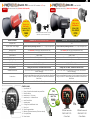
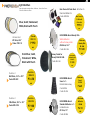
Kremlin 150 Code: MPM-150LE
3
How to Choose
Step 1. Choose your weapon.
Know what you are going to use it for.
All our flash units have a Guide Number (GN) value in each their specifications
at full power. You can use the GN to calculate your flash-to-subject distance
or workspace. The guide number of a flash is an indication of its power. The
higher the number, the more powerful the flash.
Eiffel 200 Code: PSA-200EX
A guide number is found by multiplying the flash-to-subject distance by the
aperture for a well-exposed photograph. So if good results are produced by
using f/8 for a subject 4m away, the guide number is 32. You need to know the
film speed used (ISO), and that the distance was measured in meters, so guide
numbers are usually written as ‗32 (ISO 100, meters)‘.
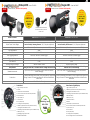
Shibuya 250 Code: ATD-250GS
Vegas 300 Code: RMF-300GT
Broadway 500 Code: MFA-500X
Milan 1000 Code: MFA-1000Z
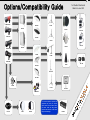
* ASSEMBLE YOUR VERY OWN KIT ACCORDING
TO WHAT YOU NEED. SEE OUR OPTIONS GUIDE.
CLICK THIS MESSAGE TO GO THERE.
© 2010 R. NOREPSE
Once the guide number has been determined, you can use it in reverse. Divide the number by the subject distance (in meters) to find the aperture needed for the exposure. For example, if the guide number is 32 (ISO 100, meters)
and the subject is 4 meters away, you need an aperture of f/8. It will be possible to double your aperture when you increase your ISO.1
Step 2. Choose your support.
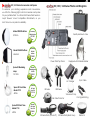
Basic Kit Plus Code: CHP-216WR
Spares
Replacement Flash Tubes for New Flash Models.
Replacement Modeling Lamps.
Other Flash and Model Lamp Spares
Replacement Flash Tube for Basic Kit
Replacement Flash Tube for Basic Kit Plus
Replacement Flash Tube for Duo Kit Pro
Replacement Flash Tube for Trio Kit Pro
Replacement Flash Tube for Trio Kit Pro Plus
Spare Modeling Lamp for Duo and Trio Kits
Supports
Light Modifiers
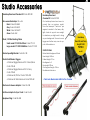
We carry standard light stands as well as models with booms and air cushion features. We also have them at
different height and length. Some of our light stands have a vertical and horizontal mounting feature as well.
Step 3. Choose your light modifier.
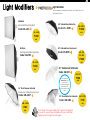
What quality of light do you need your subject be illuminated with? This is a starting point question to yourself. Adding a light modifier such as a softbox or bouncing the flash onto a reflective umbrella will reduce
the effective GN of your flash unit. More so, there are modifiers which focus and shape your flash such as a
snoot or honeycomb. Google is a very good tool to find out what you need as there are many opinions
about light modifiers; but normally, you will be generally fine with a softbox and or an umbrella - it just depends on WHERE and HOW you modify, manipulate, and position them after.
Step 4. Choose accessories.
Don‘t forget to get a flash trigger unless you want to have them all on slave mode. Ask us about an extra
receiver for a second, third or fourth studio flash.
In our Studio Accessories, we also carry adapters for your camera hot shoe to connect your sync cord when
you have your camera in a stationary situation. If you do have a an existing Bowens mount light modifier, we
can provide you with an Elinchrom-to-Bowens mount attachment so you can continue using your existing
equipment.
Step 5. Purchase and Information
You may call, email, chat or text us freely - our contact information are located on the last pages of the
catalog and in our products. We have multiple modes of payment avenues including online credit card
check out. We are open to your questions about our products. You may also go to the TERMS section of this
catalog for warranty information and support coverage.
Studio Accessories
1 with
excerpts from the Canon Professional Network
http://cpn.canon-europe.com/content/index.do