1
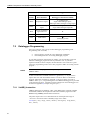
User Manual Variations: 7.3 Temperature reported as °C — set Mult to 0.1 and Offset to –40 Temperature reported as °F — set Mult to .18 and Offset to –40 Humidity reported as a percent — set Mult to 0.1 and Offset to 0 Humidity reported as a fraction — set Mult to 0.001 and Offset to 0 Installation Locate the sensor over an open, level area at least 9 m (EPA) in diameter. The surface should be covered by short grass or the natural earth surface where grass does not grow. Sensors should be located at a distance of at least four times the height of any nearby obstruction and at least 30 m (EPA) from large, paved areas. Sensors should be protected from thermal radiation and adequately ventilated. Standard measurement heights: 1.5 m (AASC) 1.25 – 2.0 m (WMO) 2.0 m (EPA) See Section 10, Attributions and References (p. 11), for a list of references that discuss temperature and relative humidity sensors. When used in the field, the HMP60 must be housed inside a solar radiation shield. Typically, the 41303-5A or RAD06 six-plate solar radiation shield is used. The HMP60 is held within the 41303-5A by a mounting clamp (Figure 7-2). This probe may also be housed in a 41003-5 or RAD10 ten-plate shield. Additional hardware must be used with the 41003-5. No additional hardware is required with the RAD10. A 41322 Adapter Plate allows the HMP60 to be mounted in the lower part of the 41003-5 shield. The white colour of these shields reflects solar radiation, and the louvered construction allows air to pass freely through, thereby keeping the probe at or near ambient temperature. The RAD06 and RAD10 use a double-louvered design that offers improved sensor protection from insect intrusion and driving rain and snow. In addition, the RAD06 and RAD10 shields have lower self-heating in bright sunlight combined with higher temperatures (> 24 °C (75 °F)) and low wind speeds (< 2 m/s (4.5 mph)), giving a better measurement. Each of these solar radiation shields attaches to a crossarm, mast, or user-supplied pipe with a 2.5 to 5.3 cm (1.0 to 2.1 in) outer diameter. Tools required for installing a radiation shield to a tripod or tower include: 1/2-inch open-end wrench small screwdriver provided with datalogger small Phillips screwdriver UV-resistant cable ties small pair of diagonal-cutting pliers adjustable wrench with a minimum 1-7/8 inch jaw size 7