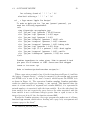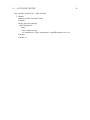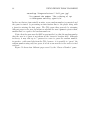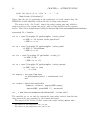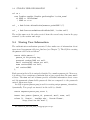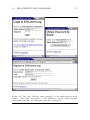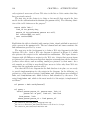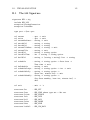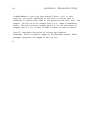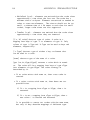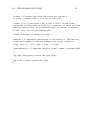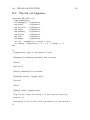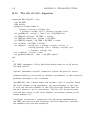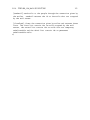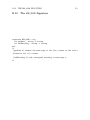
1
A Functional Approach to Web Publishing (Second Edition) April 10, 2007 Martin Elsman Niels Hallenberg Carsten Varming SMLserver A Functional Approach to Web Publishing (Second Edition) Martin Elsman ([email protected]) IT University of Copenhagen, Denmark Niels Hallenberg ([email protected]) Statistics Denmark, Denmark Carsten Varming ([email protected]) IT University of Copenhagen, Denmark April 10, 2007 c 2002–2007 by Martin Elsman, Niels Hallenberg, and Copyright Carsten Varming. Contents Preface vii 1 Introduction 1.1 Web Scripting . . . . . . . . . . . . . . . . . . . . . . . . . . . . . . 1.2 Why Standard ML . . . . . . . . . . . . . . . . . . . . . . . . . . . 1.3 Outline . . . . . . . . . . . . . . . . . . . . . . . . . . . . . . . . . 1 2 3 3 2 Getting Started 2.1 Compiling the Demonstration Web Project 2.2 Configuring and Starting Apache . . . . . . 2.3 Interfacing to an RDBMS . . . . . . . . . . 2.4 Interfacing to Postgresql . . . . . . . . . . . 2.5 So You Want to Write Your Own Project . . . . . . . . . . . . . . . . . . . . . . . . . . . . . . . . . . . . . . . . . . . . . . . . . . . . . . . . . . . . . . . . . . 5 5 6 7 7 8 3 Presenting Pages to Users 3.1 The HyperText Transfer Protocol . . . . . . . 3.2 Time of day . . . . . . . . . . . . . . . . . . . 3.3 A Multiplication Table . . . . . . . . . . . . . 3.4 How SMLserver Serves Pages . . . . . . . . . 3.5 ML Basis Files . . . . . . . . . . . . . . . . . 3.6 Compilation . . . . . . . . . . . . . . . . . . . 3.7 Loading and Serving Pages . . . . . . . . . . 3.8 Logging Messages, Warnings, and Errors . . . 3.9 Uncaught Exceptions and Aborting Execution 3.10 Accessing Setup Information . . . . . . . . . . . . . . . . . . . . . . . . . . . . . . . . . . . . . . . . . . . . . . . . . . . . . . . . . . . . . . . . . . . . . . . . . . . . . . . . . . . . . . . . . . . . . . . . . . . . . . . . . . . . . . . . . . . . . . . . . . . . . . . . . 11 11 12 16 18 18 19 20 21 21 22 4 Obtaining Data from Users 4.1 Temperature Conversion . . . . . . . . . . . . . . . . . . . . . . . 4.2 Quotations for HTML Embedding . . . . . . . . . . . . . . . . . . 4.3 A Dynamic Recipe . . . . . . . . . . . . . . . . . . . . . . . . . . . 23 23 25 27 iii iv CONTENTS 5 Emulating State Using Hidden Form Variables 5.1 Counting Up and Down . . . . . . . . . . . . . . . . . . . . . . . . 5.2 Guess a Number . . . . . . . . . . . . . . . . . . . . . . . . . . . . 33 33 34 6 Extracting Data from Foreign Web Sites 6.1 Grabbing a Page . . . . . . . . . . . . . . 6.2 Regular Expressions . . . . . . . . . . . . 6.3 The Structure RegExp . . . . . . . . . . . 6.4 Currency Service—Continued . . . . . . . 6.5 Caching Support . . . . . . . . . . . . . . 6.6 The Cache Interface . . . . . . . . . . . . 6.7 Memoization . . . . . . . . . . . . . . . . 6.8 Caching Version of Currency Service . . . . . . . . . . . . . . . . . . . . . . . . . . . . . . . . . . . . . . . . . . . . . . . . . . . . . . . . . . . . . . . . . . . . . . . . . . . . . . . . . . . . . . . . . . . . . . . . . . . . . . . . . . . . . . . . . . . 39 39 41 44 46 47 48 52 53 7 Connecting to an RDBMS 7.1 What to Expect from an RDBMS . 7.2 The ACID Test . . . . . . . . . . . 7.3 Data Modeling . . . . . . . . . . . 7.4 Data Manipulation . . . . . . . . . 7.5 Three Steps to Success . . . . . . . 7.6 Transactions as Web Scripts . . . . 7.7 Best Wines Web Site . . . . . . . . . . . . . . . . . . . . . . . . . . . . . . . . . . . . . . . . . . . . . . . . . . . . . . . . . . . . . . . . . . . . . . . . . . . . . . . . . . . . . . . . . . . . . . . . . . . . . . . . . . 57 58 59 60 61 64 66 70 8 Checking Form Variables 8.1 The Structure FormVar . . . . . . . . . . . . . . . . . . . . . . . . . 8.2 Presenting Multiple Form Errors . . . . . . . . . . . . . . . . . . . 8.3 Implementation . . . . . . . . . . . . . . . . . . . . . . . . . . . . . 83 83 85 86 9 Authentication 9.1 Feeding Cookies to Clients . . . . . . . . 9.2 Obtaining Cookies from Clients . . . . . 9.3 Cookie Example . . . . . . . . . . . . . 9.4 Storing User Information . . . . . . . . 9.5 The Authentication Mechanism . . . . . 9.6 Caching Passwords for Efficiency . . . . 9.7 Applying the Authentication Mechanism . . . . . . . 89 90 92 92 95 96 99 99 10 Scheduling and Trapping 10.1 Initialization . . . . . . . . . . . . . . . . . . . . . . . . . . . . . . 10.2 Scheduling . . . . . . . . . . . . . . . . . . . . . . . . . . . . . . . . 10.3 Trapping . . . . . . . . . . . . . . . . . . . . . . . . . . . . . . . . . 105 105 106 108 . . . . . . . . . . . . . . . . . . . . . . . . . . . . . . . . . . . . . . . . . . . . . . . . . . . . . . . . . . . . . . . . . . . . . . . . . . . . . . . . . . . . . . . . . . . . . . . . . . . . . . . . . . . . . . . . . . . . . . . . . . . . . . CONTENTS v 11 Configuration 109 12 Summary 111 A HTML Reference A.1 Elements Supported Inside Body Element A.1.1 Text Elements . . . . . . . . . . . A.1.2 Uniform Resource Locators . . . . A.1.3 Anchors and Hyperlinks . . . . . . A.1.4 Headers . . . . . . . . . . . . . . . A.1.5 Logical Styles . . . . . . . . . . . . A.1.6 Physical Styles . . . . . . . . . . . A.1.7 Definition Lists . . . . . . . . . . . A.1.8 Unordered Lists . . . . . . . . . . A.1.9 Ordered Lists . . . . . . . . . . . . A.1.10 Characters . . . . . . . . . . . . . A.2 HTML Forms . . . . . . . . . . . . . . . . A.2.1 Input Fields . . . . . . . . . . . . . A.2.2 Select Elements . . . . . . . . . . . A.2.3 Select Element Options . . . . . . A.2.4 Text Areas . . . . . . . . . . . . . A.3 Miscellaneous . . . . . . . . . . . . . . . . . . . . . . . . . . . . . . . . . . . . . . . . . . . . . . . . . . . . . . . . . . . . . . . . . . . . . . . . . . . . . . . . . . . . . . . . . . . . . . . . . . . . . . . . . . . . . . . . . . . . . . . . . . . . . . . . . . . . . . . . . . . . . . . . . . . . . . . . . . . . . . . . . . . . . . . . . . . . . . . . . . . . . . . . . . . . . . . . . . . . . . . . . . . . . . . . . . . . . . . . . . . . . . . . . . . . . . . . . . . . . . . . . . . . . . . . . . . . . . 115 116 116 116 116 117 117 117 117 118 118 118 118 119 120 121 121 121 B The B.1 B.2 B.3 B.4 B.5 B.6 B.7 B.8 B.9 B.10 B.11 B.12 B.13 B.14 B.15 B.16 . . . . . . . . . . . . . . . . . . . . . . . . . . . . . . . . . . . . . . . . . . . . . . . . . . . . . . . . . . . . . . . . . . . . . . . . . . . . . . . . . . . . . . . . . . . . . . . . . . . . . . . . . . . . . . . . . . . . . . . . . . . . . . . . . . . . . . . . . . . . . . . . . . . . . . . . . . . . . . . . . . . . . . . . . . . . . . . . . . . . . . . . . . . . . . . . . . . . . . . . . . . . . . . . . . . . . . . . . . . . . . . . 123 125 129 132 135 137 142 146 147 149 150 152 153 154 156 158 160 Web Structure The WEB Signature . . . . . . . The WEB_CACHE Signature . . . The WEB_CONN Signature . . . . The WEB_COOKIE Signature . . The WEB_DB Signature . . . . . The WEB_DB_HANDLE Signature The WEB_DYNLIB Signature . . The WEB_INFO Signature . . . . The WEB_LOG Signature . . . . The WEB_LOW_MAIL Signature . The WEB_MAIL Signature . . . . The WEB_MIME Signature . . . . The WEB_SERIALIZE Signature The WEB_SET Signature . . . . The XMLRPC Signature . . . . . The XMLRPC_TYPE Signature . . . . . . . . . . . . . . . . . . . . . . . . . . . . . . . . . . . . . . . . . . . . . . . . . . . . . . . . . . . . . . . . . . . . . . . . . . . . . . . . . . . . . . . . . . . . . . . . . . vi CONTENTS Preface The ideas behind the SMLserver project came up in 1999 when the first author was attending a talk by Philip Greenspun, the author of the book “Philip and Alex’s Guide to Web Publishing” [Gre99]. Philip and his co-workers had been writing an astonishing 250,000 lines of dynamically typed TCL code to implement a community system that they planned to maintain, extend, and even customize for different Web sites. Although Philip and his co-workers were very successful with their community system, the dynamic typing of TCL makes such a large system difficult to maintain and extend, not to mention customize. Although the cost of using statically typed programming languages for Web applications is a more tedious development cycle, a static type system may cause many bugs to be found before a Web site is launched and help the programmers in the development process. The SMLserver project was initiated in the end of 2000 by the construction of an embeddable runtime system and a bytecode backend for the MLKit [TBE+ 01], an Open Source Standard ML compiler. Once the bytecode backend and the embeddable runtime system, also called the Kit Abstract Machine (KAM), was in place, the KAM was embedded in an AOLserver module1 in such a way that requests for files ending in .sml and .msp (also called scripts) cause the corresponding compiled bytecode files to be loaded and executed. In April 2001, the basic system was running, but more work was necessary to support caching of loaded code, multi-threaded execution, and many of the other interesting AOLserver features, such as database interoperability. In 2005, SMLserver was ported to Apache 2.0 including the many great features of AOLserver, including script scheduling, Oracle and MySQL database support, caching support, and much more. SMLserver has been used in practice for building large intranet systems in the form of a course evaluation system at the IT University of Copenhagen and an online course registration system. In the following, we assume that the reader is familiar with the programming 1 AOLserver is a multi-threaded Web server provided by America Online (AOL). vii viii CONTENTS language Standard ML and with functional programming in general. There are several good introductory Standard ML text books available, including [Pau96, HR99]. The present book is not meant to be a complete user’s manual for SMLserver. Instead, the book is meant to give a broad overview of the possibilities of using SMLserver for Web application development. The choice of content and the examples presented in the book are inspired from more than six years of experience with developing and teaching the course “Web Publishing with Databases” at the IT University of Copenhagen. We would like to thank Lars Birkedal, Ken Friis Larsen, and Peter Sestoft for their many helpful comments on the project. Peter developed the concept of ML Server Pages and we are happy that much of the code that Peter wrote for his Moscow ML implementation of ML Server Pages is reused in the SMLserver project (in particular, the Msp structure is written entirely by Peter). We would also like to thank Mads Tofte for his continued encouragement on working on this project. Mads is a brilliant programmer and has developed several Web applications with SMLserver, including an alumni systemand a course evaluation system for the IT University of Copenhagen. SMLserver is Open Source and distributed under the GNU General Public License (GPL). More information about the SMLserver project can be found at the SMLserver Web site: http://www.smlserver.org Martin Elsman Niels Hallenberg Carsten Varming Copenhagen, Denmark February, 2002 (Revised January 2003 and January 2007 for Second Edition) Chapter 1 Introduction SMLserver is a Web server module for Apache 2.0, the most popular Web server on the Internet. SMLserver comes with a compiler for compiling Web applications written in Standard ML [MTHM97] into bytecode to be interpreted by the SMLserver module. SMLserver has an extensive Application Programmer Interface (API). For instance, SMLserver provides efficient interfaces to several Relational Database Management Systems (RDBMSs), including MySQL, Postgresql, and Oracle. SMLserver extends Apache by providing the possibility of programming dynamic Web pages in Standard ML using its rich language features including datatypes, pattern matching, higher-order functions, parametric polymorphism, and modules. SMLserver provides a Standard ML interface to much of the Apache API, thereby giving the Standard ML programmer access to many great features, including the following: • Different RDBMSs, including Oracle, Postgresql, and MySQL, may be accessed through a generic database interface. • SMLserver provides easy access to HTTP header information, including form content and cookie information. • Efficient caching support makes it possible to decrease the load caused by frequently run database queries, such as the querying of passwords for user authentication. • SMLserver supports scheduled execution of scripts. • SMLserver has an advanced interface for Web applications to send emails. • SMLserver has support for writing type-safe XML-RPC clients and servers in Standard ML. 1 2 CHAPTER 1. INTRODUCTION Besides the above features, SMLserver works well together with other Apache features and other Apache Modules. For instance, SMLserver works well together with Apache’s Secure Socket Layer support (SSL), which allows for encrypted communication between the Web server and its clients, and with the Apache Rewrite Module, which allows for trapping (i.e., filtering) of requests for easy access control. 1.1 Web Scripting The Common Gateway Interface (CGI) is a standard for interfacing external applications with a Web server that communicates with clients using the HyperText Transfer Protocol (HTTP). The situation is pictured as follows: The Internet HTTP External Application CGI Web Browser Web Server The external application, which is also called a CGI program, may be written in any language that allows the program to be executed on the system. It is even possible to write Standard ML CGI-scripts with your favorite Standard ML compiler using the Mosmlcgi library provided with the Moscow ML distribution. Unfortunately, the traditional CGI approach has a serious drawback: It is slow. Every time a client requests a page from the Web server, the server must fork a new process and load the external application into memory before the application is executed. Moreover, after execution, the operating system must reclaim resources used by the process. One way of increasing availability and to speed up response times is to embed an interpreter within a Web server as the following picture illustrates: The Internet Web Server Script Script Cache HTTP Interpreter Web Browser 1.2. WHY STANDARD ML 3 Notice that in this setting, scripts are cached in the Web server, which further increases the efficiency of script execution. This is the approach taken by SMLserver. 1.2 Why Standard ML Standard ML (SML) is a high-level statically typed functional programming language. It is a high-level programming language in the sense that it uses automatic memory management. In contrast to a low-level programming language, such as C, the programmer need not be concerned with the allocation and deallocation of memory. Standard ML supports many other high-level programming language features as well, including pattern-matching and exceptions. It even has an advanced modules language, which enhances the possibilities of program composition. In contrast to Web applications built with dynamically typed languages such as TCL, Perl, PHP, or so, systems built with statically typed languages are often more reliable and more robust. When a change is made to some part of the program, a static type system enforces (at compile time, that is) the change to integrate well with the entire program; in a dynamically typed setting, no errors are caught this early in the development cycle. Standard ML is a functional language in that it supports higher-order functions; that is, functions may take functions as arguments and return functions as a result. Although it is a functional language, Standard ML also has support for imperative features such as mutable data structures like arrays and references. 1.3 Outline Chapter 2 provides instructions for getting started with SMLserver. Chapter 3 presents two simple examples, which illustrate the basic mechanism for writing dynamic Web pages with SMLserver. Chapter 4 describes how SMLserver Web scripts may use data obtained from users. Chapter 5 describes how state in Web scripts may be emulated using so-called hidden form variables. The concept of regular expressions and the idea of fetching data from foreign Web sites are covered in Chapter 6. The general interface for connecting to a Relational Database Management System (RDBMS) is described in Chapter 7. A mechanism for checking that form variables contain values of the right type is presented in Chapter 8. Chapter 9 presents a user authentication mechanism based on information stored in a database and cookie information provided by the client browser. Finally, Chapter 10 demonstrates SMLserver’s support for scheduling of scripts and trapping (i.e., filtering) of requests to for easy access control. A summary is given in Chapter 12. 4 CHAPTER 1. INTRODUCTION All concepts are illustrated using a series of examples, which are all included in the SMLserver distribution. Chapter 2 Getting Started For installation requirements and instructions, please consult the SMLserver Web site (http://www.smlserver.org) or the file README_SMLSERVER in the source distribution, which is also available from the SMLserver Web site. In the following we shall assume that SMLserver is installed on your system and that the command $ smlserverc -v salutes you with a greeting from SMLserver. The remaining sections in this chapter is organised as follows. First, Section 2.1 guides you through compiling your own version of the SMLserver demonstration Web project. Second, Section 2.2 guides you through configuring Apache for use with SMLserver and the compiled Web project. 2.1 Compiling the Demonstration Web Project Start by creating your own web directory and copy the SMLserver demonstration files to this directory: $ cd $HOME $ mkdir web $ cp -pa /usr/local/lib/smlserver/{www,web_sys,web_demo_lib} \ \ web/ The cp command above assumes that SMLserver is installed in /usr/local and not in /usr, as it probably would be if SMLserver was installed as a binary package. Now, change to the web/www directory and type make: $ cd web/www $ make 5 6 CHAPTER 2. GETTING STARTED Building involves invoking smlserverc and mspcomp for compiling libraries and script files mentioned in the mlb-file web.mlb. 2.2 Configuring and Starting Apache You are now ready to configure the Apache Web server. Before starting, we note that different distributions of Apache (for different OS distributions) use different strategies for configuration. Here we show the details of configuring Apache for SMLserver on a Linux Debian System. Follow the following steps: 1. Edit the file /etc/apache2/apache2.conf by adding to DirectoryIndex the list index.sml. 2. Edit the file /etc/apache2/sites-available/default by (A) changing DocumentRoot to /home/user /web/www and (B) changing Directory path to /home/user /web/www, where user is your login name. 3. Create the file /etc/apache2/mods-available/sml.conf with the following content: <IfModule mod_sml.c> AddHandler sml-module .sml SmlPrjId "web" SmlPath "/home/user/web/www/" SmlInitScript "/home/user/web/www/../web_sys/init.sml" </IfModule> Again, substitute your own login name for user in the content. 4. Execute the following commands: $ cd /etc/apache2/mods-enable/ $ sudo ln -s /etc/apache2/mods-available/sml.conf . $ sudo ln -s /etc/apache2/mods-available/sml.load . You are now ready to (re)launch Apache with the following command: $ sudo apache2ctl restart Point your browser to http://localhost/web/ and enjoy. By executing the command 2.3. INTERFACING TO AN RDBMS 7 $ ps --cols=200 guax | grep nsd you should see that Apache is running five or six processes. Apache writes information into the file /var/log/apache2/error.log. By looking at the log, you should see a notice that Apache has loaded the SMLserver module. 2.3 Interfacing to an RDBMS To get access to an RDBMS from within your SMLserver scripts, an RDBMS supported by SMLserver must be installed on your system. Supported RDBMS’s include MySQL, Oracle, and Postgresql (http://www.postgresql.org). The MySQL and Postgresql databases are supported through unixODBC.1 . Information on how to use SMLserver with Oracle and MySQL is available from the SMLserver home page. The next section describes how to interface to the Open Source RDBMS Postgresql. 2.4 Interfacing to Postgresql This section describes how to set up a database with Postgresql for the purpose of using it with SMLserver. We assume that Postgresql (≥ 8.1) is already installed on the system. We also assume that SMLserver is configured with unixODBC support (--enable-odbc) before compilation and installation; see the file README_SMLSERVER for details. Follow the steps below: 1. (Re)start the Postgresql daemon process by executing the following command: $ sudo /etc/init.d/postgresql-8.1 restart 2. Create a database user with the same name as your user name on the Linux box: $ sudo su - postgres $ createuser -P user Invent a new password for the database user. Answer yes to the questions asked by createuser. 1 http://www.unixodbc.org 8 CHAPTER 2. GETTING STARTED 3. As user, create a database (also called user) as follows: $ createdb $USER You can now use the command psql to control your database and submit SQL queries and commands to your database. Install the data models for the demonstration programs by executing the commands $ cd $HOME/web/web_demo_lib/pgsql $ psql -c "\i all.sql" Verify that the database is available using isql: $ isql psql > select * from guest; (You should see a message from Homer Simpson...) 4. Restart Apache by executing the command $ sudo /etc/init.d/apache2 restart 5. After copying the sample Web directory to $HOME, as described in Section 2.1, edit the file $HOME/web/web_demo_lib/Db.sml. Make sure that the structure DbBackend passed to the DbFunctor is the structure Web.DbPgBackend. The lines defining the Oracle structure and the MySQL structure should be commented out. 6. Edit the file $HOME/web/web_sys/init.sml. Enable the Postgresql configuration lines. 7. Compile the sample Web project as described in Section 2.1. 8. Go start your Web browser and visit the database examples available from http://localhost/web/index.sml. 2.5 So You Want to Write Your Own Project To write your own project, create a new mlb-file and make this project the project served by SMLserver by updating the Apache configuration file. You can have only one project associated with each Web server that you run. Use the compiler smlserverc to compile the library and script-files mentioned in the mlb-file into 2.5. SO YOU WANT TO WRITE YOUR OWN PROJECT 9 bytecode. Once your project is compiled, the Web server answers requests of the files listed in the scripts...end parts of your mlb-file (see Section 3.5). Library code to be shared between scripts may be stored anywhere on the system and mentioned, for example, in the local part in the project file—look in the sample mlb-file web.mlb for examples. 10 CHAPTER 2. GETTING STARTED Chapter 3 Presenting Pages to Users In this chapter we show two examples of dynamic Web pages (also called Web scripts) written with SMLserver. The first example, which shows the time of day, takes the form of a regular Standard ML program. It uses the function Web.Conn.return to return the appropriate HTML code to the user requesting the page. The second example, which shows a simple multiplication table, uses the possibility of writing ML Server Pages (MSP) with SMLserver. 3.1 The HyperText Transfer Protocol Before we dive into the details of particular dynamic Web pages, we briefly describe the protocol that is the basis for the World Wide Web, namely the HyperText Transfer Protocol (HTTP). It is this protocol, which dictates how Web browsers (such as Microsoft’s Internet Explorer or Netscape Navigator) make requests to Web servers and how a Web server communicates a response back to the particular browser. HTTP is a text-based protocol. When a Uniform Resource Locator (URL), such as http://www.amazon.com, is entered into a Web browser’s location field, the browser converts the user’s request into a HTTP GET request. Web browsers usually request Web pages with method GET. When a user follows a link from a Web page or when a user submits a form with no method specified, the request is a GET request. Another often used request method is POST, which supports an unlimited number of form variables with form data of non-restricted size. Other possible methods include DELETE and PUT. When writing SMLserver applications, however, you need not know about methods other than GET and POST. As an example of HTTP in action, consider the case where a user enters the URL http://www.google.com/search?q=SMLserver into the location field of a 11 12 CHAPTER 3. PRESENTING PAGES TO USERS Web browser. The URL specifies a form variable q (read: query) with associated form data SMLserver. As a result, the Web browser sends the following GET request to port 80 on the machine www.google.com: GET /search?q=SMLserver HTTP/1.1 The machine www.google.com may answer the request by sending the following HTTP response back to the client—the HTML content between <html> and </html> is left out: HTTP/1.1 200 OK Date: Mon, 23 Jul 2001 11:43:32 GMT Server: GWS/1.11 Set-Cookie: PREF=ID=49cdd72654784880:TM=995888612:LM=995888612; domain=.google.com; path=/; expires=Sun, 17-Jan-2038 19:14:07 GMT Content-Type: text/html Transfer-Encoding: chunked 54d <html> ... </html> The HTTP response is divided into a status line followed by a series of response header lines and some content. Each response header takes the form key:value, where key is a response header key and value is the associated response header value. The status line specifies that the HTTP protocol in use is version 1.1 and that the status code for the request is 200, which says that some content follows after the response headers. Figure 3.1 lists the most commonly used status codes and Figure 3.2 lists some commonly used response headers.1 We have more to say about HTTP requests in Chapter 4 where we show how information typed into HTML forms turns into form data submitted with the HTTP request. 3.2 Time of day We shall now see how to create a small Web service for presenting the time-of-day to a user. The example uses the Time.now function from the Standard ML Basis 1 HTTP 1.1 supported status codes and response headers are listed in RFC 2616. http://www.ietf.org. See 3.2. TIME OF DAY Status Code 200 (OK) 301 (Moved Permanently) 302 (Found) 400 (Bad Request) 401 (Unauthorized) 404 405 500 503 (Not Found) (Method Not Allowed) (Internal Server Error) (Service Unavailable) 13 Description Indicates that everything is fine. The document follows the response headers. The requested document has moved and the URL for the new location is in the Location response header. Because the document is moved permanently, the browser may update bookmarks accordingly. The requested document has moved temporarily. This status code is very useful because it makes a client request the URL in the Location header automatically. Bad syntax in the client request. The client tries to access a password protected page without specifying proper information in the Authorization header. The “no such page” response. Request method is not allowed. The “server is buggy” response. Server is being maintained or is overloaded. Figure 3.1: The most commonly used HTTP status codes 14 CHAPTER 3. PRESENTING PAGES TO USERS Header Allow Cache-Control Description Specifies the request methods (GET, POST, etc.) that a server allows. Required for responses with status code 405 (Method Not Allowed). Tells client what caching strategy may be used. Usable values include: public: document may be cached private: document may be cached by user no-cache: document should not be cached no-store: document should not be cached and not stored on disk Content-Encoding Content-Language Content-Length Content-Type Date Expires Last-Modified Location Refresh Set-Cookie May be used for compressing documents (e.g., with gzip). Specifies the document language such as en-us and da. See RFC 1766 for details.2 Specifies the number of bytes in the document. A persistent HTTP connection is used only if this header is present. Specifies the MIME (Multipurpose Internet Mail Extension) type for the document. Examples include text/html and image/png. Specifies the current date (Greenwich Mean Time). Specifies when content should be considered out-ofdate. Indicates the last change of the document. All responses with a status code in the range 300–399 should contain this header. Indicates an interval (in seconds) at end of which the browser should automatically request the page again. Specifies a cookie associated with the page. Multiple Set-Cookie headers may appear. Figure 3.2: Some commonly used response headers 3.2. TIME OF DAY 15 Figure 3.3: The result of requesting the file time_of_day.sml using the Netscape browser. The HTTP request causes the compiled time_of_day.sml program to be executed on the Web server and the response is sent (via the HTTP protocol) to the Web browser. Library to obtain the present time of day. HTML code to send to the users browser is constructed using Standard ML string primitives. If you are new to HTML, a short reference is provided in Appendix A on page 115. val time_of_day = Date.fmt "%H.%M.%S" (Date.fromTimeLocal(Time.now())) val _ = Web.Conn.return ("<html> \ \ <head><title>Time of day</title></head> \ \ <body bgcolor=white> \ \ <h2>Time of day</h2> \ \ The time of day is " ^ time_of_day ^ ". \ \ <hr> <i>Served by \ \ <a href=http://www.smlserver.org>SMLserver</a> \ \ </i> \ \ </body> \ \</html>") Figure 3.3 shows the result of a user requesting the file time_of_day.sml from the Web server. The example uses the Web structure, which gives access to the Web server API; to get an overview of what functions are available in the Web structure, consult Appendix B, which lists the Standard ML signature for the structure. The function Web.Conn.return takes a string as argument and sends an HTTP response with 16 CHAPTER 3. PRESENTING PAGES TO USERS status code 200 (Found) and content-type text/html to the browser along with HTML code passed in the argument string. In Section 4.2 on page 25 we show how support for quotations may be used to embed HTML code in Standard ML Web applications somewhat more elegantly than using Standard ML string literals. In the next section we explore SMLserver’s support for ML Server Pages (MSP). 3.3 A Multiplication Table SMLserver supports the execution of dynamic Web pages written using ML Server Pages (MSP). In this section we show how a dynamic Web page for displaying a multiplication table is written as an ML Server Page. ML Server Pages are stored in files with extension .msp. The way in which SMLserver supports msp-files is by providing a tool mspcomp for compiling an msp-file into an sml-file, which can then be compiled using smlserverc and served by SMLserver. Section 3.5 on page 18 has more to say about projects and how msp-files are compiled. Here is how the ML Server Page for displaying a multiplication table looks like:3 <?MSP local open Msp infix && fun iter f n = if n = 0 then $"" else iter f (n-1) && f n fun col r c = $"<td width=5% align=center>" && $(Int.toString (r * c)) && $"</td>" fun row sz r = $"<tr>" && iter (col r) sz && $"</tr>" in fun tab sz = iter (row sz) sz end ?> <html> <body bgcolor=white> <h2>Multiplication Table</h2> <table border=1> <?MSP$ tab 10 ?> </table> 3 File smlserver_demo/www/web/mul.msp. 3.3. A MULTIPLICATION TABLE 17 Figure 3.4: The result of requesting the file mul.msp using the Netscape browser. The HTTP request causes the compiled mul.msp program to be executed on the Web server and the response is sent (via the HTTP protocol) to the Web browser. <hr><i>Served by <a href=http://www.smlserver.org>SMLserver</a></i> </body> </html> Figure 3.4 shows the result of a user requesting the file mul.msp from the Web server. An msp-file contains HTML code with the possibility of embedding Standard ML code into the file, using tags <?MSP ... ?> and <?MSP$ ... ?>. The former type of tag makes it possible to embed Standard ML declarations into the HTML code whereas the latter type of tag makes it possible to embed Standard ML expressions into the HTML code. The Msp structure, which the msp-file makes use of, provides functionality for constructing and concatenating HTML code efficiently, by means of constructors $ and &&, respectively. The functions col, row, and tab construct the HTML multiplication table. The functions use the function iter, which constructs HTML code by concatenating the results of repeatedly applying the anonymous function given as the first argument; the second argument controls the number of times the anonymous function is called. 18 3.4 CHAPTER 3. PRESENTING PAGES TO USERS How SMLserver Serves Pages Before we proceed with more examples of SMLserver Web applications, we describe how SMLserver Web applications are compiled and loaded and, finally, how SMLserver scripts (i.e., sml-files) are executed when requested by a client. Apache supports dynamic loading of modules when the server is started. Modules that may be loaded in this way include drivers for a variety of database vendors, a module that enables support for CGI scripts, and a module that enables encryption support, using Secure Socket Layer (SSL). Which modules are loaded when Apache starts is configurable. SMLserver is implemented as a module mod_sml.so, which is loaded into Apache—along with other modules—when Apache starts. When the mod_sml.so module is loaded into Apache, future requests for files with extension .sml are served by interpreting the bytecode file that is the result of compiling the requested sml-file. Compilation of sml-files into bytecode files is done by explicitly invoking the SMLserver compiler smlserverc. ML Server Pages, (i.e., scripts with extension .msp) may be compiled into scripts with extension .sml using the mspcomp program that comes with SMLserver. 3.5 ML Basis Files The SMLserver compiler smlserverc takes as argument an mlb-file, which lists the sml-scripts that a client may request along with Standard ML library code to be used by the client-accessible sml-scripts. The result of the compilation is stored within MLB directories relative to the individual source files. The MLB directories contain information that allows efficient recompilation of mlb-files upon change of source code. Be aware that the project file name must correspond to the string associated with the entry prjid in the Apache configuration file, which by default is sources.mlb. An example ML Basis file is listed in Figure 3.5. The mlb-file specifies that the two scripts time_of_day.sml and mul.msp.sml are made available for clients by SMLserver. Assuming the project file name corresponds to the file name mentioned in the Apache configuration file, upon successful compilation of the project, a user may request the files time_of_day.sml and mul.msp.sml. The two example scripts time_of_day.sml and mul.msp.sml (i.e, mul.msp compiled with mspcomp) may refer to identifiers declared in the files mentioned in the local-part of the project file (i.e., between the keywords local and in), includ- 3.6. COMPILATION 19 local $(SML_LIB)/basis/basis.mlb $(SML_LIB)/basis/web/lib.mlb ../web_demo_lib/Page.sml ../web_demo_lib/FormVar.sml in (* Script files; may refer to identifiers declared in * library files, but cannot refer to identifiers * in other script files. *) scripts time_of_day.sml mul.msp.sml end end Figure 3.5: An ML Basis file for the two examples in this chapter. ing identifiers declared by the Standard ML Basis Library4 and the Web library.5 In the local-part of the mlb-file, it is allowed for an sml-file to refer to identifiers declared by previously mentioned sml-files or mlb-files. However, an sml-file mentioned in the scripts...end part of an mlb-file may not refer to identifiers declared by other files in scripts...end parts of the mlb-file. Thus, in the example mlb-file, mul.msp.sml may not refer to identifiers declared in time_of_day.sml. 3.6 Compilation As mentioned, a project is compiled with the SMLserver compiler smlserverc with the name of the project file (sources.mlb is the default name to use) given as argument: smlserverc sources.mlb The bytecode files (and other information) resulting from compilation of a source file are stored in a subdirectory named MLB, located in the same directory as the source file. To work efficiently with SMLserver, you need not know anything about the content of the MLB directories. In particular, you should not alter the content 4 To see what parts of the Standard ML Basis Library that SMLserver supports, consult the file /usr/local/lib/smlserver/basis/basis.mlb on your system. 5 See the file /usr/local/lib/smlserver/basis/web/lib.mlb. 20 CHAPTER 3. PRESENTING PAGES TO USERS of these directories, although it is safe to remove MLB directories, if you want to force a recompile of an entire ML Basis File. To compile an msp-file file.msp into a file file.msp.sml, simply execute the command: $ mspcomp file.msp 3.7 Loading and Serving Pages The first time SMLserver serves an sml-file, SMLserver loads the bytecode for the Standard ML Basis Library along with user libraries mentioned in the mlb-file before the bytecode for the sml-file is loaded. Upon subsequent requests for an sml-file, SMLserver reuses the bytecode already loaded. After bytecode for a request is loaded, SMLserver executes initialization code for each library file before the bytecode associated with the request is executed. Because SMLserver initiates execution in an empty heap each time a request is served, it is not possible to maintain state implicitly in Web applications using Standard ML references or arrays. Instead, state must be maintained explicitly using a Relational Database Management System (RDBMS) or the cache primitives supported by SMLserver (see the WEB_CACHE signature in Appendix B). Another possibility is to emulate state behavior by capturing state in form variables or cookies. At first, this limitation may seem like a major drawback. However, the limitation has several important advantages: • Good memory reuse. When a request has been served, memory used for serving the request may be reused for serving other requests. • Support for a threaded execution model. Requests may be served simultaneously by interpreters running in different threads without the need for maintaining complex locks. • Good scalability properties. For high volume Web sites, the serving of requests may be distributed to several different machines that communicate with a single database server. Making the RDBMS deal with the many simultaneous requests from multiple clients is exactly what an RDBMS is good at. • Good durability properties. Upon Web server and hardware failures, data stored in Web server memory is lost, whereas, data stored in an RDBMS may be restored using the durability features of the RDBMS. 3.8. LOGGING MESSAGES, WARNINGS, AND ERRORS 21 We have more to say about emulating state using form variables in Chapter 5. Programming with cookies is covered in Chapter 9. 3.8 Logging Messages, Warnings, and Errors When Apache starts (see Chapter 2), initialization information is written to a server log file. The location and name of the server log file is configurable but for many setups, the log file is /var/log/apache2/error.log. In addition to initialization information being written to the server log file, the SMLserver module and other Apache modules may also write information to the server log file when Apache is running. It is also possible for your SMLserver scripts to write messages to the server log file using the function Web.log. The function Web.log has type Web.LogSeverity * string -> unit. The structure Web declares the following values of the type Web.LogSeverity: Value Notice Info Warning Error Emergency Critical Alert Debug Description (intended use) Something interesting occurred. Something interesting occurred. Maybe something bad occurred. Something bad occurred. Something extremely bad occurred. The server will shut down after logging this message. Something extremely bad occurred. The server will shut down after logging this message. Something extremely bad occurred. The server will shut down after logging this message. If the server is in Debug mode, specified by a flag in the configuration file, the message is printed. If the server is not in debug mode, the message is not printed. Allowing SMLserver scripts to write messages to the server log file turns out to be handy for debugging scripts. 3.9 Uncaught Exceptions and Aborting Execution We still have to explain what happens when a script raises an exception that is not handled (i.e., caught) by the script itself. SMLserver deals with such uncaught exceptions by writing a warning in the server log file explaining what exception is raised by what file: [Fri Dec 02 17:00:32 2005] [warn] 22 CHAPTER 3. PRESENTING PAGES TO USERS /home/varming/apache2worker/htdocs/web/www/web/ upload/MLB/SMLserver/upload_form.sml.uo raised Fail There is one exception to this scheme. If the exception raised is the predefined top-level exception Interrupt, no warning is written to the server log file. In this way, raising the Interrupt exception may be used to silently terminate the execution of a script, perhaps after serving the client an error page. The function Web.exit, which has type unit -> ty, for any type ty, exits by raising the exception Interrupt. An important aspect of using the function Web.exit to abort execution of a script is that, with the use of exception handlers, resources such as database connections (see Chapter 7) may be freed appropriately upon exiting. It is important that SMLserver scripts do not abort execution by calling the function OS.Process.exit provided in the Standard ML Basis Library. The reason is that the function OS.Process.exit has the unfortunate effect of terminating the Web server main process.6 3.10 Accessing Setup Information The structure Web.Info provides an interface to accessing information about the Apache setup, including the possibility of accessing the Web server configuration file settings. Consult Appendix B to see the signature of the Web.Info structure. 6 Recall that each script executes in a separate thread. Chapter 4 Obtaining Data from Users One of the fundamental reasons for the success of dynamic Web applications is that Web applications can depend on user input. In this chapter we present two small examples of SMLserver applications that query data from users. The two examples that we present are both based on two files, an HTML file for presenting a form to the user and an sml-file that accesses the submitted data and computes—and returns to the user—HTML code based on the user input. HTML forms provide for many different input types, including text fields, selection boxes, radio buttons, and drop-down menus. If you are new to HTML forms, a quick reference is provided in Appendix A.2 on page 118. 4.1 Temperature Conversion This section presents a Web application for converting temperatures in degrees Celsius to temperatures in degrees Fahrenheit. The Web application is made up of one file temp.html containing an HTML form for querying a temperature from the user and a script temp.sml for calculating the temperature in degrees Fahrenheit based on the temperature in degrees Celsius. The Temperature Form The file temp.html reads as follows:1 <html> <body bgcolor=white> <h2>Temperature Conversion</h2> Enter a temperature in degrees Celcius: 1 File smlserver_demo/www/web/temp.html. 23 24 CHAPTER 4. OBTAINING DATA FROM USERS Figure 4.1: The result of displaying the file temp.html using the Netscape browser. <form method=get action=temp.sml> <input type=text name=temp_c> <input type=submit value="Compute Fahrenheit Temperature"> </form> <hr><i>Served by <a href=http://www.smlserver.org>SMLserver</a> </i></body> </html> The result of displaying the above HTML code in a Web browser is shown in Figure 4.1. The action of the HTML form is the script temp.sml. When the user of the HTML form enters a temperature in the text field (20 say) and hits the “Compute Temperature in Fahrenheit” button, the script temp.sml is requested from the Web server with the form data temp_c = 20. Calculating the Temperature in Degrees Fahrenheit Here is the script temp.sml:2 fun calculate c = concat ["<html> <body bgcolor=white> ", "<h2>Temperature Conversion</h2> ", Int.toString c, " degrees Celcius equals ", Int.toString (9 * c div 5 + 32), " degrees Fahrenheit. <p> Go ", "<a href=temp.html>calculate a new temperature</a>.", 2 File smlserver_demo/www/web/temp.sml. 4.2. QUOTATIONS FOR HTML EMBEDDING 25 "<hr> <i>Served by <a href=http://www.smlserver.org>", "SMLserver</a></i> </body></html>"] val _ = (case of | Web.Conn.return FormVar.wrapOpt FormVar.getIntErr "temp_c" NONE => "Go back and enter an integer!" SOME i => calculate i) The structure FormVar provides an interface for accessing form variables of different types.3 The expression FormVar.wrapOpt FormVar.getIntErr results in a function, which has type string -> int option. The function takes the name of a form variable as argument and returns SOME(i), where i is an integer obtained from the string value associated with the form variable. If the form variable does not occur in the query data, is not a well-formed integer, or its value does not fit in 32 bits, the function returns NONE. We have more to say about the FormVar structure in Chapter 8. In the case that the form variable temp_c is associated with a well-formed integer that fits in 32 bits, an HTML page is constructed, which presents the submitted temperature in degrees Celsius, a calculated temperature in degrees Fahrenheit, and a link back to the temp.html form. The result of a user converting a temperature in degrees Celsius to a temperature in degrees Fahrenheit is shown in Figure 4.2. 4.2 Quotations for HTML Embedding As we have seen in the previous example, embedding HTML code in Standard ML programs using strings does not look nice; many characters must be escaped and splitting of a string across lines takes several additional characters per line. This limitation of Standard ML strings makes it difficult to read and maintain HTML code embedded in Standard ML Web applications. Fortunately, many Standard ML implementations support quotations, which makes for an elegant way of embedding another language within a Standard ML program. Here is a small quotation example that demonstrates the basics of quotations: val text = "love" val ulist : string frag list = ‘<ul> 3 File smlserver_demo/web_demo_lib/FormVar.sml. 26 CHAPTER 4. OBTAINING DATA FROM USERS Figure 4.2: The result of a user converting a temperature in degrees Celsius to a temperature in degrees Fahrenheit. <li> I ^text Web programming </ul>‘ The program declares a variable text of type string, a variable ulist of type string frag list, and indirectly makes use of the constructors of this predeclared datatype: datatype ’a frag = QUOTE of string | ANTIQUOTE of ’a What happens is that the quotation bound to ulist evaluates to the list: [QUOTE "<ul>\n <li> I ", ANTIQUOTE "love", QUOTE " Web programming\n</ul>"] Using the Quot.flatten function, which has type string frag list -> string, the value bound to ulist may be turned into a string (which can then be sent to a browser.) To be precise, a quotation is a particular kind of expression that consists of a non-empty sequence of (possibly empty) fragments surrounded by back-quotes: exp frags ::= ::= | | ‘frags‘ charseq charseq ^id frags charseq ^(exp) frags quotation character sequence anti-quotation variable anti-quotation expression 4.3. A DYNAMIC RECIPE 27 A character sequence, written charseq, is a possibly empty sequence of printable characters or spaces or tabs or newlines, with the exception that the characters ^ and ‘ must be escaped using the notation ^^ and ^‘, respectively. A quotation evaluates to a value of type ty frag list, where ty is the type of all anti-quotation variables and anti-quotation expressions in the quotation. A character sequence fragment charseq evaluates to QUOTE "charseq". An antiquotation fragment ^id or ^(exp) evaluates to ANTIQUOTE value, where value is the value of the variable id or the expression exp, respectively. Quotations are used extensively in the sections and chapters that follow. In fact, to ease programming with quotations, the type constructor quot is declared at top-level as an abbreviation for the type string frag list. Moreover, the symbolic identifier ^^ is declared as an infix identifier with type quot * quot -> quot and associativity similar to @. More operations on quotations are available in the Quot structure.4 4.3 A Dynamic Recipe This section provides another example of using quotations to embed HTML code in your Standard ML Web applications. Similarly to the temperature conversion example, this example is made up by two files, a file recipe.html that provides the user with a form for entering the number of persons to serve apple pie and a script recipe.sml that computes the ingredients and serves a recipe to the user. The Recipe Form The file recipe.html contains the following HTML code:5 <html> <body bgcolor=white> <h2>Dynamic Recipe: Apple Pie</h2> Enter the number of people you’re inviting for apple pie: <form method=post action=recipe.sml> <input type=text name=persons> <input type=submit value="Compute Recipe"> </form> <hr> <i>Served by <a href=http://www.smlserver.org>SMLserver</a></i> </body> </html> 4 5 File /usr/share/smlserver/basis/web/Quot.sml lists the signature for the Quot structure. File smlserver_demo/www/web/recipe.html. 28 CHAPTER 4. OBTAINING DATA FROM USERS Figure 4.3: The result of requesting the file recipe.html using the Netscape browser. The result of requesting the page recipe.html using Netscape Navigator is shown in Figure 4.3. Computing the Recipe The script recipe.sml, which computes the apple pie recipe and returns a page to the user reads as follows:6 fun error s = (Page.return ("Error: " ^ s) ‘An error occurred while generating a recipe for you; use your browser’s back-button to backup and enter a number in the form.‘ ; Web.exit()) val persons = case FormVar.wrapOpt FormVar.getNatErr "persons" of SOME n => real n | NONE => error "You must type a number" fun pr_num s r = if Real.== (r,1.0) then "one " ^ s else if Real.==(real(round r),r) then 6 File smlserver_demo/www/web/recipe.sml. 4.3. A DYNAMIC RECIPE 29 Int.toString (round r) ^ " " ^ s ^ "s" else Real.toString r ^ " " ^ s ^ "s" val _ = Page.return "Apple Pie Recipe" ‘To make an Apple pie for ^(pr_num "person" persons), you need the following ingredients: <ul> <img align=right src=applepie.jpg> <li> ^(pr_num "cup" (persons / 16.0)) butter <li> ^(pr_num "cup" (persons / 4.0)) sugar <li> ^(pr_num "egg" (persons / 4.0)) <li> ^(pr_num "teaspoon" (persons / 16.0)) salt <li> ^(pr_num "teaspoon" (persons / 4.0)) cinnamon <li> ^(pr_num "teaspoon" (persons / 4.0)) baking soda <li> ^(pr_num "cup" (persons / 4.0)) flour <li> ^(pr_num "cup" (2.5 * persons / 4.0)) diced apples <li> ^(pr_num "teaspoon" (persons / 4.0)) vanilla <li> ^(pr_num "tablespoon" (persons / 2.0)) hot water </ul> Combine ingredients in order given. Bake in greased 9-inch pie pans for 45 minutes at 350F. Serve warm with whipped cream or ice cream. <p> Make <a href=recipe.html>another recipe</a>.‘ When a user enters a number (say 4) in the form shown in Figure 4.3 and hits the button “Compute Recipe”, a recipe is computed by the recipe.sml program and HTML code is sent to the user’s browser, which layouts the HTML code as shown in Figure 4.4. The expression FormVar.wrapOpt FormVar.getNatErr results in a function with type string -> int option. This function takes the name of a form variable as argument and returns SOME(n), if a representable natural number n is associated with the form variable. If on the other hand the form variable does not occur in the query data or the value associated with the form variable is not a well-formed integer greater than or equal to zero or the integer does not fit in 32 bits, the function returns NONE. Besides the FormVar structure, the recipe program also makes use of a library function Page.return, which takes a heading and a page body as argument and returns a page to the client:7 7 File smlserver_demo/web_demo_lib/Page.sml. 30 CHAPTER 4. OBTAINING DATA FROM USERS Figure 4.4: The result of computing a recipe for a four-person apple pie. 4.3. A DYNAMIC RECIPE fun return head body = Web.return (‘<html> <head><title>^head</title> </head> <body bgcolor=white> <h2>^head</h2> ‘ ^^ body ^^ ‘<hr><i>Served by <a href=http://www.smlserver.org>SMLserver</a></i> </body> </html>‘) 31 32 CHAPTER 4. OBTAINING DATA FROM USERS Chapter 5 Emulating State Using Hidden Form Variables We have mentioned earlier how state in SMLserver Web applications may be implemented using a Relational Database Management System. In Chapter 7, we shall follow this idea thoroughly. In this chapter, on the other hand, we present some examples that show how state in Web applications may be emulated using so called “hidden form variables”. The main idea is that no state is maintained by the Web server itself; instead, all the state information is sent back and forth between the client and the Web server for each request and response. The first example we present implements a simple counter with buttons for counting up and down. The second example implements the “Guess a Number” game. 5.1 Counting Up and Down The implementation of the counter consists of one sml-file named counter.sml, which uses the FormVar functionality (described on page 25 in Section 4.1) to get access to the form variable counter, if present. If the form variable counter is not present, a value of 0 (zero) is used for the value of counter. The implementation also makes use of the function Web.Conn.formvar on which the FormVar structure is built (see Section 8.3 on page 86). The script counter.sml takes the following form:1 val counter = Int.toString (case FormVar.wrapOpt FormVar.getIntErr "counter" 1 File smlserver_demo/www/web/counter.sml. 33 34 USING HIDDEN FORM VARIABLES Figure 5.1: The counter rendered by Netscape Navigator after a few clicks on the “Up” button. of SOME c => (case of | | | NONE => 0) Web.Conn.formvar "button" SOME "Up" => c + 1 SOME "Down" => c - 1 _ => c) val _ = Page.return ("Count: " ^ counter) ‘<form action=counter.sml> <input type=hidden name=counter value=^counter> <input type=submit name=button value=Up> <input type=submit name=button value=Down> </form>‘ Figure 5.1 presents the counter as it is rendered by Netscape Navigator. Notice that because a request method is not specified, the request method GET is used for the form, which shows in the location field where the form variable key-value pairs are appended to the URL for the file counter.sml. In the next example, we shall see that by using the request method POST, the key-value pairs of form variables do not turn up in the location field. 5.2 Guess a Number We now demonstrate how to write a small game using SMLserver. As for the previous example, the “Guess a Number” Web game is made up of one sml-file guess.sml. The Web game uses the FormVar functionality explained on page 29 in Section 4.3 to get access to the form variables n and guess, if present. Here is 5.2. GUESS A NUMBER the script guess.sml:2 fun returnPage title pic body = Web.return ‘<html> <head><title>^title</title></head> <body bgcolor=white> <center> <h2>^title</h2> <img src=^pic> <p> ^(Quot.toString body) <p> <i>Served by <a href=http://www.smlserver.org>SMLserver</a> </i> </center> </body> </html>‘ fun mk_form (n:int) = ‘<form action=guess.sml method=post> <input type=hidden name=n value=^(Int.toString n)> <input type=text name=guess> <input type=submit value=Guess> </form>‘ val _ = case FormVar.wrapOpt FormVar.getNatErr "n" of NONE => returnPage "Guess a number between 0 and 100" "bill_guess.jpg" (mk_form (Random.range(0,100) (Random.newgen()))) | SOME n => case FormVar.wrapOpt FormVar.getNatErr "guess" of NONE => returnPage "You must type a number - try again" "bill_guess.jpg" (mk_form n) | SOME g => if g > n then returnPage "Your guess is too big - try again" "bill_large.jpg" (mk_form n) else if g < n then returnPage "Your guess is too small - try again" "bill_small.jpg" (mk_form n) else 2 File smlserver_demo/www/web/guess.sml. 35 36 USING HIDDEN FORM VARIABLES returnPage "Congratulations!" "bill_yes.jpg" ‘You guessed the number ^(Int.toString n) <p> <a href=guess.sml>Play again?</a>‘ In the case that no form variable n exists, a new random number is generated and the game is started by presenting an introduction line to the player along with a form for entering the first guess. The Web game then proceeds by returning different pages to the user dependent on whether the user’s guess is greater than, smaller than, or equal to the random number n. Notice that the game uses the POST request method, so that the random number that the user is to guess is not shown in the browser’s location field. Although in theory, it may take up to 7 guesses for a user to guess the random number, in practice—with some help from the Web browser—it is possible to “guess” the random number using only one guess; it is left as an exercise to the reader to find out how! Figure 5.2 shows four different pages served by the “Guess a Number” game. 5.2. GUESS A NUMBER Figure 5.2: Four different pages served by the “Guess a Number” game. 37 38 USING HIDDEN FORM VARIABLES Chapter 6 Extracting Data from Foreign Web Sites The Internet hosts a large set of Web services, readily available for use by your Web site! Examples of such available services include real-time population clocks (e.g., http://www.census.gov/cgi-bin/popclock), currency rate services (e.g., http://se.finance.yahoo.com), and a large number of stock quote services (e.g., http://quotes.nasdaq.com). In this chapter, we shall see how to extract data from another Web site and how to use the data for content on your own Web site, using what are called regular expressions. 6.1 Grabbing a Page The SMLserver API has a built-in function Web.fetchUrl, with type string -> string option, for fetching a page from the Internet and return the page as a string. Upon calling Web.fetchUrl, SMLserver connects to the HTTP Web server, specified by the argument URL, which must be fully qualified. The function does not handle redirects or requests for protocols other than HTTP. If the function fails, for instance by trying to fetch a page from a server that is not reachable, the function returns NONE. Web.fetchUrl has a default timeout of 60 seconds. This can be changed by configuring “FetchUrlTimeOut” with an integer. The function fetchUrlTime behaves as fetchUrl, but take a timeout as an argument. Say we want to build a simple currency service that allows a user to type in an amount in some currency and request the value of this amount in some other currency. First we must find a site that provides currency rates; one such site is Yahoo Finance: http://se.finance.yahoo.com. By browsing the site we see how to 39 40 CHAPTER 6. EXTRACTING DATA FROM FOREIGN WEB SITES obtain currency rates. For instance, if we want to exchange one American Dollar into Danish Kroner then we use the URL http://uk.finance.yahoo.com/q?s=USDDKK=X. This URL specifies a form variable s as the string =USDDKK=X, which means that we are interested in the eXchange rate from USD (US Dollars) to DKK (Danish kroner). The currencies that we shall use in our service are abbreviated according to the following table: Currency American Dollar Australian Dollar Bermuda Dollar Danish Kroner EURO Norwegian Kroner Swedish Kroner Abbreviation USD AUD BMD DKK EUR NOK SEK The service that we shall build is based on two files, a simple HTML file currency_form.html that queries the user for the amount and currencies involved (see Figure 6.1). The other file, the script currency.sml, is the target of the HTML form; the first part of the script currency.sml takes the following form: val getReal = FormVar.wrapFail FormVar.getRealErr val getString = FormVar.wrapFail FormVar.getStringErr val a = getReal ("a", "amount") val s = getString ("s", "source currency") val t = getString ("t", "target currency") val url = "http://se.finance.yahoo.com/q?s=" ^ Web.encodeUrl s ^ Web.encodeUrl t ^ "=X" fun errPage () = (Page.return "Currency Service Error" ‘The service is currently not available, probably because we have trouble getting information from the data source: <a href="^url">^url</a>.‘ ; Web.exit()) 6.2. REGULAR EXPRESSIONS 41 Figure 6.1: The Currency Service entry form, currency_form.html. val pg = case Web.fetchUrl url of NONE => errPage() | SOME pg => pg (* code that extracts the currency rate from ‘pg’ * and presents calculations for the user ... *) The code constructs the URL by use of the form variables provided by the user. Notice the use of the function Web.encodeUrl for building the URL; the function Web.encodeUrl encodes characters, such as & and ?, that otherwise are invalid or have special meaning in URLs. The returned page pg contains HTML code with the currency information that we are interested in. Before we continue the description of the currency example, we shall spend the next section on the concept of regular expressions. Later, regular expressions are used to extract the interesting currency information from the page obtained from Yahoo Finance. 6.2 Regular Expressions In this section we introduce a language of regular expressions for classifying strings. A relation called matching defines the class of strings specified by a particular regular expression (also called a pattern). By means of the definition of matching, one may ask if a pattern p matches a string s. In the context of building Web sites, there are at least two important uses of regular expressions: 42 CHAPTER 6. EXTRACTING DATA FROM FOREIGN WEB SITES 1. Checking form data by ensuring that data entered in forms follow the expected syntax. If a number is expected in an HTML form, the server program must check that it is actually a number that has been entered. This particular use of regular expressions is covered in Chapter 8. Regular expressions can only check syntax; that is, given a date, a regular expression cannot easily be used to check the validity of the date (e.g., that the date is not February 30). However, a regular expression may be used to check that the date has the ISO-format YYYY-MM-DD. 2. Extracting data from foreign Web sites, as in the Currency Service above. In the following we shall often use the term “pattern” instead of the longer “regular expression”. The syntax of regular expressions is defined according to the description in Figure 6.2. A character class class is a set of ASCII characters defined according to Figure 6.3. Potential use of regular expressions is best illustrated with a series of examples: • [A-Za-z] : matches all characters in the english alphabet. • [0-9][0-9] : matches numbers containing two digits, where both digits may be zero. • (cow|pig)s? : matches the four strings cow, cows, pig, and pigs. • ((a|b)a)* : matches aa, ba, aaaa, baaa, . . . . • (0|1)+ : matches the binary numbers (i.e., 0, 1, 01, 11, 011101010,. . . ). • .. : matches two arbitrary characters. • ([1-9][0-9]+)/([1-9][0-9]+) : matches positive fractions of whole numbers (e.g., 1/8, 32/5645, and 45/6). Notice that the pattern does not match the fraction 012/54, nor 1/0. • <html>.*</html> : matches HTML pages (and text that is not HTML). • www\.(((it-c|itu)\.dk)|(it\.edu)) : matches the three Web addresses www.itu.dk, www.it-c.dk, and www.it.edu. • http://hug.it.edu:8034/ps2/(.*)\.sml : matches all URLs denoting .sml files on the machine hug.it.edu in directory ps2 for the service that runs on port number 8034. In the next section, we turn to see how regular expressions may be used with SMLserver. 6.2. REGULAR EXPRESSIONS p . c \c p1 p2 p* (p) p+ p1 |p2 [class] [^class] $ p? 43 Definition matches all characters matches the character c matches the escaped character c, where c is one of |, *, +, ?, (, ), [, ], $, ., \, t, n, v, f, r matches a string s if p1 matches a prefix of s and p2 matches the remainder of s (e.g., the string abc is matched by the pattern a.c) matches 0, 1, or more instances of the pattern p (e.g., the strings abbbbbba and aa are matched by the pattern ab*a) matches the strings that match p (e.g., the string cababcc is matched by the pattern c(ab)*cc matches 1 or more instances of the pattern p (e.g., the pattern ca+b matches the string caaab but not the string cb) matches strings that match either p1 or p2 (e.g., the pattern (pig|cow) matches the strings pig and cow) matches a character in class; the notion of character class is defined below. The pattern [abc1-4]* matches sequences of the characters a, b, c, 1, 2, 3, 4; the order is insignificant. matches a character not in class. The pattern [^abc1-4]* matches sequences of all the characters except a, b, c, 1, 2, 3, 4. matches the empty string matches 0 or 1 instances of the pattern p (e.g., the strings aa and aba matches the pattern ab?a, but the string abba does not match the pattern ab?a). Figure 6.2: The syntax of regular expressions (patterns). The letter p is used to range over regular expressions. The word class is used to range over classes, see Figure 6.3. 44 CHAPTER 6. EXTRACTING DATA FROM FOREIGN WEB SITES class c \c c1 -c2 class1 class2 Definition class containing the specific character c class containing the escaped character c, where c is one of |, *, +, ?, (, ), [, ], $, ., \, t, n, v, f, r. class containing ASCII characters in the range c1 to c2 (defined by the characters’ ASCII value) the empty class class composed of characters in class1 and class2 Figure 6.3: The syntax of character classes. Character classes are ranged over by class. 6.3 The Structure RegExp SMLserver contains a simple interface for the use of regular expressions: structure RegExp : sig type regexp val fromString : string -> regexp val match : regexp -> string -> bool val extract : regexp -> string -> string list option end The function RegExp.fromString takes a textual representation of a regular expression (pattern) and turns the textual representation into an internal representation of the pattern, which may then be used for matching and extraction. The function RegExp.fromString raises the exception General.Fail(msg) in case the argument is not a regular expression according to the syntax presented in the previous section. The application RegExp.match p s returns true if the pattern p matches the string s; otherwise false is returned. The following table illustrates the use of the RegExp.match function: Expression match (fromString match (fromString match (fromString match (fromString match (fromString "[0-9]+") "99" "[0-9]+") "aa99AA" "[0-9]+.*") "99AA" "[0-9]+") "99AA" "[0-9]+") "aa99" Evaluates to true false true false false 6.3. THE STRUCTURE REGEXP 45 The second expression evaluates to false because the pattern [0-9]+ does not match the strings aa and AA. A number of additional examples are available in the file smlserver_demo/www/web/regexp.sml. The application RegExp.extract r s returns NONE if the regular expression r does not match the string s. It returns SOME(l) if the regular expression r matches the string s; the list l is a list of all substrings in s matched by some regular expression appearing in parentheses in r. Strings in l appear in the same order as they appear in s. Nested parentheses are supported, but empty substrings of s that are matched by a regular expression appearing in a parenthesis in r are not listed in l. For a group that takes part in the match repeatedly, such as the group (b+) in pattern (a(b+))+ when matched against the string abbabbb, all matching substrings are included in the result list: ["bb", "abb", "bbb", "abbb"]. For a group that does not take part in the match, such as (ab) in the pattern (ab)|(cd) when matched against the string cd, a list of only one match is returned, a match for (cd): ["cd"]. Again, the use of regular expressions for string extraction is best illustrated with a series of examples: • Name and telephone. The application extract "Name: ([a-zA-Z ]+);Tlf: ([0-9 ]+)" "Name: Hans Hansen;Tlf: 55 55 55 55" evaluates to SOME ["Hans Hansen", "55 55 55 55"] • Email. The application extract "([a-zA-Z][0-9a-zA-Z\._]*)@([0-9a-zA-Z\._]+)" "[email protected]" evaluates to SOME ["name","company.com"]. The application extract "([a-zA-Z][0-9a-zA-Z\._]*)@([0-9a-zA-Z\._]+)" "name@company@com" evaluates to NONE. • Login and Email. The application 46 CHAPTER 6. EXTRACTING DATA FROM FOREIGN WEB SITES extract "(([a-zA-Z][0-9a-zA-Z._]*)@[0-9a-zA-Z._]+,?)*" "[email protected],[email protected],[email protected]") evaluates to SOME ["joe", "[email protected],", "sue", "[email protected],", "pat", "[email protected]"]}. For more examples, consult the file regexp.sml in the demonstration directory smlserver_demo/www/web/. 6.4 Currency Service—Continued We are now ready to continue the development of the Currency Service initiated in Section 6.1. Recall that we have arranged for a page containing currency information to be fetched from the Yahoo Finance Web site. What we need to do now is to arrange for the currency information to be extracted from the fetched page, which is available as a string in a variable pg. By inspection, we learn that at one time pg contains the following HTML code: <table> ... AUDSEK=X</a></td><td>200.0</td><td>23:18</td> <td>5.468220</td><td><b>1,093.64</b></td></tr> </table> The pattern .+AUDSEK.+<td>([0-9]+).([0-9]+)</td>.+" may be used to extract the rate 5.468220. With this pattern, it is not the value 200.0 that is extracted, because with regular expressions, it is always the longest match that is returned. Here is the remaining part of the script currency.sml—continued from page 41: val pattern = RegExp.fromString (".+" ^ s ^ t ^ ".+<td>([0-9]+).([0-9]+)</td>.+") fun getdate() = Date.fmt "%Y-%m-%d" (Date.fromTimeLocal (Time.now())) fun round r = Real.fmt (StringCvt.FIX(SOME 2)) r 6.5. CACHING SUPPORT 47 val _ = case RegExp.extract pattern pg of SOME [rate1, rate2] => (let val rate = Option.valOf (Real.fromString (rate1^"."^rate2)) in Page.return ("Currency Service - " ^ getdate()) ‘^(Real.toString a) (^s) gives you ^((round (a*rate))) (^t).<p> The rate used is ^(round rate) and is obtained from <a href="^url">^url</a>.<p> New <a href="currency.html">Calculation</a>?‘ end handle _ => errPage()) | _ => errPage() The function RegExp.extract returns the empty string if there is no match, which is likely to happen when Yahoo Finance changes the layout of the page. 6.5 Caching Support It can happen that small easy-to-write services become tremendously popular. One example of such a Web service is Bill Gates Personal Wealth Clock (available from http://philip.greenspun.com/WealthClockIntl), which estimates your personal contribution to Bill Gates’ wealth, using stock quotes from either NASDAQ (http://quotes.nasdaq.com) or Security APL (http://qs.secapl.com), public information about the world population from the U.S. Census Bureau (http://www.census.gov/cgi-bin/ipc/popclockw), and the estimated holding of Microsoft shares owned by Bill Gates. The Web site provides a precise description of the math involved. As of January 7, 2003, the Web site estimates that each and every person in the world has contributed $9.87 to Bill Gates. This service got popular around the summer 1996 with a hit rate of two requests per second. Such a hit rate is extreme for a service that obtains data from two external sites; not only is it bad netiquette to put an extreme load on external sites for querying the same information again and again, but it almost certainly causes the Web site to break down, which of course lowers the popularity of the site. There is a simple solution; have your Web server cache the results obtained from the foreign services for a limited amount of time. The wealth clock does not depend on having up-to-the-minute information (e.g., updates every 10 minutes 48 CHAPTER 6. EXTRACTING DATA FROM FOREIGN WEB SITES are probably accurate enough). The SMLserver API has a simple caching interface that can be used to cache data so that requests may share the same information. Another use of the cache mechanism is for authentication, which is covered in Chapter 9. 6.6 The Cache Interface SMLserver has a simple type safe caching interface that can be used to cache data so that information computed by some script invocation can be used by subsequent script invocations. The cache functionality is implemented as a structure Cache, which matches the signature WEB_CACHE listed below:1 signature WEB_CACHE = sig datatype kind = WhileUsed of Time.time option * int option | TimeOut of Time.time option * int option type (’a,’b) cache include WEB_SERIALIZE type name = string val get : ’a Type * ’b Type * name * kind -> (’a,’b) cache val lookup : (’a,’b) cache -> ’a -> ’b option val insert : (’a,’b) cache * ’a * ’b * Time.time option -> bool val flush : (’a,’b) cache -> unit val memoize : (’a,’b) cache -> (’a -> ’b) -> ’a -> ’b val memoizeTime : (’a,’b) cache -> (’a -> ’b * Time.time option) ’a -> val memoizePartial : (’a,’b) cache -> (’a -> ’b option) -> ’a -> val memoizePartialTime : (’a,’b) cache -> (’a -> ’b * Time.time option) option ’a -> -> ’b ’b -> ’b end A cache of type (α,β) cache maps keys of type α Type to values of type β Type. The WEB_SERILIZE signature defines a set of base types (i.e., Int, Real, Bool, Char and String) and a set of type constructors to build new types (i.e., Pair, Option, List and Triple). A cache has a cache name, which is represented by a Standard ML string.SMLserver supports two kinds of caches: 1 The structure Cache is accessed through the Web structure. 6.6. THE CACHE INTERFACE 49 • Timeout caches. For caches of kind TimeOut(SOME(t), s), an entry inserted with timeout SOME(t0 ) expires min(t, t0 ) from insertion. If an entry is inserted with NONE, t is used and vice versa. If both are NONE no timeout occurs. If s is SOME(s’) then the cache will not grow larger than s0 . Otherwise the cache might grow very large. If supplied with a timeout this kind of cache guarantees that the cache is updated with freshly computed information, even if the cache is accessed constantly. This cache strategy is well suited for caching HTML pages obtained from foreign sites. In Section 6.8, we shall see how the Currency Service of Sections 6.1 and 6.4 is extended to cache currency information obtained from a foreign site. • Keep-while-used caches. An entry inserted with timeout t0 in a cache of kind WhileUsed(SOME(t), s) expires when it has not been accessed within min(t, t0 ). This kind of cache is useful for caching authentication information, such as passwords, so as to lower the pressure on the RDBMS. If s is provided the cache will not grow large than this. The function get obtains a cache given a domain type, a range type, a cache name, and a cache kind. The first time get is called with a particular domain type (aType), a particular range type (bType), a particular cache name (cn) and a particular cache kind (ck ), a new cache is constructed. If a cache c with cache name cn and cache kind ck already exists, then there are two possibilities to consider: 1. If the cache c is a mapping from aType to bType, then c is returned. 2. If the cache c is not a mapping from aType to bType, then a new cache c’ is created and returned. It is possible to create two caches with the same name, but only if they describe mappings of different type or they are defined with different cache kinds. Conceptually one can think of the function get as having the constrained (or bounded) polymorphic type [FP02] ∀ α ≤ Type, β ≤ Type . name * kind -> (α, β) cache where Type denotes the set of types supported by the cache interface. As an example, the following expression constructs a cache named mycache, which maps pairs of integers to lists of reals: get (Pair Int Int, List Real, "mycache", WhileUsed (NONE, SOME(9*1024))) 50 CHAPTER 6. EXTRACTING DATA FROM FOREIGN WEB SITES Figure 6.4: The example uses a cache to store a mapping from email addresses to pairs of names and user ids. Cached values are accessible 20 seconds after the last use. The cache interface also provides functions for adding entries (insert), looking up entries (lookup) and flushing caches (flush). The function flush deletes all entries in a cache, but the cache still exists. A cache cannot be deleted. Caching Demonstration In the remainder of this Section, we present a small caching demonstration, which implements the mapping from email addresses to pairs of names and user ids.2 Figure 6.4 shows the entry form. The entry form shows first the name of cache used, the cache kind and cache type. Below the table, you see three links. Clicking the links will change the cache kind used for caching entries. Notice, that three different caches are created if you click the three links. The cache kind is passed as a hidden form variable, with name kind, to the script cache_add.sml:3 2 3 File smlserver_demo/www/web/cache.sml. File smlserver_demo/www/web/cache_add.sml. 6.6. THE CACHE INTERFACE 51 val kind = Option.valOf (Web.Conn.formvar "kind") handle _ => "Size" val cache = let val k = case kind of "WhileUsed" => Web.Cache.WhileUsed (SOME(Time.fromSeconds 20),SOME(10000)) | "TimeOut" => Web.Cache.TimeOut (SOME(Time.fromSeconds 20), SOME(10000)) | "Size" => Web.Cache.WhileUsed (NONE, SOME(10000)) in Web.Cache.get (Web.Cache.String, Web.Cache.Pair Web.Cache.Int Web.Cache.String, "users", k) end The function get is used to obtain a cache with the specified name (users), the chosen cache kind (variable k) and cache type. We use the type constructor Pair to build the range type using the base types Int and String. A timeout value of 20 seconds is used for cache kinds WhileUsed and TimeOut. A cache size of 100 bytes is used for cache kind Size. The script cache_add.sml also processes the email, user id and name entered in the entry form at the left: val new_p = (* new_p true if new value added *) case (Web.Conn.formvar "email", Web.Conn.formvar "name", Web.Conn.formvar "uid", Web.Conn.formvar "timeout") of (SOME email, SOME name, SOME uid, SOME timeout) => Web.Cache.insert(cache,email, (Option.getOpt(Int.fromString uid,0) ,name), Option.map Time.fromSeconds (Int.fromString timeout)) | _ => false val head = if new_p then "New Value added" else "Key already in Cache" val _ = Page.return ("Caching Demonstration" ^ ": cache_add.sml") (‘^head <p> ‘ (*^^ ‘Pretty printing the cache: <pre> 52 CHAPTER 6. EXTRACTING DATA FROM FOREIGN WEB SITES ^(Web.Cache.pp_cache cache) </pre><p> ‘*) ^^ ‘ Go back to <a href=cache.sml?kind=^kind> Cache Demo Home Page</a>.‘) We use user id 0, in case the user id given in form variable uid is not an integer. The code to lookup a name in the cache is in the script cache_lookup.sml. Again, the cache kind is passed as a hidden form variable and used to obtain the cache. The variable cache contains the cache obtained with function get; this is similar to cache_add.sml and not shown below. The function lookup is used to lookup the entry associated with the email stored in the form variable email. The function lookup returns NONE if the email address is not in the cache:4 val kind = ... val cache = ... fun returnPage s = Page.return "Caching Demonstration" (‘^s <p> Using cache kind: ‘ ^^ (pp_kind kind) ^^ ‘<p> Go back to <a href=cache.sml?kind=^kind> Cache Demo Home Page</a>.‘) val _ = (* new_p is true if new value added *) case Web.Conn.formvar "email" of NONE => Web.returnRedirect "cache.sml" | SOME email => returnPage (case Web.Cache.lookup cache email of SOME(uid,name) => "Name and userid for " ^ email ^ " is: (" ^ name ^ "," ^ (Int.toString uid) ^ ")" | NONE => "No name in cache for " ^ email) 6.7 Memoization The function memoize adds caching functionality (i.e., memoization) to a function. Assuming that the function f has type int -> string * real and c is an appro4 File smlserver_demo/www/web/cache_lookup.sml. 6.8. CACHING VERSION OF CURRENCY SERVICE 53 priately typed cache, the expression memoize c f returns a new function f 0 , which caches the results of evaluating the function f . Subsequent calls to f 0 with the same argument results in cached pairs of strings and reals, except when a result no longer lives in the cache, in which case f is evaluated again. Consider the Fibonacci function with type int -> int:5 fun fib 0 = 1 | fib 1 = 1 | fib n = fib (n-1) + fib (n-2) To implement a cached version of fib we create a cache (named fib) with cache type (int,int) cache: val cache = Web.Cache.get(Web.Cache.Int, Web.Cache.Int, "fib", Web.Cache.WhileUsed(SOME(Time.fromSeconds 20), SOME(10000))) To implement a memorized version of fib we can do the following: val fib_m n = (Web.Cache.memoize cache fib) n However, the function fib_m only caches the result, not the intermediate results. First evaluating fib_m 1000 and then fib_m 999 will not be different from evaluating fib 1000 and then fib 999. After evaluating fib_m 1000 the cache will only contain one entry, which cannot be used when evaluating fib_m 999. The following implementation does store intermediate results in the cache, which is also the implementation you find in file cache_fib.sml: fun | | and 6.8 fib_m 0 = 1 fib_m 1 = 1 fib_m n = fib’ (n-1) fib’ (n-2) fib’ n = (Web.Cache.memoize cache fib_m) n Caching Version of Currency Service In this section we demonstrate the memoization function memoize in the context of the Currency Service of Sections 6.1 and 6.4. Similarly to the Bill Gates Personal Wealth Clock, our Currency Service should not access Yahoo Finance on each and 5 File smlserver_demo/www/web/cache_fib.sml. 54 CHAPTER 6. EXTRACTING DATA FROM FOREIGN WEB SITES every access. Instead, the currency rates obtained from Yahoo are cached in 300 seconds (five minutes). Notice the distinction between the cache strategies TimeOut and WhileUsed; the service should not make use of the cache strategy WhileUsed because rates must be updated every 300 seconds—irrespectively of whether the service is accessed every minute. Here is the script currency_cache.sml,6 which implements the cached version of the Currency Service: structure C = Web.Cache val getReal = FormVar.wrapFail FormVar.getRealErr val getString = FormVar.wrapFail FormVar.getStringErr val a = getReal ("a", "amount") val s = getString ("s", "source currency") val t = getString ("t", "target currency") val url = "http://se.finance.yahoo.com/m5?s=" ^ Web.encodeUrl s ^ "&t=" ^ Web.encodeUrl t fun errPage () = (Page.return "Currency Service Error" ‘The service is currently not available, probably because we have trouble getting information from the data source: <a href="^url">^url</a>.‘ ; Web.exit()) fun getdate () = Date.fmt "%Y-%m-%d" (Date.fromTimeLocal (Time.now())) fun round r = Real.fmt (StringCvt.FIX(SOME 2)) r val pattern = RegExp.fromString (".+" ^ s ^ t ^ ".+<td>([0-9]+).([0-9]+)</td>.+") val cache = C.get (C.String,C.Option C.Real,"currency", C.TimeOut (SOME(Time.fromSeconds(5*60)), SOME(10000))) 6 File smlserver_demo/www/web/currency_cache.sml. 6.8. CACHING VERSION OF CURRENCY SERVICE 55 val fetch = C.memoize cache (fn url => case Web.fetchUrl url of NONE => NONE | SOME pg => (case RegExp.extract pattern pg of SOME [r1,r2] => Real.fromString (r1 ^ "." ^ r2) | _ => NONE)) val _ = case fetch url of NONE => errPage () | SOME rate => Page.return ("Currency Exchange Service, " ^ getdate()) ‘^(Real.toString a) ^s gives ^(round (a*rate)) ^t.<p> The exchange rate is obtained by fetching<p> <a href="^url">^url</a><p> New <a href="currency_cache.html">Calculation</a>‘ The program creates a cache cache that maps strings (base type String) to optional reals (constructed type Option Real). The anonymous function passed to the function memoize tries to fetch a page from Yahoo Finance and extract the currency rate for the currencies encoded in the argument URL. Now, when passed to the function memoize, the fetching function is executed only if no currency rate is associated with the argument URL in the cache named currency. Notice that only currency rates are stored in the cache, not the entire fetched pages. 56 CHAPTER 6. EXTRACTING DATA FROM FOREIGN WEB SITES Chapter 7 Connecting to a Relational Database Management System Until now, the Web applications that we have looked at have been in the category of “Web sites that are programs.” In this chapter, we exploit the possibility of implementing Web applications that fall into the category “Web sites that are databases.” The ability of a Web application accessing and manipulating information stored in some sort of database drastically widens the kind of Web applications that one can build. There are many possible ways in which a Web application may keep track of data between sessions. One possibility is to use the file system on the machine on which the Web server runs for storing and reading data. Another possibility is to use some sort of Web server support for maintaining state between sessions to create and manipulate task-specific data structures. Yet another possibility is to use some proprietary relational database management system for storing and accessing data. What we argue in the following is that, unless you have some very good reasons, you want data on the server to be maintained exclusively by a Relational Database Management System (RDBMS), perhaps with the addition of some simple caching support. Let us assume for a moment that you have constructed a Web based system that uses the local file system for storing and accessing data. By request from the management department, you have constructed a Web based system for managing employee data such as office location, home addresses, and so on. The system that you came up with even has a feature that allows an employee to maintain a “What am I doing now” field. You have spent weeks developing the system. Much of the time was spent designing the layout of the data file and for writing functions for parsing and writing employee data. You have tested the system with 57 58 CHAPTER 7. CONNECTING TO AN RDBMS a few employees added to the data file and you have even been careful using locks to prevent one Web script from writing into the data file while some other Web script is reading it, and vice versa. The system is launched and the employees are asked to update the “What am I doing now” field whenever they go to a meeting or such. For the three managers and the 20 employees in the management department, the system works great; after two weeks, the success of your Web based employee system has spread to other departments in the organization. Gradually, more departments start using your system, but at some point people start complaining about slow response times, especially around lunch-time where everyone of the 300 employees that now use the system wants to update the “What am I doing now” field. After a few days of complaints, you get the idea that you can read the data file into an efficient data structure in the Web server’s memory, thereby getting quicker response and update times, as long as you write log files to disk that say how the data file should be updated so as to create a valid data file. After a few more weeks of development—and only a little sleep—the system finally performs well. You know that there are issues that you have not dealt with. For example, what happens if somebody shuts down the machine while a log file is written to disk? Is the system then left in an inconsistent state? You start realizing that what you have been doing the last month is what some companies have been doing successfully for decades; you have developed a small database management system, although tailored specifically to your problem at hand and very fragile to changes in your program. You decide to modify your Web application to use a database management system instead of your hometailored file-based system. But there are many database management systems to choose from! The next sections tell you something about what properties you want from a database management system. 7.1 What to Expect from an RDBMS Decades of research and development in the area of database management systems have resulted in easily adaptable systems, which efficiently solve the problem of serving more than one user at the same time. In some systems, such as the Oracle RDBMS, readers need not even wait for writers to finish! Here is a list of some of the features that an RDBMS may provide: • Methods for query optimizations. An RDBMS supports known methods for optimizing queries, such as index creation for improving query performance. • Data abstraction. Through the use of SQL, an RDBMS may help programmers abstract from details of data layout. 7.2. THE ACID TEST 59 • Support for simultaneous users. RDBMS vendors have solved the problems of serving simultaneous users, which make RDBMSs ideal for Web purposes. • System integration. The use of standardized SQL eases system integration and inter-system communication. • Failure recovering. A good RDBMS comes with support for recovering from system failures and provides methods for backing up data while the system is running. 7.2 The ACID Test If you want to sleep well at night while your Web site is serving user requests, you want your RDBMS of choice to support transactions. Basically, what this means is that you want your RDBMS to pass the ACID test [Gre99]: • Atomicity. A transaction is either fully performed or not performed. Example: When money is transferred from one bank account to another, then either both accounts are updated or none of the accounts is updated. • Consistency. A transaction sends a database from one consistent state to another consistent state. Transactions that would send the database into an inconsistent state are not performed. Example: A bank may specify, using consistency constraints, that for some kinds of bank accounts, the account balance must be positive. Transaction specifying a transfer or a withdrawal causing the balance on such an account to be negative are not performed. • Isolation. A transaction is invisible to other transactions until the transaction is fully performed. Example: If a bank transaction transfers an amount of money from one account to another account while at the same time another transaction computes the total bank balance, the amount transferred is counted only once in the bank balance. • Durability. A complete transaction survives future crashes. Example: When a customer in a bank has successfully transferred money from one account to another, a future system crash (such as power failure) has no influence on the effect of the transaction. Two RDBMSs that pass the ACID test are the proprietary Oracle RDBMS and the Open Source RDBMS Postgresql, both of which are supported by SMLserver. The language used to communicate with the RDBMS is the standardized Structured Query Language (SQL), although each RDBMS has its own extensions to 60 CHAPTER 7. CONNECTING TO AN RDBMS the language. SQL is divided into two parts, a Data Definition Language (DDL) and a Data Manipulation Language (DML). Although this book is not meant to be an SQL reference, in the next two sections, we discuss the two parts of the SQL language in turns. 7.3 Data Modeling The term “data modeling” covers the task of defining data entities (tables) and relations between entities. The SQL data definition language contains three commands for creating, dropping and altering tables, namely create table, drop table, and alter table. create table The SQL command create table takes as argument a name for the table to create and information about the table columns in terms of a name and a data type for each column. The following create table command specifies that the table employee be created with five columns email, name, passwd, note, and last_modified. create table employee ( email varchar(200) primary key not null, name varchar(200) not null, passwd varchar(200) not null, note varchar(2000), last_modified date ); There are a variety of column data types to choose from and each RDBMS has its own extensions to SQL, also in this respect. The column data type varchar(200) specifies that the column field can contain at most 200 characters, but that shorter strings use less memory. The column data type date is used for storing dates. The command also specifies some consistency constraints on the data, namely that the columns email, name, and passwd must be non-empty—specified using the not null constraint. The primary key constraint on the email column has two purposes. First, it specifies that no two rows in the table may have the same email address. Second, the constraint specifies that the RDBMS should maintain an index on the email addresses in the table, so as to make lookup of email addresses in the table efficient. 7.4. DATA MANIPULATION 61 alter table The alter table command is used to modify already existing tables, even when data appears in the table. The alter table command takes several forms. The simplest form makes it possible to drop a column from a table:1 alter table employee drop last_modified; Here the column last_modified is eliminated from the table. A second form makes it possible to add a column to a table: alter table employee add salary integer; In this example, a column named salary of type integer is added to the employee table. The update command may be used to initialize the new column as follows: update employee set salary = 0 where salary = NULL; drop table The drop table command is used to remove a table from a database. As an example, the command drop table employee; removes the table employee from the database. 7.4 Data Manipulation The four most useful SQL data manipulation commands are insert, select, delete, and update. In this section, we give a brief overview of these commands. insert Each insert command corresponds to inserting one row in a table. An example insert command takes the following form: insert into employee (name, email, passwd) values (’Martin Elsman’, ’[email protected]’, ’don’’tforget’); 1 This form is not supported by the Postgresql 7.2 RDBMS. 62 CHAPTER 7. CONNECTING TO AN RDBMS There are several things to notice from this insert command. First, values to insert in the table appears in the order column names are specified in the command. In this way, the order in which column names appeared when the table was created has no significance for the insert command. Second, not all columns need be specified; only those columns for which a not null constraint is specified in the create table command must be mentioned in the insert command—for the remaining columns, null values are inserted. Third, string values are written in quotes (’. . .’). For a quote to appear within a string, the quote is escaped by using two quotes (’’). Here is another example insert command: insert into employee (email, name, passwd, note) values (’[email protected]’, ’Niels Hallenberg’, ’hi’, ’meeting’); select The select command is used for querying data from tables. Here is an example querying all data from the employee table: select * from employee; The result includes the two rows in the employee table: email [email protected] [email protected] name Martin Elsman Niels Hallenberg passwd don’tforget hi note null meeting Notice that only one quote appears in the passwd string “don’tforget”. The select command allows us to narrow the result both horizontally and vertically. By explicitly mentioning the columns of interest, only the mentioned columns appear in the result. Similarly, the select command may be combined with where clauses, which narrows what rows are included in the result. Consider the following select command: select name, passwd from employee where email = ’[email protected]’; The result of this query contains only one row with two columns: name Martin Elsman passwd don’tforget 7.4. DATA MANIPULATION 63 Because the column email is primary key in the employee table, the RDBMS maintains an index that makes lookup based on email addresses in the table efficient; thus, the data model we have chosen for employees scales to work well even for millions of employees. The select command may be used in many other ways than shown here; in the sections to follow, we shall see how the select command can be used to select data from more than one table simultaneously, through what is called a join, and how the group by clause may be used to compute a summary of the content of a table. update As the name suggests, the update command may be used to update a number of rows in a table. The following example update command uses a where clause to update the content of the note column for any employee with email-address [email protected]—of which there can be at most one, because email is a key: update employee set note = ’back in office’ where email = ’[email protected]’; Here is an example that updates more than one column at the same time: update employee set note = ’going to lunch’, passwd = ’back’ where email = ’[email protected]’; After the two update commands, the employee table looks as follows: email [email protected] [email protected] name Martin Elsman Niels Hallenberg passwd back hi note going to lunch back in office delete The delete command is used to delete rows from a table. As for the select and update command, one must be careful to constrain the rows that are effected using where clauses. An example delete command that deletes one row in the employee table looks as follows: delete from table employee where email = ’[email protected]’; 64 CHAPTER 7. CONNECTING TO AN RDBMS 7.5 Three Steps to Success When developing Web sites backed by a database, we shall often commit to the following three steps: 1. Development of a data model that supports all necessary transactions. This is the hard part. 2. Design of a Web site diagram that specifies names of scripts and how scripts link to each other. Do not underestimate the importance of this part. 3. Implementation of scripts, including the implementation of database transactions using the SQL data manipulation language. This is the easy part! We emphasize that the easy part of developing a Web site backed by a database is the third part, the implementation of scripts for supporting the appropriate transactions. Not surprisingly, the more time spent on the first two parts, the better are the chances for a satisfactory result. In general, the construction of a data model results in the creation of a file containing SQL data definition language commands for defining tables and perhaps data manipulation commands for inserting initial data in the tables. The construction of a data model for the employee example results in a file employee.sql2 containing only a few data definition language commands and two insert commands for inserting example data in the table: drop table employee; create table employee ( email varchar(200) primary key not null, name varchar(200) not null, passwd varchar(200) not null, note varchar(2000), last_modified date ); insert into employee (name, email, passwd) values (’Martin Elsman’, ’[email protected]’, ’don’’tforget’); insert into employee (email, name, passwd, note) values (’[email protected]’, ’Niels Hallenberg’, ’hi’, ’meeting’); Notice that the employee.sql file contains a drop table command; this command turns out to be useful when the employee.sql file is reloaded upon changes in the data model. 2 File smlserver_demo/web_demo_lib/pgsql/employee.sql. 7.5. THREE STEPS TO SUCCESS index.html 65 search.sml Found: Martin Elsman Search Employee Note: Email: [email protected] Go lunch Passwd: ***** update.sml Go New search? Figure 7.1: Web site diagram for the employee example. Administrator pages for adding and deleting employees are not shown. To load the data model in a running Postgresql RDBMS, run the program psql with the file employee.sql as argument: % psql -f employee.sql DROP psql:employee.sql:9: \ NOTICE: CREATE TABLE/PRIMARY KEY will create implicit \ index ’employee_pkey’ for table ’employee’ CREATE INSERT 167792 1 INSERT 167793 1 For larger data models, it is important to give the data model more thought, perhaps by constructing an Entity-Relation diagram (E-R diagram) for the model; we shall see an example of such an E-R diagram in Section 7.7. A simple Web site diagram for the employee example is shown in Figure 7.1. The boxes in the diagram represents the different HTML pages that the employee Web application may send to the user. An edge in the diagram represents either a link or a form action. A labeled edge represents an update transaction on the database. The entry page to the employee example may be implemented as a simple HTML form with action search.sml:3 <html> <head><title>Search the Employee Database</title></head> <body bgcolor=white> <center> <h2>Search the Employee Database</h2> <p> 3 File smlserver_demo/www/web/employee/index.sml. 66 CHAPTER 7. CONNECTING TO AN RDBMS <form action=search.sml method=post> Email: <input type=text name=email> <input type=submit value=Search> </form> </center> </body> </html> Because the result of submitting the form is dependant on the content of the employee table, HTML code for the result page must be computed dynamically, which is what the file search.sml does (see the next section). Moreover, if a user with a valid password chooses to update the note for a given user, we arrange for the employee table to be updated by executing an SQL update command from within the update.sml script. When the transaction is finished executing, the script sends an HTTP redirect to the client, saying that the client browser should request the file search.sml. 7.6 Transactions as Web Scripts SMLserver scripts may access and manipulate data in an RDBMS through the use of a structure that matches the WEB_DB signature.4 Because SMLserver supports the Oracle RDBMS, the Postgresql RDBMS, and MySQL, there are three structures in the Web structure that matches the WEB_DB signature, namely Web.DbOra, Web.DbPg, and Web.DbMySQL. The example Web server project file includes a file Db.sml, which binds a top-level structure Db to the structure Web.DbPg; thus, in what follows, we shall use the structure Db to access the Postgresql RDBMS. Figure 7.2 lists the part of the RDBMS interface that we use in the following. To access or manipulate data in an RDBMS, SMLserver scripts need not explicitly open a connection to the RDBMS. Instead, the opening of connections is done at the time the Web server (i.e., Apache) is started, which avoids the overhead of opening connections every time a script is executed. A database handle identifies a connection to an RDBMS and a pool is a set of database handles. When the Web server is started, one or more pools are created. At any particular time, a database handle is owned by at most one script. Moreover, the database handles owned by a script at any one time belong to different pools. The functions shown in Figure 7.2 request database handles from the initialized pools and release the database handles again in such a way that deadlocks are avoided; a simple form of deadlock is caused by one thread holding on to a resource A when attempting to gain access to a resource B, while 4 See the file smlserver_demo/web_demo_lib/WEB_DB.sml. 7.6. TRANSACTIONS AS WEB SCRIPTS 67 signature WEB_DB = sig val dml : quot -> unit val fold : ((string->string)*’a->’a) -> ’a -> quot -> ’a val oneField : quot -> string val oneRow : quot -> string list val zeroOrOneRow : quot -> string list option val seqNextvalExp : string -> string val qq : string -> string val qqq : string -> string ... end Figure 7.2: Parts of the WEB_DB signature. another thread holds on to resource B when attempting to gain access to resource A. The WEB_DB function dml with type quot->unit is used to execute a data manipulation language command, specified with the argument string, in the RDBMS. On error, the function raises the exception General.Fail(msg), where msg holds an error message. Data manipulation language commands that may be invoked using the dml function include the insert and update statements. The four functions fold, oneField, oneRow, and zeroOrOneRow may be used to access data in the database. In all cases a select statement is passed as an argument to the function. The function fold requires some explanation. An application fold f b sql executes the SQL statement given by the quotation sql and folds over the result set. The function f is the function used in the folding with base b. The first argument to f is a function that maps column names into values for the row. The function raises the exception General.Fail(msg), where msg is an error message, on error. See the script wine.sml listed on page 75 for an example that uses the fold function. Because the number of database handles owned by a script at any one time is limited to the number of initialized pools, nesting of other database access functions with the fold function is limited by the number of initialized pools. The function qq, which has type string->string, returns the argument string in which every occurrence of a quote (’) is replaced with a double occurrence (’’). 68 CHAPTER 7. CONNECTING TO AN RDBMS Thus, the result of evaluating qq("don’tforget") is the string "don’’tforget". The function qqq is similar to the qq function with the extra functionality that the result is encapsulated in quotes (’...’). The script search.sml, which implements the employee search functionality, looks as follows:5 fun returnPage title body = Web.return (‘<html> <head><title>^title</title></head> <body bgcolor=white> <center><h2>^title</h2><p>‘ ^^ body ^^ ‘</center> </body> </html>‘) val email = FormVar.wrapFail FormVar.getStringErr ("email","email") val sql = ‘select name, note from employee where email = ^(Db.qqq email)‘ val _ = case Db.zeroOrOneRow sql of SOME [name, note] => returnPage "Employee Search Success" ‘<form action=update.sml method=post> <input type=hidden name=email value="^email"> <table align=center border=2> <tr><th>Name:</th> <td>^name</td></tr> <tr><th>Email:</th> <td>^email</td></tr> <tr><th>Note:</th> <td><input name=note type=text value="^note"> </td></tr> <tr><th>Password:</th> <td><input name=passwd type=password> <input type=submit value="Change Note"> 5 File smlserver_demo/www/web/employee/search.sml. 7.6. TRANSACTIONS AS WEB SCRIPTS 69 Figure 7.3: The result of searching for an employee with email [email protected] </td></tr> </table> </form><p> Try a <a href=index.html>new search?</a>‘ | _ => returnPage "Employee Search Failure" ‘Use the back-button in your Web browser to go back and enter another email address‘ The expression FormVar.wrapFail FormVar.getStringErr (var,name) returns an error page to the user in case form variable var is not available or in case it contains the empty string. The argument name is used for error reporting. Searching for an employee with email [email protected] results in the Web page shown in Figure 7.3. The script update.sml looks as follows:6 val getString = FormVar.wrapFail FormVar.getStringErr val email = getString ("email","email") val passwd = getString ("passwd","passwd") val note = getString ("note", "note") 6 File smlserver_demo/www/web/employee/update.sml. 70 CHAPTER 7. CONNECTING TO AN RDBMS val update = ‘update employee set note = ^(Db.qqq note) where email = ^(Db.qqq email) and passwd = ^(Db.qqq passwd)‘ val _ = (Db.dml update; Web.returnRedirect ("search.sml?email=" ^ Web.encodeUrl email)) handle _ => Page.return "Employee Database" ‘Update failed‘ The function Web.returnRedirect returns a redirect, which causes the browser to request the script search.sml from the server. The email address is sent along to the search.sml script as a form variable. The value is URL encoded to support characters other than letters and digits in the email address. 7.7 Best Wines Web Site We now present a somewhat larger example. The example constitutes a wine rating Web site, which we call Best Wines. The Best Wines Web site allows users to rate and comment on wines and to see the average rating for a wine in addition to other user’s comments. Recall the three steps to the successful construction of a Web site backed by a database: 1. Development of a data model that supports all necessary transactions 2. Design of a Web site diagram that specifies names of scripts and how scripts link 3. Implementation of scripts, including the implementation of database transactions using the SQL data manipulation language The next three sections cover these steps for the Best Wines Web site. Data Model and Transactions The data modeling process attempts to answer questions that focus on application data. What are the primary data objects that are processed by the system? What 7.7. BEST WINES WEB SITE year name 71 comments fullname email wine rating rating Figure 7.4: E-R diagram for the Best Wine Web site. The fork in the diagram specifies that the relation between the wine-entity and the rating-entity is a oneto-many relation; to every one wine there may be many ratings. attributes describe each object? What are the relationships between objects? What are the processes that access and manipulate objects? As the first part of developing a data model for the Best Wines Web site, we construct an Entity-Relationship diagram (E-R diagram) for the Web site, which leads to the construction of SQL data modeling commands for the data model. The second part of the data modeling process focuses on developing the appropriate transactions for accessing and manipulate data. An entity-relationship diagram is composed of three types of components: 1. Entities, which are drawn as rectangular boxes 2. Attributes, which are drawn as ellipses 3. Relationships, which connects entities When an E-R diagram is constructed for a Web site, it is a straightforward task to develop the corresponding SQL data modeling commands. In fact, entities in the E-R diagram map directly to table names and attributes map to column names in the associated tables. Before we say what relationships map to, consider the E-R diagram for the Best Wine Web site in Figure 7.4. The E-R diagram contains two entities, wine and rating. Attributes associated with the wine entity include a name and a year (vintage) for the wine. Attributes associated with the rating entity include a user’s comments, the user’s fullname and email, and a rating. Notice that the diagram does not say anything about the data types for the attributes. The relationship between the entities wine and rating is a one-to-many relationship, that is, to every one wine there may be many ratings. This type of relationship is pictured in the diagram as a fork. In general, there are other types 72 CHAPTER 7. CONNECTING TO AN RDBMS of relationships besides one-to-many relationships, including one-to-one relationships and many-to-many relationships. Before an E-R diagram can be mapped to SQL data modeling commands, many-to-many relationships are broken up by introducing intermediate entities. SQL data modeling commands corresponding to the E-R diagram in Figure 7.4 look as follows:7 create sequence wid_sequence; create table wine ( wid integer primary key, name varchar(100) not null, year integer, check ( 1 <= year and year <= 3000 ), unique ( name, year ) ); create table rating ( wid integer references wine, comments varchar(1000), fullname varchar(100), email varchar(100), rating integer, check ( 0 <= rating and rating <= 6 ) ); The first command creates an SQL sequence, with name wid_sequence, which we shall use to create fresh identifiers for identifying wines. The two entities wine and rating are transformed into create table commands with columns corresponding to attributes in Figure 7.4. Data types for the columns are chosen appropriately. The relationship between the two tables is encoded by introducing an additional column wid (with data type integer) in each table. Whereas the column wid in the wine table is declared to be primary (i.e., no two rows have the same wid value and an index is constructed for the table, making lookup based on the wid value efficient), a referential integrity constraint on the wid column in the rating table, ensures that a row in the rating table is at all times associated with a row in the wine table. Additional consistency constraints guarantee the following properties: • The year column is an integer between one and 3000 • No two rows in the wine table is associated with the same name and the same year 7 File smlserver_demo/web_demo_lib/pgsql/rating.sql. 7.7. BEST WINES WEB SITE 73 • A rating in the rating table is an integer between zero and six A list of possible transactions and associated SQL data-manipulation commands are given here: Wine insertion: insert into wine (wid, name, year) values (1, ’Margaux - Chateau de Lamouroux’, 1988); Rating insertion: insert into rating (wid, fullname, email, comments, rating) values (1, ’Martin Elsman’, ’[email protected]’, ’Great wine’, 5); Wine comments: select comments, fullname, email, rating from rating where wid = 1; Wine index: select wine.wid, name, year, avg(rating) as average, count(*) as ratings from wine, rating where wine.wid = rating.wid group by wine.wid, name, year order by average desc, name, year; The difficult transaction is the wine index transaction, which is used in the construction of the main page of the Best Wine Web site (see Figure 7.8). The select command computes the average ratings for each wine in the wine table. The transaction makes use of the group by feature of the select command to group rows with the same wid, name, and year columns. For each of the resulting rows, the average rating for the grouped rows is computed as well as the number of rows that are grouped in each group. Web Site Diagram A Web site diagram for the Best Wines Web site is shown in Figure 7.5. The Web site is made up of four scripts, three of which construct pages that are returned 74 CHAPTER 7. CONNECTING TO AN RDBMS index.sml Best Wines Pomerol ***** Margaux **** Rate new: wine.sml rate it rate it go add0.sml add.sml Pomerol, 1997 M. Elsman ***** Great Hallenberg **** Good Back to Best Wines Comment: Name: Email: Rating: go Figure 7.5: Web site diagram for the Best Wine Web site. to users. The fourth script add0.sml implements the rating-insert transaction for inserting a rating in the rating table. The next section describes the implementation of each of the SMLserver scripts. Implementation of SMLserver Scripts The scripts index.sml, wine.sml, add.sml, and add0.sml make use of functionality provided in a structure RatingUtil. We shall not present the structure RatingUtil here, but only show its signature:8 signature RATING_UTIL = sig (* [returnPage title body] returns page to browser. *) val returnPage : string -> string frag list -> unit (* [returnPageWithTitle title body] returns page * to browser with title as h1-header. *) val returnPageWithTitle : string -> string frag list -> unit (* [bottleImgs n] returns html code for 8 File smlserver_demo/web_demo_lib/RatingUtil.sml. 7.7. BEST WINES WEB SITE 75 * n bottle images. *) val bottleImgs : int -> string (* [mailto email name] returns mailto anchor. *) val mailto : string -> string -> string end The SMLserver scripts also make use of the structure FormVar presented in Chapter 8. The script wine.sml The script wine.sml lists user comments for a specific wine. The script assumes a form variable wid that denotes the wine. The script uses the Db.fold function (see page 67) to construct a page with the comments associated with the specific wine. The page is returned to the user using the RatingUtil.returnPageWithTitle function. Here is the listing of the script wine.sml:9 (* Present comments and ratings for a specific wine *) val wid = FormVar.wrapFail FormVar.getNatErr ("wid","internal number") val query = ‘select comments, fullname, email, rating from rating where wid = ^(Int.toString wid)‘ val lines = Db.fold (fn (g,r) => let val rating = case Int.fromString (g "rating") of SOME i => i | NONE => raise Fail "Rating not integer" in ‘<tr><th> ^(RatingUtil.bottleImgs rating) <td> ^(g "comments") <td> ^(RatingUtil.mailto (g "email") (g "fullname"))‘ end ^^ r) ‘‘ query val body = 9 File smlserver_demo/www/web/rating/wine.sml. 76 CHAPTER 7. CONNECTING TO AN RDBMS Figure 7.6: The Best Wines comment page. ‘<table width=95% bgcolor="#dddddd" border=1> <tr><th>Rating<th>Comment<th>Rater‘ ^^ lines ^^ ‘</table> <p>Back to <a href=index.sml>Best Wines</a>‘ val name = Db.oneField ‘select name from wine where wid = ^(Int.toString wid)‘ val _ = RatingUtil.returnPageWithTitle ("Ratings - " ^ name) body The result of a user requesting the script wine.sml with the form variable wid set to 1 is shown in Figure 7.6. The function RatingUtil.mailto is used to present the name of the raters as mailto-anchors. The script add.sml The script add.sml assumes either (1) the presence of a form variable wid or (2) the presence of form variables name and year. In case of (1), the name and year of 7.7. BEST WINES WEB SITE 77 the wine are obtained using simple select commands. In case of (2), it is checked, also using a select command, whether a wine with the given name and year is present in the wine table already; if not, a new wine is inserted in the wine table. Thus, before a rating form is returned to the user, the wine to be rated will be present in the wine table. Here is the listing of the script add.sml:10 structure FV = FormVar val (wid, name, year) = case FV.wrapOpt FV.getNatErr "wid" of SOME wid => (* get name and year *) let val wid = Int.toString wid val query = ‘select name, year from wine where wid = ^wid‘ in case Db.oneRow query of [name,year] => (wid, name, year) | _ => raise Fail "add.sml" end | NONE => let val name = FV.wrapFail FV.getStringErr ("name","name of wine") val year = FV.wrapFail (FV.getIntRangeErr 1 3000) ("year", "year of wine") val year = Int.toString year val query = ‘select wid from wine where name = ^(Db.qqq name) and year = ^(Db.qqq year)‘ in case Db.zeroOrOneRow query of SOME [wid] => (wid, name, year) | _ => (* get fresh wid from RDBMS *) let val wid = Int.toString (Db.seqNextval "wid_sequence") val _ = Db.dml ‘insert into wine (wid, name, year) values (^wid, ^(Db.qqq name), ^(Db.qqq year))‘ 10 File smlserver_demo/www/web/rating/add.sml. 78 CHAPTER 7. CONNECTING TO AN RDBMS in (wid, name, year) end end (* return forms to the user... *) val _ = RatingUtil.returnPageWithTitle ("Your comments to ‘‘" ^ name ^ " - year " ^ year ^ "’’") ‘<form action=add0.sml> <input type=hidden name=wid value=^wid> <textarea rows=5 cols=40 name=comment></textarea><br> <b>Email:</b> <input type=text name=email size=30><br> <b>Name:</b> <input type=text name=fullname size=30><br> <b>Rate (between 0 and 6):</b> <input type=text name=rating size=2> <input type=submit value="Rate it"> <p>Back to <a href=index.sml>Best Wines</a> </form>‘ A rating form for the wine “Margaux - Chateau de Lamouroux” is shown in Figure 7.7. The script add0.sml The script add0.sml implements the rating-insert transaction. Here is the listing of the script:11 structure FV = FormVar val comment = FV.wrapFail FV.getStringErr ("comment", "comment") val fullname = FV.wrapFail FV.getStringErr ("fullname", "fullname") val email = FV.wrapFail FV.getStringErr ("email", "email") val wid = Int.toString(FV.wrapFail FV.getNatErr ("wid","internal number")) val rating = Int.toString(FV.wrapFail (FV.getIntRangeErr 0 6) 11 File smlserver_demo/www/web/rating/add0.sml. 7.7. BEST WINES WEB SITE 79 Figure 7.7: The wine rating form. Users are asked to provide ratings between 0 and 6. 80 CHAPTER 7. CONNECTING TO AN RDBMS ("rating","rating")) val _ = Db.dml ‘insert into rating (wid, comments, fullname, email, rating) values (^wid, ^(Db.qqq comment), ^(Db.qqq fullname), ^(Db.qqq email), ^rating)‘ val _ = Web.returnRedirect "index.sml" The form variable functions provided in the FormVar structure are used to return error messages to the user in case a form variable is not present in the request or in case its content is ill-formed. The function Web.returnRedirect is used to redirect the user to the Best Wines main page after the insert transaction is executed. The script index.sml The script index.sml implements the Best Wines main page. It presents the rated wines, listing the wine with the highest average rate first. Here is the script index.sml:12 (* the complex query that calculates the scores *) val query = ‘select wine.wid, name, year, avg(rating) as average, count(*) as ratings from wine, rating where wine.wid = rating.wid group by wine.wid, name, year order by average desc, name, year‘ fun formatRow (g, acc) = let val avg = g "average" val avgInt = case Int.fromString avg of SOME i => i | NONE => case Real.fromString avg of SOME r => floor r | NONE => raise Fail "Error in formatRow" 12 File smlserver_demo/www/web/rating/index.sml. 7.7. BEST WINES WEB SITE 81 val wid = g "wid" in acc ^^ ‘<tr><td><a href="wine.sml?wid=^wid">^(g "name")</a> (year ^(g "year")) <th> ^(RatingUtil.bottleImgs avgInt) <td align=center>^(g "ratings") <td><a href="add.sml?wid=^wid">rate it</a></tr>‘ end val _ = RatingUtil.returnPageWithTitle "Best Wines" (‘<table width=95% bgcolor="#dddddd" border=1> <tr><th>Wine<th>Average Score (out of 6) <th>Ratings<th> ‘ ^^ (Db.fold formatRow ‘‘ query) ^^ ‘</table> <form action=add.sml> <h2>Rate new wine - type its name and year</h2> <b>Name:</b><input type=text name=name size=30> <b>Year:</b><input type=text name=year size=4> <input type=submit value="Rate it..."> </form>‘) The implementation uses the function RatingUtil.bottleImgs to generate HTML code for showing a number of bottle images. The result of presenting the Best Wines main page to a user is shown in Figure 7.8. 82 CHAPTER 7. CONNECTING TO AN RDBMS Figure 7.8: The main page for the Best Wine Web site. Chapter 8 Checking Form Variables Checking form variables is an important part of implementing a secure and stable Web site, but it is often a tedious job, because the same kind of code is written in all scripts that verify form variables. The FormVar module, which we present in this chapter, overcomes the tedious part by defining several functions, which may be used to test form variables consistently throughout a large system. 8.1 The Structure FormVar The idea is to define a set of functions corresponding to each type of value used in forms. Each function is defined to access values contained in form variables of the particular type. For instance, a function is defined for accessing all possible email addresses in a form variable. In case the given form variable does not contain a valid email address, errors are accumulated and may be presented to the user when all form variables have been checked. To deal with error accumulation properly, each function takes three arguments: 1. The name of the form-variable holding the value 2. The name of the field in the form; the user may be presented with an error page with more than one error and it is important that the error message refers to a particular field in the form 3. An accumulator of type errs, used to hold the error messages sent back to the user The functions are named FormVar.getT Err, where T ranges over possible form types. In each script, when all form variables have been checked using calls to particular FormVar.getT Err functions, a call to a function FormVar.anyErrors 83 84 CHAPTER 8. CHECKING FORM VARIABLES structure FormVar : sig exception FormVar of string type errs type ’a formvar_fn = string * string * errs -> ’a * errs val emptyErr val addErr val anyErrors : errs : Quot.quot * errs -> errs : errs -> unit val val val val val val val val : : : : : : : : getIntErr getNatErr getRealErr getStringErr getIntRangeErr getEmailErr getUrlErr getEnumErr val wrapOpt val wrapExn val wrapFail ... end int formvar_fn int formvar_fn real formvar_fn string formvar_fn int -> int -> int formvar_fn string formvar_fn string formvar_fn string list -> string formvar_fn : ’a formvar_fn -> (string -> ’a option) : ’a formvar_fn -> (string -> ’a) : ’a formvar_fn -> (string * string -> ’a) Figure 8.1: The signature of the FormVar structure (excerpt). returns an error page if any errors occurred and otherwise proceeds with the remainder of the script. If an error page is returned, the script is terminated. An excerpt of the FormVar interface1 is given in Figure 8.1. The type formvar_fn represents the type of functions used to check form variables. For instance, the function getIntErr has type int formvar_fn, which is identical to the type string * string * errs -> int * errs If it is not desirable to return an error page, the programmer may use one of the following wrapper functions to obtain appropriate behavior: 1 File smlserver_demo/web_demo_lib/FormVar.sml. 8.2. PRESENTING MULTIPLE FORM ERRORS Wrapper function FormVar.wrapOpt FormVar.wrapExn FormVar.wrapFail 85 Description Returns SOME(v) on success, where v is the form value; returns NONE, otherwise Raises exception FormVar on error On failure, a page is returned. The difference from the getT Err functions is that with wrapFail only one error is presented to the user Many of the examples in this document make use of the FormVar wrapper functions in combination with the getT Err functions. The Currency Service described in Section 6.8 on page 53 is a good example. 8.2 Presenting Multiple Form Errors We now turn to an example that uses the multi-error functionality of the FormVar structure. The example constitutes a simple email service built from two scripts, one that presents a form to the user (mail_form.sml) and one that sends an email constructed on the basis of the form content contributed by the user (mail.sml). The script mail_form.sml looks as follows:2 Page.return "Send an email" ‘<form action=mail.sml method=post> <table> <tr><th align=left>To:</th><td align=right> <input type=text name=to></td></tr> <tr><th align=left>From:</th><td align=right> <input type=text name=from></td></tr> <tr><th align=left>Subject:</th><td align=right> <input type=text name=subject></td></tr> <tr><td colspan=2><textarea name=body cols=40 rows=10>Fill in...</textarea></td></tr> <tr><td colspan=2 align=center> <input type=submit value="Send Email"></td></tr> </table> </form>‘ The action of the form is the script mail.sml. When the user presses the “Send Email” submit button, the script mail.sml is executed with the form variables to, from, subject, and body set to the values contributed by the user. Here is the script mail.sml:3 2 3 File smlserver_demo/www/web/mail_form.sml. File smlserver_demo/www/web/mail.sml. 86 CHAPTER 8. CHECKING FORM VARIABLES structure FV = FormVar val val val val val (to,errs) = FV.getEmailErr ("to", "To", FV.emptyErr) (from,errs) = FV.getEmailErr ("from", "From", errs) (subj,errs) = FV.getStringErr ("subject", "Subject", errs) (body,errs) = FV.getStringErr ("body", "Body", errs) () = FV.anyErrors errs val _ = Web.Mail.send {to=to, from=from, subject=subj, body=body} val _ = Page.return "Email has been sent" ‘Email with subject "^subject" has been sent to ^to.<p> <a href=mail_form.sml>Send another?</a>‘ Notice the use of the function anyErrors from the FormVar structure; if there are no errors in the form data, execution proceeds by sending an email using the Web.Mail.send function and a message saying that the email has been sent is presented to the user with the Page.return function. Otherwise, if one or more errors were found analyzing the form data, an error page is presented to the user; the result of a user submitting the mail form with an invalid “From” field and an empty “Subject” field is shown in Figure 8.2. For another example of using the multi-error functionality of the FormVar structure, see the file smlserver_demo/www/web/formvar_chk.sml. 8.3 Implementation The FormVar structure is based on the function Web.Conn.formvar, which provides a more primitive way of accessing form variables submitted with a request. The function Web.Conn.formvar has type string->string option and returns the query data associated with the connection and the argument key, if available.4 In addition to the use of the Web.Conn.formvar function, the implementation of the FormVar structure also makes use of regular expressions (see Section 6.2). 4 A function Web.Conn.formvarAll with type string->string list makes it possible to access all values bound to a particular form variable. 8.3. IMPLEMENTATION 87 Figure 8.2: When a user submits the email form with invalid entries, such as an invalid email address and an empty subject field, the user is presented with an error page that summarizes all errors. 88 CHAPTER 8. CHECKING FORM VARIABLES Chapter 9 Authentication Dynamic Web sites often make use of an authentication mechanism that provides some form of weak identification of users. The traditional authentication mechanism allows users of a Web site to login to the Web site, by providing an email address (or some user name) and a password. There are several reasons for adding an authentication mechanism to a Web site: • Access restriction. If some information is available to only some users, a mechanism is necessary to hide the restricted information from unprivileged users. • User contributions. If users are allowed to contribute content on the Web site, it must be possible for the system to (weakly) identify the user so as to avoid spam content. Also, the user that contributes with the content, and only that user, should perhaps be allowed to modify or delete the contributed content. • Personalization. Different users of a Web site have different needs and different preferences concerning page layout, and so on. By adding personalization to a Web site, there is a chance of satisfying more users. • User tracking. A particular user’s history on a Web site may be of great value, perhaps for an administrator to see what content the user has seen when answering questions asked by the user. For an in-depth discussion about what a user tracking system may be used for, consult [Gre99]. • User transactions. If the Web site is an e-commerce site, for instance, a secure authentication mechanism, perhaps based on SSL (Secure Socket Layer), is necessary to allow a user to perform certain transactions. 89 90 CHAPTER 9. AUTHENTICATION In this chapter we present a simple authentication mechanism, based on cookies (see the next section) and on a user table stored in a database. The authentication mechanism makes it possible for users to have a machine-generated password sent by email. Hereafter, users may login to the Web site using their email address and the newly obtained password. The authentication mechanism also provides functionality for users to logout, but the main feature of the authentication mechanism is a simple programmer’s interface for checking whether a user is logged in or not. It is straightforward to add more sophisticated features to the authentication mechanism, such as a permission system for controlling which users may do what. 9.1 Feeding Cookies to Clients Cookies provide a general mechanism for a Web service to store and retrieve persistent information on the client side of a connection. In response to an HTTP request, a server may include a number of cookies in the header part of the response. The cookies are installed on the client (e.g., Netscape and Internet Explorer) and are automatically sent back to the Web server in later requests to the Web service. Although a client sends a cookie back only to the Web service that issues the cookie, one cannot count on cookies to be a secure mechanism for transferring data between a Web service and its clients. As is the case with form data, cookies are transmitted in clear text, unless some encryption mechanism, such as SSL (Secure Socket Layer), is used. There are other problems with cookies. Because they are often stored locally on client computers, other users that have access to the computer may have access to the cookie information (Windows 98). Also, most client Web browsers support only a limited number of cookies, so if a Web service sends a cookie to a browser, then it is uncertain for how long time the cookie remains on the client. Despite the problems with cookies, it is difficult to build a useful authentication mechanism without the use of cookies. In particular, authentication mechanisms entirely based on form variables require a user to login to the Web site whenever the user visits the site. Also of importance is that authentication mechanisms entirely based on form variables require more tedious programming than when cookies are used, because authentication information is required on all links and form actions. SMLserver implements the following Cookie interface: structure Cookie : sig exception CookieError of string type cookiedata = {name : string, 9.1. FEEDING COOKIES TO CLIENTS value expiry domain path secure : : : : : 91 string, Date.date option, string option, string option, bool} val allCookies : unit -> (string * string) list val getCookie : string -> (string * string) option val getCookieValue : string -> string option val setCookie : cookiedata -> unit val setCookies : cookiedata list -> unit val deleteCookie : {name : string, path : string option} -> string end The function setCookie request the cookie to be included in the header part of the HTTP response (instructing the client to store the cookie). The function takes as argument a record with cookie attributes. The name and value attributes are mandatory strings, which are URL encoded so that it is possible to include characters other than letters and digits in the strings. The function raises the exception CookieError if the name or value attribute contains the empty string. The function setCookies generalizes the setCookie function by taking a list of cookies as argument. The expiry attribute is a date that defines the life time of the cookie. The cookie is removed from the browser when the expiration date is reached.1 The life time of a cookie with no expiry attribute is the user’s session only. A cookie may be removed from a client by specifying an expiration date in the past (or by using the function deleteCookie). To generate an expiration date that lasts in 60 seconds from the present time, the following Standard ML code may be used: let open Time in Date.fromTimeUniv(now() + fromSeconds 60) end Notice that the symbolic identifier + in the expression above refers to the identifier Time.+, which has type Time.time * Time.time -> Time.time. 1 The date string format used in cookies is of the form Wdy, DD-Mon-YYYY HH:MM:SS GMT. 92 CHAPTER 9. AUTHENTICATION 9.2 Obtaining Cookies from Clients When a user requests a URL, the user’s browser searches for cookies to include in the request. The cookie’s domain attribute is compared against the Internet domain name of the host being requested. The cookie is included in the request if there is a tail match and a path match according the the definitions below. A tail match occurs if the cookie’s domain attribute matches the tail of the fully qualified domain name of the requested host. So for instance, a domain attribute “it.edu” matches the host names “www.it.edu” and “adm.it.edu”. Only hosts within the specified domain may set a cookie for a domain and domains must have at least two periods (.) in them to prevent matching domains of the form “.com” and “.edu”. The default value of the domain attribute is the host name of the server that generates the cookie. A path match occurs if the pathname component of the requested URL matches the path attribute of the cookie. For example, there is a path match if the pathname component of the requested URL is /foo/bar.html and the cookie’s path attribute is /foo. There is no path match if the pathname component of the requested URL is index.html and the cookie’s path attribute is /foo. The default path attribute is the pathname component of the document being described by the header containing the cookie. A cookie containing the secure attribute is transmitted on secure channels only (e.g., HTTPS requests using SSL). Without the secure attribute, the cookie is sent in clear text on insecure channels (e.g., HTTP requests). The functions allCookies, getCookie, and getCookieValue may be used to access cookies and their values. The cookie name and value are URL decoded by the functions. If SMLserver fails to read the cookies transmitted from a browser, the exception CookieError is raised. This error indicates an error on the browser side. 9.3 Cookie Example To demonstrate the cookie interface, we present a simple cookie example consisting of three scripts cookie.sml, cookie_set.sml, and cookie_delete.sml. The entry page is implemented by the cookie.sml script. It shows all cookies received in the header of the request and displays two forms; one for adding cookies and one for removing cookies. Figure 9.1 shows the result of a user requesting the file cookie.sml. The code for listing all cookies uses the function Web.Cookie.allCookies: val cookies = 9.3. COOKIE EXAMPLE 93 Figure 9.1: The result of a user requesting the file cookie.sml with two cookies foo1 and foo2. 94 CHAPTER 9. AUTHENTICATION foldl (fn ((n,v),a) => ‘<li> ^n : ^v ‘ ^^ a) ‘‘ (Web.Cookie.allCookies()) Notice that the use of quotations in the application of foldl ensures that the HTML list is built efficiently, without the use of string concatenation. The action of the “Set Cookie” form is the script cookie_set.sml, which returns a redirect to the cookie.sml script, with a cookie included in the response header. The redirect is implemented using the function Web.Conn.returnRedirectWithCode:2 structure FV = FormVar val cv = case FV.wrapOpt FV.getStringErr "cookie_value" of NONE => "No Cookie Value Specified" | SOME cv => cv val cn = case FV.wrapOpt FV.getStringErr "cookie_name" of NONE => "CookieName" | SOME cn => cn val clt = case FV.wrapOpt FV.getIntErr "cookie_lt" of NONE => 60 | SOME clt => clt val cs = case FV.wrapOpt FV.getStringErr "cookie_secure" of SOME "Yes" => true | _ => false val expiry = let open Time Date in fromTimeUniv(now() + fromSeconds clt) end val cookie = Web.Cookie.setCookie {name=cn, value=cv, expiry=SOME expiry, domain=NONE, path=SOME "/", secure=cs} val _ = Web.Conn.returnRedirectWithCode(302, "cookie.sml") The variables cn, cv, cs, and clt contain the form values received from the first entry form in the page returned by the cookie.sml script. The action of the “Delete Cookie” form is the script cookie_delete.sml:3 2 3 File smlserver_demo/www/web/cookie_set.sml. File smlserver_demo/www/web/cookie_delete.sml. 9.4. STORING USER INFORMATION val cn case of | 95 = FormVar.wrapOpt FormVar.getStringErr "cookie_name" NONE => "CookieName" SOME cn => cn val _ = Web.Cookie.deleteCookie{name=cn,path=SOME "/"} val _ = Web.Conn.returnRedirectWithCode(302, "cookie.sml") The cookie name cn is the value received from the second entry form in the page returned by the cookie.sml script. 9.4 Storing User Information The authentication mechanism presented below makes use of information about users stored in a person table in a database (see Chapter 7). The SQL for creating the person table looks as follows:4 create table person ( person_id int primary key, password varchar(100) not null, email varchar(20) unique not null, name varchar(100) not null, url varchar(200) ); Each person in the table is uniquely identified by a number person_id. Moreover, it is enforced by a consistency constraint that no two persons have the same email address. The name and url columns provide additional information about a user and the password column holds passwords that are compared to the passwords entered when users login. An SQL sequence person_seq is used for creating unique person_id numbers, dynamically. Two people are inserted in the table by default: create sequence person_seq start 3; insert into person (person_id, password, email, name, url) values (1, ’Martin’, ’[email protected]’, ’Martin Elsman’, ’http://www.itu.dk/~mael’); 4 File smlserver_demo/web_demo_lib/pgsql/person.sql. 96 CHAPTER 9. AUTHENTICATION insert into person (person_id, password, email, name, url) values (2, ’Niels’, ’[email protected]’, ’Niels Hallenberg’, ’http://www.itu.dk/~nh’); Now that the table for storing user information is in place, it is possible to describe the authentication mechanism in detail. 9.5 The Authentication Mechanism The authentication mechanism is implemented by a library structure Auth and a series of SMLserver scripts for managing the issuing of passwords, sending passwords to users, serving login forms to users, and so on:5 • auth_form.sml. Serves a “Login form” to users • auth.sml. Processes the “Login form” submitted by a user; stores a cookie containing person_id and password (the password entered in the form, that is) on the client browser • auth_logout.sml. Stores a cookie on the client browser with an expiration date in the past; redirects to a predefined index page • auth_new_form.sml. Serves a “Registration form” to users, querying the user for email address, name, and home page address • auth_new.sml. Processes the “Registration form” submitted by a user; creates a password and a unique person_id for the user and enters a column for the user in the person table; sends an email to the user with the newly created password and serves a page with instructions that an email with a password is available in the user’s mail-box • auth_send_form.sml. Serves a form to the user, asking for an email address • auth_send.sml. Processes the form served by the auth_send_form.sml script; sends an email to the entered email address with the corresponding password The three forms are shown in Figure 9.2. The library structure Auth provides functionality for checking whether a user is logged in (functions verifyPerson and isLoggedIn), for issuing passwords (function newPassword), and so on:6 5 We do not present the sources for these SMLserver scripts here; the interested reader may find all sources in the directory smlserver_demo/www/web/. 6 File smlserver_demo/web_demo_lib/Auth.sml. 9.5. THE AUTHENTICATION MECHANISM 97 Figure 9.2: The three different forms presented by the authentication mechanism. The forms correspond to the SMLserver scripts auth_form.sml, auth_send_form.sml, and auth_new_form.sml, respectively. 98 CHAPTER 9. AUTHENTICATION structure Auth : sig type person_id = val loginPage val defaultHome val siteName val verifyPerson val isLoggedIn val newPassword val sendPassword end int : string : string : string : unit -> person_id option : unit -> bool : int -> string : person_id -> unit The function newPassword takes as argument an integer n and generates a new password constructed from n characters chosen randomly from the character set {a . . . zA . . . Z2 . . . 9} \ {loO}. The function sendPassword takes a person_id as argument and sends an email with the user’s password to the user. The three strings loginPage, defaultHome, and siteName are configuration strings that default to the login page provided by the authentication mechanism, the default page that the user is forwarded to once logged in, and the name of the Web site. The function verifyPerson returns SOME(p) if the user (1) is logged in, and (2) is identified by the person_id p; otherwise the function returns NONE. The implementation of the function checks if cookies with the names auth_person_id and auth_password are available, and if so, proceeds by checking that the password in the database is identical with the password in the cookie. For reasons having to do with caching of passwords (Section 9.6), we define a function verifyPerson0, which the function verifyPerson calls with a function for extracting a password for a user from the database: fun verifyPerson0 (getPasswd: string -> string option) : person_id option = (case (Web.Cookie.getCookieValue "auth_person_id", Web.Cookie.getCookieValue "auth_password") of (SOME person_id, SOME psw) => (case getPasswd person_id of NONE => NONE | SOME db_psw => if db_psw = psw then Int.fromString person_id else NONE ) | _ => NONE 9.6. CACHING PASSWORDS FOR EFFICIENCY 99 ) handle Web.Cookie.CookieError _ => NONE fun verifyPerson() = verifyPerson0 (fn p => Db.zeroOrOneField ‘select password from person where person_id = ^p‘) 9.6 Caching Passwords for Efficiency It is unsatisfactory that a Web site needs to query the database for password information every time a user accesses a restricted page. The solution is to use the SMLserver caching mechanism to avoid looking up passwords for users that have been accessing the Web site within the last 10 minutes (600 seconds). To implement this idea, the function verifyPerson is modified as follows: fun verifyPerson() = let fun f p = Db.zeroOrOneField ‘select password from person where person_id = ^p‘ val cache = Web.Cache.get (Web.Cache.String, Web.Cache.String, "auth", Web.Cache.WhileUsed (SOME (Time.fromSeconds 600), SOME 10000)) fun g = Web.Cache.memoizePartial cache f in verifyPerson0 g end For a discussion of the function Web.Cache.memoizePartial, see Section 6.6. Note that if we were to implement scripts that allow users to modify their passwords, we would, of course, need to flush the cache appropriately when users modify their passwords. This is done by the function Web.Cache.flush, presented in Section 6.6 on page 48. 9.7 Applying the Authentication Mechanism We shall now see how a Web site may apply the authentication mechanism to restrict the transactions and content available to a particular user. The example application that we present serves as a link database to keep track of Web sites developed with SMLserver. The idea is that all visitors of the Web site have access to browse the list of Web sites submitted by SMLserver users. At the same time, 100 CHAPTER 9. AUTHENTICATION only registered users can add new Web sites to the list or delete entries that they have previously entered. The first step in the design is to define a data model that extends the data model for the authentication mechanism (the person table). The following definition of the table link serves the purpose:7 create table link ( link_id int primary key, person_id int references person not null, url varchar(200) not null, text varchar(200) ); Each link in the table is identified with a unique link_id and each link is associated with a person in the person table. The two columns url and text constitute the link information provided by a user. The next step in the development is to define a Web site diagram for the link database Web site. Such a Web site diagram is pictured in Figure 9.3, which also pictures the scripts for the authentication mechanism. The figure shows a diagram with all SMLserver scripts for the Web site. Scripts that present forms are pictured as boxes whereas scripts that function as transactions on the database (or have other effects, such as sending emails) are pictured by their name. As a side remark, we add that a user should have access to delete only those Web site entries that the particular user has added. Now that the Web site diagram for the link database is in place, we are ready to provide implementations for the scripts in the diagram. In the following, we present two of the involved scripts, link/index.sml, which shows user-submitted links, and link/delete.sml, which deletes a link submitted by the user.8 The script link/index.sml, which is the most involved of the scripts, is implemented as follows:9 val person = Auth.verifyPerson() val query = ‘select person.person_id, person.name, link_id, person.url as purl, link.url, link.text from person, link where person.person_id = link.person_id‘ 7 File smlserver_demo/web_demo_lib/pgsql/link.sql. The directory smlserver_demo/www/web/link/ holds all involved scripts. 9 File smlserver_demo/www/web/link/index.sml. 8 9.7. APPLYING THE AUTHENTICATION MECHANISM 101 auth send.sml auth new form.sml email name homepg auth form.sml auth send form.sml email passwd ok register email ok send auth logout.sml auth.sml link/add form.sml URL text ok link/add.sml ok link/index.sml LINKS: logout SMLserver Martin VoteAboutIt Martin delete delete Add web-site link/delete.sml Figure 9.3: Web site diagram for the link database. SMLserver scripts pictured under the dashed line are restricted to users that are logged in; the other SMLserver scripts are accessible for all visitors. 102 CHAPTER 9. AUTHENTICATION fun delete g = if Int.fromString (g "person_id") = person then ‘ <a href=delete.sml?link_id=^(g "link_id")>delete</a>‘ else ‘‘ fun layoutRow (g, acc) = ‘<li><table width=100% cellspacing=0 cellpadding=0 border=0><tr> <td width=50%><a href="^(g "url")">^(g "text")</a> <td>added by <a href="^(g "purl")">^(g "name")</a> <td align=right>‘ ^^ delete g ^^ ‘</tr></table>‘ ^^ acc val loginout = case person of NONE => ‘To manage links that you have entered, please <a href=../auth_form.sml?target=link/>login</a>.‘ | SOME p => let val name = Db.oneField ‘select name from person where person_id = ^(Int.toString p)‘ in ‘You are logged in as user ^name - you may <a href=../auth_logout.sml>logout</a>.‘ end val list = Db.fold layoutRow ‘‘ query val _ = Page.return "Web sites that use SMLserver" (loginout ^^ ‘<ul>‘ ^^ list ^^ ‘<p><li><a href=add_form.sml>Add Web site</a></ul>‘) The script uses the function Auth.verifyPerson to present delete links for those Web site entries that a user is responsible for. Moreover, if a user is already logged in, a “Logout” button is presented to the user, whereas a “Login” button is presented if the user is not logged in. The result of a user requesting the file is shown in Figure 9.4. The script link/delete.sml is implemented by the following Standard ML 9.7. APPLYING THE AUTHENTICATION MECHANISM 103 Figure 9.4: The result of a user requesting the file link/index.sml. code:10 val person_id = case Auth.verifyPerson() of SOME p => p | NONE => (Web.returnRedirect Auth.loginPage ; Web.exit()) val link_id = FormVar.wrapFail FormVar.getNatErr ("link_id", "Link id") val delete = ‘delete from link where person_id = ^(Int.toString person_id) and link_id = ^(Int.toString link_id)‘ val _ = Db.dml delete val _ = Web.returnRedirect "index.sml" Notice that users that are not logged in, but somehow request the file, are redirected to the default login page provided in the Auth structure. Also notice that a user can delete only those links that the user is responsible for. 10 File smlserver_demo/www/web/link/delete.sml. 104 CHAPTER 9. AUTHENTICATION Chapter 10 Scheduling and Trapping SMLserver supports three ways of executing scripts besides execution of scripts based on requests made by clients, namely execution of scheduled scripts, execution of trapping scripts and execution of initialization scripts. It is possible to schedule a script to be executed periodically. This feature can be used to ensure that some state in the server or database is kept up to date. It can also be used for periodic checks on external ressources (e.g., that an external Web site is accessible; this is also known as an uptime monitor; see http://eveander.com/arsdigita/free-tools/uptime.html). It is possible to trap requests for specific files in SMLserver, in such a way that a specific trap script is executed instead of the requested file. This feature can be used to control access to Web content. In order to setup scheduled scripts and other configuration parameters, it is possible to execute a specific SML script at server initialization time. When executing the initialization file, there is no connection to a client. It is therefore not possible to use functions that depend on a connection. For instance, one cannot use the function Web.Conn.return, as described on page 132. Functions that fails in this way raises the exception Web.MissingConnection. 10.1 Initialization To have an initialization script executed at boot time, follow the steps below: 1. Write an initialization script. We have provided one in the web_sys directory ~/web/web_sys/init.sml. See Chapter 2. 2. Include the initialization script in your mlb-file. We have included the initialization script ~/web/web_sys/init.sml in the mlb-file web.mlb. See Chapter 2. 105 106 CHAPTER 10. SCHEDULING AND TRAPPING 3. Tell Apache to execute the initialization script at initialization time. This is done by adding the following to the <IfModule mod_sml.c> Apache configuration entry: # Initialization script to schedule script execution and # register trapping of URL requests; remember to include # the initialization script in the project file. SmlInitScript "../web_sys/init.sml" See also Chapter 2 on configuration of Apache for use with SMLserver. To check that it works, restart Apache as described in Chapter 2. Then consult the log file (/var/log/apache2/error.log) and look for the text executing init.sml.... 10.2 Scheduling The signature WEB specifies the following functions to control scheduling of script execution: signature WEB = sig ... val schedule : string -> string option -> Date.date -> Time.time -> unit val deSchedule : string -> unit val scheduleScript : string -> string option -> int -> unit val scheduleDaily : string -> string option -> {hour:int, minute:int} -> unit val scheduleWeekly : string -> string option -> {day:Date.weekday, hour:int, minute:int} -> unit ... end After an application schedule f s d i, the script determined by the file f is scheduled to execute the first time at date and time d with interval i using s as host. If s is not supplied then localhost is used as host. Usually, calls to the schedule function appears in the initialization script (e.g., init.sml). After an application scheduleScript f s d, the script determined by the location on the server f is scheduled to execute every d seconds using s as host. 10.2. SCHEDULING 107 The s is interpreted like in schedule. Usually, calls to the scheduleScript function appears in the initialization script (e.g., init.sml). After an application scheduleDaily f s {hour,minute}, the script determined by the location on the server f is scheduled to execute every day at the specified time (hour and minute). The hour and minute are interpreted modulo 24 and 60. The s is interpreted like in schedule. After an application scheduleWeekly f s {day,hour,minute}, the script determined by the location on the server f is scheduled to execute every week at the specified time (day, hour, and minute). The hour and minute are interpreted modulo 24 and 60. The s is interpreted like in schedule. After the application deSchedule f, any scheduling of the script determined by the location on the server f is canceled. We have included a small script log_time.sml that logs the time of day in the /var/log/apache2/error.log file:1 val time_of_day = Date.fmt "%H.%M.%S" (Date.fromTimeLocal(Time.now())) val _ = Web.log(Web.Notice, "time_of_day: " ^ time_of_day) You can do the following experiment (if you installed SMLserver as described in Chapter 2 then it should work out of the box): 1. Make sure that log_time.sml appears in your project file (e.g., web.mlb). 2. Insert the following SML code in the file init.sml: val time_of_day = Date.fmt "%H.%M.%S" (Date.fromTimeLocal(Time.now())) val _ = Web.log(Web.Debug, "time of day: " ^ time_of_day) val _ = Page.return "Time of day" (‘ <body bgcolor=white> The time of day is ‘ ^^ Quot.fromString time_of_day ^^ ‘.‘) The script log_time.sml is executed every 10 minutes. 1 File smlserver_demo//www/web/log_time.sml. 108 CHAPTER 10. SCHEDULING AND TRAPPING 3. Make sure that the script init.sml is executed at boot time, that is, try restart Apache and check the error log file. If it does not work, then check that init.sml appears in your project file, and make sure that init.sml appears in the Apache configuration file. It works when you see something similar to the following in your error log file: [Wed Dec 07 18:04:44 2005] [debug] mod_smllib.c(172): [client 127.0.0.1] time of day: 18.04.44 10.3 Trapping Trapping is setup using appropriate Apache modules. These are configured in the Apache configuration file and SMLserver is almost unaware of such mechanisms. The url function provides the url from each internal redirect in a list where the current url is in front and the initial url is in the back. In the following example the module mod rewrite is used to redirect all request from a directory to a particular script. From the Apache configuration: DocumentRoot "/home/user/web/www" <Directory /home/user/web/www/secret> RewriteEngine On RewriteBase /secret RewriteRule .* server.sml </Directory> Here requests to anything in /secret/ is redirected to /secret/server.sml Chapter 11 Configuration Configuration of SMLserver is divided into two parts; configuration of Apache and configuration of the library and your application. By keeping these concerns apart, the configuration of your application does not clutter up the configuration of Apache and vice versa. Thus the impact of the Apache configuration file on your project is kept at a minimum. In the main Apache configuration entry for SMLserver, settings for SmlPrjId and SmlPath must be provided. A setting for SmlInitScript is optional. SmlPrjId: The name of the project file (e.g. web). SmlPath: The path to the project files (e.g. /home/user/web/www/). SmlInitScript: A script to be run at Apache initialization time. This file typically handles configuration of your application and any other administrative tasks you would like (e.g. /home/user/web/www/../sys/init.sml). SMLserver provides two functions for supporting configuration of your application, as described in the information structure in the library (Web.Info): val configGetValue : (’a Type.Type * string) -> ’a option val configSetValue : (’a Type.Type * string * ’a) -> unit The configSetValue function lets you map a string to a value of the type given in the first argument. configGetValue lets you retrieve the value from the given string. As the first argument to configGetValue you must provide the same type as you gave configSetValue. A runtime check asserts this, and raises Domain if violated. You may only call configSetValue in your initialization script. If this rule is violated, the exception Web.Forbidden is raised. With this scheme every change to the initialization script (your configuration) requires a recompilation of the project to take effect. If this is not appropriate you 109 110 CHAPTER 11. CONFIGURATION can create you own configuration file and parse it in the initialization script.1 We feel that this gives you a maximum of flexibility. Example of use: init.sml: val _ = Web.Info.configSetValue (Web.Info.Type.Int, "Number of users",10) myproject.sml: val numberOfUsers = getOpt(Info.configGetValue( Web.Info.Type.Int, "Number of users"),5) 1 You have to program this yourself. Chapter 12 Summary This book provides a tutorial overview of programming dynamic Web applications with SMLserver through the presentation of a series of examples. Starting with the basic mechanism for serving dynamic pages to users, the book covers topics such as achieving and validating data from users, fetching data from foreign Web sites, interfacing to Relational Database Management Systems (RDBMSs), and authenticating users. SMLserver is already used for a series of real-purpose Web sites, including an evaluation system, an alumni system, and a course registration system for the IT University of Copenhagen. Experience with SMLserver demonstrates that the strict type system of Standard ML combined with its advanced language features, such as modules and higher-order functions, ease maintainability and extensibility. If used properly, the advanced language features make separation of code from presentation straightforward and increase reusability of code. Although it is possible to create large Web sites with SMLserver, there are currently a few features missing, which we plan to add to SMLserver soon. Among the features missing are support for XML and XSLT translations, support for the Oracle clob datatype and a SOAP interface. We have implemented several improvements to SMLserver since the previous publication of this book, including a typed cache interface and caching of region pages which speeds up script execution considerably. We have also implemented the possibility of periodic execution of scripts using the SMLserver API. Similarly, we have added support for an initialization file to be executed at server start up. We have also implemented a simple trap mechanism for supporting filtering. For technical issues concerning SMLserver, see also [EL04], [EH03], and [EH02]. 111 112 CHAPTER 12. SUMMARY Bibliography [EH02] Martin Elsman and Niels Hallenberg. A region-based abstract machine for the ML Kit. Technical Report TR-2002-18, Royal Veterinary and Agricultural University of Denmark and IT University of Copenhagen, August 2002. IT University Technical Report Series. [EH03] Martin Elsman and Niels Hallenberg. Web programming with SMLserver. In Fifth International Symposium on Practical Aspects of Declarative Languages (PADL’03). Springer-Verlag, January 2003. [EL04] Martin Elsman and Ken Friis Larsen. Typing XHTML Web applications in ML. In International Symposium on Practical Aspects of Declarative Languages (PADL’04). Springer-Verlag, June 2004. [FP02] Matthew Fluet and Riccardo Pucella. Phantom types and subtyping. In Second IFIP International Conference on Theoretical Computer Science (TCS’02), pages 448–460, August 2002. [Gre99] Philip Greenspun. Philip and Alex’s Guide to Web Publishing. Morgan Kaufmann, May 1999. 596 pages. ISBN: 1558605347. [HR99] Michael R. Hansen and Hans Rischel. Introduction to Programming using SML. Addison-Wesley, 1999. ISBN 0-201-39820-6. [MTHM97] Robin Milner, Mads Tofte, Robert Harper, and David MacQueen. The Definition of Standard ML (Revised). MIT Press, 1997. [Pau96] Lawrence C Paulson. ML for the Working Programmer (2nd Edition, ML97). Cambridge University Press, 1996. ISBN 0-521-56543-X (paperback), 0-521-57050-6 (hardback). [TBE+ 01] Mads Tofte, Lars Birkedal, Martin Elsman, Niels Hallenberg, Tommy Højfeld Olesen, and Peter Sestoft. Programming with regions in the ML Kit (for version 4). Technical report, IT University 113 114 BIBLIOGRAPHY of Copenhagen and Royal Veterinary and Agricultural University of Denmark, September 2001. Appendix A HTML Reference An HTML start tag is a name included in angle-brackets like <name>, perhaps decorated with attributes as in <name attr=arg>. An HTML end tag is a name included in angle-brackets and pre-fixed with a slash (/) as in </name>. An HTML element is either some text not including < and >, a start tag, or a start tag and an end tag, with the same name, surrounding another HTML element. Examples of HTML elements include • <title> A small element </title> • <a href="index.sml"> some text </a> An HTML document is composed of a single element <html> ... posed of head and body elements as follows: </html> com- <html> <head> ... </head> <body> ... </body> </html> For compatibility with older HTML documents, the <html>, <head>, and <body> tags are optional. A head element may include a title element—other element types are supported as well: <title> ... </title> The title element specifies a document title. Notice that the title does not appear on the document. Instead it may appear in a window bar identifying the contents of the window. The title element is also what is used as the title of the document when it is bookmarked in a browser. 115 116 APPENDIX A. HTML REFERENCE A.1 Elements Supported Inside Body Element The following sections describe elements that may be used inside the body element of a document. A.1.1 Text Elements <p> Start a new paragraph. <pre> ... </pre> Encloses preformatted text to be displayed as is. Preformatted text may include embedded tags, but not all tag types are permitted. <listing> ... </listing> Example computer listing; embedded tags are shown as is and tabs work. <blockquote> ... </blockquote> Include a section of quoted text. A.1.2 Uniform Resource Locators A Uniform Resource Locator (URL) is of the form resourceType:additionalInformation where resourceType may be file, http, telnet, or ftp (other resource types exist as well). Each resource type relates to a specific server type, each of which performs a unique function and thus requires different additionalInformation. For example, URLs with resource type http are of the form http://host.domain:port/pathname The colon followed by a TCP port number is optional, and is used when a server is listening on a non-standard port; the standard port for HTTP is port 80. A.1.3 Anchors and Hyperlinks An anchor specifies a location in a document. A hyperlink may be used to refer to a location in a document or to an entire document. <a name="anchorName"> Specify a location anchorName in a document. A.1. ELEMENTS SUPPORTED INSIDE BODY ELEMENT 117 <a href="#anchorName"> ... </a> Link to location anchorName in the present document. <a href="URL#anchorName"> ... </a> Link to location anchorName in document specified by URL. <a href="URL"> ... </a> Link to file or resource specified by URL. <a href="URL?n1=v1&...&nn=vn"> ... </a> Link to file or resource URL with form variable arguments n1=v1 ... separated by &. nn=nv, To be precise, the anchorName and form variable arguments included in the name and href attributes in the examples above are part of the URL. A.1.4 Headers <h1> <h2> <h3> <h4> <h5> <h6> A.1.5 ... ... ... ... ... ... </h1> </h2> </h3> </h4> </h5> </h6> Highest significant header Lowest significant header Logical Styles <em> ... </em> <strong> ... </strong> A.1.6 Physical Styles <b> ... </b> <i> ... </i> <u> ... </u> <tt> ... </tt> A.1.7 Emphasis Strong emphasis Definition Lists <dl> <dt> First term <dd> Definition of first term <dt> Next term Boldface Italics Underline Typewriter font 118 APPENDIX A. HTML REFERENCE <dd> Definition of next term </dl> The <dl> attribute compact, which takes no argument, can be used to generate a definition list that uses less space. A.1.8 Unordered Lists <ul> <li> First item in list <li> Next item in list </ul> A.1.9 Ordered Lists <ol> <li> First item in list <li> Next item in list </ol> A.1.10 Characters &keyword; Display a particular character identified by a special keyword. For example the entity & specifies the ampersand ( & ), and the entity < specifies the less than ( < ) character. Notice that the semicolon following the keyword is required. A complete listing of possible keywords are available from http://www.w3.org. &#ascii; Display a character using its ascii code. The semicolon following the ASCII numeric value is required. A.2 HTML Forms HTML forms allow documents to contain forms to be filled out by users. An HTML form element looks like this: <form> ... </form>. Inside a form element, the following four elements are allowed—in addition to other HTML elements: • <input> A.2. HTML FORMS • <select> ... 119 </select> • <option> • <textarea> ... </textarea> A document may contain multiple form elements, but form elements may not be nested. Attributes to the form elements include: action="URL": Specifies the location of the program to process the form. method="dataExchangeMethod" The method chosen to exchange data between the client and the program to process the form: The most important methods are GET and POST (see Section 3.1). A.2.1 Input Fields An input element <input type="inputType">, which has no associated ending tag, specifies that the user may enter information in the form. The attribute type is required in input elements. In most cases, an input field assigns a value to a variable with a specified name and a specified input type. Some possible input types are listed in the following table: inputType text password checkbox radio submit reset hidden Description Text field; size attribute may be used to specify length of field. As text, but stars are shown instead of the text that the user enters. Allows user to select zero or more options. Allows user to choose between a number of options. Shows a button that sends the completed form to the server specified by the attribute action in the enclosing form element. Shows a button that resets the form variables to their default values. Defines a hidden input field whose value is sent along with the other form values when the form is submitted. This input type is used to pass state information from one Web script to another. Additional attributes to the input element include: 120 APPENDIX A. HTML REFERENCE name="Name" where Name is a symbolic name identifying the input variable. value="Value" where the meaning of Value depends on the argument for type. For type="text" or type="password", Value is the default value for the input variable. Password values are not shown on the user’s form. Anything entered by the user replaces any default value defined with this attribute. For type="checkbox" or type="radio", Value is the value that is submitted to the server if that checkbox is selected. For type="reset" or type="submit", Value is a label that appears on the submit or reset button in place of the words “Submit” and “Reset”. checked (no arguments) For type="checkbox" or type="radio", if checked is present, the input field is selected by default. size="Width" where Width is an integer value representing the number of characters displayed for the type="text" or type="password" input field. maxlength="Length" where Length is the maximum number of characters allowed within type="text" or type="password" variable values. This attribute is used only in combination with the input types text and password. A.2.2 Select Elements The select element <select> ... </select> allows a user to select between a number of options. The select element requires an option element for each item in the list (see below). Attributes and corresponding arguments include: name="Name" where Name is the symbolic identifier for the select element. size="listLength" where listLength is an integer representing the maximum number of option items displayed at one time. multiple (no arguments) If present, more than one option value may be selected. A.3. MISCELLANEOUS A.2.3 121 Select Element Options Within the select element, option elements are used to define the possible values for the enclosing select element. If the attribute selected is present then the option value is selected by default. In the following example all three options may be chosen but Standard ML is selected by default. <select multiple> <option>Haskell <option selected>Standard ML <option>C </select> A.2.4 Text Areas A text area of the form <textarea> default text </textarea> defines a rectangular field where the user may enter text data. If “default text” is present it is displayed when the field appears. Otherwise the field is blank. Attributes and corresponding values include: name="Name" where Name is a symbolic name that identifies the form variable associated with the <textarea>. rows="numRows" and cols="numCols" Both attributes take an integer value which represents the number of rows and number of columns in the text area. A.3 Miscellaneous <!-- text --> Place a comment in the HTML source. <address> ... </address> Present address information. <img src="URL" alt="Alternate Text"> Embed an image in the document. Attributes: src: Specifies the location URL of the image. 122 APPENDIX A. HTML REFERENCE alt: Allows a text string to be put in place of the image in clients that cannot display images. align: Specifies a relationship to surrounding text. The argument for align can be one of top, middle, or bottom. border=0: Leaves out the border on the image img when it appears within <a href=img >...</a>. <br> Forces a line break immediately and retains the same style. <hr> Places a horizontal rule or separator between sections of text. Appendix B The Web Structure The Web structure gives access to the Web server API. The structure Web implements the WEB signature, which holds often used functionality and sub-structures matching a series of signatures. Reading signatures is a good way of familiarizing yourself with an API. In the sections to follow, we present the following signatures: WEB (Page 125): Main Web API. WEB_CACHE (Page 129): Support for caching of computations. WEB_CONN (Page 132): Connection-dependent functionality. WEB_COOKIE (Page 135): Support for setting and retrieving cookie information. WEB_DB (Page 137): Database connectivity. WEB_DB_HANDLE (Page 142): Handle-based database connectivity for transactions and multiple simultaneous connections. WEB_DYNLIB (Page 146): Support for dynamic linking. WEB_INFO (Page 147): Support for retrieving various kinds of connection and server information. WEB_LOG (Page 149): Support for writing to the Apache log file. WEB_LOW_MAIL (Page 150): Low-level mail API. WEB_MAIL (Page 152): High-level mail API. WEB_MIME (Page 153): Support for determining the MIME type of a file. 123 124 APPENDIX B. THE WEB STRUCTURE WEB_SERIALIZE (Page 154): Type constructor specifications for type-indexed serialization; used for caching, configurations, etc. WEB_SET (Page 156): Support for key-value associations. B.1. THE WEB SIGNATURE B.1 125 The WEB Signature signature WEB = sig include WEB_LOG exception MissingConnection exception Forbidden type quot = Quot.quot val val val val val val val val val val return write returnRedirect encodeUrl decodeUrl returnFileMime returnFile fetchUrl fetchUrlTime buildUrl : : : : : : : : : : quot -> unit quot -> unit string -> unit string -> string string -> string string -> string -> unit string -> unit string -> string option int -> string -> string option string -> (string * string) list -> string val schedule : string -> string option -> Date.date -> Time.time -> unit val deSchedule : string -> unit val scheduleScript : string -> string option -> int -> unit val scheduleDaily : string -> string option -> {hour:int, minute:int} -> unit val scheduleWeekly : string -> string option -> {day:Date.weekday, hour:int, minute:int} -> unit val exit structure structure structure structure structure structure structure structure : unit -> ’a Set Conn Cookie Info Mail Cache Mime LowMail : : : : : : : : WEB_SET WEB_CONN where type set = Set.set WEB_COOKIE WEB_INFO WEB_MAIL WEB_CACHE WEB_MIME WEB_LOW_MAIL 126 APPENDIX B. THE WEB STRUCTURE structure DbOraBackend : WEB_DB_BACKEND where type ’a Type = ’a Info.Type.Type structure DbMySqlBackend : WEB_DB_BACKEND where type ’a Type = ’a Info.Type.Type structure DbPostgreSQLBackend : WEB_DB_BACKEND where type ’a Type = ’a Info.Type.Type structure WebDynlib : WEB_DYNLIB structure XMLrpc : XMLRPC end (* [MissingConnection] exception raised by functions that cannot be called when no connection is present (e.g., at initialization time). [Forbidden] exception raised by some functions on illegal input. [quot] type of quotations. [return s] sends HTML string s with status code 200 to client, including HTTP headers. May raise MissingConnection. [write s] sends string s to client, excluding HTTP headers. May raise MissingConnection. [returnRedirect loc] sends redirection HTTP response to client (status code 302), with information that the client should request location loc. May raise MissingConnection. [encodeUrl s] returns an encoded version of the argument s as URL query data. All characters except the alphanumerics are encoded as specified in RFC1738, Uniform Resource Locators. This function can be used to append arguments to a URL as query data following a ‘?’. [decodeUrl s] decodes data s that was encoded as URL query data. The decoded data is returned. [returnFileMime mimetype file] returns the entire contents of the B.1. THE WEB SIGNATURE 127 given file to the client. In addition to setting the HTTP status response line to 200 and the Content-Type header from the given parameter, the function also uses the stat system call to generate the appropriate Last-Modified and Content-Length headers. May raise MissingConnection or Fail(msg) if file cannot be accessed. [returnFile file] as returnFileMime, but gets the Content-Type (mimetype) argument from calling the function Web.Mime.getMime with the given file as parameter. [fetchUrl u] fetches a remote URL u; connects the Web server to another HTTP Web server and requests the specified URL. The URL must be fully qualified. Currently, the function cannot handle redirects or requests for any protocol except HTTP. Returns NONE if no page is found. [fetchUrlTime u] as fetchUrl but with a specified timeout in seconds. [buildUrl u l] constructs a link to the URL u with the form variable pairs l appended to u?, delimited by &, and with the form values URL encoded. [schedule s serv d t] schedule a script s to be executed on server serv on date d at time t. If serv is NONE localhost is used as server. [deSchedule s] Unschedule the script s from execution. [scheduleScript s serv d] after a call to this function, the script determined by the file s on server serv is scheduled to execute every d seconds. Usually, calls to the scheduleScript function appears in the initialization script ../web_sys/init.sml to setup scheduled execution. If serv is NONE localhost is used as server. [scheduleDaily s serv {hour,minute}] after a call to this function, the script determined by the file s on server serv is scheduled to execute every day at the specified time (hour and minute). The hour can be an integer from 0 to 23, and the minute an integer from 0 to 59. If serv is NONE localhost is used as server. 128 APPENDIX B. THE WEB STRUCTURE [scheduleWeekly s serv {day,hour,minute}] after a call to this function, the script determined by the file s on server serv is scheduled to execute every week at the specified time (day, hour, and minute). The day can be an integer from 0 to 6, where 0 represents Sunday. The hour can be an integer from 0 to 23, and the minute an integer from 0 to 59. If serv is NONE localhost is used as server. [exit()] terminates the script by raising the exception Interrupt, which is silently caught by the SMLserver module. Other uncaught exceptions are logged in the log file. *) B.2. THE WEB_CACHE SIGNATURE B.2 129 The WEB_CACHE Signature signature WEB_CACHE = sig (* Cache kinds *) datatype kind = WhileUsed of Time.time option * int option | TimeOut of Time.time option * int option (* Cache Type *) type (’a,’b) cache include WEB_SERIALIZE type name = string (* Get or create a cache *) val get : ’a Type * ’b Type * name * kind -> (’a,’b) cache (* Entries val lookup val insert val flush in a cache *) : (’a,’b) cache -> ’a -> ’b option : (’a,’b) cache * ’a * ’b * Time.time option -> bool : (’a,’b) cache -> unit (* Memoization *) val memoize : (’a,’b) cache -> (’a -> ’b) -> ’a -> ’b val memoizeTime : (’a,’b) cache -> (’a -> (’b * Time.time option)) -> ’a -> ’b val memoizePartial : (’a,’b) cache -> (’a -> ’b option) -> ’a -> ’b option val memoizePartialTime : (’a,’b) cache -> (’a -> (’b * Time.time option) option) -> ’a -> ’b option (* Cache info *) val pp_type : ’a Type -> string val pp_cache : (’a,’b) cache -> string end (* [kind] abstract type for cache kind. A cache kind describes the strategy used by the cache to insert and emit cache entries. The following strategies are supported: 130 APPENDIX B. THE WEB STRUCTURE * WhileUsed (t,sz) : elements are emitted from the cache after approximately t time after the last use. The cache has a maximum size of sz bytes. Elements are emitted as needed in order to store new elements. The size sz should not be too small, a minimum size of 1 Kb seems to work fine for small caches; larger cache sizes are also supported. * TimeOut (t,sz) : elements are emitted from the cache after approximately t time after they are inserted. [(’a,’b) cache] abstract type of cache. A cache is a mapping from keys of type ’a to elements of type ’b. Only values of type ’a Type and ’b Type can be used as keys and elements, respectively. [’a Type] abstract type of either a key or element that can be used in a cache. [name] abstract type of the name of a cache. [get (cn,ck,aType,bType)] returns a cache which is named cn. The cache will be a mapping from keys of type aType into elements of type bType. The cache strategy is described by ck. * If no cache exists with name cn, then a new cache is created. * If a cache c exists with name cn, then there are two possibilities: 1) If c is a mapping from aType to bType, then c is returned. 2) If c is not a mapping from aType to bType, then a new cache c’ is created and returned. It is possible to create two caches with the same name, but only if they describe mappings of different type. B.2. THE WEB_CACHE SIGNATURE 131 [lookup c k] returns the value associated with the key k in cache c; returns NONE if k is not in the cache. [insert (c,k,v)] associates a key k with a value v in the cache c; overwrites existing entry in cache if k is present, in which case the function returns false. If no previous entry for the key is present in the cache, the function returns true. [flush c] deletes all entries in cache c. [memoize c f] implements memoization on the function f. The function f must be a mapping of keys and elements that can be stored in a cache, that is, f is of type ’a Type -> ’b Type. [memoizePartial c f] memoizes function values y where f returned SOME y. [pp_type aType] pretty prints the type aType. [pp_cache c] pretty prints the cache. *) 132 B.3 APPENDIX B. THE WEB STRUCTURE The WEB_CONN Signature signature WEB_CONN = sig type set val returnHtml : int * string -> unit val returnXhtml : int * string -> unit val return : string -> unit val returnFile : int * string * string -> unit val write : string -> unit val returnRedirect : string -> unit val returnRedirectWithCode : int * string -> unit val setMimeType : string -> unit val getQuery : unit -> set option val getRequestData : unit -> string val formvar : string -> string option val formvarAll : string -> string list val storeMultiformData : string * string -> unit val headers : unit -> set val host : unit -> string val location : unit -> string val peer : unit -> string val scheme : unit -> string val port : unit -> int val redirect : string -> unit val server : unit -> string val url : unit -> string list val method : unit -> string val contentLength : unit -> int val hasConnection : unit -> bool val add_headers : (string * string) -> unit end (* [set] abstract type identical to Web.Set.set. [returnHtml (sc,s)] sends HTML string s with status code sc and mime-type text/html to client, including HTTP headers and Cache-Control header set to no-cache. May raise MissingConnection. [returnXHtml (sc,s)] sends XHTML string s with status code sc and B.3. THE WEB_CONN SIGNATURE 133 mime-type application/xhtml+xml to client, including HTTP headers and Cache-Control header set to must-revalidate. May raise MissingConnection. [return s] sends HTML string s with status code 200 to client, including HTTP headers. May raise MissingConnection. [returnFile (sc,mt,f)] sends file f with status code sc to client, including HTTP headers. The mime type is mt. Raises MissingConnection if the execution is not associated with a connection. Raises Fail(msg) if the file cannot be opened for reading. [write s] sends string s to client, excluding HTTP headers. May raise MissingConnection. [returnRedirect loc] sends redirection HTTP response to client (status code 302), with information that the client should request location loc. May raise MissingConnection. [getQuery()] constructs and returns a set representing the query data associated with the connection. It reads the POST content or the query string. The POST content takes precedence over the query string. [formvar k] returns the first query data associated with the key k; the function returns NONE if no query data is present for the argument key k. [formvarAll k] returns all values associated with key k in the query data; the function returns the empty list if no query data is present for the argument key k. [storeMultiformData (fv,filename)] stores the uploaded file represented by formvariable fv in file filename. Raises Fail if some error happens (e.g., filename can’t be opened, fv does not exists or fv is not an uploaded file. [headers()] returns, as a set, the HTTP headers associated with the connection. 134 APPENDIX B. THE WEB STRUCTURE [host()] returns the server hostname associated with the connection. [location()] returns the HTTP location associated with the connection. For example: http://www.avalon.com:81. A server may be associated with more than one location at a given time, although there is always only on location associated with a connection.. [peer()] returns the name of the peer associated with the connection. The peer address is determined by the communications driver in use by the connection. Typically, it is a dotted IP address, for example, 199.221.53.205, but this is not guaranteed. [peerPort()] returns the port from which the peer is connected. [port()] returns the server port number associated with the connection. [redirect f] performs an internal redirect, to the file f; i.e., makes it appear that the user requested a different URL and then run that request. This form of redirect does not require the running of an additional thread. [server()] returns the name of the server associated with the connection. [url()] return the url (relative to server-root) associated with the request. [hasConnection()] returns true if a connection is available. Returns false otherwise. For the execution of init scripts and scheduled scripts, no connection is available. This function may be used to protect execution of code that requires a connection (e.g., execution of library code). [add_headers (key,value)] adds key:value to the http header [fullRequest()] returns the entire request as a string. Raises exception MissingConnection if no connection is present. *) B.4. THE WEB_COOKIE SIGNATURE B.4 The WEB_COOKIE Signature signature WEB_COOKIE = sig exception CookieError of string type cookiedata = {name : string, value : string, expiry : Date.date option, domain : string option, path : string option, secure : bool} val allCookies : unit -> (string * string) list val getCookie : string -> (string * string) option val getCookieValue : string -> string option val setCookie : cookiedata -> unit val setCookies : cookiedata list -> unit val deleteCookie : {name: string, path: string option} -> unit end (* [CookieError s] exception raised on error with message s. [cookiedata] type of cookie. [allCookies()] returns a list [(n1,v1), (n2,v2), ..., (nm,vm)] of all the name=value pairs of defined cookies. [getCookie cn] returns SOME(value) where value is the ’cn=value’ string for the cookie cn, if any; otherwise returns NONE. [getCookieValue cn] returns SOME(v) where v is the value associated with the cookie cn, if any; otherwise returns NONE. [setCookie {name,value,expiry,domain,path,secure}] returns a string which (when transmitted to a browser as part of the HTTP response header) sets a cookie with the given name, value, expiry date, domain, path, and security level. 135 136 APPENDIX B. THE WEB STRUCTURE [setCookies ckds] returns a string which (when transmitted to a browser as part of the HTTP response header) sets the specified cookies. [deleteCookie {name,path}] returns a string that (when transmitted to a browser as part of the HTTP response header) deletes the specified cookie by setting its expiry to some time in the past. *) B.5. THE WEB_DB SIGNATURE B.5 137 The WEB_DB Signature signature WEB_DB = sig structure Handle : WEB_DB_HANDLE type ’a Type val config : ’a Type * string * ’a -> unit (* Data manipulation language *) val dml : quot -> unit val exec : quot -> unit val maybeDml : quot -> unit val panicDml : (quot -> ’a) -> quot -> unit (* Stored Procedure *) val execSp : quot list -> unit (* Queries *) val fold : ((string->string)*’a->’a) -> ’a -> quot -> ’a val foldCol : (string list -> (string->string option)*’a->’a) -> ’a -> quot -> ’a val app : ((string->string)->’a) -> quot -> unit val appCol : (string list -> (string->string option)->’a) -> quot -> unit val list : ((string->string)->’a) -> quot -> ’a list val listCol : (string list -> (string->string option)->’a) -> quot -> ’a list val val val val val val val oneField : zeroOrOneField: oneRow : oneRow’ : zeroOrOneRow : zeroOrOneRow’ : existsOneRow : quot -> string quot -> string option quot -> string list ((string->string)->’a) -> quot -> ’a quot -> string list option ((string->string)->’a) -> quot -> ’a option quot -> bool (* Sequences *) val seqNextvalExp : string -> string val seqNextval : string -> int val seqCurrvalExp : string -> string 138 val seqCurrval APPENDIX B. THE WEB STRUCTURE : string -> int (* Miscellaneous *) val sysdateExp : val qq : val qqq : val toDate : val timestampType : val toTimestampExp: val toTimestamp : val fromDate : val toDateExp : val valueList : val setList : val toBool : val fromBool : val toReal : val fromReal : end string string -> string string -> string string -> Date.date option string string -> string string -> Date.date option Date.date -> string string -> string string list -> string (string*string) list -> string string -> bool option bool -> string string -> real option real -> string (* [dml sql] executes the data manipulation language command sql using a database handle obtained from the next pool. Raises Fail msg if sql is unsuccessful; msg is the error message returned from the database. [maybeDml sql] executes sql and returns the value unit. Does not raise Fail - errors are suppressed. [panicDml f sql] executes sql and returns the value unit. On error the function f is applied to an error string. The function always returns unit. [fold f b sql] executes SQL statement sql and folds over the result set. b is the base and f is the fold function; the first argument to f is a function that maps column names to values. Raises Fail msg on error. [foldSet f b sql] similar to fold except that f takes the result set as argument. Raises Fail msg on fail. B.5. THE WEB_DB SIGNATURE 139 [app f sql] executes SQL statement sql and applies f on each row in the result set. Raises Fail on error. [list f sql] executes SQL statement sql and applies f on each row in the result set. The result elements are returned as a list. Raises Fail on error. [oneField sql] executes SQL statement sql, which must return exactly one row with one column, which the function returns as a string. Raises Fail on error. [zeroOrOneField sql] executes SQL statement sql, which must return either zero or one row. If one row is returned then there must be exactly one column in the row. Raises Fail on error. [oneRow sql] executes SQL statement sql, which must return exactly one row. Returns all columns as a list of strings. Raises Fail on error. [oneRow’ f sql] executes SQL statement sql, which must return exactly one row. Returns f applied on the row. Raises Fail on error. [zeroOrOneRow sql] executes SQL statement sql, which must return either zero or one row. Returns all columns as a list of strings. Raises Fail on error. [zeroOrOneRow’ f sql] executes SQL statement sql, which must return either zero or one row. Returns f applied on the row if a row exists. Raises Fail on error. [existsOneRow sql] executes SQL statement sql and returns true if the query results in one or more rows; otherwise returns false. Raises Fail on error. [seqNextvalExp seq_name] returns a string to fit in an SQL statement generating a new number from sequence seq_name. [seqNextval seq_name] executes SQL statement to generate a new number from sequence seq_name. Raise Fail on error. 140 APPENDIX B. THE WEB STRUCTURE [seqCurrvalExp seq_name] returns a string to fit in an SQL statement returning the current number from the sequence seq_name. [seqCurrval seqName] executes SQL statement to get the current number from sequence seq_name. Raises Fail on error. [sysdateExp] returns a string representing the current date to be used in an SQL statement (to have your application support different database vendors). [qq v] returns a string with each quote (’) replaced by double quotes (’’) (e.g., qq("don’t go") = "don’’t go"). [qqq v] similar to qq except that the result is encapsulated by quotes (e.g., qqq("don’t go") = "’don’’t go’"). [toDate d] returns the Date.date representation of d, where d is the date representation used in the particular database. Returns NONE if d cannot be converted into a Date.date. Only year, month and day are considered. [toBool b] returns the Bool.bool representation of a boolean, where b is the bool representation used in the particular database. Returns NONE if b cannot be converted into a Bool.bool. [timestampType] returns the database type (as a string) representing a timestamp (to have your application support different database vendors). [toTimestampExp d] returns a string to put in a select statement, which will return a timestamp representation of column d. Example: ‘select ^(Db.toTimestampExp "d") from t‘ where d is a column of type date (in oracle) or datatime (in PostgreSQL and MySQL). [toTimestamp t] returns the Date.date representation of t, where d is the timestap representation from the database. Returns NONE if t cannot be converted into a Date.date. Year, month, day, hour, minutes and seconds are considered. [fromDate d] returns a string to be used in an SQL statement to B.5. THE WEB_DB SIGNATURE 141 insert the date d in the database. [fromBool b] returns a Bool.bool used in an SQL statement to insert a bool b in the database [valueList vs] returns a string formatted to be part of an insert statement: ‘insert into t (f1,f2,f3) values (^(Db.valueList [f1,f2,f3]))‘ is turned into ‘insert into t (f1,f2,f3) values (’f1_’,’f2_’,’f3_’)‘ where fi_ are the properly quoted values. [setList nvs] returns a string formatted to be part of an update statement. Say nvs = [(n1,v1),(n2,v2)], then ‘update t set ^(Db.setList nvs)‘ is turned into ‘update t set n1=’v1_’,n2=’v2_’‘ where vi_ are the properly quoted values. *) 142 B.6 APPENDIX B. THE WEB STRUCTURE The WEB_DB_HANDLE Signature signature WEB_DB_HANDLE = sig (* Database handles *) type db val getHandle val putHandle val wrapDb : unit -> db : db -> unit : (db -> ’a) -> ’a (* Data manipulation language *) val dmlDb : db -> quot -> unit val execDb : db -> quot -> unit val panicDmlDb : db -> (quot->’a) -> quot -> unit (* Transactions *) val dmlTransDb val dmlTrans val panicDmlTransDb val panicDmlTrans : : : : db -> (db -> ’a) -> ’a (db -> ’a) -> ’a db -> (quot->’a) -> (db->’a) -> ’a (quot->’a) -> (db->’a) -> ’a (* Stored Procedure *) val execSpDb : db -> quot list -> unit (* Queries *) val foldDb : db -> ((string->string)*’a->’a) -> ’a -> quot -> ’a val foldDbCol : db -> (string list -> (string -> string option) * ’a -> ’a) -> ’a -> quot -> ’a val appDb : db -> ((string->string)->’a) -> quot -> unit val appDbCol : db -> (string list -> (string->string option)->’a) -> quot -> unit val listDb : db -> ((string->string)->’a) -> quot -> ’a list val listDbCol : db -> (string list -> (string->string option)->’a) -> quot -> ’a list val zeroOrOneRowDb : db -> quot -> string list option val oneFieldDb : db -> quot -> string val zeroOrOneFieldDb: db -> quot -> string option val oneRowDb : db -> quot -> string list val oneRowDb’ : db -> ((string->string)->’a) -> quot -> ’a B.6. THE WEB_DB_HANDLE SIGNATURE 143 val zeroOrOneRowDb’ : db -> ((string->string)->’a) -> quot -> ’a option val existsOneRowDb : db -> quot -> bool (* Sequences *) val seqNextvalDb val seqCurrvalDb end : db -> string -> int : db -> string -> int (* [db] type of database handle. Whenever the Web server talks to the database, it is by means of a database handle. Database handles are kept in the Web server using a prioritized set of pools. Each Web script obtains and releases database handles from the set of pools in a stack-like manner (each script may own at most one database handle from each pool). This arrangement is to avoid the possibility of deadlocks in case multiple Web scripts run simultaneously. [getHandle] returns a database handle from the next available pool. Raises Fail if no more pools are available. [putHandle db] returns the database handle db to its pool and makes the pool available to a subsequent call to getHandle. [initPools pools] initializes the set of pools. The pools must be defined in the nsd.tcl configuration file. See the file lib/Db.sml for a use of this function. [dmlDb db dml] executes the data manipulation language command dml using database handle db. Raises Fail msg if dml is unsuccessful; msg is the error message returned from the database. [panicDmlDb db f sql] executes the data manipulation language command dml using database handle db. Calls the function f with with an error message as argument if the dml command is unsuccessful. panicDmlDb returns unit and raises an exception only if f does. [dmlTransDb db f] executes function f using handle db, which may send a series of SQL statements to the database. All SQL statements are executed as one atomic transaction. If any statement fails or any 144 APPENDIX B. THE WEB STRUCTURE exception is raised inside f, then the transaction is rolled back and the exception is raised. [dmlTrans f] similar to dmlTransDb, but with a database handle obtained from the next available pool. [panicDmlTransDb db f_panic f_db] same as dmlTransDb except that on error function f_panic is executed. panicDmlTransDb returns the value returned by f_panic unless f_panic raises an exception, in which case panicDmlTransDb raises this exception. [panicDmlTrans f_panic f_db] similar to panicDmlTransDb, but a database handle is obtained from the next available pool. [foldDb db f b sql] executes SQL statement sql and folds over the result set. b is the base and f is the fold function; the first argument to f is a function that maps column names to values. Raises Fail msg on error. [foldSetdb db f b sql] similar to foldDb except that f takes the result set as argument. Raises Fail msg on fail. [appDb db f sql] executes SQL statement sql and applies f on each row in the result set. Raises Fail on error. [listDb db f sql] executes SQL statement sql and applies f on each row in the result set. The result elements are returned as a list. Raises Fail on error. [zeroOrOneRowDb db sql] executes SQL statement that must return either zero or one row. Returns all columns as a list of strings. Raises Fail on error. [oneFieldDb db sql] executes SQL statement sql, which must return exactly one row with one column, which the function returns as a string. Raises Fail on error. [zeroOrOneFieldDb db sql] executes SQL statement sql, which must return either zero or one row. If one row is returned then there must be exactly one column in the row. Raises Fail on error. B.6. THE WEB_DB_HANDLE SIGNATURE 145 [oneRowDb db sql] executes SQL statement sql, which must return exactly one row. Returns all columns as a list of strings. Raises Fail on error. [oneRowDb’ db f sql] executes SQL statement sql, which must return exactly one row. Returns f applied on the row. Raises Fail on error. [zeroOrOneRowDb’ db f sql] executes SQL statement sql, which must return either zero or one row. Returns f applied on the row if it exists. Raises Fail on error. [existsOneRowDb db sql] executes SQL statement sql and returns true if one or more rows are returned; otherwise returns false. Raises Fail on error. [seqNextvalDb db seq_name] executes SQL statement using database handle db to generate a new number from sequence seq_name. Raise Fail on error. [seqCurrvalDb db seqName] executes SQL statement using database handle db to get the current number from sequence seq_name. Raises Fail on error. [wrapDb f] obtains a handle db with getHandle. applies f to db and before returning the result, the handle db is returned with putHandle. *) 146 B.7 APPENDIX B. THE WEB STRUCTURE The WEB_DYNLIB Signature signature WEB_DYNLIB = sig datatype flag = NOW | LAZY type ForeignLib val dlopen : string option * flag * bool -> ForeignLib val dlsym : string * string * ForeignLib -> unit val isLinked : string -> bool end B.8. THE WEB_INFO SIGNATURE B.8 147 The WEB_INFO Signature signature WEB_INFO = sig structure Type : WEB_SERIALIZE val hostname : unit -> string val pid : unit -> int val uptime : unit -> int val configGetValue : (’a Type.Type * string) -> ’a option val configSetValue : (’a Type.Type * string * ’a) -> unit val configSetSpecialValue : (((’a Type.Type * string * ’a) -> unit) * ’a Type.Type * string * ’a) -> unit val pageRoot : unit -> string val getAuxConfigData : unit -> string option val getUser : unit -> string option val getAuthType : unit -> string option end (* [hostname()] returns the host name of the machine. [pid()] returns the process id of the server process. [uptime()] returns the number of seconds the server process has been running. [configGetValue(T,key)] fetches value of type T associated with key if it exists. [configSetValue(T,key,v)] associates with key the value v of type T. [pageRoot()] returns the directory for which the server serves pages. [getAuxConfigData()] returns some string if SmlAuxData is defined in you webserver configuration file and NONE otherwise. [getUser()] returns SOME username if an authentication check has succeeded. Returns NONE otherwise. 148 APPENDIX B. THE WEB STRUCTURE [getAuthType()] returns SOME authtype if an authentication check of type authtype has succeeded. Returns NONE otherwise. *) B.9. THE WEB_LOG SIGNATURE B.9 The WEB_LOG Signature signature WEB_LOG = sig type LogSeverity val Emergency : LogSeverity and Alert : LogSeverity and Critical : LogSeverity and Error : LogSeverity and Warning : LogSeverity and Notice : LogSeverity and Info : LogSeverity and Debug : LogSeverity val log : LogSeverity * string -> unit val advLog : LogSeverity * ’a * (’a -> string) -> ’a end (* [LogSeverity] Type of log severity level. [Emergency] something extremely bad occurred. [Alert] [Critical] [Error] something bad occurred. [Warning] default logging level. [Notice] [Info] [Debug] lowest logging level. [log (ls,s)] write the string s to the log file with log severity ls. [advLog(ls,s,f)] log f(s) with log severity ls and return s. *) 149 150 B.10 APPENDIX B. THE WEB STRUCTURE The WEB_LOW_MAIL Signature signature WEB_LOW_MAIL = sig type MX_FQDN type mailer exception ConnectionErr of (string * (string * string) list * (string * string) list * (string * string) list) val getFQDN_MX : string -> (int * int * MX_FQDN) list val FQDN_MX_toString : MX_FQDN -> string val FQDN_MX_fromString : string -> MX_FQDN val FQDN_MX_compare : MX_FQDN * MX_FQDN -> order val initConn : MX_FQDN -> mailer val sendmail : string list * string * string * mailer -> (string *string) list * (string * string) list * (string * string) list val closeConn : mailer -> unit val getDefaultServer : unit -> MX_FQDN option end (* [MX_FQDN] represents a Fully Qualified Domain Name for an MX record (an smtp server). [mailer] represents the mail connection (socket and protocol state). [ConnectionErr] may be raised by initConn and sendmail if the mailer has problems and needs to call closeConn. [getFQDN_MX] take a domain names and returns a list of triplets where the first element is the preference, the second element is the time to live and the third element is the Fully Qualified Domain Name for the mail server to use if such exists. The list will be prioritized with the best server as the first element, second best server as the second element, etc. [initConn] initializes a connection with the server represented by the FQDN and associates the exception with the connection. initConn and sendmail may raise the exception. B.10. THE WEB_LOW_MAIL SIGNATURE 151 [sendmail] send mails to the people through the connection given by the mailer. sendmail returns the id on the mails that was accepted by the mail server. [closeConn] closes the connection given by mailer and returns three lists. The first list contain ids on mails accepted by the mail server, the second list contain ids on mails that was temporary undeliverable and the third list contain ids on permanent undeliverable mails. *) 152 B.11 APPENDIX B. THE WEB STRUCTURE The WEB_MAIL Signature signature WEB_MAIL = sig type email = {to: string list, cc: string list, bcc: string list, from: string, subject: string, body: string, extra_headers: string list} val sendmail : email -> unit val send : {to: string, from: string, subject: string, body: string} -> unit datatype CharSet = UTF8 | ISO88591 | USASCII val mail : (’a -> (email * ’a * CharSet) option) -> ((email * (string * string) list * ’b) -> ’b) -> ’a -> ’b -> (’a * ’b) end (* [sendmail {to,cc,bcc,from,subject,body,extra_headers}] sends an email to the addresses in to, cc, and bcc. [send {to,from,subject,body}] abbreviated version of sendmail. [mail f g a b] Advanced mail interface that supports sending of multiple emails using one SMTP connection. *) B.12. THE WEB_MIME SIGNATURE B.12 153 The WEB_MIME Signature signature WEB_MIME = sig val getMime : string -> string val addEncoding : string -> string end (* [getMime s] returns the mime-type of the file s based on the file’s extension and it’s content. [addEncoding s] adds configured encoding to mime-type s. *) 154 B.13 APPENDIX B. THE WEB STRUCTURE The WEB_SERIALIZE Signature signature WEB_SERIALIZE = sig type ’a Type = {name: string, to_string: ’a -> string, from_string: string -> ’a} val Pair : ’a Type -> ’b Type -> (’a * ’b) Type val Option : ’a Type -> (’a option) Type val List : ’a Type -> (’a list) Type val Triple : ’a Type -> ’b Type -> ’c Type -> (’a * ’b * ’c) Type val Unit : unit Type val Int : int Type val Real : real Type val Bool : bool Type val Char : char Type val String : string Type val Time : Time.time Type end (* [Pair aType bType] returns the pair type representing the pairs (a,b) where a is of type aType and b is of type bType. [Option aType] returns the type aType option, representing a option where a is of type aType. [List aType] returns the list type representing the list of elements of type aType. [Triple aType bType cType] similar to Pair except that the triple is represented with as one Pair embedded in another Pair: ((a,b),c) where a is of type aType, b is of type bType and c is of type cType. [Unit] predefined type representing units. [Int] predefined type representing integers. B.13. THE WEB_SERIALIZE SIGNATURE [Real] predefined type representing reals. [Bool] predefined type representing booleans. [Char] predefined type representing characters. [String] predefined type representing strings. [Time] predefined type representing Time.time values. *) 155 156 B.14 APPENDIX B. THE WEB STRUCTURE The WEB_SET Signature signature WEB_SET = sig type set val get : set * string -> string option val iget : set * string -> string option val getOpt : set * string * string -> string val getAll : set * string -> string list val igetAll: set * string -> string list val size : set -> int val list : set -> (string * string) list val filter : (string*string->bool) -> set -> (string*string) list val foldl : ((string*string)*’a->’a) -> ’a -> set -> ’a val foldr : ((string*string)*’a->’a) -> ’a -> set -> ’a end (* [set] abstract type of sequences of key-value pairs, returned by some calls to the web-server. [get (s,k)] returns SOME(v) if v is the first value associated with key k in set s; returns NONE if no value is associated with k in s. [iget (s,k)] is the insensitive counterpart to get. [getOpt (s,k,v)] returns the first value associated with key k in set s; returns v if no value is associated with k in s. [getAll (s,k)] returns all values associated with key k in set s; returns the empty list if no values are associated with k in s. [size s] returns the number of elements in a set. [list s] returns the list representation of set s. [filter f s] returns the list of key-value pairs in s for which applying f on the pairs (from left to right) returns true. [foldl f acc s] identical to (foldl o list). B.14. THE WEB_SET SIGNATURE [foldr f acc s] identical to (foldr o list). *) 157 158 APPENDIX B. THE WEB STRUCTURE B.15 The XMLRPC Signature signature XMLRPC = sig include XMLRPC_TYPE exception TypeConversion exception MethodInvocation of (int * string) exception ServerConnection of string val rpc : ’a T -> ’b T -> {url : string, method : string} -> (’a -> ’b) type method val dispatch : method list -> unit val method : string -> ’a T -> ’b T -> (’a -> ’b) -> method end (* [TypeConversion] is raised whenever a recieved value dosen’t match the expected type. [MethodInvocation (code, str)] is raised when a fault message is recieved from the server; code is the error code returned and str the fault string returned. [ServerConnection] is raised if problems occur during reading or writing to the connection. [rpc A B {url, method}] returns a function of type (A -> B) that when called will connect to the XML-RPC server resident at the address specified by url. The function will call the specified method on the server. The returned function raises: - TypeConversion if the returned XML-RPC response cannot be converted to a value of type B. - MethodInvocation if a fault value is returned from the server B.15. THE XMLRPC SIGNATURE 159 - ServerConnection if problems occur during reading or writing to the connection. [type method] type of method. [method m A B f] returns a method of name m bound to the function f of type A -> B. [dispatch ms] executes the first method in the list ms for which the name equals the extracted actual method name from the client request. Raises exception ServerConnection in case of connection errors. *) 160 B.16 APPENDIX B. THE WEB STRUCTURE The XMLRPC_TYPE Signature signature XMLRPC_TYPE = sig type ’a T val int : int T val bool : bool T val real : real T val string : string T val date : Date.date T val pair : ’a T * ’b T -> (’a * ’b) T val list : ’a T -> ’a list T val array : ’a T -> ’a Array.array T val vector : ’a T -> ’a Vector.vector T end (* [int] type <int> and <i4> [bool] type <boolean> [real] type <double> [string] type <string> [date] type <dateTIme.iso8601> [pair] type <struct> where type ’a = member with name=1 and ’b = member with name=2 [list] type <array>. Homogeneous lists where elements must be of identical type. [array] type <array>. Homogeneous arrays where elements must be of identical type. [vector] type <array>. Homogeneous vectors where elements must be of identical type. *) Index ^^ in quotation, 27 symbolic identifier, 27 ^‘, 27 <a> element, 116 aborting execution, 21 access control, 2 access restriction, 89 ACID test, 59 action attribute, 119 <address> element, 121 allCookies function, 92 alter table SQL command, 61 alumni system, viii, 111 anchor, 116 anonymous function, 17 anyErrors function, 86 Apache log file, 21 modules, 18 restart, 8 setup, 22 start up, 18 atomicity, 59 attribute HTML tag, 115 Auth structure, 96 authentication, 48, 89 average rating, 73 <b> element, 117 base type Bool, 48 Char, 48 Int, 48 Real, 48 String, 48 Best Wines Web site, 70 Bill Gates, 47 <blockquote> element, 116 <body> element, 115 bookmark, 115 bottle images, 81 bottleImgs function, 74 <br> element, 122 cache, 48, 99 cache type, 48 cache kind TimeOut, 48 WhileUsed, 48 cache name, 48 CGI, 2 character, 118 checkbox, 119 clob datatype, 111 cols, 121 Common Gateway Interface, 2 compact attribute, 118 compilation, 18, 19 configGetValue function, 109 configSetValue function, 109 configuration file project file name, 18 161 162 consistency, 59 consistency constraint, 59, 60, 72 content-type, 16 cookie, 20, 90 Cookie structure, 90 CookieError exception, 91, 92 course registration system, vii, 111 create sequence SQL command, 72 create table SQL command, 60 createdb command, 8 createuser command, 7 data definition language, 60 data manipulation language, 60 database handle, 66 database user, 7 Db structure, 66 Db.fold function, 75 Db.qq function, 67 Db.qqq function, 68 DbBackend, 8 DbFunctor, 8 <dd> element, 117 deadlock, 66 definition list, 117 delete SQL command, 63 deleteCookie function, 91 deSchedule function, 107 diagram Entity-Relationship (E-R), 71 Web site, 65, 100 <dl> element, 117 document location, 116 domain cookie attribute, 92 drop table, 64 INDEX SQL command, 61 <dt> element, 117 durability, 59 E-R diagram, 71 easy part, 64 element, 115 email sending, 86 employee.sql file, 64 encrypted communication, 2 end tag, 115 Entity-Relationship diagram, 71 errs type, 83 evaluation system, 111 Example Best Wines Web site, 70 caching, 50 counting up and down, 33 dynamic recipe, 27 employee, 57 guess a number, 34 link database, 99 memoization, 53 multiplication table, 16 scheduling, 107 sending email, 85 temperature conversion, 23 time of day, 12 exception Interrupt, 22 uncaught, 22 execution aborting, 21 expiry cookie attribute, 91 extensibility, 111 fetchUrl function, 39 fetchUrlTime function, 39 filtering, 2 INDEX flush function, 50 form, 118 <form> element, 118 form variable, 117 hidden, 119 FormVar structure, 25, 84 formvar_fn type, 84 frag type, 26 function anonymous, 17 functional programming, 3 get function, 49 getCookie function, 92 getIntErr function, 25 getNatErr function, 29 getStringOrFail function, 69 group by SQL command, 73 <h1> element, 117 hard part, 64 <head> element, 115 header, 117 hidden form variable, 119 high-level language, 3 higher-order function, 111 hit rate, 47 <hr> element, 122 HTML, 115 comment, 121 element, 115 form, 118 HTTP, 2 request, 11 response, 12, 15 response headers, 12 status code, 12 status codes, 16 hyperlink, 116 163 <i> element, 117 <img> element, 121 imperative features, 3 index database table, 60 init.sml, 8 initialization, 105 <input> element, 118, 119 insert SQL command, 61 insert function, 50 installation, 5 integrity constraint, 72 interpreter embedded, 2 Interrupt exception, 22 isolation, 59 language embedding, 25 <li> element, 118 library code, 9 limitations, 111 line break, 122 <listing> element, 116 little sleep, 58 log file, 21 login, 89, 90 form, 96 logout, 90 lookup function, 50 low-level language, 3 mailto function, 74 maintainability, 111 Margaux Chateau de Lamouroux, 78 memoize function, 53 memoizePartial function, 99 method attribute, 119 Mime-type, see content-type MissingConnection 164 MissingConnectionexception, 105 ML Basis File, 18 ML Server Pages (MSP), 16 MLB directories, 19 mlb-file, 8, 18 modules, 111 Mosmlcgi library, 2 Msp structure, 17 mspcomp, 6, 16, 18 MySQL, 7, 66 newPassword function, 98 news, 111 not null, 60 ODBC, see unixODBC <ol> element, 118 one-to-many relation, 71 <option> element, 118, 121 Oracle, 7 order by SQL command, 73 ordered list, 118 <p> element, 116 Page structure, 29 paragraph, 116 password field, 119 path cookie attribute, 92 pattern, 41 performance, 58 periodic execution, 111 Perl, 3 permission system, 90 person table, 95 personalization, 89 PHP, 3 pool, 66 port, 116 INDEX Postgresql daemon process, 7 installation, 7 postgresql user, 7 power failure, 59 <pre> element, 116 primary key, 60 process fork, 2 project your own, 8 psql, 65 psql command, 8 Quot structure, 27 quot type, 27 Quot.flatten, 26 quotation, 94 quotations, 25 radio button, 119 RatingUtil structure, 74 RDBMS, 7, 57 connection, 66 README_SMLSERVER file, 5 referential integrity constraint, 72 RegExp.extract, 45 RegExp.match, 44 registration, 96 regular expression, 41, 86 reset input type, 120 resource type, 116 response headers, 12 reusability, 111 rows, 121 rule horizontal, 122 schedule function, 106 scheduleDaily function, 107 scheduleScript function, 106 INDEX scheduleWeekly function, 107 scheduling, 106 script, 18 secure cookie attribute, 92 Secure Socket Layer, 2 select SQL command, 62, 73 select box, 120 <select> element, 118, 120 sending email, 86 sendPassword function, 98 sequence, 72, 95 setCookie function, 91 shut down, 58 SML, 3 SMLserver compiler, 18, 19 module, 18 smlserverc, 5, 6, 8, 18, 19 SOAP, 111 SQL, 59 alter table, 61 create sequence, 72 create table, 60 delete, 63 drop table, 61 group by, 73 insert, 61 order by, 73 select, 62, 73 update, 63 SSL, 2, 18, 89, 90, 92 Standard ML, 3 Standard ML Basis Library, 19 standard port, 116 start tag, 115 state cookie, 90 maintaining, 20 165 static type system, 3 status code, 12 structured query language, see SQL style logical, 117 physical, 117 submit input type, 120 system crash, 59 tag end, 115 TCL, 3 TCP port, 116 text field, 119 preformatted, 116 quoted, 116 <textarea> element, 118, 121 <title> element, 115 transaction, 59 trapping, 2, 108 <tt> element, 117 type attribute, 119 type constructor List, 48 Option, 48 Pair, 48 Triple, 48 type system, 111 <u> element, 117 <ul> element, 118 uncaught exception, 22 Uniform Resource Locator, 11 uniform resource locator, 116 unixODBC, 7 unordered list, 118 update SQL command, 63 URL, 11, 116 166 URL decode, 92 URL encode, 70, 91 user contribution, 89 identification, 89 input, 23 tracking, 89 transactions, 89 varchar column data type, 60 verifyPerson function, 98 INDEX WEB_LOG signature, 149 WEB_LOW_MAIL signature, 150 WEB_MAIL signature, 152 WEB_MIME signature, 153 WEB_SERIALIZE signature, 154 WEB_SET signature, 156 XML, 111 XMLRPC signature, 158 XMLRPC_TYPE signature, 160 XSLT, 111 wealth clock, 47 Web server API, 15, 123 restart, 8 WEB signature, 125 Web site real-purpose, 111 Web site diagram, 64, 100 Web structure, 123 Web.Conn.formvar, 33, 86 Web.Conn.return, 15 Web.Conn.returnRedirectWithCode function, 94 Web.DbMySQL structure, 66 Web.DbOra structure, 66 Web.DbPg structure, 66 Web.DbPgBackend, 8 Web.encodeUrl, 41 Web.exit, 22 Web.Info structure, 22 Web.Mail.send, 86 Web.returnRedirect, 70, 80 WEB_CACHE signature, 129 WEB_CONN signature, 132 WEB_COOKIE signature, 135 WEB_DB signature, 137 WEB_DB_HANDLE signature, 142 WEB_DYNLIB signature, 146 WEB_INFO signature, 147