1
Contents
Introduction
Introduction . . . . . . . . . . . . . . . . . . . . . . . . . . . . . . . . . . . . . . . . . . . . . . . . . . . . 2
Principle . . . . . . . . . . . . . . . . . . . . . . . . . . . . . . . . . . . . . . . . . . . . . . . . . . . . . . 2
New In This Addition . . . . . . . . . . . . . . . . . . . . . . . . . . . . . . . . . . . . . . . . . . . . . 2
Storage and Stability . . . . . . . . . . . . . . . . . . . . . . . . . . . . . . . . . . . . . . . . . . . . 3
Kit Contents . . . . . . . . . . . . . . . . . . . . . . . . . . . . . . . . . . . . . . . . . . . . . . . . . . . 3
Before Starting . . . . . . . . . . . . . . . . . . . . . . . . . . . . . . . . . . . . . . . . . . . . . . . . . 4
Protocol For Dried Body Fluid Samples
............................. 4
Protocol For DNA isolation from Sperm . . . . . . . . . . . . . . . . . . . . . . . . . . . . . . 6
The E.Z.N.A.® Forensic DNA Kit is designed to provide a rapid and easy method
for the isolation of genomic DNA from forensic samples such as dry blood, buccal
swabs, and sperm for consistent PCR and Southern analysis. This kit can also be
used for the preparation of genomic DNA from mouse tail snips, whole blood, buffy
coat, serum, and plasma. The kit allows single or multiple, simultaneous
processing of samples. There is no need for phenol/chloroform extractions, and
time-consuming steps such as precipitation with isopropanol or ethanol are
eliminated. DNA purified using the E.Z.N.A. ® Forensic DNA method is ready for
applications such as PCR*, Southern blotting, and restriction digestion.
The E.Z.N.A.® Forensic DNA Kit is specially designed to work with the OB
Specimen Collection Paper (product# OSP-01 & OSP-02) for isolation of genomic
DNA from forensic samples such as dry blood and sperm . This kit can be also
used for fresh or frozen tissue samples or mouse tail snips (call customer service
for detailed protocol).
Protocol For Buccal Swab . . . . . . . . . . . . . . . . . . . . . . . . . . . . . . . . . . . . . . . . 7
Protocol For Bacterial DNA From Biological Fluids . . . . . . . . . . . . . . . . . . . . . 8
Protocol For Genomic DNA From Eye, Nasal and Other Swabs . . . . . . . . . . . 8
Vacuum/Spin Protocol . . . . . . . . . . . . . . . . . . . . . . . . . . . . . . . . . . . . . . . . . . . 9
Determination of Yield and Quality . . . . . . . . . . . . . . . . . . . . . . . . . . . . . . . . . . 9
Troubleshooting Guide . . . . . . . . . . . . . . . . . . . . . . . . . . . . . . . . . . . . . . . . . . 10
Principle
E.Z.N.A.® Forensic DNA Kit uses the reversible binding properties of the HiBind®
matrix, a new silica-based material, combined with the speed of mini-column spin
technology. A specifically formulated buffer system allows genomic DNA up to 50
kb to bind to the matrix. Samples are first lysed under denaturing conditions and
then applied to the HiBind® spin columns to which the DNA binds, while cellular
debris, hemoglobin, and other proteins are effectively washed away. High quality
DNA is finally eluted in sterile deionized water or low salt buffer. Each HiBind®
column can bind approximately 100 :g DNA. Use of more than 30 mg tissue or
107 cells is not recommended.
Revised August 2005
Storage and Stability
All components of the E.Z.N.A.® Forensic DNA Kit, except the OB Protease, can
be stored at 22oC-25oC. Once reconstituted in water, OB Protease must be stored
at -20oC. Under these conditions, performance of all components of the kit are
guaranteed at least 18 months . Under cool ambient conditions, a precipitate may
form in the Buffer BL. In case of such an event, heat the bottle at 37oC to dissolve
the precipitate. Store Buffer BL at room temperature.
2
Standard Protocol For Isolation of DNA From Dried Blood,
Body Fluids and Sperm Spots
Kit Contents
Product Number
D3591-00
D3591-01
D3591-02
Purification times
5 Preps
50 Preps
200 Preps
5
50
200
15
150
600
Buffer BL
5 ml
20 ml
60 ml
Buffer STL
5 ml
20 ml
50 ml
Buffer HB
5 ml
30 ml
110 ml
DNA Wash Buffer
5 ml
20 ml
3 x 20 ml
Elution Buffer
2 ml
30 ml
2 x 50 ml
OB Protease
3 mg
30 mg
4 x 30 mg
User Manual
1
1
1
HiBind® DNA Minicolumns
2 ml Collection Tubes
Dried blood, body fluids, and sperm samples on filter paper can be processed
using the following method. We recommend using OB Specimen Paper (OSP-01
and OSP-02) for spotting blood, as this unique filter paper disintegrates when
incubated in aqueous buffers, allowing for the efficient recovery of DNA. This kit
can also be used for samples collected by using other specimen collection papers.
1.
Cut or punch out the blood spot (or other sample) from the filter paper. (Up
to 200 :l of blood can be used for each spot.) Tear or cut filter into small
pieces and place into a microfuge tube.
Note: Use 3-4 punched cycles (3mm diameter) for each DNA isolation.
Note: The E.Z.N.A.® Forensic DNA Kit is supplied with enough buffer for the
standard protocol. However, due to increased volumes called for in some
protocols (such as the buccal swab protocol), fewer preparations may be
performed. Also, additional buffers can be purchased separately from Omega BioTek. See the Accessories section in the catalog or call customer service for price
information.
2.
Add 200 :l Buffer STL and incubate at 55oC for 15 minutes. Vortex every 2
min to mix.
3.
Add 25 :l OB protease solution and mix by votexing. Incubate for 45 minutes
at 60oC with occasional mixing. Briefly centrifuge to remove any droplets
from inside the lid.
4.
Add 225 :l Buffer BL and votex to mix. Incubate at 60oC for 10 minutes.
Briefly centrifuge to remove any droplets from inside the lid.
5.
Add 225 :l absolute ethanol and mix thoroughly by vortexing. Briefly
centrifuge to remove any droplets from inside the lid.
6.
Insert each HiBind® DNA Minicolumn into a 2 ml collection tube (provided).
Transfer the entire sample from Step 5 into the column, including any
precipitate that may have formed. Centrifuge at 8,000 x g for 1 min to bind
DNA. Discard collection tube and flow-through liquid.
7.
Place each column into a second 2 ml tube and wash by pipetting 500 :l
of Buffer HB into column. Centrifuge at 8,000 x g for 1 min. Dispose of flowthrough liquid and re-use the collection tube.
8.
Place each column into a same 2 ml tube from step 7 and wash by pipetting
700 :l of DNA Wash Buffer diluted with ethanol into column. Centrifuge at
8,000 x g for 1 min. Dispose of collection tube and flow-through liquid.
Before Starting
IMPORTANT
1
Reconstitute OB Protease in 150 :l (Trial Kit) or 1.5
ml (50 and 200 preps) 10 mM Tris-HCl, pH 8.
Vortex vial briefly prior to use.
2
DNA Wash Buffer Concentrate must be diluted with
absolute ethanol(96-100%) as follows:
D3591-00
Add 20 ml absolute ethanol
D3591-01
Add 80 ml absolute ethanol
D3591-02
Add 80 ml absolute ethanol / bottle
All centrifugation steps must be performed at room temperature.
Note: DNA Wash Buffer is provided as a concentrate and must be diluted
3
4
with absolute ethanol as indicated on the bottle label and Page 3. If
refrigerated, the diluted wash buffer must be brought to room temperature
before use. Refrigeration is NOT recommended.
9.
Using a new collection tube, wash the column a second time with 700 :l
of DNA Wash Buffer and centrifuge as above. Discard flow-through and reuse the collection tube.
10. Using the same 2 ml collection tube, centrifuge at maximum speed (>10,000
x g) for 2 minutes to dry the column. This step is critical for removal of
residual ethanol that might otherwise interfere with downstream
applications.
11. Place the column into a nuclease-free 1.5 ml microfuge tube and add 50-100
:l of Elution Buffer preheated to 70oC. Allow the tube to sit for 3 minutes at
room temperature.
12. To elute DNA from the column, centrifuge at 8,000 x g for 1 min. Repeat the
elution with a second volume of 50-100 :l Elution Buffer.
Protocol For Isolation of Genomic DNA From Sperm:
This protocol can be used for fresh or frozen semen samples with equal efficiency.
Frozen samples must to be thawed thoroughly before use. Note that lysis time will
vary depending on the size and density of the source material.
Make Buffer RS before starting
20 mM TrisACl (pH 8.0)
20 mM EDTA
200 mM NaCl
80 mM DTT
4% SDS
DTT oxidizes quickly in aqueous solutions and should also be added just before
use. Store the DTT stock solution (1 M) at -20°C.
1.
Add 1-100 :l of sperm to a 1.5 ml microcentrifuge tube. Bring the volume
up to 250 :l with Elution Buffer.
2.
Add 100 :l Buffer RS and 25 :l OB Protease. Vortex to mix and incubate
at 55oC in a shaking waterbath to effect complete lysis. If no shaking
waterbath is available, vortex the sample every 20-30 minutes. Lysis time
depends on amount and type of tissue, but is usually under 1 hours.
3.
Add 200 :l Buffer BL and 210 :l absolute ethanol to the sample and mix by
vortexing.
4.
Follow the standard E.Z.N.A.® forensic DNA protocol from Step 6 on page 4,
(i.e apply sample to the HiBind® DNA Mini column).
Note: Incubation at 70oC rather than at room temperature will give a modest
increase in DNA yield per elution. Alternatively, use of the first eluate for
second elution will increase DNA concentration.
Blood spots from finger pricks usually contain no more than 50 :l blood and
yield approximately 500 ng to 1 :g DNA. This is sufficient for PCR analysis.
To obtain higher DNA concentrations, elute with 50 :l preheated Elution
Buffer or TE and repeat with the first eluate.
5
6
Protocol For Isolation of Genomic DNA From Buccal
Swabs:
Protocol for Isolation of Bacterial DNA From Biological
Fluids:
This protocol has been tested for the following swab types: cotton, C.E.P. (Life
Science). Typical yields from these swabs are 0.5 - 3 :g DNA.
1.
Pellet bacteria by centrifuging 10 minutes at 8,000rpm.
2.
Resuspend bacterial pellet with 200 :l STL buffer.
3.
Follow the standard protocol (Page 4) from Step 3.
1.
Scrape the swabs firmly against the inside of each cheek 6 -7 times. Air or
vacuum dry the swabs for 2 hours after collection. The person providing the
sample should not eat or drink for at least 30 minutes prior to the sample
collection.
2.
Separate the swab from the stick. Place the buccal swab into a 2.0 mL
microcentrifuge tube and add 550 :l PBS to the tube.
3.
Add 25 :l OB protease solution and 550 :l Buffer BL to the sample. Mix
immediately by votexing for 30 seconds. Incubate 30 min at 60oC with
occasional mixing. Briefly centrifuge to remove any droplets from inside the
lid.
4.
Add 550 :l absolute ethanol and mix thoroughly by vortexing. Briefly
centrifuge to remove any droplets from inside the lid.
Protocol For Isolation of Genomic DNA From Eye, Nasal,
And Other Swabs:
1.
Collect the sample and put into 2 ml PBS. Incubate 2-3 hours at 30oC.
2.
Pellet bacteria by centrifuging 10 minutes at 8,000rpm.
3.
Resuspend bacterial pellet with 200 :l STL buffer.
4.
Follow the standard protocol (Page 4) from Step 3.
5.
Insert the HiBind® DNA Minicolumn into a 2 ml collection tube (provided).
Carefully apply 600 :l of the mixture from Step 4 into the column. Centrifuge
at 8,000 x g for 1 min to bind DNA. Discard flow-through liquid and reuse the
collection tube for the next step..
6.
Insert the column into a new 2 ml collection tube. Carefully apply remaining
volume (about 500 :l) of the mixture from Step 4 into the column. Centrifuge
at 8,000 x g for 1 min to bind DNA. Discard the flow-through liquid.
Protocol For isolation of Genomic DNA from other
Forensic Sample
7.
Follow the standard E.Z.N.A. ® forensic DNA protocol from Step 7 on page
4, (i.e apply sample to the HiBind® DNA spin column).
1.
Collect the sample and put into tube.
2.
Resuspend sample with 200 :l STL buffer.
3.
Add 25 :l OB protease solution and mix by votexing. Incubate at 55o C in
a shaking w aterbath to effect complete lysis. If no shaking waterbath
Note: Incubation at 70oC rather than at room temperature will give a modest
increase in DNA yield per elution. Alternatively, use of the first eluate for
second elution will increase DNA concentration.
is available, vortex the sample every 20-30 minutes. Lysis time depends
on amount and type of samples, but is usually under 3 hours. One can
allow lysis to proceed overnight.
7
4.
Centrifuge at 15,000 x g for 5 min and transfer the supernatant into a new
tube.
5.
Follow the standard protocol (Page 4) from Step 4.
8
Forensic DNA Kit Vacuum/Spin Protocol
Troubleshooting Guide
Note: Please read through previous sections of this manual before using this
protocol.
Use the table below to find solutions to any problems you may have with the
E.Z.N.A.® Forensic DNA Isolation Kit:
1.
Prepare samples by following the standard protocol in previous
sections (Steps 1-5).
2.
Prepare the vacuum manifold according to manufacturer’s instructions and
connect the V-Spin column to the manifold.
3.
Load the sample/Buffer BL/ethanol mixture into the column.
4.
Switch on vacuum source to draw the sample through the column; then turn
off the vacuum.
5.
Wash the column by adding 500 :l Buffer HB. Draw Buffer HB through the
column by turning on the vacuum source.
6.
Wash the column by adding 700 :l DNA Wash Buffer. Draw the wash buffer
through the column by turning on the vacuum source. Repeat this step with
another 700 :l DNA wash buffer.
7.
Insert the column in a 2 ml collection tube. Then centrifuge 1 minute to dry
the column. Drying the column is critical for removal of residual ethanol that
might otherwise interfere with downstream applications.
8.
Place the column in a nuclease-free 1.5 ml microcentrifuge tube and add 3050:l TE or water. Allow to stand for 1-2 minutes, then centrifuge 1 minute
to elute DNA.
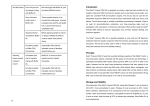
Problem
Possible Cause
Suggestions
Clogged
Column
Incomplete lysis
Extend incubation time of lysis
with Buffer STL and protease.
Add the correct volume of Buffer
BL and incubate for specified
time at 70oC. It may be necessary
to extend incubation time by 10
min.
Sample too large
If using more than 30 mg tissue,
increase volumes of OB Protease
or Proteinase K, Buffer STL,
Buffer BL, and ethanol. Pass
aliquots of lysate through one
column successively.
Sample too
viscous
Divide sample into multiple tubes,
adjust volume to 250 :l with 10
mM Tris-HCl.
Clogged column
See above
Poor sample
release from
collection paper
Incubate the OB specimen
collection paper longer in STL
buffer. Shake the tubes
frequently.
Poor elution
Repeat elution or increase elution
volume (see note on Page 4).
Incubation of column at 70oC for
5 min with Elution Buffer may
increase yields.
Improper washing
Wash Buffer Concentrate must be
diluted with absolute (100%)
ethanol as specified on Page 4
before use.
Low DNA yield
Determination of Yield and Quality
The total DNA yield can be determined by a spectrophotometer using deionized
water, Tris-HCl buffer, or Elution Buffer as blank. DNA concentration is calculated
as:
[DNA] = (Absorbance260) x (0.05 :g/:l) x (Dilution factor)
The quality of DNA can be assessed by measuring absorbance at both 260 nm
and at 280 nm. A ratio of (A260/A280) of 1.7-1.9 corresponds to 85%-95% purity.
Expected yields vary with both amount, and type of tissue used. 30 mg of fresh
tissue will yield 10-40 :g DNA with two elution (each 200 :l).
9
10
Problem
Possible Cause
Suggestions
Low A260/A280
ratio
Extended
centrifugation
during elution step.
Resin from the column may be
present in eluate. Avoid
centrifugation at speeds higher
than specified. The material can
be removed from the eluate by
centrifugation — it will not
interfere with PCR or restriction
digests.
Poor cell lysis due
to incomplete
mixing with Buffer
BL
Repeat the procedure, this time
making sere to vortex the sample
with Buffer BL immediately and
completely.
Incomplete cell
lysis or protein
degradation due to
insufficient
incubation.
Increase incubation time with
Buffer STL and protease. Ensure
that no visible pieces of tissue
remain.
Samples are rich in
protein.
After applying to column, wash
with 300 :l of a 1:1 mixture of
Buffer BL and ethanol and then
with DNA Wash Buffer.
Poor cell lysis due
to improper mixing
with Buffer BL.
Mix thoroughly with Buffer BL
prior to loading HiBind® column.
Poor cell and/or
protein lysis in
Buffer STL.
Tissue sample must be cut or
minced into small pieces.
Increase incubation time at 65oC
with Buffer STL to ensure that
tissue is completely lysed.
Absolute ethanol
not added to Buffer
BL.
Before applying sample to
column, an aliquot of Buffer
BL/ethanol must be added. See
protocol above.
No ethanol added
to Wash Buffer
Concentrate.
Dilute Wash Buffer with the
indicated volume of absolute
ethanol before use.
Incomplete lysis
due to improper
mixing with Buffer
BL.
Buffer BL is viscous and the
sample must be vortexed
thoroughly.
No DNA
eluted
Washing
leaves colored
residue in
column
Problem
Possible Cause
Suggestions
No ethanol added
to Wash Buffer
Concentrate.
Dilute Wash Buffer with the
indicated volume of absolute
ethanol before use.
If the above suggestions fail to resolve any problems you are having with the
E.Z.N.A.® Forensic DNA Isolation Kit, please feel free to contact our technical
specialists at:
Tel: 800.832.8896 (toll-free)
770.931.8400 (local/international)
Fax: 888.624.1688 (toll-free)
770.931.0230 (local/international)
Or direct your questions via e-mail to [email protected].
Orders can be placed via telephone, facsimile or e-mail.
NOTES
11