1
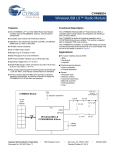
CYWM6935 WirelessUSB LR™ Radio Module Features Functional Description ■ The CYWM6935 LR 2.4-GHz DSSS Radio SoC Module includes radio (CYWUSB6935), antenna, and all external components The CYWM6935 WirelessUSB LR Radio Module offers a complete radio module solution for integration into existing or new 2.4-GHz products. ■ Complete Radio Module with Dual PCB Trace Antennas ■ Operates in the unlicensed Industrial, Scientific, and Medical (ISM) band (2.4 GHz–2.483 GHz) The CYWM6935 is tested for functional operation and is FCC/ETSI(EU)/Industry pre-certified. The module is supplied with dual integrated PCB trace antennas. ■ –95-dBm receive sensitivity ■ Up to 0-dBm output power ■ Range of up to 50 meters or more Applications ■ Data throughput of up to 62.5 kbits/sec ■ ■ SPI microcontroller interface (up to 2 MHz data rate) ■ Operating voltage from 2.7 V to 3.6 V ■ Small PCBA Design: 0.95” (23.75 mm) by 0.95” (23.75 mm) by 0.212” (5.3 mm) (L x W x H) Consumer / PC ❐ Locator alarms ❐ Presenter tools ❐ Remote controls ❐ Toys ■ ■ FCC Modular Approval Grant to meet FCC Part 15, EN 300 328-1, EN 301 489-1, and Industry Canada RSS-210 standards ■ An FCC Module Approval (MA) Grant provides customers significant cost savings, by allowing customers to adopt the CYWM6935 FCC ID into their own products Building/home automation ❐ Climate control ❐ Lighting control ❐ Smart appliances ❐ On-site paging systems ❐ Alarm and security ■ Industrial control ❐ Inventory management ❐ Factory automation ❐ Data acquisition ❐ Automatic meter reading (AMR) ■ Transportation ❐ Diagnostics ❐ Remote keyless entry Cypress Semiconductor Corporation Document #: 38-16013 Rev. *B • The CYWM6935 is available in a small PCBA design and can be mounted horizontally to the device PCB via a 12-pin header. The pin-out of the header is shown in Figure 1. 198 Champion Court • San Jose, CA 95134-1709 • 408-943-2600 Revised August 16, 2011 CYWM6935 CYWM6935 Module PCB Trace Antenna CYWUSB6935 Vcc Bypass capacitors 1.8 pF PCB Trace Antenna CYWUSB6935 3.9 nH 12-pin 2mm header Vcc RFIN RFOUT 10 10 pF WirelessUSB LR CYWUSB6935 Silicon 13MHz Crystal Reference Documentation For information on technical details of the WirelessUSB LR 2.4-GHz DSSS Radio SoC such as register settings, timing, application interfaces, clocking, and power management, see the datasheet of the CYWUSB6935 Radio SoC. Applications Support from having to perform the Radio Regulatory certification portion of the respective agency certification. The MA Grant is valid only in countries[1.] that recognize the MA Grant certification process; the USA, Canada, Belgium, Denmark, France, Finland, Germany, Italy, Netherlands, Spain, Sweden, UK. The CYWM6935 is available as a reference design, complete with PCB layout files, schematics, and a bill of materials. The CYWM6935 can be used with the CY3635 WirelessUSB N:1 sensor development kit, and the CY3632 WirelessUSB LS development kit via a 1 x 14 adaptor board. In order to be able to take advantage of Cypress’s modular certification in a end product, the following must be ensured: 1. Correct Application 2. Correct Installation 3. Correct labeling Module Certification Details Correct Application: Eligibility Requirements for Regulatory Module Approval The CYWM6935 LRTM Radio Module is a device that transmits and receives radio signals in accordance with the spectrum regulations for the 2.4-GHz unlicensed frequency range. Regional regulatory agency approval may be required to operate CYWM6935 throughout the world. Cypress Semiconductor Corporation has obtained regulatory approvals for the CYWM6935 to be used in specific countries. CYWM6935 was approved under the “Modular Approval (MA) Grant”. This certification represents a significant cost savings to the OEM. The MA Grant provides that device manufacturers who incorporate CYWM6935 as tested and approved can be relieved There are three types of application considered for wireless modules and the LR has been verified to work with all three application types at pre-certified power output levels. However, other usages are possible with re-certification. The application types are defined as follows 0.0.0.1 Fixed Application: Module is in a permanent location and has atleast 2 m separation from the human body. 0.0.0.2 Mobile Application: Module can be relocated and will have atleast 20 cm separation from the human body. 0.0.0.3 Portable Application: Module can be relocated and will have less than 20 cm separation from human body. Note 1. This list is as of march 2006. Please talk to your local Sales person for the current list. Document #: 38-16013 Rev. *B Page 2 of 9 CYWM6935 ■ Modules cannot be modified in any way other regulatory information. The text may be disbursed according to language or geographic regions if desired, but the exact text shown below must be maintained. ■ Modules must be used only in the operating range specified in the datasheets United States of America requirements: ■ Modules cannot be co-located within 20 cm of another intentional radiator in the system ■ Must guarantee that end user cannot easily change antenna Correct Installation: Note: Sidestepping these requirements is possible with additional testing and/or recertification. However, modular approval would no longer apply. Correct Labeling: If end device containing a WirelessUSB LR Module will be sold or used in the USA, the enclosure of the product must display a label with the following basic elements: CYWM6935 Contains FCC ID: R8KUGWW2USHN33A If end device containing a WirelessUSB LR Module will be sold or used in Europe, the enclosure of the product must display a label with the following basic elements: 0122 CYWM6935 If end device containing a WirelessUSB LR Module will be sold or used in Canada, the enclosure of the product must display a label with the following basic elements: CYWM6935 This product contains Cypress WirelessUSB module Canadian Cert No IC: 5125A-UGWW2US As of March 2006, Japan does not recognize the “Modular Approval” certification. Regulatory certification for Japan (TELEC) must be acquired through typical approval procedures. These approvals are the sole responsibility of the OEM. Note: Even with modular approval, the end device still has to be tested for digital emissions compliance with all agencies as an electronic device. The modular approval only eliminates the need to test for compliance on RF transmissions. User Guide Information Electronic device manufacturers using Cypress’s Modular Approval are required to follow the below mentioned labeling practice on the container in which the device is marketed or in the product user’s guide. This should be in accompaniment with Document #: 38-16013 Rev. *B The device shall bear the following statement in a conspicuous location: “This device complies with part 15 of the FCC rules. Operation is subject to the following two conditions: (1) This device may not cause harmful interference, and (2) this device must accept any interference received, including interference that may cause undesired operation”. When the device is so small or for such use that it is not practical to place the statement specified under paragraph (a) of this section on it, the information required by this paragraph shall be placed in a prominent location in the instruction manual or pamphlet supplied to the user or, alternatively, shall be placed on the container in which the device is marketed. However, the FCC identifier or the unique identifier, as appropriate, must be displayed on the device. The users manual or instruction manual for an intentional or unintentional radiator shall bear the following cautionary statement: Caution: Changes or modifications not expressly approved by the party responsible for compliance could void the user’s authority to operate the equipment.” 0.0.0.4 United States Regulatory Approval FCC Modular Approval (MA) The requirements for FCC Modular Approval were released in June 2000 in the FCC’s Public Notice: FCC Public Notice DA 00-1407, Part 15 Unlicensed Modular Transmitter Approvals. Criteria for Modular Approval In our OEM instructions it is recommend that the following rules (required by FCC grants) be adhered to. ❐ Cypress FCC ID label must appear on the outside of their product. FCC Public Notice DA 00-1407 instructs, "...if the FCC ID is not visible when the module is installed inside another device, then the outside of the device into that the module is installed must also display a label referring to the enclosed module. This exterior label can use wording such as the following: “Contains Transmitter Module FCC ID: XYZMODEL1” or “Contains FCC ID: XYZMODEL1.” Any similar wording that expresses the same meaning may be used." ❐ No co-location with other transmitters is allowed. By definition, co-location is when another radio or its antenna is located within 20 cm of our radio and it can transmit simultaneously with your radio. Only the antenna(s) that were certified with your radio may be used. Other antennas may be used only if they are of the same type (e.g. yagi, dipole, patch) and have the same or lower gain. ❐ Not withstanding the Modular Approval for the Radio Device with associated interconnect and antennae, the end product configuration must meet digital emissions compliance and must be tested in accordance with FCC Part 15 requirements confirming radiated emissions are within specified limits. Applicable sections include: ■ Part 15 Section 15.109 Sub-paragraph A, Class B Radiated Emission Limits Page 3 of 9 CYWM6935 These emissions tests can be conducted by the manufacturer or by contacting an approved test facility equipped and certified accordingly. The results of these emissions tests are not required to be submitted to the FCC or Cypress, but should be kept on file by the OEM. ❐ Cypress module can only be installed by the OEM and not by the user. It should not be installed in a user accessible location. ❐ Any modifications to the radio will void the user's authority to operate the equipment. The OEM must not modify any aspect of the radio's mechanical and electrical configuration. ❐ The OEM must include compliance information in their user information. ❐ Although no additional regulatory work may be required for the radio, the host device is probably subject to other FCC authorizations as a digital device. DoC authorization is required for PCs and peripherals; verification is required for most other digital devices. Product Labeling Requirements These emissions tests can be conducted by the manufacturer or by contacting an approved test facility equipped and certified accordingly. The results of these emissions tests are not required to be submitted to Industry Canada or Cypress, but should be kept on file by the OEM. ❐ Cypress module can only be installed by the OEM and not by the user. It should not be installed in a user accessible location. ❐ Any modifications to the radio will void the user's authority to operate the equipment. The OEM must not modify any aspect of the radio's mechanical and electrical configuration. ❐ The OEM must include compliance information in their user information. ❐ Although no additional regulatory work may be required for the radio, the host device is probably subject to other FCC authorizations as a digital device. DoC authorization is required for PCs and peripherals; verification is required for most other digital devices. Note: FCC product labeling requirements stipulate an FCC label, including specific text, be placed on the device containing the CYWM6935 module. The product label must include the following text and must be affixed to the exterior of the OEM’s product. (As shown in the ‘Correct Labeling’ section 4.1.3) Industry Canada generally follows the guidelines of the FCC for emissions level requirements. FCC end-product compliance certification results may be used to satisfy Industry Canada requirements. Please consult the Industry Canada, RSS 210 specifications to confirm interagency compliance. If comparable FCC testing has not been performed or if the specifications are not cross compliant, RSS 210 testing will be required. Industry Canadian Requirements and Regulatory Approval Industry Canada regulatory approval typically conforms to the FCC in terms of emission levels and other regulatory requirements. It is the position of the Industry Canada agency that the OEM primarily responsibility for ensuring end product compliance. Cypress (Unigen) as grantee and supplier of the module maintains responsibility for the Modular Approved design. Product Labeling Requirements Criteria for Modular Approval European Union Requirements and Regulatory Approval In our OEM instructions it is recommend that the following rules (required by Industry Canada) be adhered to. ❐ Cypress Industry Canada ID label must appear on the outside of their product.If the Industry Canada ID is not visible when the module is installed inside another device, then the outside of the device into which the module is installed must also display a label referring to the enclosed module. This exterior label can use wording such as the following: “Contains Transmitter Module Canadian Cert No IC: XYZMODEL1” or “Contains Canadian Cert No IC: XYZMODEL1.” Any similar wording that expresses the same meaning may be used. ❐ No co-location with other transmitters is allowed. By definition, co-location is when another radio or its antenna is located within 20 cm of our radio and it can transmit simultaneously with your radio. Only the antenna(s) that were certified with your radio may be used. Other antennas may be used only if they are of the same type (e.g. yagi, dipole, patch) and have the same or lower gain. ❐ Notwithstanding the Modular Approval for the Radio Device with associated interconnect and antennae, the end product configuration must meet digital emissions compliance and must be tested in accordance Industry Canada RSS-210 (Low Power License-Exempt Radio communication Devices) requirements confirming radiated emissions are within specified limits. Applicable sections include: ■ Part 15 Section 15.109 Sub-paragraph A, Class B Radiated Emission Limits The requirements for EU Regulatory Approval were released in April 2000 in the EU R&TTE Directive. Document #: 38-16013 Rev. *B Industry Canada product labeling requirements stipulate specific text be placed on the device containing the CYWM6935 module. The product label must include the following text and must be affixed to the exterior of the OEM’s product. (As shown in the ‘Correct Labeling’ section 4.1.3) This directive supports self directed testing and certification for “harmonized” bands within OEM facilities or by third party. In the case of WirelessUSB, standards have become harmonized (although frequencies are not). The R&TTE directive no longer requires a Technical Construction File however; frequency notification to EU countries is still applicable. Article 6 of the R&TTE directive states: “The manufacturer or the person responsible for placing the apparatus on the market provides information for the user on the intended use of the apparatus, together with the declaration of conformity to the essential requirements.” Ensuring regulatory compliance of the end product is the sole responsibility of the OEM. Cypress maintains responsibility for conformance of the CYWM6935, the interconnect, and the antennae as the manufacturer. The R&TTE directive maintains that first level compliance be reviewed by a “Notified Body” prior to general product marketing. This is not mandatory, but reduces the risk of the product being challenged for non-compliance. Although not specifically stated in the R&TTE Directive, corrections of non-compliance issues are the responsibility of the end product manufacturer. Page 4 of 9 CYWM6935 ❐ Criteria for Modular Approval In our OEM instructions it is recommend that the following rules (required by ETSI) be adhered to. ❐ No co-location with other transmitters is allowed. By definition, co-location is when another radio or its antenna is located within 20 cm of our radio and it can transmit simultaneously with your radio. Only the antenna(s) that were certified with your radio may be used. Other antennas may be used only if they are of the same type (e.g. yagi, dipole, patch) and have the same or lower gain. ❐ The end-product configuration must meet digital emissions compliance and must be tested in accordance with the European Union standards ETSI 300 328 (European Telecommunications Standard for 2.4 GHz ISM band Emissions) and ETSI 300 826 (Electromagnetic Compatibility). Detailed European Union regulatory standards documents may be obtained from the following url: http://europa.eu.int/comm/enterprise/rtte/infor.htm These emissions tests can be conducted by the manufacturer or by contacting an approved test facility equipped and certified accordingly. The results of these emissions tests are not required to be submitted to the ETSI or Cypress, but should be kept on file by the OEM. ❐ Cypress module can only be installed by the OEM and not by the user. It should not be installed in a user accessible location. ❐ Any modifications to the radio will void the user's authority to operate the equipment. The OEM must not modify any aspect of the radio's mechanical and electrical configuration. ❐ The OEM must include compliance information in their user information. Although no additional regulatory work may be required for the radio, the host device is probably subject to other FCC authorizations as a digital device. DoC authorization is required for PCs and peripherals; verification is required for most other digital devices. Note: The European Union generally follows the guidelines of the FCC for emissions level requirements. FCC end-product compliance certification results, if available, may be used to satisfy EU requirements (Substitution Method). Please consult the ETSI 300 328 specifications to confirm inter-agency compliance. If comparable FCC testing has not been performed or if the specifications are not cross compliant, ETSI 300 328 testing will be required. Additionally, testing to the ETSI 301 489-17 (immunity testing) is strongly recommended. Cypress assumes no responsibility for compliance of the end-product configuration. Product Labeling Requirements European Union product labeling requirements stipulate specific text be placed on the device containing the CYWM6935 module. The product label must include the following text and must be affixed to the exterior of the OEM’s product. (As shown in the ‘Correct Labeling’ section 4.1.3). This same information may be included in the product user manual, however this is not mandatory. Packaging and user documentation must indicate the use restrictions of the end-product (i.e. countries disallowing the operating frequencies of the CYWM6935). Note: The end-product must be labeled "CE" and to the right of the CE mark, the label should have '!' with a circle around it. The exclamation mark designates a non-harmonized frequency band. Pin Definitions Table 1. Pin Description Table for the CYWM6935 Pin QFN Name Direction 1 GND – Ground Description 2 VCC – Supply voltage for the entire Radio Module (2.7 V-3.6 V). It is recommended that 3.3 V be used for most applications. 3 IRQ Output 4 nRESET Input Active low reset signal from MCU to Radio Module 5 MOSI Input Master out, slave in SPI signal from MCU to Radio Module 6 nSS Input Active low slave select signal from MCU to Radio Module Interrupt signal from Radio Module to the MCU 7 SCK Input 8 MISO Output 9 GND – 10 nPD Input 11 N/C – No connect—leave open 12 N/C – No connect—leave open Document #: 38-16013 Rev. *B SPI clock from MCU to Radio Module Master in, slave out SPI signal from Radio Module to MCU Ground Active low power-down signal from MCU to Radio Module Page 5 of 9 CYWM6935 Figure 1. CYWM6935 Header Pin-out 12-pin 2mm header GND 1 2 V CC IRQ 3 4 nRESET MOSI 5 6 nSS SCK 7 8 MISO GND 9 10 nPD N/C 11 12 N/C Figure 2. CYWM6935 Mechanical Drawing Pin 1 Unit: Mils Figure 3. CYWM6935 Top View 12-pin 2-mm Header’s Pin 1 Document #: 38-16013 Rev. *B Page 6 of 9 CYWM6935 Figure 4. CYWM6935 Schematic Document #: 38-16013 Rev. *B Page 7 of 9 CYWM6935 Table 2. Ordering Information Part Number CYWM6935 Radio Transceiver Module Package Name N/A Package Type N/A Operating Range Commercial This document is subject to change, and may be found to contain errors of omission or changes in parameters. For feedback or technical support regarding Cypress WirelessUSB products please contact Cypress at www.cypress.com. WirelessUSB LR and WirelessUSB LS are trademarks of Cypress Semiconductor Corporation. All product and company names mentioned in this document are the trademarks of their respective holders. Document #: 38-16013 Rev. *B Page 8 of 9 CYWM6935 Document History Page Document Title: CYWM6935 WirelessUSB LR™ Radio Module Document Number: 38-16013 REV. ECN NO. Issue Date Orig. of Change ** 329974 See ECN BON *A 508587 See ECN UYR *B 3346223 08/16/2011 HEMP Description of Change New datasheet Added ‘Modular Certification’ details Added Ordering Information and updated template. © Cypress Semiconductor Corporation, 2005-2011. The information contained herein is subject to change without notice. Cypress Semiconductor Corporation assumes no responsibility for the use of any circuitry other than circuitry embodied in a Cypress product. Nor does it convey or imply any license under patent or other rights. Cypress products are not warranted nor intended to be used for medical, life support, life saving, critical control or safety applications, unless pursuant to an express written agreement with Cypress. Furthermore, Cypress does not authorize its products for use as critical components in life-support systems where a malfunction or failure may reasonably be expected to result in significant injury to the user. The inclusion of Cypress products in life-support systems application implies that the manufacturer assumes all risk of such use and in doing so indemnifies Cypress against all charges. Any Source Code (software and/or firmware) is owned by Cypress Semiconductor Corporation (Cypress) and is protected by and subject to worldwide patent protection (United States and foreign), United States copyright laws and international treaty provisions. Cypress hereby grants to licensee a personal, non-exclusive, non-transferable license to copy, use, modify, create derivative works of, and compile the Cypress Source Code and derivative works for the sole purpose of creating custom software and or firmware in support of licensee product to be used only in conjunction with a Cypress integrated circuit as specified in the applicable agreement. Any reproduction, modification, translation, compilation, or representation of this Source Code except as specified above is prohibited without the express written permission of Cypress. Disclaimer: CYPRESS MAKES NO WARRANTY OF ANY KIND, EXPRESS OR IMPLIED, WITH REGARD TO THIS MATERIAL, INCLUDING, BUT NOT LIMITED TO, THE IMPLIED WARRANTIES OF MERCHANTABILITY AND FITNESS FOR A PARTICULAR PURPOSE. Cypress reserves the right to make changes without further notice to the materials described herein. Cypress does not assume any liability arising out of the application or use of any product or circuit described herein. Cypress does not authorize its products for use as critical components in life-support systems where a malfunction or failure may reasonably be expected to result in significant injury to the user. The inclusion of Cypress’ product in a life-support systems application implies that the manufacturer assumes all risk of such use and in doing so indemnifies Cypress against all charges. Use may be limited by and subject to the applicable Cypress software license agreement. Document #: 38-16013 Rev. *B Revised August 16, 2011 All products and company names mentioned in this document may be the trademarks of their respective holders. Page 9 of 9