1
MTS Series Carrier Ethernet Switch
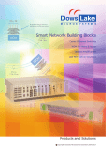
MTS19080 | 40G Carrier Ethernet L3 Switch
Main Feature
| Up to 24 x 10G SFP+ Port Carrier Ethernet Switch
| Up to 2x 40G QSFP Port
| IPv4/IPv6 L3 hardware based routing
| IPv4/IPv6 L3 hardware based multicast routing
| Support Hardware MPLS L2/L3 VPN
| Bandwidth configuration and QoS, Q-in-Q features
| Ring Protection Switching per RRPP
| Support Flexible Stacking
| OAM 802.3ah
L2 Switching Capability
Management Features
- Command Line Interface (CLI, SNMP v1,v2)
- SSHv2,Telnet, FTP/TFTP
- Remote In-band Management
- Alarm: Traps and Email
- RADIUS & Syslog
- RMON: RFC2819 groups: Ethernet history, Alarm, and Event;
- Reports for customer validation
Application Example
The major difference between a L2 and L3 switch is the possibility to
do routing. MTS19088 has the possibility to do Hot Standby when
doing routing.
In the below illustration, 2 Dowslake L3 switches, MTS19080, are
connected in the GE rings built based on Dowslake L2 Gigabit switch
MTS1080, with each of them connected to both core routers. The
built-in L3 protocol VRRP of MTS19080 takes care of monitoring and
supervision of the equipment.
Ring Broken: In case one of Gigabit switch MTS1080 is down, or
there is a fiber cut in the ring, the ring switches over in the other
direction based on automatic protection switching concept.
Conection to Core Router Broken: In case one of MTS19080 is down,
or one of the core router is down, the hot stand-by feature provided
by MTS19080 takes care of the traffic flow, making the network very
robust.
- Auto-negotiation for port speed and duplex mode Flow Control:
- IEEE 802.3x & Back-Pressure
- Spanning Tree Protocol:
IEEE 802.1D Spanning Tree Protocol (STP)
IEEE 802.1w Rapid Spanning Tree Protocol (RSTP)
IEEE 802.1s Multiple Spanning Tree Protocol (MSTP)
- VLANs:
4K IEEE 802.1Q VLANs
Port-based VLAN
Q-in-Q 802.1ad
Add/Remove inner tag
Inner tag translation
- Link Aggregation:
Static Trunk
IEEE 802.3ad LACP
Load Balancing: SA,DA,SA+DA,SIP,DIP,SIP+, DIP
Trunk groups: 8
- Multicast
IGMP Snooping/MLD Snooping
IGMP Proxy query
QoS Capability
- 8 Priority Queues
- Two levels of hierarchical scheduling policing parameters:
CIR, PIR, CBS, EBS
- Priority Queues Scheduling Scheme:
SP, WRR, WDRR, SP+WRR/WDRR
- Rate Limiting: 1Mbps per step
- UNI port Egress Policing: Per flow, EVC, UNI port
- Total number of flow: >1K
- Traffic classification and priority management based on:
IEEE 802.1p
IP Precedence/DSCP
TCP/UDP port number
IP Address
Mac Address
Ethernet Type
C-VLAN
RFC 2698 and MEF specs 10 marker (colors)
RFC3176 S-FLOW
35
7HO