1
programmer’s toolbox
Equation 18 into C++ code is as simple as writing:
Then I can write the problem in the incredibly compact
form:
x = u/A;
Ax=u
(17)
An important point may have slipped past you. As
we solved the example problem, it was not at all obvious
that the input or constraint vector, u, is practically immaterial to the solution. The matrix A is purely a matrix
of the coefficients of the elements of x—in our case, J,
x=A-1u
(18) M, and S. Therefore we can invert the matrix as a standalone entity, completely independently of u. In my statement of the problem, I could have substituted any conHow does one compute the inverse of a matrix?
stant values whatever
We’ve already done
for the elements of u.
it. The steps we took
Many other problems look a lot easier
While the resulting valin Equations 9
through 13 are nothusing matrix algebra, and many others are ues for x would absolutely be different,
ing less than the
the same problem, in disguise.
the inverse of the maGaussian eliminatrix itself would be extion leading to the
actly the same. This
inverse. This one
fact gives us a lot of leverage if we’re looking at different
time, we did it the hard way, only one step removed
values of u at different times. No matter how many such
from the high school way. If you never liked those word
values there are, we only need to invert A once.
problems that ended up as simultaneous linear equations, rejoice: this is the last time you’ll ever have to do
OTHER MATRIX APPLICATIONS
it. Armed with a matrix inverse operator—all the comSolving word problems is certainly not at all the only
mercial math aids have them, as will our C++ library—
problems we can cast into matrix form. Many other
you can go from Equation 17 to 18 in a single step.
problems look a lot easier using matrix algebra, and
Hooray!
As a teaser, I’ll just toss out there that, while the ma- many others are the same problem, in disguise. A familiar one is linear regression, which in turn is a subset of
trix division operator doesn’t exist, I’ve appropriated
polynomial regression, which is itself a subset of optimal
the division operator in the C++ class. Thus, turning
There is no such thing as a division operator for
matrices, but there is the next best thing: an inverse operator. So, conceptually, I can write:
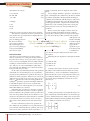
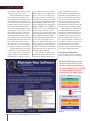
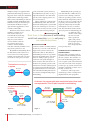
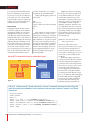
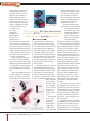
A least-squares fit.
y
A decent fit
A better fit
x
Figure 1
16
DECEMBER 2007 | embedded systems design | www.embedded.com