1
The Marauder Map
Final Report
12/19/2014
The combined information of these four sensors is sufficient to
determine if a person has left or entered the room via the
doorway.
Final Project Report
EE 249 Fall 2014
LongXiang Cui, Ying Ou, Jordan Makansi, Chenyang Xu
Dec 19th 2014
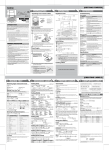
Introduction Figure 1. The block diagram of the system and
data flow
Certain building operations are necessary for an
inhabited building, to but many of these operations persist
even when the building is uninhabited. Knowledge of
building occupancy can reduce these unnecessary operations.
Two such examples are energy conservation (HVAC/lighting),
and crowdedness; if a room is known to be empty, then the
lights and AC can turn off, and likewise if a room hosting a
public service (such as a library) is too crowded, people will
go elsewhere for this service. To sense building occupancy,
The Marauder’s Map implemented a system that tracks the
flow of people in and out of a doorway.
The implementation of the system was divided into
two main components. The first component is the actual
sensing of the physical system, and modeling of the physical
dynamics. This involved decisions regarding sensors to use,
the number of sensors, and placement of sensors. The second
component transmits and displays the data in a useful manner,
so that it may be used to impact observers. This involved
decisions about what piece of hardware to use for
communication, and how to display the data. Both
components when through many design iterations, as will be
discussed below. The objective of these iterations was guided
by the expected functionality: to accurately sense building
occupancy, and display it in understandable way.
Ultrasonic sensors
An ultrasonic sensor works by computing a distance based on
the time that it takes for the sent signal to return, and the
width of this “echo pulse” as seen in the figure below, is
proportional to the distance to the object detected, as shown by
the formula in the figure.
The nature of the HC SR-04
is such that it has a detection
angle range of 30 degrees in
which it is
Figure 2a. Angle range of Ultrasonic sensor
accurate (HC
SR-04 User’s
Manual), also seen in Figure
2. The ultrasonic sensor
works by a pulse width, which is proportional to the distance
that it senses. These qualities of the HC SR-04 affected the
logical analysis used to determine the flow of people in and
out of the room.
Design The hardware decisions were driven by not only the
functionality of the system, but also the tradeoff between cost
and reliability. Figure 1 shows a complete diagram of the
system implementation. Since it was estimated that only a few
sensors would be needed, it was determined that an investment
in the ultrasonic ranging module, HC SR-04 was more fitting
than the cheaper alternative - infrared sensors.
Four sensors were used in total - three on the ground
for detecting people, and one for detecting the opening and
closing of the door. For the door sensor, a threshold of 60 cm
was used for determining the opening and closing of the door.
Figure 2. The detection angle (top) and detection
mechanism of ultrasonic sensor (bottom)
The sensors are connecting to an mbed board, which
does the logical analysis of the information (Description of the
1
The Marauder Map
Final Report
12/19/2014
Description of the Finite State Machine and Algorithm for details). After connecting the four sensors to
the mbed board, there were not enough pins to complete the
functionality of a wifi shield. So, an Arduino board was
connected to mbed, which concurrently transmits the change
in occupancy via a CC 3000 wifi shield to an online server
(dweet.io) and lights up Neopixel LEDs. The mbed board is
constantly sensing - Arduino only sends data when there is a
change in the count.
Two types of feedback are given to the user from this
system. The first is the lighting of neopixels, which occurs
when a person enters and/or leaves through the doorway. The
neopixel turns a different color according to the number of
people entering: each distinctly different color corresponds to
5 people being present within the room. For more remotely
accessible information, the count of people is displayed on the
online platform called freeboard.io. The counted data is first
pushed into the online server dweet.io with its speical label via
the wifi sheild. Afterwards, by using the socket provided by
freeboard.io, the data can be retrieved from dweet.io and the
real time data can be accessed on any web terminal.
Detection algorithm Inputs:
door_sensor, front_sensor, crossing_sensor, back_sensor
{True, False}
Variables:
Buffer
{int[500]}
buffer_it, back_it, new_it
R
count
R
door_flag, in_flag, out_flag
{True, False}
values are stored in a buffer of size 500, in order to increase the
stability of our system and save memory. For the same reason,
the bit-encoded information from all three sensors was aggregated
into a single digit integer. For example, if the first two sensors
were triggered, then the
State Description: Check door sensor: check whether the door sensor is triggered or
not.
Check door flag: check whether the door_flag is high or not,
prevent counting the number of open of the door more than it
should be.
Check front sensor: check whether front sensor is triggered or not.
Look at the condition where front and door sensor is triggered at
the same instance.
Check crossing sensor: check whether crossing sensor is triggered
or not. If it is on, we would start to check the value previously
stored in the buffer.
Check previous buffer and set flag: check the sensor values stored
in the buffer for the previous 200 instances. Setup flag based on
the value triggered.
Check door sensor again: check whether door is open or not.
Start Tracking: track the value of sensor of incoming 200 time
instances. Change the count based on the triggered sensor and
according flag.
Figure 4. Finite State Machine Diagram
Boolean representation would be 011, and the integer stored
would be 3.
The value is observed when the crossing sensor is triggered, at
which point the previous 200 values stored in the buffer are
examined. We want to find the most recent instance when the
back or front sensor is triggered. Based on the configuration of
our system, a flag is used to keep track of whether the front, or
back sensor was triggered first. After it is determined which
sensor was first triggered, the subsequent 200 values were
examined. In those 200 values, if back or front sensor was
triggered, and the corresponding flag was set to high, then the
Detection without door count would be added or subtracted appropriately. For instance, if
We started to develop our detection algorithm by modeling the
the front sensor was triggered while the flag was up, we would
doorway as a hole (ignoring the door), and aligning the three
add one to our count, and vice versa for back sensor. The portion
ultrasonic sensors. The Boolean value acquired by the sensor is
of the finite state machine with this functionality is on the right
received every 0.2 seconds, and is set to 1 when the sensor detects hand side of Figure 4.
object within 70 cm, and 0 otherwise. The acquired Boolean
2
The Marauder Map
Detection with door Final Report
12/19/2014
reads the front sensor first, and then the back sensor, this case is
considered as one person leaving.
When the door is open, the door can be treated as a hole, like
before, and we use the same detection algorithm previously
mentioned. A closed door is a different situation, so another
sensor was added to check whether the door is open or not. The
closed door affects the algorithm when the door is closed and
people are trying to come inside the door. For this purpose a front
sensor was placed close to the door (10 cm away) to make sure
that when the door sensor was triggered, the front sensor would be
triggered at the same instance. This is an indication that a person
has certainly entered the room. The portion of finite state machine
below shows the flow to deal with this situation.
Design Consideration Sensor Distance Figure 7. Sensor set up diagram for two sensors design
Based on the datasheet of the HC SR-04, the detection angle is 30
degree. Therefore in order to detect people standing at the center
of the 92 cm door as well as preventing sensor from interrupting
with each other, they should be placed cm away based on the
following calculation.
Table 1. Example of buffer value and program behavior for
two people coming in with two sensor design
Buf #
...
121
122
123
124
125
126
127
Buf val
…
NA
back
front
front
back
front
…
behavior
…
NA
In_flag
add
Out_flag
subtract
Out_flag
…
count
…
0
0
1
1
0
0
…
Three sensors
To increase the accuracy of the system, another sensor was placed
in between the front and back sensor, as shown below.
Figure 6. Two sensor laying on the same side with the
minimum distance (53 cm) that does not cause interference.
However, the two sensors should not been placed too far away
from each other, because then the latency would increase
significantly, because more buffers must be searched before a flag
is found. This prevents the system from still being considered a
real time counter.
Also, the front sensor was placed slightly towards the outside of
the room, to ensure that it wouldn’t accidentally detect people
inside an open door. To compensate for this, center sensor was
placed 60 cm away from the front sensor.
Sensor locations Figure 8. Sensor set up diagram for two sensors design
In this scenario, only the sensor reading directly in front of the
center buffer matters. For example, for the scenario where two
people are coming inside the door together, as described above,
the “In_flag” will be set at buffer 127 based on sensor reading at
buffer 126, and thus preventing the error previously encountered,
as seen in the table below.
Two sensors
We started by using only two sensors, as shown below. The
algorithm is very simple: a count is added the front sensor is
triggered after the center sensor is triggered.
However, this method is not stable. For example, if two people
are entering the door at once, then the system will incorrectly
consider it as if one person is coming outside. This is illustrated
in the table below; the buffer from 124 to 125 shows that the front
sensor is triggered twice by the two people, but because the buffer
3
The Marauder Map
Final Report
12/19/2014
The figure above shows the correlation between the sensor
detection threshold and the system performance. The test was
running under same algorithm, same system set up, same walking
test pattern and with 10 tests per case. For the ultrasonic sensors,
thresholds were used to detect the presence of a person.
Threshold distances that shorter than 40cm and larger than 60 cm
both behave poorly. By observing the curve above, the threshold
value of 45cm achieves the best results. The inaccuracy is caused
by the overlapping detection angles of the ultrasonic sensors and
the physical detection requirement such as the assumption that
people will enter the doorway in the center (where the sensor is).
Table 2. Example of buffer value and program behavior for
two people coming in with three sensors design
Based on testing, this design accurately detects two people
entering 50 cm apart from each other, when they entering the
room one following another. However, when we testing the
system in the lab, the front sensor was always interfered by the
door that is opening towards inside. This is because the front
sensor is still being used to detect people crossing this threshold.
Three sensors on one side
In order to allow our system to work in an environment with a
door, the sensors were placed outside the door, so that none of the
three human detection sensors detect the door anymore. The
figure is shown below.
Figure 11. The system accuracy related to average distance
between sensors (cm)
The picture above shows the correlation between the sensor
placement separation and the system performance. If the
separation distance is too small, multiple sensors will be triggered
concurrently, causing false readings. If it is too large, then the
buffer may clear the first sensor reading before the last sensor is
triggered. Larger also makes implementation more difficult.
Based on the test result, when placement distance is larger than
40cm, the system accuracy starts to converge to a stable state with
relative good performance around 80% accuracy. Due to the
limitation of the testing space and the observed performance after
calibration of the sensor placement, the sensors were set apart by
40cm and 60cm, respectively to achieve best performance.
People cannot follow each other too closely when they are
crossing the doorway from the same direction. As shown below,
when two people are coming inside a door, the system may
incorrectly add 1 or 0 instead of 2.
Figure 9. setup for three sensors on one side design
The distance between front sensor and the crossing sensor is
increased, since the front sensor is pointing at 10 degrees away
from parallel with door, in order to avoiding detect people inside
the door when the door is first opened.
Discussion of the performance Figure 10. The system accuracy related to detection threshold
4
The Marauder Map
Final Report
12/19/2014
Figure 12. Two people following the sensor too close that
cause the incorrect function of the system.
Table 3. Buffer value for incorrect counting when two people
are too close
In this case, the second person triggers the back sensor before the
first person triggers the front sensor, as shown in buffer #124
above. This has no effect on detecting the first person. However,
after the first person triggers the front sensor, in buffer #125, this
will be treated as the out_flag when the second person crosses the
crossing sensor. Then the system will either count 1 instead of 2,
System prototype:
if no one comes close, or will subtracting 1 when the back sensor
is triggered again in 2 seconds - both of which are incorrect.
To prevent this from happening, another sensor was used with
even narrower detection angle, so that the sensors can be placed
closer together. This will reduce the frequency of this error, since
it would be less likely that the second person triggers the back
sensor before the first person finishes crossing. This will also
make our system even more compact and easier to implement.
Conclusion This design accomplishes the objective of detecting people and
displaying it usefully. For the future, another advancement might
be to improve the accuracy, to have a more accurate count of
people in the room/building. Furthermore, the system should be
easier to implement and setup, ideally, such that it can scale to the
size of an entire building.
References 1. Ultrasonic Sensor Documentation (HC SR-04 User’s Manual)
Appendix https://docs.google.com/a/berkeley.edu/document/d/1YyZnNhMYy7rwhAgyL_pfa39RsB-x2qR4vP8saG73rE/edit
Sensor placement:
2. CC3000 WIFI module and Freeboard Platform
http://www.openhomeautomation.net/internet-of-thingsdashboard/
5